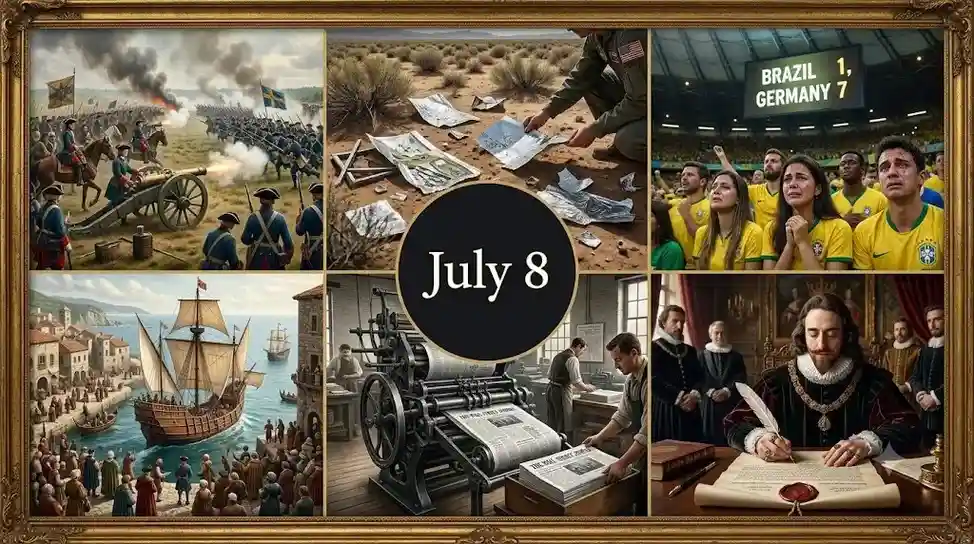
On a stifling New Mexico evening, rancher Mac Brazel stepped outside to survey his property after a fierce thunderstorm. Scattered across the brush lay a massive field of strange, metallic debris that gleamed unnaturally under the desert sun. He picked up a piece—it was incredibly light, flexible as paper, yet completely unbendable. Brazel had no idea his find would trigger a global obsession with flying saucers. This simple discovery sparked the legendary Roswell rumor mill, making the primary keyword target crucial for understanding how modern alien folklore took root on this day in history July 8.
📅 Quick Facts — July 8 in History
| 📌 Category | 📖 Event / Detail |
|---|---|
| 🌟 Most Significant Event | The Battle of Poltava alters European power dynamics as Peter the Great decisively defeats the Swedish Empire (1709) |
| 🏆 Top 10 Key Events | • Byzantine forces crush the Kingdom of Hungary at the Battle of Sirmium (1167) • Explorer Vasco da Gama sets sail from Lisbon, embarking on the first direct sea voyage to India (1497) • Tsar Peter the Great secures a monumental victory over Charles XII of Sweden at Poltava (1709) • Jonathan Edwards delivers his legendary Great Awakening sermon, “Sinners in the Hands of an Angry God” (1741) • Commodore Matthew Perry drops anchor in Edo Bay, forcing isolationist Japan to open trade relations (1853) • Dow Jones & Company prints the inaugural issue of The Wall Street Journal (1889) • News outlets broadcast reports of a crashed “flying disc” near Roswell, New Mexico, sparking modern UFO lore (1947) • West Germany edges out Argentina 1–0 to secure the FIFA World Cup trophy in Rome (1990) • Germany delivers a stunning 7–1 demolition of host nation Brazil in the World Cup semifinals (2014) • Former Japanese Prime Minister Shinzo Abe is tragically assassinated while delivering a campaign speech (2022) |
| ⚔️ Key Battles | Battle of Sirmium (1167), Battle of Malta (1283), Battle of Poltava (1709), Battle of Dynekilen (1716), Battle of Hims (1832) |
| 👤 Key Figures | Vasco da Gama, Peter the Great, Jonathan Edwards, Shinzo Abe |
| 🌍 Observances | Air Force and Air Defense Forces Day (Ukraine), Eastern Orthodox Liturgics for July 8 |
Story of the Day: The Day the German Machine Broke Brazil’s Heart
Belo Horizonte’s Estadio Mineirao was a sea of yellow jerseys, packed with millions of expectant fans convinced their team would march into the 2014 World Cup final. Instead, Thomas Müller escaped his marker in the eleventh minute, tapping in a corner that initiated an unprecedented athletic slaughter. Four more goals flew into the Brazilian net in a dizzying six-minute span, leaving players weeping openly on the pitch before halftime even arrived. Germany’s ruthless 7–1 demolition fractured the collective psyche of a soccer-obsessed nation, branding that evening forever as the Mineiraço, the worst shock in modern sporting chronicle.
Important Events That Happened On July 8 In History
1167 – The Battle of Sirmium
Manuel I Komnenos directed Byzantine tactics from afar while his general, Andronikos Kontostephanos, deployed a deadly line of heavy cavalry against Hungarian forces. The imperial center smashed through the enemy ranks, scattering the northern army and forcing their king to beg for peace terms. Hungary surrendered its grip on Dalmatia and Croatia, cementing a final era of Byzantine dominance over the Balkans. This medieval clash stands among the major historical events July 8 that redefined European borders.
1283 – The Battle of Malta
Roger of Lauria trapped an Angevin naval squadron inside the grand harbor of Malta, unleashing a lethal hail of crossbow bolts onto the enemy decks. The brilliant Aragonese admiral captured or destroyed nearly every French vessel sent to suppress the Sicilian insurgency. This fierce engagement secured Sicilian independence from French rule, establishing Aragon as the premier naval superpower across the Western Mediterranean. The outcome proved decisive for what happened on July 8 in history.
1497 – Vasco da Gama’s Departure
Vasco da Gama stepped aboard his flagship, the São Gabriel, and gave the order to unfurl sails toward the open Atlantic. Four heavily armed ships glided out of Lisbon Harbor, embarking on an unprecedented sea voyage to map a direct oceanic path to India. The expedition survived disease, storms, and hostile ports, returning with precious spices two years later. This epic maritime journey shattered the Arab monopoly on Asian commerce, kickstarting centuries of European global imperialism.
1579 – Our Lady of Kazan
A young girl named Matrona dug through the charred ruins of her family’s home in Kazan, following a vivid vision of the Virgin Mary. Her fingers brushed against a buried holy icon, miraculously unblemished by the devastating fire that had leveled the city. Russian Orthodox priests wept as they lifted the sacred image, which quickly gained a reputation for working wonders. The artifact grew into Russia’s most revered palladium, credited with saving Moscow from foreign invaders in times of national peril.
1651 – The Battle of Naxos
Alvise Mocenigo ordered his Venetian warships into a tight defensive block, blocking an Ottoman armada attempting to slip through the Aegean Sea. For three grueling days, cannon smoke blackened the skies south of Naxos as the crews traded devastating broadsides. The Venetians ultimately shattered the Turkish lines, capturing fifteen enemy vessels and burning several more. This strategic triumph preserved Venetian control over vital Mediterranean trade routes for several decades.
1658 – Abaza Hasan’s Rebellion
Abaza Hasan Pasha gathered a coalition of disaffected regional governors and openly renounced his allegiance to the imperial throne. The rebel commander marched his cavalry toward Istanbul, demanding the immediate execution of Grand Vizier Köprülü Mehmed Pasha. This bold insurrection exposed the deep fractures within the leadership of the Ottoman Empire during a period of intense political instability. The ensuing civil strife crippled state administration before the central government managed to crush the mutiny.
1663 – Rhode Island’s Royal Charter
John Clarke kneeled before King Charles II of England to receive a signed royal patent for the tiny colony of Rhode Island. The document granted unprecedented liberties, explicitly guaranteeing full religious freedom and political self-governance to the settlers. This progressive charter survived the American Revolution, serving as the legal bedrock for the state until the mid-nineteenth century. Its revolutionary stance on the separation of church and state heavily influenced the creators of the United States Constitution.
1709 – The Battle of Poltava
Peter the Great watched his modernized Russian regiments repel a desperate charge by Sweden’s elite Carolinian infantry. The Swedish king, Charles XII, could not lead from the front due to a foot wound, and his outnumbered forces were cut down by massed Russian artillery. The total collapse of the Swedish army ended their long campaign deep within Russian territory. This monumental clash effectively stripped Sweden of its empire, signaling Russia’s rise as the dominant superpower in Northern Europe.
1716 – The Battle of Dynekilen
Peter Tordenskjold guided a fleet of light Danish-Norwegian vessels into a narrow, treacherous fjord where the Swedish navy lay anchored. The daring young captain unleashed a surprise close-quarters bombardment, capturing or blowing up over twenty enemy supply ships. This devastating naval ambush starved the invading Swedish army of essential munitions and food rations. King Charles XII had no choice but to abandon his military campaign in Norway, saving the nation from foreign conquest.
1730 – The Great Valparaíso Earthquake
A violent rupture along the Nazca plate jolted the coastline of Chile, sending a massive shockwave through the city of Valparaíso. Moments later, the ocean receded before returning as a catastrophic tsunami that battered over a thousand kilometers of South American coastline. The dual disaster leveled churches, homes, and fortresses, claiming countless lives and ruining regional economies. Geologists estimate the quake reached a massive magnitude of 8.7, ranking it among the most destructive seismic events in southern colonial history.
1741 – Sinners in the Hands of an Angry God
Reverend Jonathan Edwards stepped up to the pulpit in Enfield, Connecticut, speaking in a quiet, intense monotone to his packed congregation. His vivid descriptions of a fragile humanity hanging over the fiery pits of hell by a single thread broke the composure of his listeners. People screamed, moaned, and clutched the pews in sheer terror as the sermon progressed. This powerful piece of rhetoric catalyzed the spiritual revival movement known as the First Great Awakening across the American colonies.
1758 – The Battle of Fort Carillon
Louis-Joseph de Montcalm supervised the hasty construction of a dense wooden barricade outside the walls of Fort Carillon. A British army numbering sixteen thousand men launched a series of disorganized, frontal assaults directly into the French defenses. French musketeers kept up a murderous rate of fire, killing thousands of redcoats before the British commander ordered a chaotic retreat. The surprising victory preserved French control over Lake Champlain during a critical phase of the French and Indian War.
1760 – The Battle of Restigouche
Captain John Byron commanded a squadron of British warships as they cornered three French vessels in the mouth of the Restigouche River. The British cannons systematically battered the enemy hulls, sinking the small fleet after a fierce, multi-day exchange of fire. This forgotten engagement marked the final naval battle ever fought in New France. The loss destroyed any hope of French reinforcement for Montreal, sealing the British conquest of Canada.
1775 – The Olive Branch Petition
John Dickinson watched his fellow delegates sign their names to a final, desperate appeal for peace addressed directly to King George III. The Continental Congress expressed its enduring loyalty to the British crown while begging for a repeal of harsh taxation policies. The king refused to read the document, declaring the colonies to be in open rebellion instead. This absolute royal rejection convinced moderate Americans that full independence was the only path forward.
1776 – The Reading of the Declaration
John Nixon stepped onto a wooden platform in the state house yard of Philadelphia, clearing his throat before a boisterous crowd. He read aloud the text of the Declaration of Independence, marking its first public presentation to ordinary citizens. Cheers erupted as he finished, and local soldiers tore down the King’s coat of arms from the courthouse wall. Church bells, including the iconic Liberty Bell, rang out across the city to celebrate the birth of a new nation.
1822 – The Huron Tract Treaty
Chippewa chiefs met with British colonial officials in Ontario, placing their marks on a treaty that surrendered an enormous expanse of ancestral territory. The indigenous leaders ceded over two million acres of fertile woodland in exchange for an annual cash annuity. This forced transaction displaced native communities from their traditional hunting grounds to clear a path for massive waves of European agricultural settlers. The agreement fundamentally altered the demographic and environmental landscape of Western Ontario.
1832 – The Battle of Homs
Ibrahim Pasha deployed his disciplined, French-trained Egyptian infantry against a larger Ottoman army assembled outside the Syrian city of Homs. The Egyptian forces executed a series of precise flanking maneuvers, routing the imperial troops and capturing their artillery train. This decisive victory broke the Sultan’s hold over Syria, clearing a direct path for the Egyptian army to march deep into the Anatolian heartland. The conflict brought the Ottoman Empire to the brink of complete political collapse.
1853 – The Perry Expedition
Commodore Matthew Perry guided four black-hulled, steam-powered American warships into Edo Bay, their heavy cannons aimed directly at the shore. The military commander refused to leave until Japanese officials accepted a formal letter from President Millard Fillmore demanding open trade doors. This aggressive display of gunboat diplomacy shocked the isolationist Tokugawa shogunate, which had kept its ports closed to most foreigners for over two centuries. The tense encounter forced Japan to industrialize rapidly to avoid colonization.
1859 – Succession of Charles XV
Prince Charles took the oath of office in Stockholm, ascending the dual throne as King Charles XV of Sweden and King Charles IV of Norway. The charismatic young monarch brought a new, liberal energy to the Scandinavian courts, championing major legal and political reforms. His reign saw the creation of a modern communal law system and the expansion of the regional railway network. His peaceful rule helped stabilize relations between the two united kingdoms during a period of European revolutionary turmoil.
1864 – The Ikedaya Incident
Kondo Isami led a strike force of Shinsengumi swordsmen into the Ikedaya Inn in Kyoto, swords drawn as they stormed the upper rooms. They caught a group of Choshu Han revolutionaries completely by surprise, just as they were planning an arson attack on the imperial capital. A brutal, bloody melee ensued, resulting in the deaths or arrests of several top anti-shogunate leaders. This dramatic raid delayed the fall of the Tokugawa regime by several years, altering the course of the Meiji Restoration.
1874 – The March West
George Arthur French gave the order to march, sending three hundred newly recruited North-West Mounted Police riding into the Canadian prairies. The Mounties faced extreme heat, regular water shortages, and unfamiliar terrain during their grueling thousand-mile journey across the wilderness. Their primary mission was to eliminate the illegal American whiskey trade that was devastating indigenous communities. This iconic trek established federal law across western Canada, laying the groundwork for peaceful agricultural settlement.
1876 – The Hamburg Massacre
An armed white militia surrounded a small group of African-American National Guardsmen inside a brick warehouse in Hamburg, South Carolina. The attackers opened fire with rifles and a small cannon, forcing the black soldiers to surrender after a tense standoff. The mob executed five of the captured guardsmen in cold blood later that evening. This racial atrocity was part of a coordinated campaign to terrorize black voters ahead of the critical 1876 presidential election.
1879 – The USS Jeannette Expedition
George W. De Long stood on the bridge of the USS Jeannette as the steamship glided past the Golden Gate Bridge, heading north toward the Arctic Circle. The adventurous crew aimed to reach the North Pole by navigating through an open polar sea they believed existed past the ice pack. Instead, heavy pack ice trapped the vessel just two months later, beginning a harrowing two-year drift that ended in disaster. The tragic loss of the ship claimed the lives of most crew members, including De Long.
1889 – The Wall Street Journal
Charles Dow and Edward Jones oversaw the printing of a modest, four-page newspaper in a cramped lower Manhattan office. The inaugural issue of The Wall Street Journal focused entirely on raw stock market figures, business bonds, and unbiased financial analysis. The publication offered investors a trustworthy alternative to the sensationalized, corrupt press of the Gilded Age. The small business sheet grew into one of the most widely read and influential financial publications on the planet.
1892 – The Great Fire of St. John’s
A careless stable hand dropped a lit pipe into a pile of dry hay, sparking a small blaze on the outskirts of St. John’s, Newfoundland. Fierce gale-force winds quickly carried the embers across the city, igniting hundreds of tightly packed wooden homes and commercial warehouses. The fire raged out of control for a day, wiping out nearly the entire business district and leaving twelve thousand people homeless. The massive destruction required decades of intensive reconstruction efforts to rebuild the colonial capital.
1898 – The Shootout on Juneau Wharf
Frank Reid leveled his pistol at the notorious crime boss Soapy Smith on a crowded wharf in Skagway, Alaska. Both men fired simultaneously in a desperate duel, Smith falling dead on the spot while Reid sustained a fatal wound. Smith had ruled the frontier town through an elaborate network of gambling rings, thievery, and political corruption during the height of the Klondike Gold Rush. His dramatic death instantly smashed his criminal empire, bringing law and order to the gateway of the Yukon.
1912 – The Royalist Attack on Chaves
Henrique Mitchell de Paiva Couceiro led a paramilitary force of armed royalists across the Spanish border, launching an assault on the northern city of Chaves. The insurgents aimed to overthrow the newly established First Portuguese Republic and restore the exiled king to the throne. Local republican soldiers and armed civilians fought back fiercely, routing the royalist forces after a sharp battle. This failed counter-revolution solidified the survival of the fragile Portuguese democratic experiment.
1932 – The Depths of the Depression
Stockbrokers watched in sheer horror as the ticker tape confirmed the Dow Jones Industrial Average had plummeted to a historic low of 41.22. This catastrophic closing price marked the absolute nadir of the Great Depression, representing an eighty-nine percent drop from its pre-crash peak. The collapse wiped out billions in corporate wealth, forcing factories to close and sending unemployment rates soaring across the country. It took over twenty years of economic recovery for the market to regain its lost ground.
1933 – The First Rugby Test Match
The Australian Wallabies faced off against the South African Springboks at Newlands Stadium in Cape Town, marking their first official rugby union encounter. A roaring crowd of thirty thousand spectators watched the two physical teams trade punishing tackles on a muddy field. The Springboks utilized their superior forward line to secure a hard-fought 17–3 victory over the tourists. This historic match established a fierce, lifelong international rugby rivalry that persists into the modern era.
1937 – The Treaty of Saadabad
Foreign ministers from Turkey, Iran, Iraq, and Afghanistan gathered in Tehran to sign a non-aggression pact known as the Treaty of Saadabad. The four Middle Eastern nations pledged to respect their mutual borders and coordinate efforts against regional Kurdish insurgencies. The alliance aimed to create a unified diplomatic front against growing Italian and Soviet aggression in the region. While the treaty fell apart during World War II, it represented an early attempt at regional security cooperation.
1947 – The Roswell Incident
Colonel William Blanchard ordered a sensational press release issued from the Roswell Army Air Field, announcing that intelligence officers had recovered a “flying disc” from a nearby ranch. Local newspapers splashed the incredible headline across their front pages, igniting an immediate frenzy of public speculation about alien visitors. The military quickly retracted the statement later that afternoon, claiming the debris was merely a standard weather balloon. This clumsy cover-up birthed the modern era of UFO conspiracy theories.
1948 – The Women’s Air Force
General Hoyt Vandenberg welcomed the first group of female enlistees into the newly formed United States Air Force under the pathbreaking WAF program. These pioneering women stepped into vital operational roles as air traffic controllers, radar operators, and mechanics, breaking long-standing military gender barriers. The program offered women an entry point into regular peacetime military careers, paving the way for full gender integration within the American armed forces decades later.
1960 – Francis Gary Powers Charged
Soviet prosecutors formally charged American pilot Francis Gary Powers with espionage, following the downing of his high-altitude U-2 spy plane over Siberia. The high-profile capture exposed a top-secret CIA surveillance program, causing severe embarrassment for President Dwight D. Eisenhower’s administration. The incident torpedoed a crucial East-West peace summit scheduled to take place in Paris. Powers received a ten-year sentence before being exchanged for a captured Soviet master spy on a Berlin bridge.
1962 – The Rangoon University Demolition
General Ne Win ordered military units to surround the Rangoon University student union building, opening fire on hundreds of unarmed student demonstrators overnight. The next morning, army engineers planted explosives and blew the historic structure to pieces, reducing a symbol of Burmese democratic resistance to rubble. The brutal crackdown killed dozens of young activists and silenced the burgeoning student movement for a generation. This violent episode solidified the military regime’s authoritarian grip over Burma.
1965 – Canadian Pacific Flight 21
A massive explosion ripped through the rear fuselage of a Canadian Pacific Air Lines Douglas DC-6 as it cruised over British Columbia. The crippled airliner plunged into the dense forests near 100 Mile House, killing all fifty-two passengers and crew members on board. Investigators discovered chemical traces of a gunpowder-based bomb inside the wreckage, pointing toward a deliberate act of mass murder. Despite an extensive criminal investigation, the identity of the bomber remains an unsolved mystery.
1966 – The Burundian Coup
Prince Charles Ndizi mobilized loyalist military units in Bujumbura, launching a successful coup that deposed his father, King Mwambutsa IV. The ambitious nineteen-year-old prince suspended the national constitution and declared himself the new head of state, taking the title of King Ntare V. This royal power grab worsened long-standing ethnic and political tensions between the Tutsi and Hutu communities. The fragile regime lasted only a few months before a military general overthrew the young king.
1968 – The Chrysler Wildcat Strike
A group of African-American autoworkers walked off the assembly line at Chrysler’s Dodge Main plant in Detroit, halting production without union authorization. The wildcat strike was organized by the Dodge Revolutionary Union Movement to protest unsafe working conditions and institutional racism within the auto industry. The bold labor stoppage inspired similar wildcat actions across the industrial Midwest, forcing major manufacturing companies and traditional union leadership to address minority worker grievances.
1970 – Native American Self-Determination
President Richard Nixon sent a special message to the United States Congress, formally renouncing the government’s historic policy of forced tribal assimilation. Nixon called for a new era of Native American self-determination, urging lawmakers to grant tribes direct control over federal education, healthcare, and community development funding. This progressive policy shift ended decades of destructive federal termination efforts. The speech resulted in the passage of the landmark Indian Self-Determination Act of 1975.
1972 – The Assassination of Ghassan Kanafani
A powerful car bomb detonated in a quiet Beirut neighborhood, killing prominent Palestinian writer and political activist Ghassan Kanafani instantly. The Israeli Mossad orchestrated the targeted assassination as part of a covert retaliation campaign following the deadly Lod Airport massacre. Kanafani had served as a leading voice for the Palestinian nationalist movement, writing influential novels that explored exile and identity. His violent death sparked outrage across the Arab world, turning him into a cultural martyr.
1980 – The First State of Origin
Arthur Beetson led the Queensland rugby league team onto the pitch at Lang Park, initiating the inaugural State of Origin match against New South Wales. Critics predicted a blowout, but the fierce Queensland underdogs utilized intense state pride to secure a dominant 20–10 victory. This unique selection format, which forced athletes to play for their home states rather than their current clubs, revolutionized Australian sport. The encounter grew into an annual, multi-million dollar sporting phenomenon.
1980 – Aeroflot Flight 4225
An Aeroflot Tupolev Tu-154 lost airspeed and plunged into a residential neighborhood just seconds after taking off from Almaty International Airport. The airliner encountered a severe thermal wind shear at low altitude, which forced the aircraft into an unrecoverable stall. The catastrophic crash and ensuing fire killed all one hundred and sixty-six people on board and injured several citizens on the ground. It remains the deadliest aviation disaster in the history of Kazakh transportation.
1982 – The Dujail Assassination Attempt
A small group of Shiite militants ambushed Saddam Hussein’s armored motorcade as it passed through the town of Dujail, opening fire with automatic rifles. The Iraqi dictator survived the attack unharmed, launching a brutal retributive campaign over the next several months. Secret police forces rounded up, tortured, and executed over one hundred and forty local residents, destroying their ancestral farms and orchards as collective punishment. This specific atrocity led directly to Saddam’s death sentence decades later.
1988 – The Peruman Bridge Disaster
The Island Express train careened off the rails while crossing the Peruman bridge in Kerala, sending ten passenger coaches plunging into the deep waters of Ashtamudi Lake. Hundreds of passengers became trapped inside the submerged metal cars as local fishermen rushed to rescue survivors using small wooden boats. The tragic derailment claimed the lives of one hundred and five people and left hundreds more with severe injuries. Conflicting official reports blamed the disaster on a sudden, localized tornado.
1990 – The 1990 World Cup Final
Andreas Brehme stepped up to the penalty spot in Rome’s Olympic Stadium, calmly driving a low shot past the diving Argentinian goalkeeper in the eighty-fifth minute. The single goal sufficed to secure a gritty 1-0 victory for West Germany, avenging their final defeat from four years prior. The match was a bad-tempered affair, featuring two red cards for Argentina and a defensive style of play that frustrated fans. The historic win marked the final time West Germany competed as a separate nation before reunification.
1994 – The Rise of Kim Jong Il
Radio Pyongyang broadcasted a somber announcement detailing the sudden death of North Korea’s founding leader, Kim Il Sung, from a massive heart attack. His son, Kim Jong Il, immediately stepped into the void, assuming supreme leadership over the isolated, nuclear-armed nation. This historic transition marked the first hereditary communist dynastic succession in modern history. The new leader took control just as the country was sliding into a catastrophic nationwide famine that claimed hundreds of thousands of lives.
1994 – Space Shuttle Columbia Launch
Commander Richard Richards oversaw the ignition sequence as Space Shuttle Columbia blasted off from the Kennedy Space Center on mission STS-65. The spacecraft carried the International Microgravity Laboratory into orbit, packing a crew of international scientists dedicated to running long-term materials processing experiments. The successful two-week flight set a new endurance record for the space shuttle program, gathering invaluable scientific data that helped engineers design the International Space Station.
2003 – Sudan Airways Flight 139
The pilot of a Sudan Airways Boeing 737 reported a sudden engine failure just minutes after taking off from Port Sudan, attempting an immediate emergency landing in the desert. The aircraft missed the runway in low visibility, slamming into the ground and breaking apart in an explosion. Out of one hundred and seventeen passengers and crew members on board, a single two-year-old child miraculously survived the inferno. The tragedy highlighted the severe impact of international trade sanctions on domestic aviation safety.
2011 – The Final Shuttle Mission
Commander Chris Ferguson guided the Space Shuttle Atlantis off Launch Pad 39A, riding a pillar of flame into the Florida sky on mission STS-135. This historic launch marked the absolute final flight of the United States Space Shuttle program, drawing hundreds of thousands of emotional spectators to the coast. The four-member crew delivered essential supplies to the International Space Station, wrapping up thirty years of space shuttle flight operations and closing an iconic chapter in American space exploration.
2022 – The Assassination of Shinzo Abe
Tetsuya Yamagami stepped up behind former Japanese Prime Minister Shinzo Abe during a campaign speech in Nara, firing two blasts from a crude, homemade firearm. Abe fell to the pavement with fatal wounds, shocking a nation that maintains some of the strictest gun control laws on earth. The gunman surrendered immediately, stating he targeted Abe due to the politician’s ties to the controversial Unification Church, which had bankrupted his family. The tragic event triggered a massive national investigation into political corruption.
Wondering what came before today? Find out here.
Famous People Born on July 8
| Name | Why They’re Famous | Born |
|---|---|---|
| Artemisia Gentileschi | One of the greatest Baroque painters | 1593 |
| Jean de La Fontaine | Famous French poet and writer of fables | 1621 |
| John Pemberton | Invented Coca-Cola | 1831 |
| Eli Lilly | Founded the pharmaceutical company Eli Lilly | 1838 |
| John D. Rockefeller | Founder of Standard Oil; one of history’s richest people | 1839 |
| Alfred Binet | Developed the first practical IQ test | 1857 |
| Hugo Boss | Founder of the Hugo Boss fashion brand | 1885 |
| Nelson Rockefeller | U.S. Vice President and businessman | 1908 |
| Elisabeth Kübler-Ross | Pioneer of the five stages of grief | 1926 |
| Wolfgang Puck | Celebrity chef and restaurateur | 1949 |
| Anjelica Huston | Academy Award-winning actress | 1951 |
| Kevin Bacon | Award-winning actor | 1958 |
| Yann LeCun | AI pioneer and Turing Award winner | 1960 |
| Toby Keith | Country music superstar | 1961 |
| Beck | Grammy-winning singer-songwriter | 1970 |
| Sourav Ganguly | Former captain of the Indian cricket team | 1972 |
| Robbie Keane | Ireland’s all-time leading goalscorer | 1980 |
| Sophia Bush | Actress known for television dramas | 1982 |
| Virgil van Dijk | One of the world’s top defenders | 1991 |
| Son Heung-min | International football star | 1992 |
| David Corenswet | Actor cast as Superman in the DC Universe | 1993 |
| Maya Hawke | Actress and singer | 1998 |
| Jaden Smith | Actor and musician | 1998 |
Famous People Who Died on July 8
| Name | Why They’re Remembered | Died |
|---|---|---|
| Christiaan Huygens | Pioneer in astronomy, optics, and physics | 1695 |
| Percy Bysshe Shelley | Influential Romantic poet | 1822 |
| Jean Moulin | Hero of the French Resistance during WWII | 1943 |
| Vivien Leigh | Star of Gone with the Wind | 1967 |
| Pete Conrad | Third person to walk on the Moon | 1999 |
| Betty Ford | First Lady and women’s health advocate | 2011 |
| Ernest Borgnine | Academy Award-winning actor | 2012 |
| Abdul Sattar Edhi | Founder of one of the world’s largest volunteer ambulance networks | 2016 |
| Naya Rivera | Actress and singer | 2020 |
| Shinzo Abe | Japan’s longest-serving prime minister | 2022 |
| Tony Sirico | Best known for playing Paulie Gualtieri in The Sopranos | 2022 |
Observances on July 8
- Air Force and Air Defense Forces Day (Ukraine): A national military holiday dedicated to honoring the service, bravery, and sacrifices of the personnel who defend Ukraine’s airspace.
- July 8 (Eastern Orthodox Liturgics): A traditional religious feast day within the Eastern Orthodox Church calendar, commemorating specific saints, martyrs, and holy icons associated with this date.
⚔️ Frequently Asked Questions — July 8 in History
Peter the Great led the Russian army to a decisive victory against King Charles XII of Sweden at the Battle of Poltava. The Swedish defeat destroyed their status as a European superpower and marked the rise of the Russian Empire in northern affairs.
The Battle of Poltava in 1709 stands out because it completely altered the balance of power across Europe, ending Sweden’s imperial golden age and establishing Russia as a dominant international force.
Famous Italian Baroque painter Artemisia Gentileschi was born on this day in 1593, breaking significant social barriers to become one of the most celebrated progressive artists of her generation.
The German national soccer team delivered a stunning 7–1 defeat to host nation Brazil during the 2014 FIFA World Cup semifinals, an athletic rout that devastated the home country.
Ukraine observes Air Force and Air Defense Forces Day on this date to recognize the strategic importance and bravery of the military crews who protect the country’s sovereign skies from foreign threats.
Former Japanese Prime Minister Shinzo Abe was shot and killed with an improvised firearm during a public political campaign speech in Nara, Japan, in 2022.