📅 Quick Facts — June 27 in History
| 📌 Category | 📖 Event / Detail |
|---|---|
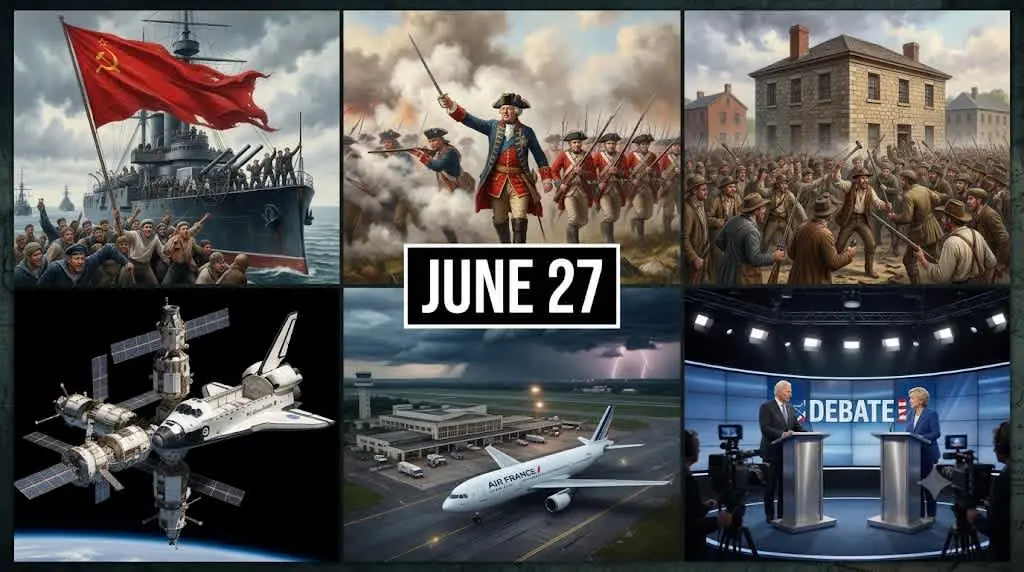
| 🌟 Most Significant Event | The Mutiny on the Russian Battleship Potemkin (1905) |
| 🏆 Top 10 Key Events | • Roman Emperor Jovian proclaimed (363) • Stratford Martyrs burned (1556) • King George II fights at Dettingen (1743) • Joseph Smith killed (1844) • Iași Pogrom begins (1941) • US enters Korean War (1950) • Entebbe hijacking occurs (1976) • Slovenia invaded (1991) • Matsumoto sarin gas attack (1994) • Biden-Trump debate reshapes election (2024) |
| ⚔️ Key Battles | Battle of Dettingen (1743); Battle of Echoee (1760); Battle of Kennesaw Mountain (1864); Ten-Day War invasion (1991) |
| 👤 Key Figures | Joseph Smith, King George II, President Richard Nixon, Tony Blair |
| 🌍 Observances | National PTSD Awareness Day (US), Helen Keller Day (US), Independence Day (Djibouti), Canadian Multiculturalism Day (Canada) |
Story of the Day: The Mutiny on the Battleship Potemkin
Foul smells filled the galley of the Black Sea Fleet’s pride, the Potemkin, as sailors openly protested the spoiled beef served for lunch. Executive Officer Ippolit Giliarovsky grabbed a canvas tarpaulin, throwing it over a group of sailors on deck—a terrifying naval tradition signaling an immediate mass execution by firing squad. Armed guards refused the order to shoot their brothers, and within minutes, helmsman Grigory Vakulinchuk led a charge to seize the armory. Vakulinchuk was shot dead in the chaos, but the sailors threw their officers overboard and hoisted a blood-red flag of rebellion. This open defiance shattered the myth of the Tsar’s absolute control and foreshadowed the total collapse of the Russian Empire.
Important Events That Happened On June 27 In History
363 – Jovian Proclaimed Roman Emperor
363 – Jovian Proclaimed Roman Emperor
Exhausted Roman legions retreated through the scorching deserts of modern-day Iraq after Emperor Julian died from a spear wound during a chaotic night retreat. Standard-bearers and weary generals quickly voted to place the purple robes on Jovian, an obscure guard commander, right there on the dusty battlefield. Jovian immediately signed a humiliating peace treaty with the Persian Empire to secure his retreating army’s safety. This desperate compromise surrendered vital eastern provinces and permanently weakened Rome’s outer borders.
678 – Pope Agatho Consecrated
Church bells rang across Rome as Agatho, a highly respected Sicilian monk, stepped into the papacy after a two-month vacancy left by Pope Donus. The city was still recovering from plague and theological divisions when the new pope assumed his heavy spiritual responsibilities. Agatho immediately began drafting letters to heal the widening rift between the Western and Eastern churches. His efforts led directly to the Sixth Ecumenical Council, which settled centuries of bitter religious arguments regarding the nature of Christ.
1499 – Amerigo Vespucci Sights Amapá
Wooden hulls creaked under a blazing Atlantic sky as Amerigo Vespucci peered through the morning mist and spotted the dense green coastline of modern-day Amapá, Brazil. The Italian navigator realized the massive volume of freshwater dumping into the ocean meant he was looking at an immense continent, not an Asian island. Vespucci charted the wild coastlines while mapping stars that Europeans had never seen before. His written letters describing this “New World” convinced mapmakers to name the entire hemisphere America in his honor.
1556 – The Stratford Martyrs Burned
Thirteen Protestant men and women stood chained to massive wooden stakes in a field outside London as thick smoke began to rise around them. Queen Mary I had ordered their execution for refusing to renounce their faith and return to the Catholic Church. A massive crowd watched in silence as the condemned sang hymns together until the flames silenced their voices. This brutal display backfired on the crown, turning ordinary citizens into powerful symbols of resistance against religious persecution.
1743 – King George II Fights at Dettingen
Musket smoke choked the air near Bavaria as King George II drew his sword and rallied his British and allied troops against a fierce French trap. The king’s horse bolted in panic during the opening cannonade, forcing the monarch to fight on foot alongside his frontline infantrymen. His stubborn presence inspired the soldiers to break the enemy lines and secure an unlikely victory. This chaotic battle marked the very last time a reigning British monarch personally led troops under enemy fire.
1760 – The Battle of Echoee
Cherokee warriors waited in total silence behind thick mountain laurel bushes as British colonial troops marched deep into a narrow North Carolina valley. Gunfire suddenly erupted from the ridges, pinning the highlanders down near the Little Tennessee River. The British forces suffered heavy casualties before abandoning their wounded and retreating back down the mountain trails. This decisive victory preserved Cherokee territory for years and forced the British military to change its frontier warfare tactics.
1806 – British Forces Take Buenos Aires
Redcoats marched triumphantly into the main square of Buenos Aires after a surprise landing easily overwhelmed the fleeing Spanish viceroy’s militia. The British commanders quickly seized the city treasury and declared the region a new crown colony to secure South American trade routes. Local residents refused to accept their new occupiers and secretly organized a massive counter-resistance network. Within months, an armed civilian uprising forced the entire British garrison into a humiliating surrender.
1844 – Joseph Smith Killed by Mob
Furious men with blackened faces stormed up the wooden stairs of the jailhouse in Carthage, Illinois, shouting threats and hammering on the doors. Joseph Smith, the controversial founder of the Latter Day Saint movement, fired a small pistol through the doorway before jumping from the second-story window. Bullets struck him repeatedly as he hit the ground below, killing him instantly alongside his brother Hyrum. This violent assassination created a powerful martyr figure and forced thousands of Mormons to flee westward toward Utah.
1864 – The Battle of Kennesaw Mountain
Union infantrymen charged up the steep, boulder-strewn slopes of Georgia under a devastating hail of Confederate artillery and rifle fire. General William T. Sherman hoped a direct assault would break the rebel lines, but the entrenched defenders held their positions with brutal efficiency. Dead and wounded Union soldiers piled up in the dense underbrush as the summer heat intensified. This tactical defeat forced Sherman to abandon frontal assaults and rely on flanking maneuvers to capture Atlanta.
1895 – The Royal Blue Inaugural Run
A sleek passenger train glided smoothly out of Washington, D.C., bound for New York City, marking the official debut of the Baltimore and Ohio Railroad’s Royal Blue service. This cutting-edge train was the very first in the United States to utilize electric locomotives to pull passengers through smoky city tunnels. Commuters marveled at the clean, quiet ride that replaced coal soot with modern luxury. This successful run proved that electric rail power was entirely viable for heavy transit networks.
1898 – Joshua Slocum Completes Solo Global Voyage
Small waves lapped against the battered wooden hull of the Spray as Joshua Slocum sailed into Briar Island, Nova Scotia, after more than three years at sea. The veteran sea captain had travelled over 46,000 miles completely alone without modern navigation tools or a radio. He survived pirate chases, coral reefs, and terrifying ocean gales using sheer skill and a simple tin clock. This incredible arrival marked the world’s very first successful solo circumnavigation of the globe.
1914 – The Illinois Monument Dedicated
Aging Civil War veterans gathered on the quiet slopes of Cheatham Hill to dedicate a massive granite monument at the Kennesaw Mountain battlefield. Surviving soldiers from both sides shook hands near the old trenches where they had fought bitterly fifty years prior. The monument honored the fallen infantrymen who had charged the deadly Confederate earthworks. This solemn ceremony served as a powerful local act of reconciliation during the dawn of the First World War.
1924 – The Johor–Singapore Causeway Opens
Long lines of cars and locomotives streamed across a massive new stone causeway connecting Malaysia to the island of Singapore for the very first time. Engineers had spent five difficult years dumping millions of tons of granite into the deep channel to complete the vital link. This permanent crossing replaced slow ferry services and opened a massive trade corridor for rubber and tin. The causeway transformed regional economics and bound the two territories tightly together for decades.
1927 – The Tanaka Conference Convenes
Prime Minister Tanaka Giichi gathered Japan’s top military officers and diplomats in Tokyo for an intense eleven-day conference regarding military strategy in China. Secret discussions focused on securing northern Chinese resources and expanding imperial influence. Critics later circulated a sensational document called the Tanaka Memorial, which detailed a wild plan for total world conquest. Though proven to be a clever forgery, the text permanently damaged Japan’s international reputation during the pre-war era.
1928 – Rovaniemi Secedes from Rural Municipality
Local officials in northern Finland signed a historic decree that officially carved the bustling trading post of Rovaniemi away from its old rural district. This administrative shift established the settlement as an independent market town with its own budget and zoning rights. The growing town quickly became the economic capital of Finnish Lapland due to its booming timber and tourism industries. This independence laid the structural foundation for the city’s modern identity as a major subarctic hub.
1941 – The Iași Pogrom Begins
Armed Romanian soldiers and local mobs smashed through the doors of Jewish homes in the city of Iași, dragging families into the streets. Terrified citizens were beaten, shot on sight, or packed into suffocating, unventilated railway cars that rolled aimlessly across the countryside. At least 13,266 Jewish people died during days of unmitigated violence orchestrated by the pro-Nazi government. This horrific event stands as one of the most violent and concentrated pogroms in European history.
1941 – German Troops Capture Białystok
Panzer divisions roared into the streets of Białystok as German forces overran Soviet defenders during the opening week of Operation Barbarossa. Flaming buildings lit the night sky while retreating Russian soldiers abandoned massive stockpiles of heavy equipment. The occupation forces immediately began terrorizing the local population, targeting the city’s large Jewish community first. This swift conquest brought a vital industrial railway hub under direct Nazi control.
1944 – Mogaung Liberated from Japanese Control
Exhausted British Chindits and allied Chinese troops fought house-to-house through the mud and ruins of Mogaung to clear out stubborn Japanese bunkers. This brutal assault marked the very first major town in Burma to be liberated from imperial occupation forces. Soldiers endured tropical diseases, torrential monsoon rains, and constant sniper fire to cut the enemy supply lines. The victory secured a critical railway link and opened up supply routes into southern China.
1946 – Canadian Citizenship Act Passed
Parliamentary leaders in Ottawa gathered to pass the Canadian Citizenship Act, creating a distinct national identity separate from British subject status. Before this landmark piece of legislation, anyone born in Canada was legally classified simply as a British subject living abroad. The law allowed citizens to carry their own passports and swear allegiance directly to Canada. This historic vote marked a major legislative step toward complete national sovereignty.
1950 – US Sends Troops to Korean War
President Harry S. Truman stood before a crowded press room and announced he had ordered American air and naval forces to support South Korea against invading communist forces. This sudden declaration bypassed Congress and committed thousands of US troops to a brutal ground conflict without an official declaration of war. UN forces rushed to set up a defensive perimeter around the southern port of Pusan. This decisive move locked the United States into the first major hot conflict of the Cold War.
1954 – Obninsk Nuclear Power Plant Opens
Engineers near Moscow flipped a series of control switches, quietly connecting the Soviet Union’s Obninsk power station to the regional electrical grid. This small facility was the world’s very first civilian nuclear power plant to generate usable electricity for public consumption. Soviet media praised the achievement as a monumental victory for peaceful atomic science over weapons development. The success sparked a global rush to build commercial nuclear reactors across Europe and America.
1954 – The Battle of Berne
The highly anticipated World Cup quarterfinal between Hungary and Brazil turned into a chaotic brawl as players traded vicious kicks and punches on a muddy field in Switzerland. The referee ejected three players, but the violence only intensified, culminating in a dressing-room riot after the final whistle. Angry athletes shattered bottles and used cleats as weapons in the corridors. This infamous match became known as the Battle of Berne, cementing it as the most violent game in World Cup history.
1957 – Hurricane Audrey Makes Landfall
A massive wall of seawater swept over the low-lying coastal communities of Cameron, Louisiana, as Hurricane Audrey roared ashore with roaring 145-mph winds. The powerful Category 4 storm caught residents completely off guard due to inaccurate weekend weather forecasts. Over 400 people perished as entire towns were flattened and dragged into the coastal marshes. This devastating tragedy forced the US Weather Bureau to completely overhaul its hurricane warning systems.
1973 – Uruguayan Dictatorship Established
President Juan María Bordaberry walked into the legislative chambers in Montevideo, backed by high-ranking military officers, and officially dissolved the country’s parliament. He immediately banned all political parties, censored the press, and suspended basic constitutional rights to crush growing leftist labor movements. This sudden coup ended decades of democratic rule and plunged Uruguay into a brutal twelve-year military dictatorship. Thousands of political dissidents were arrested, tortured, or forced into exile.
1974 – Richard Nixon Visits the Soviet Union
Air Force One touched down on a Moscow runway as President Richard Nixon arrived for a high-stakes summit with Soviet leader Leonid Brezhnev. The embattled American president hoped this highly publicized diplomatic trip would distract voters from the deepening Watergate scandal back home. The leaders signed several minor scientific agreements but failed to secure a major breakthrough on nuclear arms limitations. This tense visit was Nixon’s final international journey before his historic resignation.
1976 – Air France Flight 139 Hijacked
German and Palestinian militants pulled out hidden pistols and grenades shortly after Air France Flight 139 took off from Athens, forcing the pilots to fly toward Africa. The hijackers redirected the plane to Entebbe Airport in Uganda, where the brutal dictator Idi Amin openly welcomed them. The militants held over a hundred Jewish and Israeli passengers hostage inside an old terminal, demanding the release of jailed comrades. This terrifying crisis set the stage for one of history’s most daring military rescue operations.
1977 – Djibouti Grants Independence
Thousands of ecstatic citizens poured into the sun-baked streets of Djibouti City as the French flag was lowered for the final time, ending over a century of colonial rule. Hassan Gouled Aptidon took the oath of office as the tiny nation’s very first president. The new country faced immediate economic hardships and intense regional rivalries between its major ethnic groups. This peaceful transition of power marked the official end of France’s large territorial empire on the mainland of Africa.
1977 – Constitution for the Federation of Earth Adopted
A diverse group of international lawyers and idealistic activists gathered in Innsbruck, Austria, to officially sign the Constitution for the Federation of Earth. This ambitious document outlined a democratic world government designed to eliminate warfare, protect human rights, and manage global environmental resources. The delegates hoped to inspire nations to surrender their weapons and join a unified global parliament. While never officially adopted by any major government, the text remains an influential blueprint for global federalism.
1980 – The Ustica Massacre
An Itavia Douglas DC-9 passenger jet suddenly vanished from radar screens and plunged into the Tyrrhenian Sea near the island of Ustica, killing all 81 people on board. Investigators faced decades of military cover-ups, missing radar logs, and conflicting explanations ranging from an onboard bomb to an accidental missile strike. Rumors persisted that French or American fighter jets had accidentally shot the plane down during a secret dogfight with Libyan aircraft. This lingering mystery remains one of Italy’s most painful modern conspiracies.
1981 – China Blames Mao for Cultural Revolution
The Central Committee of the Chinese Communist Party released a historic, heavily negotiated document that officially evaluated the turbulent legacy of Chairman Mao Zedong. The resolution bluntly laid the blame for the chaotic and devastating Cultural Revolution directly at Mao’s feet, calling it a catastrophic error. However, party leaders carefully preserved his status as a revolutionary hero by stating his contributions outweighed his mistakes. This political balancing act allowed China to open its economy while maintaining total party control.
1982 – Space Shuttle Columbia Launches STS-4
A blinding flash of fire lit up the Kennedy Space Center pad as Space Shuttle Columbia roared into the sky on its fourth orbital test flight. Astronauts Ken Mattingly and Henry Hartsfield spent seven days in space conducting secret military experiments and operating a robotic cargo arm. This flight marked the very last research and development mission before NASA declared the shuttle system fully operational. The spacecraft glided to a perfect landing on a concrete runway at Edwards Air Force Base.
1988 – The Gare de Lyon Rail Accident
A crowded commuter train with failing brakes slammed into a stationary network train inside Paris’s underground Gare de Lyon station at high speed. The terrifying impact crushed the front carriages instantly, trapping dozens of passengers in the twisted metal wreckage. Investigation teams discovered that a series of human errors, including an improperly closed brake valve, had disabled the train’s safety systems. This horrific crash killed 56 people and forced European rail networks to completely redesign their braking protocols.
1988 – The Villa Tunari Massacre
Armed Bolivian anti-narcotics police opened fire on a large crowd of angry coca-growing peasants who were protesting a new U.S.-backed crop eradication law in Villa Tunari. At least nine farmers were killed and over a hundred injured during the chaotic confrontation at the rural processing facility. The government claimed the police acted in self-defense against armed agitators, while human rights groups condemned the excessive use of force. This tragedy deeply intensified the bitter social conflicts surrounding the regional war on drugs.
1991 – Slovenia Invaded by Yugoslav Troops
Yugoslav Army tanks rolled across the borders and aircraft struck main runways just two days after Slovenia officially declared its independence from the federation. Slovenian territorial defense forces quickly blocked mountain passes with heavy trucks and surrounded federal military garrisons. This sudden outbreak of fighting marked the official beginning of the Ten-Day War, which shattered the fragile peace in the Balkans. The brief conflict ended with a negotiated ceasefire that secured Slovenia’s path to international recognition.
1994 – The Matsumoto Sarin Gas Attack
Members of the apocalyptic Aum Shinrikyo cult drove a customized delivery truck into a quiet residential neighborhood in Matsumoto, Japan, and quietly released a cloud of deadly sarin gas. The toxic nerve agent drifted through open apartment windows, killing seven sleeping residents and injuring hundreds more within hours. Local police initially suspected an innocent resident who had reported the chemicals, missing crucial clues about the growing cult. This tragedy served as a horrific trial run for the deadlier Tokyo subway attack a year later.
1995 – Space Shuttle Atlantis Docks with Mir
Thrusting gently against the blackness of space, the U.S. Space Shuttle Atlantis locked smoothly into a docking module on the Russian space station Mir high above the Earth. Commander Robert “Hoot” Gibson shook hands with cosmonaut Vladimir Dezhurov through the open hatch, uniting the former Cold War rivals in a historic orbital embrace. This complex mission formed the largest spacecraft ever assembled in orbit up to that time. The successful linkup paved the way for the construction of the International Space Station.
2007 – Tony Blair Resigns
Tony Blair stepped out of 10 Downing Street for the final time as Prime Minister, ending a dramatic ten-year tenure that redefined modern British politics. He walked directly to Buckingham Palace to tender his official resignation to the Queen, clearing the path for Chancellor Gordon Brown to take power without a general election. Blair’s legacy remained deeply divided between his domestic public service reforms and his highly controversial decision to join the 2003 invasion of Iraq.
2007 – The Complexo do Alemão Massacre
Over a thousand heavily armed Brazilian military police officers backed by armored vehicles stormed into the favelas of Complexo do Alemão in Rio de Janeiro. A massive shootout erupted with local drug gangs, turning the narrow hillside alleys into an active war zone for hours. At least nineteen people were killed during the controversial operation, with independent human rights groups later alleging that many deaths were extrajudicial executions. This bloody raid highlighted the brutal human cost of the city’s urban security policies.
2008 – Robert Mugabe Re-elected in Landslide
Election officials in Harare declared President Robert Mugabe the landslide winner of a highly controversial runoff vote after his opponent Morgan Tsvangirai withdrew from the race. Tsvangirai fled the campaign trail after state-sponsored militias systematically murdered and tortured hundreds of opposition party supporters. International observers widely condemned the vote as a violent sham that completely lacked democratic legitimacy. The rigged victory allowed Mugabe to extend his authoritarian rule over Zimbabwe’s collapsing economy.
2013 – NASA Launches IRIS Space Probe
A Pegasus XL rocket dropped from the belly of a high-altitude aircraft and ignited its engines, successfully carrying NASA’s Interface Region Imaging Spectrograph probe into orbit. The specialized satellite opened its solar panels and aimed its high-resolution ultraviolet telescope directly at the sun. IRIS began capturing incredibly detailed images of the solar atmosphere to help scientists understand how solar winds and solar flares gather energy. The ongoing mission provided vital data for predicting major space weather events.
2014 – GAIL Pipeline Explosion
A massive fireball erupted from a high-pressure natural gas pipeline operated by the Gas Authority of India Limited in the East Godavari district of Andhra Pradesh. The blast incinerated a nearby village street, killing fourteen people as they slept and destroying dozens of homes and coconut plantations. Investigators discovered that gas leaking from the old pipeline had collected under local tea stalls and ignited when a stove was lit. The tragedy sparked intense public protests regarding the safety of industrial infrastructure near residential areas.
2015 – Formosa Fun Coast Fire
A massive explosion of colored cornstarch powder transformed a crowded evening dance party into a terrifying wall of fire at a water park in New Taipei City, Taiwan. The fine powder was sprayed over thousands of concertgoers and quickly ignited when it drifted into the hot exhaust fans of the stage lights. Over 500 young people suffered horrific thermal burns, and fifteen victims eventually succumbed to their injuries in overcrowded hospitals. This disaster led to an immediate global ban on the unregulated use of colored powder at public events.
2017 – The Petya Cyberattacks
Computer screens across Ukraine suddenly went black and displayed a terrifying ransom note as a powerful strain of malware called Petya swept through government ministries, banks, and electrical grids. The destructive cyberweapon quickly spread through corporate networks worldwide, crippling major international shipping lines, factories, and medical facilities. Cybersecurity experts tracked the source back to a corrupted Ukrainian accounting software update, pointing to state-sponsored hackers. The attack caused billions of dollars in global damage, making it one of history’s most destructive cyber incidents.
2024 – Biden-Trump Debate Reshapes Election
President Joe Biden and former President Donald Trump took their positions behind television podiums in Atlanta for an unprecedented early-summer presidential debate. Millions of viewers watched as Biden struggled through his answers with a raspy voice, lost his train of thought, and delivered several halting explanations. The performance triggered immediate panic among Democratic leaders and donors regarding his ability to govern for another term. This single broadcast altered American political history, culminating in Biden’s withdrawal from the race less than a month later.
Wondering what came before today? Find out here.
Famous People Born on June 27
| Name | Role/Description | Dates |
|---|---|---|
| Helen Keller | American author, disability rights activist, and educator | 1880 – 1968 |
| Khloé Kardashian | American media personality, entrepreneur, and television star | 1984 – Present |
| Tobey Maguire | American actor best known as Spider-Man | 1975 – Present |
| J. J. Abrams | American film director, producer, and screenwriter | 1966 – Present |
| Vera Wang | American fashion designer | 1949 – Present |
| Kevin Pietersen | English international cricketer | 1980 – Present |
| Tony Leung Chiu-wai | Hong Kong actor and international film star | 1962 – Present |
| Nico Rosberg | German Formula One World Champion | 1985 – Present |
| H.E.R. | American Grammy and Academy Award-winning singer-songwriter | 1997 – Present |
| Ross Perot | American billionaire businessman and presidential candidate | 1930 – 2019 |
| John Monash | Australian military commander and engineer | 1865 – 1931 |
| Emma Goldman | Lithuanian-American political activist and writer | 1869 – 1940 |
| Bankim Chandra Chattopadhyay | Indian novelist and author of Vande Mataram | 1838 – 1894 |
| Paul Laurence Dunbar | American poet and novelist | 1872 – 1906 |
| Charles Stewart Parnell | Irish nationalist political leader | 1846 – 1891 |
| Mary McAleese | 8th President of Ireland | 1951 – Present |
| R. D. Burman | Legendary Indian film composer and music director | 1939 – 1994 |
| Krzysztof Kieślowski | Polish film director (The Decalogue, Three Colours) | 1941 – 1996 |
| Grace Lee Boggs | American philosopher, activist, and author | 1915 – 2015 |
| Isabelle Adjani | Award-winning French actress | 1955 – Present |
| Simon Sebag Montefiore | British historian and bestselling author | 1965 – Present |
| Dale Steyn | South African fast bowler | 1983 – Present |
| Bobby Wagner | American NFL linebacker | 1990 – Present |
| Will Levis | American NFL quarterback | 1999 – Present |
| Chris Olave | American NFL wide receiver | 2000 – Present |
| Sam Claflin | English actor (The Hunger Games, Me Before You) | 1986 – Present |
| Ed Westwick | English actor (Gossip Girl) | 1987 – Present |
| Matthew Lewis | English actor (Harry Potter) | 1989 – Present |
| Yordan Álvarez | Cuban Major League Baseball player | 1997 – Present |
Famous People Who Died on June 27
| Name | Role/Description | Dates |
|---|---|---|
| Jack Lemmon | American Academy Award-winning actor | 1925 – 2001 |
| John Entwistle | English bassist and founding member of The Who | 1944 – 2002 |
| Bud Spencer | Italian actor, swimmer, and filmmaker | 1929 – 2016 |
| Joe Jackson | Talent manager and father of the Jackson family | 1928 – 2018 |
| Tove Jansson | Finnish author and creator of the Moomins | 1914 – 2001 |
| Chris Squire | Bass guitarist and co-founder of the rock band Yes | 1948 – 2015 |
| Joseph Smith | Founder of the Latter Day Saint movement | 1805 – 1844 |
| Hyrum Smith | Early leader of the Latter Day Saint movement | 1800 – 1844 |
| Giorgio Vasari | Italian painter, architect, and first great art historian | 1511 – 1574 |
| Ranjit Singh | Founder and Maharaja of the Sikh Empire | 1780 – 1839 |
| James Smithson | English scientist; founder of the Smithsonian Institution | 1765 – 1829 |
| Sophie Germain | French mathematician and physicist | 1776 – 1831 |
| Albert R. Broccoli | American film producer of the James Bond series | 1909 – 1996 |
| Sam Manekshaw | Indian Field Marshal and military leader | 1914 – 2008 |
| Milada Horáková | Czech politician and resistance leader | 1901 – 1950 |
| A. J. Ayer | English philosopher | 1910 – 1989 |
| Peter L. Berger | Austrian-American sociologist | 1929 – 2017 |
| Shelby Foote | American historian and Civil War author | 1916 – 2005 |
| Martin Mull | American actor, comedian, and musician | 1943 – 2024 |
| Kinky Friedman | American country singer, author, and politician | 1944 – 2024 |
| Lottie Dod | British champion tennis player | 1871 – 1960 |
| Max Dehn | German-American mathematician | 1878 – 1952 |
| Harold Mahony | Irish Wimbledon tennis champion | 1867 – 1905 |
| Wanda Gág | American children’s author and illustrator | 1893 – 1946 |
| Pierre Pflimlin | Prime Minister of France | 1907 – 2000 |
| Leslie Manigat | President of Haiti | 1930 – 2014 |
| Darrell Russell | American NASCAR driver | 1968 – 2004 |
| Stefano Borgonovo | Italian international footballer | 1964 – 2013 |
| Joan Sims | English actress and comedy star | 1930 – 2001 |
Observances on June 27
- Independence Day (Djibouti): A national holiday celebrating the day the country gained full sovereignty from French colonial rule in 1977.
- National PTSD Awareness Day (United States): A day dedicated to raising public awareness about post-traumatic stress disorder and reducing the stigma surrounding mental health treatment.
- Helen Keller Day (United States): A commemorative day celebrating the birth and lasting achievements of the famous deaf-blind author and political activist.
- Canadian Multiculturalism Day (Canada): A celebration of the diverse cultural heritages and contributions of Canada’s various ethnic communities to national identity.
🇺🇸 Frequently Asked Questions — June 27 in History
A furious mob with blackened faces stormed the jailhouse in Carthage, Illinois, and shot Joseph Smith, the founder of the Latter Day Saint movement. His brother Hyrum was also killed in the attack, forcing thousands of Mormons to flee westward to Utah.
The mutiny aboard the Russian battleship Potemkin in 1905 stands out as a critical turning point. Sailors rebelled against their officers over rotten rations, which shattered the myth of the Tsar’s control and set the stage for the Russian Revolution.
Helen Keller, the renowned American author, disability rights advocate, and political activist, was born on this day in 1880. Her incredible life story inspired global changes in how society educates and supports individuals with disabilities.
President Harry S. Truman ordered American air and naval forces to support South Korea on June 27, 1950. This decisive move officially committed United States military forces to the first hot conflict of the Cold War.
Djibouti Independence Day is a national holiday celebrating the small African nation’s freedom from French colonial rule in 1977. It marks the official end of France’s large territorial empire on the mainland of Africa.
President Joe Biden debated former President Donald Trump in a high-stakes television broadcast in 2024. Biden’s halting performance triggered widespread political panic, directly leading to his historic withdrawal from the presidential race a few weeks later.