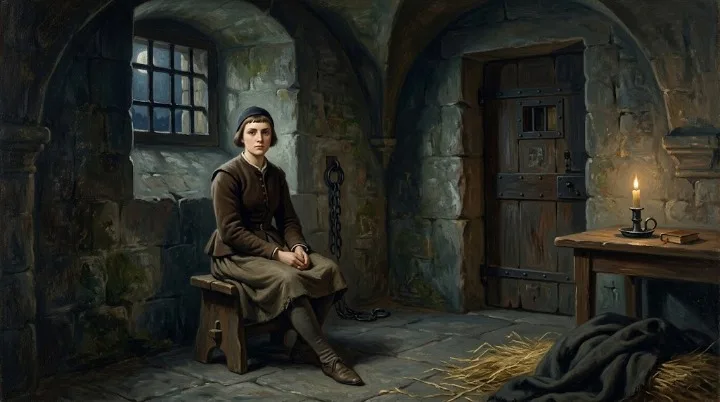

A thirteen-year-old girl is standing in her father’s garden in Domrémy when a light appears, and a voice speaks to her. She doesn’t run. She doesn’t tell anyone, not for years. Whatever she heard that day, it stayed with her long enough to convince an uncrowned king to hand her an army. So did Joan of Arc really hear voices?
By her own sworn testimony, yes — she said she heard the voices of St. Michael, St. Catherine, and St. Margaret starting around age 13, and that they guided nearly every major decision of her short life. What nobody agrees on is why. Historians, theologians, and neurologists have spent six hundred years arguing over that question, and no single explanation — religious, medical, or political — has ever won the field outright. That’s not a dodge. It’s the honest state of the evidence.
✨ Quick Facts — Joan of Arc’s Visions
| 📌 Category | 📖 Event / Detail |
|---|---|
| 📅 First Reported Vision | Around 1425, when Joan was roughly 13 years old, manifesting in her father’s garden at Domrémy, France |
| 🗣️ Voices Identified As | St. Michael the Archangel, St. Catherine of Alexandria, and St. Margaret of Antioch |
| 📜 Divine Instruction | To live a pious and virtuous life, to go to the aid of the French Dauphin (Charles VII), and to break the siege of Orléans to drive English forces out of France |
| 📖 Primary Source | Her own firsthand testimony recorded during her trial by the ecclesiastical court in Rouen (1431) |
| 🌟 Church Position | Formally recognized as authentic divine intervention when she was canonized as a saint by Pope Benedict XV on May 16, 1920 |
What Joan Said Under Oath
We don’t have to guess what Joan experienced because we have the actual court transcripts from her 1431 trial for heresy. Facing a hostile wall of English-aligned judges, the nineteen-year-old girl was incredibly specific about her sensory experiences.
She didn’t describe her visions as vague, internal thoughts or dreams. Joan insisted she heard them with her physical ears.
“I saw them with my bodily eyes, as well as I see you,” she told her prosecutors.
She testified that the voices were accompanied by a brilliant light, which usually appeared on her right side toward the local church. The entities didn’t just give vague spiritual comfort; they gave highly practical, strategic commands. They told her what clothes to wear, how to behave, and exactly where to lead an army. When they left, Joan admitted she wept, wishing they had taken her with them.
That internal consistency is exactly why this story hasn’t faded into folklore. Whatever was happening to Joan, she described it the same way whether she was talking to sympathetic priests at Poitiers in 1429 or hostile judges at Rouen in 1431.
The Religious Interpretation
To the people who fought alongside Joan, and to millions of believers today, the simplest explanation is the one Joan gave: it was a genuine divine miracle.
In the 15th century, Europe was deeply religious. People fully believed that God intervened in human affairs. To the French, who were losing a grueling, decades-long war against the English, Joan was a savior sent by Heaven. Her ability to pick out the disguised Dauphin Charles VII in a crowded room and her uncanny military predictions were seen as proof of her divine backing.
When the Catholic Church canonized her as a saint in 1920, it officially reaffirmed this stance. Within this tradition, her voices weren’t a sign of a broken mind, but a chosen vessel for a higher power.
The Medical and Psychological Theories
Modern scholars looking at the exact same trial transcripts see a very different picture. Over the last century, various neurologists and psychiatrists have tried to find a medical explanation for what Joan experienced, though they face a massive hurdle: you cannot clinically diagnose someone who has been dead for 600 years.
Some retrospective theories suggest Joan may have experienced auditory hallucinations tied to specific neurological conditions.
- Epilepsy: Certain types, like idiopathic partial epilepsy with auditory features, can cause a person to hear realistic voices accompanied by flashes of light.
- Migraine Auras: Severe migraines can cause intense visual phenomena, including the bright lights Joan described.
- Schizophrenia or Bipolar Disorder: These are occasionally hypothesized by researchers looking into chronic auditory hallucinations.
Historians urge extreme caution here. Joan never showed signs of mental decline or confusion. Her contemporary observers, even her enemies, noted that she was incredibly sharp, logical, and composed under intense pressure. A temporary neurological event might explain a flash of light, but it struggles to account for the highly organized, brilliant military focus that Joan maintained for years.
The Skeptical and Political Reading
There’s a third camp that mostly sidesteps the question of what Joan actually experienced and focuses instead on what her claims did.
France in the 1420s was desperate. The English and their Burgundian allies controlled huge swaths of the country, the French king hadn’t even been crowned, and morale among French forces was in the gutter. A peasant girl claiming a direct mandate from heaven to save the kingdom was, politically speaking, exactly what Charles VII’s cause needed — a story that could rally soldiers and terrify enemies regardless of its ultimate truth.
Historians in this camp point out that both sides used the same claim for opposite purposes. The French crown and its supporters treated Joan’s voices as proof of divine favor, useful propaganda that helped legitimize a shaky monarchy. The English and their Burgundian allies pointed to the exact same voices as evidence of witchcraft and heresy, which was precisely the charge that got her burned at the stake in 1431. Same testimony, opposite verdict — because the trial was never really about theology. It was about which political outcome the voices were being used to justify.
This reading doesn’t require deciding whether Joan was lying, deluded, or genuinely visited by saints. It simply notes that her claims functioned as a political weapon either way, and that both her allies and her executioners understood that perfectly well.
Why No Theory Fully Explains It
Here’s the honest problem sitting underneath all three interpretations: we’re trying to apply modern categories — clinical diagnosis, propaganda analysis, institutional theology — to a 15th-century teenager’s account of her own inner life, filtered through a trial transcript written by men trying to kill her.
The medical theories can’t be tested, because there’s no patient to examine, only words on a page. The political reading explains why the voices mattered to other people, but says nothing about what Joan actually experienced inside her own head. And the religious interpretation, while it’s the position of the institution that eventually canonized her, isn’t something historians can verify or falsify using the tools of their discipline.
Add to that the sheer scarcity of good evidence. Joan couldn’t read or write. Every word we have from her passed through scribes, translators, and interrogators with their own agendas before it reached paper. That’s a shaky foundation for any confident diagnosis, medical or otherwise.
Most serious historians today land in roughly the same place: Joan of Arc genuinely believed she heard these voices, that belief was sincere and consistent across years of testimony under enormous pressure, and beyond that, the honest answer is that we don’t — and largely can’t — know.
Ultimately, Joan’s voices remain an unsolved mystery. They are a brilliant reminder of how history is shaped not just by dates and battles, but by the deep, unyielding power of human belief.
🔔 Frequently Asked Questions — Joan of Arc’s Voices and Examinations
According to her trial testimony, the voices first told her to live virtuously and attend church. As the visitations continued, they instructed her to go to the aid of the French king, Charles VII, and to help drive English forces out of French territory — missions she says led directly to the relief of Orléans and the king’s coronation at Reims.
Not in the modern medical sense. Before she was allowed to lead troops, clergy at Poitiers examined her in 1429 to assess whether her visions were divinely inspired, but this was a theological inquiry, not a medical one. All medical theories about her condition are modern retrospective analyses of her trial transcripts, conducted centuries after her death.
Some neurologists have proposed epilepsy, specifically a rare auditory seizure disorder, based on the pattern of her reported symptoms. Others have suggested migraine with aura or other explanations. None of these amount to a confirmed diagnosis — they’re hypotheses built from secondhand historical testimony, and many historians and physicians dispute them.
The Catholic Church examined Joan’s claims twice: once during her lifetime at Poitiers, and again in 1456 when her heresy conviction was formally overturned. In 1920, Pope Benedict XV canonized her a saint, an act that reflects the Church’s position that her mission and visions were genuine.
That moment in the garden was just the beginning — for everything that followed, from a farm girl’s first vision to her execution at nineteen, you can read the full story of Joan of Arc here.
Sources & Further Reading
- “I heard voices…”: a historical review and hypothesis on the presumed epilepsy of Joan of Arc — Epilepsy & Behavior, 2006
- Joan of Arc: Sanctity, witchcraft or epilepsy? — Epilepsy & Behavior, 2016
- Joan of Arc — Hearing Voices — American Journal of Psychiatry
- What Really Caused the Voices in Joan of Arc’s Head? — Live Science