👤 Biography Profile — Sake Dean Mahomed
| 📌 Fact | 📖 Detail |
|---|---|
| Full name | Sheikh Din Muhammad (anglicized as Sake Dean Mahomed) |
| 🎂 Born | May 1759, Patna, Bengal Presidency, Mughal India |
| 🍂 Died | 24 February 1851, Brighton, England (aged ~91) |
| 🌍 Nationality | Indian-born British subject |
| 🌟 Known for | First Indian author in English; first Indian restaurant in Britain; introducing shampoo baths to the Western world |
| 👑 Royal title | Shampooing Surgeon to King George IV and King William IV |
| 🪦 Buried | St Nicholas’ Church, Brighton |
Introduction
There’s a plaque at 102 George Street in London. Most people walk past it without a second glance. But that small green disc marks the spot where, in 1810, a Bengali Muslim man from Patna opened Britain’s first Indian restaurant — and in doing so, quietly changed the country forever. His name was Sake Dean Mahomed, and the restaurant was just one of three things he did that no Indian had ever done before.
By the time he died in Brighton in 1851 at the age of 91, Mahomed had also written the first book in English by an Indian author, introduced shampoo baths to British high society, and served as personal physician to two kings. He had crossed continents, converted religions, eloped with an Irish woman against her family’s wishes, survived bankruptcy, and reinvented himself multiple times over nine decades.
History largely forgot him. That’s worth correcting.
A Soldier’s Childhood in Colonial India
Patna in 1759 was a city caught between empires. The Mughal dynasty was fading. The British East India Company was tightening its grip on Bengal. And into this uncertain world, Sheikh Din Muhammad was born — into a Muslim family that claimed descent from the Nawabs of Bengal, though the historical record on this is mixed.
His father worked for the East India Company and had absorbed something unusual for the era: knowledge of Mughal alchemy, including the techniques used to produce alkalis, soaps, and early shampoo preparations. That knowledge would matter enormously, decades later, on the southern coast of England. But first came tragedy. Mahomed’s father died in battle when he was about 11 years old.
What followed shaped everything. At the age of 10, he was taken under the wing of Captain Godfrey Evan Baker, an Anglo-Irish Protestant officer. Baker became mentor, commanding officer, and eventually the man Mahomed would follow halfway across the world. He served under Baker as a trainee surgeon in the East India Company’s army, seeing action against the Marathas and witnessing the last flickerings of Mughal grandeur — the decaying courts, the fading glory of Delhi and Allahabad that he would later describe in vivid prose.
Mahomed remained with Captain Baker until 1782, when the Captain resigned. That same year, Mahomed also resigned from the army, choosing to accompany Baker — “his best friend” — to Ireland. He was 23 years old, and he had just made the decision that would define his life.
Ireland, Love, and a Historic Book
Cork in the 1780s was no place to be a foreigner. But Mahomed enrolled in a local school to sharpen his English, and it was there he met Jane Daly — described in his own words as a “pretty Irish girl of respectable parentage.” Her family did not approve. The law made things even harder: at the time, it was illegal for Protestants to marry non-Protestants in Ireland.
So they eloped. Mahomed converted from Islam to Anglicanism in 1786, and they married quietly in another town. It was a bold act for a Muslim man from Bengal in Georgian Ireland — one that speaks to both his determination and his extraordinary capacity for reinvention.
While living in Cork, he did something no Indian had ever done: he wrote a book in English and published it. On January 15, 1794, Mahomed published The Travels of Dean Mahomet, a Native of Patna in Bengal, Through Several Parts of India, While in the Service of the Honorable the East India Company — not only the first English book written by an Indian author, but the first time a book published in English depicted the British colonization of India from an Indian perspective.
Written in the form of letters to a friend, the book described his army years, the cities of Mughal India, and his own observations of a world in colonial transition. It was literate, vivid, and carefully composed. Scholars today recognize it as a landmark in both English literature and postcolonial history. In its time, it sold modestly and was mostly forgotten — a pattern that would repeat itself across Mahomed’s career.
London, Curry, and the First Indian Restaurant
By around 1807, Mahomed and Jane had moved to London with their growing family. London was the centre of the Empire, and Mahomed saw opportunity. He had an idea that seemed, in hindsight, almost comically ahead of its time: open a restaurant serving Indian food.
Prior to Sake Dean Mahomed’s arrival, Indian food was impossible to find in England outside of private kitchens. He introduced the cuisine to his new home by opening the Hindoostane Coffee House in London in 1810. Located off George Street near Portman Square in Central London, the restaurant offered Indian dishes alongside hookah pipes with genuine Chilm tobacco — a rare luxury in Regency London. His target clientele was British officers returning from India and Indian aristocrats living in the city.
But the timing was off. The Indian aristocracy would not come out to eat in the restaurant because they had chefs at home cooking more authentic food. And the returning British officers, while nostalgic for the tastes of India, weren’t yet in the habit of eating out at ethnic restaurants. Though the restaurant closed a few years later due to financial troubles, it paved the way for Indian food to become a staple of the English food scene. Mahomed declared bankruptcy in 1812. It wasn’t his last failure. But it also wasn’t the end.
Brighton and the Birth of Shampooing
After bankruptcy, Mahomed did what resourceful people have always done: he started again somewhere new. In 1814, he and Jane moved to Brighton, a seaside town newly fashionable with the Regency elite thanks to the Prince Regent’s love of the place. The Royal Pavilion — that extraordinary Indo-Saracenic palace by the sea — was under construction. The wealthy were arriving in droves. And Mahomed, who had spent years studying the therapeutic properties of Indian massage and herbal steam treatments, saw exactly what was missing.
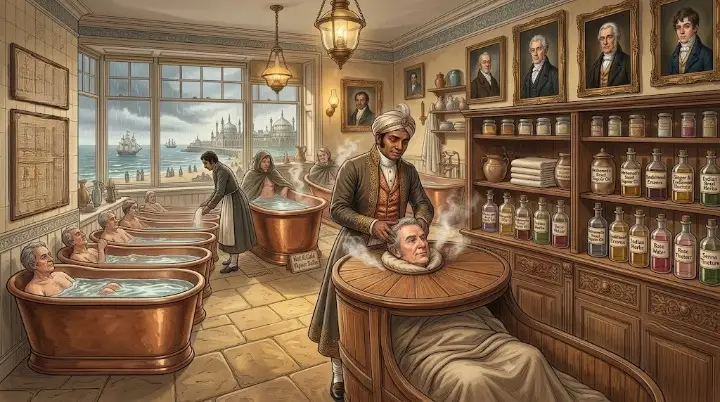
Arriving in Brighton in 1814, at the height of the popularity of sea bathing, Mahomed opened an indoor baths in Pool Valley on the seafront. He offered something he called the “Indian Medicated Vapour Bath” — a treatment combining steam, herbal preparations, and therapeutic massage drawn directly from Indian champi traditions. In a local newspaper, he described it as “a cure to many diseases and giving full relief when everything fails; particularly Rheumatic and paralytic, gout, stiff joints, old sprains, lame legs, aches and pains in the joints.”
The city loved it. His business was an instant success and he became known as “Dr. Brighton.” Hospitals sent patients to him. By 1822, he had secured the most prestigious endorsement available in Britain: he became King George IV’s personal “shampooing surgeon” and stayed in this post when George’s brother William IV became king in 1830. He had served two kings of England. The boy from Patna who lost his father at eleven had become physician to the British monarchy.
Jane was an active partner throughout. Her name features in advertisements for the baths, confirming that she also possessed “the art of shampooing” and superintended the Ladies Baths.
The Books That Defined His Legacy
Mahomed published two more books during the Brighton years, both about the baths and both serving the dual purpose of medical argument and advertisement. In 1820 came Cases Cured by Sake Dean Mahomed — essentially a collection of testimonials from patients. Then, in 1822, 1826, and again in 1838, he published three editions of Shampooing; or, Benefits Resulting from the Use of the Indian Medicated Vapour Bath, dedicated to King George IV.
In it, he wrote candidly about the resistance he had faced: how English people were initially unsure about shampooing, and how introducing an entirely new cultural practice required persuasion, patience, and proof. The baths’ success — the hospital referrals, the royal appointments, the fact that other indoor baths began opening in Brighton in imitation of his model — was that proof.
It’s worth noting that in Mahomed’s day, “shampoo” still meant the massage treatment, not hair washing. The word “shampoo” did not take on its modern meaning of washing the hair until the 1860s. But the word itself — the concept, the practice, the cultural transmission from Indian champi to British high society — runs directly through Mahomed’s bathhouse on the Brighton seafront.
The Man History Forgot — and Is Finally Remembering
By the Victorian era, Mahomed’s fame had dimmed. By the end of the 1830s, a lack of capital saw Mahomed’s Baths put up for auction and the family was once again forced to move to more modest accommodation. He died at 32 Grand Parade, Brighton, on 24 February 1851, and was buried at St Nicholas’ Church alongside Jane, who had died the year before.
For most of the next century and a half, he remained largely unknown. Academic interest revived in the 1970s and 80s, when poet and scholar Alamgir Hashmi drew attention to his literary significance. In 1996, historian Michael H. Fisher published The First Indian Author in English: Dean Mahomed in India, Ireland, and England through Oxford University Press — the definitive scholarly account of his life.
On January 15, 2019, Sake Dean Mahomed was remembered by Google with a Google Doodle on the main page. A green heritage plaque now marks the location of the Hindoostane Coffee House on George Street, unveiled in 2005 by the City of Westminster. His legacy also lives through his descendants: his most famous grandson, Frederick Henry Horatio Akbar Mahomed (c. 1849–1884), became an internationally known physician who worked at Guy’s Hospital in London and made important contributions to the study of high blood pressure.
Three firsts. Three careers. Ninety-one years. And one man whom most people — even in the country he transformed — have never heard of.
🎩 Frequently Asked Questions — Who Was Sake Dean Mahomed?
Sake Dean Mahomed (1759–1851) was a Bengali-born Indian entrepreneur, soldier, author, and surgeon who emigrated to Britain and achieved three major firsts: the first book in English by an Indian author (1794), the first Indian restaurant in Britain (1810), and the first commercial shampoo bath service in the Western world (1814). He served as personal physician to two British kings.
He is best known for three things: writing the first English-language book by an Indian author in 1794, opening Britain’s first Indian restaurant — the Hindoostane Coffee House in London — in 1810, and introducing Indian shampoo bath treatments to Britain in Brighton in 1814. He was also appointed Shampooing Surgeon to both King George IV and King William IV.
He didn’t invent shampoo from scratch — Indian herbal hair-washing traditions predate him by centuries. But he introduced the practice of therapeutic shampooing to the Western world through his Brighton bathhouse, opened in 1814. The word “shampoo” itself derives from the Hindi word chāmpo, meaning to press or knead, and entered English usage partly through Mahomed’s influence.
He was born in May 1759 in Patna, a city in what was then the Bengal Presidency of Mughal India (today the capital of the Indian state of Bihar). He came from a Bengali Muslim family and served in the British East India Company’s army before emigrating to Ireland in 1784 and later to England.
The Hindoostane Coffee House was Britain’s first Indian restaurant, opened by Sake Dean Mahomed in 1810 near Portman Square in Central London. It served Indian dishes and hookah with real Chilm tobacco, targeting British officers returning from India and Indian aristocrats in London. It closed due to financial difficulties around 1812, but pioneered the Indian restaurant industry that followed.
Mahomed was one of the first South Asians to build a successful professional life in Britain, operating at the highest levels of society — treating royalty and aristocracy at a time when racial prejudice was widespread. He introduced Indian cuisine, therapeutic massage, and shampoo culture to Britain, all of which left permanent marks on British life. His 1794 book is also the first recorded Indian voice in English literature.
Conclusion
Sake Dean Mahomed lived a life so full of firsts that it seems almost improbable — except that every single one is documented. He crossed the world with nothing but his skills, his intelligence, and a willingness to start over when things fell apart. He failed publicly, rebuilt quietly, and served two kings before dying in his nineties in a seaside town he had helped put on the cultural map.
The Indian restaurants on every British high street, the bottle of shampoo in your shower, the tradition of English-language literature by writers of South Asian origin — all of it carries some trace of the boy from Patna who followed a British officer to Cork and never stopped reinventing himself.
Enjoyed the story of Sake Dean Mahomed? Also read: What is the Indian legend regarding the discovery of tea?


