| Event Category | Key Historical Details |
|---|---|
| Most Significant Event | Gamal Abdel Nasser nationalizes the Suez Canal (1956) |
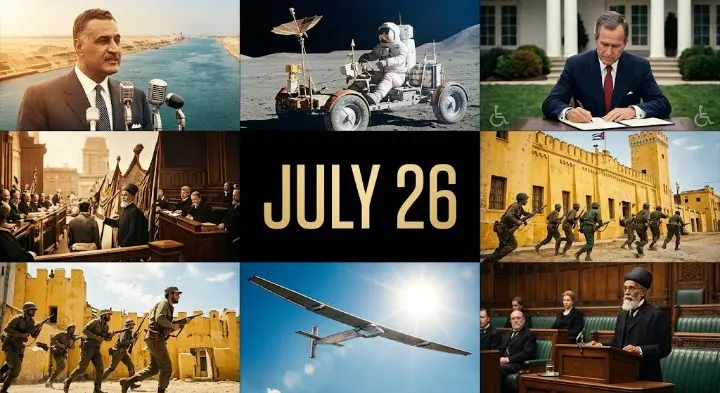
| Top 10 Key Events | Act of Abjuration declares Dutch independence (1581) • New York ratifies the U.S. Constitution (1788) • Liberia declares independence (1847) • Potsdam Declaration issued to Japan (1945) • Executive Order 9981 desegregates the U.S. military (1948) • Fidel Castro attacks the Moncada Barracks (1953) • Suez Canal nationalized by Egypt (1956) • Apollo 15 launches with the first Lunar Rover (1971) • Americans with Disabilities Act signed into law (1990) • Solar Impulse 2 completes solar-powered global flight (2016) |
| Key Battles That Day | Battle of Siffin (657), Battle of Pliska (811), Siege of Louisbourg (1758), Battle of Brunete (1937), Battle of the Samichon River (1953) |
| Key Figures Today | George Bernard Shaw, John Howard, Benjamin Franklin, Fidel Castro |
| Observances | Day of the National Rebellion (Cuba) Independence Day (Liberia) Kargil Victory Day (India) |
Story of the Day: The Night Egypt Took the Suez Canal
Cold War tension boiled over in Alexandria on July 26, 1956, when President Gamal Abdel Nasser delivered a fiery public address broadcast across the Middle East. Deep inside the speech, Nasser repeatedly dropped the name “Ferdinand de Lesseps”—the French diplomat who built the waterway—which acted as a pre-arranged signal for Egyptian military units to surround and occupy the canal’s headquarters. Enraged that the Western powers had suddenly pulled financial backing for the Aswan High Dam, Nasser chose to seize the French-and-British-owned shipping artery to fund the dam himself.
The surprise seizure sent shockwaves through London and Paris, sparking a military invasion months later alongside Israel. The resulting Suez Crisis permanently reshaped international relations, signaling the decline of European imperial influence and cementing Egypt’s status as a leader in the Arab world.
Important Events That Happened On July 26 In History
657 – First Fitna: The Battle of Siffin Begins
Troops loyal to Caliph Ali ibn Abi Talib clashed against the forces of Muawiyah I on the banks of the Euphrates River. Tensions over leadership of the rapidly expanding Islamic state brought thousands of soldiers face-to-face in a bitter struggle for unity. Negotiation attempts collapsed into heavy fighting that lasted for days without a decisive victor. The stalemate split the early Muslim community into lasting political factions, altering the religious and territorial landscape of the Middle East forever.
811 – Emperor Nikephoros I Falls at the Battle of Pliska
Byzantine Emperor Nikephoros I pursued the retreating Khan Krum deep into the rugged Balkan mountains, confident of a decisive victory over the Bulgars. Krum trapped the invading army inside a narrow wooden palisade and launched a devastating nighttime ambush. The emperor was killed in the chaos, while his heir Staurakios suffered a paralyzing wound that ended his reign within months. Khan Krum famously lined the fallen emperor’s skull with silver to use as a ceremonial drinking cup, securing Bulgar dominance in Eastern Europe.
920 – Muslims Defeat Christian Alliance at Valdejunquera
Abdurrahman III led the Umayyad Caliphate of Córdoba into a pitched battle against the combined Christian armies of King Sancho Garcés I of Navarre and King Ordoño II of León. The clash took place in the Valdejunquera valley, where Muslim cavalry shattered the Christian formations through coordinated tactical strikes. Both Christian monarchs fled the field, leaving their remaining commanders captured or slain. The victory reinforced Muslim control over the Iberian peninsula and checked Christian expansion attempts for decades.
1184 – The Erfurt Latrine Disaster Claims Dozens of Nobles
King Henry VI convened a royal council at the Church of St. Peter in Erfurt to settle a bitter land dispute between local aristocrats. The sheer weight of dozens of heavily armored nobles overwhelmed the wooden floorboards of the second-story hall, causing it to collapse without warning. The fall crashed through the floor below, dropping king’s guests directly into the massive liquid sewage pit beneath the church. Over sixty nobles drowned or suffocated before rescuers could pull them out, though King Henry survived by clinging to a stone window frame.
1309 – Pope Clement V Recognizes Henry VII
Henry VII secured official papal recognition as King of the Romans from Pope Clement V, elevating his authority across Central Europe. The announcement followed intense diplomatic maneuvers aimed at restoring order to the fractured territory of the Holy Roman Empire. This backing cleared the diplomatic path for Henry to march into Italy for a formal imperial coronation. His reign marked a brief resurgence of imperial influence in Italian affairs before his sudden death four years later.
1509 – Krishnadevaraya Ascends the Vijayanagara Throne
Krishnadevaraya took the throne as Emperor of Vijayanagara, stepping into power during a turbulent era of regional warfare in Southern India. He immediately launched military campaigns against neighboring sultanates, securing trade routes and expanding imperial borders. His reign sparked a golden age of literature, architecture, and economic growth across the peninsula. Today, his ascension marks the peak of one of India’s most powerful historical empires.
1529 – Francisco Pizarro Appointed Governor of Peru
Queen Isabel of Spain signed the Capitulación de Toledo, granting conquistador Francisco Pizarro official license to conquer and govern the territory of Peru. Pizarro had returned to the Spanish court with tales of massive gold wealth along the Pacific coast to win royal backing. The decree gave him absolute authority over newly claimed territories, effectively signing away the independence of the Inca Empire. Armed with royal authority, Pizarro launched the brutal expedition that brought down an Andean civilization.
1579 – Francis Drake Discovers New Pacific Harbor
English captain Francis Drake steered his battered ship, the Golden Hind, into an unfamiliar bay along the Pacific Northwest coast to perform urgent repairs. Seeking a safe haven after raiding Spanish ports, Drake and his exhausted crew interacted peacefully with local Native American tribes. He claimed the entire region for Queen Elizabeth I, naming it Nova Albion before setting sail across the Pacific. The exact anchorage remains debated, but the landing gave England its first territorial stake on the American west coast.
1581 – Northern Low Countries Sign the Act of Abjuration
Representatives from seven northern provinces of the Low Countries gathered in the Hague to declare official independence from King Philip II of Spain. The delegates issued the Plakkaat van Verlatinghe, arguing that a ruler who oppresses his subjects forfeits his right to rule them. This radical political move effectively created the Dutch Republic in the middle of a brutal independence war. The document set a historic precedent for anti-monarchical resistance that later influenced the American Declaration of Independence.
1703 – Tyrolean Peasants Defeat Bavarian Forces at Pontlatzer Bridge
Bavarian Prince-Elector Maximilian II Emanuel marched his army into North Tyrol, planning to link up with French troops and assault Vienna during the War of the Spanish Succession. Local Tyrolean peasants armed with hunting rifles, rocks, and improvised weapons ambushed the Bavarian column as it squeezed through the narrow Pontlatzer gorge. The militia inflicted heavy casualties from above, forcing the Prince-Elector into a rapid retreat. The sudden victory saved Austria from a two-front invasion and broke Bavarian momentum.
1745 – First Recorded Women’s Cricket Match Plays in England
Bramley and Hambledon faced off near Guildford, England, in the earliest documented women’s cricket match. Eleven young women on each side wore white dresses as they played before a crowd of local spectators. Bramley wore blue ribbons while Hambledon wore red to distinguish the two teams during the competitive play. The match proved popular enough to establish an ongoing tradition of organized women’s athletics across English towns.
1757 – French Forces Defeat Hanoverians at the Battle of Hastenbeck
Marshal d’Estrées directed French troops in a heavy assault against a smaller British-Hanoverian army under the Duke of Cumberland near the Weser River. The fighting turned chaotic in the dense woods, with both commanders temporarily believing they had lost the battle. Cumberland ordered a retreat, abandoning Hanoverian territory to French occupation during the Seven Years’ War. The victory forced King George II to sign a humiliating convention temporarily removing his German forces from the war.
1758 – British Capture Louisbourg in New France
British naval and land forces completed a grueling two-month siege of the massive French fortress at Louisbourg on Cape Breton Island. Royal Navy warships blockaded the harbor while redcoats battered the stone walls with heavy artillery until the garrison surrendered. The fall of the fortress stripped France of its naval defense at the entrance of the Saint Lawrence River. Winning the stronghold cleared the direct path for British forces to march on Quebec the following year.
1775 – Second Continental Congress Creates Post Office Department
Delegates meeting in Philadelphia voted to establish a centralized postal system for the thirteen colonies preparing for war against Britain. The congress unanimously selected Benjamin Franklin as the first Postmaster General, relying on his years of experience managing colonial mail routes. Franklin expanded mail routes, standardized rates, and set up reliable couriers to carry revolutionary dispatches safely. The network became a critical communication pipeline for military intelligence throughout the American Revolution.
1778 – Christian Emigration Begins from the Crimea
Thousands of Greek and Armenian families began leaving their ancestral villages in the Crimean Peninsula under the direction of Metropolitan Ignatius and Russian forces. The Russian Empire organized the massive relocation to populate newly acquired territories along the Sea of Azov while weakening the local Crimean Khanate. Emigrants packed their possessions onto wooden wagons and began a grueling overland journey toward New Russia. The migration reshaped the demographic structure of the northern Black Sea coast for generations.
1788 – New York Ratifies the United States Constitution
Delegates at the Poughkeepsie Convention voted 30 to 27 to approve the new United States Constitution, making New York the 11th state in the union. Alexander Hamilton fought through weeks of intense debate against Anti-Federalist delegates who feared a strong central government would strip local rights. The narrow victory ensured the new nation would not be geographically split in two, keeping Manhattan at the center of American finance and politics. New York City served as the young nation’s temporary capital shortly afterward.
1803 – Surrey Iron Railway Opens in London
Horses pulled heavy iron wagons along wooden and iron tracks as the Surrey Iron Railway officially opened for freight service in south London. Designed by engineer William Jessop, the line allowed industrial businesses to transport coal, building materials, and agricultural goods quickly between Wandsworth and Croydon. Unlike private canal tracks, the railway operated as a public toll road open to anyone paying the standard fee. It set the structural framework for the public railway systems that powered the Industrial Revolution.
1814 – The Swedish–Norwegian War Begins
Swedish military forces crossed the border into Norway to enforce the Treaty of Kiel, which transferred control of Norway from Denmark to Sweden. Norwegian troops resisted the invasion, having declared their own independent constitution just months earlier. King Charles John of Sweden launched coordinated naval landings and ground assaults to overwhelm the Norwegian defenses. The short war ended weeks later with a political compromise that preserved Norway’s constitution inside a personal union under the Swedish crown.
1822 – San Martín Meets Bolívar in Guayaquil
José de San Martín stepped off his ship in the tropical port of Guayaquil, Ecuador, to hold a confidential summit with Simón Bolívar. The two great liberators of South America locked themselves in private discussions to determine the fate of newly independent territories and the final push against Spanish forces. San Martín realized their visions for post-war government were fundamentally mismatched and agreed to step aside quietly. He resigned his military commands shortly after, leaving Bolívar in total control of the South American liberation movement.
1822 – Greek Forces Ambush Ottomans at Dervenakia
Theodoros Kolokotronis led Greek revolutionary forces into position along the narrow mountain passes of Dervenakia to intercept a massive Ottoman army under Mahmud Dramali Pasha. As the Ottoman cavalry squeezed through the rocky gorge, Greek fighters opened fire from the surrounding cliffs, trapping the troops below. The ambush turned into a rout, destroying the primary Ottoman strike force in the Peloponnese. The disaster crippled Ottoman efforts to crush the Greek War of Independence in its opening years.
1847 – Liberia Declares Independence from American Control
Americo-Liberian settlers gathered in Monrovia to sign a declaration of independence, severing formal ties with the American Colonization Society. The new republic drafted a constitution modeled directly on the United States, seeking international recognition as a sovereign African nation. France and Great Britain acknowledged the nation’s independence almost immediately, while the U.S. delayed official recognition until the American Civil War. The date remains Liberia’s premier national holiday celebrating self-governance.
1848 – University of Wisconsin–Madison Established
Governor Nelson Dewey signed the state legislation officially creating the University of Wisconsin in Madison. The board of regents held their first meeting weeks later, setting up initial classes in a temporary local schoolroom with a handful of students. The institution grew rapidly under the state’s land-grant system to become a major research powerhouse in upper Midwest academia. Its founding established higher education as a foundational priority for the newly formed state.
1861 – McClellan Assumes Command of Union Forces
General George B. McClellan arrived in Washington to take command of the Army of the Potomac following the humiliating Union defeat at the First Battle of Bull Run. McClellan found thousands of demoralized, untrained enlistees wandering the streets of the nation’s capital with minimal organization. He immediately instituted strict military discipline, rigorous drill schedules, and modern defensive earthworks around the city. His organizational talent transformed a scattered volunteer force into a formidable fighting machine, though his field caution later frustrated President Lincoln.
1863 – John Hunt Morgan Captured at Salineville
Union cavalry troops cornered Confederate raider John Hunt Morgan and his remaining men near Salineville, Ohio, ending a deep raid north of the Ohio River. Morgan had spent weeks striking Union supply lines, burning bridges, and spreading panic across Indiana and Ohio. Exhausted after days of relentless pursuit by federal units, Morgan surrendered his remaining cavalry officers in a farmhouse field. The capture ended the furthest northern penetration of Confederate land forces during the Civil War.
1882 – Wagner’s Final Opera Parsifal Premieres
Conductor Hermann Levi raised his baton at the Bayreuth Festspielhaus to premiere Richard Wagner’s final opera, Parsifal. Wagner composed the opera specifically for the acoustic environment of his private theater, drawing heavily on Arthurian holy grail legends. The performance fascinated European artistic circles, drawing composers, writers, and critics from across the continent to Germany. Wagner died less than a year after the opening, making Parsifal his dramatic musical farewell.
1882 – Stellaland Republic Founded in Southern Africa
Boer mercenaries established the Republic of Stellaland in territory seized from local Tswana tribes along the border of the Transvaal. The settlers drafted a constitution, selected a president, and declared their tiny border republic independent of European colonial administration. The strategic land strip sat directly across the main trade route running northward from the Cape Colony into central Africa. Cecil Rhodes later pressured the British Empire to annex the territory, dissolving the republic three years after its founding.
1887 – L. L. Zamenhof Publishes Unua Libro
Polish ophthalmologist L. L. Zamenhof published a booklet titled Unua Libro under the pseudonym “Dr. Esperanto,” introducing a constructed international language to the public. Zamenhof designed the simplified grammar and phonetic spelling to serve as an easily learned second language that could foster international peace. Copies of the pamphlet spread across Europe, creating reading circles, clubs, and translated literature almost overnight. His project launched the global Esperanto movement, which still retains thousands of fluent speakers today.
1890 – Park Revolution Breaks Out in Buenos Aires
Civic Union rebels seized the artillery park in Buenos Aires, launching an armed uprising against the corrupt administration of Argentine President Miguel Ángel Juárez Celman. Heavy artillery fire echoed through the capital streets for three days as rebel forces clashed directly with loyalist army units. Though military forces crushed the revolt on the ground, the political damage proved fatal to the government. President Juárez Celman lost his party support and resigned days later, clearing the path for national economic reforms.
1891 – France Formally Annexes Tahiti
French officials issued a decree extending full colonial sovereignty over Tahiti, converting the South Pacific island from a protectorate into an official territory. King Pōmare V was pressured into signing away his sovereign authority in exchange for a pension and nominal royal titles. The move expanded French colonial authority across French Polynesia, securing naval refueling stations across the Pacific trade routes. European settlement transformed local politics, society, and economics across the island chain.
1892 – Dadabhai Naoroji Elected First Indian MP in Britain
Liberal Party voters in Central Finsbury elected Dadabhai Naoroji to the British House of Commons by a narrow three-vote margin. Naoroji became the first Indian individual to sit in the British Parliament, using his position to expose the economic drain of colonial rule in India. His victory broke racial barriers in British politics and gave Indian independence advocates a direct voice inside the imperial capital. His political work laid early foundations for the Indian National Congress movement back home.
1897 – Pashtun Tribal Uprising Begins Siege of Malakand
Saidullah, a charismatic religious leader known as the “Mad Fakir,” led thousands of Pashtun tribesmen in a sudden assault on the British garrison at Malakand. The force surprised British outposts along the North-West Frontier of British India, surrounding the fortified garrison in heavy night battles. Winston Churchill served as a young officer and war correspondent during the brutal combat that followed. British relief columns spent days fighting through mountain passes to break the siege.
1899 – President Ulises Heureaux Assassinated in Moca
Dominican President Ulises Heureaux walked through the town of Moca when a group of political dissidents stepped out and shot him at point-blank range. Heureaux had ruled the country as an absolute dictator for years, running up massive foreign debts that bankrupted the national treasury. His sudden death triggered a period of severe political instability and military coups across the Caribbean nation. The economic collapse that followed led directly to foreign customs interventions years later.
1908 – FBI Precursor Agency Staffed Under Bonaparte
U.S. Attorney General Charles Joseph Bonaparte issued a formal order directing federal investigators to report directly to a newly created Chief Examiner office. Bonaparte created the special detective force within the Department of Justice to investigate land fraud, antitrust violations, and federal crimes without relying on secret service loans. The small team of thirty-four investigators grew steadily over the following decades into a national law enforcement network. The unit was later officially named the Federal Bureau of Investigation.
1918 – Emmy Noether Presents Breakthrough Theorem
Mathematician Emmy Noether presented her groundbreaking paper on symmetry and conservation laws before the Scientific Society in Göttingen, Germany. Her calculations demonstrated that every continuous symmetry in a physical system corresponds directly to a fundamental conservation law, such as energy or momentum. Theoretical physicists recognized her work as a core mathematical pillar underlying modern physics and quantum mechanics. Albert Einstein later described her as the most significant creative mathematical genius since higher education opened to women.
1936 – Germany and Italy Intervene in Spanish Civil War
Adolf Hitler and Benito Mussolini agreed to send immediate military aid to General Francisco Franco, backing the Nationalist revolt against the Spanish Republic. German transport planes began flying Franco’s African army troops across the Strait of Gibraltar, breaking an early Republican naval blockade. The decision transformed a localized military coup into a proxy conflict between European fascism and democracy. Spain became a testing ground for weapons, aircraft, and tactics used heavily in World War II.
1936 – Edward VIII Unveils Canadian Vimy Memorial
King Edward VIII removed the Canadian flag covering the massive limestone pylons of the Canadian National Vimy Memorial in France before a crowd of thousands. The monument honors over 60,000 Canadian soldiers killed in France during World War I, including thousands with no known grave. Standing atop Ridge 145, the king praised the unity and sacrifice of the troops who captured the strategic high ground in 1917. It marked one of Edward’s final official public duties before his abdication months later.
1937 – Nationalists Win the Battle of Brunete
Spanish Nationalist forces repelled a major Republican offensive west of Madrid, bringing the brutal three-week Battle of Brunete to a close. The Republican army had used tanks and aircraft to breach Nationalist lines, hoping to relieve pressure on the capital city. Heavy artillery counterattacks, combined with scorching summer heat, decimated frontline brigades on both sides with over 40,000 casualties. The Nationalist victory restored their siege line around Madrid and shattered Republican momentum.
1941 – British Forces Repel Italian Attack on Malta
Italian naval assault craft launched a surprise night raid against the strategic British naval base inside Grand Harbour, Malta. British coast artillery gunners on Fort St. Elmo spotted the incoming explosive motorboats and opened fire at point-blank range, destroying the entire attacking unit. The explosion of an Italian vessel collapsed the harbor’s iron footbridge, blocking the channel and trapping remaining forces. The failed raid cost Italy valuable special forces craft and left British naval defenses intact.
1941 – Allies Freeze Japanese Assets After Indochina Moves
President Franklin D. Roosevelt signed an executive order freezing all Japanese financial assets in the United States, with Great Britain and the Netherlands following suit. The economic embargo came in direct response to Japan’s military occupation of airfields in southern French Indochina. The policy cut off Japan from over 90 percent of its imported oil supply, paralyzing its military operations across East Asia. The economic pressure pushed the Japanese high command into planning a preventive military strike against Pearl Harbor.
1944 – Red Army Enters Lviv, Expelling German Troops
Soviet tanks and infantry pushed into the historic city of Lviv, driving out retreating Nazi forces after years of occupation. The Red Army uncovered catastrophic devastation across the city, finding that nearly the entire pre-war Jewish population of 160,000 had been murdered in camps or ghettos. Only 300 Jewish residents survived hidden in cellars and sewers until liberation arrived. The city was incorporated into the Ukrainian Soviet Socialist Republic shortly after the war ended.
1945 – Labour Landslide Removes Winston Churchill from Office
Election results revealed that Clement Attlee’s Labour Party achieved a landslide victory over Winston Churchill’s Conservative Party in the UK general election. British voters turned away from their wartime leader to favor Labour’s campaign promises of free national healthcare, expanded social welfare, and economic reconstruction. Churchill resigned as Prime Minister that afternoon, stunning foreign leaders mid-way through peace negotiations in Europe. Attlee flew out immediately to replace Churchill at the Allied summit table.
1945 – Potsdam Declaration Demands Japanese Surrender
Allied leaders issued the Potsdam Declaration from Germany, outlining explicit terms for the total surrender of the Empire of Japan. The document warned that refusal would bring “prompt and utter destruction” down upon the Japanese mainland through relentless military force. The statement demanded total demilitarization, democratic reforms, and the removal of warmongering leaders from imperial power. When Japan’s government chose to ignore the ultimatum, Allied forces authorized the use of atomic weapons weeks later.
1945 – Last Royal Navy Warship Sunk in WWII
Japanese kamikaze aircraft attacked the Royal Navy Pacific Fleet off the coast of Phuket, Thailand, striking the vessel HMS Vestal. The explosive impact caused severe fire and structural damage to the minesweeper, forcing the captain to order the crew to abandon ship. Escorting warships scuttled the burning vessel to prevent capture, making it the final Royal Navy ship lost to enemy action in World War II. The strike occurred just weeks before Japan agreed to total surrender terms.
1945 – USS Indianapolis Delivers Atomic Bomb Components
The heavy cruiser USS Indianapolis dropped anchor at the remote Pacific island of Tinian after a high-speed run from San Francisco. The ship carried secret cargo: enriched uranium and key internal components required to assemble the “Little Boy” atomic bomb. Naval officers unloaded the dangerous crates under armed guard and handed them to military technicians working on the island airfield. Days after completing its classified delivery, the ship was torpedoed by a Japanese submarine in one of the worst naval disasters in U.S. history.
1946 – Aloha Airlines Begins Hawaiian Flights
Aloha Airlines launched its passenger operations with a charter flight departing Honolulu International Airport using a single wooden-seat DC-3 aircraft. Founded to break the local transportation monopoly, the airline provided cheap inter-island travel for Hawaiian residents and post-war tourists. The regional carrier grew over decades into a major transportation system linking islands across the Hawaiian chain. Its launch transformed island tourism and business commuting across the Pacific territory.
1947 – Truman Signs the National Security Act
President Harry S. Truman signed the National Security Act into law aboard the presidential aircraft, fundamentally reorganizing the American military and intelligence apparatus. The legislation created the Central Intelligence Agency, the Department of Defense, the United States Air Force, and the National Security Council under a unified command structure. The massive overhaul adapted the federal government to meet the complex global intelligence demands of the emerging Cold War. It established the institutional architecture that guided American foreign policy for the next half-century.
1948 – Executive Order 9981 Desegregates U.S. Military
President Harry S. Truman issued Executive Order 9981, establishing equality of treatment and opportunity for all persons in the armed services regardless of race, color, or origin. Truman bypassed opposition from Southern politicians to strike down decades of rigid racial segregation inside military units. The order created a presidential committee to oversee integration across the Army, Navy, Air Force, and Marines. The military became one of the first major American institutions to formally outlaw racial segregation.
1951 – Disney’s Alice in Wonderland Premieres in London
Walt Disney’s animated feature film Alice in Wonderland held its world premiere at the Leicester Square Theatre in London. The film combined vibrant technicolor animation with Lewis Carroll’s eccentric literary characters, featuring voice performances by prominent British actors. Initial box office returns proved disappointing as critics argued the American studio altered the classical tone of the original book. The movie later gained massive popularity through re-releases and television broadcasts, turning into a classic of animated cinema.
1952 – King Farouk Abdicates Following Egyptian Coup
King Farouk boarded his royal yacht in Alexandria and sailed into exile after being forced to abdicate by the Free Officers Movement led by Gamal Abdel Nasser. The military coup stripped the monarchy of power following public anger over corruption, economic hardship, and military defeat in 1848. Farouk formally passed the royal crown to his infant son Fuad II, but power remained firmly held by the military council. Within a year, the army abolished the monarchy entirely and declared Egypt a republic.
1953 – Castro Launches Attack on Moncada Barracks
Fidel Castro led over one hundred armed rebels in a daylight assault against the Moncada Barracks in Santiago de Cuba, aiming to trigger an uprising against dictator Fulgencio Batista. Government troops alert at the perimeter gate opened fire, killing or capturing most of the poorly armed rebel force. Castro escaped into the mountains but was hunted down and put on trial, where he delivered his famous defense speech. The date gave its name to the 26th of July Movement, which eventually overthrew Batista six years later.
1953 – Short Creek Raid Targets Arizona Polygamists
Arizona state troopers and national guardsmen swept into the isolated community of Short Creek on the Utah border to enforce anti-polygamy laws. Governor John Howard Pyle ordered the raid, detaining dozens of men and taking over a hundred children into state custody. State officials framed the operation as a major law enforcement success against illegal marriages, but photos of crying families sparked public outrage. The political backlash destroyed Governor Pyle’s political career and halted mass government raids against polygamist groups.
1953 – Australian Diggers Repel Assault at The Hook
Soldiers from the 2nd Battalion, Royal Australian Regiment fought off heavy Chinese assaults against a strategic ridge position known as The Hook in Korea. Artillery shells rained down on the hill as Australian infantrymen held their trenches in hand-to-hand combat throughout the night. The defensive stand protected command positions overlooking the Samichon River valley during the final hours of the war. Negotiators signed the Korean Armistice Agreement at Panmunjom just hours after the fighting stopped on the hill.
1956 – Gamal Abdel Nasser Nationalizes the Suez Canal
Egyptian President Gamal Abdel Nasser announced the nationalization of the Suez Canal during a speech before thousands of cheering citizens in Alexandria. The decision stripped ownership from British and French shareholders to redirect canal transit tolls toward building the Aswan High Dam. Western nations condemned the move, resulting in a joint British, French, and Israeli military invasion of the Sinai Peninsula months later. The crisis cemented Nasser’s status as an anti-colonial icon while ending Britain’s imperial dominance in the region.
1957 – President Castillo Armas Assassinated in Guatemala
A presidential palace guard shot Guatemalan dictator Carlos Castillo Armas as he walked to dinner with his wife in Guatemala City. Castillo Armas had seized power three years earlier through a CIA-backed military coup that ousted democratically elected President Jacobo Árbenz. The assassin shot himself immediately after the attack, leaving investigators without a clear motive or named co-conspirators. The assassination plunged Guatemala into decades of political instability and military dictatorships.
1958 – NASA Launches Explorer 4 Satellite
An Jupiter-C rocket blasted off from Cape Canaveral, carrying the Explorer 4 satellite into Earth orbit to study space radiation. Designed by physicist James Van Allen, the satellite carried specialized Geiger counters to measure charged particles trapped in Earth’s magnetic field. The onboard instruments mapped the spatial intensity of the Van Allen radiation belts during its months in orbit. Data sent back by Explorer 4 provided vital safety information for planning future human spaceflight missions.
1963 – Syncom 2 Achieves First Geosynchronous Orbit
NASA launched Syncom 2 aboard a Delta B rocket, placing the world’s first active geosynchronous communications satellite into orbit. Built by Hughes Aircraft, the satellite orbited Earth at the exact speed of the planet’s rotation, remaining at a fixed longitudinal position over the Atlantic Ocean. The spacecraft successfully relayed voice, teletype, and test television signals between North America and Africa. The technology proved that satellite networks could provide continuous worldwide telecommunications coverage.
1963 – Devastating Earthquake Strikes Skopje
A magnitude 6.1 earthquake struck the city of Skopje, Yugoslavia, destroying over 80 percent of the city’s buildings in seconds. Over 1,100 people died under the rubble while more than 200,000 residents were left homeless without food or clean water. International relief aid poured into the country from both Eastern and Western Bloc nations, marking a rare moment of Cold War cooperation. Reconstruction efforts turned Skopje into a showcase city for modernist international architecture.
1963 – OECD Votes to Admit Japan
The Council of the Organisation for Economic Co-operation and Development voted unanimously to accept Japan as its newest member state. Japan became the first non-Western nation admitted to the organization, reflecting its rapid post-war industrial recovery and rising economic influence. Joining the group allowed Japanese economists to coordinate trade, development, and fiscal policies directly with Western industrial powers. The milestone marked Japan’s full reintegration into the global economic leadership circle.
1968 – South Vietnamese Dissident Sentenced to Hard Labor
A Saigon military court sentenced prominent South Vietnamese opposition politician Trương Đình Dzu to five years of hard labor. Dzu had finished second in the 1967 presidential election after running on a platform advocating peace negotiations with the Viet Cong to end the war. Government leaders charged him with illegal financial transactions and actions beneficial to the enemy to neutralize his political influence. His imprisonment drew heavy criticism from international human rights groups and anti-war activists.
1971 – Apollo 15 Launches First Lunar Rover Mission
A Saturn V rocket roared off Launch Complex 39A at Kennedy Space Center, carrying astronauts David Scott, Alfred Worden, and James Irwin toward the Moon. Apollo 15 represented the first extended scientific “J-Mission,” featuring advanced geological equipment and the first motorized Lunar Roving Vehicle. The rover allowed astronauts to travel miles away from their lander across the Hadley-Apennine mountain region. The mission gathered massive amounts of lunar rock samples, revolutionizing scientific understanding of lunar history.
1974 – Karamanlis Forms Democratic Government in Greece
Prime Minister Konstantinos Karamanlis announced his civil cabinet in Athens, restoring democratic rule after seven years of oppressive military junta governance. The military regime collapsed following a botched diplomatic attempt to annex Cyprus, which triggered a Turkish military intervention on the island. Citizens flooded into the streets to celebrate the end of political persecution, press censorship, and secret police surveillance. The peaceful transfer of power launched the Metapolitefsi period of modern Greek political history.
1977 – Quebec Imposes French Language Laws
The National Assembly of Quebec passed Bill 101, formally titled the Charter of the French Language, making French the official language of state administration, courts, and commercial business. The law mandated French signage across retail stores and restricted English-language instruction in public schools to preserve local Francophone culture. The policy sparked intense political debates across Canada, leading thousands of Anglophone residents and corporate headquarters to relocate to Toronto.
1989 – Robert Morris Indicted for First Computer Worm
A federal grand jury in New York indicted Cornell graduate student Robert Tappan Morris for releasing a self-replicating computer code across the ARPANET network. The “Morris Worm” infected thousands of university, military, and research computers, clogging systems and causing millions of dollars in mechanical disruptions. Prosecutors charged him under the newly passed 1986 Computer Fraud and Abuse Act, making him the first person criminally prosecuted under federal anti-hacking laws. His trial set early legal precedents for digital security and cybercrime enforcement.
1990 – President Bush Signs Americans with Disabilities Act
President George H. W. Bush signed the Americans with Disabilities Act into law before a crowd of thousands on the White House South Lawn. The landmark civil rights legislation banned discrimination against individuals with disabilities in employment, public transportation, telecommunications, and building access. Ramps, curb cuts, braille signage, and accessible restrooms became mandatory features of American public architecture. The law transformed daily life for tens of millions of Americans by guaranteeing equal physical access to public spaces.
1993 – Asiana Airlines Flight 733 Crashes in South Korea
A Boeing 737 carrying 116 passengers crashed into a ridge on Mount Ungeo during its third attempt to land at Mokpo Airport in heavy rain and wind. The impact killed 68 people on board, making it one of the deadliest aviation disasters in South Korean domestic flight history. Investigators determined pilot error and premature descent below safe radar altitude were the primary causes of the crash. The disaster led to major safety updates in Korean regional navigation systems and airport landing equipment.
1999 – Indian Army Declares Victory in Kargil War
The Indian Armed Forces announced the complete eviction of Pakistani troops and armed infiltrators from strategic mountain peaks around Kargil in Jammu and Kashmir. Indian infantry units fought for weeks in high-altitude terrain, retaking positions at Tiger Hill and Tololing under heavy artillery fire. The announcement marked the official end of the two-month conflict, which had raised global nuclear concerns between the neighboring nations. India commemorates the victory annually as Kargil Vijay Diwas.
2005 – Space Shuttle Discovery Returns NASA to Flight
Space Shuttle Discovery lifted off from Kennedy Space Center on mission STS-114, marking NASA’s first return to human spaceflight since the Columbia disaster two years prior. Astronauts tested new visual inspection techniques and heat-shield repair methods while docked at the International Space Station. A floating piece of foam insulation detached from the external tank during launch, raising immediate safety concerns inside mission control. The crew completed a safe landing weeks later, validating major safety modifications to the shuttle fleet.
2005 – Record Monsoons Trigger Devastating Mumbai Floods
A massive monsoon system dropped over 39 inches of rain on Mumbai within a 24-hour period, overwhelming the city’s ancient drainage infrastructure. Water levels rose to chest height across streets, trapping millions in train stations, cars, and flooded homes without electricity or phone service. The record rainfall triggered landslides and waterborne disease outbreaks that killed over 1,000 people across Maharashtra state. The disaster exposed severe urban infrastructure gaps, prompting major flood management overhauls.
2006 – Serial Bombings Strike Ahmedabad
A series of twenty-one synchronized bomb blasts detonated across crowded markets, bus lines, and hospitals in Ahmedabad, India, within a seventy-minute window. The coordinated terror attacks killed 56 people and injured over 200 others, targeting medical emergency wards where previous blast victims were arriving for care. Police investigations traced the explosives back to extremist networks using sophisticated timed detonators. Courts later convicted dozens of co-conspirators in one of India’s largest legal terror trials.
2009 – Boko Haram Attacks Police Station in Bauchi
Militants from the Islamist group Boko Haram launched an armed assault on a police station in Bauchi, Nigeria, sparking four days of widespread violence across multiple northern cities. Nigerian security forces responded with heavy military crackdowns, raiding the group’s compounds and killing hundreds of fighters, including leader Mohammed Yusuf. The violent crackdown radicalized the remaining movement, transforming Boko Haram from an isolated sect into a brutal regional insurgent force.
2011 – Royal Moroccan Air Force Plane Crashes near Guelmim
A military Lockheed C-130 Hercules transport aircraft crashed into a mountain while attempting to land at Guelmim Airport in bad weather. The crash killed all 80 passengers and crew members on board, including soldiers and their traveling family members. Search teams recovered the wreckage scattered across the rocky terrain, citing heavy fog and poor visibility as primary contributing factors. It remains one of the deadliest aviation disasters in Morocco’s history.
2016 – Sagamihara Care Home Stabbings Shock Japan
A former employee broke into a residential care facility for disabled individuals in Sagamihara, Japan, carrying out a knife attack that left 19 residents dead and 26 injured. The attacker surrendered to police shortly after, confessing to a hate crime driven by extreme eugenic beliefs against disabled people. The tragedy shocked a nation known for extremely low violent crime rates, raising urgent questions about security and social care protocols. It stands as one of the worst mass killings in modern Japanese history.
2016 – Hillary Clinton Secures Major Party Nomination
Delegates at the Democratic National Convention in Philadelphia officially cast their votes to make Hillary Clinton the presidential nominee of the Democratic Party. Her nomination marked the first time a major political party selected a woman to lead its national presidential ticket in United States history. She addressed the convention crowd, emphasizing political unity after a competitive primary season against Senator Bernie Sanders. The historic nomination capped a decades-long career in public service as First Lady, Senator, and Secretary of State.
2016 – Solar Impulse 2 Completes Solar Flight Around the Globe
Pilot Bertrand Piccard landed Solar Impulse 2 in Abu Dhabi, completing the first round-the-world flight powered entirely by solar energy. The experimental aircraft covered over 25,000 miles without using a drop of liquid fuel, relying on thousands of solar cells mounted on its massive wings. The voyage demonstrated the real-world potential of clean energy technologies during long-distance endurance travel. The ground team celebrated the flight as a major milestone for sustainable aviation technology.
Take another look at the past: access our archives here.
Famous People Born on July 26
| Name | Description | Date |
|---|---|---|
| Stanislaus of Szczepanów | Polish bishop and Catholic saint | 1030 – 1079 |
| Joseph I | Holy Roman Emperor | 1678 – 1711 |
| George Clinton | 4th Vice President of the United States | 1739 – 1812 |
| John Field | Irish composer who pioneered the nocturne | 1782 – 1837 |
| Alfred Marshall | Influential English economist | 1842 – 1924 |
| George Bernard Shaw | Irish playwright and Nobel Prize winner | 1856 – 1950 |
| Carl Jung | Swiss psychiatrist and founder of analytical psychology | 1875 – 1961 |
| Antonio Machado | Renowned Spanish poet | 1875 – 1939 |
| Jesse Livermore | Legendary American stock trader | 1877 – 1940 |
| Aldous Huxley | English novelist and philosopher | 1894 – 1963 |
| James Lovelock | English scientist and creator of the Gaia hypothesis | 1919 – 2022 |
| Blake Edwards | American film director (The Pink Panther) | 1922 – 2010 |
| Jason Robards | Academy Award-winning American actor | 1922 – 2000 |
| Joseph Engelberger | American engineer known as the “Father of Robotics” | 1925 – 2015 |
| Francesco Cossiga | 8th President of Italy | 1928 – 2010 |
| Ibn-e-Safi | Pakistani-Indian novelist and creator of iconic detective fiction | 1928 – 1980 |
| Stanley Kubrick | Influential American film director | 1928 – 1999 |
| John Howard | 25th Prime Minister of Australia | 1939 – Present |
| Mick Jagger | English singer and co-founder of The Rolling Stones | 1943 – Present |
| Helen Mirren | Academy Award-winning English actress | 1945 – Present |
| Roger Taylor | Drummer of the rock band Queen | 1949 – Present |
| Asif Ali Zardari | 11th President of Pakistan | 1955 – Present |
| Kevin Spacey | American Academy Award-winning actor | 1959 – Present |
| Sandra Bullock | Academy Award-winning American actress | 1964 – Present |
| Jason Statham | English action film actor | 1967 – Present |
| Kate Beckinsale | English actress | 1973 – Present |
| Liz Truss | Former Prime Minister of the United Kingdom | 1975 – Present |
| Jacinda Ardern | 40th Prime Minister of New Zealand | 1980 – Present |
| Taylor Momsen | American singer, songwriter, and actress | 1993 – Present |
| Thomasin McKenzie | New Zealand actress | 2000 – Present |
Famous People Who Died on July 26
| Name | Description | Date |
|---|---|---|
| Paul II | Pope of the Catholic Church | 1417 – 1471 |
| Atahualpa | Last emperor of the Inca Empire | c.1500 – 1533 |
| John Wilmot | English poet and courtier | 1647 – 1680 |
| Elena Cornaro Piscopia | First woman to receive a doctorate | 1646 – 1684 |
| Sam Houston | American military leader and statesman | 1793 – 1863 |
| Otto of Greece | First modern King of Greece | 1815 – 1867 |
| James Murray | Chief editor of the Oxford English Dictionary | 1837 – 1915 |
| Gottlob Frege | German mathematician and founder of modern logic | 1848 – 1925 |
| William Jennings Bryan | American politician and Secretary of State | 1860 – 1925 |
| Robert Todd Lincoln | Son of Abraham Lincoln and U.S. Secretary of War | 1843 – 1926 |
| Fred Duesenberg | Co-founder of the Duesenberg automobile company | 1876 – 1932 |
| Winsor McCay | Pioneer of comic strips and animation | 1871 – 1934 |
| Henri Lebesgue | French mathematician known for Lebesgue integration | 1875 – 1941 |
| Eva Perón | First Lady of Argentina and political icon | 1919 – 1952 |
| Diane Arbus | Influential American photographer | 1923 – 1971 |
| George Gallup | Founder of the Gallup Poll | 1901 – 1984 |
| Ed Gein | American serial killer whose crimes inspired horror fiction | 1906 – 1984 |
| Fazlur Rahman Malik | Pakistani Islamic scholar and philosopher | 1919 – 1988 |
| Mary Wells | American soul singer | 1943 – 1992 |
| Matthew Ridgway | American general and Korean War commander | 1895 – 1993 |
| George W. Romney | American businessman and Governor of Michigan | 1907 – 1995 |
| John Tukey | American mathematician and statistician | 1915 – 2000 |
| William A. Mitchell | American food chemist and inventor | 1911 – 2004 |
| Merce Cunningham | American choreographer and dance innovator | 1919 – 2009 |
| Lupe Ontiveros | American actress | 1942 – 2012 |
| Ann Rule | American true crime author | 1931 – 2015 |
| Olivia de Havilland | Academy Award-winning actress | 1916 – 2020 |
| Joey Jordison | Drummer and co-founder of Slipknot | 1975 – 2021 |
| Sinéad O’Connor | Irish singer-songwriter | 1966 – 2023 |
| Tom Lehrer | American singer, satirist, and mathematician | 1928 – 2025 |
Observances on July 26
- Day of the National Rebellion (Cuba): Commemorates Fidel Castro’s 1953 attack on the Moncada Barracks, recognized as the official spark of the Cuban Revolution.
- Independence Day (Liberia): Honors the 1847 signing of the Liberian Declaration of Independence, severing governance ties with the American Colonization Society.
- Independence Day (Maldives): Celebrates the island nation achieving full political independence from the British Empire in 1965.
- Kargil Victory Day / Kargil Vijay Diwas (India): Remembers the sacrifices of Indian military personnel who successfully retook strategic border peaks in 1999.
- Esperanto Day: Marks the 1887 publication of Unua Libro by L. L. Zamenhof, honoring the global auxiliary language movement.
- Emancipation Day (Barbados): Commemorates the abolition of slavery across the island territory and honors ancestral freedom fighters.
🚢 Frequently Asked Questions — July 26 in History
Egyptian President Gamal Abdel Nasser nationalized the Suez Canal during a speech in Alexandria, seizing control of the vital trade route from British and French shareholders. The sudden move triggered the Suez Crisis, leading to a joint military invasion by Britain, France, and Israel later that year.
The Indian military officially announced victory in the 1999 Kargil Conflict on July 26 after retaking high-altitude positions from mountain infiltrators. Additionally, Fidel Castro launched his famous attack on the Moncada Barracks on this date in 1953, initiating the Cuban Revolution.
George Bernard Shaw, Irish playwright and Nobel Prize winner, was born on July 26, 1856. John Howard, the 25th Prime Minister of Australia, was also born on July 26, in the year 1939. Other notable figures share this birthday across art, politics, and science.
Gamal Abdel Nasser’s nationalization of the Suez Canal in 1956 stands out as the most far-reaching event on this date. The move reshaped Middle Eastern geopolitics, accelerated the collapse of European colonial empires, and altered global shipping dynamics overnight.
The Day of the National Rebellion is a Cuban national holiday honoring the armed assault on the Moncada Barracks in 1953. Although the tactical attack failed, Fidel Castro used the movement to rally public support against dictator Fulgencio Batista, eventually transforming Cuban politics.
Solar Impulse 2 completed its historical circumnavigation of the globe on July 26, 2016, proving a solar-powered plane could fly around the world. On the same day, Hillary Clinton became the first female presidential nominee for a major U.S. political party.