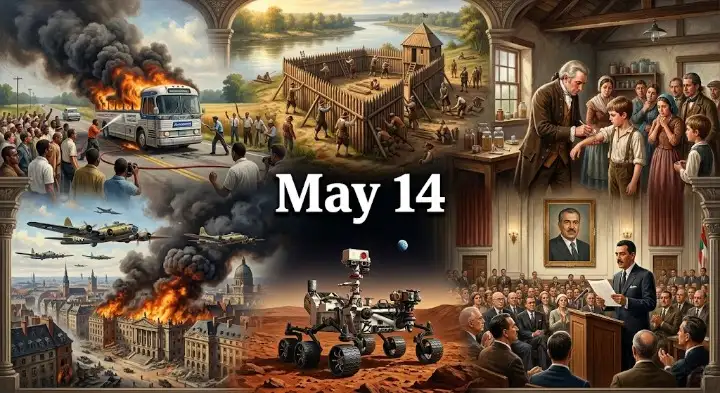
On the morning of May 14, 1607, just over 100 English adventurers stepped onto the marshy shores of Virginia to build a wooden fort. They named it Jamestown, anchoring the first lasting British presence in North America. This day in history May 14 has frequently reset the coordinates of global human civilization. Centuries later on this very same date, David Ben-Gurion stood under a portrait of Theodor Herzl in Tel Aviv to read a declaration that built a modern nation out of the ashes of World War II. From pioneering medicine to the clashing of empires, here is the breakdown of what happened on May 14 in history.
👶 Quick Facts — May 14 in History
| 📌 Category | 📖 Event / Detail |
|---|---|
| 🌟 Most Significant Event | Foundation of Jamestown (1607) / Declaration of the State of Israel (1948) |
| 🏆 Top 10 Key Events |
• Siege of Nicaea (1097) • Battle of Lewes (1264) • Jamestown Founded (1607) • Assassination of Henry IV (1610) • Jenner’s Smallpox Vaccine (1796) • Lewis and Clark Expedition Departs (1804) • Blitz of Rotterdam (1940) • Birth of Israel (1948) • Warsaw Pact Signed (1955) • Freedom Riders Bus Firebombed (1961) |
| ⚔️ Key Battles | Siege of Nicaea, Battle of Lewes, Siege of Krujë, Battle of Agnadello, First Battle of Cape Finisterre, Battle of Stillman’s Run, Battle of Jackson, Battle of Utsunomiya Castle |
| 👤 Key Figures | Captain John Smith, Edward Jenner, Meriwether Lewis, David Ben-Gurion |
| 🌍 Observances | Independence Day (Paraguay), National Unification Day (Liberia), Hastings Banda’s Birthday (Malawi), Izumo-taisha Shrine Grand Festival (Japan) |
Story of the Day: Edward Jenner Conquers Smallpox
Eight-year-old James Phipps stood shivering in a Gloucestershire clinic on May 14, 1796, as country doctor Edward Jenner sliced two shallow cuts into his arm. Jenner carefully rubbed pus harvested from a milkmaid’s fresh cowpox sores into the open scratches. It was a terrifying medical gamble based on local folklore that milkmaids never caught the deadly, disfiguring smallpox virus. Jenner’s radical experiment worked perfectly, rendering the young boy completely immune. By deliberately introducing a mild, animal-borne disease to shield a human from a killer plague, Jenner engineered the world’s very first vaccination. His brilliant breakthrough fundamentally altered human survival, kickstarting a global scientific crusade that eventually wiped smallpox off the face of the Earth entirely.
Important Events That Happened On May 14 In History
1027 – Coronation of Henry I
King Robert II of France gathered his court to crown his young son, Henry I, as junior King of the Franks. This strategic move aimed to secure a smooth royal succession and block rival claims before the reigning monarch passed away. The early coronation sparked an immediate, bitter civil war as Henry’s own mother launched a fierce rebellion to back her younger son instead. Henry eventually retained his throne, setting a powerful precedent for hereditary rule that stabilized the early Capetian dynasty.
1097 – Siege of Nicaea Begins
Thousands of European Crusaders arrived outside the massive, heavily fortified walls of Seljuk-controlled Nicaea. This aggressive encirclement marked the very first major combined military operation of the historic First Crusade. Christian armies completely isolated the garrison by land, blocking vital supply corridors and cutting off incoming Turkish relief forces. The city ultimately surrendered weeks later to the Byzantine Empire, providing the Crusader coalition with a strategic gateway into Asia Minor.
1264 – Battle of Lewes
Rebel baron Simon de Montfort led a charging army down the Sussex downs to ambush King Henry III. The royalist forces crumbled under the fierce assault, forcing the English monarch to surrender and sign the restrictive Mise of Lewes. This humiliating treaty stripped the crown of absolute authority, transforming the captive King into a mere figurehead. Montfort seized total control of the realm, immediately summoning England’s very first representative parliament to include ordinary citizens.
1450 – First Siege of Krujë Begins
Sultan Murad II led an overwhelming Ottoman host to surround the mountain fortress of Albanian rebel leader Skanderbeg. The invading troops unleashed a devastating artillery barrage, determined to crush local resistance and expand Islamic rule deeper into Europe. Skanderbeg’s outnumbered garrison held firm against the massive onslaught, utilizing daring nighttime guerilla raids to butcher Ottoman supply lines. The humiliating defense forced the broken Ottoman army to retreat months later, turning Albania into a heroic buffer zone.
1465 – Moroccan Revolution Hits Fez
Angry crowds surged through the streets of Fez, launching a violent attack against the Jewish mellah quarter during a massive anti-government uprising. The local population revolted fiercely against the ruling Marinid dynasty, targeting a Jewish vizier who held enormous political influence over the crown. The chaotic assault completely destabilized the ancient capital, resulting in a brutal massacre that wiped out the existing royal administration. A new leadership emerged from the bloodshed, ending centuries of Marinid governance over Morocco.
1509 – Battle of Agnadello
French heavy cavalry smashed into the rear lines of the Venetian army in the mud of northern Italy. This crushing engagement pitted the forces of King Louis XII against the overextended troops of the Republic of Venice. The sudden rout decimated Venice’s elite mercenary infantry, causing entire mercenary columns to abandon the battlefield in total panic. The catastrophic defeat instantly shattered Venice’s land empire, forcing the Republic to surrender vast Italian territories to European rivals.
1607 – Jamestown Settlement Established
Three English ships anchored along the James River as over 100 colonists stepped ashore to erect a fortified wooden outpost. These desperate adventurers established “James Fort,” creating the earliest permanent English settlement in the Americas. Disease, starvation, and harsh winter freezes brought the fragile colony to the brink of total extinction within months. The settlement barely survived, introducing a lasting British legal, linguistic, and cultural blueprint to the North American continent.
1608 – Protestant Union Founded
Prince Christian of Anhalt organized a defensive coalition of German states to counter the expanding power of the Catholic Church. This strategic alliance sought to secure the territory, religious freedom, and physical safety of vulnerable Protestant principalities. The bold pact deep-seated a bitter political divide across central Europe, prompting Catholics to form their own competing league. These rigid opposing alliances created a dangerous powder keg that eventually exploded into the catastrophic Thirty Years’ War.
1610 – Assassination of King Henry IV
Catholic fanatic François Ravaillac lunged into the royal carriage in Paris, plunging a dagger into King Henry IV. The assassin targeted the monarch over his progressive religious tolerance policies toward French Protestants. The sudden murder triggered immense panic throughout the kingdom, cutting short a reign focused on domestic peace and economic rebuilding. Nine-year-old Louis XIII immediately ascended the throne under a regency, changing the course of French absolutism.
1747 – First Battle of Cape Finisterre
Admiral George Anson led a formidable British fleet to intercept a heavily guarded French convoy off the coast of Spain. The Royal Navy executed an aggressive chase, completely overwhelming the French warships tasked with protecting vital colonial transport ships. British sailors captured dozens of enemy vessels, seizing immense wealth and cutting off crucial supplies headed to French forces overseas. This decisive naval victory established absolute British dominance over the Atlantic shipping lanes during the war.
1796 – First Smallpox Inoculation
Doctor Edward Jenner transferred live cowpox matter from a milkmaid’s hand into the arm of young James Phipps. This daring experiment aimed to see if a mild infection could provide immunity against the lethal smallpox plague. The young patient developed a brief fever but remained completely safe when exposed to the deadly virus later. Jenner’s revolutionary method laid the foundation for modern immunology, saving hundreds of millions of human lives worldwide.
1800 – US Government Begins Washington Move
The 6th United States Congress officially recessed its final session in the bustling, temporary capital city of Philadelphia. This legislative adjournment initiated a massive logistics operation to relocate federal records, furniture, and personnel down south. Workers loaded government documents onto cargo boats to establish a new permanent federal capital in Washington, D.C. The historic move shifted the nation’s political gravity to a custom-built capital along the Potomac River.
1804 – Lewis and Clark Expedition Departs
William Clark and a crew of 42 rugged frontiersmen steered their heavily laden boats away from Camp Dubois. The explorers traveled up the muddy Missouri River to join Meriwether Lewis for an unprecedented overland trek to the Pacific Ocean. This perilous military expedition faced unmapped terrain, treacherous river currents, and unknown indigenous nations. The journey successfully mapped the vast American West, opening up a massive continent for rapid westward expansion.
1811 – Paraguayan Revolution Begins
Patriot leaders Pedro Juan Caballero and Fulgencio Yegros mobilized armed men in the streets of Asunción to depose the Spanish governor. The revolutionaries surrounded the government house, demanding an immediate surrender of colonial authority without any bloodshed. Spanish officials yielded to the intense pressure, ending centuries of direct imperial rule over the region. This swift midnight uprising secured Paraguay’s path to independent nationhood as a sovereign South American republic.
1832 – Battle of Stillman’s Run
A panicked militia force opened fire on a small group of Native American emissaries bearing a white flag of truce. Chief Black Hawk’s hidden warriors immediately retaliated, launching a ferocious counter-charge that sent the disorganized American troops fleeing in terror. This chaotic rout marked the bloody opening engagement of the brief Black Hawk War in Illinois. The skirmish escalated racial tensions on the frontier, leading to a brutal military campaign against regional tribes.
1836 – Treaties of Velasco Signed
Captured Mexican President Antonio López de Santa Anna signed two peace agreements after his stunning defeat at San Jacinto. The documents ordered all Mexican military forces to retreat south beyond the Rio Grande river line. Texas officials kept the second treaty strictly secret, trading Santa Anna’s life for a promise of official recognition. Mexico later repudiated the agreements, sparking decades of bitter border hostilities that culminated in the Mexican-American War.
1842 – Illustrated London News Debuts
Publisher Herbert Ingram released the very first edition of the world’s premier illustrated weekly news magazine. The groundbreaking publication featured vivid woodcut engravings alongside traditional text articles, capturing sensational scenes of a recent fire in Hamburg. Readers snapped up thousands of copies, fascinated by the ability to visually see global news events. This publishing triumph revolutionized journalism, shifting the media industry toward modern visual storytelling.
1857 – Mindon Min Crowned in Burma
King Mindon Min assumed the throne during a traditional Buddhist coronation ceremony inside the royal capital of Mandalay. The new monarch inherited a fractured kingdom deeply scarred by recent territorial losses to British imperial forces. Mindon dedicated his reign to sweeping administrative reforms, economic modernization, and hosting the Fifth Buddhist Council to stabilize his realm. His rule preserved Burmese sovereignty for decades before ultimate British annexation took place.
1863 – Battle of Jackson
Union General Ulysses S. Grant launched a sweeping assault to drive Confederate forces out of the strategic capital of Mississippi. Federal troops overwhelmed the outer defensive lines, forcing Confederate General Joseph E. Johnston into a hasty northern retreat. Union soldiers systematically disabled the city’s vital rail network and burned down key manufacturing facilities. The decisive victory cut off the fortress city of Vicksburg from outside reinforcement, sealing its ultimate doom.
1868 – Battle of Utsunomiya Castle Ends
Imperial Japanese forces stormed the fortified walls of Utsunomiya, forcing the remaining Tokugawa shogunate loyalists to withdraw northward. This fierce clash formed a key part of the Boshin War, a conflict aimed at restoring direct political power to the Emperor. The heavy artillery fire left the historic castle town in ruins, breaking the back of local shogunate resistance. The imperial victory secured control over central Japan, accelerating the modernization of the Meiji Restoration.
1870 – First Rugby Game in New Zealand
Players from Nelson College squared off against the Nelson Rugby Football Club in front of 200 enthusiastic spectators. Charles Monro introduced the fast-paced, direct sport to the colony after learning the rules while schooling in England. The match featured 18 players on each side, navigating a chaotic blend of soccer and traditional English schoolyard rules. This historic match sparked a nationwide passion, laying the groundwork for rugby to become New Zealand’s core national identity.
1878 – Last US Witchcraft Trial Begins
Lucretia Brown walked into a Salem, Massachusetts courtroom to formally accuse Daniel Spofford of causing her physical harm using hypnotic mental powers. Brown was a devout follower of Christian Science, believing malicious thoughts could manifest as real bodily injuries. The presiding judge dismissed the sensational case out of hand, ruling the court had no jurisdiction over unprovable spiritual forces. This bizarre legal battle closed the long, dark chapter of witchcraft trials within American jurisprudence.
1879 – Indian Laborers Arrive in Fiji
The transport ship Leonidas dropped anchor off the coast of Ovalau, carrying 463 indentured laborers from India. British colonial authorities imported these workers under harsh contracts to cultivate Fiji’s rapidly expanding sugar cane plantations. The laborers endured brutal working conditions, low wages, and total isolation from their homeland for decades. This initial migration altered the ethnic makeup of the islands, deep-seating a vibrant Indo-Fijian culture.
1900 – Paris Olympic Games Open
Organizers opened the World Amateur Championships as part of the massive, sprawling Paris Exposition Universelle. The athletic competitions stretched across five months, completely lacking unified opening ceremonies or standard stadium facilities. Many competing athletes remained entirely unaware they were participating in the official second modern Olympic Games. Despite the chaotic management, these games marked the historic debut of female athletes on the international stage.
1913 – Rockefeller Foundation Chartered
New York Governor William Sulzer signed the official charter to establish the philanthropic Rockefeller Foundation. Oil tycoon John D. Rockefeller launched the charitable organization with an unprecedented initial endowment of $100 million. The foundation focused its immense financial resources on public health, medical training, and scientific research worldwide. This historic act transformed modern philanthropy, funding the global eradication of hookworm and pioneering yellow fever vaccines.
1915 – May 14 Revolt in Portugal
Armed democratic partisans and mutinous naval crews launched a bloody coup in Lisbon to overthrow the military dictatorship of Pimenta de Castro. The rebels bombarded government offices from warships anchored in the Tagus River, sparking fierce street fighting across the capital. The violent uprising successfully restored the democratic Portuguese constitution, causing hundreds of casualties before the junta surrendered. This chaotic revolt marked a volatile turning point in Portugal’s unstable First Republic.
1918 – Two-Minute Silence Inaugurated
Cape Town Mayor Sir Harry Hands officially instituted a daily two-minute pause to honor soldiers dying on Western Front battlefields. A signaling gun fired from Signal Hill at noon, bringing all civilian traffic, business transactions, and conversations to an absolute halt. One minute focused on silent, somber remembrance, while the second minute served as an earnest prayer for the living. This powerful ritual spread rapidly across the British Empire, becoming the standard global template for Veterans Day.
1925 – Mrs Dalloway Published
Author Virginia Woolf released her landmark modernist novel through the independent Hogarth Press in London. The intricate narrative tracks a single day in the post-war life of high-society protagonist Clarissa Dalloway. Woolf utilized a revolutionary stream-of-consciousness writing style to capture the hidden internal psychological landscapes of her characters. The book cemented her reputation as a literary pioneer, capturing the deep trauma and alienation of lost-generation Europe.
1931 – Ådalen Shootings in Sweden
Swedish military units opened fire on a peaceful march of striking industrial workers in the logging district of Ådalen. The nervous troops unleashed live ammunition into the crowded demonstration, killing five unarmed civilians and wounding several others. The shocking bloodshed triggered massive national outrage, forcing a total overhaul of Swedish labor dispute laws. This tragedy permanently banned the military from policing domestic labor strikes, paving the way for the modern Swedish welfare state.
1935 – Philippine Constitution Ratified
Hundreds of thousands of Filipino citizens cast their ballots in a historic national referendum to overwhelmingly approve a new constitution. The document established the Commonwealth of the Philippines, creating a structured ten-year transition period toward total sovereignty from the United States. Manuel Quezon assumed leadership of the semi-autonomous government, preparing national institutions for future self-governance. This popular vote marked a monumental step toward ending decades of direct American colonial administration.
1939 – Lina Medina Becomes Youngest Mother
Medical doctors in Lima, Peru, delivered a healthy baby boy via cesarean section from a five-year-old girl named Lina Medina. Examination revealed that an ultra-rare genetic condition called precocious puberty had caused her reproductive organs to mature completely during infancy. Local authorities arrested the girl’s father on suspicion of abuse, but were forced to release him due to a total lack of forensic evidence. Medina’s case remains a baffling anomaly within modern medical science.
1940 – Blitz of Rotterdam
German Luftwaffe bombers dropped tonnes of incendiary explosives onto the historic center of Rotterdam despite ongoing surrender negotiations. The devastating aerial assault killed 900 civilians, reduced ancient neighborhoods to smoking rubble, and left 80,000 residents completely homeless. The horrific destruction forced the Dutch military command to capitulate immediately to prevent similar attacks on other cities. This brutal raid shocked the international community, signaling Nazi Germany’s total commitment to unrestricted total warfare.
1943 – Sinking of the AHS Centaur
A submerged Japanese submarine launched a torpedo into the clearly marked Australian Hospital Ship Centaur off Queensland. The vessel went down within three minutes, trapping hundreds of sleeping medical personnel, wounded soldiers, and ship crew below deck. Only 64 survivors managed to escape the rapid vortex, spending hours drifting in shark-infested waters before rescue arrived. The illegal attack outraged the Australian public, becoming a potent symbol of wartime atrocities in the Pacific.
1948 – Israel Declares Independence
Jewish leader David Ben-Gurion stood inside the Tel Aviv Museum to read the official declaration establishing a sovereign Jewish state. The announcement fulfilled a long-held Zionist dream, occurring mere hours before the official expiration of the British Mandate. Armies from neighboring Arab nations immediately crossed the frontiers, triggering the bloody 1948 Arab-Israeli War. This historic declaration fundamentally remade the geopolitics of the Middle East, sparking decades of regional conflict.
1951 – Talyllyn Railway Reopens
A group of passionate volunteers operated a steam train along the narrow-gauge tracks of the Talyllyn Railway in Wales. This historic run marked the very first time a defunct commercial railway was rescued and managed entirely by preservation enthusiasts. The successful venture proved that historic transportation networks could survive through community volunteerism rather than state funding. This tiny Welsh line sparked a massive, global movement dedicated to preserving industrial heritage.
1953 – Milwaukee Brewery Strike Begins
More than 7,000 union workers walked off their jobs at major brewing icons including Miller, Pabst, and Blatz. The industrial dispute halted beer production across the city, centering on bitter disagreements over mandatory overtime, wage increases, and reduced weekly shifts. The intense walkout lasted 76 days, paralyzing local economies and creating severe regional beverage shortages. The strike ultimately ended with significant union victories, establishing high labor standards across the American brewing industry.
1955 – Warsaw Pact Signed
Soviet Premier Nikita Khrushchev gathered leaders from seven Eastern European communist states to sign a unified mutual defense treaty. This military alliance bound the Soviet Union, Poland, East Germany, and others into a single command structure to counter Western influence. The pact formalized the rigid geopolitical division of Europe, serving as a direct counterweight to the North Atlantic Treaty Organization (NATO). This agreement solidified the iron curtain, intensifying the nuclear standoff of the Cold War.
1961 – Freedom Riders Bus Firebombed
An angry white mob surrounded a civil rights Freedom Riders bus outside Anniston, Alabama, slashing its tires before smashing windows. The attackers hurled a kinetic firebomb into the vehicle, trapping the integrated activists inside as thick smoke filled the interior. The riders burst through the emergency exits only to face brutal physical beatings from the waiting crowd outside. Images of the burning bus shocked the American public, forcing federal intervention to desegregate interstate travel.
1970 – Baader-Meinhof Group Forms
Radical leftist Ulrike Meinhof led an armed raid to break anarchist leader Andreas Baader out of police custody in Berlin. The violent escape resulted in a shootout that left a regular library employee critically wounded by gunfire. This daring jailbreak served as the official operational debut of the Red Army Faction, a militant Marxist guerrilla cell. The group embarked on a decade-long campaign of bombings, assassinations, and high-profile bank robberies across West Germany.
1973 – Skylab Launched
An uncrewed Saturn V rocket roared off the launchpad at Cape Canaveral, carrying Skylab into low Earth orbit. The launch represented America’s very first dedicated space station, built to study long-duration human spaceflight and solar physics. The massive outpost suffered severe structural damage during its ascent, losing a vital meteoroid shield and solar array panel. Astronaut crews later repaired the damaged station, living aboard for months to conduct historic scientific research.
1977 – Dan-Air Cargo Crash
A leased Boeing 707 cargo aircraft suffered a catastrophic structural failure while descending toward Lusaka International Airport in Zambia. The entire right horizontal stabilizer split away from the fuselage, sending the airplane plunging nose-first into the ground. All six occupants aboard perished instantly in the violent impact and ensuing explosion. The tragedy prompted aviation authorities to mandate urgent structural inspections on older Boeing airframes worldwide to prevent similar fatigue failures.
1980 – Sumpul River Massacre
Salvadoran military units coordinated with Honduran border guards to trap fleeing civilians along the banks of the Sumpul River. Soldiers opened fire on the trapped crowd, slaughtering over 600 unarmed peasants who were trying to escape the civil war. Both governments covered up the atrocity for years, claiming the deaths resulted from a regular military engagement with leftist guerrillas. The horrific massacre marked a grim escalation in state-sponsored violence against rural communities in El Salvador.
1887 – First Fijian Coup d’État
Lieutenant Colonel Sitiveni Rabuka marched armed soldiers into parliament to depose newly elected Fijian Prime Minister Timoci Bavadra. Rabuka launched the military takeover to strip Indo-Fijian politicians of power and restore absolute political dominance to ethnic Fijians. The sudden coup shattered the island nation’s democratic institutions, triggering widespread racial tensions and severe economic instability. The military intervention prompted Fiji to declare itself a republic, temporarily severing ties with the British Crown.
1988 – Carrollton Bus Collision
A heavily intoxicated driver steered his pickup truck the wrong way down Interstate 71 in Kentucky, smashing head-on into a church youth bus. The high-speed impact ruptured the converted school bus’s fuel tank, sparking a raging fire that quickly engulfed the interior. Twenty-seven people died in the inferno, mostly children trapped in the narrow rear exit aisle. This horrific tragedy prompted strict national safety standards for school bus fuel tanks and sparked tougher drunk driving laws.
2004 – Roh Moo-hyun Impeachment Overturned
The Constitutional Court of South Korea voted decisively to dismiss all impeachment charges against President Roh Moo-hyun. Parliament had previously voted to suspend the leader over allegations of minor election law violations and economic mismanagement. The court ruled that the political infractions were far too minor to justify stripping a democratically elected leader of office. Roh immediately resumed full executive powers, triggering massive public celebrations among his reformist supporters.
2004 – Royal Wedding in Denmark
Crown Prince Frederik of Denmark stood at the altar of Copenhagen Cathedral to marry Australian commoner Mary Donaldson. Thousands of citizens lined the streets of the capital, waving Danish and Australian flags to celebrate the high-profile union. The fairytale wedding captured intense global media attention, transforming the former marketing executive into a popular European crown princess. The marriage modernized the public image of Europe’s oldest continuous monarchy.
2004 – Rico Flight 4815 Crashes in Amazon
A twin-engine regional airliner encountered severe weather while descending toward Manaus, Brazil, plunging directly into the dense Amazon rainforest. The high-impact crash tore the aircraft apart, instantly killing all 33 passengers and crew members on board. Rescue teams cut through thick jungle canopy for days to reach the remote, swampy crash site. Investigators later blamed the tragedy on pilot spatial disorientation during a night approach in heavy tropical rainstorms.
2008 – Battle of Piccadilly Gardens
Riot police clashed with thousands of furious Rangers football fans in the city center of Manchester, England. The violence erupted when a giant outdoor screen broadcast system failed right before the UEFA Cup Final match kicked off. Frustrated supporters hurled bottles, metal barriers, and bricks at officers, resulting in 39 injuries and dozens of immediate arrests. The chaotic street battle caused extensive property damage, forcing a total overhaul of big-screen sporting events across the UK.
2010 – Space Shuttle Atlantis Launches
The Space Shuttle Atlantis blasted off on mission STS-132, roaring into orbit to deliver a critical Russian research module to the ISS. Astronauts successfully installed the Rassvet compartment during a series of complex spacewalks. The launch was scheduled to be the grand finale for Atlantis before NASA managers extended the program for one final flight. The flawless mission added vital infrastructure to the space station, ensuring long-term international scientific cooperation.
2012 – Agni Air Flight CHT Crashes
A Dornier 228 passenger plane carrying global tourists slammed into a steep mountain ledge near Jomsom Airport in Nepal. The pilots were attempting a difficult go-around maneuver after encountering severe high-altitude winds during their initial approach. The violent impact killed 15 people on board, including both pilots, while miraculously sparing six survivors from the wreckage. The tragedy highlighted the extreme dangers of operating commercial flights within the unpredictable microclimates of the Himalayas.
2021 – China Lands Zhurong on Mars
The Chinese space agency successfully guided its automated Tianwen-1 lander through the thin Martian atmosphere to touch down on Utopia Planitia. The landing deployed the Zhurong rover, making China the second nation to operate a robotic vehicle on the surface of Mars. The solar-powered rover began scanning the soil for underground ice deposits and ancient signs of microbial life. This milestone established China as a major independent superpower in modern interplanetary exploration.
2022 – Buffalo Supermarket Shooting
A heavily armed white supremacist walked into a crowded supermarket in a Black neighborhood of Buffalo, New York, opening fire on shoppers. The gunman wore tactical gear and livestreamed the entire racially motivated assault on the internet, killing ten innocent civilians. The horrific tragedy shocked the nation, sparking intense debate over domestic terrorism laws and online radicalization. The community rallied around the victims, creating permanent memorials to honor those targeted by hate.
Keep the timeline turning—see yesterday’s facts here.
Famous People Born On May 14
| Name | Description | Date |
|---|---|---|
| Charles IV | Holy Roman emperor (1355–78), king of Bohemia | May 14, 1316 – November 29, 1378 |
| Victor Amadeus II | First king of Sardinia-Piedmont, Savoyard ruler | May 14, 1666 – October 31, 1732 |
| Robert Owen | Welsh utopian socialist and social reformer | May 14, 1771 – November 17, 1858 |
| Jules-Armand, prince de Polignac | French ultraroyalist statesman | May 14, 1780 – March 2, 1847 |
| George Barrington | Irish adventurer and pickpocket | May 14, 1755 – December 27, 1804 |
| Sir Squire Bancroft | English actor and theatrical manager | May 14, 1841 – April 19, 1926 |
| Pieter Cort van der Linden | Dutch Liberal statesman, prime minister (1913–18) | May 14, 1846 – July 15, 1935 |
| Albert Robida | French illustrator, science fiction pioneer | May 14, 1848 – October 11, 1926 |
| Alton B. Parker | American jurist, Democratic presidential nominee (1904) | May 14, 1852 – May 10, 1926 |
| Sir Hall Caine | British popular novelist | May 14, 1853 – August 31, 1931 |
| Wilhelm Steinitz | Austrian-American chess world champion (1866–94) | May 14, 1836 – August 12, 1900 |
| Adam Cleghorn Welch | Scottish biblical scholar | May 14, 1864 – February 19, 1943 |
| Kurt Eisner | German socialist, led Bavarian Revolution (1918) | May 14, 1867 – February 21, 1919 |
| Bruce Rogers | American typographer and book designer | May 14, 1870 – May 18, 1957 |
| Mikhail Semyonovich Tsvet | Russian botanist, invented chromatography | May 14, 1872 – June 26, 1919 |
| José Santos Chocano | Peruvian poet, Latin American epic singer | May 14, 1875 – December 13, 1934 |
| Julian Eltinge | American vaudeville female impersonator | May 14, 1883 – March 7, 1941 |
| Claudius Dornier | German aircraft designer | May 14, 1884 – December 5, 1969 |
| Cecil Edgar Tilley | British mineralogist | May 14, 1894 – January 24, 1973 |
| Al White | American diver, first to win both platform and springboard Olympic gold | May 14, 1895 – July 8, 1982 |
| Sidney Bechet | American jazz soprano saxophonist | May 14, 1897 – May 14, 1959 |
| Robert Finch | American-born Canadian poet | May 14, 1900 – June 11, 1995 |
| Antonio Berni | Argentine social realist painter | May 14, 1905 – October 13, 1981 |
| Maekawa Kunio | Japanese modernist architect | May 14, 1905 – June 27, 1986 |
| Franjo Tudjman | First president of independent Croatia (1991–99) | May 14, 1922 – December 10, 1999 |
| Mrinal Sen | Indian filmmaker, parallel cinema pioneer | May 14, 1923 – December 30, 2018 |
| Maria Irene Fornés | Cuban-born American dramatist | May 14, 1930 – October 30, 2018 |
| Zoltán Huszárik | Hungarian filmmaker, Szindbád (1971) | May 14, 1931 – October 15, 1981 |
| Richard Kostelanetz | American avant-garde writer and critic | May 14, 1940 – Present |
| Cate Blanchett | Australian actress, two-time Oscar winner | May 14, 1969 – Present |
Famous People Died On May 14
| Name | Description | Date |
|---|---|---|
| Laelius Socinus | Italian anti-Trinitarian theologian | March 25, 1525 – May 14, 1562 |
| Nikolaus von Amsdorf | German Protestant Reformer, Luther supporter | December 3, 1483 – May 14, 1565 |
| Charles II | Duke of Lorraine (1545–1608) | February 18, 1543 – May 14, 1608 |
| Georg Ernst Stahl | German chemist, phlogiston theory | October 21, 1660 – May 14, 1734 |
| Richard Cantillon | Irish economist, early economic treatise | Unknown – May 14, 1734 |
| Louis-Auguste de Bourbon, duke du Maine | Illegitimate son of Louis XIV | March 31, 1670 – May 14, 1736 |
| St. Mother Théodore Guérin | Franco-American nun, founded schools in Indiana | October 2, 1798 – May 14, 1856 |
| Joseph Sturge | English philanthropist, antislavery leader | August 2, 1793 – May 14, 1859 |
| Ōkubo Toshimichi | Japanese statesman, Meiji Restoration leader | September 26, 1830 – May 14, 1878 |
| Mahmud Nedim Paşa | Ottoman grand vizier (1871–72, 1875–76) | c.1818 – May 14, 1883 |
| William B. Woods | Associate justice of U.S. Supreme Court (1880–87) | August 3, 1824 – May 14, 1887 |
| Samuel Hirsch | German-American Reform rabbi and philosopher | June 8, 1815 – May 14, 1889 |
| Ernst Eduard Kummer | German mathematician, ideal numbers | January 29, 1810 – May 14, 1893 |
| Thomas Valpy French | First Anglican bishop of Lahore | January 1, 1825 – May 14, 1891 |
| Carl Schurz | German-American politician and reformer | March 2, 1829 – May 14, 1906 |
| Frederick VIII | King of Denmark (1906–12) | June 3, 1843 – May 14, 1912 |
| August Strindberg | Swedish playwright and novelist | January 22, 1849 – May 14, 1912 |
| Henry John Heinz | American food manufacturer, Heinz Company | October 11, 1844 – May 14, 1919 |
| Ronald Montagu Burrows | British archaeologist of Pylos | August 16, 1867 – May 14, 1920 |
| Enrico Barone | Italian mathematical economist | December 22, 1859 – May 14, 1924 |
| Sir H. Rider Haggard | English novelist, King Solomon’s Mines | June 22, 1856 – May 14, 1925 |
| Władysław Orkan | Polish poet of Tatra Mountains | November 27, 1875 – May 14, 1930 |
| David Belasco | American theatrical producer and playwright | July 25, 1853 – May 14, 1931 |
| Charles Homer Haskins | American medievalist historian | December 21, 1870 – May 14, 1937 |
| Edgar du Perron | Dutch writer and critic, Forum co-founder | November 2, 1899 – May 14, 1940 |
| Menno ter Braak | Dutch critic, “conscience of Dutch literature” | January 26, 1902 – May 14, 1940 |
| Sir John Martin Harvey | English actor and theatre manager | June 22, 1863 – May 14, 1944 |
| Yasuo Kuniyoshi | Japanese-born American painter | September 1, 1889 – May 14, 1953 |
| Heinz Guderian | German general, blitzkrieg pioneer | June 17, 1888 – May 14, 1954 |
| Sidney Bechet | American jazz soprano saxophonist | May 14, 1897 – May 14, 1959 |
Observances on May 14
Independence Day (Paraguay)
Paraguayans celebrate the anniversary of their 1811 bloodless revolution against Spanish colonial authorities. Families mark the national holiday with vibrant street parades, traditional folk music performances, and large barbecues featuring native yerba mate tea.
National Unification Day (Liberia)
This public holiday honors the historic political integration of Liberia’s indigenous tribes with the descendants of Americo-Liberian settlers. Communities host national cultural dances, sports matches, and school pageants to promote lasting ethnic harmony.
Hastings Banda’s Birthday (Malawi)
Malawi remembers the birth of its founding president and “Kamuzu” (the Liberator) who led the nation to independence from British colonial rule. Citizens mark the day with official wreath-laying ceremonies, historical lectures, and reflective church services.
Izumo-taisha Shrine Grand Festival (Japan)
Shinto priests launch the opening day of the annual grand festival at one of Japan’s oldest and most sacred shrines. Devotees gather to witness ancient ritual dances, sacred musical offerings, and formal prayers aimed at securing good fortune and relationship harmony.
📅 Frequently Asked Questions — May 14 in History
David Ben-Gurion read the official declaration of independence inside the Tel Aviv Museum, establishing the modern State of Israel. This historic announcement occurred mere hours before the official expiration of the British Mandate over Palestine. Within a single day, neighboring Arab armies advanced across the borders, triggering the first Arab-Israeli War.
The foundation of Jamestown in 1607 stands out because it established the earliest permanent English presence in North America. This tiny wooden fort introduced the English language, legal customs, and agricultural systems that eventually evolved into the United States. Its survival altered the demographic and geopolitical landscape of the entire western hemisphere.
George Lucas, the visionary American filmmaker who created the multi-billion-dollar Star Wars and Indiana Jones cinematic franchises, was born on this day in 1944. His pioneering work in special effects, sound design, and independent production transformed Hollywood storytelling. His mythic space opera permanently altered global pop culture and modern blockbuster merchandising.
German Luftwaffe bombers executed the devastating Blitz of Rotterdam in 1940, reducing the historic heart of the Dutch city to smoking rubble. The aerial bombardment killed 900 civilians and forced the immediate surrender of the Netherlands military forces. This brutal attack signaled Nazi Germany’s total commitment to unrestricted total warfare against civilian centers.
This holiday remembers the swift, bloodless midnight coup of 1811 when local patriots forced the Spanish governor to surrender control. The peaceful revolution successfully ended centuries of direct Spanish imperial domination without a war. It secured Paraguay’s path to independent nationhood, making it one of the earliest South American republics to claim total sovereignty.
China successfully landed its automated Zhurong rover on the surface of Mars within the Utopia Planitia region in 2021. This space milestone made China only the second country in human history to successfully deploy a robotic vehicle on the red planet. The rover spent months transmitting valuable radar data regarding underground ice structures.