Quick Facts — July 31 in History
| Category | Detail |
|---|---|
| Most Significant Event | The Battle of Passchendaele begins in West Flanders, Belgium (1917) |
| Top Key Events |
|
| Key Battles | Battle of Cravant (1423), Battle of Bloody Run (1763), Battle of Hsimucheng (1904), Battle of Passchendaele (1917), Battle of Smolensk (1941) |
| Key Figures | Christopher Columbus, Daniel Defoe, General Reinhard Heydrich, Michael Phelps |
| Observances | Lā Hae Hawaiʻi Day (Hawaii), Warriors’ Day (Malaysia), Martyrdom Day of Shahid Udham Singh (India), Treasury Day (Poland) |
Story of the Day: The Mud and Blood of Passchendaele Begins
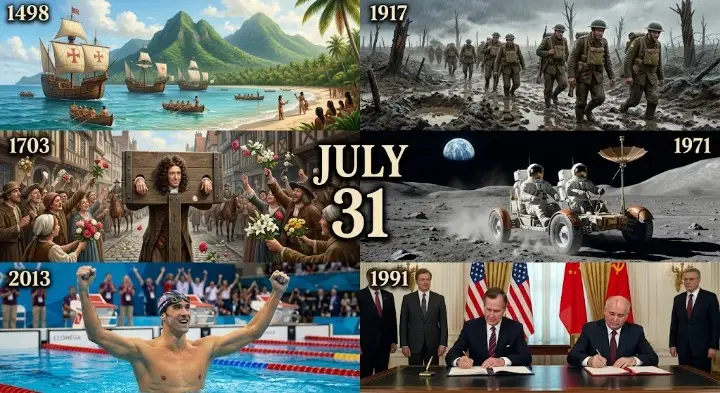
Heavy rain turned the artillery-churned fields of West Flanders into a sea of liquid mud on July 31, 1917. British and Allied forces launched a massive offensive near Ypres, aiming to break through German lines and seize critical submarine bases along the Belgian coast. Shell craters filled with water, creating dangerous traps for soldiers carrying heavy equipment under relentless machine-gun fire. What was meant to be a swift breakthrough turned into a nightmare lasting over three months. By the time the village fell, over half a million men had lost their lives for a few miles of ground.
Important Events That Happened On July 31 In History
398 – End of the Gildonic Rebellion
Gildo, a rebel Berber prince turned Roman commander, faced total defeat in North Africa when his forces fell to his own brother Mascezel. Western Roman Emperor Honorius had dispatched the loyalist troops to reclaim critical grain shipments bound for Rome. Cornered and abandoned by his followers, Gildo died shortly after the battlefield route. The victory secured the empire’s immediate food supply for another season.
432 – Election of Pope Sixtus III
Church leaders in Rome gathered to elect Pope Sixtus III four days after the death of his predecessor, Pope Celestine I. His papacy brought massive construction projects across the city, including the restoration of Santa Maria Maggiore. He worked tirelessly to reconcile deep theological divisions between the Eastern and Western factions of early Christianity. His leadership stabilized the Western Church during a turbulent era of imperial decline.
768 – Antipope Constantine II Arrested
Primicerius Christopher led a combined force of Roman officials and Lombard soldiers directly into Rome to seize Antipope Constantine II. The military faction had illegally installed Constantine a year earlier despite his lay status. His captors stripped him of his clerical robes and imprisoned him inside a local monastery. The dramatic raid restored the authority of the traditional Church hierarchy in Rome.
781 – Mount Fuji’s Oldest Recorded Eruption
Ash drifted across central Japan as Mount Fuji erupted in the earliest documented volcanic event in the nation’s history. Imperial court scribes recorded the explosion during the first year of the Ten’o era. Local villagers watched the snow-capped peak spew fire and gray clouds into the sky. The event cemented the mountain’s legendary status as a powerful, living spirit in Japanese culture.
1009 – Pope Sergius IV Ascends the Papal Throne
Pietro Martino Boccadeporci was consecrated as Pope Sergius IV, taking the reins of a papacy heavily controlled by Roman nobility. He succeeded Pope John XVIII during a period of intense political corruption in the Holy See. Despite his weak political position, he earned a reputation for organizing local famine relief. His papal bull calling for the liberation of the Holy Sepulchre foreshadowed the Crusades.
1201 – John Komnenos the Fat Attempts a Coup
John Komnenos stormed the Great Palace of Constantinople in a bid to overthrow Byzantine Emperor Alexios III Angelos. Supported by an angry mob, the obese nobleman briefly sat on the imperial throne. Palace guards quickly rallied under the emperor’s son-in-law and captured the usurper overnight. By morning, the rebellion was crushed, and John’s head was put on public display.
1423 – Battle of Cravant
Anglo-Burgundian forces confronted a Franco-Scottish army along the banks of the Yonne River in Burgundy. The French troops tried to block an enemy relief column from reaching a besieged local town. English archers rained arrows across the river narrows, breaking the Scottish ranks in a bloody frontal assault. The Anglo-Burgundians won a decisive victory, capturing senior commanders and securing the regional territory.
1451 – King Charles VII Arrests Jacques Cœur
Royal officers arrested Jacques Cœur, the wealthiest merchant in France, under direct orders from King Charles VII. Cœur had financed the king’s military campaigns against England, but his rising power made royal advisors envious. Prosecutors fabricated absurd charges against him, including allegations of poisoning the king’s mistress. The crown seized his massive fortune, showing the cold reality of royal debt cancellation.
1492 – Alhambra Decree Takes Full Effect
Thousands of Jewish families packed their possessions and fled Spain as the final deadline of the Alhambra Decree expired. King Ferdinand and Queen Isabella had ordered the total expulsion of all unbaptized Jews earlier that spring. Those who refused to convert to Catholicism left behind properties, businesses, and centuries of heritage. The mass exodus permanently altered the cultural landscape of the Mediterranean basin.
1498 – Christopher Columbus Lands on Trinidad
Christopher Columbus spotted three prominent mountain peaks rising from an island horizon while sailing on his third Atlantic journey. He named the land Trinidad in honor of the Holy Trinity and sent crew members ashore to search for fresh water. The landing brought European forces into direct contact with the indigenous Arawak populations. It expanded the Spanish Empire’s claims deep into the southern Caribbean.
1618 – Maurice of Orange Disbands Utrecht Militia
Maurice, Prince of Orange, marched troops into Utrecht and forced the local mercenary militia to lay down their arms. The military action targeted the political power of his rival, Johan van Oldenbarnevelt, amid intense religious conflicts. Maurice dismantled the town council and replaced it with loyal Calvinist supporters. The bold move gave the Prince total dominance over the Dutch Republic.
1655 – Russian Troops Occupy Vilnius
Tsar Alexis’s armies swept into Vilnius, the capital of the Grand Duchy of Lithuania, during the Russo-Polish War. Russian forces plundered the city, burning major historic neighborhoods and massacring thousands of local residents. The occupying army held the ruined metropolis under strict military control for six long years. The fall of Vilnius signaled a massive power shift across Eastern Europe.
1658 – Aurangzeb Takes the Mughal Throne
Aurangzeb declared himself the sixth Mughal emperor of India after defeating his brothers in a brutal war of succession. He imprisoned his ailing father, Shah Jahan, inside the fort at Agra to prevent any challenge to his rule. The newly crowned emperor launched aggressive military campaigns to expand his borders across the subcontinent. His reign pushed the Mughal Empire to its greatest territorial extent.
1667 – Treaty of Breda Ends Second Anglo-Dutch War
English and Dutch diplomats signed the Treaty of Breda, reshaping colonial borders across North America and the Caribbean. England officially gained control of the strategic settlement of New Amsterdam, renaming it New York. In return, the Dutch retained the sugar-rich territory of Suriname and the spice island of Run. The agreement ended years of fierce naval battles in the North Sea.
1703 – Daniel Defoe Placed in the Pillory
Author Daniel Defoe stood in a public pillory in London after being convicted of seditious libel for writing a political satire. Authorities intended to humiliate the writer before a hostile mob. Instead, sympathetic crowds threw flowers at his feet and drank to his health while reciting his poetry aloud. What was meant as a public punishment turned into a triumphant celebration of free speech.
1715 – Spanish Treasure Fleet Sinks Off Florida
Eleven Spanish treasure ships sank off the east coast of Florida after sailing directly into a hurricane. Loaded with silver, gold, and jewels from the Americas, the fleet was battered by high waves and driven into sharp reefs. Over a thousand sailors perished, and tons of precious cargo washed into the ocean sand. The lost wrecks became legendary targets for modern deep-sea salvage operations.
1741 – Charles Albert Invades Upper Austria
Charles Albert, the Elector of Bavaria, marched his troops into Upper Austria and Bohemia during the War of the Austrian Succession. Backed by French allies, he sought to challenge Maria Theresa’s rightful claim to the Habsburg lands. The military invasion destabilized Central Europe and sparked years of intense territorial warfare. Charles briefly secured his election as Holy Roman Emperor before losing his own home territory.
1763 – Battle of Bloody Run
Ottawa Chief Pontiac led native warriors in a surprise night ambush against British troops near Fort Detroit. Captain James Dalyell had led a column of soldiers out to destroy Pontiac’s camp, but walked straight into a trap at a narrow bridge. Native fighters opened fire from surrounding brush, killing Dalyell and twenty of his men. The stream ran red with blood, giving the engagement its lasting name.
1777 – Marquis de Lafayette Commissioned as Major-General
The Second Continental Congress appointed nineteen-year-old French nobleman Gilbert du Motier, Marquis de Lafayette, to the rank of Major-General. Motivated by idealist views of liberty, Lafayette had traveled to America at his own personal expense to fight British rule. His aristocratic background and military enthusiasm quickly impressed General George Washington. His arrival helped cement the vital military alliance between the United States and France.
1790 – First U.S. Patent Issued
Samuel Hopkins of Philadelphia received the very first United States patent for a new chemical process to manufacture potash. President George Washington personally signed the official document after review by the cabinet. Potash was an essential ingredient used in glassmaking, soap production, and fertilizer production across the young republic. The milestone marked the birth of America’s formal intellectual property system.
1856 – Christchurch Officially Chartered
Christchurch was formally chartered as a city, making it the oldest established city in New Zealand. European settlers had systematically built the township around a central cathedral and square inspired by English ideals. The new civic charter provided formal administrative governance to the rapidly growing agricultural hub. It transformed the remote plains settlement into a major South Island center.
1865 – World’s First Narrow-Gauge Mainline Opens
Queensland Railways opened the world’s first narrow-gauge mainline railway at Grandchester, Australia. Engineers chose the narrower track width to drastically cut construction costs across rugged, mountainous terrain. The steam train successfully carried passengers and freight through rugged wilderness that standard railways could not reach cheaply. The model proved narrow-gauge lines could run long-distance rail operations efficiently.
1874 – Patrick Francis Healy Takes Office
Patrick Francis Healy was formally inaugurated as president of Georgetown University in Washington, D.C. Born into slavery in Georgia, he passed as white throughout his academic career to overcome institutional racism. He modernized the university’s curriculum, oversaw major building expansions, and established its law school. He became the first African-American president of a predominantly white American university.
1904 – Battle of Hsimucheng
Imperial Japanese forces attacked entrenched Russian defensive positions near Hsimucheng during the Russo-Japanese War. Japanese infantry advanced across difficult mountain terrain despite heavy artillery fire from Russian lines. Outmaneuvered, the Russian troops were forced to abandon their fortified positions and retreat north. The strategic victory cleared the path for Japan’s army to press deeper into Manchuria.
1917 – Battle of Passchendaele Begins
Allied forces launched a massive artillery bombardment near Ypres, Belgium, signaling the start of the Third Battle of Ypres. Torrential rainfall quickly converted the heavy clay soil into a swamp of deep mud and shell holes. British, Canadian, and Australian troops struggled forward against reinforced German pillboxes under terrifying conditions. The bloody battle became a defining symbol of World War I trench warfare.
1932 – Nazi Party Wins German Elections
The National Socialist German Workers’ Party won over 38 percent of the vote in the German federal election. Led by Adolf Hitler, the party became the largest political faction in the Reichstag by exploiting deep economic misery. The triumph effectively shattered the political stability of the fragile Weimar Republic. It set the stage for Hitler’s ultimate appointment as Chancellor early the following year.
1938 – Bulgaria Signs Balkan Non-Aggression Pact
Bulgaria signed a historic non-aggression agreement with Greece, Turkey, Romania, and Yugoslavia in Salonika. The treaty revoked restrictive military clauses imposed on Bulgaria after its defeat in World War I. European leaders hoped the pact would secure stability across the Balkan region as tensions rose across Europe. However, the fragile peace dissolved when major world powers dragged the region into war.
1938 – Darius the Great Gold Plates Discovered
Archaeologists working in Persepolis uncovered engraved gold and silver foundation plates hidden inside a stone box. King Darius the Great had placed the trilingual inscriptions there around 500 BCE to mark the boundaries of the Persian Empire. The ancient artifacts were found preserved in pristine condition after remaining buried for over two millennia. They provided invaluable historical proof regarding the empire’s vast administrative reach.
1941 – Göring Orders the “Final Solution”
Senior Nazi official Hermann Göring sent a written directive to SS General Reinhard Heydrich regarding Jewish populations across Europe. Göring ordered Heydrich to submit a comprehensive plan for administrative and financial measures needed to carry out the “Final Solution.” The formal memo escalated systematic anti-Semitic persecution into state-sponsored mass murder. It laid the bureaucratic foundation for the systematic horrors of the Holocaust.
1941 – Battle of Smolensk Ends
German military forces concluded the Battle of Smolensk after encircling massive pockets of Soviet troops. The Wehrmacht captured approximately 300,000 Soviet Red Army soldiers along with thousands of tanks and artillery pieces. Despite heavy Soviet losses, fierce resistance delayed the German army’s planned drive toward Moscow by several crucial weeks. That delay ultimately exposed German forces to the brutal Russian winter.
1945 – Pierre Laval Surrenders
Pierre Laval, the former Prime Minister of the puppet Vichy France government, surrendered to Allied forces in Austria. Laval had fled westward after the liberation of France to escape charges of high treason and collaboration with Nazi occupiers. Allied commanders quickly turned him over to the restored French government to stand trial. His arrest marked a reckoning for those who assisted the Nazi regime.
1948 – New York International Airport Dedicated
President Harry S. Truman spoke before a massive crowd to dedicate New York International Airport at Idlewild Field. Built on a vast marshland, the facility was designed to handle the post-war boom in commercial aviation. The state-of-the-art air hub quickly replaced older airfields as the primary international gateway to the United States. It was later renamed John F. Kennedy International Airport in 1963.
1948 – USS Nevada Sunk in Target Practice
The battle-scarred battleship USS Nevada was towed into deep Pacific waters and sunk by an aerial torpedo. The vessel had survived the surprise attack on Pearl Harbor and weathered two nuclear bomb explosions during post-war tests at Bikini Atoll. Unwilling to scrap the legendary ship, the Navy used it for target practice by three warships before launching the final aerial drop.
1964 – Ranger 7 Transmits Moon Photos
NASA’s unmanned Ranger 7 probe snapped and transmitted the first close-up photographs of the lunar surface before impacting the Moon. The detailed images were over a thousand times clearer than anything captured by earth-based telescopes. Scientists analyzed the pictures to confirm that the lunar soil could safely support a landing craft. The successful mission cleared a massive hurdle for the upcoming Apollo human landings.
1966 – Disappearance of the MV Darlwyne
The pleasure cruiser MV Darlwyne vanished off the rugged coast of Cornwall during a sea trip from Fowey to Mevagissey. The wooden boat was carrying 31 passengers and crew, including twelve children, when bad weather swept through the area. No distress call was sent, and an extensive search turned up only minor debris from the vessel. The mysterious tragedy prompted major overhauls of commercial boat safety regulations across Britain.
1970 – Royal Navy Black Tot Day
British sailors gathered on warship decks to receive their final official rum ration, ending a tradition dating back to 1655. Known across the fleet as “Black Tot Day,” sailors wore black armbands and held mock funerals for the beloved daily ritual. Admiralty leadership abolished the practice due to concerns about crew safety around advanced machinery and weapons systems.
1971 – First Lunar Rover Ride
Apollo 15 astronauts David Scott and James Irwin became the first humans to drive a motorized vehicle on the Moon. The Lunar Roving Vehicle allowed the crew to travel miles away from their landing module across the Hadley-Apennine region. The electric rover let the astronauts collect rare geological samples from deep lunar valleys. The mission transformed lunar exploration by vastly expanding the range of surface operations.
1972 – Operation Motorman Launched in Northern Ireland
The British Army deployed thousands of troops and armored bulldozers to dismantle barricaded “no-go” areas in Derry and Belfast. Operation Motorman represented the largest British military deployment since the 1956 Suez Crisis. Troops successfully breached the street barricades without facing heavy armed resistance from paramilitary groups. However, later that day, three car bombs exploded in the village of Claudy, killing nine civilians.
1973 – Delta Air Lines Flight 723 Crash
A Delta Air Lines Douglas DC-9 crashed into a sea wall while attempting an instrument landing in thick fog at Boston’s Logan Airport. The plane drifted below the glide path, striking the barrier and destroying the airframe. All 89 passengers and crew members aboard lost their lives in the tragic accident. Investigators traced the cause to flight director settings and crew distraction during final descent.
1975 – Miami Showband Killings
Members of an Irish loyalist paramilitary group intercepted a minibus carrying the popular Miami Showband near Newry, Northern Ireland. The gunmen attempted to plant a bomb under the bus, but it detonated prematurely, killing two attackers. The remaining gunmen opened fire on the band members, killing three musicians and wounding two others. The attack sparked widespread public outrage and condemnation across Ireland.
1987 – Edmonton Tornado Strike
An F4 tornado ripped through the eastern edge of Edmonton, Alberta, leaving a 25-mile path of destruction. High winds overturned heavy tractor-trailers, flattened industrial parks, and tore through residential neighborhoods. The violent storm killed 27 people, injured over a thousand others, and caused hundreds of millions in damage. The tragedy led directly to the creation of advanced weather warning systems across Canada.
1988 – Sultan Abdul Halim Ferry Terminal Collapse
A crowded pedestrian bridge collapsed at the Sultan Abdul Halim ferry terminal in Butterworth, Malaysia. Over a thousand people were packed onto the upper deck platform waiting for dual festival ferry services. Supporting steel structures buckled under the weight, sending concrete and panic-stricken crowds falling to the ground below. The collapse killed 32 people and injured more than 1,600 others.
1991 – START I Treaty Signed
U.S. President George H.W. Bush and Soviet President Mikhail Gorbachev signed the Strategic Arms Reduction Treaty in Moscow. The landmark START I agreement ordered both superpowers to dismantle thousands of strategic nuclear warheads. It was the first treaty to mandate actual deep reductions in strategic arms alongside strict on-site inspection protocols. The historic signing marked the end of Cold War nuclear posturing.
1992 – Georgia Joins the United Nations
The former Soviet republic of Georgia was officially admitted as the 179th member state of the United Nations. The landmark admission came as the nation struggled to build democratic institutions amid bitter internal ethnic conflicts. UN membership provided international recognition of Georgia’s post-Soviet borders and opened diplomatic channels for assistance. It marked a crucial step in the country’s integration into global politics.
1992 – Thai Airways Flight 311 Crashes in Nepal
A Thai Airways Airbus A310 struck a steep mountain ridge while approaching Tribhuvan International Airport in Kathmandu under cloud cover. The pilots encountered radio equipment trouble and lost situational awareness in the rugged Himalayan terrain. The crash killed all 113 passengers and crew members on board. The disaster highlighted the urgent need for ground proximity warning systems in high-altitude airports.
1992 – China General Aviation Flight 7552 Crash
A Yakovlev Yak-42 airliner lost control during takeoff from Nanjing Dajiaochang Airport and crashed into a earthen embankment. The aircraft failed to gain sufficient altitude due to an improperly set horizontal stabilizer trim. The explosion killed 108 of the 126 people on board and destroyed the airframe instantly. It stood as one of the deadliest aviation accidents in Chinese history.
1992 – Space Shuttle Atlantis Launches STS-46
Space Shuttle Atlantis lifted off from Kennedy Space Center carrying an international astronaut crew on mission STS-46. The crew successfully deployed the European Retrievable Carrier to conduct long-term space science experiments. They also tested the Tethered Satellite System, unspooling a satellite on a long cable attached to the shuttle bay. The mission delivered valuable engineering data for future orbital operations.
1997 – FedEx Flight 14 Crash Landing
A FedEx Express McDonnell Douglas MD-11 cargo plane bounced violently during a night landing at Newark International Airport. The hard impact caused the right wing to break off, flipping the aircraft onto its back before catching fire. All five crew members escaped through a cockpit window with only minor injuries. Investigators cited pilot error during flare-out as the primary cause of the crash.
1999 – NASA Crashes Lunar Prospector
NASA intentionally commanded the Lunar Prospector spacecraft to crash into a crater near the Moon’s south pole. Scientists hoped the planned impact would kick up a plume of dust containing traces of frozen water. While ground-based telescopes failed to detect water vapor in the debris, data gathered during the main orbit confirmed vast ice deposits near the poles.
2006 – Fidel Castro Hands Over Power
Fidel Castro provisionally transferred his presidential duties to his younger brother, Raúl Castro, following emergency intestinal surgery. The unexpected announcement marked the end of Fidel’s uninterrupted 47-year rule over Cuba. Cuban citizens watched cautiously as Raúl assumed control of the government and military apparatus. The political handoff marked the start of a gradual political and economic transition across the island.
2007 – Operation Banner Concludes
The British Army officially ended Operation Banner, its 38-year military deployment in Northern Ireland. Launched in 1969 to support local police, it became the longest continuous military campaign in British history. Over 300,000 soldiers served during the deployment, with over 700 losing their lives. The historic withdrawal marked a major milestone in sustaining the peace process established by the Good Friday Agreement.
2008 – East Coast Jets Flight 81 Crash
A Hawker 800 business jet crashed into a field while attempting a go-around at Owatonna Degner Regional Airport in Minnesota. The flight crew encountered sudden weather changes and attempted to abort the landing after running out of runway. The aircraft struck power lines and crashed, killing all eight passengers and crew members on board. The accident led to updated pilot training for aborting landings late.
2012 – Michael Phelps Sets Olympic Medal Record
American swimmer Michael Phelps anchored the U.S. 4×200-meter freestyle relay team to a dominant gold medal finish at the London Olympics. The victory earned Phelps his 19th career Olympic medal, surpassing the long-standing record of 18 set by Soviet gymnast Larisa Latynina in 1964. The milestone confirmed his status as the most decorated Olympian in modern sports history.
2014 – Kaohsiung Gas Explosions
A series of underground gas explosions ripped through streets in the Qianzhen District of Kaohsiung, Taiwan. Petrochemical pipelines leaking propene caused massive fireballs that tore open major roadways, flipping cars and collapsing buildings. The disaster killed 32 people, injured over 300 others, and destroyed miles of urban infrastructure. Investigations revealed poor pipeline maintenance by local chemical companies.
Trace our historical timeline one step further by clicking here.
Famous People Born on July 31
| Name | Description | Dates |
|---|---|---|
| J. K. Rowling | British author, creator of the Harry Potter series | 1965 – Present |
| Mark Cuban | American billionaire entrepreneur and investor | 1958 – Present |
| Milton Friedman | American economist and Nobel Prize winner | 1912 – 2006 |
| Wesley Snipes | American actor and film producer | 1962 – Present |
| Antonio Conte | Italian football manager and former player | 1969 – Present |
| Evonne Goolagong Cawley | Australian tennis legend and Grand Slam champion | 1951 – Present |
| Louis de Funès | French comedy actor | 1914 – 1983 |
| Premchand | Indian novelist and pioneer of modern Hindi-Urdu literature | 1880 – 1936 |
| Stephanie Kwolek | American chemist, inventor of Kevlar | 1923 – 2014 |
| Primo Levi | Italian Holocaust survivor, chemist, and author | 1919 – 1987 |
| Peter Benenson | British human rights activist, founder of Amnesty International | 1921 – 2005 |
| John Ericsson | Swedish-American engineer and inventor of the USS Monitor | 1803 – 1889 |
| Friedrich Wöhler | German chemist, pioneer of organic chemistry | 1800 – 1882 |
| Maximilian II | Holy Roman Emperor | 1527 – 1576 |
| Philip III, Duke of Burgundy | Powerful ruler of Burgundy | 1396 – 1467 |
| Emperor Nijō | Emperor of Japan | 1143 – 1165 |
| Jean Dubuffet | French painter and founder of Art Brut | 1901 – 1985 |
| Ahmet Ertegun | Turkish-American music executive, co-founder of Atlantic Records | 1923 – 2006 |
| Hilary Putnam | American philosopher and mathematician | 1926 – 2016 |
| Nick Bollettieri | Legendary American tennis coach | 1931 – 2022 |
| Geraldine Chaplin | American actress | 1944 – Present |
| Mumtaz | Indian film actress | 1947 – Present |
| Fatboy Slim (Norman Cook) | English DJ and electronic music producer | 1963 – Present |
| Emilia Fox | English actress | 1974 – Present |
| Zac Brown | American country music singer-songwriter | 1978 – Present |
| Victoria Azarenka | Belarusian Grand Slam tennis champion | 1989 – Present |
| Evgeni Malkin | Russian NHL ice hockey star | 1986 – Present |
| Kyle Larson | American NASCAR champion | 1992 – Present |
| Lil Uzi Vert | American rapper and songwriter | 1995 – Present |
| Rico Rodriguez | American actor (Modern Family) | 1998 – Present |
Famous People Who Died on July 31
| Name | Description | Dates |
|---|---|---|
| Ignatius of Loyola | Spanish priest, founder of the Jesuits | 1491 – 1556 |
| Denis Diderot | French Enlightenment philosopher and writer | 1713 – 1784 |
| Franz Liszt | Hungarian virtuoso pianist and composer | 1811 – 1886 |
| Mohammed Rafi | Legendary Indian playback singer | 1924 – 1980 |
| Antoine de Saint-Exupéry | French aviator and author of The Little Prince | 1900 – 1944 |
| Bill Russell | American NBA legend and civil rights advocate | 1934 – 2022 |
| Bobby Robson | English football player and iconic manager | 1933 – 2009 |
| Andrew Johnson | 17th President of the United States | 1808 – 1875 |
| Udham Singh | Indian revolutionary and freedom fighter | 1899 – 1940 |
| Jean Jaurès | French socialist leader and journalist | 1859 – 1914 |
| Paul-Henri Spaak | Belgian Prime Minister and European statesman | 1899 – 1972 |
| Baudouin | King of Belgium | 1930 – 1993 |
| Fidel V. Ramos | 12th President of the Philippines | 1928 – 2022 |
| Alan Parker | English film director | 1944 – 2020 |
| Harold Prince | Legendary Broadway producer and director | 1928 – 2019 |
| Jeanne Moreau | French actress and cinema icon | 1928 – 2017 |
| Roddy Piper | Canadian professional wrestler and actor | 1954 – 2015 |
| Gore Vidal | American novelist and political commentator | 1925 – 2012 |
| Jim Reeves | American country music singer | 1923 – 1964 |
| Chiune Sugihara | Japanese diplomat who saved thousands during WWII | 1900 – 1986 |
| Wim Duisenberg | First President of the European Central Bank | 1935 – 2005 |
| Seymour Papert | South African mathematician and AI education pioneer | 1928 – 2016 |
| Omar Torrijos | Military leader of Panama | 1929 – 1981 |
| Dheeran Chinnamalai | Indian freedom fighter | 1756 – 1805 |
| John V | King of Portugal | 1689 – 1750 |
| Peter Chrysologus | Christian bishop, saint, and theologian | 380 – 450 |
| William Courtenay | Archbishop of Canterbury | 1342 – 1396 |
| Francis Ledwidge | Irish poet and soldier | 1881 – 1917 |
| Angus Cloud | American actor | 1998 – 2023 |
| Paul Bucha | U.S. Army Medal of Honor recipient | 1943 – 2024 |
Observances on July 31
- Feast of Kamál (Baháʼí Faith): Marks the first day of the eighth month in the Baháʼí calendar, celebrating the spiritual attribute of perfection through community gatherings.
- End of the Trinity Term: Marks the official conclusion of the summer legal sitting for the High Court of Justice of England and Wales.
- Treasury Day (Poland): Recognizes the historical contributions and administrative service of financial officers working across Polish state institutions.
- Lā Hae Hawaiʻi Day (Hawaii, United States): Celebrates the official Hawaiian Flag Day, commemorating the restoration of sovereignty to the Kingdom of Hawaii in 1843.
- Sovereignty Restoration Day (Hawaiian Movement): Commemorates King Kamehameha III regaining control of the Hawaiian kingdom following a brief, unauthorized British occupation.
- Martyrdom Day of Shahid Udham Singh (India): Honors the Indian revolutionary who assassinated former colonial official Michael O’Dwyer to avenge the 1919 Jallianwala Bagh massacre.
- Warriors’ Day (Malaysia): Commemorates Malaysian armed forces personnel who sacrificed their lives during the Malayan Emergency and subsequent military conflicts.
🌺 Frequently Asked Questions — July 31 in History
The Battle of Passchendaele began near Ypres, Belgium, as British and Allied troops launched a massive offensive against German lines. Heavy rain turned the terrain into deep mud, resulting in hundreds of thousands of casualties over three months of intense fighting.
British forces launched Operation Banner in Northern Ireland in 1969, which officially ended on July 31, 2007, making it the longest military deployment in British history. Additionally, the START I nuclear arms reduction treaty was signed on this date in 1991.
British author J. K. Rowling, creator of the Harry Potter series, and Emperor Nijō, the 78th Emperor of Japan, were both born on July 31. Many other world leaders, athletes, and artists share this birthday across history.
The commencement of the Battle of Passchendaele in 1917 stands as one of the most defining military events on this date, symbolizing the horrors of World War I. Christopher Columbus reaching Trinidad in 1498 also shaped world geography and colonial expansion.
Lā Hae Hawaiʻi Day is Hawaiian Flag Day, celebrating the moment King Kamehameha III officially restored the sovereignty of the Kingdom of Hawaii in 1843 following a brief British seizure. It remains a major symbol of native Hawaiian pride and political history.
Swimmer Michael Phelps broke the all-time record for most Olympic medals on July 31, 2012, winning his 19th medal at the London Games. In 2014, major underground gas pipeline explosions devastated whole neighborhoods in Kaohsiung, Taiwan.