Quick Facts — July 30 in History
| Category | Detail |
|---|---|
| Most Significant Event | England wins its first and only FIFA World Cup title at Wembley Stadium (1966) |
| Top Key Events |
|
| Key Battles | Battle of Alexandria (30 BC), Siege of Schenkenschans (1635), Battle of Warsaw (1656), Battle of the Crater (1864) |
| Key Figures | Mark Antony, Father Miguel Hidalgo y Costilla, Emperor Meiji, Jimmy Hoffa, Hongzhi Emperor, Patrick Modiano |
| Observances | International Day of Friendship, Independence Day (Vanuatu), Feast of the Throne (Morocco), Martyrs Day (South Sudan) |
Story of the Day: The Vanishing of Jimmy Hoffa
At 2:30 p.m. on July 30, 1975, former Teamsters union leader Jimmy Hoffa stood outside the Machus Red Fox restaurant in Bloomfield Hills, Michigan, growing increasingly impatient. He was supposed to meet two high-ranking mob figures to settle an ongoing power struggle, but his contacts were nowhere to be seen. Hoffa placed a brief phone call to his wife from a nearby payphone, mentioning that he had been stood up, and then hung up. That brief conversation was the last time anyone ever heard from him.
His car remained abandoned in the parking lot, offering investigators zero physical evidence, no signs of a struggle, and no clear trail. Decades of federal investigations, media speculation, and searches across the Midwest have turned up nothing, leaving his disappearance one of the most famous unsolved crimes in American history.
Important Events That Happened On July 30 In History
30 BC – Mark Antony Wins His Final Victory
Mark Antony led his horsemen into a furious charge outside the walls of Alexandria, driving back Octavian’s advance forces in a sudden flash of brilliance. It was a fleeting victory for a man whose political world was rapidly crumbling around him. By the following morning, his fleet and infantry deserted en masse to join his rival. Realizing all was lost, Antony drew his sword and fell upon it, bringing a dramatic end to the Roman Republic’s final civil war.
657 – Election of Pope Vitalian
Cardinals and Roman clergy gathered in the heart of the city to choose a successor following the death of Pope Eugene I. They selected Vitalian, a cleric known for his diplomatic tact during a era of intense theological division. His pontificate immediately faced pressure from the Byzantine Emperor in Constantinople over papal authority. Vitalian spent his reign navigating these dangerous political waters, working to restore strained ties between the Eastern and Western churches.
762 – The Foundation of Baghdad
Caliph Al-Mansur walked the grassy banks of the Tigris River, carefully choosing the location for his new imperial capital. He envisioned a magnificent, perfectly circular settlement that would serve as the economic and administrative heart of the Abbasid Caliphate. Thousands of architects, engineers, and laborers immediately set to work laying the city’s mud-brick foundation walls. Within a few generations, this new settlement grew into the intellectual center of the Islamic Golden Age.
1183 – Destruction of Mor Bar Sauma Monastery
Thick clouds of black smoke billowed over the hills surrounding the ancient Syrian monastery of Mor Bar Sauma. A fire broke out within the complex, rapidly spreading through the wooden roof beams and burning down the priceless library. Monks scrambled to save sacred texts, but centuries of regional religious history turned to ash within hours. The disaster dealt a heavy blow to the Syriac Orthodox community, destroying records that were never recovered.
1419 – The First Defenestration of Prague
An angry crowd of radical Hussites marched up to the Prague town hall, demanding the release of their imprisoned religious allies. When a stone was thrown from a upper window hitting their leader, the mob stormed the municipal building in a rage. They seized seven members of the city council and hurled them out of the high windows onto the pikes of the crowd below. This violent act shattered local peace and launched the bloody, decade-long Hussite Wars across Bohemia.
1502 – Christopher Columbus Lands at Guanaja
On his fourth and final voyage across the Atlantic, Christopher Columbus dropped anchor off the coast of Guanaja in the Bay Islands. Stepping ashore on the sandy island, he encountered a massive trading canoe filled with native Mayan goods, including cacao beans and woven textiles. The local trade networks hinted at vast civilizations located further inland, but Columbus turned his ships southward instead. His brief stop marked the first official European contact with the Honduran coastline.
1609 – Samuel de Champlain Kills Iroquois Chiefs
Near the quiet shores of Lake Champlain at Crown Point, French explorer Samuel de Champlain stood alongside his native Huron and Algonquin allies. Facing a line of two hundred Iroquois warriors, Champlain stepped to the front carrying a heavy arquebus loaded with shot. He fired a single blast, instantly killing two Iroquois chiefs and mortally wounding another. The terrifying sound of gunpowder scattered the defenders, sparking a bloody, century-long conflict known as the Beaver Wars.
1619 – Virginia General Assembly Convenes
Twenty-two elected burgesses gathered inside a small wooden church in Jamestown, Virginia, stepping out of the summer heat. They sat alongside the colonial governor to draft the very first set of laws created by an elected body in the Americas. Over six days, the delegates debated local taxes, tobacco prices, and community conduct under English law. This modest gathering planted the organizational seeds for representative self-government across the American continent.
1627 – Earthquake Devastates Gargano
A sudden, violent tremor tore through the Gargano peninsula in southern Italy, collapsing entire stone villages in seconds. Panic spread as church towers collapsed into narrow streets, crushing residents who were taking shelter indoors. Nearly 5,000 people lost their lives in the catastrophe, while massive sea swells battered the coastline. The disaster left thousands homeless and fundamentally altered the region’s economy for generations.
1635 – Siege of Schenkenschans Begins
Prince Frederick Henry of Orange led his Dutch army to the massive river fortress of Schenkenschans, surrounding its heavily fortified walls. The strategically vital stronghold had recently fallen to a surprise Spanish assault, threatening the heart of the Dutch Republic. Dutch artillery opened fire, beginning a grueling nine-month siege to starve out the Spanish garrison. The struggle became one of the key military showdowns of the Eighty Years’ War.
1645 – Siege of Hereford Opens
Scottish Covenanter forces under the Earl of Leven marched toward the royalist stronghold of Hereford, surrounding the city’s ancient stone walls. The town stood as one of King Charles I’s remaining military anchors in the West Country during the English Civil War. Scottish engineers began digging trenches and positioning heavy mortars to bombard the defenders inside. The siege dragged on for weeks, pinning down vital troops while the Royalist cause crumbled elsewhere.
1656 – The Battle of Warsaw Concludes
Swedish King Charles X Gustav commanded his unified Swedish-Brandenburg army through a final, decisive charge across the fields outside Warsaw. Despite being heavily outnumbered, his disciplined infantry broke the cavalry lines of the Polish-Lithuanian Commonwealth. The defeat forced King John II Casimir to evacuate the city, leaving Warsaw in enemy hands. The battle stood as a masterclass in military coordination, reshaping Northern European power dynamics.
1676 – Nathaniel Bacon Issues the Declaration of the People
Planter Nathaniel Bacon stood before his armed supporters in Virginia and read aloud a fiery document targeting Governor William Berkeley. The declaration accused the colonial government of unfair taxation, favoritism, and failing to protect frontier settlers from native attacks. Bacon’s open defiance rallied poor farmers and indentured servants into an armed mob, officially launching Bacon’s Rebellion. Within months, the rebels marched on Jamestown and burned the colonial capital to the ground.
1729 – Founding of Baltimore
Landowners gathered near the patapsco River after the Maryland General Assembly authorized the purchase of sixty acres for a new town. They mapped out a grid of streets near a natural deepwater harbor, naming the settlement after Lord Baltimore. The location was chosen to help local tobacco planters ship their crops directly to overseas markets. That quiet waterfront settlement quickly expanded into one of the busiest industrial ports on the American eastern seaboard.
1733 – First American Masonic Grand Lodge Established
A group of prominent Boston citizens gathered at the Bunch of Grapes tavern under the direction of Henry Price. They officially constituted the St. John’s Lodge, establishing the first provincial Masonic Grand Lodge in North America under English authority. The organization brought together influential colonial merchants, politicians, and thinkers under a shared code of civic brotherhood. The network grew rapidly, laying social foundations that connected leaders across the Thirteen Colonies.
1756 – Catherine Palace Unveiled
Empress Elizabeth walked through the massive gold-leaf doors of the newly rebuilt Catherine Palace in Tsarskoye Selo, flanked by her dazzled courtiers. Italian architect Bartolomeo Rastrelli had spent years transforming the modest residence into a breathtaking, blue-and-gold Rococo masterpiece. The grand opening featured sparkling crystal chandeliers, intricate painted ceilings, and the famous Amber Room. The palace stood as a clear statement of Russia’s immense wealth and European cultural ambitions.
1811 – Father Miguel Hidalgo Executed
Father Miguel Hidalgo y Costilla stood tied to a post in a courtyard in Chihuahua City, facing a royalist firing squad. The Catholic priest had launched the Mexican War of Independence a year earlier with his famous rally cry, leading thousands of peasants against Spanish rule. Spanish forces eventually captured him during his retreat toward the northern border. Though his execution was intended to crush the rebellion, Hidalgo’s death turned him into the foundational martyr of Mexican independence.
1859 – First Ascent of Grand Combin
Mountain climber Charles Hudson stepped onto the icy, windswept summit of Grand Combin, taking in a panoramic view of the Swiss Alps. Alongside his climbing party and local guides, he had navigated treacherous glaciers and steep ice walls to conquer the 14,154-foot peak. The successful expedition marked one of the major triumphs of the golden age of Alpinism. Their route opened up new technical possibilities for mountain exploration across Western Europe.
1863 – Signing of the Treaty of Box Elder
Chief Pocatello of the Northwestern Shoshone met with United States commissioners along Box Elder Creek in Utah Territory. Facing starvation and heavy military pressure, tribal leaders agreed to stop attacks on emigrant trails and telegraph lines in exchange for annual government annuities. The treaty dramatically restricted the tribe’s traditional hunting grounds while clearing the way for white settlement and transcontinental travel.
1863 – Valuev Circular Restricts Ukrainian Publishing
Russian Interior Minister Pyotr Valuev issued a secret administrative decree banning most books printed in the Ukrainian language across the Russian Empire. The circular declared that a separate Ukrainian language “never existed, does not exist, and shall not exist,” restricting publications to the Russian tongue. The decree targeted educational, religious, and elementary textbooks, crippling local literacy programs. It initiated a decades-long policy of forced Russification aimed at suppressing Ukrainian national identity.
1864 – The Battle of the Crater
Union soldiers detonated four tons of gunpowder packed into a tunnel beneath the Confederate fortifications at Petersburg, Virginia. The massive explosion blew a giant gap in the defensive line, killing hundreds of defenders instantly and leaving a massive crater. However, charging Union troops blundered directly down into the steep pit instead of moving around its edges, becoming trapped under heavy enemy crossfire. What was planned as a war-ending breakthrough descended into a bloody disaster, costing the Union thousands of casualties.
1865 – Sinking of the Steamboat Brother Jonathan
The wooden paddle steamer Brother Jonathan struck a uncharted reef off Crescent City, California, during a fierce Pacific storm. Heavy waves pounded the damaged hull, causing the ship to capsize and sink within forty-five minutes of impact. Out of more than 240 passengers and crew on board, only sixteen people managed to escape in a single lifeboat. It remained the deadliest shipwreck in the history of the American Pacific Coast for decades.
1866 – New Orleans Race Riot
A group of Radical Republicans and Black citizens gathered at the Mechanics’ Institute in New Orleans to draft a new state constitution securing voting rights. Armed Confederate veterans and local police surrounded the building, opening fire on the unarmed crowd inside. The mob hunted down attendees through the streets, killing forty-eight people and injuring over a hundred more. The massacre shocked the nation and convinced Northern voters to push for harsher Reconstruction laws across the South.
1871 – Staten Island Ferry Westfield Explosion
Passengers crowded the decks of the Staten Island Ferry Westfield as it prepared to slip out of its slip in Manhattan. Without warning, the ship’s main steam boiler ruptured violently, tearing through the wooden deck structures and spraying boiling water onto the crowd. Over eighty-five people were killed in the blast, and dozens more suffered severe burns. The tragedy prompted strict new federal regulations governing maritime steam engine inspections and safety standards.
1912 – Succession of Emperor Taishō
Emperor Meiji passed away in Tokyo at age fifty-nine, bringing a close to the dramatic era that transformed Japan into an industrial powerhouse. His son, Crown Prince Yoshihito, immediately acceded to the Chrysanthemum Throne, marking the official start of the Taishō period. The political transition brought a wave of democratic reform and cultural experimentation across Japanese society. It closed a foundational chapter in East Asian history and opened an era of rapid modernization.
1916 – The Black Tom Explosion
A massive shockwave shattered windows across New York City and shook the Statue of Liberty when a munitions depot blew up on Black Tom Island. German saboteurs had set fire to thousands of tons of heavy artillery shells waiting to be shipped to Allied forces in Europe. The blast killed four people, damaged national monuments, and caused tens of millions of dollars in property damage. The terror attack played a major role in shifting American public opinion toward entering World War I.
1930 – Uruguay Wins the First World Cup
Ninety thousand fans packed into the newly built Estadio Centenario in Montevideo for the final match of the inaugural FIFA World Cup. Home team Uruguay fell behind 2–1 against rivals Argentina at halftime before storming back with three unanswered goals in the second half. The final whistle blew on a 4–2 victory, crowning Uruguay as the first official world champions of international soccer. The tournament established soccer as a truly global sport, launching a global tradition that continues today.
1932 – Premiere of Flowers and Trees
Moviegoers in Los Angeles settled into their seats for the premiere of Walt Disney’s groundbreaking cartoon short, Flowers and Trees. The short film was the first commercial animation to utilize the new three-strip Technicolor process, filling the screen with vivid reds, greens, and blues. Audience reactions were overwhelmed by the vibrant visuals, turning the project into a massive box-office hit. The film went on to win the very first Academy Award for Best Animated Short Subject.
1945 – Sinking of the USS Indianapolis
Two Japanese torpedoes slammed into the side of the heavy cruiser USS Indianapolis as it sailed through the Philippine Sea, cutting power and snapping the ship in two. The vessel sank in just twelve minutes, forcing nearly nine hundred sailors into shark-infested waters with few lifeboats. Because the ship was on a top-secret mission delivering atomic bomb components, no rescue effort was launched for nearly four days. By the time a passing patrol plane spotted the survivors floating in the ocean, only 316 men were left alive.
1956 – “In God We Trust” Becomes National Motto
President Dwight D. Eisenhower signed a joint congressional resolution into law, establishing “In God We Trust” as the official national motto of the United States. The phrase had appeared on American coinage during the Civil War, but the new law required its inclusion on all paper currency as well. Passed at the height of the Cold War, the policy was intended to visually contrast American democratic values with state atheism in the Soviet Union.
1962 – Opening of the Trans-Canada Highway
Canadian Prime Minister John Diefenbaker cut the ribbon near Rogers Pass, British Columbia, to officially open the Trans-Canada Highway. Spanning over 4,800 miles from Newfoundland to Vancouver Island, it was the longest uninterrupted national highway in the world at the time. Construction workers spent over a decade blasting through granite mountains and bridging isolated rivers to complete the link. The road physically unified the nation’s provinces, opening up remote regions to trade and tourism.
1965 – Medicare and Medicaid Signed into Law
President Lyndon B. Johnson sat alongside former President Harry Truman in Independence, Missouri, to sign the Social Security Act of 1965. The legislation created Medicare to provide health insurance for elderly Americans and Medicaid to support low-income families. Johnson handed the first official Medicare card to Truman, honoring his early proposals for national health coverage decades prior. The law reshaped the American social safety net, providing medical care to tens of millions of citizens.
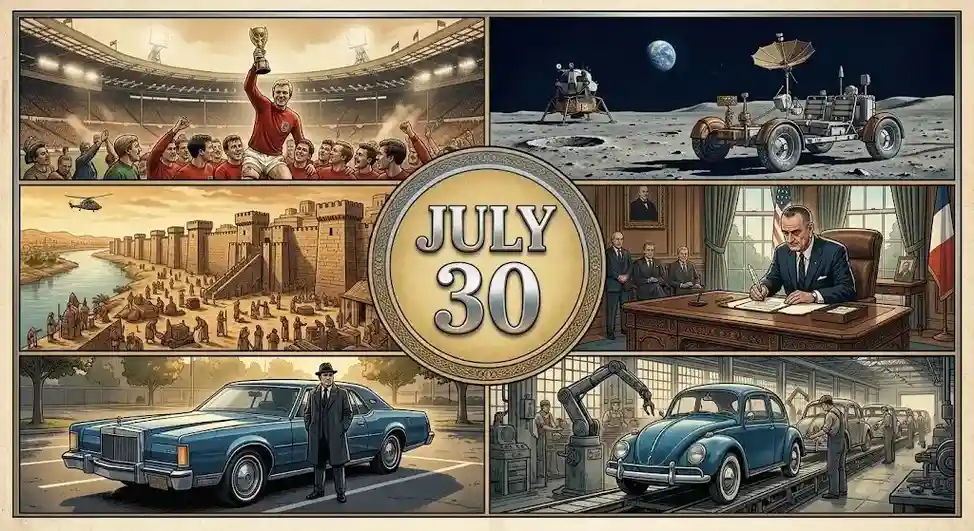
1966 – England Wins the World Cup at Wembley
Over ninety-six thousand fans filled Wembley Stadium as England faced West Germany in a thrilling FIFA World Cup final. Trailing in extra time, English striker Geoff Hurst fired a controversial shot off the crossbar that bounced downward onto the goal line, which the referee ruled a goal. Hurst struck again in the final seconds, completing a historic hat-trick to secure a dramatic 4–2 victory. It remains England’s single World Cup victory, cementing the 1966 squad into British sports folklore.
1971 – Apollo 15 Lands on the Moon
Astronauts David Scott and James Irwin steered the Lunar Module Falcon down onto the dusty plains of the Moon’s Hadley-Apennine region. Hours after touchdown, the crew unfolded the very first Lunar Roving Vehicle, an electric dune buggy designed to traverse the rugged surface. Scott and Irwin drove miles across the terrain, collecting unique geological samples, including the famous “Genesis Rock.” The mission marked a massive leap forward in scientific exploration during the Apollo program.
1971 – Morioka Mid-Air Collision
An All Nippon Airways Boeing 727 airliner collided in mid-air with a Japanese Air Force F-86 fighter jet over the mountains near Morioka, Japan. The military jet’s wing clipped the tail of the airliner, sending the commercial plane into a fatal dive, while the air force pilot managed to eject safely. All 162 passengers and crew aboard the airliner lost their lives in the disaster. It stood as the deadliest aviation accident in global history up to that point, driving sweeping upgrades to air traffic control systems.
1974 – Nixon Releases the Subpoenaed Tapes
Facing a unanimous order from the U.S. Supreme Court, President Richard Nixon surrendered hours of subpoenaed White House tape recordings to federal prosecutors. Among the reels was the infamous “Smoking Gun” tape, which proved the president had personally ordered a cover-up of the Watergate break-in just days after it occurred. The public release destroyed his remaining political support in Congress, making his impeachment and resignation inevitable.
1978 – The 730 Traffic Switch in Okinawa
At exactly 6:00 a.m., thousands of drivers across Okinawa Prefecture pulled over to switch their vehicles from the right side of the road to the left. Dubbed “730” for the July 30 date, the massive operation brought Okinawa’s road network into line with the rest of Japan after decades of American military administration. Road crews spent months reconfiguring bus stops, highway signs, and traffic lights across the islands. The seamless overnight change stood as a major logistical success for Japanese authorities.
1980 – Vanuatu Gains Independence
Cheering crowds gathered in the capital city of Port Vila as the new national flag of Vanuatu was raised for the very first time. The Pacific island nation officially broke free from shared Anglo-French colonial control, ending decades of dual administration known as the Condominium. Father Walter Lini stepped into office as the country’s first prime minister, promising to unify the diverse island cultures. The moment closed out colonial rule across the New Hebrides chain.
1980 – Israel Passes the Jerusalem Law
Members of the Israeli Knesset voted to pass the Jerusalem Law, officially declaring the unified city of Jerusalem as the country’s complete and undivided capital. The legislative act consolidated control over the city’s eastern sectors following the 1967 war. The move drew immediate condemnation from the United Nations Security Council, which passed resolutions declaring the law legally void under international norms. The legislation remains a central flashpoint in Middle Eastern diplomacy.
1981 – Łódź Hunger Demonstrations
Upward of fifty thousand people—mostly mothers marching alongside their young children—flooded the streets of Łódź, Poland, to protest severe food shortages. Carrying banners that read “We are hungry,” the crowd marched silently past government buildings to demand basic daily rations. The protest was organized by the Solidarity trade union, highlighting economic mismanagement under the ruling communist regime. It marked one of the largest public demonstrations in post-war Polish history.
1990 – Assassination of MP Ian Gow
British Conservative Member of Parliament Ian Gow stepped into his car outside his home in East Sussex, unaware that a bomb had been planted underneath the chassis. The explosive device detonated as he started the engine, killing the prominent politician instantly. The Provisional Irish Republican Army claimed responsibility for the attack, citing Gow’s fierce public opposition to Irish republicanism. His murder shocked the British political establishment, leading to tightened security protocols for politicians.
2003 – Final Classic VW Beetle Manufactured
Assembly line workers at the Volkswagen plant in Puebla, Mexico, gathered around a ocean-blue subcompact car to watch the final “old style” Beetle roll off the line. The event marked the end of a sixty-five-year manufacturing run that saw over 21 million classic Beetles produced globally. The simple, air-cooled design had grown from a post-war German transport project into an international pop culture icon. The final vehicle was shipped directly to a museum in Wolfsburg, Germany.
2003 – De-Extinction of the Pyrenean Ibex
Scientists in Spain successfully cloned a Pyrenean ibex, a wild mountain goat species that had gone extinct three years earlier when the last living female died. The newborn kid was delivered via a surrogate domestic goat, marking the first time in history an extinct animal had been brought back to life. However, the infant died just minutes after birth due to severe lung defects. The event earned the Pyrenean ibex the tragic distinction of becoming the only animal species to go extinct twice.
2006 – Top of the Pops Broadcasts Final Episode
BBC Two aired the final weekly episode of Top of the Pops, closing out a legendary forty-two-year run on British television. The show had served as the premier stage for pop musicians since 1964, featuring iconic performances from bands ranging from The Beatles to Queen. Shifting viewer habits and falling ratings led network executives to retire the weekly chart program. The finale featured a nostalgic countdown of classic performances, bringing an end to a staple of British music culture.
2006 – Qana Airstrike Kills Civilians
An Israeli airstrike struck a residential building in the southern Lebanese village of Qana during the 2006 Lebanon War. The blast collapsed the structure onto families taking shelter in the basement, killing twenty-eight civilians, including sixteen children. Images of the destruction sparked international outrage and prompted urgent calls for a ceasefire across the region. The tragedy became one of the defining humanitarian crises of the month-long conflict.
2011 – Royal Wedding of Zara Phillips and Mike Tindall
Queen Elizabeth II’s eldest granddaughter, Zara Phillips, married former England rugby union star Mike Tindall at Canongate Kirk in Edinburgh, Scotland. Crowds lined the streets of the Royal Mile to catch a glimpse of the royal family as they arrived for the private ceremony. The wedding brought together figures from the British sports world and the royal family, followed by a reception at the Palace of Holyroodhouse. It marked the first royal wedding held in Scotland in nearly twenty years.
2012 – Tamil Nadu Express Fire
A sudden fire broke out inside a sleeping coach of the Tamil Nadu Express as the train traveled through Andhra Pradesh, India, in the early morning hours. Passengers woke up to find thick smoke filling the carriage, triggering panic as people rushed toward locked emergency exits. Thirty-two people lost their lives in the flames, while twenty-seven others suffered critical injuries. The tragedy forced Indian Railways to overhaul emergency exit designs and fire safety systems across its passenger fleets.
2012 – Northern India Power Grid Collapse
A massive electrical grid failure plunged over three hundred million people into darkness across northern India, marking one of the largest blackouts in human history. The sudden surge tripped power plants off the line, bringing passenger trains to a standstill and shutting down water treatment facilities. The outage disrupted traffic systems across major metropolitan areas, including New Delhi, for over twelve hours. The systemic failure exposed heavy structural strains on the nation’s energy infrastructure.
2014 – Malin Landslide Disaster
Heavy monsoon rains triggered a massive mudslide in the village of Malin, located in the Western Ghats region of Maharashtra, India. The hillside gave way before dawn, burying forty-four homes under mud and debris while residents were still sleeping inside. Over twenty people were killed instantly, and emergency workers spent days digging through thick mud to rescue survivors trapped beneath the rubble. Environmentalists cited deforestation and improper land development as major contributing factors.
2020 – NASA Launches Perseverance Mars Rover
An Atlas V rocket blasted off from Cape Canaveral Air Force Station, carrying NASA’s Perseverance rover toward the Red Planet. The high-stakes Mars 2020 mission was designed to land in Jezero Crater to search for signs of ancient microscopic life and gather soil samples for future return to Earth. Tucked beneath the rover was Ingenuity, a experimental helicopter built to attempt the first powered flight on another planet. The launch marked a major leap forward in interplanetary exploration.
2024 – Wayanad Landslides in Kerala
Torrential monsoon rains poured over the hilly Wayanad district in Kerala, India, triggering a catastrophic series of morning landslides. Massive flows of mud, boulders, and uprooted trees tore down the mountainsides, sweeping away entire villages while residents slept. The disaster claimed over 420 lives, destroying bridges and cutting off rescue teams from surviving victims. It stood as one of the deadliest natural disasters in the state’s modern history.
2025 – Magnitude 8.8 Kamchatka Earthquake
A megathrust earthquake struck off the coast of Russia’s Kamchatka Peninsula, sending shockwaves across the Pacific Ocean. Seismometers recorded the quake at magnitude 8.8, making it one of the most powerful seismic events registered in over a century. Tsunami warnings were triggered across coastal communities from Japan to the Americas as ocean surges spread outward. Despite the massive release of tectonic energy, damage was mostly contained to coastal port infrastructure.
Need a history fix? Click here for our previous tales.
Famous People Born on July 30
| Name | Description | Dates |
|---|---|---|
| Hongzhi Emperor | Emperor of China’s Ming dynasty | 1470 – 1505 |
| Giorgio Vasari | Italian painter, architect, and art historian | 1511 – 1574 |
| Ferdinando I de’ Medici | Grand Duke of Tuscany | 1549 – 1609 |
| Maria Anna Mozart (Nannerl Mozart) | Austrian pianist, sister of Wolfgang Amadeus Mozart | 1751 – 1829 |
| Emily Brontë | English novelist and poet, author of Wuthering Heights | 1818 – 1848 |
| Thorstein Veblen | American economist and sociologist | 1857 – 1929 |
| Henry Ford | American industrialist, founder of Ford Motor Company | 1863 – 1947 |
| Smedley Butler | American Marine Corps general, Medal of Honor recipient | 1881 – 1940 |
| Casey Stengel | American Baseball Hall of Fame manager | 1890 – 1975 |
| Henry Moore | English sculptor and artist | 1898 – 1986 |
| C. Northcote Parkinson | British historian, creator of Parkinson’s Law | 1909 – 1993 |
| Henry W. Bloch | American businessman, co-founder of H&R Block | 1922 – 2019 |
| C. T. Vivian | American civil rights leader | 1924 – 2020 |
| Betye Saar | American visual artist | 1926 – 2026 |
| Sulochana Latkar | Indian film actress | 1928 – 2023 |
| Bud Selig | Commissioner of Major League Baseball | 1934 – Present |
| Buddy Guy | American blues guitarist and singer | 1936 – Present |
| Paul Anka | Canadian singer-songwriter | 1941 – Present |
| Patrick Modiano | French novelist, Nobel Prize winner | 1945 – Present |
| Françoise Barré-Sinoussi | French virologist, Nobel Prize winner | 1947 – Present |
| Arnold Schwarzenegger | Austrian-American actor, bodybuilder, and politician | 1947 – Present |
| Jean Reno | French actor | 1948 – Present |
| Kate Bush | English singer-songwriter | 1958 – Present |
| Richard Linklater | American film director and screenwriter | 1960 – Present |
| Laurence Fishburne | American actor | 1961 – Present |
| Lisa Kudrow | American actress | 1963 – Present |
| Jürgen Klinsmann | German footballer and coach | 1964 – Present |
| Christopher Nolan | British-American filmmaker | 1970 – Present |
| Sonu Nigam | Indian playback singer | 1973 – Present |
| Joey King | American actress | 1999 – Present |
Famous People Died on July 30
| Name | Description | Dates |
|---|---|---|
| William Penn | English Quaker, founder of Pennsylvania | 1644 – 1718 |
| Thomas Gray | English poet | 1716 – 1771 |
| Miguel Hidalgo y Costilla | Mexican priest and leader of independence | 1753 – 1811 |
| George Pickett | Confederate general in the American Civil War | 1825 – 1875 |
| Otto von Bismarck | First Chancellor of Germany | 1815 – 1898 |
| Emperor Meiji | Emperor who modernized Japan | 1852 – 1912 |
| Joan Gamper | Founder of FC Barcelona | 1877 – 1930 |
| Joseph Cook | 6th Prime Minister of Australia | 1860 – 1947 |
| Jun’ichirō Tanizaki | Japanese novelist | 1886 – 1965 |
| George Szell | Hungarian-American conductor | 1897 – 1970 |
| James Blish | American science fiction author | 1921 – 1975 |
| Julia Robinson | American mathematician | 1919 – 1985 |
| Joe Shuster | Canadian-American illustrator, co-creator of Superman | 1914 – 1992 |
| Claudette Colbert | French-American Academy Award-winning actress | 1903 – 1996 |
| Sam Phillips | American record producer, founder of Sun Records | 1923 – 2003 |
| John Garang | South Sudanese military leader and politician | 1945 – 2005 |
| Michelangelo Antonioni | Italian film director | 1912 – 2007 |
| Ingmar Bergman | Swedish film director and screenwriter | 1918 – 2007 |
| Bill Walsh | American NFL coach | 1931 – 2007 |
| Mohammed Yusuf | Nigerian Islamist militant, founder of Boko Haram | 1970 – 2009 |
| Maeve Binchy | Irish novelist | 1939 – 2012 |
| Berthold Beitz | German industrialist and philanthropist | 1913 – 2013 |
| Robert Bellah | American sociologist | 1927 – 2013 |
| Dick Smith | American Academy Award-winning makeup artist | 1922 – 2014 |
| Lynn Anderson | American country singer | 1947 – 2015 |
| Lee Teng-hui | President of Taiwan | 1923 – 2020 |
| Herman Cain | American businessman and presidential candidate | 1945 – 2020 |
| Nichelle Nichols | American actress, Star Trek icon | 1932 – 2022 |
| Paul Reubens | American actor and comedian | 1952 – 2023 |
| Onyeka Onwenu | Nigerian singer, actress, and politician | 1952 – 2024 |
Observances on July 30
- International Day of Friendship: Established by the United Nations to promote understanding between different cultures, communities, and countries.
- Independence Day (Vanuatu): Commemorates the day the Pacific island nation gained sovereignty from joint British and French colonial rule in 1980.
- Feast of the Throne (Morocco): Celebrates the official accession of the reigning monarch to the throne with national festivities.
- Martyrs Day (South Sudan): Honors the lives lost during the long struggle for South Sudanese independence and sovereignty.
⚽ Frequently Asked Questions — July 30 in History
England defeated West Germany 4–2 after extra time at Wembley Stadium to win the FIFA World Cup. Geoff Hurst scored a controversial goal off the crossbar, completing a historic hat-trick that gave England its first and only world soccer title.
On July 30, 1864, Union forces detonated a massive underground bomb beneath Confederate trenches at the Battle of the Crater in Petersburg, Virginia. The explosion blew a massive pit in the line, but poorly executed follow-up charges resulted in heavy Union casualties.
Hongzhi Emperor, the ninth emperor of the Ming dynasty known for his peaceful reign, was born on July 30, 1470. French author Patrick Modiano, who went on to win the Nobel Prize in Literature, was born on July 30, 1945. Additional notable births are listed in historical registers.
England’s victory in the 1966 FIFA World Cup final stands as one of the date’s most globally recognized events. The disappearance of union leader Jimmy Hoffa in 1975 and the signing of Medicare in 1965 also mark massive historical turning points.
International Day of Friendship was designated by the United Nations to encourage peace efforts and bridge cultural divides between people worldwide. It serves as a annual reminder of the power of unity, community dialogue, and mutual respect across global borders.
In 2024, catastrophic landslides in Wayanad, India, swept away entire hillside communities following heavy monsoon rains. In 2025, a massive magnitude 8.8 earthquake struck off the coast of Kamchatka, Russia, triggering tsunami alerts across the Pacific.