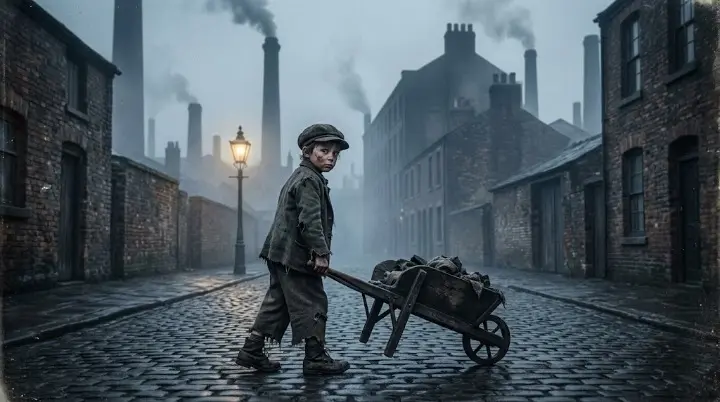
Picture a six-year-old awake before dawn, trudging through cold cobbled streets while the gas lamps still flicker. By the time your own kids are pouring cereal, this child has already spent three hours crawling beneath a thundering cotton machine. So why did children work in Victorian times, often twelve hours a day, in places that could maim or kill them? The reason isn’t simple cruelty. It’s a tangled knot of poverty, booming industry, and a society that hadn’t yet decided childhood was worth protecting. Here’s the part that surprises most people — at the time, it all made perfect economic sense.
Why Did Children Work in Victorian Times? Poverty Gave Families No Choice
Walk into any working-class home in 1840s Manchester and you’d find the same quiet arithmetic playing out at the kitchen table. Wages were low. Rent came due every week. A father’s pay alone rarely stretched far enough to feed five or six mouths.
For most families, a child’s few shillings a week wasn’t pocket money. It was the difference between eating and going hungry. A boy of nine might bring home three shillings, and that small sum could buy bread for days.
Children weren’t sent to work because their parents were heartless. They were sent because the family would sink without them. In a world with no pensions, no benefits, and no safety net, every pair of hands counted.
Poverty explains the why. But the where and the how came from something newer, louder, and far hungrier than anything Britain had ever seen.
Victorian Child Labour at a Glance: Jobs, Ages, and Dangers
Here’s how the most common children’s jobs compared across Victorian industry.
| 👷 Job | 🏭 Industry | 👶 Typical Starting Age | ⏰ Hours per Day | ⚠️ Main Danger |
|---|---|---|---|---|
| Scavenger | Cotton Mill | 6–8 years | 12–14 hours | Crushed by moving machinery |
| Piecer | Cotton Mill | 9–12 years | 12–14 hours | Lung disease from cotton dust |
| Trapper | Coal Mine | 5–6 years | 12 hours | Darkness, isolation, tunnel collapse |
| Hurrier | Coal Mine | 8–12 years | 12 hours | Exhaustion and crush injuries |
| Climbing Boy | Chimney Sweeping | 4–7 years | Varied | Burns, suffocation, and chimney sweep’s cancer |
The Industrial Revolution Created a Hunger for Small Hands
Steam changed everything. As factories rose across northern England in the early 1800s, they created a demand for labour that adults alone couldn’t fill — and children fit the work in ways that unsettle us today.
Small bodies could squeeze between machines. Small fingers could tie broken threads at speed. And crucially, a child could be paid a fraction of an adult’s wage for similar work.
Factory owners knew a nimble child cost less and complained less. In some cotton mills, youngsters made up close to half the workforce by the 1830s.
Orphans were especially vulnerable. So-called “pauper apprentices” were shipped from London workhouses to distant mills, bound to their masters until adulthood, with nowhere to run.
The machines never stopped, and neither, it seemed, did the children who served them. Yet no factory floor was quite as loud, or as dangerous, as the cotton mill.
Inside the Cotton Mills: Scavengers, Piecers, and Endless Noise
The roar hit you first. Hundreds of spinning frames pounding at once, the air thick with cotton dust that coated lungs and settled on eyelashes.
The youngest children worked as scavengers, crawling under moving machinery to sweep up loose cotton while the gears churned inches from their heads. Older ones became piecers, leaning over the frames to join snapped threads, hour after hour, on aching legs.
Shifts ran twelve to fourteen hours, six days a week. Accidents were common — a caught sleeve, a crushed hand, sometimes far worse.
Robert Blincoe, a former workhouse child, later described beatings and mangled fingers in his 1832 memoir, a book that helped shock the public into paying attention.
Above ground the mills were brutal. But some of the darkest child labour in Victorian Britain happened where daylight never reached at all.
Down in the Dark: Children in the Coal Mines
Imagine sitting alone in total blackness for twelve hours, your only job to open a wooden door whenever a coal cart rumbled past. This was the life of a trapper, often a child no older than five or six.
Older children worked as hurriers, dragging heavy coal carts through tunnels too low for a grown adult to stand in. Girls and boys laboured side by side, harnessed like small ponies, chains looped around their waists.
The heat was suffocating, the air foul, and a single slip could mean a broken limb far from any help. Some children spent so long underground that they barely saw the sun from one week to the next.
A government report in 1842 exposed these conditions with illustrations that horrified Victorian readers. Comfortable families had no idea children were crawling through the earth beneath their feet.
That report led directly to the Mines and Collieries Act of 1842, which banned all women and girls, and boys under ten, from working underground.
Reform was finally coming. But for one group of children, rescue took a great deal longer.
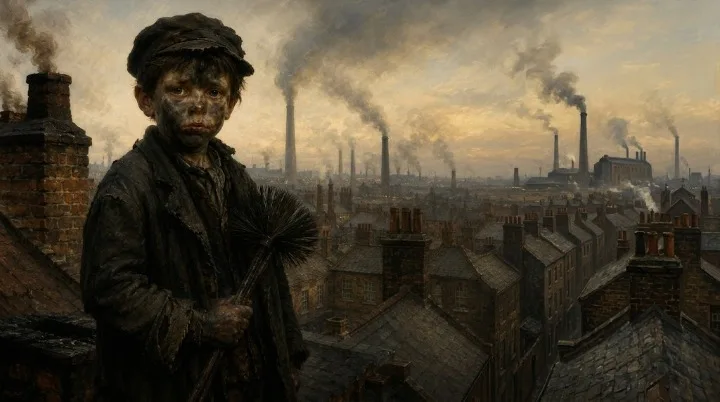
Climbing Boys: The Brutal World of Chimney Sweeps
Few jobs were as feared as that of the climbing boy. Master sweeps sent small children up narrow, soot-choked flues, some barely wider than a dinner plate.
Boys as young as four scrambled upward in the dark, elbows and knees scraped raw against rough brick. A few cruel masters lit fires beneath them to force them to climb faster.
Many developed a disease known as “chimney sweep’s cancer”, one of the first occupational cancers ever recorded, identified as far back as 1775.
Laws to stop the practice were passed and then quietly ignored for decades. Real change came only after twelve-year-old George Brewster died in a Fulbourn chimney in 1875, sparking an outcry that finally pushed a new act through Parliament.
Behind that law stood one determined man who had spent much of his life fighting for these children. His name deserves to be remembered.
What Wealthy Children Did While Poor Children Laboured
Not every Victorian child knew the factory or the mine. In the grand townhouses of London and the country estates beyond, childhood looked like another world entirely.
Upper-class boys were sent to boarding schools such as Eton, groomed for careers in law, the church, or the army. Girls learned French, piano, and needlework under a governess at home.
These children had nurseries, toys, and time to simply be young. Their biggest worry might be a strict tutor rather than a severed finger.
The gap between rich and poor wasn’t only about money. It was two completely different ideas of what a child was for. One was meant to be educated. The other was meant to earn.
That divide couldn’t hold forever. Slowly, a handful of reformers began to argue that every child deserved something better.
The Factory Acts and the Slow Death of Child Labour
Change didn’t arrive overnight. It came law by law, argument by argument, across half a century.
The first real step was the Factory Act of 1833, which barred children under nine from textile mills and limited the hours of those who were older. For the first time, factory inspectors were sent in to enforce the rules.
Leading the charge was Lord Shaftesbury — Anthony Ashley-Cooper — a devout reformer who championed the Mines Act, factory reform, and the cause of the climbing boys.
The Ten Hours Act of 1847 then capped the working day for women and young people, a victory won after years of campaigning by the mill workers themselves.
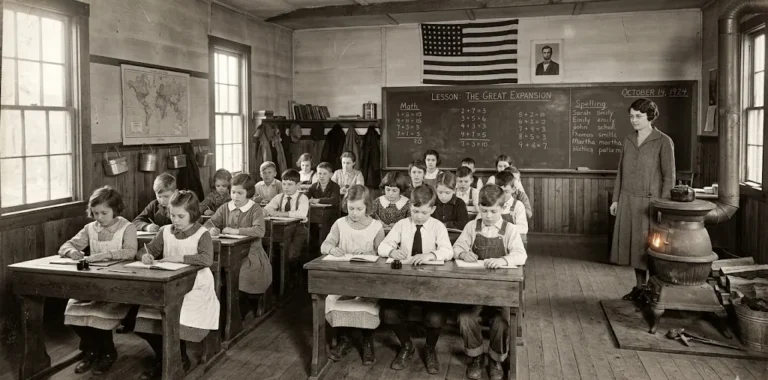
By the century’s end, schooling had become compulsory, and the sight of small children toiling in factories slowly faded into memory. Undoing it had taken generations. Each act chipped away at a system that had once seemed as fixed and permanent as the weather.
🏭 Frequently Asked Questions — Child Labour in Victorian Times
Many started shockingly young. Children as young as four or five worked as chimney sweeps or coal-mine trappers, while factory work often began around six to nine. The Factory Act of 1833 finally set nine as the minimum age for textile mills.
Very little — usually only a few shillings a week, far below what an adult earned for similar work. That low cost was exactly why factory owners hired them. Even so, those coins were often vital to a poor family’s survival.
They worked as cotton-mill scavengers and piecers, coal-mine trappers and hurriers, chimney sweeps, farm hands, match-makers, and street sellers. The work usually depended on where a family lived and which industries stood nearby.
There was no single end date. A series of laws from 1833 onward gradually restricted it, and compulsory schooling in the 1870s and 1880s pulled most children out of full-time work. Child labour faded slowly rather than stopping all at once.
They were cheap, small enough to reach tight spaces, and less likely to resist harsh treatment. Their tiny fingers and slender bodies suited delicate or cramped tasks that adults simply couldn’t manage.
The Children History Almost Forgot
Strip away the machines and the statistics, and you’re left with something simple and heartbreaking: children who never got to be children. They woke in the dark, worked until they ached, and handed their few coins to parents who had no other choice. Their labour helped build the modern world we live in — the railways, the fabric, the fortunes.
What changed things wasn’t only new laws. It was ordinary people refusing to look away, and reformers who believed a child belonged in a classroom, not a coal seam. The next time you pass a school at three o’clock, spare a thought for the children who never had one.
If this pulled you into the past, you might also enjoy reading about How Did People Wash Clothes Before Washing Machines?