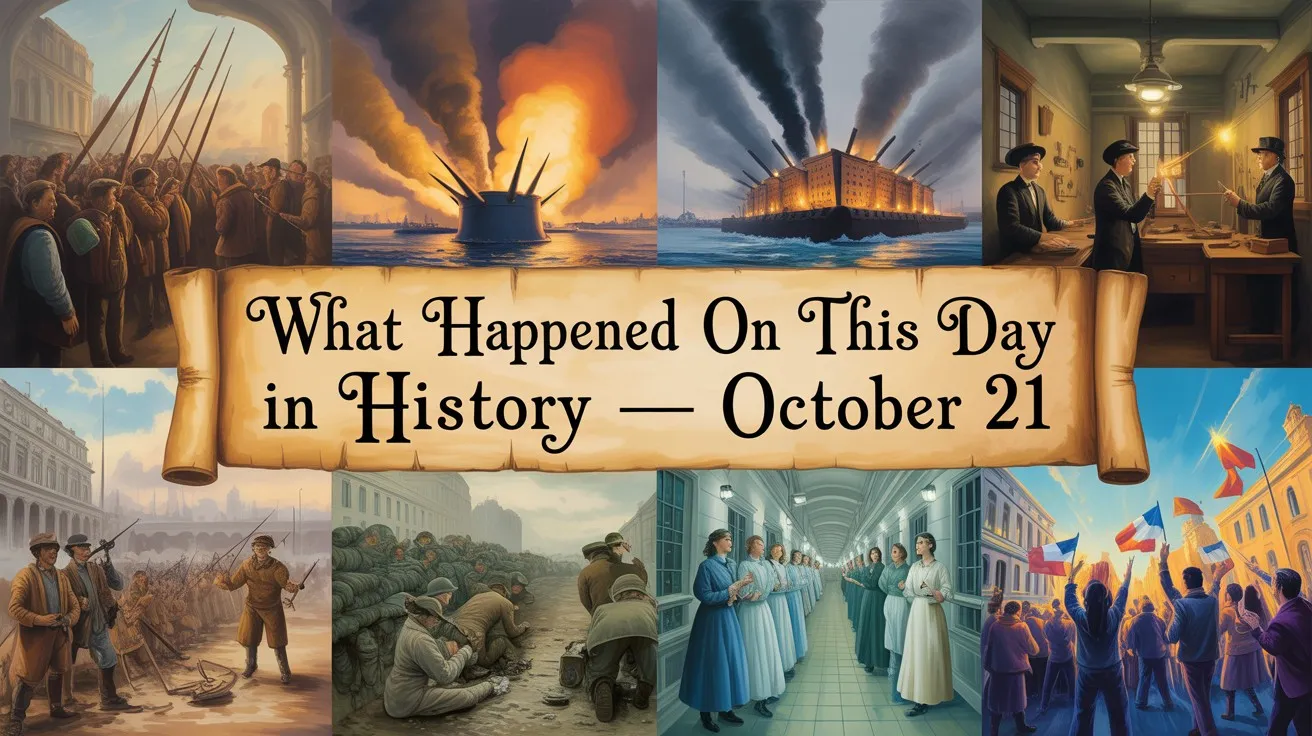
From ancient sieges and medieval crusades to industrial patents, modern coups and tragic disasters, What happened on this day in history October 21 collects moments of military turning points, cultural firsts and wrenching human losses. The date repeatedly marks shifts in politics, science and everyday life — a compact cross-section of how institutions, inventions and crises reshape societies across centuries.
Quick sections
Earlier history
202 BC — Zama; 439 — Vandals take Carthage; 1600 — Sekigahara; ancient and early-medieval turning points shape later state formations.
Exploration & foundations
1386 — Heidelberg lecture (related lists); 1797 — USS Constitution launch; 1824 — Portland cement patent; institutional and technological foundations emerge.
Wars & politics
1097 — Siege of Antioch; 1805 — Trafalgar; 1944 — Aachen falls; 1969 — Somali coup; episodes illustrate shifts in naval, continental and postcolonial power.
Arts & culture
1847 — Jane Eyre published; 1940 — Hemingway’s For Whom the Bell Tolls; 1959 — Guggenheim opens — cultural production and institutions mark the date.
Science, technology & media
1879 — Edison patent; 1907 — Qaratog quake observations; 1983 — metre redefinition; 2005 — Eris images — scientific milestones and measurement advances.
Disasters & human rights
1966 — Aberfan disaster; 1941 — Kragujevac massacre; 1989 — Tegucigalpa crash; contemporary incidents and wartime atrocities show recurring human costs.
Read About: What Happened On This Day In History October 20: Celebrating Moments
Major Events on October 21
310 — Death of Pope Eusebius after exile
Pope Eusebius died in Sicily sixty-five days after being exiled by Emperor Maxentius, closing a brief and troubled papacy marked by theological disputes and political pressure. His death reflected the fraught relationship between Rome’s bishops and imperial power in the early fourth century and the precarious position of the clergy under competing authorities.
1096 — Battle of Civetot: People’s Crusade defeated
A Seljuk Turkish force routed the ill-equipped People’s Crusade at Civetot, shattering one of the early, informal waves of crusading enthusiasm. The engagement demonstrated the limits of poorly organized volunteer expeditions and foreshadowed the bloodier, more disciplined campaigns that would follow during the First Crusade’s main armies.
1097 — Siege of Antioch begins (First Crusade)
Crusader forces under leaders such as Godfrey of Bouillon, Bohemund and Raymond began the long siege of Antioch, a strategic Syrian city whose capture would prove pivotal for crusader footholds in the Levant. The siege’s hardships, internecine tensions and eventual fall shaped the crusading presence in the region for years afterward.
1392 — Emperor Go-Kameyama abdicates for Go-Komatsu in Japan
Japanese court politics produced a dynastic change when Go-Kameyama abdicated in favor of rival claimant Go-Komatsu, resolving a period of imperial division. The negotiated transfer affected the structure of court authority and the ceremonial dimensions of rulership during a turbulent medieval phase.
1512 — Martin Luther joins Wittenberg theological faculty
Martin Luther accepted a professorship at the University of Wittenberg, a post that positioned him within academic and ecclesiastical networks and later amplified the impact of his theological critiques. His role at Wittenberg provided institutional authority that aided the spread of reformist ideas.
1520 — João Álvares Fagundes discovers Saint Pierre and Miquelon
Explorer João Álvares Fagundes sighted the islands later named Saint Pierre and Miquelon, an early European contact influencing Atlantic navigation and territorial claims. The islands’ discovery became part of evolving North Atlantic fishing and colonial activity between Europe and North America.
1600 — Tokugawa Ieyasu wins Sekigahara, becomes shōgun of Japan
Ieyasu’s decisive victory at Sekigahara consolidated rival daimyo power under his leadership and paved the way for Tokugawa hegemony. His triumph inaugurated a long era of centralized shogunal rule, political stability and social order that would define early modern Japan for centuries.
1774 — Taunton flag first to display the word “Liberty”
The town flag of Taunton, Massachusetts, became one of the earliest American banners to include “Liberty,” reflecting rising colonial protest and symbolic culture in the years before open revolution. Such local emblems signaled political sentiment and community identity in the run-up to independence.
1797 — USS Constitution launched in Boston Harbor
The 44-gun frigate USS Constitution was launched, later becoming an iconic vessel in U.S. naval history. Built for durability and speed, the ship played roles in early American maritime defense and became a potent symbol of naval craftsmanship and national sovereignty.
1805 — Battle of Trafalgar: Nelson defeats combined French–Spanish fleet
A British fleet under Admiral Nelson routed the combined Franco-Spanish armada at Trafalgar, securing British naval supremacy and preventing Napoleon from achieving maritime control. The victory reshaped naval strategy and confirmed Britain’s dominance at sea, though it cost Nelson his life and left complex diplomatic consequences.
1824 — Portland cement patented
The patenting of Portland cement marked a major step in construction technology, enabling stronger, more durable building materials and accelerating modern infrastructure and architectural developments. Cement’s availability transformed civil engineering, urban growth and industrial construction practices.
1854 — Florence Nightingale and nurses sent to the Crimean War
Florence Nightingale led a staff of nurses to the Crimea, introducing sanitary reforms and systematic nursing practices that dramatically reduced mortality and reshaped military medicine. Her work established foundations for professional nursing and public health reforms in the nineteenth century.
1861 — Second major battle defeat of Union forces under Edward Baker
Union troops under Colonel Edward Baker suffered defeat in a significant early Civil War engagement, highlighting the chaotic and costly nature of opening conflicts. The battle affected regional control and underscored the war’s uncertain fortunes in its initial campaigns.
1867 — Medicine Lodge Treaty signed with southern Great Plains tribes
The Medicine Lodge Treaty formalized agreements that required Plains tribes to relocate to reservations in Indian Territory, reflecting U.S. Indian policy’s coercive settlement and the reshaping of indigenous lifeways. The treaty had long-term ramifications for tribal sovereignty, landholding and cultural survival.
1879 — Thomas Edison applies for incandescent light bulb patent
Edison filed for his incandescent lamp design, a key moment in developing practical electric lighting. The patent application was part of a broader era of electrical invention that transformed daily life, industry, and urban environments through reliable artificial illumination.
1888 — Swiss Social Democratic Party founded
The foundation of the Swiss Social Democratic Party institutionalized labor and socialist politics within Switzerland, contributing to the growth of organized political representation for working-class interests and shaping the country’s social-democratic traditions in the twentieth century.
1892 — Opening ceremonies for the World’s Columbian Exposition held in Chicago
Ceremonies inaugurated the Columbian Exposition project in Chicago, a major cultural and industrial showcase (opened fully in 1893) that displayed technological progress, architectural innovation and national aspirations in the Gilded Age, influencing American cultural life and urban planning.
1895 — Capitulation of Tainan completes Japanese conquest of Taiwan
Japanese forces secured Tainan, completing military operations that established Japanese rule in Taiwan. The conquest marked a significant moment in Japan’s imperial expansion and reconfigured governance and colonial administration on the island.
1907 — Qaratog earthquake devastates border region of Uzbekistan/Tajikistan
A catastrophic quake struck the Qaratog border area, causing large-scale fatalities and destruction estimated in the tens of thousands. The disaster highlights Central Asia’s seismic vulnerability and the human costs of major tectonic events in poorly prepared regions.
1910 — HMS Niobe arrives in Halifax as first Royal Canadian Navy ship
HMS Niobe’s arrival marked an early milestone in the formation of Canada’s naval forces, representing nascent national maritime capability and the evolving defense ties within the British Empire as dominions developed their own military institutions.
1912 — Greek navy captures Lemnos in First Balkan War
Greek forces secured Lemnos as a forward base against the Dardanelles, strengthening naval positioning in the Aegean and contributing to the First Balkan War’s rapid territorial changes that would erode Ottoman control in southeastern Europe.
1921 — President Harding delivers first presidential anti-lynching speech
President Warren G. Harding publicly denounced lynching during a speech, marking an early presidential engagement against extrajudicial racial violence. His words signalled federal concern about racial terror, though legislative progress on anti-lynching measures would remain contested for decades.
1931 — Abortive coup attempt by secret society in Imperial Japanese Army
A faction within the Imperial Japanese Army launched an abortive coup, reflecting internal political tensions and nationalist radicalism in interwar Japan. The failed plot underscored military factionalism that later influenced the country’s trajectory toward militarism.
1940 — Publication of Ernest Hemingway’s For Whom the Bell Tolls
Hemingway’s novel appeared in its first edition, a work shaped by Spanish Civil War experiences and later celebrated as a major twentieth-century literary treatment of war, loyalty and moral complexity. The book influenced literary modernism and readers’ understanding of contemporary conflict.
1941 — Kragujevac massacre: mass killing of Serbian men and boys
German forces carried out a large-scale massacre in Kragujevac, executing civilians as reprisals and producing one of the atrocities of the occupation of Yugoslavia. The event remains a tragic example of wartime reprisals and the brutalities of occupation policies.
1943 — Provisional Government of Free India established in Japanese-occupied Singapore
Leaders of the Indian independence movement proclaimed a provisional government in exile, aligning with Japanese occupation forces as part of broader anti-colonial initiatives. The government embodied complex wartime alliances and the contested strategies for achieving independence.
1944 — First kamikaze damages HMAS Australia; Battle of Leyte Gulf begins
Japanese kamikaze tactics inflicted damage on Allied ships as the massive Leyte Gulf operations began, signaling an escalation in desperate aerial attacks and marking a crucial campaign that would accelerate Japan’s strategic decline in the Philippines.
1944 — Nemmersdorf massacre against German civilians
Reports of killings at Nemmersdorf became one of several contested wartime atrocities affecting civilians, feeding wartime propaganda and complicated historical debates about reprisals and violence in Eastern Europe as frontlines shifted.
1944 — Aachen falls to American forces, first German city taken by Allies
After weeks of fighting, Aachen’s capture by U.S. forces marked a symbolic and strategic breach of Germany’s western defenses, the first major German city to fall and a stepping stone to deeper incursions into the Reich’s industrial regions.
1945 — French women vote for the first time in legislative elections
Women in France cast ballots in national legislative elections for the first time, a pivotal expansion of suffrage that redefined French citizenship and political participation in the immediate postwar era and reshaped party politics and representation.
1950 — Battle of Yongju: heavy fighting in Korean War
British and Australian units clashed with North Korean forces at Yongju in intense combat, part of wider UN operations during the Korean War. The fighting illustrated the multinational nature of the UN coalition and the war’s fluctuating frontlines.
1956 — Mau Mau Uprising in Kenya defeated (campaign phase)
British colonial forces quelled major Mau Mau resistance in Kenya, a turning point in the anti-colonial struggle that nevertheless left deep social scars and presaged eventual decolonization and political transformation in the colony.
1959 — Solomon R. Guggenheim Museum opens in New York City
Frank Lloyd Wright’s iconic Guggenheim building opened to the public, introducing an influential modern museum architecture and becoming a landmark for collecting, exhibiting and public engagement with modern art in the United States.
1959 — Eisenhower transfers Army space activities to NASA
President Eisenhower approved moving US Army space-related programs to NASA, consolidating civilian space efforts and advancing the institutional development that would support the U.S. space program during the Cold War space race.
1965 — Comet Ikeya–Seki approaches perihelion in spectacular display
Comet Ikeya–Seki made a close solar approach, producing a visually spectacular appearance that attracted public and astronomical interest. Such bright comets provided opportunities for observation and inspired amateur and professional attention to transient celestial phenomena.
1966 — Aberfan disaster: spoil tip collapses, killing 144 (116 children)
A colliery spoil tip slid onto a village and school in Aberfan, Wales, producing a catastrophic loss of life that exposed industrial negligence, regulatory failures and had profound effects on British community grief, safety law and mining oversight reforms.
1967 — Mass Vietnam antiwar march from Lincoln Memorial to the Pentagon
Organized by the National Mobilization Committee to End the War in Vietnam, a fifty-thousand-person march demonstrated burgeoning opposition to the war and amplified public protest’s role in shaping U.S. policy debates during a turbulent era of domestic dissent.
1969 — Somali coup d’état establishes Marxist–Leninist administration
A military coup in Somalia brought a new Marxist–Leninist government to power, altering domestic politics and Cold War alignments in the Horn of Africa and setting the stage for long-term authoritarian rule and subsequent regional instability.
1971 — Gas explosion at Glasgow shopping centre kills 22
A devastating blast at a retail complex near Glasgow caused numerous fatalities and highlighted the dangers of urban industrial accidents, leading to inquiries into safety standards, emergency responses and building regulations.
1973 — Fred Dryer records two safeties in a single NFL game
Fred Dryer made NFL history by scoring two safeties in the same game, an uncommon sporting feat that entered league records and trivia and illustrated unusual scoring outcomes in professional American football.
1978 — Pilot Frederick Valentich vanishes after reporting unidentified aircraft
Australian pilot Frederick Valentich disappeared over Bass Strait after reporting contact with an unidentified aircraft; his disappearance spawned enduring mystery and conspiracy among aviation and UFO enthusiasts while remaining unresolved.
1979 — Moshe Dayan resigns from Israeli government over Arab policy disagreements
Veteran statesman Moshe Dayan resigned amid deep policy disagreements with Prime Minister Menachem Begin about approaches to Arab neighbors, signaling shifts in Israeli political alignments and debates over security and diplomacy in the region.
1981 — Andreas Papandreou becomes Prime Minister of Greece
Papandreou’s electoral victory ended a long period of conservative dominance and inaugurated a new era of Greek politics under a centre-left government, reshaping social policy, economic priorities and Greece’s role in European affairs.
1983 — Metre redefined as distance light travels in a vacuum in 1/299,792,458 s
The international definition of the metre was anchored to the speed of light, reflecting advances in precision measurement and atomic standards that improved scientific reproducibility and international metric consistency.
1984 — Niki Lauda clinches his third and final Formula One title
Lauda’s narrow championship victory at the Portuguese Grand Prix capped a distinguished racing career and underscored the competitive intensity of Formula One, sportsmanship and the technical developments shaping motor racing in the 1980s.
1986 — Kidnapping claim in Lebanon involving American writer Edward Tracy (later released)
In Lebanon’s complex civil war environment, pro-Iran kidnappers claimed abduction of an American writer, an episode that exemplified the dangers facing foreign nationals and the prolonged hostage crises that marked the conflict era.
1987 — Jaffna hospital massacre carried out, killing Tamil patients and staff
Indian peacekeeping forces were reported responsible for a deadly attack at Jaffna hospital, causing many civilian casualties and deepening controversy over intervention, human rights and the Sri Lankan civil conflict’s humanitarian toll.
1989 — Honduran Boeing 727 crash near Tegucigalpa kills 131
A fatal air accident on approach to Toncontín International Airport caused large loss of life and prompted scrutiny of aviation safety, approach procedures in challenging terrain and the regulatory oversight of regional carriers.
1994 — Agreed Framework signed between North Korea and the United States
The pact required North Korea to freeze its nuclear weapons program in exchange for aid and normalized relations steps, representing a diplomatic attempt to curb proliferation though later implementation and verification proved contentious.
1994 — Seongsu Bridge collapse in Seoul kills 32
A span of the Seongsu Bridge collapsed, causing fatalities and raising urgent concerns about infrastructure maintenance, construction practices and urban engineering standards in rapidly modernizing cities.
2005 — Images of dwarf planet Eris taken, aiding its discovery documentation
Observations of Eris contributed to the recognition and documentation of a large trans-Neptunian object, a discovery that later played a role in reclassifying planetary definitions and the debate leading to Pluto’s reclassification.
2011 — President Obama announces full withdrawal of U.S. troops from Iraq by year’s end
The announcement signalled the end phase of large-scale U.S. combat operations in Iraq, reflecting shifting policy priorities and the long-term consequences of the 2003 invasion for regional security and U.S. military strategy.
2019 — Fiery bus crash in western Democratic Republic of the Congo kills thirty
A deadly traffic accident underscored ongoing transport safety challenges in many parts of the world and the human cost of infrastructural deficits, prompting local emergency responses and attention to road safety measures.
2019 — Canada’s federal election yields Liberal minority; Trudeau remains prime minister
The October 21 vote produced a parliamentary outcome that kept Justin Trudeau’s Liberals in power albeit without an outright majority, shaping Canada’s political agenda and coalition dynamics in the following parliamentary term.
2021 — Rust film set shooting kills cinematographer Halyna Hutchins, injures director Joel Souza
A tragic on-set firearms accident resulted in the death of cinematographer Halyna Hutchins and injured director Joel Souza, sparking widespread industry debate about prop safety, protocols and legal accountability in film production.
Notable births — October 21
Hongwu Emperor — founder of the Ming dynasty — born 1328.
Jean Bart — French admiral and privateer — born 1650.
Nicolaus I Bernoulli — Swiss mathematician — born 1687.
Samuel Taylor Coleridge — English poet & critic — born 1772.
Alphonse de Lamartine — French poet & statesman — born 1790.
Will Carleton — American poet — born 1845.
Alfred Nobel — Swedish inventor & Nobel Prizes founder — born 1833.
Oswald Avery — physician & molecular biologist — born 1877.
Tan Kah Kee — Chinese businessman & philanthropist — born 1874.
Mary Blair — American illustrator & animator — born 1911.
Georg Solti — conductor — born 1912.
Dizzy Gillespie — jazz trumpeter & composer — born 1917.
Martin Gardner — mathematics popularizer — born 1914.
Whitey Ford — baseball pitcher — born 1928.
Celia Cruz — singer, “Queen of Salsa” — born 1925.
Ursula K. Le Guin — speculative fiction author — born 1929.
Benjamin Netanyahu — Israeli politician — born 1949.
Carrie Fisher — actress & writer — born 1956.
Kim Kardashian — media personality & businesswoman — born 1980.
George Ulyett — English cricketer — born 1851.
Notable deaths — October 21
Horatio Nelson — British admiral (Trafalgar) — died 1805.
Charles VI — King of France — died 1422.
Jack Kerouac — American novelist & poet — died 1969.
François Truffaut — French film director — died 1984.
Ben Bradlee — American journalist (Washington Post) — died 2014.
Gough Whitlam — Australian prime minister — died 2014.
Elliott Smith — singer-songwriter — died 2003.
Bobby Charlton — English footballer — died 2023.
George McGovern — American politician — died 2012.
Yash Chopra — Indian film director — died 2012.
Anastas Mikoyan — Soviet statesman — died 1978.
Hans Asperger — Austrian physician — died 1980.
Wacław Sierpiński — Polish mathematician — died 1969.
Jim Garrison — American lawyer — died 1992.
Isabelle Eberhardt — explorer & writer — died 1904.
Arthur Schnitzler — Austrian author — died 1931.
Edward Dickinson Baker — U.S. congressman & colonel — died 1861.
James Henry Greathead — civil engineer — died 1896.
Nelson Bunker Hunt — businessman — died 2014.
Observances & institutional dates — October 21
Armed Forces Day (Honduras).
Egyptian Naval Day (Egypt).
Indian Police Commemoration Day (India).
National Nurses’ Day (Thailand).
Ndadaye Day (Burundi).
Overseas Chinese Day (Republic of China).
Trafalgar Day (historic commemorations in British tradition).
Birth of the Báb (Baháʼí Faith, observed variably).
Frequently asked questions
What is the special day of October 21?
October 21 carries varied national observances, including Armed Forces Day (Honduras) and National Nurses’ Day (Thailand); it is also associated with commemorations like Trafalgar Day in British tradition and other local religious and civic remembrances.
What happened on October 21st in history?
October 21st links decisive military victories, cultural firsts and technical breakthroughs—from Sekigahara and Trafalgar to Edison’s lamp patent and the opening of the Guggenheim—alongside tragic disasters and modern political events, making it a date where power, invention and loss repeatedly converge.