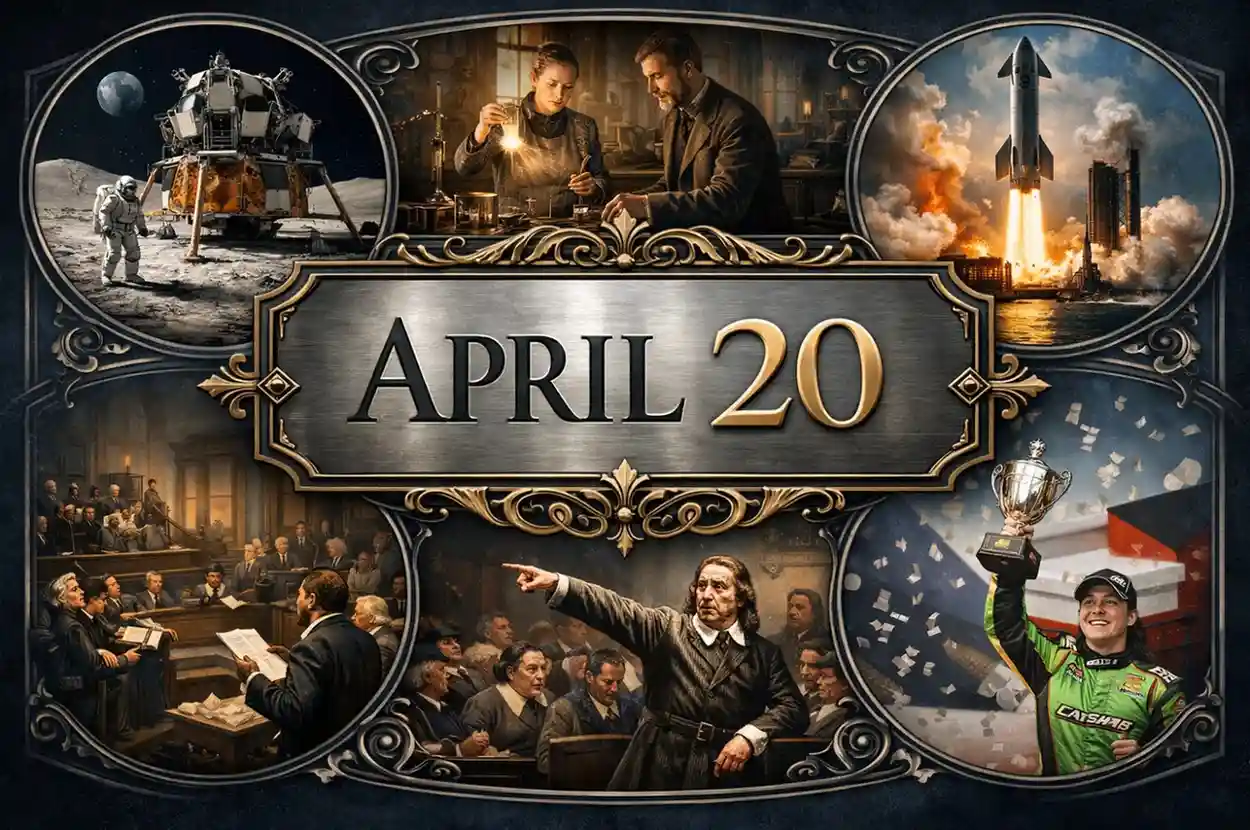
Tracing the evolution of modern society requires looking at the pivotal moments that shifted our global perspective, and revisiting this day in history April 20 offers a unique look at the events that shaped our scientific and political landscapes. By examining everything from the frontiers of space exploration to the challenging pursuit of human rights, we gain a clearer understanding of how these specific historical anchors continue to influence our shared story today.
Important Events That Happened On April 20 In History
1152 – Baldwin III Gains Control
After an eight-year internal conflict, Baldwin III of Jerusalem successfully secured sole control of the Kingdom of Jerusalem from his mother, Melisende. This victory brought an end to a period of joint rule and political friction that had divided the nobility of the Crusader state. Baldwin III’s consolidation of power allowed him to focus on external threats and stabilize the kingdom’s borders during a volatile era. His reign followed this transition with significant military efforts to strengthen the Latin East against surrounding regional powers.
1303 – Sapienza University Instituted
The Sapienza University of Rome was officially instituted by a papal bull issued by Pope Boniface VIII to serve as a center for higher learning. It was originally established to provide a dedicated space for the study of ecclesiastical and civil law within the heart of the Papal States. Over the centuries, the institution grew into one of the largest and most prestigious universities in Europe, fostering generations of scholars and scientists. Its founding remains a major milestone in the development of the European academic tradition and the preservation of classical knowledge.
1303 – Battle of Marj al-Saffar
The Bahri Mamluks achieved a decisive victory over the Ilkhanate forces at the Battle of Marj al-Saffar, effectively ending the Mongol incursions into Syria. This military triumph stopped the westward expansion of the Mongol Empire and secured the Mamluk Sultanate’s position as the dominant power in the Levant. The conflict involved high-stakes cavalry maneuvers and represented a final, desperate attempt by the Ilkhanate to reclaim lost regional territories. This success ensured that Syrian cities remained under Islamic governance and free from the threat of further Mongol conquest.
1653 – Dissolution of the Rump Parliament
Oliver Cromwell took the dramatic step of forcibly dissolving England’s Rump Parliament, famously accusing its members of self-interest and corruption. This action effectively centralized power in his hands and paved the way for the establishment of the Protectorate with Cromwell as Lord Protector. The dissolution marked a significant turning point in the aftermath of the English Civil War, moving the nation away from parliamentary rule toward military-backed governance. It remains a famous moment in British constitutional history, symbolizing the collapse of the initial republican experiment.
1657 – Battle of Santa Cruz de Tenerife
English Admiral Robert Blake led a successful attack to destroy a Spanish silver fleet while under heavy defensive fire from the shore at Santa Cruz de Tenerife. Despite the strong Spanish fortifications, the English fleet managed to sink or burn the entire treasure fleet, depriving Spain of vital colonial wealth. This victory was a major naval achievement for the Commonwealth and demonstrated Blake’s innovative tactical approach to attacking heavily defended coastal positions. The engagement weakened the Spanish economy and bolstered England’s growing dominance over the Atlantic trade routes.
1657 – Religious Freedom in New Amsterdam
Official freedom of religion was granted to the Jewish residents of New Amsterdam, which would later be known as the city of New York. This legal recognition followed persistent advocacy by the local Jewish community for the right to practice their faith and participate in civic life. It was a rare and significant step toward pluralism in the Dutch colonial world, setting an early precedent for the religious diversity of the region. This decision allowed for the establishment of more permanent Jewish institutions and contributed to the vibrant cultural landscape of the colony.
1752 – Konbaung–Hanthawaddy War Begins
The start of the Konbaung–Hanthawaddy War marked a new and intense phase in the long-running Burmese Civil War that had devastated the region since 1740. This conflict pitted the rising Konbaung dynasty against the Restored Hanthawaddy Kingdom in a struggle for total control over the central and southern territories. The fighting involved large-scale sieges and naval engagements along the Irrawaddy River, fundamentally reshaping the political map of mainland Southeast Asia. The eventual Konbaung victory would lead to the unification of a powerful new Burmese empire.
1770 – Victory at Aspindza
The Georgian king, Erekle II, won a stunning victory over Ottoman forces at Aspindza despite being abandoned by his Russian ally, Count Totleben. Faced with overwhelming numbers, the Georgian army utilized the rugged terrain to trap and defeat the invading Ottoman troops during a critical mountain pass engagement. This success proved the resilience of the Georgian military and its ability to defend the kingdom’s sovereignty without external support. The victory at Aspindza remains an important symbol of national pride and military independence in the history of the Caucasus.
1789 – George Washington Reaches Philadelphia
George Washington arrived at Grays Ferry in Philadelphia while traveling from his home at Mount Vernon to Manhattan for his first presidential inauguration. He was greeted by cheering crowds and ceremonial honors, reflecting the immense public hope and respect placed in the new national leader. His journey through the states served as a unifying tour that helped build early confidence in the newly established federal government. This stop in Philadelphia highlighted the city’s role as a major political hub during the formative years of the United States.
1792 – France Declares War on Hungary and Bohemia
The French Legislative Assembly voted to declare war against the “King of Hungary and Bohemia,” signaling the official start of the French Revolutionary Wars. This decision followed months of rising tension between the new revolutionary government in Paris and the traditional monarchies of Europe who feared the spread of radical ideals. The conflict would expand to involve nearly every major European power and last for more than two decades, fundamentally altering the continent’s borders. This declaration launched a period of unprecedented social and military upheaval across the Western world.
1800 – Establishment of the Septinsular Republic
The Septinsular Republic was officially established as a protectorate over the seven main Ionian Islands following the withdrawal of French forces. This new state was unique as it represented the first instance of Greek self-rule in the modern era, though it remained under Ottoman suzerainty and Russian protection. The republic’s creation provided a laboratory for early Greek constitutional development and the rise of a new administrative class. Its existence was a vital precursor to the later Greek War of Independence and the formation of a fully sovereign Greek nation.
1809 – Battle of Abensberg
Napoleon led the French army to a victory over two Austrian army corps in Bavaria during the second day of a decisive four-day military campaign. This engagement at the Battle of Abensberg showcased Napoleon’s ability to divide and conquer his opponents through rapid movement and tactical coordination. The defeat of the Austrian forces allowed the French to gain the upper hand in the Danube valley and move toward the eventual occupation of Vienna. This victory highlighted the ongoing effectiveness of the French military system during the height of the First Empire.
1828 – René Caillié Enters Timbuktu
René Caillié became the second non-Muslim European to enter the city of Timbuktu, reaching the legendary trading post by disguising himself as a poor traveler. Unlike his predecessor, Major Gordon Laing, Caillié successfully managed to return to Europe alive to document his experiences and observations of the fabled city. His detailed reports provided the first accurate western description of Timbuktu’s architecture and society, dispelling many myths regarding its supposed gold-paved streets. His journey remains a celebrated feat of endurance and cultural immersion in the history of African navigation.
1836 – Creation of Wisconsin Territory
The U.S. Congress passed an act officially creating the Wisconsin Territory, carving it out of the larger Michigan Territory to provide for better local governance. This administrative move established a new territorial capital and organized a legal system for the rapidly growing population of settlers in the Upper Midwest. The territory initially included vast areas that would eventually become parts of several other neighboring states, including Iowa and Minnesota. Its creation was a critical step in the organized expansion of the United States toward the Great Lakes region.
1861 – Resignation of Robert E. Lee
Robert E. Lee officially resigned his commission in the United States Army in order to take command of the military forces of his home state of Virginia. Despite being offered a high-ranking position in the Union army, Lee felt his primary loyalty belonged to his state as the American Civil War began to escalate. This decision was a major blow to the federal military leadership, which lost one of its most capable and respected officers to the secessionist cause. His resignation ensured that the upcoming conflict would be led by some of the most skilled commanders on both sides.
1861 – Lowe’s Record Balloon Flight
Thaddeus S. C. Lowe completed a record-breaking balloon journey, flying approximately 900 miles from Cincinnati, Ohio, to South Carolina in only nine hours. This flight was an attempt to demonstrate the potential value of balloons for military reconnaissance and rapid communication during the onset of the Civil War. Although he landed in Confederate territory and was briefly detained as a spy, the mission proved the feasibility of long-distance aerial travel. His efforts eventually led to the creation of the Union Army Balloon Corps, the first official aerial unit in American history.
1862 – Disproving Spontaneous Generation
Louis Pasteur and Claude Bernard successfully completed a series of experiments that officially disproved the long-standing theory of spontaneous generation. By utilizing swan-necked flasks to prevent contamination, they demonstrated that microorganisms only grow from existing life rather than appearing spontaneously from non-living matter. This discovery provided a foundational proof for the germ theory of disease and revolutionized the fields of biology and medicine. Their work paved the way for modern pasteurization, vaccination, and sterilization techniques that have saved countless lives worldwide.
1865 – Demonstration of the Secchi Disk
Astronomer Angelo Secchi first demonstrated the use of the Secchi disk to measure water clarity while aboard the yacht of Pope Pius IX. The simple device consists of a plain white or black-and-white disk that is lowered into the water to determine the depth at which it is no longer visible. This invention provided a standardized and inexpensive method for assessing the turbidity of oceans and lakes, a technique that remains in widespread use by marine scientists today. The demonstration marked a significant contribution to the early development of the field of limnology.
1876 – Start of the April Uprising
The April Uprising began in Bulgaria as local revolutionaries rose up against Ottoman rule in a quest for national independence and human rights. Although the uprising was violently suppressed by Ottoman forces, the resulting atrocities shocked European public opinion and drew international attention to the Bulgarian cause. This widespread outcry turned the status of Bulgaria into a central condition for ending the subsequent Russo-Turkish War. The courage shown by the insurgents eventually led to the liberation of the Bulgarian people and the formation of a modern state.
1884 – Publication of Humanum Genus
Pope Leo XIII published the encyclical Humanum genus, a formal document that officially condemned the principles and practices of Freemasonry. The text argued that the secretive organization promoted secularism and naturalism, which the Church viewed as a threat to religious authority and social order. This publication reinforced the long-standing opposition between the Catholic Church and Masonic lodges that had existed since the early eighteenth century. It served as a definitive statement on the Church’s stance toward clandestine societies during a period of rising political liberalism in Europe.
1898 – McKinley Signs War Resolution
U.S. President William McKinley signed a joint resolution from Congress authorizing a declaration of war against Spain, marking the start of the Spanish–American War. The conflict was sparked by public outrage over the sinking of the USS Maine and the ongoing struggle for independence in Cuba. This decision launched the United States into its first major overseas conflict and signaled its emergence as a global imperial power. The resulting war would lead to the acquisition of several territories, including Puerto Rico, Guam, and the Philippines, altering America’s international role.
1902 – Refinement of Radium Chloride
Pierre and Marie Curie successfully refined one-tenth of a gram of pure radium chloride from several tons of pitchblende ore after years of labor. This achievement allowed them to accurately determine the atomic weight of radium and provided the first tangible sample of the highly radioactive element. Their meticulous work in a rudimentary laboratory proved the existence of new elements and laid the groundwork for the field of nuclear physics. This milestone earned the Curies worldwide fame and eventually led to Marie Curie becoming the first woman to win a Nobel Prize.
1908 – First NSW Rugby League Competition
Opening day for the New South Wales Rugby League was held in Sydney, marking the beginning of the first professional rugby league competition in Australia. The new league was formed by players who sought fair compensation for injuries and loss of wages, breaking away from the amateur rugby union establishment. Nine original clubs participated in the inaugural season, sparking a long-standing sporting tradition that would become a central part of Australian culture. This event was a major turning point in the professionalization of team sports and the growth of the rugby league code.
1914 – The Ludlow Massacre
Nineteen people, including women and children, were killed during the Ludlow Massacre when the Colorado National Guard attacked a camp of striking coal miners. The miners had been on strike for months to protest dangerous working conditions and low pay in the mines owned by the Rockefeller family. The violence erupted as the state militia opened fire on the tent colony and set it ablaze, leading to widespread national outrage and labor unrest. This tragic event remains a somber and pivotal moment in the history of the American labor movement and industrial relations.
1918 – Final Victories of the Red Baron
Manfred von Richthofen, famously known as the “Red Baron,” shot down his 79th and 80th victims, marking his final aerial victories of World War I. These successes solidified his status as the highest-scoring ace of the conflict and a legendary figure in the history of military aviation. Flying his distinctive red triplane, he had become a symbol of both fear and respect for Allied pilots across the Western Front. Richthofen was killed in action the very next day, bringing an end to his influential career and the era of early air combat.
1922 – Creation of South Ossetian Oblast
The Soviet government officially created the South Ossetian Autonomous Oblast as an administrative unit within the Georgian Soviet Socialist Republic. This move was intended to manage the ethnic and regional identity of the South Ossetian people within the centralized structure of the USSR. The establishment of this autonomous region aimed to balance local national sentiments with the overarching goals of Soviet state-building in the Caucasus. This administrative division would later become a focal point of intense political and military conflict following the eventual collapse of the Soviet Union.
1945 – Capture of Leipzig
U.S. troops successfully captured the city of Leipzig, Germany, after facing heavy resistance from entrenched Nazi defenders during the final weeks of World War II. The city was a major industrial and transportation hub, making its fall a significant blow to the remaining German war effort. However, according to prior agreements between the Allied powers, the Americans later ceded the city to the Soviet Union to be included in their occupation zone. This transition of power was part of the complex geopolitical negotiations that defined the post-war division of Germany and Europe.
1945 – Hitler’s Last Public Appearance
On his 56th birthday, Adolf Hitler made his final trip to the surface from the Führerbunker to award Iron Crosses to boy soldiers of the Hitler Youth. This somber event occurred in the garden of the Reich Chancellery while Soviet forces were closing in on the heart of Berlin. The footage of the shaking and aging dictator greeting teenage soldiers became a haunting symbol of the total collapse of the Third Reich. This was the last time Hitler was seen in public before his eventual suicide as the war in Europe reached its definitive conclusion.
1945 – Bullenhuser Damm Massacre
Twenty Jewish children who had been subjected to horrific medical experiments at the Neuengamme concentration camp were killed in the basement of the Bullenhuser Damm school. The SS carried out the murders to cover up the evidence of the illegal experiments as Allied forces approached the city of Hamburg. This tragic event remains one of the most chilling examples of the specialized atrocities committed by Nazi doctors and officials during the Holocaust. The school now serves as a memorial to honor the young victims and to ensure that their names and stories are never forgotten.
1946 – Dissolution of the League of Nations
The League of Nations was officially dissolved during its final assembly in Geneva, transferring most of its assets and administrative power to the newly formed United Nations. The organization had been created after World War I to prevent future conflicts but had largely failed to stop the aggression that led to World War II. Its dissolution marked the end of the first global experiment in collective security and international cooperation. The transition to the United Nations aimed to create a more effective and inclusive body for maintaining world peace and addressing global challenges.
1949 – The Amethyst Incident
The People’s Liberation Army attacked the British warship HMS Amethyst as it traveled up the Yangtze River toward the embassy in Nanjing during the Chinese Civil War. The ship was grounded by heavy artillery fire, leading to a tense and bloody standoff that lasted for several months before its eventual escape. This event, known as the “Amethyst Incident,” signaled the definitive end of the era of Western “gunboat diplomacy” in Chinese waters. It highlighted the changing power dynamics in Asia as the communist forces moved toward total victory on the mainland.
1961 – Failure of the Bay of Pigs Invasion
The U.S.-backed invasion of Cuba by a group of exiles officially ended in total failure as the remaining invaders were captured or forced to retreat. The operation at the Bay of Pigs had aimed to spark a popular uprising against Fidel Castro’s government but was poorly executed and lacked necessary air support. The defeat was a major embarrassment for the Kennedy administration and significantly strengthened Castro’s political position within Cuba and the broader Soviet bloc. This failure led to increased tensions in the Cold War and pushed Cuba toward a closer military alliance with the USSR.
1968 – “Rivers of Blood” Speech
English politician Enoch Powell delivered his highly controversial and divisive “Rivers of Blood” speech to a meeting of Conservative Party members in Birmingham. The address criticized current immigration policies and predicted a future of violent social conflict if the demographic shifts in Britain were not halted. The speech sparked immediate widespread condemnation from across the political spectrum and led to Powell’s dismissal from the shadow cabinet. It remains one of the most debated and polarizing moments in modern British political history, highlighting the deep tensions surrounding race and national identity.
1968 – South African Airways Flight 228
A South African Airways Flight 228 crashed shortly after takeoff from J.G. Strijdom Airport in South West Africa, resulting in the tragic deaths of 123 people. The aircraft struck the ground in a steep descent after the crew apparently mismanaged the flaps during the initial climb. This tragedy remains the deadliest aviation accident in the history of the region and led to significant changes in pilot training and cockpit procedures. The loss of life caused a national period of mourning and focused international attention on the safety of the growing global air travel industry.
1972 – Apollo 16 Lunar Landing
The Apollo 16 Lunar Module, commanded by John Young and piloted by Charles Duke, successfully landed in the Descartes Highlands of the Moon. This was the fifth human landing on the lunar surface and the first to target a mountainous highland region for scientific study. The crew spent nearly three days on the Moon, conducting three separate moonwalks and collecting over 200 pounds of lunar soil and rock samples. This mission provided essential data regarding the geological history of the Moon and demonstrated the ongoing success of the American space program.
1985 – UCR Laboratory Raid
The Animal Liberation Front conducted a large-scale raid on a research laboratory at the University of California, Riverside, rescuing 467 animals being used for testing. The activists caused approximately $700,000 in damages to the facility while removing various species, including a young macaque monkey named Britches. This action was taken to advocate for animal rights and to draw public attention to the treatment of animals in scientific research. The raid sparked a national debate regarding the ethics of animal testing and the tactics used by radical animal rights organizations.
1998 – Air France Flight 422
An Air France Flight 422 crashed shortly after taking off from El Dorado International Airport in Bogotá, resulting in the deaths of all 53 people on board. The aircraft, which was being operated by TAME on behalf of Air France, struck a mountainside during poor visibility and heavy rain. An investigation later determined that the crew had failed to follow established departure procedures, leading to a loss of situational awareness in the challenging terrain. This tragedy highlighted the persistent risks of mountain aviation and the critical importance of strict adherence to flight protocols.
1999 – Columbine High School Massacre
Two students, Eric Harris and Dylan Klebold, carried out a mass shooting and bombing attack at Columbine High School in Colorado, killing 12 students and one teacher. The perpetrators also injured 23 others before committing suicide in the school library as police closed in on the building. This horrific event remains one of the most infamous and influential school shootings in American history, sparking a national conversation about gun control, bullying, and mental health. The tragedy led to significant changes in school security and law enforcement response tactics across the country.
2004 – Nicoll Highway Collapse
A section of the Nicoll Highway in Singapore collapsed during the construction of a new mass rapid transit line, resulting in the tragic deaths of four workers. The collapse occurred due to the failure of a temporary retaining wall, which caused a massive sinkhole to open up and swallow a large portion of the road. This industrial disaster led to a major investigation into construction safety standards and engineering practices in the city-state. The event resulted in new regulations and a renewed focus on the importance of geological assessments in large-scale urban infrastructure projects.
2007 – Johnson Space Center Shooting
William Phillips barricaded himself with a handgun inside a building at NASA’s Johnson Space Center in Houston, sparking a tense hostage situation. Before police could resolve the standoff, Phillips killed a male hostage and then took his own life as security forces breached the room. The incident caused a lockdown of the entire space center and raised serious questions regarding workplace violence and security protocols at high-profile government facilities. This tragedy was a somber event for the NASA community, which was forced to re-evaluate its internal safety and mental health support systems.
2008 – Danica Patrick’s Historic Win
Danica Patrick won the Indy Japan 300, becoming the first female driver in history to win a major Indy car race. Her victory at the Twin Ring Motegi circuit was a breakthrough moment for women in motorsports, proving that female athletes could compete and win at the highest levels of the sport. Patrick had been a prominent figure in racing for several years, and her success in Japan brought a massive increase in public interest and sponsorship to the league. This achievement remains a landmark event in the ongoing journey toward gender equality in professional sports.
2010 – Deepwater Horizon Explosion
The Deepwater Horizon drilling rig exploded in the Gulf of Mexico, resulting in the deaths of eleven workers and triggering the largest marine oil spill in history. The blast was caused by a blowout of the wellhead, leading to an uncontrollable leak that lasted for six months and devastated the regional ecosystem. The disaster caused billions of dollars in economic damage and sparked a massive environmental cleanup and legal battle that lasted for years. This event highlighted the extreme risks of deep-water drilling and led to significant changes in offshore safety regulations and industry oversight.
2012 – Bhoja Air Flight 213
An aircraft operated by Bhoja Air crashed into a residential area near the Benazir Bhutto International Airport in Pakistan, resulting in the deaths of all 127 people on board. The plane was attempting to land during a severe thunderstorm and wind shear when it lost altitude and struck several homes. This tragedy remains one of the deadliest aviation accidents in Pakistan’s history and led to a temporary suspension of the airline’s operations. An investigation into the crash focused on the age of the aircraft and the training of the crew in handling extreme weather conditions.
2013 – Lushan Earthquake
A powerful 6.6-magnitude earthquake struck Lushan County in China’s Sichuan province, resulting in the deaths of at least 193 people and injuring thousands. The seismic event caused extensive damage to rural housing and infrastructure, leaving tens of thousands of residents homeless in the rugged mountainous region. The Chinese government launched a massive rescue and relief operation, utilizing military and civilian resources to reach isolated communities. This disaster occurred in the same general region as the devastating 2008 earthquake, highlighting the persistent seismic vulnerability of western China.
2015 – Puntland Convoy Attack
Ten people were killed in a brutal bomb attack targeting a convoy carrying food supplies to a United Nations compound in the Garowe region of Puntland, Somalia. The attack, which was claimed by the extremist group Al-Shabaab, targeted international aid workers and their local security detail. This event underscored the ongoing volatility and danger faced by humanitarian organizations operating in conflict zones across East Africa. The bombing drew international condemnation and led to a temporary suspension of aid deliveries in the region while security protocols were being thoroughly re-evaluated.
2020 – Negative Oil Prices
For the first time in history, global oil prices dropped below zero as a result of a major price war between Russia and Saudi Arabia and the impact of the global health crisis. This unprecedented economic event meant that producers were essentially paying buyers to take delivery of oil due to a total lack of storage space and a collapse in demand. The negative pricing highlighted the extreme volatility of the global energy market and the profound economic disruptions caused by the sudden halt of international travel and industry. This day remains a unique and historic anomaly in the history of global commodities trading.
2021 – Verdict in the Chauvin Trial
Derek Chauvin was found guilty of all charges, including second-degree murder, in the death of George Floyd by a jury in the Fourth Judicial District Court of Minnesota. The verdict followed a high-profile trial that focused on the video evidence of Floyd’s death and sparked a massive wave of protests and social justice movements worldwide. This legal outcome was seen by many as a historic milestone in the effort to hold law enforcement accountable for the use of excessive force. The decision had a profound impact on the national conversation regarding race, policing, and the American justice system.
2023 – First Starship Launch
SpaceX’s Starship rocket, the largest and most powerful launch vehicle ever built, lifted off for the first time from its launch site in south Texas. While the rocket successfully cleared the tower and reached an altitude of approximately 24 miles, it experienced multiple engine failures and exploded four minutes into the flight. Despite the loss of the vehicle, the test provided invaluable data for the ongoing development of the spacecraft, which is designed to eventually carry humans to Mars. This launch represented a major step forward in the future of heavy-lift spaceflight and interplanetary exploration.
Read Also: April 19: Revolutionary Beginnings
Famous People Born On April 20
| Name | Description | Date |
|---|---|---|
| Pietro Aretino | Italian poet, prose writer, and dramatist | April 20, 1492 – October 21, 1556 |
| David Brainerd | American Presbyterian missionary to Native Americans | April 20, 1718 – October 9, 1747 |
| Florimund Mercy, Count d’Argenteau | Austrian diplomat during the French Revolution | April 20, 1727 – August 25, 1794 |
| Philippe Pinel | French physician, pioneered humane treatment of mentally ill | April 20, 1745 – October 25, 1826 |
| Marc Séguin, the Elder | French engineer, invented wire-cable suspension bridge | April 20, 1786 – February 24, 1875 |
| Sir William Edmond Logan | Welsh-Canadian geologist | April 20, 1798 – June 22, 1875 |
| Franz Xaver Winterhalter | German painter of royal portraits | April 20, 1805 – July 8, 1873 |
| Aloysius Bertrand | French author, introduced prose poem | April 20, 1807 – April 29, 1841 |
| James David Forbes | Scottish physicist, researched heat conduction and glaciers | April 20, 1809 – December 31, 1868 |
| Odilon Redon | French Symbolist painter and printmaker | April 20, 1840 – July 6, 1916 |
| Carol I | First king of Romania | April 20, 1839 – October 10, 1914 |
| Wilhelm Körner | German organic chemist, benzene ring studies | April 20, 1839 – March 28, 1925 |
| Alexandre Alberto da Rocha de Serpa Pinto | Portuguese explorer of southern and central Africa | April 20, 1846 – December 28, 1900 |
| Vyacheslav Konstantinovich Plehve | Russian imperial statesman | April 20, 1846 – July 28, 1904 |
| Daniel Chester French | American sculptor, Lincoln Memorial statue | April 20, 1850 – October 7, 1931 |
| Thomas Morris, Jr. | Scottish golfer, four-time Open Championship winner | April 20, 1851 – December 25, 1875 |
| Eduardo Acevedo Díaz | Uruguayan novelist and politician | April 20, 1851 – June 18, 1924 |
| Pieter Jelles Troelstra | Dutch socialist statesman and poet | April 20, 1860 – May 12, 1930 |
| Charles Maurras | French writer, “integral nationalism” theorist | April 20, 1868 – November 16, 1952 |
| Wojciech Korfanty | Polish political leader, Upper Silesia independence | April 20, 1873 – August 17, 1939 |
| Paul Poiret | French couturier, pre-World War I fashion designer | April 20, 1879 – April 30, 1944 |
| Maurice Le Noblet Duplessis | Premier of Quebec (1936–39, 1944–59) | April 20, 1890 – September 7, 1959 |
| Howard Leroy Vickery | U.S. naval admiral, merchant shipbuilder of WWII | April 20, 1892 – March 21, 1946 |
| Martinus Nijhoff | Dutch poet, master of poetic technique | April 20, 1894 – January 26, 1953 |
| Henry de Montherlant | French novelist and dramatist | April 20, 1895 – September 21, 1972 |
| Gregory Ratoff | Russian-born actor and director | April 20, 1897 – December 14, 1960 |
| Michel Leiris | French writer and anthropologist | April 20, 1901 – September 30, 1990 |
| George Robert Stibitz | U.S. mathematician, invented Complex Number Calculator | April 20, 1904 – January 31, 1995 |
| Stanley Marcus | American retail executive, Neiman Marcus | April 20, 1905 – January 22, 2002 |
| Lionel Hampton | American jazz vibraphonist and bandleader | April 20, 1908 – August 31, 2002 |
Famous People Died On April 20
| Name | Description | Date |
|---|---|---|
| Victor | Antipope (1159–64) against Pope Alexander III | Unknown – April 20, 1164 |
| Richard FitzGilbert, 2nd earl of Pembroke | Anglo-Norman lord, invaded Ireland (1170) | c.1130 – April 20, 1176 |
| Hōjō Tokimune | Japanese regent, repelled Mongol invasions | June 5, 1251 – April 20, 1284 |
| Caedwalla | King of Wessex (685/86–688) | c.659 – April 20, 689 |
| Johann Christoph Denner | German instrument maker, invented the clarinet | August 13, 1655 – April 20, 1707 |
| Marie Camargo | French ballerina, technical innovator | April 15, 1710 – April 20, 1770 |
| Alexandre-François Desportes | French painter of animals and hunts | 1661 – April 20, 1743 |
| John Goodricke | English astronomer, discovered periodicity of variable stars | September 17, 1764 – April 20, 1786 |
| Johan Henrik Kellgren | Swedish poet of the Enlightenment | December 1, 1751 – April 20, 1795 |
| John Russell | English pastel artist and amateur astronomer | March 29, 1745 – April 20, 1806 |
| George Clinton | 4th vice president of the United States | July 26, 1739 – April 20, 1812 |
| Arthur Young | English writer on agriculture and economics | September 11, 1741 – April 20, 1820 |
| Albertine-Adrienne Necker de Saussure | Swiss writer on women’s education | 1766 – April 20, 1841 |
| Nicolas-François, Count Mollien | French statesman, financial adviser to Napoleon | February 28, 1758 – April 20, 1850 |
| Robert Livingston Stevens | U.S. engineer, invented railroad rail and spike | October 18, 1787 – April 20, 1856 |
| Chauncey Jerome | American inventor and clock maker | June 10, 1793 – April 20, 1868 |
| Carl Loewe | German composer of dramatic ballads | November 30, 1796 – April 20, 1869 |
| Frank Stockton | American novelist, “The Lady, or the Tiger?” | April 5, 1834 – April 20, 1902 |
| Charles Friedel | French chemist, Friedel-Crafts reaction | March 12, 1832 – April 20, 1899 |
| Ferdinand Braun | German physicist, Nobel Prize for wireless telegraphy | June 6, 1850 – April 20, 1918 |
| Paul, Baron Gautsch von Frankenthurn | Austrian prime minister (three terms) | February 26, 1851 – April 20, 1918 |
| George Ferdinand Becker | American geologist | January 5, 1847 – April 20, 1919 |
| John Henry Wigmore | American legal scholar, Wigmore on Evidence | March 4, 1863 – April 20, 1943 |
| Charles Sumner Tainter | American inventor, improved phonograph | August 25, 1854 – April 20, 1940 |
| Alfred Cort Haddon | British anthropologist, founder of modern British anthropology | May 24, 1855 – April 20, 1940 |
| Giuseppe Peano | Italian mathematician, founder of symbolic logic | August 27, 1858 – April 20, 1932 |
| Christian X | King of Denmark (1912–47), symbol of resistance to Nazi occupation | September 26, 1870 – April 20, 1947 |
| Ivanoe Bonomi | Prime minister of Italy before and after Mussolini | October 18, 1873 – April 20, 1951 |
| Paul Fort | French Symbolist poet | February 1, 1872 – April 20, 1960 |
| Archibald MacLeish | American poet and public official | May 7, 1892 – April 20, 1982 |
Observances & Institutional Dates
- UN Chinese Language Day: An international awareness day established by the United Nations to celebrate multilingualism and the history of the Chinese language.
- 420 (Cannabis Culture): An unofficial global holiday celebrated by enthusiasts of cannabis culture, characterized by social gatherings and advocacy for legal reform.
- Evacuee Flag Day (Finland): A day of remembrance in Finland dedicated to those who were forced to flee their homes during the conflicts of World War II.
- Earth Day (Observed): While traditionally April 22, many organizations and schools hold Earth Day-related events and educational programs on the nearest weekday.
Frequently Asked Questions
- What was the Ludlow Massacre? It was a 1914 event where the Colorado National Guard killed nineteen people during a coal miners’ strike over poor working conditions.
- When did Apollo 16 land on the Moon? The Lunar Module landed on April 20, 1972, marking the fifth human landing and the first in a highland region.
- Who was the first female driver to win an Indy car race? Danica Patrick made history on April 20, 2008, by winning the Indy Japan 300.
- What happened to oil prices on this day in 2020? For the first time in history, oil prices dropped below zero due to an international price war and a global collapse in demand.