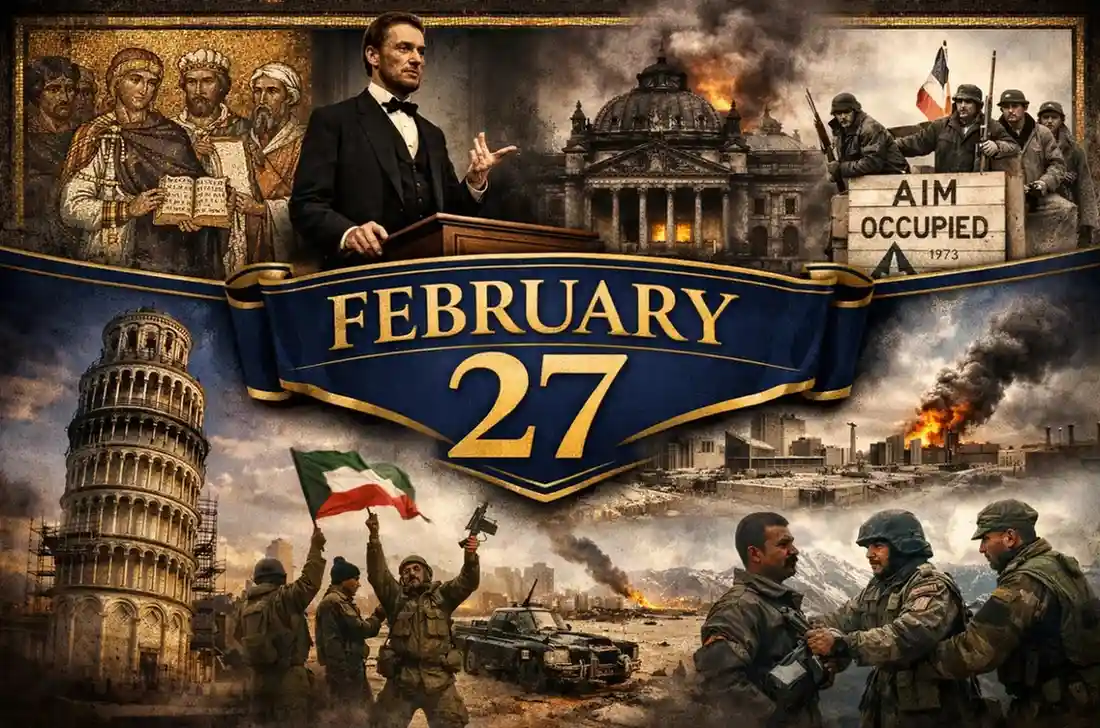
The narrative of human progress often shifts on a single day of profound transformation, and when we look at what happened on this day in history February 27, we see the foundations of modern society being poured. It is a day where the Roman Empire officially embraced a single faith, where the scientific world unlocked the secrets of carbon-14, and where the United States established the two-term limit for its presidency.
From the fires of the Reichstag to the liberation of nations, today serves as a vivid reminder that the structures we inhabit—spiritual, scientific, and political—are the result of centuries of calculated risks and historic turning points.
Important Events That Happened On February 27 In History
380 – Edict of Thessalonica
Emperors Theodosius I, Gratian, and Valentinian II issued a joint decree declaring their desire for all Roman citizens to convert to Nicene Christianity. This move effectively made this specific branch of Christianity the official state religion of the Roman Empire while branding dissenters as heretics. This was a monumental shift that ended centuries of religious pluralism and set the stage for the dominance of the Catholic Church in Europe.
425 – University of Constantinople Founded
Emperor Theodosius II officially founded the University of Constantinople, an institution that would become a beacon of learning for the Byzantine Empire. The school was established at the urging of his wife, Aelia Eudocia, and focused on rhetoric, law, philosophy, and medicine. It played a critical role in preserving Greek and Roman knowledge during a time when much of Western Europe was entering a period of intellectual decline.
907 – Abaoji Named Khagan
Abaoji, the ambitious chieftain of the Yila tribe, was officially named the khagan of the Khitans, marking the rise of a powerful new force in East Asia. He eventually founded the Liao dynasty, which would rule over vast territories in Northern China and Mongolia for over two centuries. His leadership successfully blended traditional nomadic customs with Chinese administrative practices, creating a unique and enduring imperial system.
1560 – Treaty of Berwick
England and the Lords of the Congregation of Scotland signed the Treaty of Berwick to address the presence of French troops on Scottish soil. The agreement allowed English military forces to enter Scotland specifically to help the local Protestant lords expel the occupying French Catholic forces. This alliance was a major turning point in the Scottish Reformation and helped secure the future of Protestantism in the British Isles.
1594 – Coronation of Henry IV
Henry IV was officially crowned King of France at Chartres Cathedral, following his strategic conversion from Protestantism to Catholicism. His ascension ended years of bloody religious wars in France, as he famously remarked that “Paris is well worth a Mass” to win over the Catholic majority. His reign brought a rare period of stability and religious tolerance to the kingdom, most notably through the Edict of Nantes.
1617 – Treaty of Stolbovo
Sweden and the Tsardom of Russia signed the Treaty of Stolbovo, bringing a formal end to the Ingrian War. Under the terms of the peace, Russia was forced to cede significant territories, including Ingria and Kexholm, effectively shutting the Russians out of the Baltic Sea for nearly a century. This victory established Sweden as a dominant regional power and a major player in Northern European politics.
1626 – Yuan Chonghuan Appointed Governor
Following a stunning military victory against the Manchurian forces led by Nurhaci, Yuan Chonghuan was appointed as the Governor of Liaodong. His successful defense of Ningyuan was a rare bright spot for the Ming dynasty during its period of decline. Yuan’s tactical brilliance and use of heavy artillery proved that the Manchurians could be defeated, though he would later fall victim to political intrigue within the imperial court.
1776 – Battle of Moore’s Creek Bridge
In a significant early clash of the American Revolutionary War, Patriot forces defeated a Loyalist militia at Moore’s Creek Bridge in North Carolina. The Patriots removed the floorboards from the bridge and greased the remaining beams, causing the advancing Loyalists to slip and fall into a deadly trap. The victory effectively ended British authority in North Carolina and galvanized the revolutionary spirit throughout the southern colonies.
1782 – House of Commons Votes Against War
The British House of Commons took a historic vote against continuing the war in the American colonies, signaling the beginning of the end of the Revolutionary War. The motion was passed following the disastrous British defeat at Yorktown, as parliamentarians grew weary of the immense financial and human costs of the conflict. This vote forced King George III to eventually accept the necessity of negotiating for American independence.
1801 – D.C. Placed Under Congressional Jurisdiction
Pursuant to the District of Columbia Organic Act of 1801, the city of Washington, D.C. was officially placed under the exclusive jurisdiction of the U.S. Congress. This act organized the territory into two counties and established a local court system, but it also famously deprived the city’s residents of voting representation in Congress. This status remains a subject of intense political debate regarding statehood and civil rights to this day.
1809 – Capture of HMS Proserpine
During the Napoleonic Wars, Captain Bernard Dubourdieu led a successful naval action to capture the British frigate HMS Proserpine. The French forces utilized superior positioning and firepower to overwhelm the British vessel off the coast of Toulon. This capture was a notable victory for the French Navy during a period where British maritime dominance was largely unchallenged across the Mediterranean.
1812 – First Raising of the Argentine Flag
Manuel Belgrano, a key leader in the Argentine War of Independence, raised the newly designed blue and white Flag of Argentina for the first time in the city of Rosario. Belgrano created the flag to give his troops a distinct identity and to symbolize the dawn of a new, sovereign nation. Though the government initially resisted the use of the flag to avoid offending Spain, it eventually became the official national symbol.
1812 – Lord Byron’s First Address
The famed poet Lord Byron gave his maiden speech as a member of the House of Lords, where he spoke in passionate defense of the Luddites. He argued against the death penalty for workers who destroyed industrial machinery in Nottinghamshire, framing their violence as a desperate response to poverty and displacement. His address was a rare instance of a high-profile aristocrat championing the cause of the working class against the Industrial Revolution.
1844 – Dominican Independence
The Dominican Republic officially gained its independence from Haiti following a successful uprising led by the secret society La Trinitaria. After twenty-two years of Haitian rule, the revolutionaries captured the Fortress of Ozama and declared the birth of a new sovereign state. This day is celebrated as the primary National Independence Day for the Dominican people, marking the end of foreign occupation on the eastern side of Hispaniola.
1859 – Murder of Philip Barton Key II
U.S. Representative Daniel Sickles shot and killed U.S. Attorney General Philip Barton Key II in broad daylight near the White House after discovering Key was having an affair with his wife. Sickles surrendered to the police but was later acquitted in a landmark trial that utilized the first successful plea of temporary insanity in U.S. history. Despite the scandal, Sickles later became a prominent Union General during the American Civil War.
1860 – Lincoln’s Cooper Union Speech
Abraham Lincoln delivered a powerful and meticulously researched speech at the Cooper Union in New York City, which catapulted him to national prominence. He argued that the Founding Fathers never intended to prevent the federal government from regulating slavery in the territories, directly challenging the platform of his rivals. The speech’s intellectual depth and clarity are credited with securing him the Republican nomination for the presidency.
1864 – First Prisoners Arrive at Andersonville
The first Northern prisoners of war arrived at the newly constructed Confederate prison camp at Andersonville, Georgia. The camp was designed to hold roughly 10,000 men but was soon overcrowded with over 30,000, leading to horrific conditions, starvation, and disease. By the end of the war, nearly 13,000 Union soldiers had died there, making it the most notorious prison of the American Civil War.
1870 – Adoption of the Japanese Merchant Flag
The current flag of Japan, featuring a red sun on a white field, was first officially adopted as the national ensign for Japanese merchant ships. This move was part of the Meiji Restoration’s efforts to modernize Japan and provide a clear national identity for its growing maritime trade. The design, known as the Hinomaru, eventually became the official national flag of Japan for all state and civilian purposes.
1881 – Battle of Majuba Hill
In a decisive engagement of the First Boer War, Boer forces successfully defeated a British army at the Battle of Majuba Hill in South Africa. The Boers utilized superior marksmanship and hill-fighting tactics to overwhelm the British positions, resulting in heavy casualties for the Empire. The defeat forced the British government to sign a peace treaty and recognize the independence of the South African Republic.
1898 – Assassination Attempt on George I
King George I of Greece narrowly survived an assassination attempt while he was out for a drive with his daughter, Princess Maria. Two gunmen opened fire on the royal carriage, but the King’s coachman managed to speed away, leaving the attackers behind. The incident led to a wave of public sympathy for the monarchy and a crackdown on radical political groups within the Greek capital.
1900 – Surrender at Paardeberg
During the Second Boer War, Boer General Piet Cronjé issued an unconditional notice of surrender to British military leaders following the Battle of Paardeberg. This surrender of over 4,000 Boer fighters was the first major British victory of the war and a significant blow to Boer morale. The event marked a transition in the conflict from conventional warfare to the grueling guerrilla campaign that followed.
1900 – Founding of the British Labour Party
The Labour Representation Committee was founded at a meeting in London, which would eventually evolve into the modern British Labour Party. The organization was created to provide a political voice for the working class and to represent the interests of trade unions in Parliament. This founding changed the landscape of British politics, eventually replacing the Liberal Party as one of the two major political forces in the country.
1900 – FC Bayern München Founded
Fußball-Club Bayern München was officially founded by eleven football players led by Franz John in Munich, Germany. The club started as a breakaway group from a local gymnastics club and steadily grew into one of the most successful and popular football teams in the world. Today, Bayern Munich is a global powerhouse, having won numerous Bundesliga titles and multiple European championships.
1902 – Execution of “Breaker” Morant
Australian soldiers Harry “Breaker” Morant and Peter Handcock were executed by a British firing squad in Pretoria after being convicted of war crimes during the Second Boer War. They were accused of killing Boer prisoners and a German missionary, though many in Australia argued they were being used as scapegoats for higher-ranking British officers. The case remains a controversial and emotive piece of Australian military history.
1916 – Sinking of the SS Maloja
The British ocean liner SS Maloja struck a German naval mine near Dover and sank rapidly, resulting in the loss of 155 lives. The ship was carrying passengers and mail to Bombay when the disaster occurred within sight of the English coast. The sinking was part of Germany’s aggressive mine-laying campaign during World War I, which aimed to disrupt British shipping and communication routes.
1921 – Founding of the “Two-and-a-Half International”
The International Working Union of Socialist Parties, often nicknamed the “Two-and-a-Half International,” was founded in Vienna. The organization sought to provide a middle ground between the moderate Second International and the revolutionary Third International (Comintern). While it only lasted a few years before merging with other groups, its founding reflected the deep ideological splits within the global socialist movement after World War I.
1922 – Leser v. Garnett Decision
The Supreme Court of the United States upheld the constitutionality of the Nineteenth Amendment in the case of Leser v. Garnett. The challenge argued that the amendment, which guaranteed women the right to vote, had been improperly ratified and infringed upon state sovereignty. The Court’s unanimous decision firmly rebuffed these claims, ensuring that women’s suffrage was a permanent and legally protected part of American democracy.
1932 – Mäntsälä Rebellion Begins
The Mäntsälä rebellion broke out in Finland when members of the far-right Lapua Movement opened fire at a Social Democratic event. The insurgents demanded the resignation of the government and the banning of all socialist political activities in the country. The rebellion was eventually suppressed by the Finnish government without significant bloodshed, leading to the decline of the radical right-wing movement in Finland.
1933 – The Reichstag Fire
The Reichstag building, the home of the German parliament in Berlin, was set on fire in a pivotal event that Adolf Hitler used to consolidate power. Marinus van der Lubbe, a young Dutch Communist, was arrested at the scene and claimed responsibility for the arson. The Nazis used the fire as a pretext to suspend civil liberties and launch a massive crackdown on political opponents, paving the way for the establishment of the Third Reich.
1939 – NLRB v. Fansteel Metallurgical Corp.
The U.S. Supreme Court ruled in NLRB v. Fansteel Metallurgical Corp. that the National Labor Relations Board did not have the authority to force employers to rehire workers who participated in sit-down strikes. The Court argued that the illegal occupation of an employer’s property was not a protected activity under labor law. This decision was a significant setback for labor unions, as it curtailed one of their most effective protest tactics.
1940 – Discovery of Carbon-14
Scientists Martin Kamen and Sam Ruben discovered carbon-14, a radioactive isotope of carbon, at the University of California, Berkeley. Their discovery revolutionized the fields of archaeology and geology by enabling the development of radiocarbon dating. This scientific breakthrough allowed researchers to accurately determine the age of organic materials, fundamentally changing our understanding of human and natural history.
1942 – Battle of the Java Sea
An Allied naval strike force was decisively defeated by a Japanese task force during the Battle of the Java Sea in the Dutch East Indies. The battle was the largest surface ship engagement since Jutland and resulted in the sinking of several Allied cruisers and destroyers. The Japanese victory effectively ended Allied naval resistance in the region and led to the rapid Japanese occupation of Java.
1943 – Smith Mine Disaster
A massive methane gas explosion at the Smith Mine #3 in Bearcreek, Montana, killed 74 coal miners. It remains the worst coal mining disaster in Montana’s history, leaving a profound impact on the small mining community. The tragedy led to renewed calls for stricter mine safety regulations and a better understanding of gas buildup in deep underground shafts to prevent future loss of life.
1943 – Rosenstrasse Protest Begins
In Berlin, the Gestapo arrested roughly 1,800 Jewish men who were married to non-Jewish German women, sparking the Rosenstrasse protest. The wives of the arrested men gathered in the streets and refused to leave for several days, chanting for the release of their husbands. In a rare instance of successful public defiance against the Nazi regime, the government eventually released the men to avoid further public unrest.
1951 – Ratification of the 22nd Amendment
The Twenty-second Amendment to the U.S. Constitution was officially ratified, limiting presidents to serving a maximum of two terms. The amendment was proposed following Franklin D. Roosevelt’s unprecedented four-term presidency, as many felt a formal limit was necessary to prevent the executive branch from becoming too powerful. This change codified the two-term tradition originally established by George Washington.
1961 – First Congress of Spanish Trade Unions
General Francisco Franco inaugurated the first congress of the Spanish Trade Union Organisation in Madrid. This state-controlled “vertical syndicate” was designed to integrate labor and management under the supervision of the government, effectively banning independent trade unions. The congress was an attempt by the Franco regime to maintain social order and economic control during Spain’s period of industrial growth.
1962 – Bombing of Independence Palace
Two dissident South Vietnamese Air Force pilots bombed the Independence Palace in Saigon in a failed attempt to assassinate President Ngô Đình Diệm. The pilots claimed their goal was to spark a popular uprising against Diệm’s increasingly authoritarian and corrupt government. While the President survived unharmed, the attack highlighted the deep-seated military and political instability within South Vietnam during the early years of the Vietnam War.
1963 – Inauguration of Juan Bosch
Juan Bosch was inaugurated as the first democratically elected president of the Dominican Republic following the end of the long and brutal dictatorship of Rafael Trujillo. Bosch, a prominent intellectual and social democrat, aimed to implement significant land reforms and social programs. However, his presidency was short-lived, as he was overthrown in a military coup just seven months later, leading to further political chaos.
1964 – Italy Asks for Help with the Leaning Tower
The government of Italy officially requested international assistance to prevent the Leaning Tower of Pisa from toppling over. Engineers and historians warned that the tower’s lean was becoming critically dangerous due to the soft soil beneath its foundation. This request launched a decades-long project involving various stabilization techniques, including lead weights and soil extraction, which eventually secured the tower for future generations.
1971 – First Dutch Abortion Clinic Opens
The Mildredhuis in Arnhem became the first clinic in the Netherlands to start performing artificially induced abortions. This move by Dutch doctors was a significant step toward the eventual legalization and regulation of the procedure in the country. The opening of the clinic sparked intense national debate but ultimately helped establish the Netherlands as a leader in reproductive health rights and secular social policies.
1973 – Occupation of Wounded Knee
Members of the American Indian Movement (AIM) took control of the town of Wounded Knee, South Dakota, to protest the federal government’s treatment of Native Americans and tribal leadership. The site was chosen for its symbolic importance as the location of the 1890 massacre. The 71-day standoff with federal authorities drew international attention to the issues of treaty rights and indigenous sovereignty in the United States.
1976 – Independence of Western Sahara Declared
The Polisario Front officially declared the independence of Western Sahara as the Sahrawi Arab Democratic Republic (SADR). This declaration followed the withdrawal of Spanish colonial forces and the subsequent invasion of the territory by Morocco and Mauritania. The proclamation initiated a long and ongoing conflict over the region’s status, as the Sahrawi people continue to seek international recognition and full self-determination.
1988 – Sumgait Pogrom
A violent pogrom targeted the Armenian community in the Azerbaijani city of Sumgait, resulting in dozens of deaths and hundreds of injuries. The ethnic violence was fueled by rising tensions over the status of Nagorno-Karabakh as the Soviet Union began to fragment. The massacre was a major catalyst for the First Nagorno-Karabakh War and led to the mass displacement of Armenians from Azerbaijan and Azerbaijanis from Armenia.
1991 – Liberation of Kuwait Announced
U.S. President George H.W. Bush announced to the world that “Kuwait is liberated” after coalition forces successfully expelled the Iraqi military. The ground campaign had lasted only 100 hours, resulting in the rapid collapse of Saddam Hussein’s occupation forces. While the victory restored Kuwaiti sovereignty, it also left Iraq devastated and set the stage for future Middle Eastern conflicts in the decades to follow.
2001 – Loganair Flight 670A Crash
A Loganair Shorts 360 aircraft, operating as Flight 670A, crashed while attempting an emergency water landing in the Firth of Forth near Edinburgh, Scotland. Both pilots on board were killed when the plane’s engines failed shortly after takeoff due to the ingestion of snow and ice during a pre-flight delay. The accident led to improved safety procedures regarding the use of engine covers and de-icing protocols during winter operations.
2002 – Ryanair Flight 296 Fire
A Ryanair Boeing 737 caught fire shortly after landing at London Stansted Airport, forcing an emergency evacuation of the 117 people on board. The fire originated in the aircraft’s galley, but quick action by the flight crew and emergency services prevented any fatalities. The incident resulted in only minor injuries and led to a review of galley equipment maintenance and fire suppression systems for the airline’s fleet.
2002 – Godhra Train Burning
In a horrific event that triggered widespread communal violence, a Muslim mob torched a train in Godhra, India, killing 59 Hindu pilgrims returning from Ayodhya. The attack led to the 2002 Gujarat riots, one of the deadliest periods of religious conflict in modern Indian history. The tragedy remains a deeply sensitive and contested subject in Indian politics, with ongoing legal and social repercussions for the region.
2004 – SuperFerry 14 Bombing
A bomb exploded on the SuperFerry 14 in Manila Bay, causing the vessel to capsize and kill 116 people in the Philippines’ worst terrorist attack. The Abu Sayyaf group claimed responsibility for the bombing, which they stated was in retaliation for the government’s military actions against them. The tragedy forced a massive overhaul of maritime security in the Philippines and increased international cooperation in counter-terrorism efforts.
2004 – Shoko Asahara Sentenced to Death
Shoko Asahara, the leader of the Japanese doomsday cult Aum Shinrikyo, was sentenced to death for masterminding the 1995 Tokyo subway sarin gas attack. The court found him guilty of 13 separate charges, including the murder of 27 people across multiple incidents. Asahara’s sentencing brought a sense of closure to a long and painful chapter for the Japanese public, though his execution was delayed for many years.
2007 – Chinese Stock Bubble Bursts
The Shanghai Stock Exchange suffered its largest daily fall in a decade, dropping nearly 9% in a single trading session. The crash followed rumors of a government crackdown on illegal share offerings and fears about rising inflation in the rapidly growing Chinese economy. The sudden drop sent shockwaves through global financial markets, highlighting the increasing interconnectedness of the world economy and China’s major role within it.
2008 – Escape of Mas Selamat Kastari
Mas Selamat Kastari, the leader of the Singapore branch of the Jemaah Islamiyah terrorist group, escaped from a high-security detention center in Singapore. His escape through a toilet window triggered a massive nationwide manhunt and led to significant embarrassment for the country’s internal security services. Kastari was eventually recaptured over a year later in Johor, Malaysia, following a tip-off from local residents.
2010 – Chile Earthquake and Tsunami
An 8.8 magnitude earthquake, one of the strongest ever recorded, struck central Chile, killing over 500 people and injuring thousands more. The quake triggered a tsunami that caused extensive damage along the Chilean coast and prompted tsunami warnings across the entire Pacific, including Hawaii. The disaster resulted in billions of dollars in damage and forced a massive rebuilding effort for the nation’s infrastructure.
2013 – Menznau Factory Shooting
A long-term employee opened fire at a wood-processing factory in Menznau, Switzerland, killing four of his colleagues and injuring five others. The gunman eventually turned the weapon on himself, leaving the small Swiss community in a state of shock. The tragedy was particularly jarring for Switzerland, a country known for its high rate of gun ownership but relatively low levels of gun-related violent crime.
2015 – Assassination of Boris Nemtsov
Russian opposition politician and former deputy prime minister Boris Nemtsov was shot and killed while walking across a bridge near the Kremlin in Moscow. Nemtsov was a vocal critic of President Vladimir Putin and had been organizing a protest against Russia’s involvement in the war in Ukraine. His death sparked massive protests in Moscow and drew international condemnation as a blow to democratic dissent in Russia.
2019 – Pakistan-India Aerial Dogfight
In a major escalation of tensions, the Pakistan Air Force downed an Indian Mig-21 during an aerial dogfight over the disputed region of Kashmir. The Indian pilot, Wing Commander Abhinandan Varthaman, was captured by Pakistani forces after ejecting from his aircraft. Varthaman was released two days later as a “gesture of peace,” but the incident marked a significant military confrontation between the two nuclear-armed neighbors.
After reading Feb 27 Tales, Take A look at 26 Feb Amazing facts
Famous People Born On February 27
| Name | Description | Date |
|---|---|---|
| John Steinbeck | American novelist (Grapes of Wrath) | February 27, 1902 – December 20, 1968 |
| Elizabeth Taylor | Hollywood film icon | February 27, 1932 – March 23, 2011 |
| Josh Groban | Singer & actor | February 27, 1981 – Present |
| Chelsea Clinton | Author & public figure | February 27, 1980 – Present |
| Paul Ricoeur | Philosopher & historian | February 27, 1913 – May 20, 2005 |
| Lawrence Durrell | Novelist (Alexandria Quartet) | February 27, 1912 – November 7, 1990 |
| Dexter Gordon | Jazz saxophonist | February 27, 1923 – April 25, 1990 |
| Gene Sarazen | Golf legend | February 27, 1902 – May 13, 1999 |
| Irving Fisher | Economic theorist | February 27, 1867 – April 29, 1947 |
| George Herbert Mead | Social psychologist | February 27, 1863 – April 26, 1931 |
| David Sarnoff | Radio & TV pioneer | February 27, 1891 – December 12, 1971 |
| Hugo Black | U.S. Supreme Court justice | February 27, 1886 – September 25, 1971 |
| Kelly Johnson | Aircraft designer | February 27, 1910 – December 21, 1990 |
| Joan Bennett | Film actress | February 27, 1910 – December 7, 1990 |
| Joaquín Sorolla | Impressionist painter | February 27, 1863 – August 10, 1923 |
| Ellen Terry | Stage actress | February 27, 1847 – July 21, 1928 |
| Henry E. Huntington | Railroad magnate | February 27, 1850 – May 23, 1927 |
| Ralph Linton | Cultural anthropologist | February 27, 1893 – December 24, 1953 |
| Yuly Khariton | Nuclear physicist | February 27, 1904 – December 19, 1996 |
| Robert H. Grubbs | Nobel Prize chemist | February 27, 1942 – December 19, 2021 |
| N. Scott Momaday | Pulitzer Prize novelist | February 27, 1934 – January 24, 2024 |
| Irwin Shaw | Novelist & playwright | February 27, 1913 – May 16, 1984 |
| Lotte Lehmann | Opera singer | February 27, 1888 – August 26, 1976 |
| Angelina Weld Grimké | Poet & dramatist | February 27, 1880 – June 10, 1958 |
| Charles H. Best | Insulin co-discoverer | February 27, 1899 – March 31, 1978 |
| Henry Chandler Cowles | Ecologist pioneer | February 27, 1869 – September 12, 1939 |
| Kenneth Koch | Poet & playwright | February 27, 1925 – July 6, 2002 |
| Marino Marini | Modern sculptor | February 27, 1901 – August 6, 1980 |
| Bernard Lyot | Inventor of coronagraph | February 27, 1897 – April 2, 1952 |
| Hou Yifan | Chess world champion | February 27, 1994 – Present |
Famous People Died On February 27
| Name | Description | Date |
|---|---|---|
| Leonard Nimoy | Star Trek actor (Spock) | March 26, 1931 – February 27, 2015 |
| Boris Nemtsov | Opposition leader | October 9, 1959 – February 27, 2015 |
| Ivan Pavlov | Nobel-winning scientist | September 26, 1849 – February 27, 1936 |
| Aleksandr Borodin | Composer & chemist | November 12, 1833 – February 27, 1887 |
| Van Cliburn | Classical pianist | July 12, 1934 – February 27, 2013 |
| Lillian Gish | Silent film star | October 14, 1893 – February 27, 1993 |
| Fred Rogers | Children’s TV icon | March 20, 1928 – February 27, 2003 |
| Spike Milligan | Writer & comedian | April 16, 1918 – February 27, 2002 |
| Henry Cabot Lodge Jr. | Politician & diplomat | July 5, 1902 – February 27, 1985 |
| William F. Buckley Jr. | Conservative author | November 24, 1925 – February 27, 2008 |
| Necmettin Erbakan | Turkish leader | October 29, 1926 – February 27, 2011 |
| Konrad Lorenz | Ethology founder | November 7, 1903 – February 27, 1989 |
| Nadezhda Krupskaya | Lenin’s wife & activist | February 25, 1869 – February 27, 1939 |
| John Evelyn | Diarist & author | October 31, 1620 – February 27, 1706 |
| Peter Behrens | Modern architecture pioneer | April 14, 1868 – February 27, 1940 |
| Nicholas Biddle | Banker | January 8, 1786 – February 27, 1844 |
| John Dickson Carr | Mystery novelist | November 30, 1906 – February 27, 1977 |
| Carlos Manuel de Céspedes | Independence leader | April 18, 1819 – February 27, 1874 |
| George H. Hitchings | Nobel laureate | April 18, 1905 – February 27, 1998 |
| Robert Sobukwe | Anti-apartheid activist | December 5, 1924 – February 27, 1978 |
| Kingsley Davis | Demography expert | August 20, 1908 – February 27, 1997 |
| Karel Doorman | WWII naval commander | April 23, 1889 – February 27, 1942 |
| George F. Edmunds | Senator | February 1, 1828 – February 27, 1919 |
| Martha Berry | Education reformer | October 7, 1866 – February 27, 1942 |
| Gino Severini | Futurist artist | April 7, 1883 – February 27, 1966 |
| Frank Buckles | WWI veteran | February 1, 1901 – February 27, 2011 |
| Duke Snider | MLB legend | September 19, 1926 – February 27, 2011 |
| S. I. Hayakawa | Linguist & politician | July 18, 1906 – February 27, 1992 |
| Carlos Humberto Romero | President of El Salvador | February 29, 1924 – February 27, 2017 |
| Boris Spassky | World chess champion | January 30, 1937 – February 27, 2025 |
Observances & Institutional Dates
- Independence Day (Dominican Republic): Celebrating the 1844 liberation from Haitian rule.
- Doctors’ Day (Vietnam): A day dedicated to honoring the contributions of medical professionals to society.
- World NGO Day: Recognizing the vital work of non-governmental organizations in addressing global challenges.
- Marathi Language Day: Celebrating the rich literary and cultural heritage of the Marathi-speaking people of India.
Frequently Asked Questions
- What was the Edict of Thessalonica?
- Issued in 380, it made Nicene Christianity the official state religion of the Roman Empire.
- Why is the 22nd Amendment important?
- Ratified on February 27, 1951, it limits the President of the United States to serving only two terms.
- How was carbon-14 discovered?
- It was discovered on this day in 1940 by Martin Kamen and Sam Ruben, leading to the development of radiocarbon dating.
- What happened at the Reichstag in 1933?
- The German parliament building was set on fire, an event the Nazis used to seize absolute control of the government.