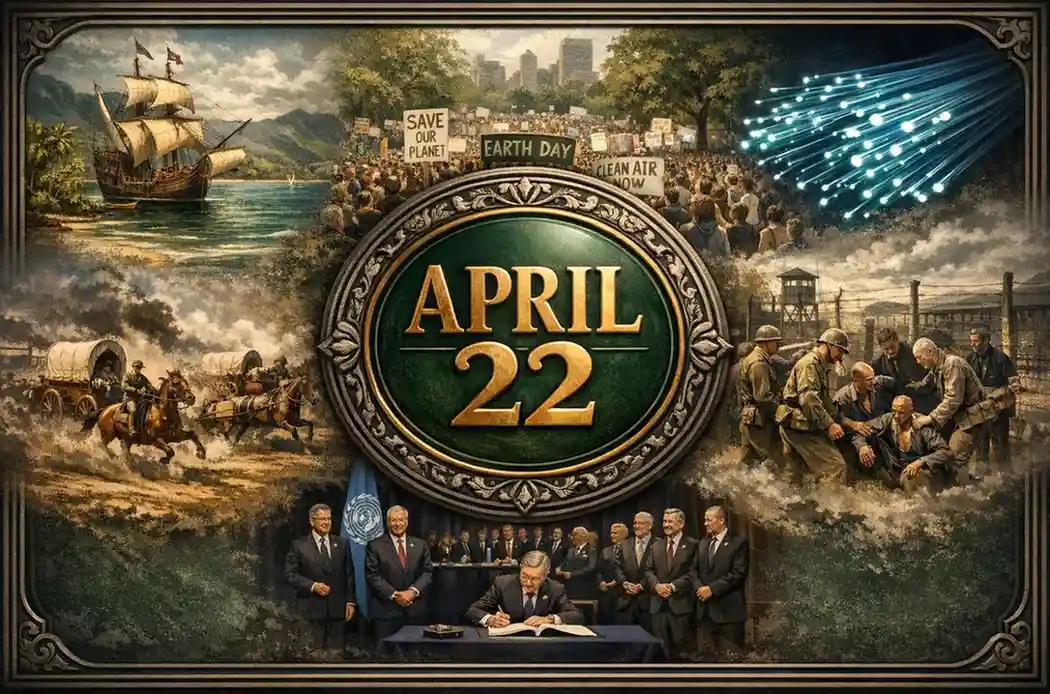
The progression of our global story is often marked by a unique intersection of territorial expansion and a growing awareness of our natural world, and exploring this day in history April 22 reveals a timeline where discovery meets modern stewardship. From the initial arrival of European explorers on the shores of South America to the worldwide mobilization for environmental protection, these events illustrate the shifting priorities that have influenced national borders and international conservation efforts.
Important Events That Happened On April 22 In History
960 – Coronation of Basil II
Basil II was officially crowned as the co-Emperor of the Byzantine Empire, beginning a reign that would eventually see him become one of its most powerful leaders. Though he initially shared the title, his long tenure was marked by significant military expansion and the stabilization of the empire’s northern borders. His administration focused on centralizing imperial authority and reducing the influence of the powerful landed aristocracy. This coronation set the stage for a period of Byzantine dominance in the Eastern Mediterranean and the Balkans.
1073 – Election of Pope Gregory VII
Following the death of Pope Alexander II, the church moved quickly to elect Pope Gregory VII as the new leader of the Catholic world. His papacy became famous for the Gregorian Reforms, which sought to address clerical issues and assert the independence of the church from secular rulers. This election triggered a major power struggle with the Holy Roman Empire, a conflict that redefined the relationship between church and state in Europe. His leadership was a pivotal moment in the development of the medieval papacy and its legal authority.
1500 – Portuguese Landing in Brazil
Portuguese navigator Pedro Álvares Cabral reached the coast of South America, marking the formal arrival of Portugal in what is now Brazil. His fleet was originally traveling toward India when it veered west across the Atlantic, reaching the mainland near Mount Pascoal. This landing allowed the Portuguese crown to claim vast new territories under the terms of previous international agreements. The event established a colonial presence that would last for over three hundred years and fundamentally alter the region’s demographics.
1519 – Establishment of Veracruz
Spanish conquistador Hernán Cortés officially established a settlement at Veracruz on the coast of Mexico to serve as a military and logistical base. This founding allowed him to create a formal legal administration that was technically independent of the colonial authorities in Cuba. The settlement provided a secure port for the arrival of reinforcements and supplies during the initial phases of the Spanish conquest. Veracruz grew into a primary gateway for trade and communication between the Spanish Empire and its mainland American territories.
1529 – Treaty of Zaragoza
Spain and Portugal signed the Treaty of Zaragoza to resolve competing claims over the eastern hemisphere, specifically the valuable spice islands. The agreement established a line of demarcation located 297.5 leagues east of the Moluccas, effectively dividing the Pacific between the two nations. Portugal paid 350,000 ducats to Spain to maintain control of the region, while Spain focused its efforts on the Americas. This diplomatic settlement was a major effort to manage global imperial competition through precise geographical boundaries.
1809 – Battle of Eckmühl
On the second day of the Battle of Eckmühl, the Austrian army suffered a defeat at the hands of the First French Empire army led by Napoleon. The French victory forced the Austrian troops to retreat across the Danube River into the city of Regensburg. This success allowed Napoleon to secure the tactical advantage in the Danube valley and move toward the occupation of Vienna. The engagement was a key part of the 1809 campaign, demonstrating the continued speed and coordination of the French military forces.
1836 – Capture of Santa Anna
A day after the Battle of San Jacinto, Texas forces under General Sam Houston successfully identified Mexican General Antonio López de Santa Anna among the captives. He had attempted to hide his identity by wearing a common soldier’s uniform, but was recognized when his fellow soldiers addressed him as “El Presidente.” This capture effectively ended the Texas Revolution, as the Mexican leader was forced to order his remaining troops to withdraw. The event secured the independence of the Republic of Texas and led to the signing of the Treaties of Velasco.
1864 – Passage of the Coinage Act
The U.S. Congress passed the Coinage Act of 1864, which authorized the use of the inscription “In God We Trust” on United States currency. This decision was driven by a period of increased religious sentiment during the American Civil War and a desire to reflect national values on the coinage. The phrase first appeared on the two-cent piece before being expanded to other denominations minted by the federal government. This act created a lasting tradition that remains a prominent feature of American money to the present day.
1876 – First National League Game
The first National League baseball game was played at the Jefferson Street Grounds in Philadelphia, launching the modern era of professional team sports. The inaugural contest featured the Philadelphia Athletics hosting the Boston Red Caps, with Boston winning the game 6–5. This event established a formal organizational structure for the sport, moving it away from the less regulated amateur competitions of the past. The National League persists today as a core component of Major League Baseball and American cultural history.
1889 – Oklahoma Land Rush
At the stroke of noon, thousands of settlers participated in the Land Rush of 1889 to claim property in previously unassigned territories. Within only a few hours, the cities of Oklahoma City and Guthrie were established with populations of at least 10,000 residents each. This mass movement followed federal legislation that opened two million acres of land for settlement under the Homestead Act. The event was a rapid and chaotic transformation of the frontier, leading to the organized development of the Oklahoma Territory.
1898 – Call for Volunteers
President William McKinley issued a call for 125,000 volunteers to join the National Guard as the United States prepared for conflict in Cuba. Simultaneously, Congress authorized a significant expansion of the regular Army forces, increasing the total number of soldiers to 65,000. These measures were taken to ensure the military was prepared for the escalating hostilities of the Spanish–American War. This mobilization signaled the beginning of a major overseas intervention that would end Spanish colonial rule in the Caribbean.
1906 – Opening of Intercalated Games
The 1906 Intercalated Games officially opened in Athens, Greece, as an international multi-sport event intended to maintain the momentum of the Olympic movement. While these games were not eventually recognized as official Olympics by the International Olympic Committee, they were highly successful at the time. They featured athletes from twenty nations and helped restore the popularity of international competition following less organized events in 1900 and 1904. The games played an important role in establishing the four-year cycle of the modern Olympic tradition.
1915 – Gas Attack at Ypres
During World War I, the use of chemical weapons escalated when German forces released chlorine gas during the Second Battle of Ypres. This was the first large-scale use of lethal poison gas in combat, causing a massive gap in the Allied lines as soldiers fled the toxic cloud. The attack resulted in thousands of casualties and introduced a terrifying new technological aspect to the conflict on the Western Front. This event triggered a chemical arms race and led to the widespread development of protective equipment like gas masks.
1930 – London Naval Treaty
The United Kingdom, Japan, and the United States signed the London Naval Treaty to regulate submarine warfare and limit the size of their respective navies. This agreement set specific tonnage limits for various classes of warships and established rules for the humane treatment of merchant vessels during war. It was a major effort by the world’s leading naval powers to prevent a costly and destabilizing arms race following World War I. The treaty aimed to maintain a balance of power in the Atlantic and Pacific oceans through international law.
1944 – First Combat Use of Helicopters
The 1st Air Commando Group utilized Sikorsky R-4 helicopters to conduct the first-ever use of helicopters in a combat environment. These operations took place in the China Burma India Theater, where the aircraft were used for critical combat search and rescue missions. The ability of the helicopter to land in remote or rugged terrain proved to be a significant advancement for military logistics and medical evacuations. This milestone marked the beginning of the helicopter’s vital role in modern aerial warfare and rescue strategy.
1944 – Operation Persecution Begins
Allied forces initiated Operation Persecution, launching amphibious landings in the Hollandia area of New Guinea during World War II. This offensive aimed to bypass Japanese strongholds and capture strategic airfields to support the continued advance toward the Philippines. The operation involved a massive naval and air bombardment followed by the successful landing of thousands of American and Australian troops. The capture of Jayapura provided a vital base for the final campaigns in the South West Pacific Area.
1944 – Attack on Bassgeiger Station
In the remote environment of Greenland, the Allied Sledge Patrol conducted an attack on the German Bassgeiger weather station. This engagement was part of a secret struggle to control meteorological data, which was essential for planning naval and air operations in the North Atlantic. The Allied patrol aimed to destroy the German facility and prevent the enemy from gathering accurate weather reports. This minor but strategic conflict highlighted the global reach of World War II even in the most isolated regions of the planet.
1945 – Jasenovac Camp Revolt
Prisoners at the Jasenovac concentration camp in Croatia staged a desperate revolt against their guards during the final weeks of the war. During the uprising and the subsequent escape attempt, five hundred twenty prisoners were killed by the camp’s security forces. Only around eighty people managed to successfully escape the facility to reach safety with nearby resistance groups. This event remains a somber and heroic chapter in the history of the camp, which was one of the largest and most brutal in occupied Europe.
1945 – Liberation of Sachsenhausen
The Sachsenhausen concentration camp was officially liberated by soldiers of the Soviet Red Army and the Polish First Army. As they reached the site, the liberating forces found thousands of starving and sick prisoners who had been left behind by retreating Nazi guards. This liberation ended years of systematic atrocities at the camp, which had served as a primary site for political prisoners and forced labor. The event provided the world with further evidence of the specialized crimes committed by the Third Reich during the Holocaust.
1948 – Capture of Haifa
During the Arab–Israeli War, Jewish forces successfully captured the strategic port city of Haifa following intense urban combat. The fall of the city provided the newly established Israeli military with a vital deep-water harbor for the arrival of supplies and immigrants. Most of the Arab population fled the city during and after the fighting, a movement that had long-term demographic impacts on the region. The capture of Haifa was a major strategic victory that secured control over one of the most important industrial centers in the Levant.
1951 – Battle of Kapyong
The Chinese People’s Volunteer Army launched a major assault against positions defended by the Royal Australian Regiment and the Princess Patricia’s Canadian Light Infantry. This engagement during the Korean War was a desperate attempt to break through the UN lines and reach the capital city of Seoul. Despite being heavily outnumbered, the Australian and Canadian forces held their ground in intense fighting, preventing a breakthrough. The successful defense at Kapyong is remembered as one of the most significant achievements of the UN forces during the conflict.
1954 – Army–McCarthy Hearings Begin
Live television coverage of the Army–McCarthy hearings began in the United States, allowing the public to see the testimony of high-ranking military and political witnesses. Senator Joseph McCarthy had accused the U.S. Army of harboring communist sympathizers, leading to a series of confrontational sessions. The televised nature of the hearings allowed millions of Americans to see McCarthy’s aggressive tactics, which eventually led to a decline in his public support. This event was a major turning point in the Red Scare and led to the senator’s eventual political downfall.
1966 – Flight 280/D Crash
An American Flyers Airline Flight 280/D crashed while on approach to the Ardmore Municipal Airport in Oklahoma, resulting in the tragic deaths of 83 people. The aircraft was transporting a group of soldiers when it struck a hill during a period of low visibility and poor weather conditions. An investigation into the accident focused on the pilot’s health and the operational procedures of the airline at the time. This tragedy remains one of the deadliest aviation accidents in the history of the state and led to calls for improved safety regulations.
1969 – First Solo Circumnavigation
British yachtsman Sir Robin Knox-Johnston won the Sunday Times Golden Globe Race, completing the first-ever solo, non-stop circumnavigation of the world. He arrived back in Falmouth after spending 312 days at sea aboard his 32-foot ketch, the Suhaili. His journey was a feat of incredible endurance and seamanship, as he was the only competitor to finish the challenging race. This achievement made him a national hero and set a new standard for offshore sailing and individual human achievement in maritime history.
1969 – Formation of CPI(ML)
The formation of the Communist Party of India (Marxist–Leninist) was officially announced during a mass rally in the city of Calcutta. The new party was formed by radical activists who sought to launch a revolutionary struggle modeled after the Maoist movement in China. This political development led to the rise of the Naxalite insurgency, which would impact Indian internal security for several decades. The announcement marked a significant split within the Indian communist movement and the beginning of a period of intense ideological and social conflict.
1970 – First Earth Day
The first Earth Day was celebrated across the United States, marking the birth of the modern environmental movement as millions of people participated in rallies. The event was organized to raise public awareness about air and water pollution and to advocate for new laws to protect the natural world. This massive demonstration of public concern led to the creation of the Environmental Protection Agency and the passage of several major environmental acts. Today, Earth Day has grown into an international observance that promotes sustainability and conservation on a global scale.
1970 – Occupation of Chicano Park
Chicano residents in San Diego, California, began an occupation of a site located under the Coronado Bridge to prevent the construction of a highway patrol station. The community members demanded that the land be used for a public park that reflected the heritage and culture of the local neighborhood. After twelve days of peaceful occupation and negotiations, the city agreed to create Chicano Park, which now houses the largest collection of Chicano murals in the world. This event was a major success for community activism and the preservation of cultural identity.
1974 – Pan Am Flight 812 Crash
A Pan Am Flight 812 crashed into a mountainside while on approach to the Ngurah Rai International Airport in Bali, Indonesia, killing all 107 people on board. The aircraft was traveling from Hong Kong when it veered off course during a night approach in difficult weather conditions. An investigation determined that the crew had misidentified their position, leading to a tragic loss of situational awareness. This accident remains the deadliest aviation disaster in the history of Bali and resulted in a review of regional navigation and approach procedures.
1977 – First Fiber Optic Traffic
Optical fiber was used to carry live telephone traffic for the first time, signaling a major technological shift in the telecommunications industry. This trial demonstrated that light pulses traveling through thin glass fibers could transmit significantly more data than traditional copper wires. The success of this first live deployment paved the way for the high-capacity networks that would eventually form the backbone of the modern internet. This milestone transformed global communications, making the rapid transmission of information possible across vast distances with high reliability.
1992 – Guadalajara Gas Explosions
A series of massive gas explosions ripped through the sewer system in Guadalajara, Mexico, resulting in the deaths of 206 people and injuring hundreds more. The blasts were caused by gasoline leaking from a nearby pipeline and accumulating in the underground pipes, where it eventually ignited. The explosions destroyed several miles of streets and caused extensive damage to thousands of homes and businesses across the city. A subsequent investigation led to the arrest of several government and industrial officials for negligence in maintaining the safety of the infrastructure.
1993 – Murder of Stephen Lawrence
Eighteen-year-old Stephen Lawrence was murdered in a racially motivated attack while he was waiting for a bus in Eltham, South London. The failure of the initial police investigation to bring his killers to justice sparked a national outcry and led to a major public inquiry into the British justice system. The resulting Macpherson Report famously described the Metropolitan Police Service as “institutionally racist” and led to significant changes in police procedures and race relations laws. His legacy is honored through a national day of commemoration and ongoing work to promote social equality.
2005 – Apology from Prime Minister Koizumi
Japan’s Prime Minister Junichiro Koizumi issued a formal apology for his nation’s war record during an international summit in Indonesia. He expressed “deep remorse” and a “heartfelt apology” for the suffering caused by Japan’s colonial rule and military aggression in the twentieth century. The statement aimed to improve relations with neighboring Asian countries, particularly China and South Korea, which had been strained by historical disputes. This public acknowledgment was seen as a significant diplomatic gesture toward regional reconciliation and a peaceful future for East Asia.
2016 – Signing of the Paris Agreement
The Paris Agreement was officially signed by representatives from over 170 countries at the United Nations headquarters in New York. This international treaty established a global framework to fight climate change by limiting global warming to well below 2 degrees Celsius. The signing ceremony took place on Earth Day to highlight the urgent need for collective action to protect the planet’s environment for future generations. This agreement represents the most comprehensive international effort to date to transition the global economy toward sustainable and low-carbon energy sources.
2020 – Eastern Freeway Tragedy
Four police officers were killed after being struck by a truck on the Eastern Freeway in Melbourne, Australia, while they were speaking to a speeding driver. The incident occurred during a routine traffic stop and resulted in the largest loss of police lives in a single event in the history of the Victoria Police. The tragedy shocked the nation and led to a massive outpouring of public support for the families of the fallen officers and the broader law enforcement community. A subsequent investigation led to criminal charges against the driver of the truck and the speeding motorist.
2025 – Pahalgam Terrorist Attack
At least 26 people were killed in a brutal terrorist attack on a group of tourists in the town of Pahalgam, located in Jammu and Kashmir. The Resistance Front (TRF), which is considered an offshoot of the militant group Lashkar-e-Taiba, officially claimed responsibility for the violence. The attack targeted innocent travelers in a popular tourist destination, causing widespread fear and international condemnation of the act. This event underscored the ongoing security challenges in the region and the persistent threat posed by extremist organizations operating across the border.
Previous Day Stories: This day in history April 21: Royal Successions
Famous People Born On April 22
| Name | Description | Date |
|---|---|---|
| Jonathan Dickinson | American Presbyterian clergyman, first president of Princeton | April 22, 1688 – October 7, 1747 |
| John Carteret, 2nd Earl Granville | British statesman, opponent of Robert Walpole | April 22, 1690 – January 2, 1763 |
| Henry Fielding | English novelist, Tom Jones and Joseph Andrews | April 22, 1707 – October 8, 1754 |
| Eleazar Wheelock | American educator, founder of Dartmouth College | April 22, 1711 – April 24, 1779 |
| Germaine de Staël | French-Swiss author and political propagandist | April 22, 1766 – July 14, 1817 |
| Georg Hermes | German Roman Catholic theologian, Hermesianism | April 22, 1775 – May 26, 1831 |
| Richard Roberts | British inventor, versatile mechanical engineer | April 22, 1789 – March 16, 1864 |
| Johann Friedrich Böhmer | German historian, Regesta of medieval Germany | April 22, 1795 – October 22, 1863 |
| Jean-Louis-Marie Poiseuille | French physician, Poiseuille’s law of fluid flow | April 22, 1797 – December 26, 1869 |
| Fox Maule Ramsay, 11th earl of Dalhousie | British secretary of state for war (1855–58) | April 22, 1801 – July 6, 1874 |
| James Andrew Broun Ramsay, marquess and 10th earl of Dalhousie | British governor-general of India (1847–56) | April 22, 1812 – December 19, 1860 |
| Charles-Denis-Sauter Bourbaki | French general, Crimean and Franco-German wars | April 22, 1816 – September 23, 1897 |
| Philip James Bailey | English poet, Festus (1839) | April 22, 1816 – September 6, 1902 |
| Friedrich Martin von Bodenstedt | German writer and translator | April 22, 1819 – April 18, 1892 |
| Emily Davies | English educator, founder of Girton College, Cambridge | April 22, 1830 – July 13, 1921 |
| Gaston Planté | French physicist, invented lead-acid battery | April 22, 1834 – May 21, 1889 |
| August Wilhelm Eichler | German botanist, natural plant classification | April 22, 1839 – March 2, 1887 |
| Alexander Kohut | Hungarian-born American rabbi, Talmudic lexicon | April 22, 1842 – May 25, 1894 |
| William IV | Grand Duke of Luxembourg (1905–12) | April 22, 1852 – February 25, 1912 |
| Henri La Fontaine | Belgian lawyer, Nobel Peace Prize (1913) | April 22, 1854 – May 14, 1943 |
| Ada Rehan | American actress, Shakespearean performer | April 22, 1857 – January 8, 1916 |
| Dame Ethel Smyth | British composer, suffragette | April 22, 1858 – May 9, 1944 |
| Alexandru Averescu | Romanian premier, national hero of WWI | April 22, 1859 – October 3, 1938 |
| István, Count Tisza | Hungarian prime minister, dualist system defender | April 22, 1861 – October 31, 1918 |
| Phil May | British social and political caricaturist | April 22, 1864 – August 5, 1903 |
| Hans von Seeckt | German general, rebuilt Reichswehr under Weimar | April 22, 1866 – December 27, 1936 |
| Ellen Glasgow | American novelist, realistic portrayals of Virginia | April 22, 1873 – November 21, 1945 |
| Wu Peifu | Chinese warlord, dominated Beijing (1917–24) | April 22, 1874 – December 4, 1939 |
| Robert Bárány | Austrian otologist, Nobel Prize for inner ear physiology | April 22, 1876 – April 8, 1936 |
| O. E. Rölvaag | Norwegian-American novelist of prairie settlers | April 22, 1876 – November 5, 1931 |
Famous People Died On April 22
| Name | Description | Date |
|---|---|---|
| St. Gaius | Pope (283–296) | Unknown – April 22, 296 |
| Saint Agapetus I | Pope (535–536) | Unknown – April 22, 536 |
| Kūkai | Japanese Buddhist monk, founder of Shingon school | July 27, 774 – April 22, 835 |
| Elias of Cortona | Franciscan monk, early leader of the order | c.1180 – April 22, 1253 |
| Georg Stiernhielm | Swedish poet, “father of Swedish poetry” | August 7, 1598 – April 22, 1672 |
| John Tradescant | British naturalist and gardener | August 4, 1608 – April 22, 1662 |
| Richard Mather | English-born American Puritan clergyman | 1596 – April 22, 1669 |
| Bartolommeo Ammannati | Italian sculptor and architect, transition to Baroque | June 18, 1511 – April 22, 1592 |
| Jared Eliot | American colonial clergyman and agronomist | November 7, 1685 – April 22, 1763 |
| James Hargreaves | English inventor of the spinning jenny | January 8, 1721 – April 22, 1778 |
| Chrétien Guillaume de Lamoignon de Malesherbes | French lawyer and royal administrator | December 6, 1721 – April 22, 1794 |
| Jean Le Chapelier | French revolutionary, introduced Le Chapelier Law | June 12, 1754 – April 22, 1794 |
| Pierre-Charles-Jean-Baptiste-Silvestre de Villeneuve | French admiral, commander at Trafalgar | December 31, 1763 – April 22, 1806 |
| John Crome | English landscape painter, founder of Norwich school | December 22, 1768 – April 22, 1821 |
| Richard Trevithick | British engineer, built first steam railway locomotive | April 13, 1771 – April 22, 1833 |
| Samuel Smith | U.S. soldier and politician, defender of Baltimore | July 27, 1752 – April 22, 1839 |
| James Prinsep | English antiquarian, deciphered Ashoka’s edicts | August 20, 1799 – April 22, 1840 |
| William Stubbs | English historian, medieval constitutional history | June 21, 1825 – April 22, 1901 |
| Édouard Lalo | French composer, Symphonie espagnole | January 27, 1823 – April 22, 1892 |
| Léon Say | French economist, finance minister of Third Republic | June 6, 1826 – April 22, 1896 |
| Jeppe Aakjær | Danish poet and novelist of social consciousness | September 10, 1866 – April 22, 1930 |
| Sir Henry Royce, Baronet | English industrialist, co-founder of Rolls-Royce | March 27, 1863 – April 22, 1933 |
| Käthe Kollwitz | German graphic artist and sculptor, advocate for the oppressed | July 8, 1867 – April 22, 1945 |
| Robert E. Horton | American hydraulic engineer, drainage analysis | May 18, 1875 – April 22, 1945 |
| Harlan Fiske Stone | 12th chief justice of the U.S. Supreme Court | October 11, 1872 – April 22, 1946 |
| Charles Hamilton Houston | American lawyer, legal groundwork for desegregation | September 3, 1895 – April 22, 1950 |
| Muḥammad Taqī Bahār | Iranian poet, greatest of early 20th-century Iran | 1885 – April 22, 1951 |
| Roy Campbell | South African poet | October 2, 1901 – April 22, 1957 |
| Fritz Strassmann | German chemist, co-discoverer of nuclear fission | February 22, 1902 – April 22, 1980 |
| Earl Hines | American jazz pianist and bandleader | December 28, 1903 – April 22, 1983 |
Observances & Institutional Dates
- Earth Day: An international event celebrated annually on April 22 to advocate for environmental protection and global sustainability efforts.
- Discovery Day (Brazil): A public observance in Brazil commemorating the arrival of Portuguese navigator Pedro Álvares Cabral in the year 1500.
- Stephen Lawrence Day (UK): A national day of commemoration in the United Kingdom established to honor the memory of the murdered teenager and promote social justice.
- Fighter Aviation Day (Brazil): A military observance in Brazil that celebrates the achievements and history of the nation’s fighter pilots and air force.
- Holocaust Remembrance Day (Serbia): A somber day of reflection in Serbia dedicated to honoring the victims of the genocide and the liberation of concentration camps.
Frequently Asked Questions
- What was the Treaty of Zaragoza? Signed in 1529, it was an agreement between Spain and Portugal that divided the eastern hemisphere between their two global empires.
- When was the first Earth Day? The first Earth Day was organized on April 22, 1970, to raise awareness for environmental conservation in the United States.
- Who was Stephen Lawrence? He was a British teenager whose racially motivated murder in 1993 led to major reforms in the UK’s police and legal systems.
- What happened in the 1954 Army–McCarthy hearings? These were televised government sessions where Senator Joseph McCarthy’s accusations against the military were publicly scrutinized, leading to his political decline.