| Event Category | Key Historical Details |
|---|---|
| Most Significant Event | Austria-Hungary issues the July Ultimatum to Serbia (1914), setting off World War I |
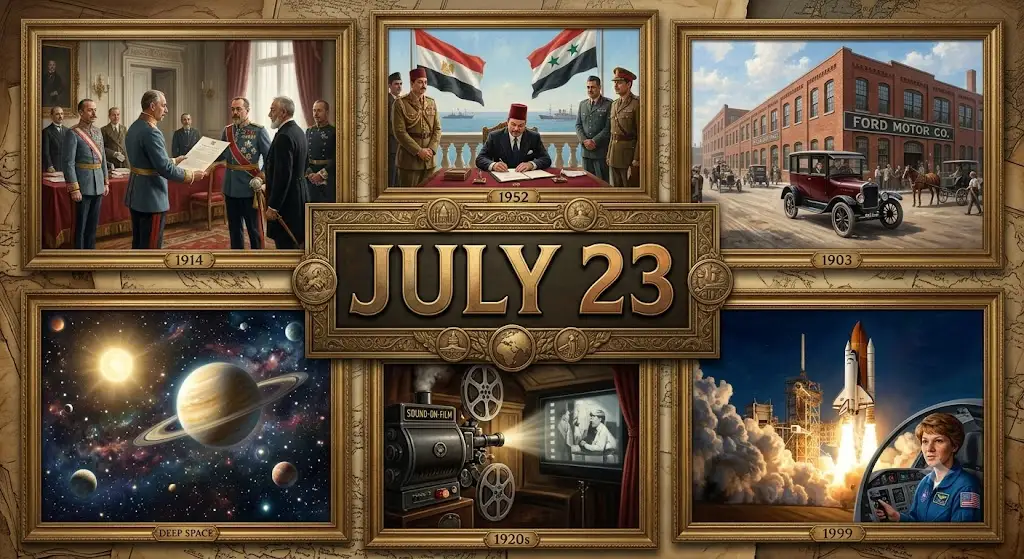
| Top 10 Key Events | Pope John V elected (685) • Typographer patented by William Austin Burt (1829) • July Ultimatum issued to Serbia (1914) • Chinese Communist Party founded (1921) • Fox acquires Movietone sound-on-film system (1926) • Egyptian Revolution overthrows King Farouk (1952) • Telstar broadcasts first live transatlantic TV (1962) • Detroit Riots begin (1967) • STS-93 launches with Eileen Collins as first female commander (1999) • NASA discovers Earth-like planet Kepler-452b (2015) |
| Key Battles That Day | The Siege of Pliska (811), Capture of Monemvasia Castle (1821), Eastern Front Offensives (1942) |
| Key Figures Today | King Farouk, Gamal Abdel Nasser, Eileen Collins, Haile Selassie |
| Observances | Revolution Day (Egypt) Renaissance Day (Oman) Children’s Day (Indonesia) Birthday of Haile Selassie (Rastafari) National Remembrance Day (Papua New Guinea) |
Story of the Day: The July Ultimatum Triggers World War I
Austria-Hungary’s ambassador handed a written demand to the Serbian government in Belgrade at 6:00 PM on July 23, 1914. Still reeling from the assassination of Archduke Franz Ferdinand, Vienna demanded total surrender of Serbian sovereignty within forty-eight hours, insisting Austrian officials direct the murder investigation on Serbian soil. Serbian officials accepted almost every point to preserve peace, but refused total occupation of their legal system. That single refusal gave Austria-Hungary its excuse to launch a war. Five days later, artillery shells pounded Belgrade, pulling Europe’s network of military alliances into the deadliest conflict humanity had ever seen.
Important Events That Happened On July 23 In History
685 – Election of Pope John V
Church leaders gathered in Rome to elect Pope John V just two months after Pope Benedict II died. The choice marked a rare moment of smooth papal succession without waiting for long imperial approvals from Constantinople. John V brought much-needed administrative stability to the Vatican during his short time in office. His peaceful election set an important precedent for medieval papal autonomy.
811 – Plunder of Pliska
Byzantine Emperor Nikephoros I marched his imperial army straight into the Bulgarian capital of Pliska, forcing Khan Krum to flee into the mountains. Nikephoros systematically looted the royal palace and seized Krum’s personal treasury. The imperial victory seemed total, but the triumph proved short-lived when Bulgarian forces trapped the Byzantines in mountain passes days later. Nikephoros lost his life, turning a temporary conquest into an imperial nightmare.
1319 – Battle of Chios
Knights Hospitaller warships intercepted a massive Aydinid Turkish fleet in the waters off Chios. The Christian knights smashed through enemy lines, sinking dozens of ships and crushing the regional naval power of the Aydinid Beylik. Victory secured Hospitaller dominance across the Aegean trade routes for decades. It also delayed Ottoman expansion across the Mediterranean shipping lanes.
1632 – French Settlers Depart for New France
Three hundred brave colonists boarded ships in the port town of Dieppe, setting sail toward the harsh wilderness of North America. They carried basic farming tools, winter supplies, and hopes of building new lives in French-claimed territory. Their arrival dramatically boosted the European population of New France along the St. Lawrence River. These settlers laid the permanent cultural foundation for modern French Canada.
1677 – Siege of Marstrand
Danish-Norwegian military forces launched a coordinated amphibious assault against the Swedish-held harbor town of Marstrand. Scandinavian soldiers stormed the harbor defenses, capturing the valuable port during the fierce Scanian War. Taking the harbor stripped Sweden of a critical naval anchorage along the western coastline. The loss forced Swedish commanders onto the defensive for the remainder of the campaign.
1711 – Treaty of Pruth Signed
Grand Vizier Baltaci Mehmet Pasha signed the Treaty of Pruth with representatives of Russian Tsar Peter the Great along the riverbank. Tsar Peter faced complete military encirclement and gladly accepted harsh Ottoman terms to save his trapped army. Russia surrendered the fortress of Azov and agreed to dismantle key border fortifications. The signature halted Russia’s southwards expansion toward the Black Sea for an entire generation.
1793 – Recapture of Mainz
Prussian heavy artillery pounded the French garrison occupying Mainz until the Republican defenders finally raised the white flag. King Frederick William II took back the strategic fortress city after a grueling multi-month siege. The defeat collapsed the short-lived Republic of Mainz, France’s first client state on German soil. Prussian victory temporarily halted the outward spread of the French Revolution toward central Europe.
1813 – Sir Thomas Maitland Named Governor of Malta
Sir Thomas Maitland formally assumed absolute power as the first official Governor of Malta. Maitland swept away old knightly legal structures, transforming the Mediterranean island from a loose British protectorate into a crown colony. His aggressive legal overhaul established direct civil control and massive military harbor upgrades. The island officially became the central anchor of Britain’s imperial Mediterranean fleet.
1821 – Fall of Monemvasia Castle
Greek revolutionaries forced the Ottoman garrison inside Monemvasia Castle to surrender after a long, desperate siege during the War of Independence. Greek leaders agreed to transport the surviving Turkish soldiers and civilian residents safely to the coast of Asia Minor. Capturing the imposing coastal fortress gave Greek forces a vital strategic stronghold across the Peloponnese. The victory proved to European observers that the Greek uprising possessed real military power.
1829 – William Austin Burt Patents the Typographer
Inventor William Austin Burt walked out of the U.S. Patent Office carrying a legal patent for his crude mechanical writing machine, the typographer. Burt built the device out of wood and metal levers, operated by turning a manual dial to strike paper. Though slower than writing by hand, his invention created the fundamental blueprint for practical commercial typewriters. His crude frame kicked off the modern revolution in business documentation.
1840 – The Act of Union Creates Canada
British Parliament formally passed the Act of Union, merging Upper Canada and Lower Canada into a single political territory called the Province of Canada. British officials hoped uniting the English and French-speaking populations under one legislature would weaken French influence. The political reorganization triggered intense power struggles between political factions for decades. Ultimately, this structural change forced the colonies toward the modern Canadian Confederation of 1867.
1862 – Henry Halleck Takes Command of Union Army
President Abraham Lincoln appointed General Henry Halleck as general-in-chief of all Union forces in Washington. Halleck brought administrative order and military scholarship to a war effort plagued by chaos and field retreats. His cautious strategic style quickly frustrated field commanders like Ulysses S. Grant, who favored aggressive combat operations. Still, Halleck streamlined Union supply logistics and military communications during critical campaigns.
1862 – Hyde Park Riots Begin
Thousands of angry working-class Londoners tore down the iron railings surrounding Hyde Park after police locked the gates to block a political reform meeting. Protesters flooded into the open grounds, clashing violently with mounted police officers for several chaotic hours. The mass demonstration highlighted growing public demand for expanded voting rights across Victorian Britain. The public anger forced Parliament to pass sweeping electoral reform laws five years later.
1874 – Vasconcelos Appointed Archbishop of Goa
Aires de Ornelas e Vasconcelos received his papal appointment as Archbishop of the historic Portuguese colonial enclave of Goa, India. Vasconcelos took control of a historic archdiocese struggling to balance European religious doctrine with native South Asian traditions. His administrative leadership reorganized local parishes and restored influence to Portuguese missionary networks across Asia.
1881 – Chile and Argentina Sign Boundary Treaty
Diplomats from Chile and Argentina met in Buenos Aires to sign the milestone Boundary Treaty of 1881. The agreement drew a definitive border along the highest peaks of the Andes Mountains, dividing vast untamed territories across Patagonia. The diplomatic compromise successfully prevented an imminent South American war over southern land rights. Both nations secured clear legal borders that permanently shaped their modern geographic outlines.
1900 – Canada Closes Borders to Paupers
Canadian immigration officials enacted strict legal bans forbidding impoverished immigrants and convicts from entering the country’s ports. Facing huge waves of European migration, Canadian politicians argued incoming settlers needed sufficient money to survive the rugged Western frontier. The law marked a sharp shift away from open-door immigration toward selective economic entrance criteria.
1903 – Ford Sells Its First Model A
Dr. Ernst Pfenning of Chicago bought the very first two-cylinder Model A car built by the Ford Motor Company for $850. Henry Ford had down to under $223 in the bank, making this sale a lifeline for his struggling Detroit startup. The cash infusion paid factory workers and kept production lines running through the summer. That single automobile delivery launched what would become a global manufacturing superpower.
1906 – Amsden Building Collapses in Massachusetts
Constructors stood helpless as the multi-story Amsden Building suddenly caved in without warning in Framingham, Massachusetts. Falling brick and heavy wooden beams crushed dozens of workers underneath thousands of tons of debris, taking twelve lives. Investigators discovered cheap building materials and severe structural neglect had doomed the commercial project. The disaster forced American municipalities to adopt strict, modern building codes and mandatory safety inspections.
1908 – Ottoman Empire Accepts Second Constitution
Sultan Abdul Hamid II gave in to overwhelming pressure from the Young Turks military movement, officially restoring the Ottoman Constitution of 1876. Citizens flooded the streets of Istanbul celebrating the sudden end to decades of absolute royal rule and secret police repression. The constitutional mandate established a multi-party parliament and promised equal rights for ethnic minorities across the empire. However, political instability soon led directly to military dictatorship.
1914 – The July Ultimatum Issued to Serbia
Austro-Hungarian diplomats delivered a harsh list of political demands to the Serbian government following the assassination of Archduke Franz Ferdinand. The ultimatum demanded Serbia allow Austrian officials to enter the country and suppress nationalist groups within forty-eight hours. Serbia’s partial rejection of the extreme demands gave Austria the green light to declare war five days later. This diplomatic gamble sparked the military chain reaction that started World War I.
1919 – Decree Establishes University of Ljubljana
Prince Regent Aleksander Karađorđević signed the royal decree creating the University of Ljubljana in modern-day Slovenia. The decree established the first native Slovenian-language higher education institution in history. Thousands of students who previously traveled to Vienna or Prague could now earn degrees within their homeland. The university became the central engine of Slovenian intellectual, scientific, and cultural life.
1921 – Founding of the Chinese Communist Party
Twelve delegates, including a young Mao Zedong, met quietly inside a Shanghai girls’ school to hold the First National Congress of the Chinese Communist Party. They drafted a secret manifesto pledging to organize factory workers and overthrow foreign imperial rule. Operating completely underground, the tiny political group grew from roughly fifty members into a revolutionary force. Within twenty-eight years, this small meeting altered Asia’s geopolitical landscape by founding the People’s Republic of China.
1926 – Fox Film Buys Movietone Sound System
Studio executive William Fox signed a major deal buying the patents for the revolutionary Movietone sound-on-film system. Movietone recorded audio tracks directly onto the physical edge of cinematic film strips, keeping sound and picture perfectly synced. The technology eliminated the clumsy optical discs previously used by early motion picture theaters. Fox’s risky financial purchase accelerated the global film industry’s transition from silent cinema to modern talking pictures.
1927 – Indian Broadcasting Company Hits the Airwaves
Radio engineers flipped the power switches at the Indian Broadcasting Company’s original transmitter in Bombay, airing the colony’s first commercial broadcast. Thousands of listeners gathered around private receiver sets and public loudspeakers to hear live music and local news bulletins. The broadcast opened up a brand-new medium for mass communication across the Indian subcontinent. The network eventually evolved into All India Radio, one of the largest broadcasting operations in the world.
1936 – Catalonian Leftists Merge Parties
Socialist and communist leaders met in Barcelona during the opening days of the Spanish Civil War to form the Unified Socialist Party of Catalonia. Four separate leftist organizations pooled their union members and militia fighters into a single political force to combat General Franco’s military coup. The new party quickly became the dominant political authority across Republican Catalonia. Their political alliance altered internal politics on the anti-fascist front lines.
1940 – The Welles Declaration Rejects Soviet Annexation
U.S. Under Secretary of State Sumner Welles issued an official policy statement condemning the Soviet Union’s forcible military annexation of Estonia, Latvia, and Lithuania. Welles announced the United States would refuse to legally recognize the Soviet conquest of the independent Baltic states. The diplomatic stance protected Baltic financial assets held in American banks for over fifty years. It set a firm legal precedent for American Cold War foreign policy.
1942 – German Eastern Front Offensives Begin
Nazi Field Marshal Fedor von Bock launched Operation Edelweiss and Operation Braunschweig, sending Wehrmacht armies rolling toward the Caucasus oil fields and the city of Stalingrad. German panzers tore through Soviet defense lines, seeking to choke off crucial Soviet oil supplies along the Volga River. The ambitious double offensive stretched German supply lines across hundreds of miles of open steppe. That overextension set the stage for a catastrophic defeat at Stalingrad months later.
1942 – Nikola Vaptsarov Executed by Firing Squad
Bulgarian guards marched famous poet and anti-fascist resistance leader Nikola Vaptsarov into a Sofia firing squad enclosure for immediate execution. Vaptsarov had smuggled weapons and organized secret underground communist resistance units against the pro-Nazi Bulgarian government. Right before his execution, he handed scribbled poems to fellow prisoners that captured the spirit of human resilience. His tragic death transformed him into an iconic cultural martyr across Eastern Europe.
1943 – Rayleigh Bath Chair Murder
An elderly invalid woman died mysteriously in her home in Rayleigh, Essex, after someone tampered with her heavy bath chair. Police detectives discovered a lethal mechanism designed to harm the vulnerable woman, launching a sensational murder investigation that gripped wartime Britain. The strange crime exposed dark family financial secrets and domestic disputes hidden behind suburban doors. The legal case remains one of Britain’s most unusual mid-century murder stories.
1943 – Royal Navy Sinks Italian Submarine Ascianghi
Royal Navy destroyers HMS Eclipse and HMS Laforey cornered the Italian submarine Ascianghi off the coast of Sicily, dropping depth charges until the vessel resurfaced. British warships opened fire and sank the submarine shortly after the Italian crew torpedoed the light cruiser HMS Newfoundland. The successful naval operation secured Allied supply lanes supporting the invasion of Sicily. Italian submarine operations across the central Mediterranean collapsed soon after.
1945 – Legal Trials of Philippe Pétain Begin
French prosecutors opened treason proceedings against Marshal Philippe Pétain, the eighty-nine-year-old leader of the fallen pro-Nazi Vichy regime. Pétain sat in a Paris courtroom accused of collaborating with Nazi Germany and dissolving democratic institutions. The emotional trial forced post-war France to publicly face its painful history of wartime collaboration and moral compromise. Pétain received a death sentence, though it was later commuted to life imprisonment.
1952 – Egyptian Revolution Overthrows King Farouk
General Muhammad Naguib and Gamal Abdel Nasser led the secret Free Officers Movement in an early morning military coup across Cairo. Rebel troops seized government radio stations, surrounding royal palaces and forcing corrupt King Farouk to abdicate his throne and flee the country by yacht. The swift overthrow ended centuries of foreign political dominance and royal rule in Egypt. The military victory established the modern Egyptian Republic and sparked Arab nationalist movements across the Middle East.
1961 – Sandinista Movement Founded in Nicaragua
Marxist revolutionaries Carlos Fonseca, Tomás Borge, and Silvio Mayorga met secretly in Honduras to found the Sandinista National Liberation Front. Named after historic anti-imperialist leader Augusto César Sandino, the guerrilla group pledged to overthrow the American-backed dictatorship of Anastasio Somoza. The small rebel movement fought a long insurgent war from rural mountain hideouts for nearly two decades. They eventually swept into Managua in 1979 to seize national power.
1962 – Telstar Transmits First Live Transatlantic TV
Engineers turned on the Telstar 1 satellite, bouncing live black-and-white television pictures across the Atlantic Ocean between the United States and Europe. Famed news anchor Walter Cronkite appeared on European TV screens speaking directly to international audiences in real time. The technological breakthrough shattered geographic barriers for global news media. The live broadcast marked the true dawn of instantaneous global communication.
1962 – Declaration on the Neutrality of Laos
Fourteen nations, including the United States, China, and the Soviet Union, signed the International Agreement on the Neutrality of Laos in Geneva. The treaty legally barred foreign troops from entering Laos and prohibited the country from joining foreign military alliances. World leaders hoped the agreement would keep Laos from becoming a battleground in the Cold War. However, secret military operations along the Ho Chi Minh Trail soon violated the treaty terms.
1962 – Jackie Robinson Inducted into Hall of Fame
Jackie Robinson stood before cheering crowds in Cooperstown, New York, as the first African American inducted into the National Baseball Hall of Fame. Robinson broke Major League Baseball’s racial color barrier in 1947, facing intense racism while winning a MVP award and a World Series championship with the Brooklyn Dodgers. His induction recognized both his incredible athletic talents and his courage as a civil rights icon.
1967 – Detroit Riots Begin
Police officers raided an unlicensed night spot on 12th Street in a predominantly Black neighborhood of Detroit, arresting dozens of patrons. Angry crowds gathered outside to protest police harassment, and small clashes quickly exploded into one of the deadliest urban riots in American history. Over five days, violent firebombing and looting destroyed entire commercial blocks, killing 43 people and injuring hundreds. The tragedy exposed deep racial divisions and economic inequality in Northern industrial cities.
1968 – Glenville Shootout Explodes in Cleveland
A violent gun battle erupted between members of a Black Nationalist group and Cleveland police officers in the Glenville neighborhood. The shootout killed three police officers and three suspects, instantly triggering four days of widespread arson and civil unrest. The violence shattered relations between local minority communities and city officials. The event highlighted rising militant political activism across Northern urban centers during the late 1960s.
1968 – Hijacking of El Al Flight 413
Three armed members of the Popular Front for the Liberation of Palestine took control of an El Al Boeing 707 flying from Rome to Tel Aviv. The hijackers forced the pilots to land in Algiers, holding ten crew members and thirty-eight passengers hostage. The international crisis lasted forty days until complex diplomatic negotiations secured the safe release of all hostages. The incident stands as the only successful hijacking in El Al’s history, permanently changing global airline security protocols.
1970 – Sultan Qaboos Takes Power in Oman
Qaboos bin Said al Said overthrew his isolationist father, Sultan Said bin Taimur, in a palace coup supported by British advisers. Qaboos inherited an impoverished nation crippled by a long civil war in the Dhofar region. He used national oil revenues to build modern hospitals, schools, roads, and electric grids. His strategic leadership transformed Oman into a modern, stable Middle Eastern nation.
1972 – NASA Launches Landsat 1
A Delta rocket blasted off from Vandenberg Air Force Base carrying Landsat 1, the world’s first satellite built specifically to monitor Earth’s natural resources. The satellite beamed back thousands of multispectral images tracking global agriculture, forestry, water reserves, and urban expansion. The mission transformed environmental science by giving researchers continuous, high-resolution global Earth data.
1974 – Greek Military Junta Collapses
Greece’s ruling military junta collapsed under the weight of an escalating military crisis in Cyprus and mounting public unrest. Military commanders stepped down and invited exiled former Prime Minister Konstantinos Karamanlis back to Athens to restore democratic civilian rule. Karamanlis landed that night to cheering crowds, ending seven years of harsh military dictatorship. His return launched the metapolitefsi era, establishing modern Greek constitutional democracy.
1980 – Phạm Tuân Becomes First Asian in Space
Vietnamese fighter pilot Phạm Tuân blasted into orbit aboard the Soviet Soyuz 37 spacecraft alongside cosmonaut Viktor Gorbatko. Tuân became both the first Vietnamese citizen and the first Asian person to reach outer space as part of the Intercosmos space program. He spent nearly eight days aboard the Salyut 6 space station conducting scientific experiments. His orbital flight became a massive point of national pride for post-war Vietnam.
1982 – Twilight Zone Movie Helicopter Crash
A low-flying stunt helicopter lost control during an explosive pyrotechnic scene on a movie set near Santa Clarita, California, crashing directly onto actors on the ground. The tragic accident killed veteran actor Vic Morrow and child actors Myca Dinh Le and Renee Chen. The tragedy shocked Hollywood and led to strict new safety regulations for film sets, especially regarding child actors and explosive stunts. Director John Landis faced years of criminal and civil legal trials following the catastrophe.
1983 – Tamil Tigers Ambush Sri Lankan Troops
Militants from the Liberation Tigers of Tamil Eelam ambushed a Sri Lankan Army military convoy in Four Four Bravo, killing thirteen soldiers. The deadly ambush triggered massive anti-Tamil riots across Colombo, known as Black July, where mobs killed thousands of Tamil civilians. The outbreak of violence escalated minor civil unrest into a full-scale Sri Lankan Civil War that lasted twenty-six years.
1983 – The Gimli Glider Deadstick Landing
Air Canada Flight 143 ran completely out of jet fuel at 41,000 feet due to a fuel conversion error using the metric system. Captain Robert Pearson used his experience as a glider pilot to glide the Boeing 767 toward an abandoned airbase in Gimli, Manitoba, which had been turned into a racetrack. Pearson landed the massive aircraft safely without power, saving all sixty-one passengers and six crew members. The miraculous landing remains one of the greatest feats of aviation skill in history.
1988 – General Ne Win Resigns in Burma
General Ne Win, who had ruled Burma with an iron fist through a socialist military dictatorship since 1962, abruptly resigned as leader. Weeks of massive pro-democracy street protests led by students and workers forced the aging dictator to step down. His sudden exit raised brief hopes for political freedom across the nation. However, the military violently cracked down on protests weeks later, establishing a new junta that retained hardline power.
1992 – Vatican Statement on Anti-Discrimination Laws
Cardinal Joseph Ratzinger led a Vatican commission that issued a doctrinal document regarding legal rights for non-married and homosexual couples. The statement argued that limiting legal privileges in specific areas like military service or child adoption did not constitute unfair discrimination. The document reinforced traditional Catholic moral teachings on marriage and family structures. It sparked intense global debates about religious doctrine and civil rights laws.
1992 – Abkhazia Declares Independence
The regional parliament of Abkhazia formally declared its independence from the Republic of Georgia, restoring its 1925 constitution. Georgian leaders in Tbilisi declared the vote illegal and dispatched thousands of armed troops to reassert control over the breakaway region. The move ignited a bitter war that displaced over 200,000 ethnic Georgians from their homes. The unresolved conflict left Abkhazia as a contested breakaway state backed by Russia.
1993 – China Northwest Flight 2119 Crash
China Northwest Airlines Flight 2119 failed to lift off during takeoff at Yinchuan Xihuayuan Airport, overrunning the runway and crashing into a lake. The interior cabin disintegrated upon impact, killing fifty-five passengers and crew members. Investigations revealed a mechanical failure in the flap system prevented the aircraft from gaining enough lift. The tragedy forced Chinese aviation authorities to overhaul safety maintenance standards across domestic regional airlines.
1995 – Discovery of Comet Hale-Bopp
Amateur astronomers Alan Hale in New Mexico and Thomas Bopp in Arizona independently spotted a bright new comet drifting near the constellation Sagittarius. The icy celestial visitor, designated Comet Hale-Bopp, proved to be one of the largest and brightest comets discovered in modern history. It became visible to the naked eye for eighteen months, mesmerizing skywatchers across the world.
1997 – Digital Equipment Corporation Files Intel Lawsuit
Tech pioneer Digital Equipment Corporation filed a landmark antitrust lawsuit against microchip giant Intel in federal court. Digital accused Intel of illegally copying patented Pentium chip designs from Digital’s high-speed Alpha microprocessor technology. The high-stakes legal battle threatened to disrupt global computer processor production lines. The dispute ended months later when Intel agreed to purchase Digital’s semiconductor manufacturing operations.
1999 – ANA Flight 61 Hijacking
Yuji Nishizawa pulled out a knife aboard All Nippon Airways Flight 61 shortly after takeoff from Tokyo, forcing his way into the cockpit. Nishizawa fatally stabbed the pilot, Captain Akiyoshi Tashima, so he could manually fly the Boeing 747 himself based on flight simulator video games. Brave crew members and passengers wrestled the hijacker to the floor and pulled the aircraft out of a steep dive. The tragic incident exposed vulnerabilities in cockpit security, leading to locked security doors across Japanese airlines.
2009 – Columbia Launches STS-93
Space Shuttle Columbia roared off Launch Pad 39B carrying Air Force Colonel Eileen Collins, the first woman ever to command an American space shuttle mission. The shuttle carried the massive Chandra X-ray Observatory, designed to study black holes and exploding stars from deep orbit. Despite experiencing a brief electrical short circuit during liftoff, Collins and her crew placed the telescope into orbit. The mission marked a major milestone for women in aerospace engineering and space exploration.
2001 – Megawati Sukarnoputri Sworn In
Megawati Sukarnoputri took the presidential oath of office, becoming Indonesia’s first female president after Parliament impeached her predecessor, Abdurrahman Wahid. As the daughter of Indonesia’s founding father Sukarno, Megawati brought political stability to a nation recovering from severe economic and social instability. Her historic inauguration represented a major step forward for women’s leadership across Southeast Asia. She guided Indonesia through crucial post-dictatorship democratic reforms.
2005 – Sharm El Sheikh Bombings
Three suicide bombers detonated explosive-laden vehicles inside packed hotels and market areas in the Egyptian resort town of Sharm El Sheikh. The coordinated terrorist attacks killed eighty-eight people and injured over two hundred, targeting both foreign tourists and local hotel workers. The horrific violence shattered Egypt’s vital tourism industry and forced security forces to launch massive counter-terrorism operations across the Sinai Peninsula.
2010 – One Direction Forms on The X Factor
Music producer Simon Cowell and guest judge Nicole Scherzinger grouped five individual teenage auditionees—Harry Styles, Zayn Malik, Niall Horan, Liam Payne, and Louis Tomlinson—into a vocal group on The X Factor. Though they finished third in the British television competition, the boy band signed a record deal and became a global pop phenomenon. They sold tens of millions of records and built one of the largest fan bases in modern music history.
2011 – Wenzhou Train Collision
A high-speed bullet train lost power after a lightning strike on a viaduct in Wenzhou, China, causing a trailing train to slam into its rear cars. The impact derailed four train cars, sending them plunging off the elevated track and killing forty passengers. Public outrage forced Chinese rail authorities to pause bullet train expansion plans, conduct nationwide safety audits, and reduce top operating speeds across the entire high-speed rail network.
2012 – Near-Miss Solar Storm of 2012
The Sun ejected an unusually massive coronal mass ejection that tore through Earth’s orbital path at millions of miles per hour. The intense solar storm missed Earth by nine days, passing harmlessly through open space. Physicists later calculated that a direct hit would have fried satellite networks, destroyed global electrical grids, and caused trillions of dollars in worldwide economic damage. The narrow miss served as an urgent wake-up call for world governments to upgrade power grid space-weather protections.
2014 – TransAsia Airways Flight 222 Crash
TransAsia Airways Flight 222 crashed into residential buildings in Xixi village while trying to land during torrential rains caused by Matmo Typhoon. The crash killed forty-eight people on board and injured five villagers on the ground. Air accident investigators determined pilot error and poor weather judgment caused the twin-engine turboprop to fly too low during its final approach. The disaster led to a overhaul of domestic airline safety standards across Taiwan.
2015 – Discovery of Planet Kepler-452b
NASA scientists announced the discovery of Kepler-452b, an Earth-sized exoplanet orbiting within the habitable zone of a Sun-like star. Dubbed “Earth’s older cousin,” the planet sits fourteen hundred light-years away and takes 385 days to complete an orbit around its host star. Data from the Kepler space telescope suggested the world could hold liquid surface water and a rocky atmosphere. The discovery marked a breakthrough in humanity’s search for potentially habitable alien worlds.
2018 – Deadliest Wildfires in Greek History
Fierce winds fanned fast-moving wildfires across the East Attica region of Greece, trapping residents and summer tourists in the coastal resort town of Mati. Flames swept through narrow streets toward the sea, killing 102 people and burning thousands of homes to the ground. The tragedy became the deadliest wildfire event in modern Greek history. It forced European emergency management agencies to overhaul disaster response plans for climate-driven natural disasters.
Dig deeper into our timeline of past events right here.
Famous People Born on July 23
| Name | Description | Dates |
|---|---|---|
| Francesco I Sforza | Italian military leader and Duke of Milan | 1401–1466 |
| Anne of Bohemia and Hungary | Queen of Hungary and Bohemia | 1503–1547 |
| Thomas Brisbane | Scottish general and Governor of New South Wales | 1773–1860 |
| Étienne-Louis Malus | French physicist known for Malus’s Law | 1775–1812 |
| Bal Gangadhar Tilak | Indian nationalist, lawyer, and freedom leader | 1856–1920 |
| Apolinario Mabini | First Prime Minister of the Philippines | 1864–1903 |
| Raymond Chandler | American crime novelist and screenwriter | 1888–1959 |
| Haile Selassie | Emperor of Ethiopia | 1892–1975 |
| Vladimir Prelog | Croatian-Swiss chemist and Nobel Prize winner | 1906–1998 |
| Chandra Shekhar Azad | Indian revolutionary freedom fighter | 1906–1931 |
| M. H. Abrams | American literary critic and scholar | 1912–2015 |
| Tajuddin Ahmad | First Prime Minister of Bangladesh | 1925–1975 |
| Vera Rubin | American astronomer who helped prove dark matter | 1928–2016 |
| Richard Rogers | Pritzker Prize-winning British architect | 1933–2021 |
| Anthony Kennedy | Associate Justice of the U.S. Supreme Court | 1936–Present |
| Sergio Mattarella | President of Italy | 1941–Present |
| Graham Gooch | Legendary English cricketer | 1953–Present |
| Najib Razak | Sixth Prime Minister of Malaysia | 1953–Present |
| Martin Gore | Songwriter and founding member of Depeche Mode | 1961–Present |
| Woody Harrelson | American actor and activist | 1961–Present |
| Slash | Legendary guitarist of Guns N’ Roses | 1965–Present |
| Philip Seymour Hoffman | Academy Award-winning American actor | 1967–2014 |
| Gary Payton | Basketball Hall of Fame player | 1968–Present |
| Marlon Wayans | American actor, comedian, and filmmaker | 1972–Present |
| Monica Lewinsky | American activist and public speaker | 1973–Present |
| Maurice Greene | American Olympic sprint champion | 1974–Present |
| Judit Polgár | Greatest female chess player in history | 1976–Present |
| Daniel Radcliffe | English actor best known as Harry Potter | 1989–Present |
| David Dobrik | Slovak-American YouTube personality | 1996–Present |
| Deandre Ayton | Bahamian NBA basketball player | 1998–Present |
Famous People Died on July 23
| Name | Description | Dates |
|---|---|---|
| Bridget of Sweden | Swedish mystic, saint, and founder of the Bridgettine Order | 1303–1373 |
| Michael I of Russia | First Tsar of the Romanov dynasty | 1596–1645 |
| Domenico Scarlatti | Influential Italian Baroque composer | 1685–1757 |
| Roger Sherman | American Founding Father and statesman | 1721–1793 |
| Isaac Singer | Inventor and founder of the Singer sewing machine company | 1811–1875 |
| Ulysses S. Grant | 18th President of the United States and Civil War general | 1822–1885 |
| William Ramsay | Nobel Prize-winning Scottish chemist | 1852–1916 |
| Reginald Dyer | British Army officer linked to the Jallianwala Bagh massacre | 1864–1927 |
| Glenn Curtiss | American aviation pioneer and aircraft manufacturer | 1878–1930 |
| D. W. Griffith | American film director and cinema pioneer | 1875–1948 |
| Philippe Pétain | French military commander and Vichy leader | 1856–1951 |
| Cordell Hull | U.S. Secretary of State and Nobel Peace Prize laureate | 1871–1955 |
| Montgomery Clift | Influential American film actor | 1920–1966 |
| Henry Hallett Dale | Nobel Prize-winning British physiologist | 1875–1968 |
| Eddie Rickenbacker | America’s leading World War I fighter ace | 1890–1973 |
| Vic Morrow | American television and film actor | 1929–1982 |
| Hassan II | King of Morocco | 1929–1999 |
| Eudora Welty | Pulitzer Prize-winning American novelist | 1909–2001 |
| Chaim Potok | American novelist and rabbi | 1929–2002 |
| Mehmood Ali | Legendary Indian actor and comedian | 1932–2004 |
| Mohammed Zahir Shah | Last King of Afghanistan | 1914–2007 |
| Amy Winehouse | Grammy Award-winning English singer-songwriter | 1983–2011 |
| Sally Ride | First American woman in space | 1951–2012 |
| Lakshmi Sahgal | Indian freedom fighter and INA commander | 1914–2012 |
| Emile Griffith | Six-time world boxing champion | 1938–2013 |
| Djalma Santos | Brazilian football legend and World Cup winner | 1929–2013 |
| Ariano Suassuna | Renowned Brazilian playwright and novelist | 1927–2014 |
| William Wakefield Baum | American Cardinal of the Roman Catholic Church | 1926–2015 |
| John Kundla | Hall of Fame basketball coach | 1916–2017 |
| Robin Warren | Nobel Prize-winning Australian pathologist | 1937–2024 |
Observances on July 23
- Revolution Day (Egypt): Honors the 1952 Free Officers Movement coup that ended the monarchy and established the modern Egyptian Republic.
- Renaissance Day (Oman): Commemorates Sultan Qaboos bin Said taking power in 1970, marking the beginning of Oman’s modern development era.
- Children’s Day (Indonesia): A national day highlighting youth rights, child protection, and educational welfare programs across the nation.
- Birthday of Haile Selassie (Rastafari): Celebrates the birth of Emperor Haile Selassie I of Ethiopia in 1892, a central spiritual holy day for Rastafarians worldwide.
- National Remembrance Day (Papua New Guinea): Honors the soldiers and fallen heroes who lost their lives during World War II and internal national conflict.
📜 Frequently Asked Questions — July 23 in History
On July 23, 1914, Austria-Hungary presented Serbia with the July Ultimatum following the assassination of Archduke Franz Ferdinand. The extreme diplomatic demands forced Serbia to choose between total surrender of its sovereignty or war. Serbia’s refusal of one key term prompted Austria-Hungary to declare war five days later, starting World War I.
On July 23, 1952, the secret Free Officers Movement led by Gamal Abdel Nasser and Muhammad Naguib launched a bloodless coup in Cairo. They forced King Farouk to abdicate his throne, ending British colonial influence and establishing the modern Egyptian Republic.
Rastafarians celebrate the birthday of Ethiopian Emperor Haile Selassie, born on July 23, 1892. Queen Anne of Bohemia was also born on this day in 1366, alongside many other famous historical figures listed above.
The delivery of the Austro-Hungarian ultimatum to Serbia on July 23, 1914, stands as the most consequential historical event on this date. The aggressive diplomatic move collapsed European peacekeeping efforts and directly triggered the outbreak of World War I.
Revolution Day marks the July 23, 1952 overthrow of King Farouk by the Free Officers Movement. Egyptians celebrate the holiday because it ended royal corruption, eliminated British imperial control, and birthed the modern democratic republic.
In recent history on July 23, 2015, NASA announced the discovery of Kepler-452b, the first near-Earth-sized planet found in the habitable zone of a Sun-like star. Three years later, on July 23, 2018, devastating wildfires swept through East Attica, Greece, taking 102 lives.