📅 Quick Facts — July 3 in History
| 📌 Category | 📖 Event / Detail |
|---|---|
| 🌟 Most Significant Event | The Battle of Gettysburg reaches its bloody climax with Pickett’s Charge (1863) |
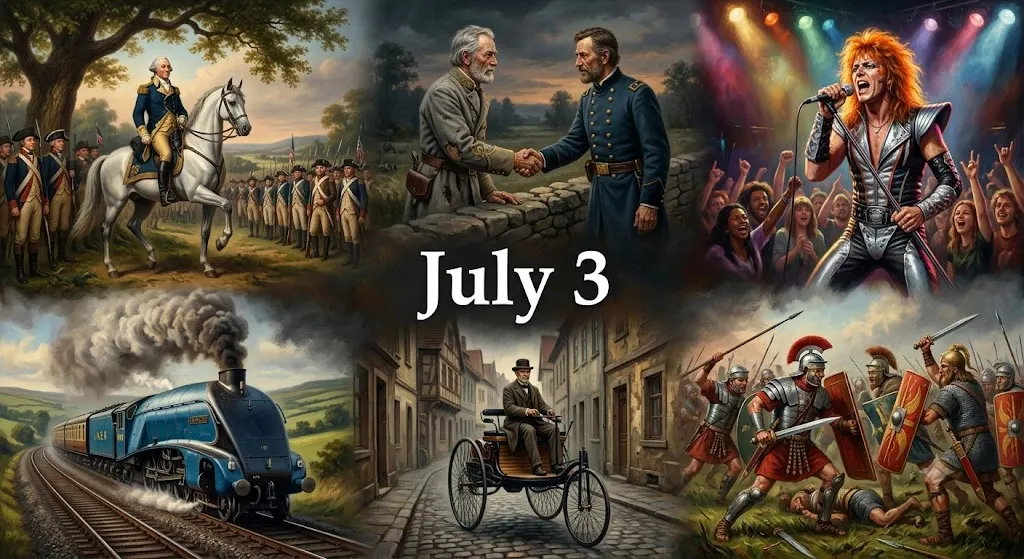
| 🏆 Top 10 Key Events | • Constantine I decisively defeats Licinius at the Battle of Adrianople (324) • Hugh Capet is crowned King of France, founding the Capetian Dynasty (987) • Samuel de Champlain establishes a permanent settlement at Québec City (1608) • George Washington surrenders Fort Necessity to the French during the Seven Years’ War (1754) • George Washington officially takes command of the Continental Army at Cambridge (1775) • The bloody Confederate infantry assault known as Pickett’s Charge fails at Gettysburg (1863) • Karl Benz publicly unveils the Benz Patent-Motorwagen, the first purpose-built automobile (1886) • The LNER Class A4 steam locomotive Mallard breaks the world speed record at 125.88 mph (1938) • David Bowie famously kills off his iconic Ziggy Stardust persona during a concert at London’s Hammersmith Odeon (1973) • The Egyptian military deposes President Mohamed Morsi following nationwide protests (2013) |
| ⚔️ Key Battles | Battle of Adrianople (324), Battle of Wyoming (1778), Battle of Fort Erie (1814), Battle of Gettysburg (1863), Battle of Königgrätz (1866), Battle of Santiago de Cuba (1898), Battle of the Crater (1967) |
| 👤 Key Figures | Constantine I, George Washington, Karl Benz, David Bowie |
| 🌍 Observances | Emancipation Day (US Virgin Islands), Independence Day (Belarus), Women’s Day (Myanmar) |
Story of the Day: The Day the Steam Train Flew
Driver Joseph Duddington gripped the regulator of the Mallard locomotive as it blasted down the Stoke Bank line in Lincolnshire, England. On this afternoon in 1938, the sleek, blue steam engine was built for one reason: to prove British engineering could outrun the world. The coal fire roared, the pistons screamed, and the speedometer needle crept past 120 miles per hour. For a few brief seconds, the mechanical beast hit 125.88 miles per hour, rattling the crew to their bones. It set a world record for steam traction that has never been broken to this day.
Important Events That Happened On July 3 In History
324 – Battle of Adrianople
Constantine I watched his seasoned legionaries smash through the defensive lines of his co-emperor and rival, Licinius, outside a strategic Roman city. This fierce clash left thousands dead and forced Licinius to flee across the straits into Byzantium. Constantine’s decisive victory smashed the uneasy dual rule that had split the Roman territories. By winning this battle, he cleared his path to becoming the sole master of the entire Roman world.
987 – Hugh Capet Crowned King
Hugh Capet stood before a grand assembly of French nobles as the crown of France was placed firmly onto his head. This ambitious nobleman managed to seize the throne from the dying Carolingian line, establishing his own family brand of royalty. His coronation birthed the Capetian dynasty, a massive family tree of monarchs who would hold the French throne for centuries. This continuous line of royal power would last all the way until the French Revolution upended society in 1792.
1035 – William the Conqueror Inherits Normandy
A seven-year-old boy named William suddenly found himself carrying the heavy title of Duke of Normandy after his father died on a pilgrimage. Born out of wedlock, the young boy had to spend his entire childhood dodging assassination plots from ruthless rival barons. Surviving these treacherous early years hardened him into a brilliant, iron-willed military commander. Thirty-one years later, he would cross the English Channel and conquer England, changing western history forever.
1450 – Jack Cade Enters London
Jack Cade led a massive, angry army of Kentish rebels straight through the gates of London without facing a single scrap of opposition from King Henry VI. The common people and local shopkeepers opened their doors to the rebels, completely fed up with royal corruption and crushing taxes. This unopposed entry threw the royal court into a state of absolute panic and chaos. Though the rebellion was put down days later, it exposed how incredibly fragile the King’s grip on England really was.
1535 – Diego de Almagro Marches South
Diego de Almagro rode out from the high-altitude Inca capital of Cuzco, leading a heavily armed expeditionary force into uncharted southern territories. Driven by a desperate hunger for gold and territory, he dragged thousands of Spanish soldiers and enslaved locals into brutal mountain passes. The unforgiving terrain and hostile native resistance turned the trek into an absolute nightmare. This grueling journey failed to find gold, but it opened up the first European route deep into modern-day Chile.
1608 – Québec City Founded
Samuel de Champlain stepped off his ship onto the banks of the St. Lawrence River and ordered his men to construct a fortified wooden habitation. This tiny, isolated outpost was surrounded by thick wilderness and faced a brutal winter that killed most of his crew. Despite the staggering death toll, the settlement hung on through trade alliances with local indigenous nations. This fragile base survived to become Québec City, the historic cradle of French civilization in North America.
1754 – Surrender at Fort Necessity
George Washington watched his colonial soldiers drop their weapons in the muddy, rain-soaked trenches of an poorly positioned wooden fort. Surrounded by French forces and indigenous warriors, the young colonial officer signed a humiliating surrender document written in poorly translated French. This bitter frontier defeat forced Washington to lead his surviving men back to Virginia in shame. The small, bloody skirmish sparked a global conflict that escalated into the Seven Years’ War.
1767 – Pitcairn Island Sighted
Midshipman Robert Pitcairn scanned the vast, empty horizons of the South Pacific from the deck of HMS Swallow when he spotted a lonely rock wall. The ship’s commander named the isolated island after the young lookout, noting its steep, unapproachable cliffs in the logbook. This remote island was so inaccurately mapped that it remained hidden from standard shipping lanes for decades. That extreme isolation made it the perfect hideout for the HMS Bounty mutineers years later.
1767 – Norway’s Oldest Newspaper Born
Printers in the city of Trondheim carefully pulled the very first inked sheets of Adresseavisen off a manual press. This small publication gave local citizens access to public announcements, foreign notices, and domestic trade news for the first time. The paper survived through centuries of political shifts, printing strikes, and world wars. Today, it ranks as Norway’s oldest newspaper still in active print, carrying on a media tradition spanning generations.
1775 – Washington Takes Command
George Washington drew his sword beneath an elm tree in Cambridge to take formal command of the Continental Army. He found a chaotic, undisciplined gathering of local militias rather than a real fighting force. The wealthy Virginian immediately set to work enforcing strict military discipline and organizing supply lines. This crucial moment turned a local New England rebellion into a unified, continental war for American independence.
1778 – Battle of Wyoming Massacre
Loyalist rangers and their Iroquois allies ambushed a desperate force of Patriot defenders in the Wyoming Valley of Pennsylvania. The Patriot lines broke under the sudden assault, turning the retreat into a chaotic, terrifying slaughter. Over three hundred Patriot soldiers were hunted down and killed in the woods during the panic. This brutal colonial massacre sparked furious Retaliation campaigns across the American frontier for the rest of the war.
1814 – Capture of Fort Erie
Major General Jacob Brown ordered his American troops to storm across the Niagara River and surround the British battlements at Fort Erie. The surprised British commander realized he was completely outnumbered and surrendered the fort after a very brief exchange of fire. This clean victory gave the American forces a vital tactical foothold on the Canadian side of the border. It set the stage for some of the bloodiest, most hard-fought battles of the War of 1812.
1819 – First US Savings Bank Opens
Tellers at the Bank for Savings in the City of New-York opened their heavy wooden doors to everyday working-class citizens for the first time. Before this institution opened, commercial banks only dealt with wealthy merchants and large-scale businesses. This new system allowed ordinary laborers and immigrants to safely deposit small earnings and build interest. This simple concept revolutionized personal finance and helped fund the rapid growth of the American working class.
1839 – First State Normal School Opens
Three young women walked through the doors of a modest schoolhouse in Lexington, Massachusetts, to attend America’s first state-funded teacher training institution. Educator Cyrus Peirce ran the school, aiming to turn teaching into a standardized, respected profession. This tiny experiment in public education faced heavy skepticism from traditional schools. The model succeeded wildly, evolving into Framingham State University and reshaping public school education across the country.
1848 – Emancipation in Danish West Indies
Governor-General Peter von Scholten stood before thousands of angry, assembled slaves who had surrounded his compound in Saint Croix. Realizing that a violent, bloody rebellion was just minutes away from breaking out, he bypassed his own government and declared all slaves free on the spot. This sudden decree instantly broke the chains of over twenty thousand people in the colony. His brave action averted a massacre but ruined his career, leading to his arrest upon returning to Denmark.
1849 – French Army Invades Rome
French troops breached the ancient walls of Rome, crushing the idealistic young Roman Republic after a fierce, month-long siege. General Charles Oudinot led the assault to restore Pope Pius IX to his absolute temporal power over the region. The defenders, including the famous freedom fighter Giuseppe Garibaldi, were forced to scatter into the Italian countryside. This bloody intervention restored the Papal States and delayed the unification of Italy for decades.
1852 – San Francisco Mint Established
Congress passed a critical piece of legislation ordering a branch of the United States Mint to be built in San Francisco. The wild California Gold Rush had flooded the region with raw gold dust, but the local economy lacked actual coin currency to function smoothly. Miners were constantly being cheated by private assayers and fluctuating local prices. The new mint turned raw nuggets into official gold coins, bringing stability to the chaotic western economy.
1863 – Pickett’s Charge at Gettysburg
General George Pickett watched fifteen thousand Confederate soldiers march out of the woods into an open, mile-wide field under a scorching summer sun. Union artillery tore massive holes through the advancing gray lines, but the soldiers kept moving forward until they breached the stone wall at the Union center. The desperate breakthrough lasted only minutes before Union reinforcements swarmed in and crushed the assault. This disastrous failure ended the Battle of Gettysburg, breaking the back of the Confederate invasion.
1866 – Battle of Königgrätz
Prussian infantrymen armed with rapid-fire needle guns decimated the massed formations of the Austrian army in a colossal clash of empires. General Helmuth von Moltke used advanced railway networks and telegraph lines to coordinate a flawless, crushing pincer movement. The devastating Austrian defeat forced them to sue for peace within a matter of weeks. This single triumph allowed Prussia to permanently eject Austria from German affairs and unite Germany under Prussian rule.
1884 – First Dow Jones Average Published
Charles Dow carefully hand-calculated the closing prices of eleven key companies and published the average in his Customer’s Afternoon Letter. Nine of those original companies were railroads, reflecting the massive industrial engines driving the American economy at the time. This simple daily number gave investors a clear, reliable snapshot of how the overall stock market was performing. This financial experiment laid the groundwork for the modern Dow Jones Industrial Average.
1886 – Benz Patent-Motorwagen Unveiled
Karl Benz guided his strange, three-wheeled mechanical contraption down the public streets of Mannheim, Germany, for its first official public demonstration. Powered by a small, noisy single-cylinder internal combustion engine, the vehicle managed to reach a top speed of ten miles per hour. Onlookers stared in absolute disbelief at a carriage moving forward without a horse attached to it. This historic drive marked the true birth of the modern automobile industry.
1886 – Linotype Machine Changes Printing
Operators at the New-York Tribune sat down at a massive keyboard and used a linotype machine to set a newspaper page for the first time. The mechanical monster cast entire lines of type from molten metal in seconds, completely replacing the tedious process of setting individual letters by hand. This invention allowed newspapers to print dozens of pages a day instead of just a few. It triggered a global revolution in mass media and literacy.
1890 – Idaho Becomes 43rd State
President Benjamin Harrison signed the official proclamation making the rugged, mountainous territory of Idaho the 43rd state in the Union. This signing came after years of bitter local political battles over mining rights, land boundaries, and Mormon voting rights. The new state entered the nation during a period of massive mining booms and rapid population growth. This statehood locked the territory’s vast natural resources into the growing American economy.
1898 – Battle of Santiago de Cuba
Admiral Pascual Cervera ordered his trapped Spanish squadron to steam out of Santiago harbor in a desperate, suicidal run against a waiting American fleet. The heavily armored American warships easily tracked the Spanish vessels, setting them ablaze with devastating, heavy gunfire. The entire Spanish squadron was burned, grounded, or sunk within a few chaotic hours. This decisive naval battle smashed Spain’s military power in the Caribbean and effectively ended the Spanish-American War.
1908 – Young Turk Revolution Begins
Major Ahmed Niyazi led a defiant group of military officers into the rugged Macedonian hills, launching an open rebellion against the absolute rule of Sultan Abdul Hamid II. The mutiny spread like wildfire through the Ottoman army, with troops flatly refusing to fight their own officers. Cornered and powerless, the Sultan was forced to restore the historic 1876 Constitution and bring back parliament. This sudden uprising shattered centuries of absolute royal power in the empire.
1913 – Pickett’s Charge Reenacted
Confederate veterans walked across the peaceful Gettysburg battlefield to meet their old Union adversaries at the historic stone wall. Instead of firing rifles, the aging, gray-haired survivors reached across the wall to shake hands and embrace each other in tears. President Woodrow Wilson stood before the massive crowd to deliver a speech focusing on national healing and unity. This emotional anniversary reunion came to symbolize the final emotional closing of the American Civil War.
1938 – Eternal Light Peace Memorial Dedicated
President Franklin D. Roosevelt stood before a massive crowd of a quarter-million people to dedicate a towering stone monument on the Gettysburg battlefield. He watched an old Union veteran and a Confederate veteran pull the cord to ignite an eternal flame burning in a bronze urn. Roosevelt used his address to remind a worried nation of the vital importance of democracy and unity during a time when fascism was rising rapidly across Europe.
1940 – British Fleet Attacks French Navy
British warships opened fire on their own ally’s naval squadron anchored at Mers-el-Kébir, Algeria, in a brutal, unexpected bombardment. Following the sudden fall of France, Prime Minister Winston Churchill feared the powerful French fleet would be handed over to Nazi control. The devastating artillery fire sank a massive French battleship and killed over one thousand French sailors in minutes. This controversial attack shocked the world and proved Britain would stop at nothing to defeat Germany.
1944 – Minsk Offensive Liberates City
Soviet tank columns smashed through shattered German rear guards to roll victoriously into the burning streets of Minsk. This rapid advance trapped over one hundred thousand soldiers of the German Fourth Army in a massive pocket east of the city. The liberation of the capital completely broke the back of Army Group Centre, the main German defensive line on the Eastern Front. This major victory cleared the Red Army’s path for a direct march toward Berlin.
1952 – Puerto Rican Constitution Approved
The United States Congress passed a joint resolution officially approving the newly drafted Constitution of the Commonwealth of Puerto Rico. This historic document established a high degree of local self-government, including an elected governor and a bicameral legislature. Governor Luis Muñoz Marín proclaimed the constitution weeks later, establishing a unique political relationship with the United States. This status gave the island internal autonomy while retaining its American territory ties.
1952 – SS United States Wins Blue Riband
Engineers watched the luxury ocean liner SS United States slice through the Atlantic waves on her highly anticipated maiden voyage to Southampton. The massive passenger ship crossed the ocean in just three days, ten hours, and forty minutes, shattering the previous record held by the RMS Queen Mary. Her high-pressure steam turbines kept the ship moving at an astonishing average speed of thirty-five knots. This triumph won the ship the coveted Blue Riband for the fastest transatlantic crossing.
1967 – Battle of the Crater
Lieutenant Colonel Colin Mitchell led the pipes and drums of the Argyll and Sutherland Highlanders marching straight into the hostile Crater district of Aden. Following a violent mutiny by local Arab police, British forces had completely lost control of this vital area. The disciplined Scottish troops retook the entire district in a swift, stealthy night operation without losing a single soldier. This daring reoccupation restored British authority during the final, chaotic months of the Aden Emergency.
1970 – Falls Curfew Begins in Belfast
British Army commanders ordered thousands of soldiers to seal off the Catholic Lower Falls area of Belfast, launching a strict, aggressive search for illegal weapons. Soldiers fired hundreds of canisters of tear gas into the crowded streets and locked residents in their homes for thirty-six hours. The heavy-handed lockdown resulted in four civilian deaths and widespread destruction of local property. This controversial curfew permanently turned the local Catholic population against the British military presence.
1970 – Dan-Air Flight 1903 Crashes
A Dan-Air Comet aircraft flying from Manchester suddenly plunged out of the clouds into the dense pine forests of the Montseny Massif in Spain. The pilots had become completely disoriented by a combination of minor air traffic control errors and deceptive cloud formations over the mountains. The violent impact instantly killed all one hundred and twelve passengers and crew on board. This tragedy ranked as the deadliest aviation accident involving a British-operated aircraft up to that date.
1973 – David Bowie Kills Ziggy Stardust
David Bowie stepped up to the microphone at London’s Hammersmith Odeon and shocked his roaring fans by announcing it was the last show he would ever do. The crowd screamed in disbelief, completely unaware that the rock star was merely killing off his famous alien alter-ego, Ziggy Stardust. Bowie was exhausted by the intense, blurred lines between his real life and his theatrical stage persona. This dramatic retirement allowed him to reinvent his musical style for his next career phase.
1979 – Secret Aid to Afghanistan Signed
President Jimmy Carter signed a highly classified executive directive authorizing initial covert financial support to opponents of the pro-Soviet regime in Kabul. This quiet decision allowed the CIA to begin funnelling millions of dollars in non-lethal aid and propaganda materials to rebel factions. The administration aimed to draw the Soviet Union into a costly, exhausting military quagmire in Central Asia. This covert program escalated into Operation Cyclone, deeply altering global politics.
1988 – USS Vincennes Shoots Down Flight 655
Crew members inside the high-tech combat center of the USS Vincennes mistakenly identified an Iranian commercial airliner as an attacking F-14 fighter jet. The American warship fired two surface-to-air missiles, blowing Iran Air Flight 655 out of the sky over the Persian Gulf. All two hundred and ninety innocent civilians on board were killed in the horrific explosion. This tragic military blunder pushed relations between Washington and Tehran to a dangerous, explosive breaking point.
1888 – Fatih Sultan Mehmet Bridge Completed
Engineers tightened the final suspension cables on the Fatih Sultan Mehmet Bridge in Istanbul, spanning the treacherous waters of the Bosphorus strait. This massive steel structure created a vital second highway link connecting the continents of Europe and Asia. The modern bridge was designed to alleviate the massive, choking traffic congestion plaguing the city’s older crossings. Its successful completion accelerated the rapid economic and urban expansion of modern Istanbul.
1996 – Stone of Scone Returned to Scotland
British Prime Minister John Major stood before Parliament to make the surprise announcement that the historic Stone of Scone would be returned to Scotland after seven hundred years. King Edward I had stolen the sacred red sandstone block in 1296 and placed it under the coronation chair in Westminster Abbey. The ancient artifact had served as the traditional seat for crowning Scottish kings for generations. This symbolic return aimed to ease growing nationalist tensions north of the border.
2006 – Valencia Metro Derailment
A crowded commuter train entered a sharp curve near the Jesús station in Valencia, Spain, traveling at twice the posted speed limit. The speeding train jumped the tracks and smashed violently into the tunnel wall, killing forty-one people and injuring dozens more. Investigators discovered that the driver had suffered a sudden medical emergency, and the old track lacked automatic speed-braking safety systems. This disaster triggered massive public protests and forced a complete overhaul of metro safety.
2013 – Egyptian President Morsi Removed
General Abdel Fattah el-Sisi appeared on national television to announce that the military had removed Egypt’s first democratively elected president, Mohamed Morsi, from power. This sudden intervention followed four days of massive, nationwide street protests demanding the Islamist leader’s immediate resignation. The military suspended the constitution, arrested Morsi, and placed the head of the Supreme Constitutional Court in charge as acting president. This dramatic ouster split the nation and altered the aftermath of the Arab Spring.
Step back one more day—explore yesterday’s archives here.
Famous People Born on July 3
| Name | Role / Description | Lifespan |
|---|---|---|
| Louis XI | King of France | 1423–1483 |
| Li Shizhen | Chinese physician and medical scholar | 1518–1593 |
| Robert Adam | Scottish architect | 1728–1792 |
| John Singleton Copley | American painter | 1738–1815 |
| Leoš Janáček | Czech composer | 1854–1928 |
| Charlotte Perkins Gilman | American author and feminist | 1860–1935 |
| R. B. Bennett | 11th Prime Minister of Canada | 1870–1947 |
| George M. Cohan | American entertainer and songwriter | 1878–1942 |
| Franz Kafka | Influential novelist and short-story writer | 1883–1924 |
| George Sanders | British actor | 1906–1972 |
| Dorothy Kilgallen | American journalist and television personality | 1913–1965 |
| S. V. Ranga Rao | Indian actor and filmmaker | 1918–1974 |
| S. R. Nathan | 6th President of Singapore | 1924–2016 |
| Ken Russell | English film director | 1927–2011 |
| Pete Fountain | American jazz clarinetist | 1930–2016 |
| Harrison Schmitt | American astronaut; Apollo 17 moonwalker | 1935– |
| Gloria Allred | American attorney and activist | 1941– |
| Kurtwood Smith | American actor | 1943– |
| Dave Barry | American humorist and author | 1947– |
| Richard Hadlee | New Zealand cricket legend | 1951– |
| Laura Branigan | American singer | 1952–2004 |
| Montel Williams | American television host | 1956– |
| Vince Clarke | English musician and songwriter | 1960– |
| Tom Cruise | American actor and producer | 1962– |
| Yeardley Smith | Voice actress of Lisa Simpson | 1964– |
| Connie Nielsen | Danish actress | 1965– |
| Audra McDonald | American actress and singer | 1970– |
| Julian Assange | Australian publisher and activist | 1971– |
| Patrick Wilson | American actor | 1973– |
| Sebastian Vettel | German Formula One world champion | 1987– |
Famous People Who Died on July 3
| Name | Role / Description | Lifespan |
|---|---|---|
| Marie de’ Medici | Queen of France | 1573–1642 |
| Theodor Herzl | Founder of modern Zionism | 1860–1904 |
| Joel Chandler Harris | American author | 1845–1908 |
| Hetty Green | American financier | 1834–1916 |
| Mehmed V | Ottoman Sultan | 1844–1918 |
| André Citroën | Founder of Citroën | 1878–1935 |
| Jacob Schick | Inventor of the electric razor | 1877–1937 |
| Brian Jones | Founding member of The Rolling Stones | 1942–1969 |
| Jim Morrison | Lead singer of The Doors | 1943–1971 |
| John Crowe Ransom | American poet and critic | 1888–1974 |
| Rudy Vallée | American singer and actor | 1901–1986 |
| Jim Backus | American actor and voice artist | 1913–1989 |
| Don Drysdale | American baseball Hall of Famer | 1936–1993 |
| Lew Hoad | Australian tennis champion | 1934–1994 |
| Pancho Gonzales | American tennis legend | 1928–1995 |
| Danielle Bunten Berry | Video game designer | 1949–1998 |
| Mark Sandman | American musician | 1952–1999 |
| Mordecai Richler | Canadian novelist | 1931–2001 |
| Gaylord Nelson | American politician; Earth Day founder | 1916–2005 |
| Joseph Goguen | American computer scientist | 1941–2006 |
| Boots Randolph | American saxophonist | 1927–2007 |
| Andy Griffith | American actor | 1926–2012 |
| Sergio Pininfarina | Italian automotive designer | 1926–2012 |
| Francis Ray | American novelist | 1944–2013 |
| Zalman Schachter-Shalomi | Rabbi and author | 1924–2014 |
| Diana Douglas | British-American actress | 1923–2015 |
| Saroj Khan | Indian choreographer | 1948–2020 |
| Diogo Jota | Portuguese footballer | 1996–2025 |
| Michael Madsen | American actor | 1957–2025 |
| Peter Rufai | Nigerian football goalkeeper | 1963–2025 |
Observances on July 3
- Emancipation Day (United States Virgin Islands): A legal holiday commemorating July 3, 1848, when a massive slave rebellion forced Governor Peter von Scholten to abolish slavery.
- Independence Day (Belarus): A major state holiday celebrating the day in 1944 when Soviet troops liberated the capital city of Minsk from Nazi occupation during World War II.
- Women’s Day (Myanmar): An annual national day dedicated to promoting women’s rights and celebrating the historical contributions of women throughout the country’s development.
Frequently Asked Questions — July 3 in History
The Battle of Gettysburg ended following the disastrous infantry assault known as Pickett’s Charge. Fifteen thousand Confederate soldiers marched across an open field into intense Union artillery fire, breaking their army’s offensive strength. This massive defeat forced General Robert E. Lee to retreat south, marking the turning point of the American Civil War.
The failure of Pickett’s Charge at the Battle of Gettysburg in 1863 stands as the most critical event of this date. It effectively ended the Confederacy’s final major invasion of the North and altered the course of American history.
Franz Kafka, the legendary modernist author known for his surreal and nightmarish psychological fiction, was born on July 3, 1883, in Prague. His unique writing style gave birth to the term “Kafkaesque” to describe bizarre, bureaucratic nightmares.
The United States Navy cruiser USS Vincennes shot down a civilian airliner, Iran Air Flight 655, over the Persian Gulf in 1988 after misidentifying it as an Iranian fighter jet. The tragic error killed all 290 people on board during a period of intense military tensions in the region.
Emancipation Day is a major historical holiday celebrated in the United States Virgin Islands to remember the successful 1848 slave revolt on Saint Croix. Thousands of enslaved people rebelled and surrounded a royal fortress, forcing the governor to grant them immediate freedom.
The Egyptian military launched a coup in 2013 to remove the country’s first democratively elected president, Mohamed Morsi, from office. This sudden military intervention followed days of immense nationwide protests against his administration’s policies.