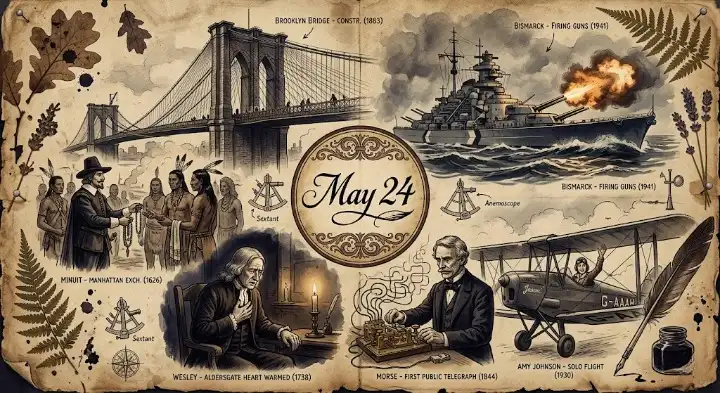
John Wesley sat in a small society room on Aldersgate Street in London on May 24, 1738, listening to someone read Martin Luther’s preface to the Romans. He felt his heart strangely warmed, describing an internal shift that altered the path of religious practice globally. This single evening transformed the spiritual landscape of England and America, fueling a movement built on personal faith and social action. Millions of modern Methodists still recognize this exact calendar night as the foundational spark of their entire community.
Exploring what happened on May 24 in history reveals a dense collection of human ambition, tragedy, and endurance across centuries of documented events.
👶 Quick Facts — May 24 in History
| 📌 Category | 📖 Event / Detail |
|---|---|
| 🌟 Most Significant Event | The opening of the Brooklyn Bridge in New York City, connecting Manhattan and Brooklyn across the East River as the longest suspension bridge in the world at the time (1883) |
| 🏆 Top 10 Key Events | • Henry the Fowler is elected King of East Francia (919) • Dutch colonial governor Peter Minuit purchases Manhattan Island from Native Americans (1626) • John Wesley’s Aldersgate conversion occurs, sparking the global Methodist movement (1738) • The Irish Rebellion of 1798 breaks out against British rule (1798) • Samuel Morse transmits the first commercial telegraph message: “What hath God wrought” (1844) • Brooklyn Bridge opens to traffic and thousands of pedestrians (1883) • Amy Johnson lands in Darwin, completing the first historic solo flight by a woman from England to Australia (1930) • During World War II, the German battleship Bismarck sinks the British battlecruiser HMS Hood (1941) • Civil Rights Freedom Riders are arrested in Jackson, Mississippi, after arriving on a Greyhound bus (1961) • Eritrea officially gains full independence from Ethiopia (1993) |
| ⚔️ Key Battles | Battle of Pichincha (1822), Battle of the Denmark Strait (1941), Battle of Yad Mordechai (1948) |
| 👤 Key Figures | Samuel Morse, Amy Johnson, John Wesley, Simón Bolívar |
| 🌍 Observances | Aldersgate Day (Methodism), Independence Day (Eritrea), Battle of Pichincha Day (Ecuador), Bermuda Day (Bermuda), Commonwealth Day (Belize), Lubiri Memorial Day (Buganda) |
Story of the Day: The Day the German Bismarck Shattered the Pride of the Royal Navy
Lookout men aboard the HMS Hood peered through the freezing mist of the Denmark Strait in the early hours of May 24, 1941. Britain’s largest, most beloved battlecruiser was rushing to intercept the Bismarck, Nazi Germany’s terrifying new capital ship, before it could break out into the Atlantic shipping lanes. At 05:52, the heavy guns opened fire, filling the Arctic air with thunder and blinding flashes of cordite smoke.
Five gun salvos from the Bismarck were all it took to change naval warfare forever. A continuous stream of fifteen-inch armor-piercing shells tore through the Hood’s thin deck armor, detonating the ship’s aft ammunition magazines in a catastrophic, blinding pillar of fire. The massive vessel broke completely in two, slipping beneath the icy waves in less than three minutes. Out of a crew of 1,418 elite British sailors, only three men survived the freezing waters.
Shock waves reverberated through the British Admiralty, turning a routine patrol into a desperate, furious hunt for vengeance. Prime Minister Winston Churchill immediately issued his famous directive to “Sink the Bismarck,” initiating a relentless three-day chase involving dozens of warships. The loss of the Hood marked the literal end of the big-gun capital ship era, proving that even the most legendary fortresses of steel were completely vulnerable to modern naval artillery and air power.
Important Events That Happened On May 24 In History
919 – Henry the Fowler Elected King
Noble warriors from Franconia and Saxony gathered at the Imperial Diet in Fritzlar to choose a new ruler. Henry the Fowler accepted the crown of the East Frankish Kingdom, breaking a long cycle of traditional Carolingian bloodline rulers. This dynamic political shift united independent German duchies under a centralized defensive alliance against aggressive Magyar raiders. His coronation laid the institutional framework for what grew into the massive Holy Roman Empire.
1218 – Fifth Crusade Sails for Egypt
Christian knights and infantrymen pulled up their heavy iron anchors at the port of Acre to begin a bold naval campaign. The Fifth Crusade set its military sights directly on Egypt, planning to capture the wealthy port city of Damietta as a strategic bargaining chip. This specific shift in strategy targeted the economic heart of the Ayyubid Sultanate rather than marching directly onto the fortified walls of Jerusalem. Disease, rising Nile floodwaters, and tactical errors ultimately doomed the expedition to a humiliating surrender.
1276 – Magnus Ladulås Crowned King of Sweden
Archbishop Fulco raised the heavy royal crown inside the stone walls of Uppsala Cathedral during a lavish medieval ceremony. Magnus Ladulås officially took the throne of Sweden, solidifying his control after a bitter civil war against his own brother. His reign introduced the historic Statute of Alsnö, which exempted loyal nobles from taxes in exchange for providing elite cavalry soldiers. This critical decree formally established the Swedish nobility and built a highly structured feudal society.
1487 – Lambert Simnel Crowned in Dublin
Ten-year-old Lambert Simnel stood before a crowded congregation inside Christ Church Cathedral, Dublin, while conspirators placed a golden crown upon his head. Irish Yorkists proclaimed the young baker’s son as King Edward VI, using him as a puppet to challenge King Henry VII’s new Tudor dynasty. This bold deception forced the English crown to mobilize troops for battle against a peasant child. Henry VII crushed the boy’s army weeks later at the Battle of Stoke Field, dryly putting the young pretender to work as a turnspit in the royal kitchens.
1567 – Sture Murders in Uppsala Castle
King Erik XIV of Sweden paced erratically through the dark corridors of Uppsala Castle, consumed by severe paranoia and delusions of treason. The mentally unstable monarch suddenly drew his dagger, personally attacking Count Nils Sture before ordering his royal guards to slaughter four incarcerated nobles. This shocking royal betrayal deeply horrified the Swedish aristocracy and decimated the king’s political credibility. Within a year, the furious nobility revolted, throwing Erik into prison and stripping him of his crown.
1595 – First Institutional Library Catalog Printed
Scholars at Leiden University Library unrolled pages of the freshly bound Nomenclator, creating a new milestone in academic organization. This historic document stood as the world’s very first printed catalog of an institutional library collection. Students could suddenly view every available title in the university’s possession without manually searching through dusty stacks of text. This innovative tool transformed how European universities managed knowledge, setting a new standard for modern archival systems worldwide.
1607 – Jamestown Colony Founded
Three small English ships—the Susan Constant, the Godspeed, and the Discovery—moored along the muddy banks of the James River in Virginia. One hundred and four adventurous settlers stepped ashore to build Jamestown, establishing the first permanent English settlement in North America. The pioneers faced immediate starvation, hostile native encounters, and deadly outbreaks of malaria in the swampy terrain. Tobacco cultivation eventually saved the colony from complete financial ruin, permanently shifting global trade networks.
1621 – Protestant Union Dissolved
Princes and diplomats gathered at Heilbronn to sign official documents that closed a major chapter in European religious politics. The Protestant Union formally dissolved its defensive alliance after suffering catastrophic military defeats during the early phases of the Thirty Years’ War. This collapse left individual Protestant territories deeply exposed to the marching armies of the Catholic Holy Roman Emperor. The structural failure dragged major foreign powers like Denmark, Sweden, and France directly into a devastating pan-European conflict.
1626 – Peter Minuit Buys Manhattan
Dutch colonial governor Peter Minuit met with local Canarseé native leaders along the wooded shores of the Hudson River. Minuit traded a collection of glass beads, iron kettles, and cloth valued at sixty guilders for complete control of Manhattan Island. This highly lopsided real estate deal laid the physical foundation for New Amsterdam, which later became the global financial metropolis of New York City. The transaction highlighted two completely clashing cultural ideas of land ownership that disrupted indigenous populations for centuries.
1667 – French Royal Army Crosses Spanish Border
French drums rolled as King Louis XIV’s elite troops marched directly across the frontier into the Spanish Netherlands. This aggressive invasion launched the War of Devolution, sparked by the French king’s bold claim that his wife was the rightful heir to these rich territories. Heavy artillery and superior numbers quickly overwhelmed isolated Spanish frontier garrisons. The rapid French advance deeply alarmed neighboring Protestant nations, forcing England, Sweden, and the Dutch Republic into a defensive Triple Alliance to halt Louis’s expansion.
1683 – Ashmolean Museum Opens in Oxford
Curators unlocked the heavy wooden doors of a new building on Broad Street, welcoming curious visitors inside. The Ashmolean Museum in Oxford opened its rooms as the world’s very first purpose-built university museum. Elias Ashmole donated an immense collection of antique coins, books, and geological specimens to encourage public education. This pioneering institution transformed how universities taught natural history, shifting academic learning away from textbook memorization toward physical, hands-on evidence.
1689 – Act of Toleration Passed in England
Members of the English Parliament gathered in Westminster to vote on a major piece of religious legislation. The passing of the Act of Toleration granted freedom of worship to dissenting Protestants like Quakers, Baptists, and Presbyterians. This historic decree intentionally excluded Roman Catholics from these new civil protections, keeping them barred from public office. The law effectively ended decades of violent religious persecution in Britain, stabilizing the crown under William and Mary.
1738 – John Wesley’s Aldersgate Conversion
Anglican cleric John Wesley sat listening to a reading of Martin Luther’s theology in a small room on Aldersgate Street, London. Wesley felt his heart strangely warmed, experiencing an intense spiritual awakening that erased his deep personal anxieties about salvation. This single evening of profound faith served as the catalyst for the global Methodist movement. His subsequent outdoor preaching tours brought religious renewal to working-class communities ignored by the traditional Church of England.
1798 – Irish Rebellion of 1798 Begins
Secret cells of United Irishmen rose up across the countryside, wielding pikes and stolen muskets against British garrisons. The Great Irish Rebellion began with coordinated attacks on military outposts surrounding Dublin, aiming to break British colonial rule and establish an independent republic. Enraged government forces responded with immediate, brutal martial law to suppress the spreading insurrection. The bloody conflict claimed over thirty thousand lives in just a few months, leading directly to the Act of Union.
1813 – Simón Bolívar Proclaimed El Libertador
Simón Bolívar rode triumphantly into the mountain city of Mérida, surrounded by cheering crowds and revolutionary soldiers. The South American independence leader was officially proclaimed El Libertador after leading a daring invasion force across the Andes into Venezuela. His bold military maneuvers successfully drove back royalist Spanish forces during the famous Admirable Campaign. This political victory established the Second Republic of Venezuela, cementing Bolívar’s legacy as a revolutionary icon.
1822 – Battle of Pichincha Secures Quito’s Freedom
General Antonio José de Sucre led his revolutionary army up the steep, muddy slopes of the active Pichincha volcano. Patriot forces clashed with royalist Spanish troops over three thousand meters above sea level, fighting through dense mountain fog for control of Quito. Sucre’s tactical brilliance won a decisive victory that shattered Spanish colonial power across the region. This triumph secured the immediate independence of the Presidency of Quito, which later formed the modern nation of Ecuador.
1832 – First Kingdom of Greece Declared
Diplomats from Britain, France, and Russia sat around a negotiating table at the London Conference to finalize Mediterranean borders. The great powers officially declared the creation of the First Kingdom of Greece, picking seventeen-year-old Prince Otto of Bavaria to be its new king. This international treaty concluded a bloody, decade-long war of independence against the Ottoman Empire. The decision imposed a foreign Catholic monarch on an Orthodox population, sparking years of domestic political tension.
1844 – Samuel Morse Transmits First Telegraph Message
Inventor Samuel Morse sat inside a committee room at the United States Capitol and tapped a mechanical key. His electrical impulses traveled along wires to Baltimore, sending the biblical quote “What hath God wrought” to his assistant Alfred Vail. This historic demonstration inaugurated the world’s first commercial long-distance telegraph line. The achievement shattered the limitations of physical distance, allowing news to travel instantaneously and laying the groundwork for the modern telecommunications age.
1856 – Pottawatomie Rifles Kill Slavery Supporters
Abolitionist John Brown led a small band of armed men into a pro-slavery settlement along Pottawatomie Creek, Kansas. Brown’s followers dragged five pro-slavery settlers from their cabins, executing them with broadswords in the pitch black of night. This brutal retaliatory attack responded directly to the recent sacking of the anti-slavery town of Lawrence. The bloody event escalated the local conflict known as “Bleeding Kansas,” driving the United States closer to an all-out civil war.
1861 – Union Officers Occupy Alexandria
Federal troops marched across the Potomac River at dawn to take control of Alexandria, Virginia. Colonel Elmer E. Ellsworth spotted a large Confederate flag flying over the Marshall House inn and rushed inside to tear it down. The inn’s pro-slavery owner shot Ellsworth dead on the stairs, making the young colonel the very first Union officer killed in the American Civil War. Ellsworth’s death deeply shocked the North, turning him into an instant martyr whose name became a rallying cry for enlistment.
1873 – Patrick Francis Healy Named Georgetown President
Jesuit educators at Georgetown University made history by appointing Patrick Francis Healy as their new administrative leader. Healy became the very first black president of a predominantly white university within the United States. Born into slavery in Georgia to a white planter and a mixed-race enslaved woman, he concealed his African ancestry to pursue higher education in Europe. His transformative leadership modernized the curriculum and constructed the iconic campus building that bears his name today.
1883 – Brooklyn Bridge Opens to Traffic
Thousands of cheering New Yorkers packed the riverbanks as standard steamships blew their whistles in celebration. The iconic Brooklyn Bridge officially opened to public traffic after fourteen grueling years of construction and over two dozen worker deaths. Chief Engineer Washington Roebling watched the opening through a telescope from his apartment window, having been bedridden by decompression sickness. This structural masterpiece linked Manhattan and Brooklyn, creating the largest suspension bridge in the world at the time.
1900 – Orange Free State Annexed by Britain
Lord Roberts stood before British imperial troops in South Africa to read an official royal proclamation. The United Kingdom formally annexed the independent Boer republic of the Orange Free State, renaming it the Orange River Colony. This aggressive move followed the capture of the capital city, Bloemfontein, during the Second Boer War. The annexation forced Boer commandos to abandon traditional military formations, launching a brutal guerrilla warfare campaign that lasted for two more bloody years.
1930 – Amy Johnson Lands in Darwin
Aviator Amy Johnson guided her small de Havilland Gipsy Moth biplane down onto the grass runway at Darwin. Johnson became the very first woman to fly solo from England to Australia, completing an eleven-thousand-mile trek across open oceans and deserts. She braved severe tropical monsoons, forced desert landings, and a total lack of modern instruments during her nineteen-day journey. Her historic arrival turned her into an international icon, inspiring an entire generation of female pilots.
1935 – First Major League Night Game Played
Groundkeepers flipped a massive switch at Crosley Field in Cincinnati, flooding the diamond with over one million watts of electric light. The Cincinnati Reds beat the Philadelphia Phillies two-to-one in the first night game in Major League Baseball history. President Franklin D. Roosevelt symbolically turned on the lights via a remote signal sent directly from the White House. This innovative experiment allowed working-class fans to attend games after working hours, permanently altering sports entertainment economics.
1940 – Igor Sikorsky Flies Single-Rotor Helicopter
Engineer Igor Sikorsky climbed into the open cockpit of his experimental VS-300 aircraft in Stratford, Connecticut. Sikorsky pulled the controls, performing the world’s first successful tethered flight of a functional single-rotor helicopter design. His innovative use of a small vertical tail rotor successfully countered the spinning torque generated by the main overhead blades. This breakthrough breakthrough solved a massive aviation engineering puzzle, shaping the design of nearly all modern military and civilian helicopters.
1940 – Assassination Attempt on Leon Trotsky Fails
Gunmen dressed in Mexican police uniforms stormed into a fortified villa compound in Coyoacán, Mexico. Soviet NKVD agent Iosif Grigulevich orchestrated the attack, acting directly on the orders of Joseph Stalin to eliminate the exiled revolutionary Leon Trotsky. The assassins fired over two hundred rounds into Trotsky’s bedroom, but the old Marxist hid beneath his bed and escaped with minor scratches. This security failure forced Trotsky to harden his compound, though a separate assassin managed to kill him with an ice axe just months later.
1944 – Berlin Stock Exchange Destroys by Bombing
Allied bomber formations dropped payloads of heavy incendiary bombs directly over the heart of Germany’s capital city. The historic Börse Berlin building burned to the ground after taking a direct hit during the massive air raid. The destruction of this central financial institution halted paper trading operations and shattered the bureaucratic infrastructure of the wartime Nazi economy. This raid formed part of a continuous Allied air offensive aimed at crippling German industrial and economic capabilities.
1944 – Congress of Përmet Convenes
Partisan resistance leaders gathered in the liberated mountain town of Përmet to establish a new political order. The historic assembly formed an Anti-Fascist National Liberation Committee, creating Albania’s first independent provisional government since the 1939 Italian invasion. Enver Hoxha took control as military commander, laying the structural foundations for a postwar communist state. In recognition of this turning point, the nation’s state emblem inscribed this exact date from 1946 until 1992.
1948 – Kibbutz Yad Mordechai Falls to Egypt
Exhausted Israeli defenders slipped out of their ruined bunkers under cover of darkness after five days of relentless artillery bombardment. Egyptian forces finally captured the strategic kibbutz of Yad Mordechai, which sat directly along the main coastal highway to Tel Aviv. This desperate, low-odds defense bought precious time for the Israeli army to fortify positions further north. The delay allowed fresh troops to assemble artillery, successfully halting the Egyptian advance just one week later.
1956 – First Eurovision Song Contest Held
Seven European nations sent their best vocalists to the Kursaal Theatre in Lugano, Switzerland. The first Eurovision Song Contest opened its broadcast, aiming to unite a fractured postwar Europe through lighthearted musical entertainment. Lys Assia won the inaugural competition for the host nation with her performance of the song “Refrain.” This small-scale radio experiment blossomed into a massive annual television event, launching international stars and drawing hundreds of millions of global viewers.
1958 – United Press International Formed
Media executives signed final merger agreements in New York City, combining two of America’s largest independent news providers. United Press joined forces with the International News Service to form United Press International, creating a massive global news agency. This strategic consolidation allowed the new entity to compete directly with the dominant Associated Press for wire service dominance. The merger reshaped twentieth-century journalism, providing hundreds of newspapers with rapid, independent reporting.
1960 – Cordón Caulle Volcano Erupts
Subterranean pressure ripped open a two-mile fissure along the Chilean Andes, spewing ash miles into the atmosphere. The Cordón Caulle volcanic complex began an explosive eruption just thirty-eight hours after the region suffered the largest earthquake ever recorded in human history. The massive volcanic activity blanketed nearby agricultural valleys in thick layers of toxic gray pumice. This rare twin disaster forced thousands of rural residents to evacuate, altering local geography and weather patterns.
1961 – Freedom Riders Arrested in Jackson
Civil rights activists stepped off an interstate bus at the Greyhound terminal in Jackson, Mississippi. White police officers immediately arrested the Freedom Riders for “disturbing the peace” when they attempted to use a whites-only cafeteria and restroom facility. The activists refused to pay bail, filling the notorious parchment penitentiary cells to protest illegal southern segregation laws. This bold strategy forced the federal government to strictly enforce integration across all interstate transit terminals.
1962 – Scott Carpenter Orbits the Earth
Technicians secured the hatch of the Aurora 7 space capsule at Cape Canaveral, Florida, before a massive Atlas rocket ignited. American astronaut Scott Carpenter successfully orbited the Earth three times during the historic Project Mercury space mission. Carpenter conducted crucial scientific experiments, studying liquid behavior in zero gravity and capturing detailed photographs of the upper atmosphere. A minor targeting error during reentry caused his capsule to splash down two hundred and fifty miles off course.
1967 – Egypt Blockades Israel’s Red Sea Coast
Egyptian military units moved into position along the Straits of Tiran, sealing off the Gulf of Aqaba. President Gamal Abdel Nasser imposed a strict naval blockade, barring all Israeli ships and vessels carrying strategic cargo from reaching the port of Eilat. This aggressive closure choked off Israel’s primary maritime supply route to East Africa and Asia. The hostile act escalated regional tensions to a breaking point, serving as a primary catalyst for the Six-Day War.
1967 – Belle de Jour Premieres in Paris
Audiences packed into a Parisian cinema for the controversial debut of Luis Buñuel’s latest cinematic project. The provocative film Belle de Jour, starring Catherine Deneuve, officially premiered, challenging traditional French bourgeois morality through its surreal depiction of a housewife’s secret life. The movie won the prestigious Golden Lion award at the Venice Film Festival later that year. This artistic success redefined modern psychological cinema, breaking down longstanding censorship barriers regarding adult themes.
1976 – Judgment of Paris Upends Wine Industry
Renowned French wine experts gathered for a blind tasting event at the InterContinental Hotel in Paris. The judges shocked the global culinary establishment by rating unknown California Chardonnays and Cabernet Sauvignons higher than Bordeaux’s finest estates. This unexpected outcome shattered the historic myth that quality wine could only be produced on French soil. The event transformed California’s Napa Valley into a global powerhouse, opening the international market to New World winemakers.
1981 – Ecuadorian President Dies in Plane Crash
A twin-engine presidential aircraft slammed into the side of Huairapungo Mountain near Zapotillo, killing everyone on board. Ecuadorian President Jaime Roldós Aguilera, his wife, and his cabinet died just minutes after Roldós delivered an emotional address marking the Battle of Pichincha. His sudden death cut short a transformative democratic administration focused on human rights and labor reform across South America. The tragedy sparked decades of intense political speculation and conspiracy theories regarding the crash’s origin.
1982 – Iranians Recapture Port of Khorramshahr
Thousands of celebratory Iranian soldiers poured into the streets of a strategic port city along the Shatt al-Arab waterway. Iranian forces successfully recaptured Khorramshahr from Iraqi control, capturing over nineteen thousand Iraqi prisoners during the bloody Iran–Iraq War. This massive military victory shattered Saddam Hussein’s dreams of a quick conquest, shifting the conflict’s momentum entirely. The retreat forced Iraqi forces back across the border, turning the war into a brutal war of attrition.
1988 – Section 28 Enacted in United Kingdom
Prime Minister Margaret Thatcher’s Conservative government passed a controversial amendment to the Local Government Act. Section 28 officially prohibited local authorities from intentionally promoting homosexuality or publishing material aimed at promoting gay relationships. The law banned British public schools from teaching about LGBTQ+ issues, forcing teachers to hide their identities and canceling student support groups. This legislation sparked massive nationwide protests, driving a major wave of modern British gay rights activism.
1991 – Operation Solomon Evacuates Ethiopian Jews
Non-stop flights began landing at Ben Gurion Airport as Israeli military transport planes opened their cargo doors. Israel completed Operation Solomon, a covert military airlift that evacuated over fourteen thousand Ethiopian Jews from Addis Ababa in just thirty-six hours. Technicians stripped thirty-four aircraft of their seats to pack as many refugees as possible away from a spreading Ethiopian civil war. This dramatic humanitarian mission set an international record for the most passengers ever carried on a single Boeing 747.
1992 – Thai Dictator Suchinda Resigns
General Suchinda Kraprayoon stood before television cameras to announce his immediate resignation as Prime Minister of Thailand. This sudden departure followed massive, bloody pro-democracy protests in Bangkok known as “Black May,” where military forces shot dozens of unarmed students. King Bhumibol Adulyadej personally intervened, forcing the dictator to publicly reconcile with protest leaders on live television. This dramatic royal intervention ended military rule, restoring a civilian constitutional government to the country.
1992 – Ethnic Cleansing Begins in Kozarac
Armed Serbian militia units and federal police forces advanced into the Bosnian town of Kozarac, firing heavy artillery into civilian neighborhoods. This assault marked the formal beginning of a brutal ethnic cleansing campaign targeting Bosnian Muslims and Croats across the Prijedor region. Soldiers systematically separated families, executing community leaders and burning thousands of homes to the ground. Surviving residents were marched into notorious concentration camps like Omarska, sparking international war crimes investigations.
1993 – Eritrea Gains Full Independence
Cheering crowds flooded the decorated streets of Asmara as the green, red, and blue national flag rose into the sky. Eritrea officially declared its full independence from Ethiopia, concluding a brutal thirty-year war of liberation that decimated the Horn of Africa. A UN-monitored referendum showed that over ninety-nine percent of citizens voted in favor of separation. The historic milestone allowed the new nation to seek international recognition and begin rebuilding its war-torn economy.
1993 – Cardinal Posadas Ocampo Assassinated
A hail of automatic gunfire shattered the windscreen of a white Grand Marquis at Guadalajara International Airport in Mexico. Roman Catholic Cardinal Juan Jesús Posadas Ocampo and five other innocent people died instantly during a chaotic shootout between rival drug cartels. Government investigators later revealed that gunmen from the Tijuana Cartel mistook the cardinal’s luxury car for that of rival kingpin Joaquin “El Chapo” Guzmán. This high-profile murder horrified the Mexican public, escalating the country’s war on organized crime.
1994 – World Trade Center Bombers Convicted
Federal marshals escorted four men out of a Manhattan courtroom following a tense, high-profile domestic terrorism trial. A federal judge sentenced each defendant to two hundred and forty years in prison for their roles in the 1993 World Trade Center bombing. The blast had ripped through an underground parking garage, killing six people and injuring over one thousand others. This landmark conviction sent a clear message to international terror networks operating within the United States.
1995 – Knight Air Flight 816 Crashes
A small Embraer Bandeirante turboprop plane climbed into heavy storm clouds after taking off from Leeds Bradford Airport. Knight Air Flight 816 suffered a critical instrument failure just minutes into the flight, causing the pilots to lose all spatial orientation. The aircraft entered an uncontrollable spiral dive, breaking apart in mid-air and crashing into a field at Dunkeswick, North Yorkshire. All twelve passengers and crew members aboard died instantly upon impact.
1999 – Slobodan Milošević Indicted for War Crimes
Chief Prosecutor Louise Arbour stood before reporters at The Hague to read a historic international legal document. The International Criminal Tribunal for the former Yugoslavia officially indicted Yugoslav President Slobodan Milošević for crimes against humanity committed in Kosovo. The warrant accused Milošević of orchestrating a systematic campaign of deportation, murder, and persecution against ethnic Albanians. This marked the very first time a sitting head of state was charged with war crimes by an international tribunal.
2000 – Israeli Troops Withdraw from Lebanon
Heavy military convoys rumbled south across the international border, closing security gates behind them. Israeli troops completed a rapid withdrawal from southern Lebanon, ending a complex twenty-two-year military occupation. The sudden pullout caused the immediate collapse of Israel’s local proxy militia, the South Lebanon Army, as Hezbollah fighters quickly seized abandoned hilltop outposts. This milestone repositioned regional defenses, shifting the cross-border conflict into an uneasy, tense standoff.
2002 – Moscow Treaty Signed
President George W. Bush and President Vladimir Putin sat at a polished wooden table inside the Kremlin to sign an arms reduction agreement. The United States and Russia formalized the Moscow Treaty, committing both global superpowers to slash their active nuclear arsenals by two-thirds. This landmark accord required both nations to limit their deployed strategic nuclear warheads to under twenty-two hundred each within a decade. The signing signaled a temporary era of close post-Cold War security cooperation.
2014 – Aegean Sea Earthquake Injures Hundreds
Panic spread through coastal towns as walls cracked and store shelves collapsed without warning. A powerful 6.4 magnitude earthquake struck deep beneath the Aegean Sea between Greece and Turkey, sending violent shockwaves across the region. The intense tremors severely damaged historic buildings on the Greek island of Lemnos and caused widespread structural destruction in western Turkey. Emergency services treated over three hundred and twenty injured people who fled panicking into the streets.
2014 – Brussels Jewish Museum Shooting
A lone gunman pulled a Kalashnikov rifle from a bag and opened fire inside the Jewish Museum of Belgium in Brussels. The targeted anti-Semitic attack killed three innocent people instantly, with a fourth victim dying of injuries days later. Security forces launched an international manhunt, capturing a French national with ties to radical extremist networks in Syria a week later. This tragedy forced European authorities to dramatically increase security measures around Jewish cultural institutions.
2019 – Surat Commercial Complex Fire
Thick black smoke poured from the windows of a multi-story commercial building in Surat, India. A sudden electrical short circuit ignited a fast-moving fire that trapped dozens of students inside an illegal rooftop coaching academy. Twenty-two young students died when the flimsy plastic roof collapsed or when they leaped from windows to escape the flames. The tragedy sparked massive public outrage, leading to strict structural safety audits across the country.
2019 – Prime Minister Theresa May Announces Resignation
Speaking outside the door of 10 Downing Street, British Prime Minister Theresa May fought back tears as she addressed the nation. May officially announced her resignation as Leader of the Conservative Party, yielding to immense political pressure over her failure to pass a Brexit withdrawal agreement through Parliament. Her departure concluded three turbulent years of bitter legislative gridlock and deep divisions within her own cabinet. The announcement opened a path for a new leadership contest to decide Britain’s exit from the European Union.
2022 – Robb Elementary School Shooting
A lone teenage gunman armed with an assault rifle stormed inside a fourth-grade classroom at Robb Elementary School in Uvalde, Texas. The attacker killed nineteen young children and two teachers during an hour-long siege before border patrol agents breached the room. A subsequent state investigation revealed a catastrophic systemic failure by local law enforcement officers who waited in hallways instead of confronting the killer. This horrifying event reignited a fierce, emotional national debate regarding American gun control laws.
2026 – Quetta Shuttle Train Bombing
A devastating explosion tore through a crowded passenger carriage at the central railway station in Quetta, Balochistan. A suicide bomber detonated a vest packed with ball bearings and military-grade explosives just as commuters boarded a morning shuttle train. The blast killed at least forty-eight people and left ninety-eight others with severe blast injuries. Regional security forces locked down the transit network, blaming separatist militant cells targeting public infrastructure.
Dig deeper into our timeline of past events right here.
Famous People Born On May 24
| Name | Description | Date |
|---|---|---|
| John Jewel | Anglican bishop of Salisbury, defender of Elizabeth I’s religious policies | May 24, 1522 – September 23, 1571 |
| William Gilbert | English scientist, pioneer researcher into magnetism | May 24, 1544 – December 10, 1603 |
| John Maitland, duke of Lauderdale | Scottish politician, chief minister of Charles II | May 24, 1616 – August 20, 1682 |
| John Mayow | English chemist and physiologist, identified oxygen | May 24, 1640 – October 1679 |
| Daniel Gabriel Fahrenheit | Polish-born Dutch physicist, invented mercury thermometer | May 24, 1686 – September 16, 1736 |
| Georg Raphael Donner | Austrian sculptor, transition from Baroque to Neoclassical | May 24, 1693 – February 15, 1741 |
| Charles Emmanuel IV | King of Sardinia-Piedmont (1796–1802) | May 24, 1751 – October 6, 1819 |
| Pierre-Gaspard Chaumette | French Revolutionary leader, cult of Reason promoter | May 24, 1763 – April 13, 1794 |
| Thomas Jefferson Hogg | English biographer of Percy Bysshe Shelley | May 24, 1792 – August 27, 1862 |
| Minh Mang | Emperor of Vietnam (1820–41), anti-Western policies | May 24, 1792 – January 11, 1841 |
| William Whewell | English philosopher and historian, theory of induction | May 24, 1794 – March 6, 1866 |
| Abraham Geiger | German-Jewish theologian, leader of Reform Judaism | May 24, 1810 – October 23, 1874 |
| Sir John Eldon Gorst | British lawyer and politician, reorganized Conservative Party | May 24, 1835 – April 4, 1916 |
| Aleksey Kondratyevich Savrasov | Russian landscape painter, The Rooks Have Returned | May 24, 1830 – October 8, 1897 |
| Sir Arthur Wing Pinero | British playwright, “social drama” pioneer | May 24, 1855 – November 23, 1934 |
| Alfred Cort Haddon | British anthropologist, founder of modern British anthropology | May 24, 1855 – April 20, 1940 |
| George Grey Barnard | American sculptor, collector for the Cloisters | May 24, 1863 – April 24, 1938 |
| John Wheatley | British Labour politician | May 24, 1869 – May 12, 1930 |
| Benjamin Nathan Cardozo | Associate justice of U.S. Supreme Court (1932–38) | May 24, 1870 – July 9, 1938 |
| Harry Emerson Fosdick | American liberal Protestant minister | May 24, 1878 – October 5, 1969 |
| Lillian Evelyn Gilbreth | American psychologist and engineer, time-and-motion study | May 24, 1878 – January 2, 1972 |
| Clark L. Hull | American psychologist, mathematical learning theory | May 24, 1884 – May 10, 1952 |
| Howard W. Odum | American sociologist, Southern regional studies | May 24, 1884 – November 8, 1954 |
| W.F. Albright | American biblical archaeologist | May 24, 1891 – September 19, 1971 |
| Helen Brooke Taussig | American physician, founder of pediatric cardiology | May 24, 1898 – May 20, 1986 |
| José Maria Ferreira de Castro | Portuguese social-realist novelist | May 24, 1898 – June 29, 1974 |
| Suzanne Lenglen | French tennis champion, six-time Wimbledon winner | May 24, 1899 – July 4, 1938 |
| Henri Michaux | Belgian-born French poet and painter | May 24, 1899 – October 18, 1984 |
| Sir William Haley | British BBC director general, editor of The Times, Britannica editor | May 24, 1901 – September 6, 1987 |
| Lionel Conacher | Canadian athlete, Athlete of the Half-Century | May 24, 1901 – May 26, 1954 |
Famous People Died On May 24
| Name | Description | Date |
|---|---|---|
| St. Eleutherius | Pope (c.175–189) | – May 24, 189 |
| David I | King of Scotland (1124–53), introduced Norman aristocracy | c.1082 – May 24, 1153 |
| Benedetto da Maiano | Italian early Renaissance sculptor | 1442 – May 24, 1497 |
| Ferdinand II | Grand duke of Tuscany (1621–70) | July 14, 1610 – May 24, 1670 |
| María de Agreda | Spanish mystic and abbess | April 2, 1602 – May 24, 1665 |
| Nicodemus Tessin the Elder | Swedish architect, Drottningholm palace | December 7, 1615 – May 24, 1681 |
| William Hamilton of Gilbertfield | Scottish vernacular poet | c.1665 – May 24, 1751 |
| Jonathan Wild | English criminal mastermind of 18th-century London | c.1682 – May 24, 1725 |
| George Brydges Rodney, 1st Baron Rodney | British admiral, won key naval battles | February 13, 1718 – May 24, 1792 |
| Nikolay Vasilyevich, prince Repnin | Russian diplomat and military officer | March 22, 1734 – May 24, 1801 |
| Juan Meléndez Valdés | Spanish Neoclassical poet | March 11, 1754 – May 24, 1817 |
| John Randolph | American politician, states’ rights advocate | June 2, 1773 – May 24, 1833 |
| William Crockford | English gambling establishment founder | 1775 – May 24, 1844 |
| Annette, Freiin von Droste-Hülshoff | German poet and prose writer | January 10, 1797 – May 24, 1848 |
| Julius Schnorr von Carolsfeld | German Nazarene painter | March 26, 1794 – May 24, 1872 |
| Henry Kingsley | English novelist, Ravenshoe | January 2, 1830 – May 24, 1876 |
| Ramón Cabrera | Spanish Carlist general | December 27, 1806 – May 24, 1877 |
| Samuel Palmer | English visionary landscape painter | January 27, 1805 – May 24, 1881 |
| Georg Waitz | German historian, medievalist | October 9, 1813 – May 24, 1886 |
| Joseph Roumanille | Provençal poet, Félibrige founder | August 8, 1818 – May 24, 1891 |
| Hugh McCulloch | American financier, secretary of the Treasury | December 7, 1808 – May 24, 1895 |
| To’ Janggut | Malay peasant rebellion leader against British rule | 1853 – May 24, 1915 |
| Amado Nervo | Mexican Modernist poet | August 27, 1870 – May 24, 1919 |
| Sir Erskine Holland | English legal writer, Elements of Jurisprudence | July 17, 1835 – May 24, 1926 |
| John Bach McMaster | American social historian | June 29, 1852 – May 24, 1932 |
| Elmore James | American blues singer-guitarist, “King of the Slide Guitar” | January 27, 1918 – May 24, 1963 |
| Alan Hazeltine | American engineer, invented neutrodyne circuit | August 7, 1886 – May 24, 1964 |
| Duke Ellington | American jazz composer and bandleader | April 29, 1899 – May 24, 1974 |
| Michał Choromański | Polish novelist | June 22, 1904 – May 24, 1972 |
| George Jessel | American comedian, Toastmaster General of the United States | April 3, 1898 – May 24, 1981 |
Observances on May 24
- Aldersgate Day / Wesley Day (Methodism): Methodists worldwide gather for special services to commemorate John Wesley’s life-changing spiritual experience in London.
- Independence Day (Eritrea): Citizens across the nation celebrate their hard-fought 1993 separation from Ethiopian rule with cultural parades and street festivals.
- Battle of Pichincha Day (Ecuador): Military parades and civic ceremonies take place in Quito to honor General Sucre’s historic 1822 victory over Spanish colonial rule.
- Bermuda Day (Bermuda): Locals participate in traditional dinghy races and a lively parade in Hamilton, marking the official start of the island’s summer season.
- Commonwealth Day (Belize): Communities hold educational school events and sports competitions to highlight historical ties and modern cultural cooperation within the Commonwealth.
- Lubiri Memorial Day (Buganda): Kingdom loyalists gather to remember the tragic 1966 military assault on the Kabaka’s royal palace by Ugandan government forces.
🌉 Frequently Asked Questions — May 24 in History
New York authorities officially opened the iconic Brooklyn Bridge to public traffic after fourteen grueling years of dangerous construction. The engineering masterpiece connected Manhattan and Brooklyn for the first time, standing as the largest suspension bridge in the world at its opening.
Opening the Brooklyn Bridge in 1883 represents a major leap in modern engineering, infrastructure, and urban architecture. This monument fundamentally reshaped New York’s economy and proved that massive steel-wire suspension bridges could safely span major commercial waterways.
Queen Victoria of the United Kingdom was born on May 24, 1819, inside Kensington Palace in London. Her long, historic sixty-three-year reign defined the prosperous Victorian Era, overseeing massive industrial expansion and the height of the British Empire.
German battleship Bismarck sank the pride of the British Royal Navy, the HMS Hood, during the fierce Battle of the Denmark Strait in 1941. The catastrophic explosion killed over fourteen hundred sailors, sparking a relentless three-day naval chase across the Atlantic.
Aldersgate Day is an annual Methodist observance commemorating preacher John Wesley’s deep spiritual conversion on May 24, 1738. His experience of a “strangely warmed” heart served as the foundational spark for the worldwide Methodist movement.
A devastating suicide bombing targeted a crowded morning shuttle train at the central railway station in Quetta, Balochistan, in 2026. The tragic explosion claimed at least forty-eight innocent lives and left nearly one hundred other commuters injured.