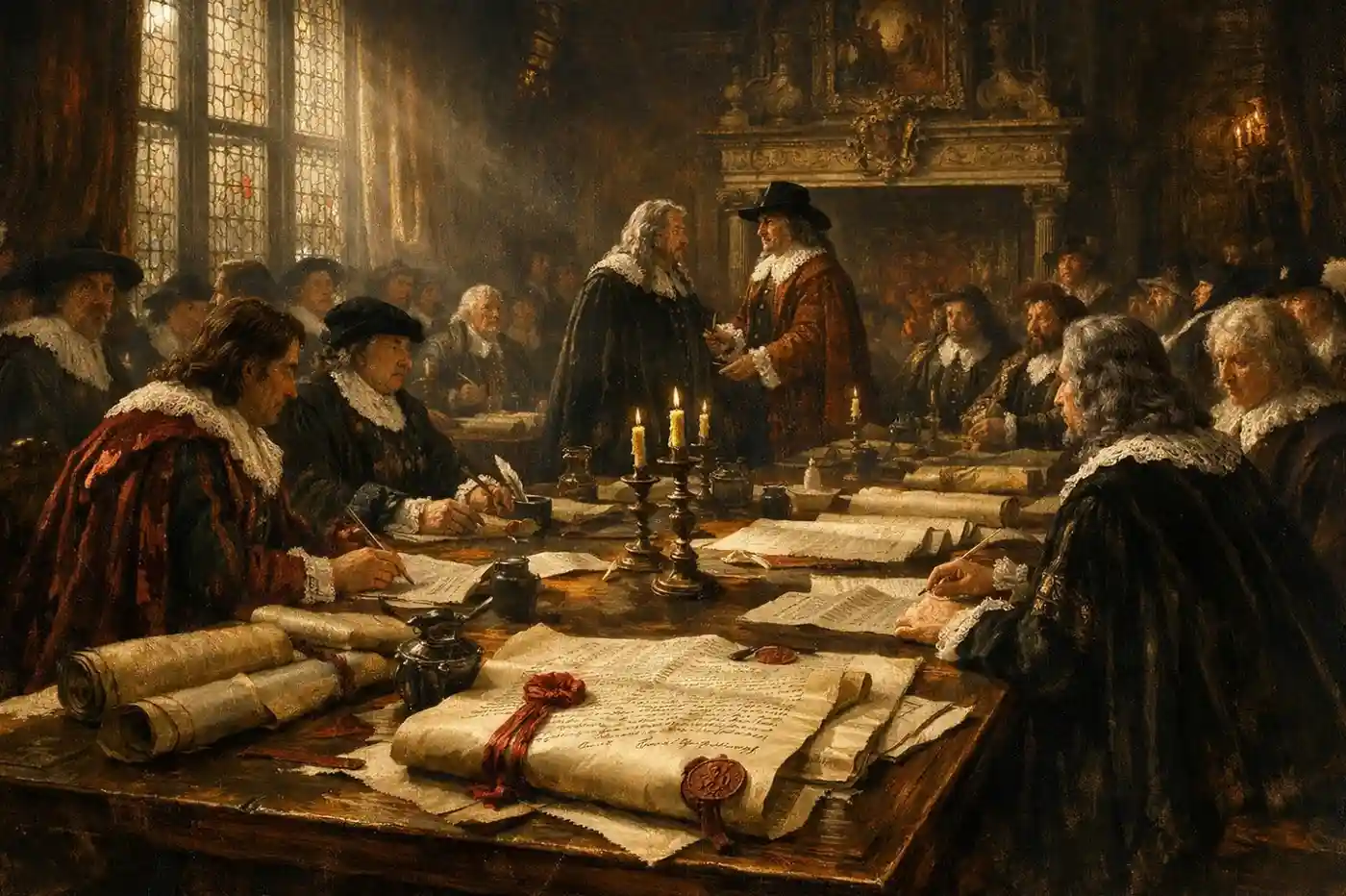
In the autumn of 1648, after nearly five years of exhausting negotiations and thirty years of the most destructive warfare Europe had ever seen, diplomats from across the continent put their signatures on two documents that would quietly reshape the entire international order. The agreements signed in the German cities of Osnabrück and Münster did not just end a war. They drew a line between the medieval world and everything that came after it. Most people have heard of World War I or the Congress of Vienna, but the Treaty of Westphalia quietly sits beneath all of them — the foundation that made the very concept of a nation-state possible.
This is the full story of how Europe broke itself apart and then, through years of painful diplomacy, stitched something entirely new together.
Treaty of Westphalia: Quick Facts
| Detail | Information |
|---|---|
| 📅 Date Signed | October 24, 1648 |
| 📍 Location | Osnabrück and Münster, Westphalia (modern Germany) |
| ⚔️ Wars Ended | The Thirty Years’ War (1618–1648) and the Eighty Years’ War between Spain and the Dutch Republic |
| 🖋️ Main Signatories | Holy Roman Empire, France, Sweden, Spain, Dutch Republic |
| 📜 Documents | Peace of Osnabrück + Peace of Münster |
| 🏛️ Key Legacy | Established the principle of sovereign nation-states |
What Was the Treaty of Westphalia?
The Treaty of Westphalia was not a single document. It was actually two separate peace agreements signed on October 24, 1648, concluding both the Thirty Years’ War and the Eighty Years’ War between Spain and the Dutch Republic. The first was the Peace of Osnabrück, signed between the Holy Roman Empire and Sweden. The second was the Peace of Münster, signed between the Holy Roman Empire and France, as well as between Spain and the Dutch Republic. Together these two texts are referred to as the Westphalian Peace, and together they form one of the most consequential legal agreements in all of human history.
The negotiations themselves were extraordinary. Representatives from nearly every major European power gathered in the Westphalia region of what is now northwestern Germany. Some estimates put the number of participating delegations at over 100. It was, in effect, the first truly multilateral peace conference in European history — a forerunner to the United Nations, the Concert of Europe, and every other multinational diplomatic gathering that followed.
The two cities were chosen deliberately. Osnabrück was a Protestant city, and Münster was Catholic. The dual-city arrangement was itself a diplomatic compromise that reflected the deeply religious nature of the conflict being resolved.
The Background: What Was the Thirty Years’ War?
To understand why the Treaty of Westphalia mattered so deeply, you have to understand the Thirty Years’ War — and it was brutal in a way that modern readers find genuinely shocking. Fought primarily on German soil between 1618 and 1648, the conflict began as a religious dispute within the Holy Roman Empire but quickly evolved into a continent-wide political catastrophe. Catholic powers fought Protestant ones. German princes fought their emperor. Sweden, France, Denmark, and Spain all intervened for their own strategic interests, turning Central Europe into a prolonged and merciless battleground.
The human cost was staggering. Historians estimate that the population of the Holy Roman Empire fell by somewhere between 25 and 40 percent during the war. Some regions of Germany lost more than half their population. Villages were burned, harvests were destroyed, disease spread through armies and civilian populations alike. The Battle of Breitenfeld in 1631, one of the largest Protestant victories, left tens of thousands dead in a single engagement. This was not a tidy conflict fought by professional soldiers far from civilian life. It devoured everything.
By the mid-1640s, nearly everyone was exhausted. The original religious justifications had long since blurred into competing territorial ambitions and dynastic rivalries. All sides wanted out, but no one wanted to appear weak. The negotiations that eventually produced the Westphalian Peace were themselves a years-long exercise in collective face-saving.
The Key Terms of the Treaty
The Principle of State Sovereignty
The most revolutionary aspect of the Westphalian settlement was the formal recognition that each signatory state had sovereign authority over its own territory and its own internal affairs. Outside powers could no longer intervene in a country’s religious or political arrangements simply because they disagreed with them. The Pope, the Holy Roman Emperor, or any foreign king — none of them had the right to dictate how a state governed itself internally.
This sounds obvious today. It was anything but obvious in 1648. For centuries, the idea that the Pope held ultimate spiritual authority over all Christian rulers, and that the Holy Roman Emperor held a kind of supreme political authority over German-speaking territories, had shaped European politics. The Treaty of Westphalia effectively ended both claims, at least in practical terms. Every state, large or small, was theoretically equal in its right to exist and govern without outside interference.
Religious Settlements
The treaty extended the Peace of Augsburg of 1555, which had established the principle that rulers could determine the religion of their own territories, to now include Calvinism alongside Lutheranism and Catholicism. The year 1624 was designated as the normative year for determining which territories were Protestant and which were Catholic, meaning that ecclesiastical properties held in that year would remain in those religious hands permanently.
It was an imperfect compromise. Neither Catholics nor Protestants got everything they wanted. But it created a workable framework that prevented the religious question from exploding into open warfare again — at least for a generation.
Territorial Adjustments
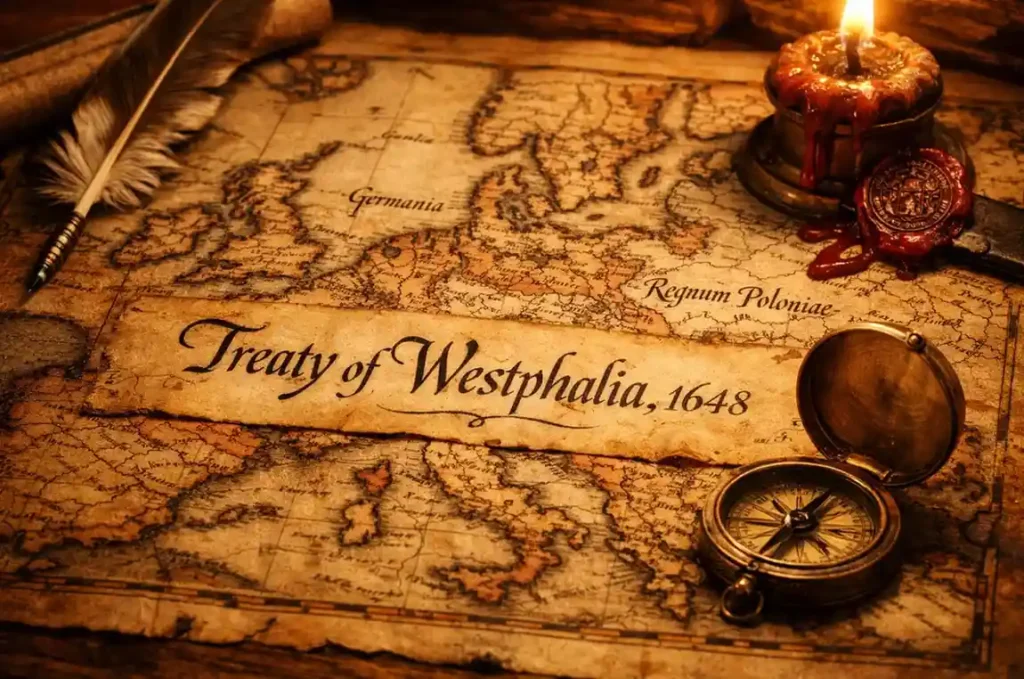
France gained significant territories in Alsace (though the city of Strasbourg remained independent until 1681) and confirmed its long-held control over the bishoprics of Metz, Toul, and Verdun. Sweden gained territories along the Baltic coast and river mouths, consolidating its position as a major northern power. The Swiss Confederation received formal recognition of its independence from the Holy Roman Empire, a status it had effectively held for decades but which was now legally confirmed. The Dutch Republic similarly gained recognition of its independence from Spain, ending a struggle that had lasted eighty years.
The German princes within the Holy Roman Empire gained considerably expanded powers at the expense of the Emperor, accelerating the fragmentation of central authority in the German lands that would persist until the unification of Germany in 1871.
The French delegation, led by the shrewd Cardinal Mazarin, pushed hard to weaken the Habsburgs, while Swedish negotiators led by Johan Oxenstierna secured their Baltic dominance. Together, they hammered out a new map of Europe.
Why Historians Call It the Birth of the Modern World
The phrase “Westphalian sovereignty” has become a cornerstone of international relations theory, and for good reason. The treaty established several principles that, while not entirely new, were codified for the first time in a broadly accepted multilateral agreement.
The first was the equality of sovereign states. Before Westphalia, the international order was hierarchical. The Pope stood above kings in spiritual matters. The Holy Roman Emperor claimed a kind of primacy over German rulers. The Westphalian settlement collapsed that hierarchy into a flat system where, in theory, every recognized state was juridically equal to every other.
The second was the non-interference principle. If a state’s internal religious or political arrangements were its own business, then other states had no legal basis to intervene in them. This became the foundational norm of international law for the next three and a half centuries.
The third was the idea of a balance of power as an organizing principle. Rather than trying to create a single supreme authority to govern Europe, the Westphalian settlement accepted that multiple powers would coexist, and that stability would come from their mutual checking of each other rather than from domination by one.
Together, these three principles form what political scientists and historians call the Westphalian system — the framework within which modern international relations has operated ever since. The United Nations Charter, with its commitment to sovereign equality and non-interference in internal affairs, is in many ways a direct descendant of the agreements signed in those two German cities in 1648.
The Criticism: Was Westphalia Really So Revolutionary?
Not every historian accepts the grand narrative around the Treaty of Westphalia, and it is worth being honest about the pushback. Scholars like Andreas Osiander and Stéphane Beaulac have argued that the treaty’s reputation as the founding document of the modern state system is largely a myth created by later international relations theorists who read their own preoccupations back into a 17th-century text.
Their argument has merit. The treaty did not use the language of sovereignty in the way modern theorists use it. The Holy Roman Empire continued to exist for another 158 years after 1648 and remained a complex, overlapping jurisdictional mess that was very far from the clean model of a sovereign state. Religion continued to be a source of international conflict. And many of the actual provisions of the treaty were violated or ignored within decades of its signing.
What is probably closest to the truth is that Westphalia was less a single founding moment and more one important step in a much longer and messier process by which the modern state system gradually emerged. It mattered enormously. It did not, on its own, create the modern world overnight. History rarely works that way.
The Legacy That Outlasted the Treaty Itself
The specific territorial arrangements of the Treaty of Westphalia were already being revised and renegotiated within a generation. France and Sweden were fighting new wars by the 1660s. The religious settlements were imperfect and required constant local negotiation. The Holy Roman Empire lurched on in its cumbersome way until Napoleon dissolved it in 1806.
But the conceptual inheritance was different. When European statesmen gathered at the Congress of Vienna in 1814 and 1815 to rebuild the continent after the Napoleonic Wars, they consciously invoked Westphalian principles of state sovereignty and balance of power. When the League of Nations was created after World War I, and the United Nations after World War II, both drew on the foundational Westphalian idea that sovereign states are the basic units of international order and that their internal affairs are in principle their own business.
Even today, when debates occur about humanitarian intervention — whether the international community has the right or the duty to intervene in a country to stop atrocities — those debates are essentially arguments about whether Westphalian sovereignty should have limits. The framework being argued over is still, at its core, the one that was sketched in Osnabrück and Münster in 1648.
That is a remarkable longevity for a diplomatic settlement. Most peace treaties are forgotten within a century. The Treaty of Westphalia gave the world an operating system for international relations that is still running, even if it now runs alongside newer code.
Frequently Asked Questions
What did the Treaty of Westphalia actually establish?
It established the principle that sovereign states have the right to govern their own territories without outside interference. It also resolved the religious conflicts of the Thirty Years’ War by recognizing Lutheranism, Calvinism, and Catholicism as equally legitimate faiths within their respective territories.
Why is the Treaty of Westphalia considered so important?
It is considered the founding document of the modern international order because it introduced the concept of sovereign equality among states — the idea that every recognized nation has equal legal standing regardless of its size or power. This principle still underpins international law today.
Who were the main parties that signed the Treaty of Westphalia?
The main signatories were the Holy Roman Empire, France, Sweden, Spain, and the Dutch Republic. Over 100 delegations participated in the broader negotiations, making it one of the earliest examples of multilateral diplomacy in European history.
Did the Treaty of Westphalia actually create lasting peace?
In the short term, no. France and Sweden were engaged in new conflicts within a generation. But the treaty’s conceptual framework — sovereign states, balance of power, non-interference — proved remarkably durable and shaped European and eventually global diplomacy for centuries.
Where exactly was the Treaty of Westphalia signed?
It was signed in two cities in the Westphalia region of what is now Germany. The Peace of Osnabrück was signed in Osnabrück and the Peace of Münster was signed in the city of Münster. The dual-city arrangement reflected a deliberate compromise between Protestant and Catholic interests.
Final Thoughts
The Treaty of Westphalia is one of those rare historical events that fundamentally changed everything while most people at the time were simply relieved that the killing had stopped. The exhausted diplomats gathered in those two German cities in 1648 were not trying to build a new world order. They were trying to end a terrible war. But the principles they agreed upon — that states are sovereign within their own borders, that no outside power has the right to interfere in their internal arrangements, that stability comes from balance rather than domination — turned out to be the intellectual building blocks of the entire modern international system.
Every time the United Nations debates state sovereignty, every time international lawyers argue about humanitarian intervention, every time diplomats insist that internal affairs are off-limits at the negotiating table, they are working within a framework that traces its lineage directly back to Osnabrück and Münster on October 24, 1648.
That is the true measure of a great treaty. Not whether its specific provisions survived, but whether the ideas it embedded into the world’s operating assumptions are still shaping events nearly 380 years later. By that measure, the Treaty of Westphalia stands in a category almost entirely its own.