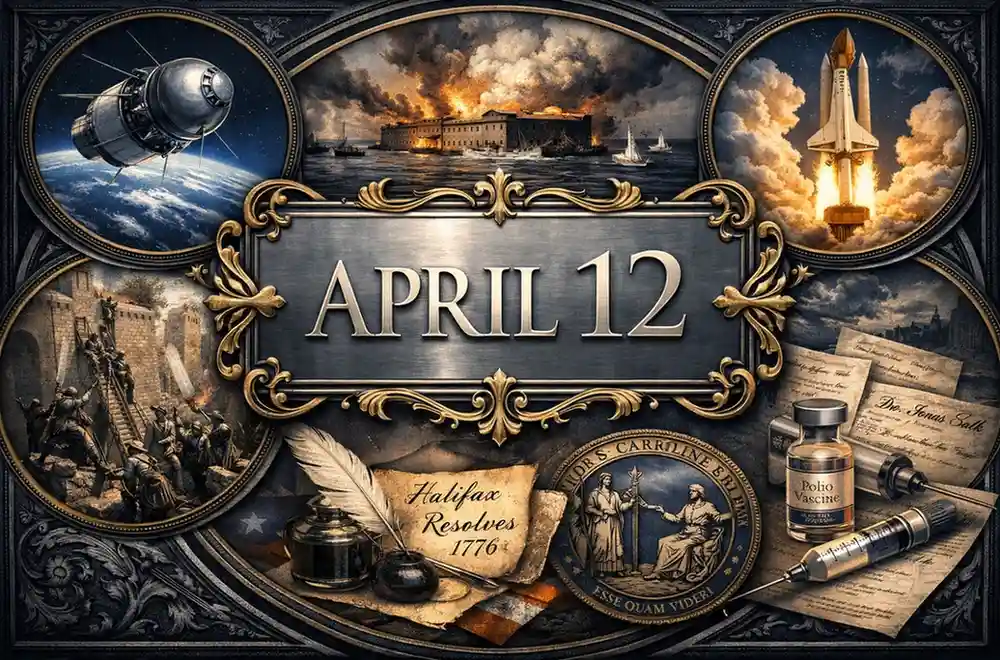
Gunfire at Fort Sumter in 1861 and Yuri Gagarin’s historic 1961 spaceflight represent two of the most transformative moments in the human story. Records from this day in history April 12 capture a century-long leap from the battlefields of a divided nation to the silent vacuum of the cosmos. It remains a date defined by the sheer force of change, driven by both the weight of war and the heights of discovery.
Important Events That Happened On April 12 In History
240 – Shapur I Becomes Co-Emperor
Shapur I was officially elevated to serve as the co-emperor of the Sasanian Empire alongside his father, Ardashir I. This transition of power was designed to ensure political stability and prepare the young leader for the defense of the Persian realm. During his subsequent reign, he became famous for his military victories over the Roman Empire and his patronage of various religious movements. His ascension marked the beginning of a powerful era that saw the Sasanian dynasty reach a new peak of regional influence.
467 – Anthemius Proclaimed Emperor
Anthemius was elevated to the position of Emperor of the Western Roman Empire during a period of terminal political decline in the West. His appointment was backed by the Eastern Roman government in an attempt to restore order and combat the rising threat of the Vandals. Despite his efforts to reorganize the military and administration, he struggled to unify the fractured Roman factions and the powerful Germanic generals. His reign represented one of the final significant attempts to save the Western Roman state before its ultimate collapse.
627 – Conversion of King Edwin
King Edwin of Northumbria was officially converted to Christianity and baptized by Paulinus, the Bishop of York, during a historic Easter ceremony. This event followed years of diplomatic efforts and a promised victory in battle, which convinced the king to abandon his traditional Germanic paganism. The conversion of the monarch led to the rapid spread of the Christian faith throughout the northern English kingdom. It established a lasting religious framework that would influence the political and cultural development of the British Isles.
1159 – Manuel I Enters Antioch
Byzantine Emperor Manuel I Komnenos made a triumphant entry into the city of Antioch following the submission of Prince Raynald of Châtillon. The prince had been forced to seek forgiveness for his previous raids against Byzantine territories and to recognize the emperor as his suzerain. This event was a major diplomatic success for the Byzantine Empire, reasserting its authority over the Crusader states in the Levant. The grand procession showcased the wealth and military prestige of the empire to the leaders of the Latin East.
1204 – Crusaders Breach Constantinople
The soldiers of the Fourth Crusade successfully breached the massive defensive walls of Constantinople and entered the capital of the Byzantine Empire. This assault followed months of political maneuvering and a failed attempt to secure the promised payments from the imperial claimants. The entry of the crusading forces led to the total occupation of the city by the following day and initiated a period of intense looting. This event resulted in the temporary collapse of the Byzantine state and a deep, lasting schism between Eastern and Western Christendom.
1606 – Adoption of the Union Flag
The Union Flag was officially adopted as the common maritime ensign for English and Scottish ships following the personal union of the two crowns. This original design combined the red cross of Saint George with the white saltire of Saint Andrew on a blue background. King James I intended for the flag to represent the unity of his two kingdoms while they were traveling at sea. It served as the precursor to the modern Union Jack and remains one of the most recognizable national symbols in global history.
1776 – The Halifax Resolves
The North Carolina Provincial Congress officially adopted the Halifax Resolves, a document that authorized its congressional delegation to vote for independence from Britain. This was the first formal action taken by any of the thirteen American colonies to call for total separation from the British Crown. The resolves reflected the growing revolutionary sentiment and the breakdown of colonial administrative ties with the United Kingdom. This bold legislative move paved the way for the eventual signing of the Declaration of Independence in Philadelphia.
1782 – Battle of the Saintes
A British Royal Navy fleet led by Admiral George Rodney achieved a decisive victory over a French fleet under the Comte de Grasse. The engagement took place off the coast of Dominica in the Caribbean and utilized the innovative tactic of “breaking the line.” This success allowed the British to capture the French flagship and restore their naval dominance in the region during the American Revolution. The victory significantly weakened French maritime influence and protected British interests in the valuable West Indian territories.
1796 – Battle of Montenotte
Napoleon Bonaparte secured his first major victory as an army commander by defeating Austrian and Piedmontese forces at the Battle of Montenotte. This strategic success allowed him to split the allied armies and force the Piedmontese toward an eventual surrender in the conflict. The battle demonstrated Napoleon’s talent for rapid movement and concentrated force, which would define his future campaigns across Europe. It marked the brilliant beginning of his Italian Campaign and his rise to prominence in the French military.
1861 – Bombardment of Fort Sumter
Confederate forces in South Carolina opened fire on the federal garrison at Fort Sumter, marking the official beginning of the American Civil War. The heavy artillery bombardment lasted for thirty-four hours until the Union troops were forced to surrender the fort in Charleston Harbor. This act of aggression signaled the collapse of all previous diplomatic efforts to resolve the secession crisis between the North and South. The event galvanized both sides and led to the mobilization of hundreds of thousands of soldiers for a prolonged war.
1862 – The Andrews Raid
A group of Union volunteers led by James J. Andrews seized a steam locomotive named The General in Big Shanty, Georgia. Known as the Great Locomotive Chase, the raiders aimed to destroy vital Confederate railway lines and telegraph wires between Atlanta and Chattanooga. The mission ultimately failed when the raiders ran out of fuel and were captured after a high-speed pursuit by Confederate railway employees. This daring operation remains one of the most famous and romanticized intelligence missions of the entire American Civil War.
1864 – Battle of Fort Pillow
Confederate cavalry forces under General Nathan Bedford Forrest captured Fort Pillow in Tennessee and allegedly killed the majority of the surrendering troops. The massacre was particularly brutal toward the African American soldiers who were serving in the Union garrison at the time of the assault. This event became a rallying cry for the North and led to a refusal to exchange prisoners between the two warring sides. It remains one of the most controversial and tragic incidents involving the treatment of soldiers during the conflict.
1868 – Surrender of Edo Castle
Tokugawa Yoshinobu officially surrendered Edo Castle to the Imperial forces, marking the formal conclusion of the Tokugawa shogunate’s military rule. This peaceful handover was a critical step in the Meiji Restoration, allowing the Emperor to assume direct authority over the Japanese state. The transition prevented a destructive civil war within the capital and facilitated the rapid modernization of the country’s political and social systems. This act signaled the end of the feudal era and the beginning of Japan’s rise as a modern global power.
1900 – Signing of the Foraker Act
President William McKinley signed the Foraker Act into law, establishing a limited civilian government for the newly acquired territory of Puerto Rico. The legislation granted the island’s residents a form of self-rule while maintaining the ultimate authority of the United States federal government. It created a legislative body and a judicial system but also imposed certain economic and political restrictions on the local population. This act defined the early legal relationship between the United States and Puerto Rico following the Spanish-American War.
1917 – Victory at Vimy Ridge
Canadian forces successfully completed the capture of Vimy Ridge from German troops during a major offensive of the First World War. This operation was notable for its meticulous planning and the effective use of a “creeping barrage” to protect the advancing infantry. The victory was a significant strategic gain for the Allied powers and became a defining moment for Canadian national identity and military pride. It is remembered as a major achievement of the war where all four divisions of the Canadian Corps fought together.
1927 – Shanghai Massacre
Chiang Kai-shek initiated a violent purge of the Chinese Communist Party members and their supporters in the city of Shanghai. This brutal crackdown effectively ended the First United Front between the Nationalists and the Communists and sparked a decade of civil war. Thousands of activists and laborers were executed or imprisoned during the surprise operation, which sought to consolidate Nationalist power. The massacre had a lasting impact on the political landscape of China and the future direction of the revolutionary movement.
1927 – Rocksprings F5 Tornado
An incredibly powerful F5 tornado struck the town of Rocksprings, Texas, destroying nearly every building and killing seventy-two residents in its path. The storm was so intense that only twelve structures in the entire community remained standing after the winds subsided. It remains the third deadliest tornado in the history of the state and caused massive injuries and economic loss to the rural area. This disaster led to increased awareness regarding the need for better storm warning systems and shelter construction in the plains.
1928 – First East-to-West Transatlantic Flight
The Bremen, a German aircraft, successfully completed the first-ever non-stop flight across the Atlantic Ocean from Europe to North America. The flight departed from Ireland and landed in Canada, overcoming difficult weather and navigation challenges that had defeated previous attempts. This achievement proved that flying westward against prevailing winds was possible for long-distance aviation missions of the era. The crew members were hailed as international heroes for their bravery and their contribution to the advancement of global flight.
1945 – Death of Franklin D. Roosevelt
President Franklin D. Roosevelt passed away while in office at his retreat in Warm Springs, Georgia, during the final months of World War II. Having served four terms, his leadership during the Great Depression and the war made him a central figure in modern American history. Following his death, Vice President Harry S. Truman was immediately sworn in as the 33rd President of the United States. This transition occurred at a critical moment as the nation prepared for the final victory in Europe and the Pacific.
1955 – Salk Polio Vaccine Declared Safe
The polio vaccine developed by Dr. Jonas Salk was officially declared safe and effective for public use following extensive national testing. This medical breakthrough offered a way to prevent a paralyzing disease that had affected thousands of children and adults every year. The news was met with widespread celebration and led to a massive vaccination campaign that nearly eradicated the virus in many parts of the world. It remains one of the most significant and successful public health achievements in the history of modern medicine.
1961 – Yuri Gagarin Enters Space
Soviet cosmonaut Yuri Gagarin became the first human to travel into outer space aboard the Vostok 1 spacecraft during the Space Race. He completed a single orbit around the Earth, reaching heights that had never been achieved by any person before him. This historic flight demonstrated the capabilities of Soviet aerospace technology and changed the course of human history forever. Gagarin’s mission opened the door for future lunar landings and the long-term exploration of our solar system.
1970 – Sinking of the K-8 Submarine
The Soviet nuclear-powered submarine K-8 sank in the Bay of Biscay several days after a fire broke out in its engine room. The vessel was carrying four nuclear torpedoes at the time of its loss, raising concerns about environmental contamination in the deep ocean. Despite the efforts of the crew to save the ship, fifty-two sailors lost their lives during the accident and subsequent sinking. This disaster was one of several high-profile incidents involving the early generations of nuclear-powered submarines during the Cold War.
1980 – Terry Fox Begins His Run
Canadian athlete Terry Fox began his “Marathon of Hope” in St. John’s, Newfoundland, to raise money and awareness for cancer research. Having lost his leg to the disease, he aimed to run across the entire country on a prosthetic limb to inspire others. His journey captured the hearts of millions of people and became a powerful symbol of human resilience and the fight against illness. While he was unable to finish the run, his legacy continues through annual events that have raised hundreds of millions for medical science.
1981 – Launch of the Space Shuttle Columbia
NASA successfully launched the Space Shuttle Columbia on the STS-1 mission, marking the first flight of a reusable spacecraft. This event inaugurated a new era of space exploration where vehicles could return to Earth and be flown again for multiple missions. The crew, led by John Young and Robert Crippen, tested the shuttle’s performance during a two-day orbital flight before landing in California. This mission proved that the shuttle concept was a viable and revolutionary way to access and work in low Earth orbit.
1992 – Opening of Euro Disney
The Euro Disney Resort officially opened its doors to the public near Paris, France, bringing the American theme park experience to Europe. The project was one of the largest and most complex entertainment developments on the continent, featuring a detailed theme park and multiple hotels. While it faced early financial and cultural challenges, the resort eventually grew into a major tourist destination for visitors from around the world. The site’s name was later changed to Disneyland Paris to better align with the brand’s global identity.
1999 – Contempt Citation for Bill Clinton
A federal judge cited President Bill Clinton for contempt of court for providing “intentionally false statements” during a civil lawsuit. This legal action was related to his testimony regarding his personal relationships and became a central part of the broader political scandal of the era. He was later fined and faced professional consequences, including disbarment from practicing law in his home state for several years. This event represented a rare and significant legal rebuke of a sitting president by the judicial branch.
2009 – Zimbabwe Abandons Its Currency
The government of Zimbabwe officially abandoned the Zimbabwean dollar as its national currency following a period of extreme hyperinflation. The currency had become virtually worthless, with prices doubling almost daily and the central bank printing bills in trillions. To stabilize the economy, the nation began using a multi-currency system that included the United States dollar and the South African rand. This move brought a level of financial stability to the country after years of economic collapse and extreme poverty.
2010 – Merano Derailment
A passenger train traveling through the scenic South Tyrol region of Italy was struck by a sudden landslide, causing a fatal derailment. The impact of the mud and debris forced the train off the tracks near the town of Merano, resulting in the deaths of nine people. Emergency responders worked through difficult terrain to assist the 28 additional passengers who sustained injuries during the crash. This accident led to an intense review of railway safety protocols and hillside monitoring in the mountainous Alpine corridors.
2013 – Kidal Market Bombing
Two suicide bombers targeted a busy outdoor market in Kidal, Mali, resulting in a deadly explosion that claimed the lives of three Chadian soldiers. The attack occurred during a period of high instability in the region and left dozens of local civilians with serious injuries. The soldiers were part of a peacekeeping mission aimed at stabilizing the area following intense conflict between government forces and insurgents. This tragedy highlighted the persistent dangers faced by international troops and innocent bystanders in the struggle for regional security.
2014 – Great Fire of Valparaíso
A catastrophic forest fire spread into the densely populated hills of Valparaíso, Chile, creating one of the worst urban disasters in the city’s history. The fast-moving flames claimed the lives of 16 residents and forced nearly 10,000 people to flee their homes as the fire consumed over 2,000 structures. The city’s unique geography and wooden architecture made it particularly vulnerable to the blaze, which took several days for firefighters to fully contain. This event triggered a massive national relief effort and led to long-term changes in urban planning and disaster preparedness.
Read Also: This day in history April 11: Unbelievable Facts
Famous People Born on April 12
| Name | Description | Date |
|---|---|---|
| Robert Delaunay | French painter, pioneer of Orphism (colourful Cubism) | April 12, 1885 – October 25, 1941 |
| Montserrat Caballé | Spanish operatic soprano | April 12, 1933 – October 6, 2018 |
| Christian IV | King of Denmark and Norway (1588–1648) | April 12, 1577 – February 28, 1648 |
| Edward de Vere, 17th earl of Oxford | English poet, leading candidate for authorship of Shakespeare’s plays | April 12, 1550 – June 24, 1604 |
| Jan Tinbergen | Dutch economist, first Nobel Prize in Economics (1969) | April 12, 1903 – June 9, 1994 |
| Scott Turow | American lawyer and best-selling author (Presumed Innocent) | April 12, 1949 – Present |
| Alan Ayckbourn | British playwright | April 12, 1939 – Present |
| Lily Pons | French-born American coloratura soprano | April 12, 1898 – February 13, 1976 |
| Joschka Fischer | German politician, foreign minister and vice-chancellor (1998–2005) | April 12, 1948 – Present |
| John George Lambton, 1st earl of Durham | British statesman, governor-general of Canada | April 12, 1792 – July 28, 1840 |
| Aleksandr Nikolayevich Ostrovsky | Russian dramatist, greatest representative of Russian Realism | April 12, 1823 – June 14, 1886 |
| Garcilaso de la Vega (El Inca) | Spanish chronicler of Inca history | April 12, 1539 – April 24, 1616 |
| C.I. Lewis | American logician and philosopher | April 12, 1883 – February 3, 1964 |
| Nikolay Przhevalsky | Russian explorer of east-central Asia | April 12, 1839 – November 1, 1888 |
| Otto Meyerhof | German biochemist, Nobel Prize winner (muscle metabolism) | April 12, 1884 – October 6, 1951 |
| Raymond Barre | Prime minister of France (1976–1981) | April 12, 1924 – August 25, 2007 |
| Ferdinand von Lindemann | German mathematician, proved π is transcendental | April 12, 1852 – March 1, 1939 |
| Henry Darger | American outsider artist and writer | April 12, 1892 – April 13, 1973 |
| Johnny Dodds | American jazz clarinetist | April 12, 1892 – August 8, 1940 |
| Antoine-Laurent de Jussieu | French botanist, developed natural plant classification | April 12, 1748 – September 17, 1836 |
| Francis P. Blair | American journalist and politician, helped form Republican Party | April 12, 1791 – October 18, 1876 |
| F.N. Souza | Indian modern painter | April 12, 1924 – March 28, 2002 |
| Grenville Mellen Dodge | American civil engineer, railroad builder | April 12, 1831 – January 3, 1916 |
| Constantin Meunier | Belgian sculptor and painter, social realist | April 12, 1831 – April 4, 1905 |
| John Shaw Billings | American surgeon and librarian, organized U.S. medical institutions | April 12, 1838 – March 11, 1913 |
| Joe Lapchick | American basketball player and coach | April 12, 1900 – August 10, 1970 |
| Armen A. Alchian | American economist | April 12, 1914 – February 19, 2013 |
| Georges Franju | French film director | April 12, 1912 – November 5, 1987 |
| James Winkfield | American jockey, last African American to win Kentucky Derby | April 12, 1882 – March 23, 1974 |
| Richard B. Goldschmidt | German-born American zoologist and geneticist | April 12, 1878 – April 24, 1958 |
Famous People Died on April 12
| Name | Description | Date |
|---|---|---|
| Henry Darger | American outsider artist and writer | April 12, 1892 – April 13, 1973 |
| William Graham Sumner | American sociologist, proponent of Social Darwinism | October 30, 1840 – April 12, 1910 |
| Feodor Chaliapin | Russian operatic bass, greatest singer-actor of his time | February 13, 1873 – April 12, 1938 |
| Jacques-Bénigne Bossuet | French bishop, most eloquent spokesman for Gallican church | September 25, 1627 – April 12, 1704 |
| Arthur Freed | American film producer (MGM musicals) | September 9, 1894 – April 12, 1973 |
| Alan Paton | South African writer (Cry, the Beloved Country) | January 11, 1903 – April 12, 1988 |
| George Wald | American biochemist, Nobel Prize winner (vision chemistry) | November 18, 1906 – April 12, 1997 |
| Edward Drinker Cope | American paleontologist, discovered ~1,000 extinct species | July 28, 1840 – April 12, 1897 |
| Stirling Moss | British Formula One driver, greatest driver never to win world championship | September 17, 1929 – April 12, 2020 |
| Charles Messier | French astronomer, created catalog of nebulae and star clusters | June 26, 1730 – April 12, 1817 |
| Igor Yevgenyevich Tamm | Soviet physicist, Nobel Prize winner (Cherenkov radiation) | July 8, 1895 – April 12, 1971 |
| Adoniram Judson | American Baptist missionary, translated Bible into Burmese | August 9, 1788 – April 12, 1850 |
| William Kent | English architect, master of Palladian style | c.1685 – April 12, 1748 |
| Pietro Metastasio | Italian poet, most celebrated librettist of 18th century | January 3, 1698 – April 12, 1782 |
| Saint Julius I | Pope (337–352) | unknown – April 12, 352 |
| Claude de Lorraine, 1st duke de Guise | French noble, founder of the House of Guise | October 20, 1496 – April 12, 1550 |
| Charles Burney | English music historian and composer | April 7, 1726 – April 12, 1814 |
| Patrick J. Hillery | President of Ireland (1976–1990) | May 2, 1923 – April 12, 2008 |
| Antoine Pevsner | Russian-born French sculptor, Constructivist | January 18, 1886 – April 12, 1962 |
| Saint Innocent Veniaminov | Russian Orthodox missionary, Metropolitan of Moscow | September 6, 1797 – April 12, 1879 |
| James Schuyler | American poet, New York School | November 9, 1923 – April 12, 1991 |
| William Sloane Coffin, Jr. | American clergyman and civil rights activist | June 1, 1924 – April 12, 2006 |
| Arthur B. Krock | American journalist, Pulitzer Prize winner | November 16, 1886 – April 12, 1974 |
| Claude Prosper Jolyot de Crébillon | French novelist of 18th-century high society | February 14, 1707 – April 12, 1777 |
| Valentin Katayev | Soviet novelist and playwright | January 28, 1897 – April 12, 1986 |
| Herbie Nichols | American jazz pianist and composer | January 3, 1919 – April 12, 1963 |
| Charlotta Spears Bass | American editor, first Black woman to run for vice president | October 1880 – April 12, 1969 |
| Kazimierz Ajdukiewicz | Polish logician and philosopher | December 12, 1890 – April 12, 1963 |
| Thomas, 1st Marquess Wharton | English Whig politician | August 1648 – April 12, 1715 |
| Sergio Pitol | Mexican author, Cervantes Prize winner | March 18, 1933 – April 12, 2018 |
Observances & Institutional Dates
- Halifax Day (North Carolina): A state holiday commemorating the 1776 Halifax Resolves and the early push for American independence.
- Children’s Day (Bolivia): A day dedicated to celebrating the rights and welfare of children throughout the nation of Bolivia.
- National Redemption Day (Liberia): An observance marking the 1980 event that changed the political structure of the country.
- Anniversary of the First Spaceflight: Celebrating Yuri Gagarin’s 1961 mission as a landmark achievement for all of humanity.
Frequently Asked Questions
- When did the first human go to space? Yuri Gagarin made the first crewed orbital flight on April 12, 1961, aboard the Soviet Vostok 1.
- What started the American Civil War? The war began on April 12, 1861, when Confederate forces opened fire on Fort Sumter in South Carolina.
- Who was the first black mayor of Chicago? Harold Washington was elected as the city’s first black mayor on April 12, 1983.
- When did the first Space Shuttle launch? The Space Shuttle Columbia took off on its maiden mission, STS-1, on April 12, 1981.