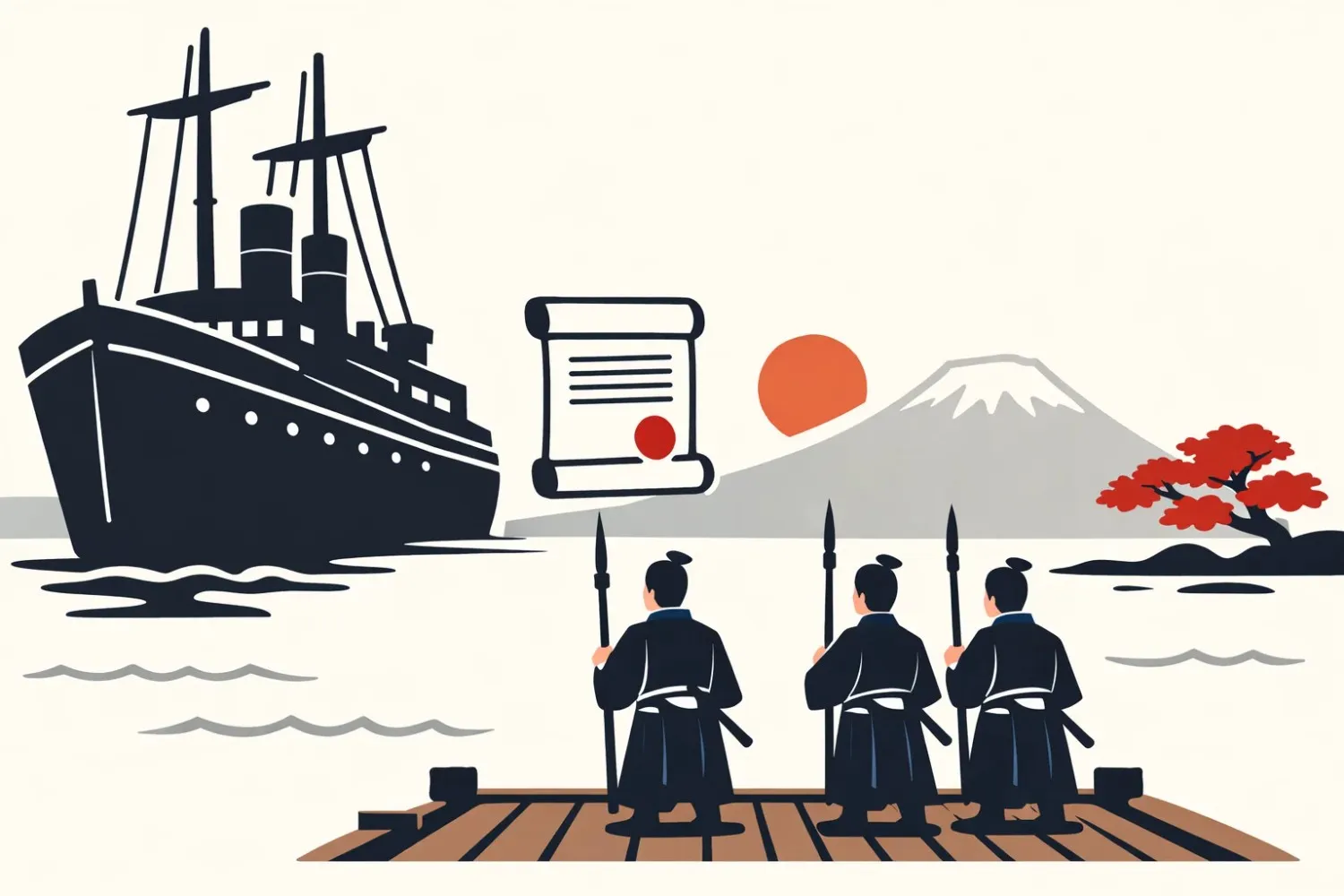
When Commodore Matthew Perry sailed into Edo Bay with a fleet of steam-powered warships, he didn’t just open two Japanese ports. He cracked open an entire civilisation — and set in motion a chain of events that reshaped the 19th and 20th centuries. The Treaty of Kanagawa, signed on March 31, 1854, was the pivotal diplomatic agreement between the United States and the Tokugawa Shogunate that effectively ended Japan’s 220-year-old policy of national seclusion (sakoku). Commodore Matthew C. Perry wasn’t just delivering a letter from President Millard Fillmore; he was delivering an ultimatum. This treaty ignited a domestic revolution that would transform a feudal island nation into a global industrial powerhouse within a single generation.
Quick Facts: Treaty of Kanagawa at a Glance
| 📋 Quick Facts: Treaty of Kanagawa at a Glance | 🇯🇵 🇺🇸 Information |
|---|---|
| 📜 Official Name | Convention of Kanagawa (神奈川条約) |
| ✍️ Signed | March 31, 1854 — Kanagawa (near present-day Yokohama) |
| 🖋️ Signatories | Commodore Matthew C. Perry (USA) & Hayashi Akira (Japan) |
| ⚓ Ports Opened | Shimoda (Izu Peninsula) and Hakodate (Hokkaido) |
| 📄 Articles | 12 articles |
| 🔑 Key Provisions | Port access, shipwreck protection, most-favored-nation clause, US consul right |
| 🚫 Japan’s Policy Before | Sakoku — roughly 220 years of enforced isolation (c. 1635–1854) |
| ⚡ Immediate Consequence | Triggered Harris Treaty (1858), leading to full commercial opening |
| 🏯 Long-term Consequence | Catalyzed the Meiji Restoration (1868) and Japan’s modernization |
| 🇺🇸 Key U.S. Negotiator | Commodore Matthew Calbraith Perry |
| 🇯🇵 Key Japanese Negotiator | Hayashi Akira (Chief Lord of the Council of Elders) |
What Exactly Was the Treaty of Kanagawa? (And What Did It Force Japan to Do?)
The Treaty of Kanagawa (formally the Japan–US Treaty of Peace and Amity) was signed on March 31, 1854. It was not a trade treaty. That is a common misconception. Instead, it was a “ship’s welfare” agreement designed to solve a very American problem: whalers and coal ships needed safe ports in the Pacific to resupply and repair without being attacked.
Under the treaty, Japan was forced to agree to three radical changes:
- Port Openings: The ports of Shimoda (on the Izu Peninsula) and Hakodate (on the northern island of Hokkaido) were opened exclusively to U.S. vessels for coal, water, and food.
- Consular Rights: The U.S. would be allowed to appoint a consul to live in Shimoda.
- Most-Favored-Nation Status (implied): Any future privileges Japan gave to other nations would automatically extend to the U.S.
Why Did Japan Sign a Treaty Under Duress? The Gunboat Diplomacy Explained
The Treaty of Kanagawa was a textbook case of “gunboat diplomacy” —foreign policy backed by the credible threat of military force. Japan signed because it had no navy capable of resisting Perry’s steam-powered fleet.
To understand the panic, you have to understand Japan’s “Sakoku” (locked country) policy. Since the 1630s, under the Tokugawa Shogunate, Japan had banned Christianity, destroyed most oceangoing vessels, and executed Westerners who landed. The only exception was a small Dutch trading post in Nagasaki, kept under armed guard.
By 1853, Japan’s coastal defenses were 18th-century technology—cannons that fired stones, wooden rowboats, and swords. Perry’s ships could level Edo (a city of over 1 million wooden buildings) in an afternoon.
The human drama: When Perry first delivered Fillmore’s letter, the Shogun (Emperor’s military ruler) was bedridden and dying. The Shogunate’s council was paralyzed. For eight months, they debated. Hayashi Akira, the chief negotiator, knew refusal meant annihilation. He famously wrote in his private journal: “We cannot fight them. Our spears will not reach their iron hulls.”
On March 8, 1854, Perry returned with an even larger fleet: seven ships, including three steam frigates. He staged a mock “cannon salute” (accidentally firing a live shell that exploded near a village). The message was clear: sign, or burn.
Why Did America Want to Open Japan? The Strategic Calculus
The United States pursued the opening of Japan primarily for three converging interests, not altruism. First, American whaling fleets in the Pacific needed safe harbor and coal resupply stations — Japan’s geography was ideal. Second, the rapid expansion of trans-Pacific trade with China demanded a reliable midway port. Third, American merchant and naval ambitions required that any shipwrecked sailors on Japanese shores receive humane treatment, not imprisonment — a recurring and infuriating problem before 1854.
- Coal and steam: The transition to steam-powered shipping made Japan’s location strategically critical for Pacific trade routes.
- Whaling industry: The US whaling fleet, then the world’s largest, operated throughout the North Pacific and needed safe refueling points.
- Manifest Destiny: An ideological conviction was growing that American commerce and “civilization” had a right — even a duty — to expand across the Pacific.
- Competition with Britain: Washington was acutely aware that if America didn’t open Japan, the British Empire might — with consequences for US Pacific dominance.
The Black Ships: How Perry’s Arrival Became a Psychological Weapon
On July 8, 1853, Commodore Matthew Calbraith Perry sailed into Edo Bay (Tokyo Bay) with four warships — two of them steam-powered paddle frigates, the Susquehanna and Mississippi, belching black smoke from their funnels. The Japanese called them Kurofune — “Black Ships” — and the name lodged in cultural memory as a symbol of overwhelming foreign power. Perry carried a letter from President Millard Fillmore demanding trade rights, and he made his intent unmistakable by training his cannons on the Japanese coastline.
“Perry’s fleet was not merely a diplomatic mission. It was a threat dressed in diplomatic language — a gun pointed at Japan’s sovereignty, wrapped in the rhetoric of friendship.”
Perry deliberately cultivated an air of imperious authority. He refused to meet with lower-ranking Japanese officials, insisted on ceremony befitting a head of state, and staged elaborate theatrical landings with full military pomp. This was coercive diplomacy at its most calculated. He then departed — giving the Tokugawa shogunate several months to deliberate — and returned with an even larger fleet of eight ships in February 1854. The message was unmistakable: comply or face consequences.
Who Were the Key Figures? The Negotiators.
Commodore Matthew Perry — The impatient empire-builder
Perry was ambitious, often arrogant, and convinced of American exceptionalism. He was also strategically shrewd. He understood that a formal agreement — however limited — would establish the legal precedent for subsequent, more aggressive treaties. Perry refused Japanese demands to move his ship to Nagasaki. He brought gifts designed to intimidate: a miniature steam locomotive (a technology that Japan had never seen) and a telegraph. He also brought a coffin—a rumor he never denied—suggesting he was ready to die rather than retreat. His tactic worked. He created a psychological siege.
Hayashi Akira – The Man Who Had to Bend
Hayashi was a man caught between worlds. As a learned scholar of the old order, he understood what concessions to Perry would mean for Tokugawa authority. Yet he also grasped, with intellectual clarity, that Japan could not resist American military power in 1854. He was the head of the Shogunate’s foreign affairs (a job that barely existed before 1853). He faced an impossible choice: sign a humiliating treaty and be called a coward, or refuse and watch millions die. He chose survival. After signing, he was publicly shamed by samurai hardliners. He died in 1868, the same year the Shogunate he tried to save collapsed.
What Did the Treaty of Kanagawa Actually Say? The 12 Articles Explained
The Treaty of Kanagawa contained 12 articles that collectively ended Japan’s policy of maritime isolation, though they stopped well short of full commercial trade.
The Breakdown of the 12 Articles:
- Article 1: Eternal Peace. A formal declaration of “perfect, permanent, and universal peace” between the U.S. and the Empire of Japan.
- Article 2: The Two Ports. Japan officially opened the ports of Shimoda (immediately) and Hakodate (one year later) for American ships to get wood, water, coal, and provisions.
- Article 3: Help for the Shipwrecked. A vital humanitarian clause. Any American ships wrecked on Japanese shores would be assisted, and the crews brought to Shimoda or Hakodate.
- Article 4: Humane Treatment. Guaranteed that shipwrecked citizens would not be imprisoned or restricted like criminals (as had happened in the past).
- Article 5: Freedom of Movement (Temporary). Allowed Americans at Shimoda and Hakodate to move about within limited boundaries (about 7 Japanese miles) rather than being confined to a trading post.
- Article 6: Future Business. Stated that any further business or issues would be “carefully settled” through negotiation.
- Article 7: Limited Trade. Allowed Americans to exchange gold, silver, and goods for needed supplies under Japanese government regulations.
- Article 8: Government Control. Stipulated that all American purchases must go through Japanese officials, preventing direct private trade with citizens.
- Article 9: The “Most-Favored-Nation” Clause. The most critical point. It ensured that if Japan gave any other country a better deal in the future, the U.S. would automatically get those same benefits.
- Article 10: Weather Restrictions. Forbidden for American ships to enter ports other than Shimoda or Hakodate unless forced by severe weather or distress.
- Article 11: The U.S. Consul. Granted the U.S. government the right to appoint “consuls or agents” to reside in Shimoda 18 months after the signing.
- Article 12: Ratification. Bound both nations to honor the treaty, with the exchange of formal documents to happen within 18 months.
The Criticism & Historical Debate: Was the Treaty a Victory or a Humiliation?
This is where intellectual depth matters. Historians are sharply divided.
The “American Victory” Narrative (Traditional View): Perry forced open an irrational, feudal state. The treaty was a masterstroke of naval strategy. It saved shipwrecked American sailors (who were previously jailed or killed) and allowed the U.S. to dominate Pacific refueling routes. By this logic, the Treaty of Kanagawa was a necessary, benevolent “awakening” of Japan.
The “Japanese Agency” Counter-Perspective (Revisionist View): Modern historians like Michael R. Auslin argue that Japan wasn’t just a passive victim. The Shogunate’s leadership knew they were militarily outclassed. They signed the treaty to buy time. Over the next 14 years, Japan obsessively studied Western military science, built a modern navy, and overthrew the Shogunate (the Meiji Restoration of 1868). By 1905, Japan defeated Russia in a naval war—a feat no Asian nation had ever accomplished. From this angle, Kanagawa was not a defeat. It was a painful, deliberate pivot that turned Japan into an empire.
The Human Cost Debate: What’s rarely discussed is the cost to ordinary Japanese. The treaty triggered hyperinflation. Gold poured out of Japan to pay for foreign goods. Rural peasants starved while samurai lost their stipends. The anger culminated in the “Ansei Purge” (1858–1860), where the Shogunate executed over 100 dissidents, including intellectuals who simply asked: “Why did we surrender without a fight?”
What Happened After the Treaty? The Cascade of Consequences
The Treaty of Kanagawa was not an end point — it was a beginning. Within four years, it was superseded by the far more sweeping Harris Treaty (1858), which opened additional ports and granted extraterritorial legal rights to Americans in Japan. Similar treaties followed with Britain, France, Russia, and the Netherlands — the so-called “Ansei Treaties” that Japanese nationalists called the treaties of humiliation.
- 1858 — Harris Treaty: Townsend Harris, the first US consul to Japan, negotiated full commercial access, fixed low tariffs, and extraterritoriality — Americans in Japan could not be tried by Japanese courts.
- 1860s — Civil strife: Armed clashes between pro-imperial samurai factions and shogunate forces intensified across Japan.
- 1868 — Meiji Restoration: The Tokugawa shogunate collapsed. Emperor Meiji was restored to power. Japan embarked on a deliberate, state-directed program of industrialization and Westernization.
- 1894–95 — First Sino-Japanese War: Within four decades of forced opening, Japan had built a modern military capable of defeating imperial China — the most dramatic geopolitical transformation of the 19th century.
- 1905 — Russo-Japanese War: Japan defeated a European great power, announcing itself as a global force and permanently altering the racial hierarchy that Western imperialism had assumed.
Why the Treaty of Kanagawa Still Matters Today
The Treaty of Kanagawa remains relevant in 2026 because it is one of the clearest historical case studies of what happens when a rising industrial power forces open a closed economy — and of how a nation can respond to that pressure with strategic agency rather than passive victimhood. Japan’s path from the Black Ships of 1853 to global industrial and military power by 1905 is, in the bluntest terms, the most successful response to Western imperial pressure in modern history.
For contemporary debates about economic coercion, trade pressure, and the sovereignty of nations to set their own terms of engagement with the global economy — from China’s economic statecraft to debates over trade agreements — the Kanagawa episode offers a precise, historically grounded case study. The questions Perry raised at gunpoint in 1854 have never fully gone away: who has the right to force open markets, and on whose terms?
Frequently Asked Questions
Did the Treaty of Kanagawa open Japan to trade?
No. That is a common myth. The Treaty of Kanagawa opened two ports only for refueling and provisions. Full trade (including tariffs and currency exchange) came later with the Treaty of Amity and Commerce (Harris Treaty) in 1858.
How did the Japanese people react to the treaty?
With shock and fury. The common phrase at the time was “Jōi” (Revere the Emperor, Expel the Barbarians). Violent attacks on foreigners increased. The Shogun who signed the treaty, Tokugawa Iesada, was mocked as weak. The treaty directly fueled the civil war that led to the Meiji Restoration.
What did the Treaty of Kanagawa do?
The Treaty of Kanagawa effectively ended Japan’s 220-year-old policy of national seclusion (sakoku). It established a formal “peace and amity” between the United States and Japan, opening two specific ports for American ships and ensuring that shipwrecked sailors would be treated with dignity rather than imprisoned.
Why did the US force Japan to open?
The United States was driven by three main goals: whaling, steam, and trade. American whaling ships in the North Pacific needed safe harbors for resupply, and the new steam-powered navy required “coaling stations” to bridge the gap between San Francisco and China. Additionally, the U.S. wanted to ensure that any American sailors shipwrecked on Japanese shores were protected and returned home safely.
What did the Treaty of Kanagawa 1854 promise?
The treaty made several specific promises:
- Port Access: The opening of Shimoda and Hakodate for coal, water, and provisions.
- Shipwreck Relief: A guarantee to assist and protect distressed American vessels and crews.
- Most-Favored-Nation Status: A promise that any future privileges Japan gave to other countries would automatically apply to the U.S.
- Consular Presence: The right for the U.S. to station a consul in Shimoda.
What was the Treaty of Kanagawa 1853?
Technically, there was no treaty in 1853. In July 1853, Commodore Matthew Perry arrived in Edo Bay with four “Black Ships” to deliver a letter from President Millard Fillmore. He did not sign a treaty then; instead, he issued an ultimatum and promised to return the following year for an answer. The actual agreement was not signed until his return in March 1854.
Was there any violent resistance to Perry’s fleet?
Minimal. In one incident, a samurai from the Satsuma domain charged a U.S. landing party with a sword and was shot dead. But the Shogunate strictly ordered no resistance. The real violence came after the treaty, when anti-foreign samurai assassinated the first U.S. consul’s interpreter, Henry Heusken, in 1861.
Who signed the Treaty of Kanagawa?
The treaty was signed by Commodore Matthew Perry for the United States and Hayashi Akira (also known as Hayashi Daigaku-no-kami), a chief scholar and negotiator for the Tokugawa Shogunate.
What is Kanagawa best known for?
Historically, Kanagawa is best known as the site where the Great Wave off Kanagawa (the famous woodblock print by Hokusai) was set and where the treaty was signed. Today, the prefecture is home to Yokohama, Japan’s second-largest city, and serves as a major industrial and maritime hub that grew from the very ports opened by Perry’s mission.
What happened to Commodore Perry after the treaty?
He returned to the U.S. as a national hero. Congress gave him a $20,000 bonus (over $700,000 today). He wrote a three-volume account, Narrative of the Expedition of an American Squadron to the China Seas and Japan. He died in 1858, just as the trade treaty he had sought was finally signed.