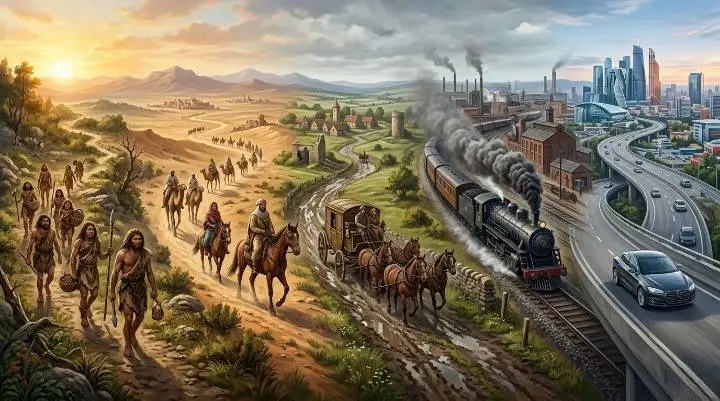
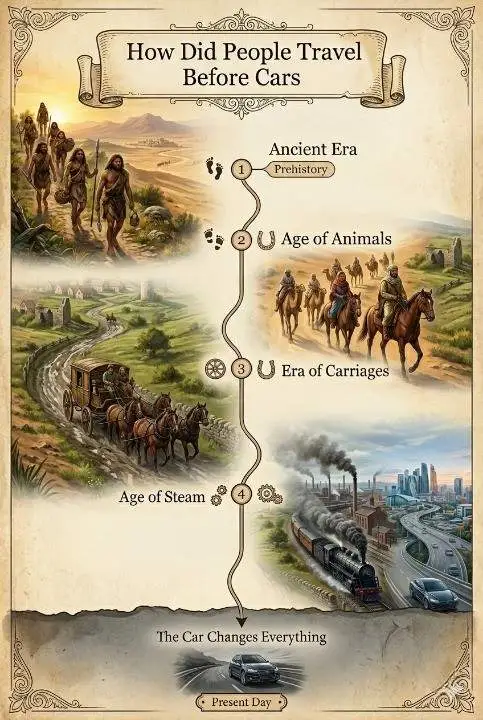
Imagine waking up in 1810 with an urgent need to visit a relative fifty miles away. There is no ignition to turn, no climate control to set, and definitely no GPS to guide you through the winding lanes. You are looking at a gruelling two-day odyssey through thick mud or choking dust, likely sharing a cramped, rattling wooden box with five sweaty strangers. We often forget that for most of human history, a journey of thirty miles was a massive life event rather than a morning commute. Speed was limited by the stamina of a beast or the strength of your own legs. So, how did people travel before cars changed the scale of our world forever?
Walking Was the Original Way to Travel — And People Did It Seriously
Picture yourself standing at the edge of a Roman road in the year 120 AD, watching a legionary march past with sixty pounds of gear on his back. For the vast majority of people throughout history, “travel” didn’t involve wheels or sails; it involved the steady rhythm of footsteps. If you were a peasant, a pilgrim, or a foot soldier, your world was only as large as the distance you could walk in a day. On a good day, with decent weather and flat ground, you might cover twenty miles, but most people rarely strayed more than ten miles from the village where they were born.
The Romans were the masters of the road, building over 250,000 miles of interconnected highways that stretched from the rainy hills of Britain to the burning sands of the Sahara. These weren’t just dirt paths; they were engineered marvels with layers of gravel, sand, and heavy paving stones. Yet, even with these “superhighways,” walking was a slow and exhausting business. You would wear out a pair of leather sandals in a matter of weeks, and your main concern wasn’t traffic—it was finding a clean well and a spot of shade before the sun went down.
What nobody tells you about ancient walking is that it was deeply social. You wouldn’t just walk alone; you would join a group of traders or pilgrims for safety against bandits. In medieval Europe, the roads were filled with people heading to shrines like Santiago de Compostela, carrying nothing but a staff and a scrip. They walked through forests where wolves still lurked, relying on the hospitality of monasteries. It was a slow, meditative way to see the world, where every hill gained was a hard-won victory for the human spirit.
Chariots and Caravans: The Ancient Power of the Horse
Long before the stagecoach, the horse was the undisputed king of the road. But riding a horse wasn’t as simple as hopping on and galloping away. Imagine the Mongolian steppes in the 1200s, where Genghis Khan’s riders could cover 100 miles a day by switching between a string of five or six horses. This “Yam” system was the fastest communication network the world had ever seen, allowing messages to fly across the largest land empire in history.
In the ancient world, the chariot was the “sports car” of the elite. During the Battle of Kadesh in 1274 BC, thousands of Egyptian and Hittite chariots clashed in what was essentially a high-speed tank battle. These vehicles were light, made of wood and leather, and could reach speeds of twenty-five miles per hour. However, they were useless on rough terrain. For everyday travel, the horse-drawn wagon or the humble donkey was far more common.
Donkeys and mules were the unsung heroes of history. They could carry heavy loads over mountain passes where horses would stumble. In the Andes, the Inca used llamas in a similar way, creating a vast trade network without ever using the wheel. What nobody tells you is that horses were incredibly expensive to maintain. Owning a horse was like owning a high-maintenance luxury car today; you needed to pay for food, stabling, and “servicing” by a farrier. Most people simply couldn’t afford the petrol—or rather, the oats—to keep one.
| 📅 Era | 🚲 Mode of Transport | ⏱️ Approximate Time |
|---|---|---|
| 🏰 Medieval (1300s) | 👣 On foot | ~3–4 weeks |
| 👑 Early modern (1600s) | 🐎 Stage coach | ~10–14 days |
| 📬 Late coaching era (1820s) | ✉️ Fast mail coach | ~45 hours |
| 🚂 Railway era (1850s) | 💨 Steam train | ~8–10 hours |
| 🚗 Today (car) | 🏎️ Motor vehicle | ~7–8 hours |
The Roman Road Network: Engineering That Outlasted an Empire
If you want to understand ancient travel, you have to talk about roads. And if you want to understand roads, you have to start with Rome.
At its peak, the Roman Empire had over 250,000 miles of roads — about 50,000 miles of which were paved with stone. These weren’t rough tracks. They were engineered surfaces with drainage ditches, raised centres to shed rainwater, and milestones marking every Roman mile. Some of those roads are still visible today.
The point wasn’t scenic. Roman roads existed to move armies, merchants, and official communications as fast as possible. They connected every major city from Britain to Mesopotamia. A Roman courier could carry a message from Rome to London in roughly four to five days — faster than the British postal service managed in the 1600s.
Other civilisations built impressive road systems too. The Inca Empire created over 24,000 miles of roads across the Andes, complete with rope suspension bridges and regular rest stops called tambos. All of it built without wheels, iron tools, or horses. The Incas used human runners called chasquis to carry messages at relay speeds that rivalled any mounted postal system.
River and Sea Travel: The Highways Nobody Talks About
Roads get all the attention. But for most of history, water was faster, cheaper, and far more practical for moving goods in bulk.
Imagine the sheer scale of a Chinese Ming Dynasty “Treasure Ship” in the early 1400s, commanded by the explorer Zheng He. These wooden giants were over 400 feet long—nearly the size of a modern football pitch—and they moved purely on the power of the wind. Before the steam engine, the ocean was the only place where you could truly experience a sense of speed, provided the weather cooperated.
For civilizations like the Ancient Egyptians, the Nile was a gift from the gods that doubled as a perfect two-way street. Because the current flowed north and the wind usually blew south, you could drift downstream with the water and sail back upstream with the wind. It was efficient, cool, and far more comfortable than a dusty overland trek. Further north, the Vikings used their iconic longships to navigate both the open Atlantic and shallow European rivers, striking fear into coastal villages because they could appear out of the mist with terrifying speed.
By the 1700s, the “Age of Sail” had turned the world into a global marketplace, but life on board was anything but luxurious. If you were a passenger crossing the Atlantic, you might spend six to eight weeks trapped in a damp, pitching cabin, eating salted beef and hardtack biscuits that were often crawling with weevils. Scurvy was a constant threat, and a sudden calm could leave you stranded in the middle of the ocean for days. The sea offered the fastest route between continents, but it demanded a level of patience and bravery that most of us today can barely imagine.
Carriages, Coaches, and the First Passenger Services
The idea of paying for a seat in a shared vehicle is older than most people realise. By the early 17th century, stage coaches were running regular routes across England, France, and Germany — picking up passengers at fixed stops and running on predictable schedules.
The word “stage” referred to the stages of a journey, where fresh horses replaced tired ones every 10 to 15 miles. It was a clever system that stretched horse power across long distances. By the 1700s, you could book a seat from London to Bath for a few shillings — though you’d better have a strong stomach and a willingness to sit beside strangers for hours.
Journey times were still sobering. London to Edinburgh took around 60 hours of continuous travel in the 1700s. By 1830, improved roads and better coaching techniques had cut that to around 45 hours. Progress, yes. But it still wasn’t fast.
Class divisions showed up immediately. Inside the coach was for wealthy passengers. Outside — on the roof, exposed to wind and rain — was for those who couldn’t afford better. The class system wasn’t invented by the railways. The railways just inherited it.
Camels, Elephants, and Pack Animals Across the World’s Toughest Terrain
Not every civilisation built roads or sailed rivers. Some relied on animals perfectly suited to their landscape.
Camels were the cargo ships of the Sahara and the Arabian Peninsula. A Bactrian camel can carry up to 600 pounds and go days without water. The trans-Saharan trade routes that flourished between the 8th and 16th centuries CE moved gold, salt, ivory, and enslaved people across thousands of miles of desert — entirely on the backs of camel caravans. The city of Timbuktu became fabulously wealthy because it sat at the intersection of those routes.
In South and Southeast Asia, elephants served as the heavy transport of choice. They could haul timber, carry soldiers into battle, and navigate terrain that defeated horses. The Mughal emperor Akbar reportedly owned over 32,000 elephants in the 16th century — a fleet of living, breathing cargo vehicles.
In the Andes, before and after Spanish colonisation, llamas served a similar purpose. Too small to ride, they were ideal pack animals for the mountain passes that connected Inca cities.
Every landscape developed its own solution. Human ingenuity, it turns out, is pretty good at finding one.
Iron Horses and the End of the Old World
The beginning of the end for the old ways of travelling came in 1829 at the Rainhill Trials. A spindly, clanking machine called “Rocket,” built by George Stephenson, hit a staggering thirty miles per hour. This was the birth of the steam railway. Suddenly, the biological limit that had governed human life for ten thousand years was shattered. You no longer needed to worry about a horse getting tired or a canal freezing.
The railway didn’t just change how we travelled; it changed how we perceived time. Before the train, every town had its own “local time” based on the sun. But you can’t run a railway on local time, or the trains will crash. In 1840, the Great Western Railway in Britain adopted “Railway Time,” which eventually led to the standard time zones we use today. The world was shrinking, and the local, slow-paced life of the past was being replaced by a fast-paced, industrial future.
By the time the first petrol-powered cars appeared in the late 1800s, the world was already primed for speed. But the car did something the train couldn’t: it gave us back our individual freedom. The train took you where the tracks went; the car took you wherever there was a road. As we look back at the dusty sandals, the swaying sedan chairs, and the creaking stagecoaches, we realise that our ancestors didn’t just travel—they survived their journeys. Every trip was an adventure, a risk, and a story waiting to be told.
Frequently Asked Questions
Before horse domestication around 3500 BCE, long-distance travel was almost entirely on foot. People also used rivers and coastlines by boat where possible, using simple dugout canoes or reed vessels. Trade routes across Neolithic Europe and the ancient Middle East were walked, often following seasonal patterns and river valleys. Journeys that took weeks were simply accepted as part of life.
A fit walker in medieval Europe could cover roughly 20–25 miles per day on reasonable roads. A rider on horseback could manage 30–40 miles per day, or faster in short bursts. A stage coach, which became common in the 1600s, averaged 5–7 mph on good roads. Speed was always weather-dependent — a muddy road in winter could cut these figures significantly.
Many did, though not always by choice. Military conscription, famine, religious pilgrimage, and seasonal labour migration all moved large numbers of ordinary people across long distances. Medieval pilgrimage routes were used by people of all classes. Many of the great migrations in history — including movements across the Americas and Eurasia in prehistoric times — were undertaken entirely on foot by ordinary families, not wealthy elites.
For most Romans, walking was the primary way to get around. The city of Rome itself banned wheeled vehicles during daylight hours to manage congestion, so goods were moved by cart at night and people walked during the day. For longer distances, wealthy Romans rode horses or used litters carried by enslaved people. Commercial travellers often hired space on a river barge or merchant ship rather than travelling overland, as it was cheaper and faster for bulk goods.
Organised passenger transport for paying customers dates back further than most people assume. River ferry services existed in ancient Egypt and Rome. Japan had organised palanquin-carrying services in the Edo period. The first true urban public transport — horse-drawn omnibuses with fixed routes and fares — appeared in Paris in 1662, organised by the philosopher Blaise Pascal, though the service collapsed after a few years. Horse omnibuses returned in Paris and London in the early 19th century and became the template for the modern bus.
Most travellers relied on local guides, landmarks, and verbal directions from “milestones” placed along major roads. For sea travel, sailors used the stars, the sun, and eventually tools like the sextant and magnetic compass to navigate the open ocean.
The biggest dangers were accidents and disease. Stagecoaches frequently overturned on poor roads, and the lack of sanitation at coaching inns meant that food poisoning or “road fever” was common. In isolated areas, robbery by highwaymen was also a persistent threat.
Wealthy Romans were famous for “tourism,” travelling to see the Pyramids in Egypt or the statues in Greece. However, for 99% of the population, travel was only done for survival, trade, war, or religious pilgrimage.
In the age of sail, a crossing from Europe to North America typically took between six to eight weeks. However, this depended entirely on the wind; a bad storm could push a ship off course for weeks, while a total lack of wind could leave a crew stranded in the “doldrums” for a month.
Conclusion
Before the car, before the train, people still got where they needed to go. They walked incredible distances, sailed monsoon winds, drove camel caravans across deserts, and pulled themselves through mountain passes on animal-back. They built some of the most impressive road and canal networks the world has ever seen, centuries before anyone dreamed of tarmac.
What’s striking isn’t how limited the options were — it’s how resourceful and determined people were within them. Every civilisation found the solution that suited their landscape, their animals, and their economy. The wealthy moved faster and more comfortably; the poor walked and endured. That tension is as old as transport itself.
The car didn’t create mobility. It accelerated something that had been evolving for thousands of years. Next time you’re stuck in traffic, it’s worth remembering: your great-great-grandmother would have considered your journey an absolute miracle.
If this made you curious about everyday life in the past, you might also enjoy reading about What Did People Eat for Breakfast 200 Years Ago or reading about The Fascinating History of Tea.