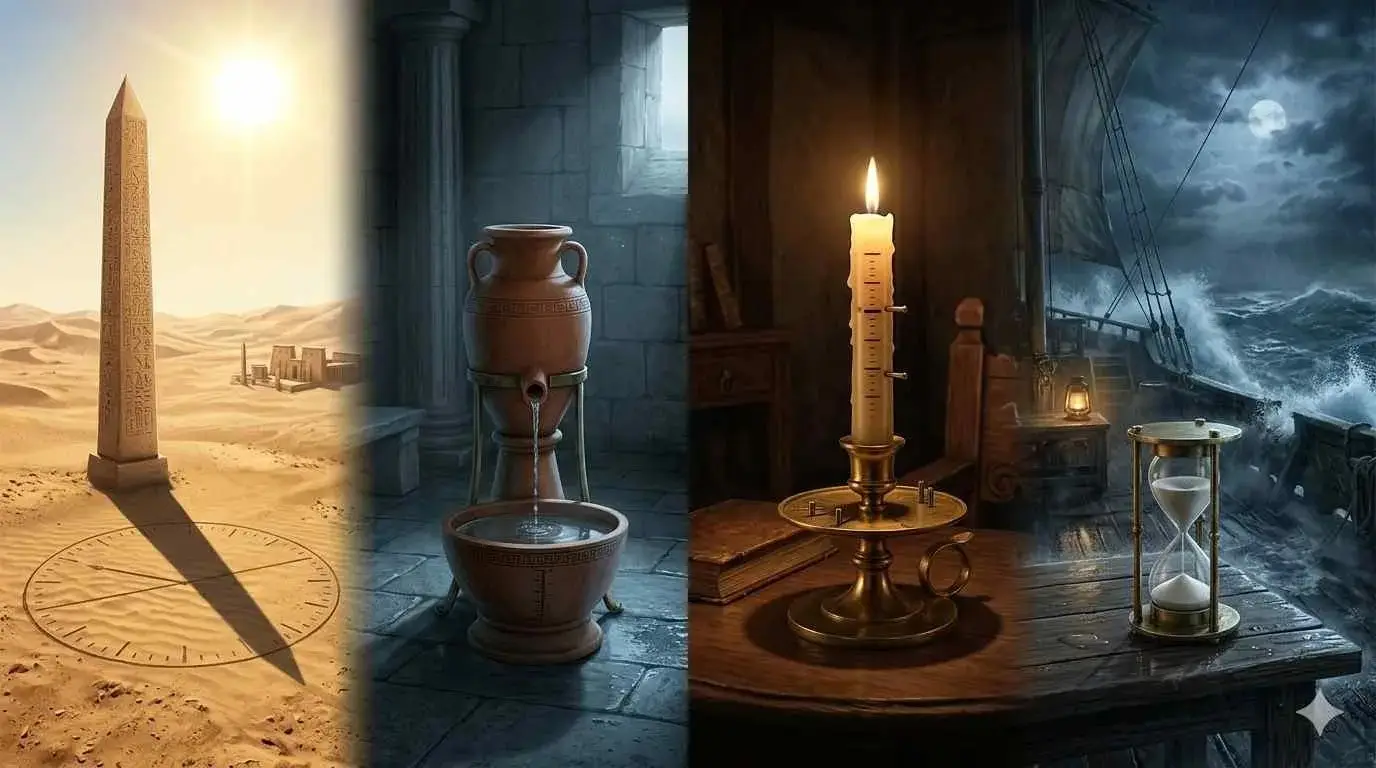
Picture yourself waking up on a cold morning in ancient Rome. There is no buzzing smartphone in your pocket, and no ticking watch on your wrist. You need to meet a neighbour or start a harvest, but there are no minutes or seconds to guide you. The only thing guiding your day is the slow, majestic arc of the sun and the shifting shadows of the trees. So what do you do? You step outside, scan the horizon, maybe listen for a rooster, and make your best guess.
The question of how did people tell time before clocks is one of those questions that sounds simple — until you realise just how radically different every single day of human life must have felt without it.
The Sun Was Your Original Clock
Before any device existed, the sky was the only timekeeper humanity had — and the sun was its hour hand. For tens of thousands of years, people organised their entire day around its position. Low in the east meant morning. Directly overhead meant midday. Dropping toward the west meant the working day was ending. Simple, reliable, and completely free.
But here’s what’s easy to forget: this system was genuinely effective for agricultural societies. If you’re a farmer in 3000 BCE Mesopotamia, you don’t need to know it’s 2:47 PM. You need to know whether you have enough daylight left to finish ploughing the field. The sun tells you exactly that.
The problem, of course, was cloudy days. And winter, when the sun barely cleared the horizon at all. Which is why humans started getting creative.
Sundials — The Ancient World’s Most Sophisticated Timepiece
Imagine standing in a grand Egyptian marketplace around 1500 BCE, glancing at a carved stone pillar to check the time. That’s exactly what people did — because the Egyptians had already invented the sundial, one of humanity’s oldest precision instruments.
The earliest known sundial dates to around 1500 BCE in Egypt. It was a simple T-shaped bar of stone that cast a shadow across a marked surface. As the sun moved, so did the shadow — dividing the day into segments with surprising accuracy.
The Greeks and Romans elevated sundial design into an art form. By the 1st century BCE, sundials were everywhere in Roman cities — mounted in public squares, in bathhouses, even miniaturised as pocket versions carried by the wealthy. The philosopher Plautus complained around 200 BCE that the city was filled with sundials, forcing people to eat only when permitted by the sun rather than when they were actually hungry. Some things, it seems, haven’t changed much.
The limitation was obvious: you couldn’t use a sundial at night, indoors, or on overcast days. And so the search continued.
The Constant Rhythm of the Water Clock — Time Measured in Drips
The sun has set, so your sundial is useless. Instead, you hear a rhythmic, steady drip-drip-drip coming from a stone vessel. This is the clepsydra, or the water clock. It is one of the oldest timekeeping devices in the world, dating back to at least 1600 BC in Babylon and Egypt.
The concept was brilliantly simple. You had a bowl with a tiny hole at the bottom and markings on the inside. As the water leaked out at a steady rate, the level dropped past the marks to show the passing hours. Some versions worked the opposite way, where water dripped into a container and a floating stick rose to point at the time.
The Greeks took this to a whole new level of engineering. By the 3rd century BC, Ctesibius of Alexandria added gears and escapements to water clocks. He even created “alarm clocks” that dropped pebbles onto a gong or blew a trumpet when the water reached a certain level. It was the pinnacle of high-tech for the ancient world.
The answer to why these were so popular is stranger than you’d think. They were the only way to ensure fairness in courtrooms. In Athens, lawyers were given a specific amount of water for their speeches. When the water ran out, their time was up. It prevented people from talking forever and ensured the legal system moved at a predictable pace.
Candle Clocks and Incense — Time You Could Smell
Some cultures literally burned time. The candle clock — a candle marked with evenly spaced lines, each representing a fixed period — was used across medieval Europe, China, and the Islamic world from at least the 9th century CE.
King Alfred the Great of England, reigning in the late 800s CE, reportedly used candle clocks to divide his day into precise thirds — eight hours for work, eight for prayer, and eight for sleep. His candles were even kept in lanterns made from polished ox horn, to prevent draughts from making them burn unevenly.
The part that surprises people is that some candle clocks were used as alarms. You could stick a heavy metal nail into the wax at a certain mark. When the candle burned down to that point, the nail would lose its grip and fall onto a metal tray below. The sudden noise would wake you up for your midnight studies or your early morning patrol.
Incense Clocks
In Japan and China, incense clocks were even more refined. The Chinese used intricate metal trays filled with trails of incense powder. These trails were laid out in elaborate maze-like patterns. Because the incense was manufactured to burn at a very specific, consistent rate, you could tell how much time had passed by looking at how far the glowing ember had travelled.
Sometimes, they would hang small metal weights on threads across the path of the incense. When the fire reached the thread, it would burn through, and the weight would drop onto a metal platter below. This created a loud “clang” that acted as a prehistoric alarm clock. It told the monks it was time for prayer or alerted a scholar to take a break.
Different sections of the incense trail could be made with different perfumes. You didn’t even have to open your eyes to know it was late evening. If the scent changed from spicy cinnamon to sweet jasmine, you knew exactly what hour it was.
Hourglasses and the Rhythm of the Sea
Sailors staring out at a featureless grey ocean had a particular problem with time. The sun was sometimes hidden for days. There were no landmarks. Navigation depended on knowing not just your position, but how long you’d been travelling in a given direction — which meant knowing the time, constantly.
The hourglass, which appeared in Europe around the 14th century CE, became the sailor’s answer. Unlike water clocks, it didn’t freeze in cold temperatures or leak in rough seas. A ship’s boy (often a young teenager) was appointed the specific duty of watching the glass and flipping it every thirty minutes, shouting the time so the helmsman could log it. Miss a flip, and the navigation calculations could be thrown off by miles.
On land, hourglasses were used in churches to time sermons — reportedly to the great frustration of congregations when preachers flipped them over and started again — and in kitchens for boiling eggs. The hourglass also carried enormous symbolic weight: death, fate, and the relentless passage of time. That’s quite a lot of meaning for a bit of glass and sand.
The Robotic Wonders of Al-Jazari
In 1206, the Islamic engineer Al-Jazari built what may be the most theatrical timekeeper ever conceived. it is one of the most sophisticated timekeeping machines ever built. This was the work of Al-Jazari, a brilliant engineer from the Islamic Golden Age who changed the way we think about machinery.
The Elephant Clock used a hidden water tank inside the elephant’s body. As a perforated bowl sank into the tank, it pulled strings that moved figures on the elephant’s back. A mechanical bird would chirp, a scribe would move his pen, and a dragon would tip forward. Every half hour, the entire scene would come to life in a flurry of movement.
This was more than just a way to tell the time; it was a display of global harmony. The elephant represented India, the dragons represented China, and the phoenix represented ancient Egypt. It showed that time was a universal concept that united all civilizations. Al-Jazari’s work used complex “escapements” long before they became common in European clocks.
The level of detail was staggering. These machines used bypass valves and automatic controls that we still see in modern robotics today. While the average peasant was still looking at the sun, the elites of the Islamic world were living with proto-computers that managed their daily schedules with mechanical precision.
⏱️ Comparison: Timekeeping Methods Through the Ages
| 🔧 Method | 📅 Era / Origin | 🌙 Works At Night? | 🎯 Accuracy | 👥 Who Used It |
|---|---|---|---|---|
| ☀️ Sun Position | Prehistoric, global | No | Low (hour-ish) | Everyone |
| 🕰️ Sundial | ~1500 BCE, Egypt | No | Moderate | Educated / wealthy |
| 💧 Water Clock (Clepsydra) | ~1500 BCE, Egypt & Greece | Yes | Moderate–High | Courts, scholars |
| 🕯️ Candle Clock | ~9th century CE, global | Yes | Moderate | Monasteries, royalty |
| 🪔 Incense Clock | ~6th century CE, China/Japan | Yes | Moderate | Buddhist monasteries |
| ⌛ Hourglass | ~14th century CE, Europe | Yes | Fixed interval only | Sailors, clergy |
| ⭐ Stars / Moon | Prehistoric, global | Night only | Seasonal / low | Farmers, nomads |
The Stars, the Moon, and the Seasons — Nature’s Bigger Calendar
While daily time was challenging, ancient peoples had an extraordinary command of something even larger: the year. By carefully watching which stars rose at dawn, where the sun set on the horizon, and how the moon moved through its phases, civilisations across the globe built calendars of staggering precision thousands of years before any clock existed.
Stonehenge in England, built around 2500 BCE, aligns perfectly with the midsummer sunrise — meaning its builders had tracked the sun’s path through the year with enough precision to mark the exact day of the solstice. The Mayan calendar, developed by 200 BCE, calculated the solar year to within minutes of modern measurements.
For farmers, this was survival knowledge. Plant too early and frost kills the crops. Plant too late and the harvest comes after the rains. Knowing the season — the real season, verified by the stars rather than guessed by temperature — was the difference between eating and starving.
The night sky was essentially a free almanac, available to anyone who learned to read it.
Church Bells, Muezzins, and the Soundscape of Shared Time
Walk through a medieval European town at any point between 800 and 1400 CE and you’d live your life by sound, not by sight. Church bells rang at fixed points throughout the day — originally tied to the seven monastic prayer hours known as the Divine Office — and the entire population structured their day around those sounds. When the bells rang for Terce (roughly 9 AM), merchants opened their stalls. When they rang for Vespers (around sunset), workers headed home.
The Islamic call to prayer, the adhan, served a strikingly similar function across the medieval Islamic world from the 7th century CE onward. Five times daily, the muezzin’s voice from the minaret announced not just a religious obligation but a shared civic timepoint that everyone — merchants, scholars, travellers — could use to orient their day.
What’s striking about both systems is that they required no device to own, no literacy to use, and no wealth to access. Time was broadcast into the air for everyone. That communal relationship with time — experienced collectively, through shared sound — is something we’ve almost entirely lost in the age of private, silent, glowing screens.
“Time was once broadcast into the air for everyone — a shared sound that marked the rhythm of an entire community’s day.”
What Ordinary People Actually Did Every Single Day
Here’s the part that most history books gloss over: for the vast majority of human beings throughout history, precise time simply didn’t matter. A medieval English peasant didn’t need to know it was 3:15 PM. They needed to know whether there was enough daylight left to finish the ploughing, whether the cows needed milking, and whether the shadows were long enough to suggest it was time to head home.
The body itself served as a clock — hunger signalled midday, tiredness signalled evening, and the quality of light did most of the rest. Animals provided cues too: roosters crowing at dawn was so reliable it became embedded in culture across virtually every human civilisation. In rural communities, the length of a shadow cast by a stick in the ground — a basic form of sundial anyone could improvise — was often enough.
The Clock Changed Everything — But Not All at Once
What’s remarkable about the long history of human timekeeping isn’t the ingenuity of any single invention — it’s the gradual shift in how time felt. For most of human history, time was something you lived inside, not something you tracked. The sun moved, the seasons turned, the bells rang, and life moved with them. There was no such thing as running five minutes late, because five minutes wasn’t a concept anyone carried in their head.
⏱️ Timekeeping Questions Answered
The very first method was simply observing the sun. Long before any device existed, people used the position of the sun in the sky to judge the rough time of day — and the stars and moon to navigate the seasons. This required no tools at all, just careful observation passed down through generations.
The first mechanical clock — using a system of gears and an escapement mechanism — appeared in Europe around the late 13th century CE, with early examples recorded in England and Italy in the 1280s–1290s. Before that, the most sophisticated timekeeping devices were water clocks and sundials, both of which date back over 3,500 years.
Most people simply woke with the light — the body’s natural circadian rhythm, tied to sunrise and sunset, meant waking at dawn happened quite naturally without an alarm. For those who needed to wake at a specific hour, options included hiring a “knocker-upper” (a person paid to tap on windows at a set time), relying on roosters, or requesting a monk or servant to rouse them.
The ancient Egyptians used both star charts and water clocks for night-time timekeeping. Astronomers observed specific stars — called decans — that rose on the horizon at predictable intervals through the night. By identifying which decan was visible, a trained observer could determine the approximate hour. The water clock (clepsydra) was also used indoors, where star observation wasn’t possible.
Not even close. The concept of strict punctuality is largely a product of the industrial age, particularly the 19th century, when factory shifts and railway timetables demanded precise synchronisation for the first time. For most of human history, time was approximate, communal, and tied to natural rhythms rather than minutes and seconds. The philosopher E.P. Thompson wrote influentially about this shift in his 1967 essay “Time, Work-Discipline, and Industrial Capitalism.”
Final Thoughts
Our modern world is obsessed with the clock. We measure our lives in minutes, seconds, and even nanoseconds. It is easy to forget that for most of our history, we were far more connected to the rhythms of the earth. We watched the shadows lengthen across the grass and listened to the steady drip of water to know where we stood in the day. There was a certain peace in that “soft” time that we have largely lost in our digital age. Next time you look at your watch, think of the sailor flipping his hourglass or the Chinese monk smelling the changing scent of incense.
If this made you curious about daily life in the past, you might also enjoy reading about, How Did People Travel Before Cars.