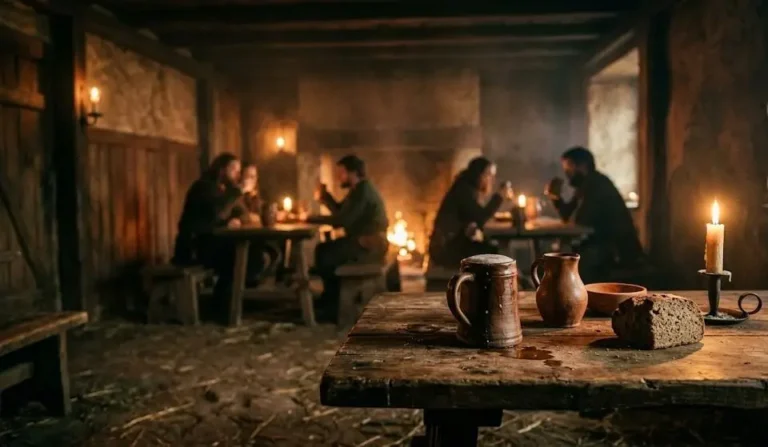
Imagine waking up in 1650 with a broken leg. There is no hospital nearby. No morphine. No X-ray, no anaesthetic, no A&E. Just a bone-setter, a bottle of something strong, and a leather strap to bite down on. Pain was simply part of life — an intimate, daily companion for most of human history. So how did doctors treat pain before modern medicine? And what did the healers of the ancient world do to help? The answer is stranger, more creative, and sometimes more sophisticated than most people expect.
The Ancient World’s Surprising Pharmacy
Long before the white coat and the prescription pad, civilisations were building remarkably detailed pain-management systems.
You might assume that ancient societies were helpless, but they were remarkably clever at turning the natural world into a pharmacy. In Sumerian clay tablets dating back to 3000 BCE, you can find records of opium poppies being harvested for their milky, pain-relieving latex. The ancient Egyptians followed suit, often mixing crushed poppy seeds with wine to help restless patients find a sliver of rest.
It was not just about the poppy, though. In ancient China, during the Han Dynasty around 200 CE, a physician named Hua Tuo reportedly developed a herbal concoction called Mafeisan. He dissolved this powder in wine and offered it to patients before performing complex surgeries. While the exact recipe was lost to time, it represents an early, desperate reach for surgical anesthesia.
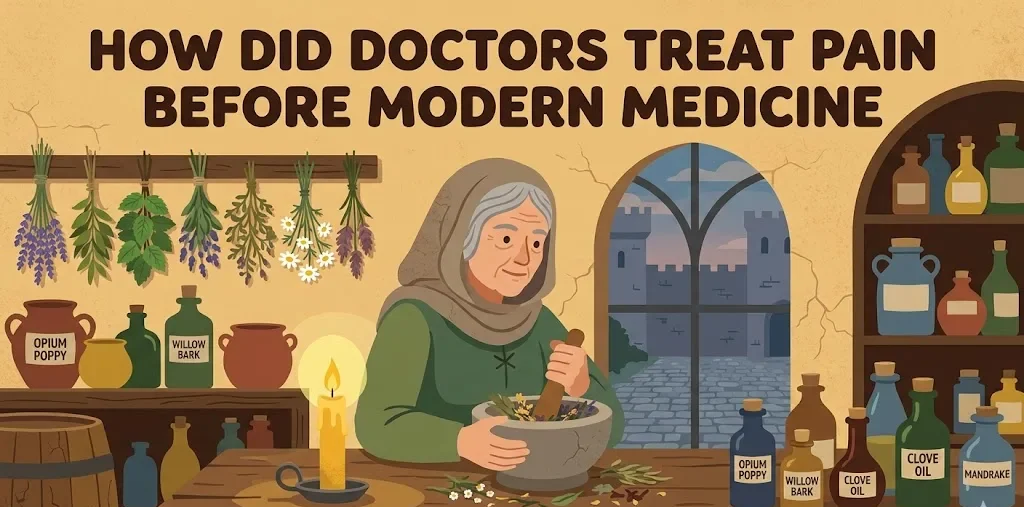
For the common person, the approach was much more localized. You likely relied on the village herbalist who knew exactly which patches of willow bark to strip. Willow bark contains salicin, the chemical ancestor of aspirin. You would chew it, swallow the bitter juice, and hope the dulling sensation would calm your aching head. It was a slow, hit-or-miss science, but it kept the edge off.
Opium: The World’s First Painkiller
If there was one substance that dominated pain relief across the ancient and medieval world, it was opium.
The Sumerians were cultivating the opium poppy by 3400 BCE — they called it hul gil, meaning “joy plant.” From Mesopotamia, knowledge of its properties spread to Egypt, Greece, Rome, Persia, and eventually across the Islamic world and into medieval Europe.
Greek physicians used it extensively. Hippocrates, writing in the fifth century BCE, recommended it cautiously for certain ailments. Galen, the most influential physician of the Roman world, prescribed opium preparations for everything from insomnia to ear pain to internal bleeding. He was aware of its addictive potential — but so were his patients, apparently.
In the medieval Islamic world, scholars like Ibn Sina (Avicenna) devoted serious intellectual energy to understanding opium’s properties. His Canon of Medicine, written in the early eleventh century, described precise dosages and warned against overuse. For centuries, this text was used as a medical reference across both the Islamic world and Christian Europe.
The problem with opium was, of course, the same problem it poses today. It worked brilliantly, and it was brutally addictive. This tension would define pain medicine for centuries.
Medieval Europe: Prayers, Plants, and the Surgeon’s Knife
In medieval Christian Europe, pain took on a theological meaning that complicated treatment considerably.
Suffering, in much of medieval thinking, was connected to spiritual purification. Enduring pain could be a form of penance. This did not mean physicians refused to treat it — they most certainly did — but it created a cultural context in which pain was not simply a problem to be solved.
Monastic infirmaries were the main centres of medical knowledge in early medieval Europe. Monks cultivated herb gardens with medicinal plants: valerian (a sedative), henbane (an anticholinergic with genuine analgesic effects), mandrake (highly toxic but used in small doses as a narcotic), and poppy. The so-called “dwale,” a medieval anaesthetic potion mentioned in documents from the 9th century onwards, combined several of these plants and was used to render patients unconscious during surgery.
Surgery itself was performed without anything resembling modern anaesthesia. The goal was speed. The fastest surgeons in Europe were celebrities of a kind — a leg amputation performed in two minutes was a feat worth talking about. One notorious surgeon of the 19th century, Robert Liston, allegedly performed an amputation so fast that he accidentally amputated his assistant’s fingers at the same time.
Before the knife, patients were given alcohol, opium, or both. Sometimes that was enough. Sometimes it very much was not.
What the Ancient Romans Did That Surprises Most People
Here is something most people don’t know: Roman physicians used electric fish for pain relief.
Scribonius Largus, a first-century Roman physician, documented the use of the electric torpedo ray for treating headaches and gout. The patient would stand on a live ray on the beach and receive a shock from it. This was essentially an early form of electrotherapy — the same principle, broadly speaking, as the TENS machines used in physiotherapy today.
It sounds bizarre. But it worked — at least partially. The electrical current disrupted pain signals in the nervous system in ways that Roman physicians couldn’t explain but had clearly observed.
Romans also had access to a sophisticated pharmacopoeia. Dioscorides, a Greek physician serving with the Roman army in the first century CE, compiled De Materia Medica — a five-volume catalogue of medicinal plants that remained a reference text in European medicine until the 17th century. He described over 600 plants with analgesic properties.
For the wealthy Roman, pain relief could be relatively sophisticated. For a slave or a poor citizen, it was whatever herbs the local healer could find.
Indigenous and Traditional Knowledge Around the World
While European medicine gets most of the historical attention, other parts of the world developed equally rich traditions of pain management.
In South America, indigenous peoples had long used coca leaves — the plant from which cocaine is derived — for pain relief, endurance, and altitude sickness. Spanish colonisers documented their use extensively in the 16th century. When cocaine was eventually isolated in 1859, it became the first true local anaesthetic, used in eye surgery and dentistry.
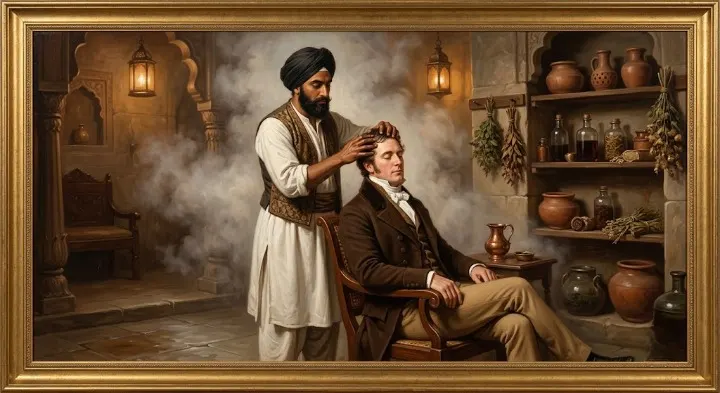
In South Asia, Ayurvedic medicine, which dates back over 3,000 years, classified pain by type and cause in extraordinary detail. Treatments included turmeric (a genuine anti-inflammatory, now widely studied by pharmacologists), ashwagandha, and preparations involving cannabis. Cannabis was used medicinally across ancient India, China, Egypt, and the Islamic world — often specifically for pain.
North American indigenous peoples used willow bark, as the Egyptians had, along with dozens of other plant-based preparations. Many of these were documented only after European contact — and many more were likely lost.
What these traditions share is centuries of empirical observation. Without the scientific method, healers relied on trial, error, memory, and accumulated wisdom passed carefully between generations.
The Gruesome Reality of Pain During Surgery
Before the discovery of anaesthesia in 1846, surgery was essentially controlled torture.
The patient was conscious. They were held down — often by several strong men. The surgeon worked as fast as possible, and speed was the closest thing to mercy available. For a patient undergoing abdominal surgery, the experience was so traumatic that many died not from the operation itself but from shock.
Some surgeons gave patients alcohol beforehand. Some used opium. Some used a combination called “laudanum” — opium dissolved in alcohol — which was widely available in England and America throughout the 18th and early 19th centuries. A bottle of laudanum could be bought at any apothecary for a few pence. It was prescribed for everything from toothache to period pain to teething infants.
In October 1846, a Boston dentist named William Morton publicly demonstrated the use of ether as a surgical anaesthetic at Massachusetts General Hospital. The patient, a printer named Edward Abbott, had a tumour removed from his neck while completely unconscious. When he woke up and reported feeling nothing, the surgeon turned to the audience and said: “Gentlemen, this is no humbug.”
Everything changed after that morning. The age of conscious surgery was over.
🌿 Pain Relief Across Cultures: A Comparison
| 🏛️ Civilisation / Era | 📿 Key Methods | 🔬 Notable Substance or Technique |
|---|---|---|
| Ancient Egypt (1550 BCE+) | Herbal medicine, opium, ritual | Willow bark, poppy preparations |
| Ancient China (2700 BCE+) | Acupuncture, herbal remedies, cannabis | Acupuncture, cannabis preparations |
| Ancient Greece / Rome | Pharmacopoeia, surgery, electrotherapy | Opium, torpedo ray shocks |
| Medieval Islamic World (9th–13th c.) | Systematic pharmacology, surgery | Opium dosage, Ibn Sina’s Canon |
| Medieval Europe (5th–15th c.) | Herbal medicine, monastic care, prayer | Dwale (herbal anaesthetic), laudanum |
| Indigenous Americas (pre-contact+) | Plant-based remedies, ritual | Coca leaves, willow bark |
| 18th–19th Century Europe | Laudanum, early surgery, ether | Ether anaesthesia (1846) |
The Class Divide: Who Got Relief and Who Didn’t
Pain relief throughout history was never equally distributed. Wealth made an enormous difference.
A wealthy Roman patrician with gout could consult Galen himself, receive carefully dosed opium preparations, and recuperate in a well-appointed house with skilled attendants. A Roman slave with the same condition had whatever the household could spare — which was probably not much.
In 18th-century England, a prosperous merchant with a bad tooth could visit a skilled tooth-drawer, receive a dose of laudanum beforehand, and have the offending molar removed with some efficiency. A farm labourer in the same situation would pull the tooth themselves, bite on a cloth, and get back to work.
The industrial revolution made this divide even sharper. Laudanum was cheap and widely available — so opium addiction cut across class lines in Victorian England in ways that disturbed contemporary observers. But the quality of care for other conditions remained starkly unequal. Wealthy Victorians had access to trained surgeons, private nursing, and the emerging science of anaesthesia. The poor had the workhouse infirmary.
Universal access to pain relief is, historically speaking, a very recent and very radical idea.
🌿 Frequently Asked Questions
It is likely that people did not have a higher tolerance, but they had a different cultural expectation. Suffering was often viewed as an unavoidable part of existence, which meant people were conditioned to endure it with a stoicism that feels foreign to us today.
Almost always. While some doctors used herbal concoctions or alcohol to dull the senses, there was no reliable way to induce total unconsciousness. Patients were typically fully awake and aware during the procedure, making speed the surgeon’s most important skill.
Opium, derived from the poppy plant, was the gold standard for severe pain across many civilizations, from Egypt to China. For milder aches, willow bark and various fermented plant extracts were commonly used as home remedies.
Yes, significantly. Wealthy individuals could afford imported narcotics, specialized physicians, and more complex medicinal blends. Those with fewer resources relied on locally sourced herbs, traditional folk knowledge, and faith-based practices.
Conclusion
What strikes you most, looking back at this history, is not how primitive the past was — it’s how desperately human it was. People in every era, in every culture, looked for ways to ease suffering. They observed, experimented, and shared knowledge. Some of what they discovered was remarkably effective. Some of it was useless at best and deadly at worst. But the impulse behind it all — to look at a person in pain and try to help — is one of the oldest and most recognisable human instincts there is.
The transformation from willow bark and opium to aspirin and morphine wasn’t a clean break. It was a slow accumulation of knowledge across thousands of years and dozens of cultures. Every civilisation that ever tried to treat pain left something behind — an observation, a plant, a technique — that eventually fed into the medicine we have today.
If you found this journey through the history of medicine interesting, you might also enjoy reading about How Did People Communicate Before Phones: The Extraordinary Ways or What Did People Drink Before Clean Water?