Picture yourself in ancient Mesopotamia, about 3,000 years before the first coin was ever struck. You need grain. Your neighbour needs wool. Somewhere across the river, a merchant wants silver. Everyone needs something — and nobody has what the other person wants. So how on earth did commerce work? The answer takes you deep into some of the most creative problem-solving in human history, and it turns out the story of money before coins is far stranger and far more human than you’d expect.
💰 A Quick Comparison: Pre-Coin Currencies Across Civilisations
| 🪙 Currency Type | 🌍 Where Used | ⏳ Approximate Era | 💡 Key Advantage |
|---|---|---|---|
| Barley / Grain | Mesopotamia, Egypt | 3000 BCE onward | Universally needed |
| Cowrie Shells | China, India, West Africa | 1200 BCE – 19th century CE | Durable, hard to fake |
| Weighed Silver | Babylon, Egypt | 2500 BCE onward | Divisible, portable |
| Cloth (quachtli, vaðmál) | Aztec Mexico, Iceland | 1000–1500 CE | Standardisable, durable |
| Cacao Beans | Mesoamerica | 900–1521 CE | Small-denomination flexibility |
| Bronze Tool-Shapes | China | 800–300 BCE | Metal value + recognised form |
| Wampum | Northeast North America | Pre-contact – 1700s CE | Ceremonial and commercial value |
Bartering Was the First “Money” — But It Broke Down Fast
Before any formal currency existed, people traded. You had surplus fish, I had surplus pottery — we swapped and both walked away satisfied. Simple enough on the surface.
But here’s where it fell apart almost immediately: what economists call the “double coincidence of wants.” For a trade to happen, both parties had to want exactly what the other was offering, at exactly the same time. A farmer with ten jars of olive oil didn’t always find a sandal-maker who wanted olive oil and had sandals to spare that particular week.
This made large-scale trade nearly impossible. Villages could manage it. Empires couldn’t.
The real surprise is that even modern anthropologists debate whether pure barter ever truly dominated any large society. What replaced it, almost everywhere, wasn’t barter made more efficient — it was something entirely different.
Commodity Money: When Useful Things Became Currency
The earliest “money” wasn’t money at all in the way we think of it — it was stuff. Valuable, useful, desirable stuff that people agreed to treat as a medium of exchange.
In ancient Mesopotamia around 3000 BCE, barley was used as payment. Workers who helped build temples and palaces were paid in measured quantities of grain. The Code of Hammurabi, written around 1754 BCE, literally sets fines and wages in silver and barley side by side.
Salt was so valuable in the ancient world that Roman soldiers were sometimes paid in it — which is where the word “salary” actually comes from (from the Latin salarium). Cattle were used across ancient Africa, Europe, and Asia. The Latin word for money, pecunia, comes from pecus — meaning cattle.
What made something work as commodity money? It had to be useful in itself, reasonably portable, divisible, and hard to fake. Grain, salt, cloth, and livestock all ticked most of those boxes. None of them ticked all of them — which is exactly why humans kept searching for something better.
Cowrie Shells: The World’s Most Widespread Early Currency
If you had to pick one object that functioned as money across more human cultures than any other, the answer isn’t gold. It’s a small, shiny sea shell.
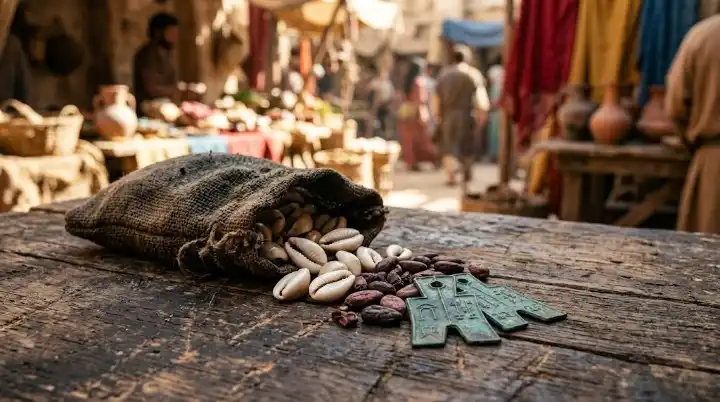
Cowrie shells — particularly the species Cypraea moneta — were used as currency across China, India, Southeast Asia, West Africa, and parts of the Americas for thousands of years. Chinese records of cowrie use go back to at least 1200 BCE, and the shells appear in graves and hoards from that era as far inland as central Africa.
What made them so universally trusted? They’re durable, difficult to counterfeit, satisfying to handle, and they can’t be grown or easily replicated. Their supply was naturally limited to coastal regions, which made them genuinely scarce to inland populations.
In West Africa, cowrie shells remained in active use as currency well into the 19th century. By the time European colonial powers flooded the market with boatloads of imported shells from the Maldives — deliberately, to purchase enslaved people more cheaply — they caused what amounts to one of the first recorded cases of hyperinflation. The shell economy collapsed almost overnight.
Cloth and Textile: Fabric as a Financial Instrument
Woven fabric is one of the most labour-intensive things a pre-industrial society could produce — which made it extraordinarily valuable as a store of wealth.
In Aztec Mexico, lengths of cotton cloth called quachtli functioned as currency long before Spanish conquest. Different grades of cloth had different values. A good cloak might be worth roughly 100 cacao beans (which were also used as money). A debt could be settled in fabric.
In medieval Iceland, homespun wool cloth called vaðmál was so standardised as a unit of account that laws were written specifying its exact dimensions and thread count for it to qualify as legal payment.
The Silk Road, which stretched from China to the Mediterranean from roughly the 2nd century BCE onward, was named after the most coveted textile on earth. Raw silk didn’t just travel along that road — it was currency on stretches of it, used by Tang Dynasty China to pay soldiers and buy alliances.
Fabric had one major advantage over grain or cattle: it didn’t rot, couldn’t run away, and could be cut into smaller pieces for smaller transactions.
Metal Before Coins: Weighed Silver and Bronze
Here’s the part that surprises most people about ancient finance: metal was used as money for centuries before anyone bothered stamping it into coins.
In ancient Egypt and Mesopotamia, silver was weighed out for transactions using carefully calibrated scales. You didn’t receive coins — you received a lump of silver that was weighed on the spot. Merchants carried weights and balances as essential business tools, the way a modern trader might carry a smartphone.
The “shekel” — which most people know as a modern Israeli currency — was originally not a coin at all. It was a unit of weight: roughly 8.3 grams of silver in ancient Babylon. A shekel of silver could buy about a month’s worth of grain around 2000 BCE.
Bronze also served this role across East Asia. In ancient China, bronze was cast into standardised shapes — sometimes resembling miniature tools like spades or knives — specifically to be used in trade. These tool-shaped bronzes predate round coins in China by centuries.
Grain Banks and the World’s First Accounting Systems
One of the most surprising chapters in pre-coin money is this: ancient Egyptians and Mesopotamians essentially invented banking — without coins, and without paper.
In Egypt, a system of grain banks developed where farmers could deposit their harvest and withdraw it later, or transfer amounts to other people’s accounts. Transactions were recorded on clay tablets or papyrus. You could pay a debt to someone in another city by having your local grain bank send a message to their local grain bank, adjusting both accounts accordingly.
This is, in structure, nearly identical to how electronic banking works today.
The temple complexes of Mesopotamia, such as those at Ur around 2100 BCE, functioned as both religious centres and financial institutions. Priests recorded deposits, loans, and interest payments in meticulous detail. Some of the oldest written documents in human history are grain receipts and debt contracts — not poetry or prayers.
Wampum, Cacao, and the Global Diversity of Early Money
Across the Atlantic, entirely separate monetary traditions developed with their own logic and elegance.
In North America, wampum — shell beads made from quahog clam shells — was used by Indigenous peoples of the Northeast as a medium of exchange, a record of agreements, and a ceremonial object. Wampum belts woven in particular patterns could record treaties. European colonists initially used it as currency themselves because they were desperately short of coins.
The Maya and Aztec civilisations used cacao beans as small-denomination currency. Counterfeit cacao was a real problem — merchants would hollow out beans and fill them with dirt or clay to pass them off as full beans. Market inspectors existed specifically to detect fraud.
In ancient Tibet and parts of Central Asia, tea compressed into hard bricks served as both trade good and currency. Tea bricks remained in use in remote parts of Siberia well into the 20th century.
🪙 Frequently Asked Questions — The History of Money
Before coins, people used a wide range of commodity money including grain, livestock, salt, cloth, metal by weight, and shells. The specific item varied by region and era. In ancient Mesopotamia, barley and weighed silver dominated; in China, cowrie shells and bronze pieces; in Mesoamerica, cacao beans and cotton cloth. There was no single universal answer — different cultures solved the problem of exchange in ways that made sense for their local resources.
The first standardised coins are generally credited to the kingdom of Lydia (in modern Turkey) around 600–650 BCE. These were made from electrum, a natural alloy of gold and silver, and stamped with official marks to guarantee their weight and purity. China independently developed round coins with square holes around the same period, during the Warring States era.
Pure barter — direct swapping of goods — was used in small communities but was impractical at scale because it required both parties to want exactly what the other had. Most early economies actually relied on credit, gift exchange, and commodity money long before anything resembling modern barter dominated. The idea that barter universally preceded money has been questioned by many modern anthropologists and economic historians.
Cowrie shells were durable, attractive, naturally uniform in size, difficult to counterfeit, and — crucially — rare in inland regions where most trade happened. Their supply was limited to specific coastal areas, which gave them genuine scarcity value. These properties made them trustworthy across completely different cultures that had no contact with each other.
Some of the earliest physical evidence of monetary systems comes from ancient Mesopotamia, where clay tablets recording grain debts date to around 3000 BCE. Cowrie shells used as grave goods in China date to at least 1200 BCE. However, the concept of credit and debt likely predates any physical evidence — meaning the oldest “money” may have been promises recorded in memory long before anyone thought to write them down.
The Thread That Runs Through All of It
What strikes you, looking at this whole sweep of human history, is how consistent the underlying problem was. Every society that grew beyond a small village needed a way to store value, transfer it across distances, and settle debts without having to drag a cow to market.
The solutions were wildly different — shells and grain and silver and cloth and cacao beans — but the logic behind them was always the same. Something worked as money when enough people agreed it did, when it was hard to fake, and when it was useful enough that nobody wanted to refuse it.
Coins didn’t appear until around 600 BCE, but by then, humans had already been solving the money problem for at least 2,400 years. That’s worth sitting with for a moment.
If this got you thinking about how ordinary people lived and worked in the ancient world, you might also enjoy reading about What Did People Use Before Toilet Paper? Unbelievable Methods, or exploring How People Kept Food Cold Before Refrigerators.