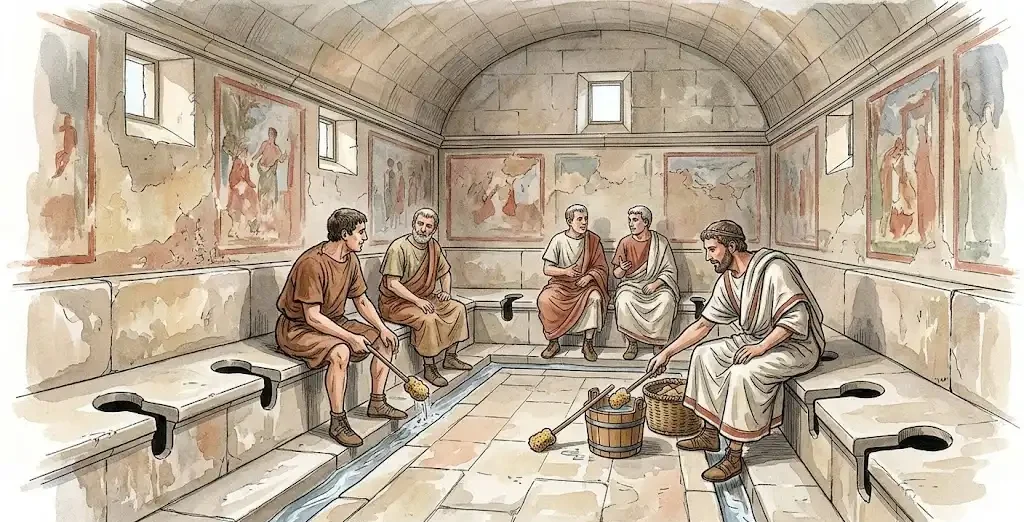
Imagine it’s a cold morning in ancient Rome. You’ve just used a public latrine — a long marble bench with holes cut into it, side by side with strangers. There’s no privacy screen. No cubicle door. And where the toilet paper should be, there’s a communal sponge on a stick soaking in a bucket of salt water. You pick it up, use it, rinse it, and put it back for the next person.
That was just Tuesday. So what did people use before toilet paper — and how different was it depending on where you lived?
The Roman Xylospongium — A Sponge Stick Everyone Shared
The Romans were surprisingly advanced in many ways, but their bathroom habits would make most modern people shudder. The xylospongium — a sea sponge fixed to the end of a wooden stick — was the standard cleaning tool in Roman public latrines from around the 1st century BCE onward.
These weren’t private items. They were shared. You used it, rinsed it in the channel of running water at your feet or in a vinegar solution, and left it for the next visitor.
What’s remarkable is that Roman latrines themselves were engineering marvels — fed by aqueducts, with running water beneath the seats carrying waste away. The hygiene of the xylospongium, however, was another matter entirely. Scholars debate whether the vinegar rinse was remotely effective at killing bacteria, and given what we know about Roman gastrointestinal health from analysing ancient waste sites, the answer seems to be: not really.
The detail that surprises most people? The Romans didn’t see this as primitive. This was the height of civilised public sanitation.
Ancient Greece and the Pessoi — Smooth Stones and Broken Pottery
Before the Romans, the ancient Greeks had their own method — and archaeologists have actually found the evidence to prove it. Small, smooth, rounded pebbles or broken pieces of ceramic called pessoi were used for personal hygiene after defecation.
The word pessoi also referred to game pieces, which gives you a slightly unsettling image. Excavations at ancient Greek latrines, including sites in Athens dating back to the 5th century BCE, have unearthed these ceramic pieces alongside the drains. Some even had inscriptions — including the names of political enemies, which added a deeply satisfying layer of insult to the process.
The ceramic sherds used were typically smooth-edged and hand-sized. You wouldn’t want something jagged, obviously. This was a practical, low-cost solution that required no preparation and could be carried or simply found.
It’s a reminder that human ingenuity around even the most basic needs has always been inventive — even if the solutions look bizarre from where we’re standing.
Ancient China and the First Paper — 6th Century Innovation
Here’s where the story takes a genuinely important turn. The earliest recorded use of paper specifically for personal hygiene comes from China, and the record is surprisingly specific.
In 589 CE, the scholar-official Yan Zhitui wrote that he would never use paper bearing the written word for such a base purpose — which tells us, clearly, that paper was already being used this way by other people. By the Tang Dynasty (618–907 CE), paper hygiene was common among the wealthy.
The real shift came in the 14th century. By the 1390s, the imperial court of the Ming Dynasty was reportedly ordering around 720,000 sheets of toilet paper per year — with a special order of 15,000 especially soft, perfumed sheets reserved for the Emperor’s family.
The rest of the world wouldn’t catch up for another 500 years. While Chinese emperors were using soft, perfumed paper, medieval Europeans were still largely reaching for whatever came to hand.
Medieval Europe — Hay, Moss, Leaves, and the Left Hand
In medieval Europe, what you used after using the toilet depended almost entirely on where you lived and how much you had.
Wealthy households might use wool, hemp, or lace. Peasants and ordinary people used whatever was available: hay, dried grass, moss, leaves, or corn cobs. In coastal areas, smooth mussel shells were common. In colder northern climates, snow and ice were used seasonally — which, if nothing else, had a certain bracing efficiency to it.
The “hand” method — cleaning with water and the left hand — was the standard practice across much of the Islamic world, South Asia, and parts of Africa. This is why the left hand was considered unclean in many cultures, a taboo that still persists in etiquette today. Far from being primitive, the water method is arguably more hygienic than dry wiping, which is why bidets remain standard in much of the world.
In castles, the garderobe — a small room built into the wall that dropped waste into a pit or moat below — often had no cleaning material at all. You used your undergarment, or the straw scattered on the floor. Medieval hygiene was, by necessity, enormously creative.
The Islamic Golden Age — Hygiene as Religious Obligation
While Europe muddled through with hay and wool, the Islamic world had elevated personal cleanliness to a matter of faith. The practice of istinja — cleaning oneself after using the toilet — is an explicit requirement in Islamic law, detailed in texts from the 7th century CE onward.
The preferred method was water, applied with the left hand. If water wasn’t available, three smooth stones were prescribed as a minimum — a rule codified by Islamic jurists and practised across the vast geographic spread of the Islamic world, from Spain to Central Asia.
What’s striking is how systematic this was. Medieval Islamic cities like Baghdad and Córdoba had sophisticated sanitation infrastructure — public baths (hammams), running water, and detailed religious guidance on hygiene — centuries before comparable systems appeared in northern Europe.
The Prophet Muhammad’s instructions on hygiene, recorded in the hadith collections of the 9th century, specified clean water, privacy, and the use of the left hand specifically — a framework that shaped the daily lives of hundreds of millions of people for over a thousand years.
The Americas Before European Contact — Corn Cobs and Local Materials
Indigenous cultures across North and South America developed their own solutions long before European colonisation arrived. In what is now the eastern United States, corn cobs were a remarkably practical and widely available option — smooth enough to be functional, abundant after harvest, and disposable.
In tropical regions of South America and Central America, large, smooth leaves were the obvious choice. In coastal areas, mussel shells and smooth river stones served the same purpose as they did in other parts of the world.
The Aztec civilisation had well-developed sanitation practices, including designated waste areas and the use of water. The city of Tenochtitlan — the Aztec capital on an island in the middle of Lake Texcoco — had a sophisticated waste collection system by the 14th century, with human waste collected by canoe and used as agricultural fertiliser.
What people used was almost always determined by what was locally abundant. Human ingenuity tends to work with what’s nearby.
The Invention of Commercial Toilet Paper — New York, 1857
The moment that changed everything happened quietly, in New York City, in 1857. A man named Joseph Gayetty began selling “Medicated Paper” — pre-moistened, flat sheets infused with aloe — marketed as a medical product for haemorrhoid relief. Each sheet was watermarked with his name.
It didn’t sell well. The public was sceptical, and paper for this purpose felt unnecessary when rags, pages from almanacs and newspapers, and catalogues were freely available in most households.
The real breakthrough came in 1890, when the Scott Paper Company began selling toilet paper on a roll — the format we recognise today. Even then, it was sold under other companies’ names because the Scott brothers were embarrassed to be publicly associated with the product.
By 1930, the key selling point had shifted. Northern Tissue advertised their product as “splinter-free” — which tells you that earlier commercially produced toilet paper had, apparently, a splinter problem. The soft, reliable paper we take for granted today is a genuinely recent luxury, barely a century old in its current form.
🧼 Civilisations at a Glance — Hygiene Methods Across History
| 🏛️ Civilisation / Region | 📅 Era | 🧻 Primary Method | 📝 Notes |
|---|---|---|---|
| Ancient Greece | 5th century BCE | Pessoi (smooth stones / ceramic) | Names of enemies inscribed on sherds |
| Ancient Rome | 1st century BCE–4th century CE | Xylospongium (shared sponge stick) | Rinsed in salt water or vinegar |
| Tang Dynasty China | 618–907 CE | Paper | First recorded regular paper use |
| Ming Dynasty China | 1390s CE | Perfumed paper sheets | 720,000 sheets/year for imperial court |
| Medieval Europe | 500–1500 CE | Hay, moss, leaves, wool (wealthy) | Depended heavily on wealth and location |
| Islamic World | 7th century CE onward | Water and left hand (istinja) | Religiously mandated; three stones as backup |
| Pre-Columbian Americas | Pre-15th century | Corn cobs, leaves, smooth stones | Varied by region and available materials |
| United States | 1857 onward | Commercial paper (flat sheets, then rolls) | Toilet roll standardised by Scott Paper, 1890 |
🧻 Frequently Asked Questions
Medieval Europeans used whatever was locally available — hay, dried grass, moss, leaves, and in wealthier households, wool or hemp cloth. Smooth stones and broken pottery shards were also common. The choice depended almost entirely on geography, season, and social class. Royalty and the very wealthy used soft cloths, sometimes perfumed.
Yes. The xylospongium — a sea sponge on a wooden stick — was a standard fixture in Roman public latrines from around the 1st century BCE. It was shared between users and rinsed in salt water, vinegar, or the channel of running water that ran beneath the latrine seats. Roman latrines were remarkably engineered spaces; the hygiene of the sponge stick was considerably less impressive.
The first commercial toilet paper in the Western world was sold by Joseph Gayetty in New York in 1857, marketed as medicated paper. The perforated toilet roll we recognise today was introduced by the Scott Paper Company in 1890. Paper hygiene, however, had been practised in China since at least the 6th century CE, and the Ming imperial court was ordering hundreds of thousands of sheets per year by the 1390s.
Many hygiene experts argue that water is more effective than dry paper alone — it’s the reason bidets are standard in Japan, much of southern Europe, the Middle East, and South Asia. The Islamic practice of istinja, using water after using the toilet, has been standard for over 1,400 years and is considered by many public health professionals to be more sanitary than paper alone.
Ancient Egypt left relatively limited written records on the specifics of personal hygiene after defecation, but archaeological and textual evidence suggests cloth rags, smooth stones, and water were likely used, consistent with practices across the ancient Near East. The Egyptian elite had access to fine linen, which would have served as the most comfortable available option.
Yes, in the large public latrines, a single sea sponge mounted on a stick was often shared among users. It was rinsed in a bucket of vinegar or saltwater between uses, which reflected the public and communal nature of Roman sanitation.
Final Reflections
Looking back at this evolution, it is clear that we have come a long way from the river stones and sea sponges of our ancestors. The convenience of today is a testament to the rapid pace of technological and social change. While we might look back on these methods with a sense of relief, they were simply the solutions of their time—perfectly adapted to the environments and social structures of the people who used them. It reminds us that even our most “basic” daily habits are products of history. Understanding how people lived before the era of modern luxury allows us to see our own lives with a bit more perspective.
If this glimpse into the past made you curious about other elements of daily life in the previous centuries, you might also enjoy reading about how people kept their clothes clean before the invention of the washing machine.