Picture a child in 1925 pulling on worn leather boots before dawn, walking two miles to a single-room schoolhouse with a pot-bellied stove and no electricity. No backpack stuffed with colour-coded folders. No lunch tray. Just a slate, a pencil, and the fear of the teacher’s ruler. What was school like 100 years ago is a question that sounds simple — but the answer will genuinely surprise you.
The One-Room Schoolhouse Was the Norm, Not the Exception
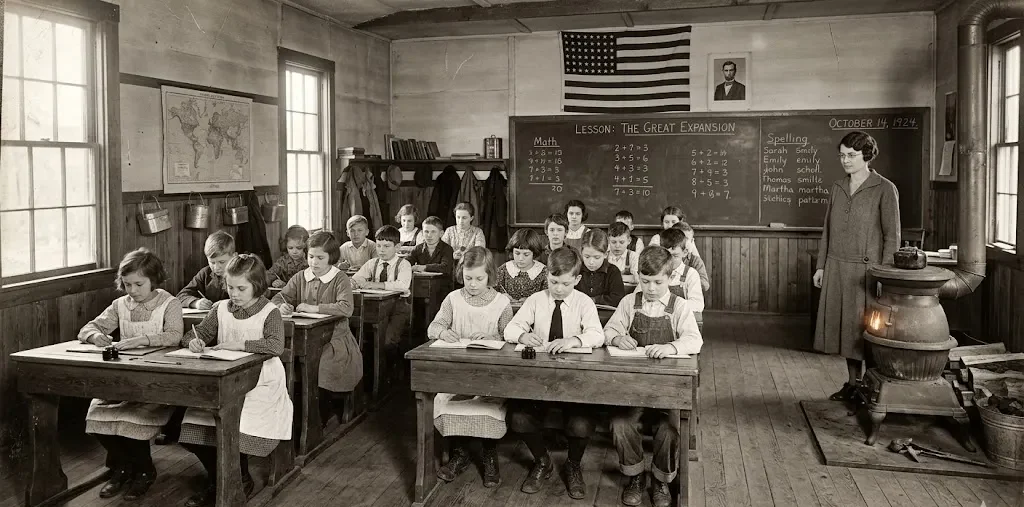
In rural America and across much of Britain, Canada, and Australia in the 1920s, the one-room schoolhouse was the beating heart of community education. One teacher. Every age, from five to fourteen. One room.
The teacher — usually a young woman in her late teens or early twenties — managed everything. She split the day into rotating groups, calling the older children forward for arithmetic while the younger ones practised their letters. The 1920 U.S. Census reported that over 190,000 one-room schools were still operating across the country. That number is almost impossible to imagine today.
Discipline was strict and physical. A ruler across the knuckles was standard. Talking out of turn could earn you a humiliating stint in the corner, sometimes wearing a dunce cap. Children learned early to sit still, speak only when spoken to, and never, ever question the teacher.
And yet — there was something intimate about it. Children learned alongside their siblings. Older students often helped teach younger ones. It wasn’t perfect, but it was a community.
The School Day Started Much Earlier — and Was Far Shorter
Here’s something that surprises most people: children 100 years ago often attended school for far fewer total hours than children do today, but the experience was far more intense.
In many American states in the 1920s, the rural school year ran only 120 to 160 days — compared to roughly 180 days in modern American schools. Children were needed on farms. Harvest season could empty a school entirely. Teachers adjusted, or simply waited.
The school day itself typically ran from 8am to 3pm, with a midday break for lunch. But “lunch” usually meant whatever you had carried from home. There were no canteens, no hot meals, no school kitchens. A cold biscuit and an apple if you were lucky.
Urban schools in cities like New York, London, and Chicago ran differently. By 1925, larger cities had introduced half-day sessions for overcrowded schools, with morning and afternoon shifts. One group of children left as another arrived.
What Students Actually Learned — and What Was Left Out
The curriculum of 1925 looks almost alien compared to what children study today. The three Rs — reading, writing, and arithmetic — dominated everything. There was no art class. No music programme. Certainly no physical education. History, if it was taught at all, was patriotic rather than critical.
In Britain, the 1918 Fisher Education Act had just raised the school leaving age to 14, making secondary education a legal requirement for the first time. In practice, many working-class children still left school early, often to help support their families. The law said one thing; poverty said another.
Science barely existed as a subject in primary schools. Nature study — observing local plants and weather — was as close as most children got to anything scientific. Latin was still considered the mark of a truly educated person, reserved for grammar schools and the children of the middle and upper classes.
One subject almost every child studied? Penmanship. Perfect handwriting was not considered a nice-to-have. It was a life skill, a job requirement, and a mark of character. Children drilled letter forms for hours each week.
The Sharp Divide Between Rich and Poor Children
The honest answer to “what was school like 100 years ago” is that it depended enormously on who you were.
A child from a wealthy family in London in 1925 attended a private preparatory school with heated classrooms, individual desks, proper textbooks, and a curriculum leading toward Oxford or Cambridge. They had sports fields, school uniforms, and teachers with university degrees.
A child from a mining family in South Wales or a sharecropping family in Mississippi had something entirely different. Overcrowded rooms. Shared textbooks, if any. Teachers who might themselves have had only a few years of formal schooling. In the American South, racial segregation ensured that Black children attended underfunded, underequipped schools — by design.
In India under British colonial rule, formal Western-style schooling was expanding in cities, but the vast majority of children — particularly girls, and particularly in rural areas — received no formal education at all. The global picture of schooling in 1925 was one of radical inequality.
Teachers: Young, Underpaid, and Often Untrained
The teacher standing at the front of that 1925 classroom was probably not who you are imagining.
In the United States, many rural teachers were barely older than their oldest pupils. The average age of a one-room schoolhouse teacher in the 1920s was 20. Most were women, because teaching was one of the few respectable careers open to educated women — and because they could be paid less than men. The average annual salary for a teacher in rural America in 1920 was around $650, equivalent to roughly $10,000 today. Barely a living wage.
Many states required teachers to sign contracts promising they would not marry, not keep company with men, and not wear short skirts. In some districts, teachers had to live with a local family approved by the school board. Their private lives were considered public business.
Male teachers were increasingly rare in primary schools by the 1920s, as better-paid industrial work lured men away. This created a generation of schools almost entirely run by young women working under near-impossible conditions. They deserve far more recognition than history usually gives them.
Attendance Was Never Guaranteed
Here’s the part that rarely makes it into the history books: going to school every day was simply not the reality for millions of children in 1925.
Illness was a constant disrupter. Tuberculosis, scarlet fever, measles, whooping cough — these diseases swept through schools with devastating regularity. The 1918-1919 influenza pandemic had killed between 50 and 100 million people worldwide, and public health infrastructure was still fragile. A single case of scarlet fever could close a school for weeks.
Child labour remained widespread. In 1920, the U.S. Census recorded nearly 1 million children between 10 and 15 working in mines, mills, and factories. The Keating-Owen Child Labor Act of 1916 had been struck down by the Supreme Court in 1918. It wouldn’t be until 1938, with the Fair Labor Standards Act, that child labour was federally restricted in the United States.
For many working-class families, school was a luxury they could not fully afford. Even when it was free, the loss of a child’s income — however small — was a real sacrifice.
📚 A Comparison: School in 1925 vs. School Today
| 📌 Feature | 🏫 School in 1925 | 📱 School Today |
|---|---|---|
| School year length (USA) | 120–160 days (rural) | ~180 days |
| Leaving age (UK) | 14 (from 1918) | 16–18 |
| Class size | Mixed ages, often 30–50 pupils | 20–30, same age |
| Core subjects | Reading, writing, arithmetic, penmanship | Literacy, numeracy, science, arts, PE |
| Teacher qualifications | Often minimal; average age ~20 | University degree + certification |
| Physical punishment | Common and legal | Banned in most countries |
| Access for girls | Limited, especially at secondary level | Equal in most countries |
| Lunch provision | Bring your own or go without | School meals common or mandatory |
The Seeds of Modern Education Were Already Being Planted
Not everything about schooling in 1925 was grim. Something genuinely exciting was beginning to happen in progressive educational circles.
In the United States, philosopher and educator John Dewey had been championing a radical idea since the 1890s: that children learn best by doing, not by memorising. His ideas were slowly filtering into progressive urban schools by the 1920s. Rather than rote recitation, some schools were beginning to introduce project-based learning and student discussion.
In Germany, the Bauhaus school — founded in 1919 in Weimar — was reshaping ideas about creativity and practical education. In Italy, Maria Montessori had developed her method of child-led learning, which by 1925 had spread to schools across Europe and North America.
These were minority movements. Most children still spent their days copying from a blackboard and reciting answers in unison. But the philosophical battle for a kinder, more child-centred education was already underway — and the children of 1925 were living through the very beginning of that transformation.
📚 Frequently Asked Questions
No, attendance was not universal. Many children, especially those in rural areas or from lower-income families, were required to work on farms or in factories to support their families.
In many cases, they went without. While some school districts provided basic chalk or slates, most parents were expected to purchase textbooks, notebooks, and pencils, which was a significant financial burden.
Yes, but it often looked different. While physical intimidation existed, the rigid structure and constant presence of a teacher meant that much of the peer-to-peer friction was suppressed or kept strictly out of sight.
Teacher training varied wildly. While many attended “normal schools” specifically designed for pedagogy, many rural teachers had very little formal education beyond what they had received in the same one-room schoolhouses they eventually taught in.
How Far We Have Come — And What We Can Still Learn
Standing in that cramped, cold schoolhouse in 1925, chalk dust in the air and a ruler waiting on the teacher’s desk, it is almost impossible to recognise it as the ancestor of the modern classroom. And yet the instinct at the heart of it — the belief that children deserve to be educated, that knowledge can lift lives — was exactly the same.
The children who sat in those rows became the parents and grandparents of the post-war generation that rebuilt schools, expanded universities, and fought for equal access to education. Every improvement we now take for granted — school lunches, trained teachers, equal access for girls, the abolition of physical punishment — was won by people who looked at what existed and decided it was not good enough.
If this glimpse into the past has sparked your curiosity about everyday life a century ago, you might also enjoy reading about How Did Doctors Treat Pain Before Modern Medicine?, or How People Had Fun in the Middle Ages