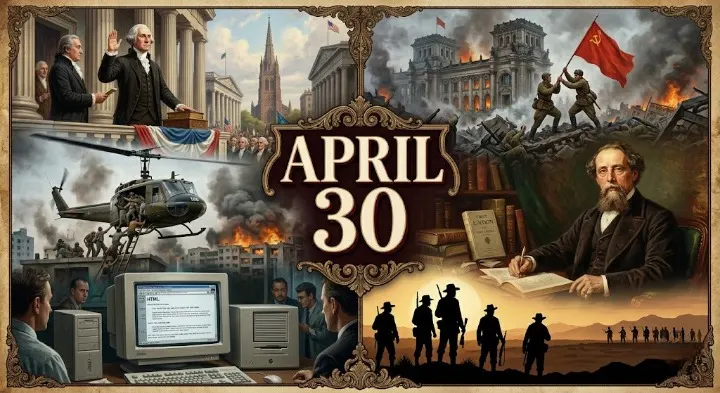
George Washington stood on the balcony of Federal Hall in New York City, taking the inaugural oath that launched the American presidency. That same date, 156 years later, Soviet soldiers planted their flag over the ruins of the Reichstag while Adolf Hitler ended his life in a dark bunker below. From the formal close of the Vietnam War to the day the World Wide Web became free for everyone, April 30 remains a collision of endings and beginnings.
🏳️ Quick Facts — April 30 in History
| 📌 Category | 📖 Event / Detail |
|---|---|
| 🌟 Most Significant Event | The Fall of Saigon and the end of the Vietnam War (1975) |
| 🏆 Top 10 Key Events | • Louisiana Purchase negotiated — 1803 • George Washington inaugurated as first US President — 1789 • Edict of Nantes issued — 1598 • Discovery of the electron (J.J. Thomson) — 1897 • CERN releases World Wide Web protocols — 1993 • Suicide of Adolf Hitler — 1945 • First women’s federal prison opens in the US — 1927 • Fall of Saigon — 1975 • Chrysler files for bankruptcy — 2009 • Meron stampede (Mount Meron, Israel) — 2021 |
| ⚔️ Key Battles | Battle of Jenkins’ Ferry (1864), Battle of Camarón (1863), Siege of a fort in the Eighty Years’ War (1636) |
| 👤 Key Figures Today | George Washington, Adolf Hitler, Christopher Columbus, Charles Dickens, Willem-Alexander of the Netherlands |
| 🌍 Observances | International Jazz Day, Honesty Day, Reunification Day (Vietnam), Martyrs’ Day (Pakistan), Children’s Day (Mexico) |
Story of the Day: The Fall of Saigon
North Vietnamese tanks smashed through the gates of the Independence Palace in Saigon, marking the absolute collapse of the South Vietnamese government. President Dương Văn Minh surrendered unconditionally, bringing a bitter, decades-long conflict to a formal close. Thousands of desperate people scrambled for the last helicopters departing the U.S. Embassy as the city transformed into Ho Chi Minh City overnight. This moment defined the end of American military involvement in Southeast Asia and signaled a new, unified era for Vietnam, leaving behind a nation forever altered by the weight of war.
Important Events That Happened On April 30 In History
311 – The Diocletianic Persecution Ends
The Roman Empire issued an edict halting the state-sponsored violence against Christians. After years of brutal attempts to wipe out the faith, the imperial government finally recognized that the movement could not be crushed by force. This policy shift allowed believers to gather without fear of execution for the first time in an era. The decision effectively ended the last great wave of Roman persecution before Constantine’s eventual legalization of the faith.
1305 – The Murder of Roger de Flor
Roger de Flor, the formidable leader of the Catalan Company, sat down for a banquet in Adrianople. His hosts, the Byzantine authorities, betrayed him by orchestrating his assassination during the meal. His death triggered a violent rampage as his mercenary army pillaged the surrounding Thracian countryside in retaliation. The event crippled Byzantine defenses and removed one of the most powerful military freelancers of the medieval era.
1315 – The Execution of Enguerrand de Marigny
Enguerrand de Marigny, once the most powerful advisor to the French throne, faced the gallows after being condemned by political rivals. Charles, Count of Valois, orchestrated the downfall of the former chamberlain to consolidate his own influence over the royal court. His public hanging sent a shockwave through the French nobility, demonstrating the fragility of power in a treacherous political climate. The execution remained a cautionary tale about the dangers of accumulating too much proximity to the king.
1492 – Columbus Receives His Commission
Spain granted Christopher Columbus his official mandate to sail across the Atlantic. The crown named him admiral of the ocean sea, along with the titles of viceroy and governor for any lands he managed to reach. This document provided the legal and financial framework for a voyage that would permanently link two hemispheres. The expedition set the stage for the massive shift in global trade and colonial expansion that dominated the following centuries.
1513 – The Execution of Edmund de la Pole
Edmund de la Pole, the last major Yorkist claimant to the English throne, was led to the scaffold on the direct orders of Henry VIII. His existence had been a persistent thorn in the side of the Tudor dynasty, threatening the legitimacy of the young king’s rule. His death eliminated the primary figurehead around whom disaffected nobles could rally against the crown. Henry VIII’s ruthless decision secured his grip on power and signaled a new, unforgiving approach to potential rivals.
1598 – Juan de Oñate Begins New Mexico Conquest
Juan de Oñate marched his expedition toward the upper Rio Grande to establish a permanent Spanish colony. His journey marked the formal start of the conquest of Santa Fe de Nuevo México, bringing Spanish law and religious missions to the region. The venture resulted in the founding of one of the oldest European-settled areas in the present-day United States. His arrival permanently altered the lives of the indigenous Puebloan people and established centuries of Spanish influence in the Southwest.
1598 – The Edict of Nantes
Henry IV of France signed a landmark decree granting substantial rights to his Huguenot subjects. The document ended the bloody Wars of Religion by allowing Protestants freedom of worship in specific parts of the kingdom. It provided a fragile but necessary framework for coexistence in a nation fractured by sectarian violence. This policy served as one of the earliest examples of state-sponsored religious tolerance in modern Europe.
1636 – Victory in the Eighty Years’ War
Dutch Republic forces reclaimed a vital strategic fort from Spanish control after enduring a grueling nine-month siege. The capture of this stronghold tilted the regional balance of power in the ongoing struggle for independence. The successful defense and eventual assault showcased the rising military capability of the young Dutch state. This triumph bolstered morale and proved that the Republic could withstand and overcome imperial Spanish fortifications.
1789 – Washington’s First Inauguration
George Washington stood on the balcony of Federal Hall in New York City and swore the oath of office as the first U.S. President. Thousands of onlookers filled the streets to witness the birth of a constitutional executive branch. The ceremony solidified the transition from colonial rebellion to a functional, organized government under the new Constitution. His quiet, dignified presence set the standard for the office that every successor would inherit.
1803 – The Louisiana Purchase
The United States finalized the acquisition of the vast Louisiana Territory from France for $15 million. This massive deal effectively doubled the size of the young nation almost overnight. The land stretched from the Mississippi River to the Rocky Mountains, opening a frontier for expansion and future economic growth. Jefferson’s gamble transformed the country from a fragile coastal power into a burgeoning continental nation.
1812 – Louisiana Statehood
The Territory of Orleans officially joined the Union as the 18th U.S. state, adopting the name Louisiana. This move consolidated American control over the critical port of New Orleans and the mouth of the Mississippi River. The entry signaled the further integration of former French territories into the American political framework. It marked a new chapter for the diverse populations living in the bayou region as they became citizens of the United States.
1838 – Nicaraguan Independence
Nicaragua formally declared its separation from the fragile Central American Federation. After years of internal political friction and regional instability, the nation chose to pursue a sovereign path. The proclamation aimed to establish a government independent of the federation’s failing administrative structure. This break defined the start of a new, albeit difficult, journey toward establishing a distinct national identity and autonomy.
1859 – Dickens Publishes All the Year Round
Charles Dickens launched his new literary magazine, introducing the world to the first installment of his classic, A Tale of Two Cities. The serial format allowed the author to reach a massive audience of weekly readers across Britain. Each issue became a cultural event, driving demand for his social commentary and dramatic narratives. The success of the publication cemented Dickens’ status as the preeminent voice of the Victorian era.
1863 – The Battle of Camarón
Sixty-five men of the French Foreign Legion held a remote hacienda against a force of nearly 2,000 Mexican soldiers. The legionnaires refused to surrender, fighting until almost every man was killed or wounded. Their legendary stand became a defining moment of duty and resilience for the unit. To this day, the Foreign Legion commemorates the battle as the ultimate example of their code of honor.
1864 – Battle of Jenkins’ Ferry
Confederate General E. Kirby Smith launched a desperate assault on federal troops retreating across the Saline River in Arkansas. The intense fighting took place in difficult, muddy terrain that hampered troop movements and increased the brutality of the engagement. Despite the Confederate attack, the Union forces managed to successfully complete their withdrawal. The battle served as the final major engagement of the Red River Campaign, leaving the region in a stalemate.
1871 – The Camp Grant Massacre
A group of Americans, Mexicans, and Tohono O’odham attacked an Apache encampment near Camp Grant in the Arizona Territory. The raid resulted in the deaths of over a hundred people, mostly women and children, who had been living under the protection of the U.S. Army. The brutality of the incident triggered national outrage and forced a reevaluation of the government’s approach to the Apache Wars. It remains a dark chapter that highlights the violence and lawlessness of the American frontier.
1885 – Niagara Falls Preservation
The Governor of New York signed legislation creating the Niagara Reservation, the first state park in New York. The move halted the spread of industrial factories and commercial advertisements that threatened to swallow the natural beauty of the falls. This decision established the principle that natural landmarks should be protected for the public good rather than sold for private profit. It set a precedent for the modern conservation movement in the United States.
1897 – The Discovery of the Electron
J. J. Thomson stepped onto the stage at the Royal Institution in London to announce the existence of the electron. He identified it as a subatomic particle, far smaller than anything previously thought to exist within the atom. This revelation shattered the long-held belief that the atom was the smallest indivisible unit of matter. The discovery laid the physical foundation for the entire field of modern particle physics and electronics.
1900 – Hawaii Becomes a U.S. Territory
Hawaii officially entered the status of a U.S. territory, with Sanford B. Dole installed as the governor. The shift followed the overthrow of the Hawaiian monarchy and years of political maneuvering by American business interests. This administrative change integrated the islands into the American legal and economic system. The status remained in place for decades until Hawaii eventually achieved statehood in the mid-20th century.
1905 – Einstein’s Doctoral Thesis
Albert Einstein submitted his doctoral thesis to the University of Zurich, a quiet step that preceded his “miracle year” of groundbreaking physics. He focused his research on the molecular dimensions of liquids, a topic that laid groundwork for his later work on light and relativity. Though largely unnoticed at the time, this work demonstrated the early genius that would soon redefine human understanding of the universe. It was the moment he shifted from a promising student to a revolutionary thinker.
1925 – The Sale of Dodge Brothers
Dodge Brothers, Inc. was sold to the investment firm Dillon, Read & Co. for a massive sum of US$146 million, with additional funds earmarked for charity. The deal represented one of the largest corporate acquisitions in the auto industry up to that time. It marked the end of the Dodge family’s direct control over the company they had built from the ground up. The sale signaled the increasing consolidation and financialization of the American automotive market.
1927 – First Federal Women’s Prison
The Federal Industrial Institute for Women opened in Alderson, West Virginia, as the first facility of its kind in the United States. Designed to provide reformative programs alongside incarceration, it shifted the focus of women’s corrections toward vocational training. The opening acknowledged the growing need for a distinct penal approach for female offenders in the federal system. It established a model for future correctional facilities focused on rehabilitation rather than purely punitive measures.
1937 – Filipino Women’s Suffrage
The Commonwealth of the Philippines held a historic plebiscite, asking women whether they wanted the right to vote. More than 90% of the electorate answered with a resounding “yes,” signaling a massive cultural shift in the nation. This landslide victory paved the way for women to fully participate in the upcoming national elections. The result remains a celebrated milestone for democratic inclusion in Southeast Asian history.
1939 – The New York World’s Fair
The 1939–40 New York World’s Fair officially opened its gates to the public under the theme “Building the World of Tomorrow.” Crowds flocked to see futuristic exhibits, architectural marvels, and the latest in industrial technology. The fair offered a glimpse of hope and innovation during the late Great Depression years. It became a cultural touchstone that defined the aesthetic of mid-century American optimism.
1939 – NBC’s Television Debut
NBC broadcast the opening ceremonies of the New York World’s Fair, marking the inauguration of its regularly scheduled television service. President Franklin D. Roosevelt became the first U.S. president to appear on television, reaching a small but captivated audience in New York City. The broadcast proved that live visual media could transmit national events into private homes in real time. It was the spark that ignited the television age, changing communication forever.
1943 – The Man Who Never Was
The British submarine HMS Seraph surfaced silently in the night near the coast of Huelva, Spain. The crew cast adrift a dead body dressed as a military courier, carrying a briefcase filled with fabricated invasion plans. This elaborate deception, known as Operation Mincemeat, aimed to mislead German intelligence about the upcoming Allied landing in Sicily. The plan succeeded beyond expectations, saving countless lives by diverting Nazi forces to the wrong location.
1945 – The Death of Hitler
Adolf Hitler and Eva Braun ended their lives inside the Führerbunker as Soviet troops closed in on the center of Berlin. Having been married for less than two days, the couple chose suicide rather than capture as the Nazi regime disintegrated. Their deaths signaled the final, frantic collapse of the Third Reich. The event removed the architect of the war and marked the transition into the final days of the conflict in Europe.
1945 – The Soviet Flag Over the Reichstag
Soviet soldiers climbed to the roof of the ruined Reichstag building and hoisted the first Soviet flag. The act served as a powerful symbolic victory, showing the world that the heart of the Nazi capital had fallen. While the more famous “Victory Banner” would be raised the following day, this initial action demoralized the remaining German defenders. It remains one of the most iconic images of the end of the war in Europe.
1945 – Liberation of Stalag Luft I
Soviet forces reached the Stalag Luft I prisoner-of-war camp near Barth, Germany, and opened the gates. Nearly 9,000 American and British airmen were finally freed after months of starvation and uncertainty. The liberation took place just days before the total collapse of the German military in the region. For the prisoners, the sight of the Allied soldiers marked the end of their long, harrowing confinement.
1947 – Hoover Dam Renamed
The U.S. government officially renamed the massive structure on the Nevada-Arizona border from Boulder Dam to Hoover Dam. The change honored the former president who had championed the massive infrastructure project during the depths of the Depression. The concrete monolith, once a symbol of economic struggle, had become a testament to American engineering ingenuity. It continues to provide water and electricity to the entire American Southwest today.
1948 – Birth of the OAS
Representatives gathered in Bogotá, Colombia, to formally establish the Organization of American States. The group aimed to foster peace, security, and cooperation among the nations of the Western Hemisphere. By creating a collective framework for diplomacy, they hoped to prevent regional conflicts and support economic development. The organization remains a central pillar of inter-American relations, addressing everything from trade to human rights.
1956 – Alben Barkley’s Final Speech
Former U.S. Vice President Alben Barkley collapsed and died while delivering a speech at Washington and Lee University in Virginia. As he finished his remarks, he famously stated, “I would rather be a servant in the House of the Lord than sit in the seats of the mighty.” His sudden death shocked the nation, ending a long and distinguished political career. His final words became a lasting part of his public legacy.
1957 – Abolition of Slavery Convention
The Supplementary Convention on the Abolition of Slavery officially entered into force. This international treaty aimed to close the remaining legal loopholes that allowed forms of bonded labor and human trafficking to continue. By setting global standards, it pushed signatory nations to update their laws and protect vulnerable individuals. The agreement represented a significant step forward in the universal fight for human liberty and fundamental rights.
1961 – The Commissioning of K-19
The Soviet Union commissioned K-19, its first nuclear-powered submarine capable of carrying nuclear-tipped missiles. The vessel represented the cutting edge of Cold War military technology, designed to challenge American naval dominance. Its development marked a high-stakes turning point in the nuclear arms race beneath the waves. The submarine would soon become famous—and infamous—for its troubled technical history and the bravery of its crew.
1963 – The Bristol Bus Boycott
Black and Asian residents in Bristol, United Kingdom, launched a coordinated boycott of the local bus company. The protest challenged the firm’s explicit refusal to hire non-white crews, shining a national spotlight on systemic racial discrimination. The action lasted for months, putting significant pressure on the transport company to change its hiring policies. It ultimately forced an end to the “colour bar” and sparked a wider national conversation about civil rights in Britain.
1973 – The Watergate Purge
President Richard Nixon moved to contain the growing Watergate scandal by firing his White House Counsel, John Dean. At the same time, top aides H. R. Haldeman and John Ehrlichman were forced to resign their positions. The sudden purge signaled that the scandal had reached the highest levels of the administration, shaking the president’s inner circle. These departures marked a major turning point in the unfolding political crisis that would eventually lead to Nixon’s resignation.
1975 – The Fall of Saigon
North Vietnamese forces entered Saigon and accepted the unconditional surrender of President Dương Văn Minh. The Vietnam War reached its formal conclusion as the South Vietnamese government collapsed under the weight of the communist advance. Thousands of people desperately attempted to flee the city before the new regime took full control. The event united Vietnam under one government and ended decades of intense, global military engagement.
1979 – Eruption of Mount Marapi
Mount Marapi, a complex volcano on the Indonesian island of Sumatra, exploded in a sudden, violent eruption. Ash and debris buried nearby villages, killing between 80 and 100 people in the immediate vicinity. The event highlighted the volatile nature of the volcanic region and the constant risks faced by those living in the shadow of active peaks. Rescue teams struggled to reach the isolated areas, making the disaster a significant tragedy for the island.
1980 – Inauguration of Queen Beatrix
Beatrix was officially inaugurated as Queen of the Netherlands following the abdication of her mother, Juliana. The ceremony drew massive crowds to Amsterdam, celebrating the transition to a new generation of royal leadership. Beatrix began her reign during a time of significant social and political change in the Dutch nation. Her inauguration became a symbol of continuity and stability for the country’s modern monarchy.
1980 – The Iranian Embassy Siege
A group of armed men seized the Iranian Embassy in London, taking 26 hostages inside the building. The crisis immediately drew international media attention as the gunmen demanded political concessions. British security forces established a perimeter around the embassy, beginning a standoff that would grip the world for days. The siege marked a dangerous escalation in international terrorism that forced Britain to reassess its security and tactical response protocols.
1982 – The Bijon Setu Massacre
A horrific incident unfolded on Bijon Setu bridge in Calcutta, India, where 17 Ananda Marga monks and a nun were attacked and burned to death by a mob. The brutality of the event left the city in shock and raised deep questions about the rise of communal and political violence. Despite the public nature of the tragedy, many questions regarding the perpetrators remained unanswered for years. The event continues to be remembered as a dark example of sectarian hatred.
1989 – The Monkseaton Shootings
A lone gunman opened fire in the quiet town of Monkseaton, England, killing one person and injuring 16 others. The event terrorized the local community, which was completely unprepared for such a random act of violence. The incident triggered an immediate and intense police response to track down the perpetrator. It left a lasting scar on the area and forced the United Kingdom to reconsider its laws regarding firearm ownership and public safety.
1993 – The Web Goes Free
CERN officially announced that World Wide Web protocols would be made free and accessible to the public forever. The decision meant that anyone, anywhere, could build websites and share information without paying royalties to the inventors. This move served as the catalyst for the explosive growth of the internet, transforming it from a research tool into the global backbone of modern life. It remains arguably the most consequential decision in the history of digital technology.
1994 – The Death of Roland Ratzenberger
Formula One driver Roland Ratzenberger lost his life during the qualifying session of the San Marino Grand Prix in Imola, Italy. His high-speed crash on the track sent a wave of grief through the racing community and heightened awareness of driver safety. The accident occurred just one day before the death of Ayrton Senna at the same venue, triggering a complete overhaul of track and vehicle standards. His death remains a somber reminder of the extreme risks inherent in professional motor racing.
1999 – The Admiral Duncan Bombing
Neo-Nazi David Copeland detonated a nail bomb at the Admiral Duncan, a gay pub in London, killing three people and injuring 79. The attack was the final act in a series of three bombings designed to incite racial and social hatred. The tragedy united Londoners against the extremist ideology behind the crime and led to a massive, successful manhunt for the perpetrator. The event is remembered as a painful instance of hate crime that targeted one of the city’s most vibrant communities.
2000 – Canonization of Faustina Kowalska
Pope John Paul II canonized Saint Faustina Kowalska during a ceremony attended by 200,000 pilgrims in Rome. The event also marked the global celebration of the first Divine Mercy Sunday, a tradition established by the pope to honor her spiritual revelations. The day drew international attention to the message of mercy, which had grown in popularity across the Catholic world. It cemented Faustina’s place as one of the most influential figures in modern religious devotion.
2004 – Abu Ghraib Photos
American media outlets released graphic photographs documenting the abuse of Iraqi prisoners by U.S. military personnel at Abu Ghraib prison. The images caused a global scandal, sparking intense debate about the ethics of military detention and the treatment of prisoners during the Iraq War. The revelation damaged the reputation of the U.S. military and changed the way the conflict was perceived internationally. It serves as a stark reminder of the moral consequences and abuses that can occur in the fog of war.
2008 – The Discovery of the Romanovs
Russian scientists confirmed that skeletal remains found near Yekaterinburg were those of Alexei and Anastasia Romanov. The two children of the last Tsar had been missing since the entire family was executed by Bolsheviks in 1918. The discovery finally closed a long, painful chapter in Russian history by accounting for every member of the imperial family. The identification allowed their descendants to finally give the children a proper burial.
2009 – Chrysler’s Bankruptcy
Chrysler, one of the “Big Three” American automakers, filed for Chapter 11 bankruptcy in the midst of a massive financial crisis. The move aimed to restructure the company’s debts and find a way to survive the economic downturn that had crippled the industry. The government intervened with massive support, viewing the company as essential to the health of the American economy. The filing represented a low point for the U.S. manufacturing sector but eventually led to a major corporate turnaround.
2009 – Attack on Queen’s Day
A lone attacker drove his car into a crowd attending a Queen’s Day parade in Apeldoorn, Netherlands, aiming at Queen Beatrix’s bus. The vehicle killed seven civilians and injured ten others before crashing into a monument. The shocking event turned a day of national celebration into a site of mourning and terror. It sparked a total review of security procedures for the Dutch royal family and public events across the country.
2012 – Brahmaputra Ferry Disaster
An overloaded ferry capsized during a storm on the Brahmaputra River in India, killing at least 108 people. Hundreds more were thrown into the water, and many remained missing and presumed dead for weeks. The tragedy drew attention to the dangerous conditions and lack of safety standards for ferry travel in rural areas. It led to national calls for better transport regulations to protect the millions of people who rely on river transit.
2013 – The Dutch Succession
Willem-Alexander was inaugurated as the new King of the Netherlands after his mother, Queen Beatrix, formally abdicated the throne. The ceremony marked the transition to the first male monarch in over a century, signaling a new era for the Dutch royal family. Thousands of people dressed in orange filled the streets of Amsterdam to welcome the king and his wife, Queen Máxima. The day was celebrated as both a tribute to the former queen and a beginning for the next generation of leadership.
2014 – Ürümqi Bombing
A bomb blast tore through a railway station in Ürümqi, China, killing three people and injuring 79 others. The explosion was part of a series of security challenges facing the region, leading to an immediate crackdown by government forces. The incident brought the city to a standstill as emergency responders scrambled to handle the casualties. The violence remains a sensitive and high-stakes point of tension regarding local stability and regional policy.
2021 – Meron Stampede
A massive crowd surge at the Lag B’Omer festival in Meron, Israel, led to the deaths of 45 men and boys. The tragedy occurred in a narrow, overcrowded walkway during the religious celebration, causing chaos and panic. It became the deadliest civilian disaster in Israel’s history, sparking immense national grief and a public inquiry into safety failures. The event changed how mass religious gatherings are managed in the country to ensure such a disaster never happens again.
Take A Look At April 29 Tails:
Famous People Born On April 30
| Name | Description | Date |
|---|---|---|
| Casimir III | King of Poland (1333–70), called “the Great” | April 30, 1310 – November 5, 1370 |
| Francesco Primaticcio | Italian Mannerist painter, leader of first School of Fontainebleau | April 30, 1504 – 1570 |
| Johann Peter Friedrich Ancillon | Prussian statesman and foreign minister | April 30, 1767 – April 19, 1837 |
| David Thompson | English explorer, mapped western North America | April 30, 1770 – February 10, 1857 |
| Hosea Ballou | American Universalist theologian | April 30, 1771 – June 7, 1852 |
| Adolphe Crémieux | French politician and Jewish leader | April 30, 1796 – February 10, 1880 |
| Albrecht Theodor Emil, count von Roon | Prussian minister of war, architect of German unification | April 30, 1803 – February 23, 1879 |
| William Bradford | American marine painter | April 30, 1823 – April 25, 1892 |
| Muḥammad Tawfīq Pasha | Khedive of Egypt (1879–92) | April 30, 1852 – January 7, 1892 |
| Antonio Sant’Elia | Italian Futurist architect, visionary city drawings | April 30, 1888 – October 10, 1916 |
| John Crowe Ransom | American poet and critic, The New Criticism | April 30, 1888 – July 4, 1974 |
| Herbert Vere Evatt | Australian statesman, president of UN General Assembly (1948–49) | April 30, 1894 – November 2, 1965 |
| Ringuet (Philippe Panneton) | French-Canadian novelist, Thirty Acres | April 30, 1895 – December 29, 1960 |
| Theodore William Schultz | American economist, Nobel Prize for human capital theory | April 30, 1902 – February 26, 1998 |
| Robert Shaw | American choral and orchestral conductor | April 30, 1916 – January 25, 1999 |
| F.E. McWilliam | Irish Surrealist sculptor | April 30, 1909 – May 13, 1992 |
| Vermont Royster | American journalist, editor of The Wall Street Journal | April 30, 1914 – July 22, 1996 |
| Richard Fariña | American folk singer and novelist | April 30, 1937? – April 30, 1966 |
| Pierre-Félix Guattari | French psychiatrist and philosopher, antipsychiatry movement | April 30, 1930 – August 29, 1992 |
| Ellen Taaffe Zwilich | American composer, first woman to win Pulitzer for music | April 30, 1939 – Present |
| Lewis MacKenzie | Canadian general, UN commander in Sarajevo | April 30, 1940 – Present |
| Sonal Mansingh | Indian classical dancer (odissi) | April 30, 1944 – Present |
| Mimi Fariña | American folk singer and social activist | April 30, 1945 – July 18, 2001 |
| Robert McHenry | American editor in chief of Encyclopædia Britannica (1992–97) | April 30, 1945 – Present |
| Don Schollander | American swimmer, four gold medals in 1964 Olympics | April 30, 1946 – Present |
| Robert Endre Tarjan | American computer scientist, Turing Award (1986) | April 30, 1948 – Present |
| Jacques Audiard | French film director and screenwriter | April 30, 1952 – Present |
| Michelle Howard | First woman to become four-star admiral in U.S. Navy | April 30, 1960 – Present |
| Kirsten Dunst | American actress | April 30, 1982 – Present |
| Gal Gadot | Israeli actress, Wonder Woman | April 30, 1985 – Present |
Famous People Died On April 30
| Name | Description | Date |
|---|---|---|
| Roger de Flor | Sicilian mercenary captain in Byzantine service | c.1267 – April 30, 1305 |
| Sigismund III Vasa | King of Poland (1587–1632) and Sweden (1592–99) | June 20, 1566 – April 30, 1632 |
| Johann Tserclaes, count von Tilly | Bavarian general, commander of Catholic League in Thirty Years’ War | February 1559 – April 30, 1632 |
| Pierre Terrail, seigneur de Bayard | French knight, “without fear and without reproach” | c.1473 – April 30, 1524 |
| Thomas Audley, Baron Audley | Lord chancellor of England under Henry VIII | 1488 – April 30, 1544 |
| Eustache Le Sueur | French classical Baroque painter | November 19, 1617 – April 30, 1655 |
| Johann Albert Fabricius | German classical scholar and bibliographer | November 11, 1668 – April 30, 1736 |
| Peter Harrison | British-American architect | June 14, 1716 – April 30, 1775 |
| John Montagu, 4th earl of Sandwich | British first lord of Admiralty, namesake of sandwich | November 13, 1718 – April 30, 1792 |
| Jean-Jacques Barthélemy | French archaeologist and author | January 20, 1716 – April 30, 1795 |
| Samuel Heinicke | German educator of the deaf, oralism advocate | April 10, 1727 – April 30, 1790 |
| Peter Andreas Heiberg | Danish poet and radical political writer | November 16, 1758 – April 30, 1841 |
| Saint Giuseppe Cottolengo | Italian saint, founder of Little House of Divine Providence | May 3, 1786 – April 30, 1842 |
| James Montgomery | Scottish poet and hymn writer | November 4, 1771 – April 30, 1854 |
| Sir Henry Rowley Bishop | English composer, “Home, Sweet Home” | November 18, 1786 – April 30, 1855 |
| Casey Jones | American railroad engineer, folk hero | March 14, 1864 – April 30, 1900 |
| Robert Fitzroy | British naval officer, captain of HMS Beagle | July 5, 1805 – April 30, 1865 |
| William Becknell | American trader, established Santa Fe Trail | 1796? – April 30, 1865 |
| William Starling Sullivant | American botanist, leading bryologist | January 15, 1803 – April 30, 1873 |
| Jens Peter Jacobsen | Danish Naturalist novelist and poet | April 7, 1847 – April 30, 1885 |
| Joseph Leidy | American zoologist, paleontologist, parasitologist | September 9, 1823 – April 30, 1891 |
| Gustav Freytag | German realistic novelist | July 13, 1816 – April 30, 1895 |
| Ludwig Büchner | German physician and materialist philosopher | March 29, 1824 – April 30, 1899 |
| Nikolay Vasilyevich Chaykovsky | Russian revolutionary socialist | January 7, 1851 – April 30, 1926 |
| Birger Sjöberg | Swedish poet and songwriter | December 6, 1885 – April 30, 1929 |
| Anna de Noailles | French poet, leading literary figure of pre-WWI era | November 15, 1876 – April 30, 1933 |
| A.E. Housman | English poet and classical scholar | March 26, 1859 – April 30, 1936 |
| William Henry Welch | American pathologist, Johns Hopkins leader | April 8, 1850 – April 30, 1934 |
| Beatrice Webb | British economist, co-founder of London School of Economics | January 22, 1858 – April 30, 1943 |
| Otto Jespersen | Danish linguist, authority on English grammar | July 16, 1860 – April 30, 1943 |
Observances on April 30
- International Jazz Day: A UNESCO-led celebration recognizing the role of jazz in promoting dialogue and unity.
- Consumer Protection Day (Thailand): A day dedicated to promoting awareness of consumer rights and ethical business practices.
- Honesty Day (United States): A day aimed at promoting truthfulness in personal and public life.
- National Persian Gulf Day (Iran): A cultural observance commemorating the historical and geographical name of the Persian Gulf.
- Reunification Day (Vietnam): A major holiday marking the end of the Vietnam War and the reunification of the country.
- Rincon Day (Bonaire): A vibrant cultural celebration in the town of Rincon, showcasing local traditions and heritage.
- Russian State Fire Service Day (Russia): An observance honoring the bravery and service of firefighters across the nation.
- Martyrs’ Day (Pakistan): A solemn day of remembrance for those who have sacrificed their lives for the nation.
- Camarón Day (French Foreign Legion): A traditional day of reflection and pride for the Legion honoring their stand in Mexico.
- Armed Forces Day (Georgia): A celebration of the nation’s military branches and their contribution to state security.
- Teachers’ Day (Paraguay): A day of appreciation for the educators who shape the nation’s youth.
- Children’s Day (Mexico): A day centered on celebrating the happiness and well-being of children.
🏳️ Frequently Asked Questions — April 30 in History
The Vietnam War officially ended when North Vietnamese tanks captured Saigon and the South Vietnamese government surrendered unconditionally. It was a massive historical turning point that unified the country.
The Fall of Saigon in 1975 is arguably the most significant due to its global impact on Cold War geopolitics. It marked the definitive end of long-term American military involvement in Southeast Asia.
While many have birthdays today, April 30 is less famous for births and more famous for pivotal events like the deaths of Adolf Hitler or the inauguration of George Washington.
The Battle of Camarón occurred in 1863, where a small unit of the French Foreign Legion fought to the last man. It is still considered a defining example of military duty.
UNESCO established this day to celebrate jazz as a medium for freedom, creativity, and intercultural dialogue. It is observed globally to highlight how music can bring different people together.
In 2021, the tragic Meron stampede occurred in Israel, resulting in 45 deaths. It led to major national changes regarding the safety and management of large-scale public gatherings.