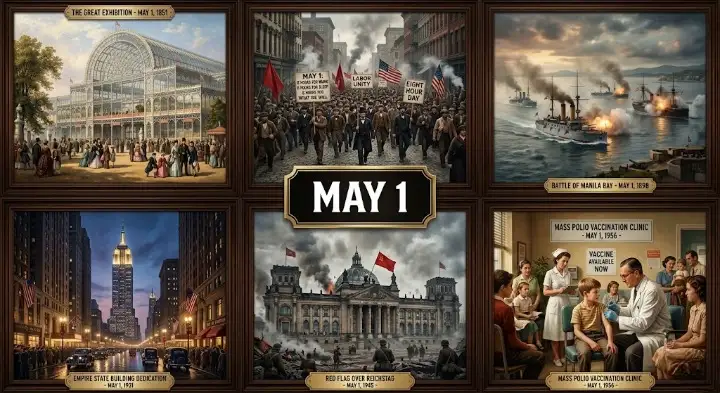
Queen Victoria stepped into the shimmering expanse of the Crystal Palace in London on May 1, 1851, signaling to the world that Britain was the undisputed center of industry and progress. That same morning, workers across the globe marched to demand a fairer slice of the progress they created, a movement that transformed the very structure of our modern workday. History is rarely just one story; it is a tug-of-war between the builders of empires and the people who keep them running. Here is what happened on this day in history May 1.
🌍 Quick Facts — May 1 in History
| 📌 Category | 📖 Event / Detail |
|---|---|
| 🌟 Most Significant Event | The Great Exhibition opens at The Crystal Palace (1851) |
| 🏆 Key Historical Events | • Act of Union (1707) • Slave trade abolished in the British Empire (1807) • Haymarket Affair (1886) • Battle of Manila Bay (1898) • Empire State Building dedication (1931) |
| ⚔️ Key Battles | Battle of Arkinholm (1455), Battle of Chancellorsville (1863), Battle of Port Gibson (1863), Battle of Manila Bay (1898) |
| 👤 Key Figures | Queen Victoria, Christopher Columbus, Henry Morgan, Jonas Salk, Ayrton Senna, Naruhito |
| 🌍 Observances | International Workers’ Day (Labour Day), Maharashtra Day, Lei Day (Hawaii), Constitution Day (Argentina/Latvia) |
Story of the Day: The Crystal Palace Opens
London’s Hyde Park transformed in 1851 when the Crystal Palace—a massive, daring structure of iron and plate glass—threw open its doors. Queen Victoria arrived to preside over the Great Exhibition, a bold display of technological triumph that gathered inventions from every corner of the globe. For the first time, humanity saw the sheer scale of the Industrial Revolution housed under one roof. While it celebrated British manufacturing prowess, the event served as a fleeting moment of global optimism before the shadows of the next century’s conflicts began to gather.
Important Events That Happened On May 1 In History
305 – Roman Emperors Retire
Diocletian and Maximian stepped down from their thrones, voluntarily surrendering the highest office in the Roman Empire. Their departure marked a rare moment of planned power transition in a system usually defined by violent succession. This abdication shifted the power balance of the empire, setting the stage for Constantine to rise shortly after. The move ultimately signaled the end of the Tetrarchy and forced a reorganization of Roman governance.
418 – The Synod of Carthage
Church leaders gathered in Carthage to formally condemn Pelagianism, a theology that challenged the traditional view of original sin and human autonomy. By rejecting these teachings, the council solidified the doctrinal stance of the Western Church regarding grace and human nature. This decision curbed the influence of Pelagius’s followers across the Mediterranean. It anchored theological authority in Rome and North Africa for the coming centuries.
880 – The Nea Ekklesia Inaugurated
Emperor Basil I stood in the heart of Constantinople to witness the opening of the Nea Ekklesia, a masterpiece of Byzantine architecture. This building introduced the cross-in-square design, a structural innovation that became the standard for Orthodox cathedrals across the region. Its construction served as a physical manifesto of the Macedonian dynasty’s power and artistic reach. The design influence is still visible in Eastern Orthodox churches today.
1169 – Norman Invasion of Ireland
Robert FitzStephen and a force of Norman mercenaries waded ashore at Bannow Bay in County Wexford, landing on Irish soil for the first time. They had been invited by a displaced local king to help settle internal power struggles. This arrival fundamentally altered Irish politics, initiating centuries of external control and cultural fusion. The landing remains the starting point of the long, complex history of Norman-Irish relations.
1328 – Treaty of Edinburgh–Northampton
English officials formally signed the document in Edinburgh, acknowledging Robert the Bruce as the rightful King of an independent Scotland. This act effectively ended the First War of Scottish Independence, which had raged for decades. Scotland’s status as a sovereign nation was finally cemented after years of bloodshed and political maneuvering. The treaty forced England to abandon its long-standing territorial ambitions north of the border.
1455 – Battle of Arkinholm
King James II’s forces clashed with the rebellious Black Douglas clan in the Scottish Borders, a conflict for the soul of the monarchy. The royal victory here shattered the power of the Black Douglases, who had long rivaled the crown for control of Scotland. By crushing the rebellion, the King established a more centralized, stable government. This outcome effectively consolidated royal authority in Scotland for the remainder of the century.
1486 – Columbus Petitions the Crown
Christopher Columbus stood before Queen Isabella I of Castile to pitch his vision of a western sea route to the Indies. He argued that crossing the Atlantic would provide a faster, more lucrative path to wealth than existing land routes. The proposal was met with skepticism, yet it planted the seed for his eventual journey in 1492. That audience with the Queen changed the trajectory of global exploration forever.
1492 – Edict of Expulsion
Spanish monarchs issued a royal decree in Castile demanding that all Jewish residents convert to Christianity or leave the country within three months. This decision forced thousands of families to abandon their homes and heritage, fundamentally altering the demographic landscape of the region. It signaled the end of a long period of religious diversity in the Iberian Peninsula. The mass exodus rippled across Europe, as refugees sought safety in new lands.
1669 – Raid on Lake Maracaibo
Captain Henry Morgan led his fleet of privateers against the Spanish Armada de Barlovento, turning the tide of the battle through daring tactical maneuvering. Despite being outnumbered, the English force successfully outplayed the Spanish, capturing ships and significant plunder. This victory elevated Morgan’s status, making him a nightmare for Spanish colonial interests in the Caribbean. It demonstrated that small, agile fleets could dismantle much larger state-backed forces.
1707 – Act of Union
England and Scotland formally merged their parliaments to create the Kingdom of Great Britain, erasing the political boundaries that had separated them for centuries. The union sought to stabilize the island, create a unified economy, and bolster military strength. While unpopular in many corners, it launched a new era of global influence for the combined nation. The legislative framework signed on this day remains the foundation of the modern British state.
1753 – Species Plantarum Published
Carl Linnaeus released Species Plantarum to the world, a massive work that finally brought order to the chaotic naming of the natural world. He introduced binomial nomenclature, giving every plant a unique two-part scientific name that scientists use to this day. This system provided a common language for botany, allowing researchers across the globe to identify species accurately. It remains the bedrock of modern biological taxonomy.
1807 – Slave Trade Act Takes Effect
The British Empire officially banned the Atlantic slave trade, turning a new page in its legal and moral history. This legislation stopped the forced transport of enslaved people across the ocean on British vessels. While the act did not end slavery itself, it marked the beginning of a massive state-led effort to stop the industry. The ban put immense pressure on other colonial powers to follow suit.
1820 – Cato Street Conspirators Executed
Arthur Thistlewood and his fellow radicals were executed for their failed plot to assassinate the British Prime Minister and his cabinet. The conspirators had hoped to ignite a revolution by decapitating the government during a dinner party. Instead, the plan was foiled, and the public execution served as a stark warning against political violence. The event solidified the government’s resolve to suppress radical dissent during a period of deep social unrest.
1840 – The Penny Black Issued
The United Kingdom introduced the Penny Black, the world’s first adhesive postage stamp, revolutionizing how information moved across the country. Before this, the recipient paid for letters, often making communication prohibitively expensive for the working class. The new system made sending a letter affordable for everyone, democratizing correspondence overnight. It spurred a massive increase in literacy and public connectivity.
1844 – Hong Kong Police Force Established
The government created the Hong Kong Police Force to maintain order in the burgeoning colonial port city. It became the first modern police force in Asia and the second in the world, modeling itself after London’s Metropolitan Police. This establishment reflected the need for structured law enforcement in a rapidly growing international trade hub. Its creation marked a shift toward formal civil administration in the region.
1846 – Nauvoo Temple Dedicated
The last remaining members of the Mormon community in Nauvoo, Illinois, held a formal dedication ceremony for their newly completed temple. They were preparing to abandon the city and head west to escape mounting persecution. This act of faith was a defiant conclusion to their time in the region before the long, arduous journey to Utah. The temple stands as a symbol of their early struggles and eventual migration.
1851 – The Great Exhibition Opens
Queen Victoria walked through the doors of the Crystal Palace in Hyde Park, welcoming the world to the first international exposition. Thousands of visitors marveled at industrial machines, textiles, and art from around the globe, all under one massive glass roof. The event projected British technological dominance and signaled the rapid acceleration of the modern age. It set the template for all future world’s fairs.
1863 – Battle of Chancellorsville Begins
Robert E. Lee’s Confederate troops engaged the Union Army in a dense forest in Virginia, initiating one of the most tactical battles of the Civil War. General Lee split his forces, a high-stakes gamble against General Hooker’s larger army. This confrontation demonstrated Lee’s aggressive leadership style and significantly influenced the war’s momentum in the East. It is still studied by military tacticians for its bold execution.
1863 – Battle of Port Gibson
Ulysses S. Grant’s Union forces defeated the Confederates at Port Gibson, Mississippi, during a critical phase of the Vicksburg campaign. By taking the field, Grant secured a vital foothold on the eastern side of the Mississippi River. This victory cleared the path for his eventual siege of Vicksburg, a turning point in the wider war. It proved that Grant could navigate difficult terrain to outmaneuver his opponents.
1865 – Treaty of the Triple Alliance
Brazil, Argentina, and Uruguay entered into a formal military pact to fight against Paraguay. This alliance emerged from long-standing border tensions and disagreements over regional control in the River Plate basin. The treaty unified the military efforts of these three nations, leading to the deadliest interstate war in South American history. It fundamentally reshaped the geopolitical map of the continent for decades to follow.
1866 – Memphis Race Riots
Violence erupted in Memphis as white mobs attacked Black neighborhoods, killing 48 people over the course of three days. The brutality of the riots shocked the nation and highlighted the deep instability of the post-Civil War South. This tragedy galvanized the push for federal intervention and legal protections for freedmen. It was a catalyst for the eventual passage of the Fourteenth Amendment, granting citizenship rights.
1885 – Chicago Board of Trade Building
The new Board of Trade building opened in Chicago, providing a permanent home for the rapidly growing commodities market. Its iconic architecture became a symbol of Chicago’s rise as a central hub for American agricultural and financial trade. Traders flocked to the floor to manage the flow of grain and livestock that fed a growing nation. The building solidified Chicago’s position as a global financial powerhouse.
1886 – The Haymarket Affair
Protesters gathered across the United States to demand an eight-hour workday, fueling a movement that changed labor conditions forever. In Chicago, these rallies escalated into the Haymarket affair, where a confrontation between workers and police turned deadly. This event brought national attention to the plight of laborers and the brutality of industrial suppression. It became the reason why May 1 is celebrated globally as International Workers’ Day.
1894 – Coxey’s Army Arrives
Jacob Coxey led a group of unemployed workers into Washington, D.C., marking the first significant protest march on the nation’s capital. They traveled hundreds of miles to demand that the government create jobs through public works programs during a severe economic depression. Although the authorities arrested the leaders, the march forced the government to acknowledge the plight of the working class. It created a precedent for future political activism in the capital.
1896 – Assassination of Naser al-Din Shah
Mirza Reza Kermani entered the Shah Abdol-Azim Shrine and shot the Iranian monarch, killing him instantly. The assassin was a follower of Jamal al-Din al-Afghani, who sought to curb the Shah’s absolute power and Western influence. This political murder sent shockwaves through Iran, accelerating the public desire for constitutional reform. It was a decisive moment that weakened the monarchy and empowered reformist movements.
1898 – Battle of Manila Bay
Admiral George Dewey led the U.S. Asiatic Squadron into Manila Bay and systematically destroyed the Spanish Pacific fleet. Within seven hours, every Spanish ship was lost, while the U.S. fleet suffered zero combat deaths. This decisive victory effectively ended Spanish influence in the Philippines and marked America’s emergence as a global naval power. It was a lopsided encounter that changed the geopolitical landscape of the Pacific.
1900 – Scofield Mine Disaster
A massive explosion ripped through the Scofield mine in Utah, claiming the lives of over 200 men and boys. It remains one of the deadliest industrial accidents in American history, leaving almost every family in the town grieving. The tragedy exposed the lack of safety regulations in the mining industry and ignited calls for better labor protections. It left a permanent scar on the community that is still remembered today.
1915 – RMS Lusitania Departs
The luxury liner steamed out of New York harbor on what would be its final voyage across the North Atlantic. Passengers aboard were unaware that a German U-boat was patrolling the Irish coast, waiting for a target. The ship’s sinking six days later became a defining moment of the First World War. It served as a powerful rallying cry that helped shift American public opinion toward joining the conflict.
1919 – Munich Suppressed
German government troops marched into Munich to dismantle the short-lived Bavarian Soviet Republic. The intervention ended a chaotic period of revolutionary governance that had emerged in the wake of Germany’s defeat in World War I. This action solidified the authority of the Weimar Republic in Bavaria. It highlighted the deep internal divisions and radical political volatility of post-war Germany.
1921 – Jaffa Riots
Violent clashes broke out in Jaffa between different ethnic groups, triggered by political tensions during the British Mandate in Palestine. The unrest lasted several days and resulted in casualties on both sides, escalating the already fragile situation in the region. These riots served as a grim precursor to the long-standing conflict over land and national identity. It forced the British authorities to reconsider their administrative approach to the area.
1925 – Trade Unions Founded
The All-China Federation of Trade Unions was established, bringing a unified structure to the nation’s labor force for the first time. Over the years, it grew into the largest trade union organization on the planet, representing over 100 million members. Its foundation marked a significant step in the organized movement of Chinese workers within the national economy. The union remains a powerful force in Chinese governance and social life.
1929 – Kopet Dag Earthquake
A powerful 7.2-magnitude earthquake struck the border region between Iran and Turkmenistan, leveling buildings and killing thousands. The devastation was widespread, as communities were caught unprepared for such intense seismic activity. Rescue efforts were hampered by the rugged terrain, making it one of the deadliest regional disasters in modern history. The earthquake forced local authorities to begin rethinking construction standards for the area.
1930 – Pluto Named
Vesto Slipher of the Lowell Observatory officially proposed the name “Pluto” for the newly discovered dwarf planet in the outer solar system. The name, derived from the god of the underworld, captured the public’s imagination and was adopted almost immediately. It provided a permanent identity to the mysterious, distant object that had been found just months prior. The name helped bring the vast, dark reaches of the solar system into focus.
1931 – Empire State Building Dedicated
President Herbert Hoover pressed a button from Washington, D.C., that turned on the lights of the Empire State Building in New York City. The ceremony marked the official completion of the world’s tallest building during the depth of the Great Depression. Its construction provided work for thousands of laborers and offered a symbol of hope for a struggling nation. The Art Deco spire became an instant icon of the Manhattan skyline.
1945 – Hitler’s Death Reported
German radio listeners heard the false announcement that Adolf Hitler had died fighting at his command post. In reality, the dictator had taken his own life in a bunker, but the Nazi leadership tried to frame his death as a heroic final stand. Hours later, Soviet soldiers raised their flag over the Reich Chancellery in Berlin. This event marked the final collapse of the Third Reich’s propaganda machine.
1945 – Demmin Mass Suicide
The arrival of the Soviet Red Army in the town of Demmin triggered a wave of panic, leading up to 2,500 people to take their own lives. Fearing the brutal reputation of the advancing soldiers, residents chose death over what they believed was inevitable destruction. This mass tragedy remains one of the darkest chapters of the final days of World War II. It highlights the absolute terror that gripped many German civilians during the war’s conclusion.
1946 – Pilbara Strike Begins
Indigenous pastoral workers in Western Australia walked off their jobs to protest low pay and inhumane working conditions. The strike, led by figures like Dooley Bin Bin, grew into a three-year struggle for fair treatment and basic human rights. It became a watershed moment for Indigenous activism in Australia. The strike eventually paved the way for broader national movements for land rights and wage equality.
1947 – Portella della Ginestra Massacre
Bandit leader Salvatore Giuliano opened fire on workers celebrating May Day in a rural pass in Sicily. The attack left 11 dead and dozens wounded, as the separatist leader sought to destabilize the Italian government. This massacre became a symbol of the dark intersection of organized crime and political extremism in post-war Italy. It forced the nation to confront the influence of lawless armed groups in its southern regions.
1956 – Polio Vaccine Released
Jonas Salk’s revolutionary polio vaccine finally became available to the general public, offering a shield against a paralyzing disease that terrified parents for decades. Clinics saw lines wrapping around city blocks as families rushed to secure protection for their children. This medical breakthrough was celebrated as one of the great humanitarian achievements of the 20th century. It set the stage for the global eradication of the virus.
1957 – Vickers VC.1 Viking Crash
A Vickers VC.1 Viking aircraft crashed while attempting an emergency return to Blackbushe Airport in the U.K., claiming 34 lives. The tragedy deeply affected the aviation industry, leading to stricter safety protocols and training requirements. It remains a somber event in the history of British commercial aviation. The crash reminded the public of the inherent risks faced in the early era of mass air travel.
1960 – U-2 Spy Plane Incident
Francis Gary Powers was flying his Lockheed U-2 spy plane deep over Soviet territory when a missile strike brought him crashing down. The incident shattered the diplomatic thaw between the U.S. and the Soviet Union, triggering an international crisis that dominated the news for weeks. Powers’ capture proved to the world that the U.S. was conducting covert surveillance on its superpower rival. It increased Cold War tensions to a dangerous new level.
1961 – Cuba Declares Socialism
Fidel Castro announced that Cuba would become a socialist state, effectively ending the island’s democratic election process. This move signaled a definitive pivot toward the Soviet bloc and away from Western influence. It solidified Castro’s hold on power and led to a radical transformation of the Cuban economy and social structure. The declaration set the stage for decades of geopolitical confrontation in the Caribbean.
1970 – Cambodian Campaign Protests
Following the announcement that U.S. and South Vietnamese forces were expanding their operations into Cambodia, protests erupted on campuses across America. Students took to the streets to express their anger at the perceived widening of an already controversial war. The protests highlighted the deep generational and political divide within the United States. This civil unrest forced the government to grapple with the limits of its war policy.
1971 – Amtrak Takes Control
The National Railroad Passenger Corporation, known as Amtrak, officially took over the operation of the struggling U.S. passenger rail network. This federal consolidation was designed to save a system on the brink of collapse due to the rising popularity of air travel and personal automobiles. It aimed to preserve a national transport link that private companies could no longer afford to run. Amtrak remains the backbone of American intercity rail today.
1975 – Särkänniemi Amusement Park Opens
The Särkänniemi park opened its gates in Tampere, Finland, offering locals a new destination for leisure and family entertainment. Built on a scenic peninsula, it quickly became a staple of Finnish culture, featuring rides, an aquarium, and later, a planetarium. The opening was part of a broader trend of developing public recreation spaces across Scandinavia. It continues to draw visitors who enjoy the unique blend of nature and fun.
1978 – North Pole Expedition
Naomi Uemura of Japan completed his incredible journey, becoming the first person to reach the North Pole alone by dog sled. He navigated the frozen Arctic landscape with minimal supplies, battling sub-zero temperatures and shifting ice. This feat of human endurance captured global attention and redefined the limits of polar exploration. Uemura’s success cemented his legacy as one of the most resilient adventurers in history.
1982 – Operation Black Buck
The British Royal Air Force launched a daring long-range mission against Argentine forces stationed in the Falkland Islands. Using mid-air refueling, the RAF attacked the airfield at Port Stanley to limit Argentina’s ability to operate aircraft. This mission showcased the technical capability of the British military during the Falklands War. It demonstrated the lengths to which both sides were willing to go to secure the remote territory.
1991 – Bicesse Accords
The MPLA and UNITA factions in Angola reached an agreement aimed at ending their long and brutal civil war. The Bicesse Accords promised a pathway to multi-party democracy and the demobilization of opposing armies. While the agreement faced significant hurdles, it provided a framework for a brief window of peace. It remains a critical example of international mediation in post-colonial conflicts.
1993 – Assassination of Ranasinghe Premadasa
A suicide bomber affiliated with the Liberation Tigers of Tamil Eelam detonated a device in Colombo, killing the Sri Lankan President. The attack was the latest in a series of targeted assassinations that had destabilized the nation during its ongoing civil war. The President’s death created a massive vacuum in the government and heightened the sense of national crisis. It proved that no public official was safe from the reach of the militant group.
1994 – Death of Ayrton Senna
The Formula One racing world stood in shock after Ayrton Senna, a three-time champion, crashed at the San Marino Grand Prix. He was a hero to millions, known for his intense competitiveness and incredible talent behind the wheel. His death led to an immediate and complete overhaul of safety regulations in professional motorsports. The loss of such a gifted driver remains a pivotal moment in the history of racing.
1997 – Tony Blair Elected
The British Labour Party won a landslide victory in the general election, bringing Tony Blair to the office of Prime Minister. His win ended 18 years of Conservative Party rule and signaled a shift toward a new, modern approach to governance. Blair’s victory was celebrated by many as the start of a “Cool Britannia” era of cultural and political renewal. It reshaped the British political landscape for the next decade.
1999 – George Mallory Found
Searchers on Mount Everest discovered the body of British climber George Mallory, who had vanished 75 years earlier. His disappearance in 1924 had long been one of mountaineering’s greatest mysteries. Finding him helped historians and climbers piece together what might have happened during his final ascent. The discovery provided a somber but fascinating closure to a legendary chapter in the history of human exploration.
2003 – Mission Accomplished Speech
President George W. Bush landed a fighter jet on the USS Abraham Lincoln and declared that major combat operations in Iraq had ended. This speech, given under a banner reading “Mission Accomplished,” was intended to mark the end of the initial invasion. However, the conflict continued for years, making the moment highly controversial in retrospect. It remains a key case study in how political messaging can collide with the reality of war.
2004 – EU Expansion
Ten new nations, including the Czech Republic, Poland, and Hungary, officially joined the European Union in a historic ceremony. This enlargement brought the former Eastern Bloc countries into the political and economic fold of Western Europe. It was the largest single expansion in the EU’s history, aiming to heal the divisions of the Cold War. The celebration reflected a new vision of a unified, peaceful European continent.
2009 – Sweden Legalizes Same-Sex Marriage
The Swedish parliament enacted legislation that allowed same-sex couples to marry, making it one of the most progressive nations on the issue. This change built upon years of public debate and existing civil partnership laws. By ensuring equal rights, Sweden became a global leader in legalizing marriage equality. The move reflected the country’s broader commitment to human rights and individual freedom.
2010 – Times Square Bomb Plot
A man named Faisal Shahzad drove an SUV laden with a crude car bomb into Times Square, intending to trigger a massive explosion. The device failed to ignite properly, and alert bystanders alerted the police, averting a potential catastrophe in the heart of New York City. The attempted attack triggered a massive investigation that eventually led to his arrest. It served as a stark reminder of the persistent threats faced by major cities.
2011 – Beatification of John Paul II
Pope Benedict XVI presided over the beatification of his predecessor, Pope John Paul II, in a massive ceremony in Vatican City. Hundreds of thousands of pilgrims gathered to honor the long-serving pontiff who had steered the Catholic Church through the late 20th century. The event was a significant step in the process toward his eventual sainthood. It highlighted the lasting influence of John Paul II on the global religious community.
2018 – Deir ez-Zor Campaign Resumes
The Syrian Democratic Forces launched a renewed effort to clear remaining ISIL fighters from the border region between Iraq and Syria. This campaign was part of a larger, international effort to dismantle the territorial power of the militant group. Intense ground battles took place as forces pushed to reclaim the final enclaves held by the organization. The military push was essential for restoring security to the volatile border area.
2019 – Naxalite Attack in Gadchiroli
Militants ambushed an anti-Naxal operations team in the Gadchiroli district of India, killing 16 soldiers in an IED blast. The attack was a calculated strike against the state’s efforts to suppress the long-running insurgency in the region. This incident underscored the ongoing security challenges posed by the militant group. It prompted renewed calls for better protection and tactical reforms for security forces in the area.
2019 – Naruhito Ascends the Throne
Emperor Naruhito formally ascended to the throne of Japan, succeeding his father, Akihito, who had abdicated his position. This historic moment marked the beginning of the Reiwa period, a new era for the world’s oldest hereditary monarchy. The transition was a rare and carefully orchestrated event in Japanese tradition. It symbolized both a continuity of the past and a new beginning for the country.
2024 – Loblaw Boycott
Thousands of Canadians began a coordinated boycott of the retail giant Loblaw Companies to protest rising grocery prices. The movement quickly gained momentum across social media, drawing attention to the cost-of-living crisis affecting millions of households. It became a powerful example of consumer activism aimed at influencing corporate pricing policies. The boycott highlighted the public’s growing frustration with food inflation.
2026 – Canvas Ransomware Attack
The education platform Canvas, which serves thousands of institutions, went dark following a major ransomware attack by the group ShinyHunters. Teachers and students across the country suddenly lost access to their coursework and grades as the company struggled to regain control of its systems. The incident paralyzed remote and hybrid learning environments, leaving schools scrambling for solutions. It demonstrated the vulnerability of critical educational infrastructure to modern cyber-attacks.
Famous People Born On May 1
| Name | Description | Date |
|---|---|---|
| Rudolf I | First German king of the Habsburg dynasty | May 1, 1218 – July 15, 1291 |
| Marco da Gagliano | Italian composer, early opera pioneer | May 1, 1582 – February 25, 1643 |
| Adam Schall von Bell | German Jesuit missionary and astronomer in China | May 1, 1591 – August 15, 1666 |
| Jean Jouvenet | French Baroque religious painter | May 1, 1649 – April 5, 1717 |
| Michiel Janszoon van Mierevelt | Dutch portrait painter | May 1, 1567 – June 27, 1641 |
| Gustav Philip, Count Creutz | Swedish Rococo poet | May 1, 1731 – October 30, 1785 |
| Benjamin Latrobe | British-born American architect, Greek Revival in U.S. | May 1, 1764 – September 3, 1820 |
| Hugues-Bernard Maret, duke de Bassano | French diplomat and statesman of Napoleonic era | May 1, 1763 – May 13, 1839 |
| John McKinley | Associate justice of U.S. Supreme Court (1837–52) | May 1, 1780 – July 19, 1852 |
| James Clarence Mangan | Irish poet | May 1, 1803 – June 20, 1849 |
| Johann Jakob Balmer | Swiss mathematician, Balmer series of hydrogen | May 1, 1825 – March 12, 1898 |
| George Inness | American landscape painter | May 1, 1825 – August 3, 1894 |
| José de Alencar | Brazilian novelist, O Guarani | May 1, 1829 – December 12, 1877 |
| Guido Gezelle | Flemish priest and lyric poet | May 1, 1830 – November 27, 1899 |
| Hilaire Bernigaud, count de Chardonnet | French chemist, developed rayon | May 1, 1839 – March 12, 1924 |
| James Ford Rhodes | American historian of Civil War and Reconstruction | May 1, 1848 – January 22, 1927 |
| Arthur William Patrick Albert, duke of Connaught | Third son of Queen Victoria, military officer | May 1, 1850 – January 16, 1942 |
| Santiago Ramón y Cajal | Spanish histologist, Nobel Prize for neuron theory | May 1, 1852 – October 17, 1934 |
| Cecilia Beaux | American portrait painter | May 1, 1855 – September 17, 1942 |
| Marcel Prévost | French novelist | May 1, 1862 – April 8, 1941 |
| Hamaguchi Osachi | Prime minister of Japan (1929–30) | May 1, 1870 – August 26, 1931 |
| Romaine Goddard Brooks | American painter of gray-shaded portraits | May 1, 1874 – December 7, 1970 |
| Albert Lasker | American advertising executive and philanthropist | May 1, 1880 – May 30, 1952 |
| Sir Alan Gordon Cunningham | British army officer, WWII victories in East Africa | May 1, 1887 – January 30, 1983 |
| Vincenzo Cardarelli | Italian poet and essayist | May 1, 1887 – June 15, 1959 |
| Ignazio Silone | Italian anti-Fascist novelist | May 1, 1900 – August 22, 1978 |
| Nikolay Aleksandrovich Tikhonov | Premier of Soviet Union (1980–85) | May 1, 1905 – June 1, 1997 |
| Volmari Iso-Hollo | Finnish runner, two Olympic golds in steeplechase | May 1, 1907 – June 23, 1969 |
| Kate Smith | American singer, “first lady of radio” | May 1, 1909 – June 17, 1986 |
| Yannis Ritsos | Greek poet | May 1, 1909 – November 11, 1990 |
Famous People Died On May 1
| Name | Description | Date |
|---|---|---|
| Dermot Macmurrough | King of Leinster, invited Anglo-Normans to Ireland | Unknown – May 1, 1171 |
| Isabella II | Queen of the Latin kingdom of Jerusalem (1212–28) | 1212 – May 1, 1228 |
| Walter de Gray | English churchman, chancellor under King John | Unknown – May 1, 1255 |
| Albert I | King of Germany, duke of Austria (1298–1308) | c.1255 – May 1, 1308 |
| Moses ben Israel Isserles | Polish-Jewish rabbi and codifier | c.1525 – May 1, 1572 |
| Marcellus II | Pope for 22 days in April–May 1555 | May 6, 1501 – May 1, 1555 |
| Charles Howard, 3rd earl of Carlisle | British chief minister (1701–02, 1715) | 1674 – May 1, 1738 |
| Jacques Delille | French poet, “French Virgil” | June 22, 1738 – May 1, 1813 |
| William Hewson | English physiologist, discovered fibrinogen | November 14, 1739 – May 1, 1774 |
| Arthur Thistlewood | British revolutionary, Cato Street Conspiracy | 1774 – May 1, 1820 |
| Jean-Baptiste Bessières, duke d’Istrie | French marshal, commander of imperial guard | August 6, 1768 – May 1, 1813 |
| Jean Coralli | French dancer and choreographer, co-creator of Giselle | January 15, 1779 – May 1, 1854 |
| Adolphe Chéruel | French historian of Louis XIV | January 17, 1809 – May 1, 1891 |
| Buṭrus al-Bustānī | Lebanese scholar, Arabic dictionary and encyclopaedia | 1819 – May 1, 1883 |
| Octave Pirmez | Belgian man of letters | April 19, 1832 – May 1, 1883 |
| William Knox D’Arcy | English businessman, founder of Iranian oil industry | October 11, 1849 – May 1, 1917 |
| José Enrique Rodó | Uruguayan philosopher, “Spanish America’s greatest philosopher” | July 15, 1872 – May 1, 1917 |
| Grove Karl Gilbert | U.S. geologist, founder of modern geomorphology | May 6, 1843 – May 1, 1918 |
| Weetman Dickinson Pearson, 1st Viscount Cowdray | British engineer, developed Mexican petroleum | July 15, 1856 – May 1, 1927 |
| Sir Ebenezer Howard | English urban planner, garden-city movement | January 29, 1850 – May 1, 1928 |
| Mary Elizabeth Wood | American librarian and missionary in China | August 22, 1861 – May 1, 1931 |
| Frederic Stanley Kipping | British chemist, pioneer of silicone chemistry | August 16, 1863 – May 1, 1949 |
| Nāṣer al-Dīn Shāh | Qājār shah of Iran (1848–96) | July 17, 1831 – May 1, 1896 |
| Leland Ossian Howard | American entomologist, biological control pioneer | June 11, 1857 – May 1, 1950 |
| Arthur Deakin | British trade union leader | November 11, 1890 – May 1, 1955 |
| Israel Beer | Israeli military analyst, convicted Soviet agent | 1912 – May 1, 1966 |
| Sir Harold Nicolson | British diplomat and author | November 21, 1886 – May 1, 1968 |
| Asger Jorn | Danish painter, CoBrA movement | March 3, 1914 – May 1, 1973 |
| Sylvia Townsend Warner | English novelist and poet | December 6, 1893 – May 1, 1978 |
| Ayrton Senna | Brazilian Formula One racing driver | March 21, 1960 – May 1, 1994 |
Observances on May 1
- International Workers’ Day (Labour Day): A global celebration of the labor movement and the achievements of workers everywhere.
- Maharashtra Day: Commemorating the formation of the state of Maharashtra in India.
- Lei Day (Hawaii): A vibrant celebration of Hawaiian culture and the tradition of making leis.
- Constitution Day: Observed in Argentina, Latvia, and the Marshall Islands to celebrate national legal foundations.
- International Sunflower Guerrilla Gardening Day: A day when people plant sunflowers in neglected public spaces to beautify their communities.
- Loyalty Day/Law Day (United States): Observances designated to reaffirm loyalty to the U.S. and recognize the role of law in society.
🌍 Frequently Asked Questions — May 1 in History
The Great Exhibition, the first international world’s fair, opened at the Crystal Palace in London. Queen Victoria attended the opening, showcasing industrial innovations from around the globe to the public.
The opening of the Great Exhibition in 1851 is widely considered the most significant for its cultural and industrial impact. It defined the Victorian era’s focus on technological progress and global trade.
Several notable figures share this birthday, including actress Audrey Hepburn (1929) and composer Scott Joplin (1868).
The Battle of Manila Bay in 1898 stands out, where the U.S. Navy destroyed the Spanish fleet, ending Spanish rule in the Philippines and marking America’s rise as a global naval power.
It commemorates the struggle for the eight-hour workday, specifically referencing the 1886 Haymarket Affair in Chicago. It serves as a day to honor the contributions and rights of workers globally.
In 2026, the educational platform Canvas was forced offline by a major ransomware attack, disrupting classes for thousands of institutions worldwide.