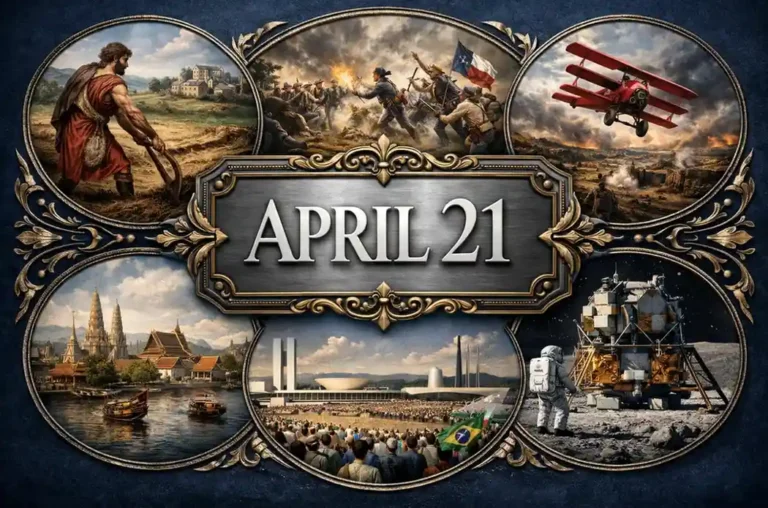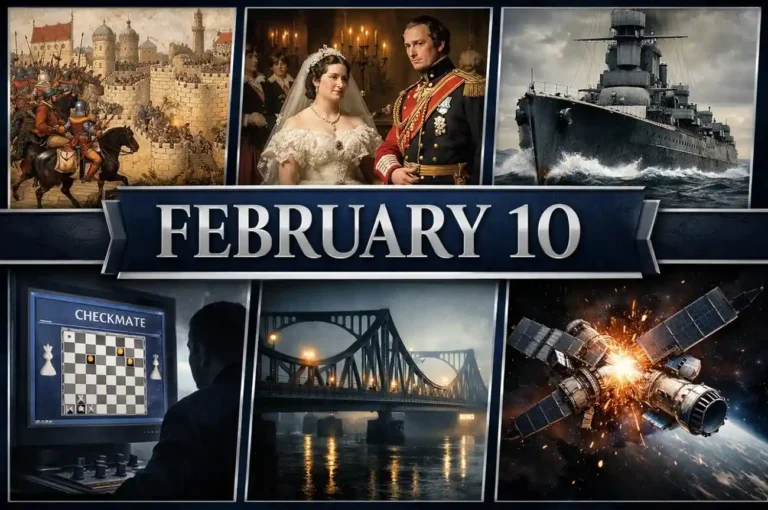
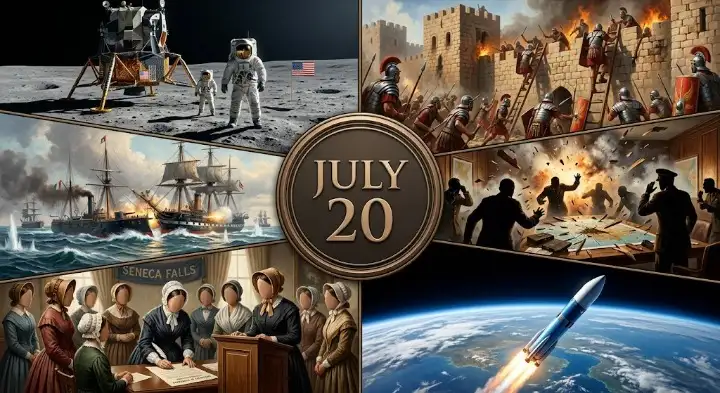
Jerusalem, July 20, 1951. King Abdullah I of Jordan walks into the Al-Aqsa Mosque for Friday prayers with his young grandson beside him. A gunman steps out of the crowd and shoots him dead before prayers even begin. It’s one of dozens of moments packed onto a single square on the calendar — assassinations, sieges, treaties, and one giant leap for mankind. This day in history July 20 holds an unusual number of turning points, running from ancient Jerusalem all the way to the surface of the Moon.
| Event Category | Key Historical Details |
|---|---|
| Most Significant Event | Apollo 11 Lunar Module lands on the Moon (1969) |
| Top 10 Key Events | Siege of Jerusalem breaks through (70) • Treaty of San Germano signed (1230) • Women’s Rights Convention closes (1848) • Ford ships first car (1903) • Finland grants equal voting rights (1906) • Stauffenberg attempts to bomb Hitler (1944) • King Abdullah I assassinated (1951) • Viking 1 lands on Mars (1976) • Provisional IRA bombs London parks (1982) • Jeff Bezos flies to space (2021) |
| Key Battles That Day | Siege of Jerusalem, Battle of Marcellae, Siege of Chartres, Battle of Peachtree Creek, Battle of Lissa, Battle of Ras al-Ayn ends |
| Key Figures Today | Titus, Toyotomi Hideyoshi, Nicéphore Niépce, General John Bell Hood, Neil Armstrong, Buzz Aldrin, Claus von Stauffenberg, King Abdullah I |
| Observances | Independence Day (Colombia) Día del Amigo (Argentina, Brazil) International Chess Day Engineer’s Day (Costa Rica) Lempira Day (Honduras) |
Story of the Day: The Day the Eagle Landed on the Moon
The master alarm beeped inside the cramped cabin of the Lunar Module as the onboard computer overloaded with radar data. Flight Controller Gene Kranz sat gripped by tension in Houston, knowing they were operating on pure grit and manual piloting. Armstrong took control of the descending craft, steering over a treacherous crater field while the countdown to empty fuel ticked away mercilessly.
When the metal probes beneath the landing pads finally brushed the lunar dust, the engine cut out, leaving a profound stillness. “The Eagle has landed,” Armstrong crackled across space, shattering the silence of two worlds. Six hours later, his boot compressed the soft dust, completing the long journey from ancient stargazing to practical interplanetary travel.
Important Events That Happened On July 20 In History
70 – Siege of Jerusalem
Titus watched from his command post as Roman legionaries smashed through the heavy stone walls of the Fortress of Antonia just north of the Temple Mount. Jewish fighters belonging to the Zealot factions rushed into the gap, turning the narrow streets into an immediate, bloody bottleneck. Swords clashed in blinding dust clouds as the defenders fought with suicidal bravery to protect their sacred sanctuary. The successful breach broke the city’s outer shell, setting up the total destruction of Jerusalem and the scattering of its people across the empire.
514 – Consecration of Pope Hormisdas
Roman clergy gathered inside the basilica to place the papal vestments onto Hormisdas just one day after the passing of Pope Symmachus. The new pontiff inherited a fractured Church split by bitter theological rivalries and political meddling from rival kings. Hormisdas turned away from hostility, spending years drafting diplomatic compromises to heal the deep rifts between western and eastern Christians. His sudden elevation stabilized the Roman see and created a legacy of successful reconciliation that reunited the fractured European churches.
792 – Battle of Marcellae
Kardam of Bulgaria led his hidden cavalry out from the dense woods near the Marcellae fortress, catching the advancing Byzantine forces completely off guard. Emperor Constantine VI had confidently marched his troops out of their fortified camp, thinking the Bulgarian army was retreating in fear. The sudden impact of the Bulgarian charge shattered the imperial lines, forcing the panicked emperor to flee back toward Constantinople for safety. This decisive ambush forced the mighty Byzantine Empire to pay annual taxes to the Bulgarians to keep a fragile peace.
911 – Siege of Chartres
Rollo stood before the fortified walls of Chartres, directing his Viking warriors to surround the ancient French city. The defenders inside braced themselves as Norse longships clogged the nearby rivers and cut off all supply lines to the outside world. The relentless pressure forced King Charles the Simple to realize that he could not defeat these fierce northern raiders using weapons alone. This tense standoff led directly to the historic Treaty of Saint-Clair-sur-Epte, which gave the Vikings land in exchange for protection, birthing the region known as Normandy.
1189 – Richard I Invested as Duke of Normandy
Richard Cœur de Lion walked down the long stone nave of Rouen Cathedral to receive the sacred sword and banner of the Duchy of Normandy. The local barons watched closely, knowing this ceremony cemented his transition from a rebellious prince to the rightful ruler of vast lands. Archbishop Walter de Coutances placed the ducal coronet upon Richard’s head, binding the powerful territory to the English crown. This grand coronation set the stage for Richard to launch the Third Crusade, securing his place as one of the most famous crusader kings.
1230 – Treaty of San Germano
Guala, a diplomatic Dominican friar, sat between Holy Roman Emperor Frederick II and the representatives of Pope Gregory IX to finalize a peace deal. The emperor had been excommunicated, sparking bitter proxy wars across the towns and castles of southern Italy. Guala used careful wording to restore the emperor to the Church while returning disputed lands back to papal administration. The signing of this parchment temporarily halted decades of open war between the papacy and the empire, changing the politics of medieval Europe.
1398 – Battle of Kellistown
Roger Mortimer led his heavily armored English knights into the marshy terrain of Kellistown, intent on crushing the native Irish clans. Art Óg mac Murchadha Caomhánach, the dominant chieftain of Leinster, waited in the brush with his mobile O’Byrne and O’Toole infantry. The light Irish troops moved through the bogs, swarming the trapped English soldiers and cutting down Mortimer in the chaotic melee. The shocking death of the king’s heir forced Richard II to launch a massive invasion of Ireland, which ultimately cost him his own English throne.
1592 – Capture of Pyongyang
Toyotomi Hideyoshi’s samurai forces charged through the broken gates of Pyongyang, forcing the desperate Korean defenders to flee northward. The Japanese invasion had sliced through the peninsula using advanced firearms, aiming to use Korea as a stepping stone to conquer Ming Dynasty China. The victorious soldiers raised their banners over the city walls, unaware that their long supply lines were exposed to local resistance. Korean guerrilla attacks and incoming Chinese armies soon forced the Japanese to abandon the city, stopping their grand invasion plan.
1705 – Great Fire of Oulu
Flames roared through the wooden homes of Oulu’s fourth district, feeding on the dry timber structures during the hot summer night. Terrified citizens formed bucket brigades, but the fierce winds pushed the fire rapidly across the crowded southern streets. By dawn, the largest and wealthiest section of the northern Finnish town lay in smoking ash, leaving hundreds of families completely homeless. The massive disaster forced local leaders to redesign the entire town with wider streets to prevent fires from ruining the community again.
715 – Siege of Nauplia
Ottoman soldiers stormed the outer bastions of Nauplia, overwhelming the Venetian garrison defending the capital of the Kingdom of the Morea. Grand Vizier Silahdar Damat Ali Pasha directed the massive artillery bombardment that cracked the heavy stone defenses. The quick collapse of this strategic coastal stronghold shattered Venice’s control over the Peloponnese peninsula in southern Greece. The Ottoman victory ended Venetian colonial ambitions in the region, bringing Greece back under stable Ottoman administration for over a century.
1738 – La Vérendrye Reaches Lake Michigan
Pierre Gaultier de Varennes et de La Vérendrye stepped out of his birchbark canoe onto the western shore of Lake Michigan. The Canadian fur trader scanned the endless water, searching for a navigable river route that might lead toward the Pacific Ocean. He noted the locations of native villages and established vital trade agreements with the local tribes he encountered along the coast. His journey mapped out vast areas of the American wilderness, opening up the fur trade for generations of future voyageurs.
1799 – Reign of Tekle Giyorgis I
Tekle Giyorgis I accepted the imperial crown of Ethiopia, starting the first of what would eventually become six separate, chaotic reigns. Local warlords held the true power in the provinces, reducing the central monarchy to a mere political puppet. The emperor struggled constantly against these noble factions, frequently losing his throne only to win it back through clever military schemes. His unstable rule epitomized the Era of the Princes, a bloody time when internal civil wars tore the ancient African nation apart.
1807 – Invention of the Pyréolophore
Nicéphore Niépce stood beside the river Saône, watching his experimental boat chug steadily upstream against the strong current. Napoleon Bonaparte had just granted him a formal patent for the Pyréolophore, a machine that burned controlled puffs of lycopodium powder inside a chamber. The device successfully pushed the boat forward, making it the very first working internal combustion engine in human history. Though the engine proved too expensive for commercial use, the technology laid the groundwork for the modern motors that power today’s transportation.
1810 – Colombia Declares Independence
Citizens of Bogotá rushed into the public square, shouting defiance against the Spanish viceroy after a planned argument over a flower vase boiled over. Local leaders quickly formed a revolutionary junta, taking advantage of Napoleon’s invasion of Spain to claim self-governance. The crowd cheered as the formal declaration was signed, marking the end of three centuries of direct imperial rule. This bold uprising sparked a long war for freedom across South America, turning Colombia into a cradle of continental liberty.
1831 – Seneca and Shawnee Land Cession
Seneca and Shawnee chiefs dipped their pens in ink to sign away their ancestral lands in western Ohio to federal agents. The United States government offered sixty thousand acres of unfamiliar territory west of the Mississippi River as compensation for the loss. Families packed up their belongings, preparing for a long journey away from the graves of their ancestors. This treaty marked another step in the forced removal of native peoples from the American Midwest, reshaping the demographics of Ohio.
1848 – Seneca Falls Convention Concludes
Elizabeth Cady Stanton stood before the crowd in New York, calling for a final vote on the Declaration of Sentiments. The two-day gathering ended with one hundred men and women signing the document, which boldly demanded equal legal rights and voting power for American women. Many critics ridiculed the meeting as scandalous, while early newspapers predicted it would destroy traditional family structures. The historic convention started the organized women’s suffrage movement, launching a seventy-two-year fight that changed the constitution.
1864 – Battle of Peachtree Creek
General John Bell Hood hurled his Confederate soldiers against the Union lines just north of Atlanta, Georgia. General William T. Sherman’s troops quickly dug in along the creek banks, using superior numbers to push back the desperate southern assault. The fields quickly filled with casualties as Hood’s uncoordinated attacks broke against the firm federal defense. The costly Confederate defeat forced Hood to retreat behind Atlanta’s inner fortifications, hastening the eventual fall of the vital southern rail hub.
1866 – Battle of Lissa
Admiral Wilhelm von Tegetthoff stood on the wooden deck of his ironclad flagship, ordering the Austrian fleet to ram the modern Italian vessels near Vis Island. The Italian navy possessed superior numbers and newer steel ships, but their command structure was crippled by hesitation. The Austrian flagship smashed directly into the side of the Italian ironclad Re d’Italia, sending the large vessel straight to the bottom of the Adriatic Sea. This dramatic encounter altered naval tactics for decades, proving that aggressive leadership could defeat superior technology.
1871 – British Columbia Joins Canada
Local politicians in Victoria celebrated as British Columbia officially became the sixth province to join the Canadian Confederation. The isolated Pacific colony faced deep debts and political isolation, making union with the eastern provinces a financial necessity. Prime Minister John A. Macdonald secured the deal by promising to build a transcontinental railway linking the Pacific coast to the Atlantic within ten years. The arrival of the railroad transformed the Canadian wilderness, turning the nation into a transcontinental power.
1885 – Professional Football Legalized
The British Football Association succumbed to immense pressure from northern clubs, voting to officially legalize professionalism in association football. Wealthy factory owners had secretly been paying top players for years, defying the strict amateur rules set by elite southern universities. The rule change allowed working-class athletes to earn a living playing sports, sparking a rapid rise in competitive quality. This single decision transformed football from an elite pastime into a global industry, creating the modern sports world.
1903 – First Ford Car Ships
Workers at the small Mack Avenue plant in Detroit wheeled the very first Model A out the door, addressing it to a doctor in Chicago. Henry Ford had nearly exhausted his company’s cash reserves, leaving less than three hundred dollars in the bank before this sale went through. The successful delivery brought in immediate revenue, proving there was a market for reliable, middle-class automobiles. This initial shipment launched the Ford Motor Company, which soon revolutionized factory assembly lines and changed global travel.
1906 – Equal Suffrage in Finland
Czar Nicholas II signed a new electoral law for Finland, granting all adult citizens equal rights to vote and run for public office. The bold legislation made Finnish women the first in Europe to secure full voting power, dismantling centuries of elite male political control. The change followed a massive general strike that had paralyzed the region and forced the Russian empire to make democratic concessions. The new law established a global standard for modern democracy, inspiring civil rights movements across Europe.
1917 – The Corfu Declaration
Yugoslav Committee leaders sat down with Serbian politicians on the Mediterranean island of Corfu to sign a joint political declaration. The delegates agreed to unite their peoples after the collapse of the Austro-Prussian empires, creating a single kingdom for Serbs, Croats, and Slovenes. The document laid out a democratic framework for a unified state, despite deep-seated ethnic and religious differences among the groups. The signing led directly to the birth of Yugoslavia, reshaping Balkan history for the rest of the twentieth century.
1920 – Greek Army Occupies Silivri
Greek infantry marched into the strategic coastal city of Silivri, taking administrative control under the terms of the Paris Peace Conference. The local Turkish population watched the flag exchange with quiet anger, as the Ottoman Empire crumbled under post-war treaties. The expansion aimed to fulfill Greece’s dream of uniting historic Greek populations across the Aegean Sea under one government. The occupation lasted only three years before Mustafa Kemal’s nationalist forces reclaimed the region, forcing a massive population exchange.
1922 – League of Nations Mandates
Diplomats in Geneva officially divided the former German colony of Togoland between France and Great Britain under a new League of Nations mandate. The international body also granted Great Britain administrative control over the vast territory of Tanganyika in East Africa. The system promised to prepare these African regions for future independence, but often functioned as traditional colonial rule. The redrawn borders divided native communities, leaving a complicated geopolitical legacy that affects West and East Africa today.
1932 – The Preußenschlag
German Chancellor Franz von Papen used an emergency decree signed by President Hindenburg to dissolve the elected government of Prussia. Paramilitary police marched into the state ministries in Berlin, removing the ruling Social Democratic officials from their offices without any resistance. Von Papen appointed himself Reich Commissioner, crushing the largest democratic stronghold within the unstable Weimar Republic. This authoritarian takeover cleared the path for the Nazi party to seize total control over Germany’s state police apparatus.
1934 – Minneapolis Teamsters Strike
Police officers opened fire on striking truck drivers in downtown Minneapolis, killing two workers and injuring sixty-seven others during a tense standoff. The picketers had blocked a local alleyway to prevent non-union trucks from moving commercial goods through the city. The violence provoked widespread outrage, forcing the governor to declare martial law and bring in the National Guard to maintain order. The strike ended with employers recognizing the union, turning the Teamsters into a major force in American labor.
1934 – West Coast Waterfront Strike
Police forces in Seattle fired tear gas canisters into a crowd of two thousand striking longshoremen who had shut down the city’s commercial docks. Down the coast, the governor of Oregon ordered National Guard troops onto the Portland piers to protect strikebreakers moving freight. The maritime workers demanded safer conditions and union control over the hiring halls, paralyzing shipping along the entire Pacific coast. The federal government stepped in to arbitrate, giving the union a victory that stabilized West Coast shipping.
1935 – Royal Dutch Airlines Crash
A Royal Dutch Airlines Douglas DC-2 climbed into the stormy skies over Milan, bound for Frankfurt with thirteen people on board. The pilots encountered blinding rain and thick fog as they approached the Swiss Alps, losing their bearings in the turbulent air. The aircraft slammed into the side of a steep mountain peak, instantly killing everyone on board the plane. The tragic accident prompted European aviation authorites to improve alpine weather reporting and flight communication systems.
1936 – Montreux Convention Signed
Diplomats gathered in Switzerland to sign the Montreux Convention, giving Turkey full military control over the strategic Dardanelles and Bosphorus straits. The agreement allowed Ankara to fortify the vital waterways while guaranteeing free passage for civilian merchant ships during peacetime. Soviet delegates secured special limits on non-Black Sea naval vessels, protecting their southern ports from sudden naval threats. The treaty remains an active piece of international law, regulating naval access to the Black Sea today.
1938 – Hollywood Antitrust Lawsuit
Federal attorneys filed a major lawsuit in New York against the top Hollywood movie studios, charging them with violating the Sherman Antitrust Act. The government argued that the studio system unfairly controlled everything from production to distribution by owning the local theaters. The legal battle dragged through the courts for a decade, disrupting the classic Hollywood studio monopoly. The final Supreme Court ruling forced studios to sell their theaters, opening the entertainment industry to independent filmmakers.
1940 – Denmark Leaves the League of Nations
Danish government officials formally announced their country’s withdrawal from the League of Nations following months of intense pressure from Berlin. Nazi forces had occupied the small Scandinavian nation in April, leaving the local government with little real diplomatic independence. The resignation signaled the total collapse of the League’s collective security system in northern Europe during the war. Denmark remained under German occupation until Allied forces liberated the country in May of 1945.
1940 – Arroyo Seco Parkway Opens
California officials cut the ribbon to open the Arroyo Seco Parkway, connecting the downtown skyscrapers of Los Angeles to Pasadena. The six-mile stretch of smooth asphalt featured banked curves and dedicated exit ramps, separating local traffic from fast-moving automobiles. Engineers designed the road to carry twenty-seven thousand cars a day, using modern concrete barriers to prevent dangerous head-on collisions. The road became the first true freeway in the American West, transforming the urban landscape of Southern California.
1941 – Stalin Consolidates the NKVD
Joseph Stalin signed an emergency decree merging the Commissariats of Home Affairs and National Security into a single agency called the NKVD. The Soviet dictator selected Lavrentiy Beria to lead the expanded internal security apparatus, giving him total control over the secret police and the Gulag labor camps. The consolidation aimed to eliminate potential spies and domestic dissent as German armies pushed deep into Soviet territory. Beria used his immense power to run internal purges, cementing Stalin’s control over the state.
1944 – July 20 Plot Against Hitler
Colonel Claus von Stauffenberg walked into a briefing room at the Wolf’s Lair, placed a briefcase bomb beneath Adolf Hitler’s conference table, and quietly left. The heavy oak table leg deflected the force of the blast, allowing the dictator to survive the explosion with only minor injuries. Stauffenberg rushed to Berlin to launch a military coup, but hesitant conspirators delayed taking control of the radio stations. By midnight, the regime arrested the leaders, executing them in a courtyard and crushing the internal German resistance.
1949 – Israel–Syria Armistice Agreement
United Nations mediators watched as Israeli and Syrian officers signed a formal ceasefire agreement on the border, ending the 1948 Arab–Israeli War. The treaty established a series of demilitarized zones along the Jordan River to prevent immediate military border clashes. This pact marked the last of four armistice agreements Israel secured with its neighboring Arab nations. While the signing brought a temporary end to the open fighting, it left the core political disputes unresolved, shaping modern Middle Eastern politics.
1950 – Harry Gold Pleads Guilty
Harry Gold stood before a federal judge in Philadelphia, quietly pleading guilty to charges of committing atomic espionage for the Soviet Union. The American chemist admitted to working as a courier, passing sensitive nuclear secrets from British scientist Klaus Fuchs to Soviet handlers during World War II. His confession exposed a massive underground spy ring that had operated inside the high-security labs of the Manhattan Project. Gold’s cooperation led to the arrest of other operatives, intensifying the anti-communist fears of the Cold War.
1950 – Destruction of the North Korean Air Force
Anti-communist coalition forces concluded a month-long air campaign that destroyed the vast majority of North Korea’s combat aircraft. United Nations fighters swept through the skies, catching the North Korean planes on the ground or shooting them down in dogfights. The total elimination of enemy air power gave UN forces complete control over the skies above the Korean peninsula. This aerial dominance protected ground troops from air attacks, shifting the tactical balance of the Korean War.
1951 – Assassination of King Abdullah I
King Abdullah I of Jordan walked toward the Al-Aqsa Mosque in Jerusalem for Friday prayers when a Palestinian tailor stepped out and fired three shots into his head. The assassin feared the king was planning to sign a separate peace treaty with the new state of Israel. Royal guards immediately shot the gunman dead on the mosque steps, preventing further violence in the crowded courtyard. The sudden death shocked the Arab world, passing the Jordanian throne to his young grandson, Hussein.
1954 – Defection of Otto John
Dr. Otto John, the chief of West Germany’s internal security agency, crossed the border into East Berlin under mysterious circumstances. Days later, his voice broadcasted over East German radio, criticizing West German rearmament and the inclusion of former Nazi officials in the government. The high-profile defection shocked Western intelligence agencies, raised fears of deep Soviet infiltration, and compromised active spy networks. John later returned to the West, claiming he had been drugged and kidnapped by Soviet agents.
1960 – First Submarine Missile Launch
The USS George Washington cruised beneath the Atlantic waters off Cape Canaveral, prepping its launch tubes for an experimental weapons test. Crewmen monitored the controls as a Polaris missile burst from the submarine, broke the ocean surface, and soared into the sky. The success marked the first time a ballistic missile had been launched from a submerged naval vessel. This technological breakthrough gave the United States a hidden nuclear deterrent, changing naval strategy during the Cold War.
1961 – Battle of Bizerte Ends
French paratroopers launched a fierce counterattack to break the Tunisian military siege of the strategic naval base at Bizerte. Tunisian President Habib Bourguiba had ordered a blockade of the base, demanding the immediate withdrawal of all French military forces from his independent country. The French military responded with air strikes and naval gunfire, easily overwhelming the poorly equipped Tunisian troops in the city streets. The lopsided battle left hundreds dead, straining diplomatic ties between France and North Africa.
1964 – Cái Bè Attack
Viet Cong guerrillas slipped into the provincial capital of Cái Bè under the cover of darkness, launching a surprise assault on the local military compound. The attackers fired rockets and threw grenades into the barracks, killing eleven South Vietnamese soldiers as they slept. The chaotic crossfire swept through the surrounding civilian neighborhoods, taking the lives of forty innocent residents, including thirty young children. The brutal raid underscored the growing insecurity in the Mekong Delta during the early years of the Vietnam War.
1968 – First Special Olympics Held
One thousand athletes with intellectual disabilities marched onto the field at Chicago’s Soldier Field for the opening ceremony of the first Special Olympics. Eunice Kennedy Shriver stood at the microphone, declaring that sports could prove these individuals possessed immense human potential. The competitors competed in floor hockey, track events, and swimming, defying the common medical assumptions of the era that advocated isolation. The successful event grew into a global movement, changing public perceptions of disability worldwide.
1969 – Apollo 11 Moon Landing
Neil Armstrong stepped off the ladder of the Lunar Module, pressing his left boot into the soft soil of the Sea of Tranquility. “That’s one small step for man, one giant leap for mankind,” his voice crackled across the radio to millions of humans watching on Earth. Buzz Aldrin joined him on the surface shortly after, describing the empty landscape as a scene of magnificent desolation. The historic walk fulfilled a decade-long national goal, proving that human beings could travel to and walk upon other celestial bodies.
1969 – Football War Ceasefire
Honduran and Salvadoran diplomats signed a formal ceasefire agreement under pressure from the Organization of American States, ending the short Football War. The fighting had erupted after tense World Cup qualifying matches, worsening long-standing arguments over land reform and immigration. The six days of border fighting displaced thousands of families and caused severe economic damage to both Central American countries. The truce stopped the military advances, but left deep political resentments that took decades to resolve.
1974 – Turkish Invasion of Cyprus
Turkish naval vessels landed troops on the northern beaches of Cyprus, launching a massive military intervention code-named Operation Atilla. The invasion followed a Greek-backed military coup that had overthrown Cypriot President Makarios, aiming to unite the island with Greece. Heavy fighting broke out in the streets as Turkish forces pushed toward Nicosia to protect the minority Turkish Cypriot community. The conflict split the island along a United Nations buffer zone, establishing a geopolitical division that exists to this day.
1976 – Viking 1 Lands on Mars
The robotic Viking 1 lander completed its descent through the thin Martian atmosphere, settling onto the desert plains of Chryse Planitia. Minutes later, the spacecraft beamed its first high-resolution photograph back to Earth, showing a rocky surface littered with red dust. The automated laboratory extended a mechanical arm to scoop up soil samples, testing the alien dirt for signs of microscopic life. The historic mission gave scientists their first direct look at the surface of Mars, transforming modern planetary science.
1977 – MKUltra Documents Released
The Central Intelligence Agency released thousands of pages of secret documents under a Freedom of Information Act request filed by investigative journalists. The uncovered paperwork revealed that the agency had spent years conducting clandestine mind-control experiments on unwitting American and Canadian citizens. Researchers used hallucinogenic drugs, sensory deprivation, and hypnosis in an effort to develop effective interrogation techniques during the Cold War. The public disclosure sparked deep outrage, leading to strict congressional investigations into intelligence abuses.
1977 – The Johnstown Flood
A violent thunderstorm stalled over Johnstown, Pennsylvania, dumping twelve inches of rain onto the narrow river valleys in a single night. The rising waters quickly overwhelmed local earthen dams, sending a wall of mud and debris crashing through the city streets. The deluge trapped families inside their homes, killing eighty-four people and causing millions of dollars in structural damage. The tragedy prompted federal authorities to modernize local flood-control networks and establish better emergency warning systems.
1977 – Aeroflot Flight B-2 Crash
An Aeroflot Antonov An-24 engine sputtered and lost power immediately after taking off from the remote Vitim Airport in the Sakha Republic. The pilots struggled to maintain altitude in the heavy summer air, but the aircraft clipped the tops of nearby trees and crashed into a forest. The violent impact and subsequent fire took the lives of thirty-nine people on board the aircraft. Aviation investigators blamed the crash on mechanical failure and overloaded cargo, leading to stricter safety inspections on Siberian regional flights.
1981 – Somali Airlines Flight 40
A Somali Airlines Fokker F27 entered a zone of severe atmospheric turbulence just minutes after taking off from the airport in Mogadishu. The structural stress proved too great for the aircraft, causing one of the wings to detach cleanly from the fuselage mid-flight. The crippled plane spun out of control, crashing into a field near the town of Balad and killing all fifty people on board. The disaster remains the deadliest aviation accident in Somali history, prompting reviews of regional maintenance standards.
1982 – Hyde Park and Regent’s Park Bombings
Provisional IRA operatives detonated two remote-controlled bombs in central London, targeting British soldiers during public military parades. The first blast tore through a troop of Blues and Royals in Hyde Park, while the second ripped through a military bandstand in Regent’s Park. The explosions killed eight soldiers, injured forty-seven civilians, and killed seven horses belonging to the royal cavalry units. The high-profile attacks brought the violence of the Troubles directly into the heart of the British capital.
1985 – Aruba Secession Legislation
The local parliament of Aruba passed historic legislation approving a plan to secede from the Netherlands Antilles federation. The island politicians desired direct governance, separate from the administration based on the neighboring island of Curaçao. The Dutch government accepted the transition, granting Aruba a special autonomous status within the Kingdom of the Netherlands. The political shift allowed the island to manage its own economy and tourism industry, boosting local development.
1989 – Aung San Suu Kyi House Arrest
Burma’s ruling military junta deployed armed soldiers to surround the home of opposition leader Aung San Suu Kyi, placing her under strict house arrest. The activist had gained massive popularity by leading peaceful rallies demanding democratic elections and an end to military dictatorship. The regime offered to let her leave the country, but she refused to abandon her followers, remaining confined behind her gates. Her long isolation turned her into an international symbol of democratic resistance against authoritarian rule.
1992 – Václav Havel Resigns
Václav Havel stepped down from his office as President of Czechoslovakia after Slovak politicians blocked his efforts to maintain a unified nation. The dissident playwright refused to preside over the inevitable breakup of the state, which had thrown off communist rule just three years earlier. His resignation cleared the path for politicians to negotiate the peaceful separation of the country into two independent states. The political split took place smoothly on New Year’s Day, becoming known as the Velvet Divorce.
1992 – Tbilisi Airport Crash
A heavily loaded Tupolev Tu-154 cargo plane taxied down the runway at Tbilisi International Airport, struggling to lift off into the morning air. The aircraft failed to achieve sufficient altitude, crashing through the airport perimeter fence and slamming into nearby buildings. The disaster took the lives of all twenty-four people on board the plane and killed four more individuals working on the ground. Air traffic investigators pointed to pilot error and a severe cargo overload as the primary causes of the crash.
1997 – USS Constitution Sets Sail
The fully restored wooden frigate USS Constitution raised its massive canvas sails in Boston Harbor, moving under its own power for the first time in 116 years. The historic warship, affectionately nicknamed “Old Ironsides” during the War of 1812, celebrated its two-hundredth birthday with the short cruise. Naval historians and engineers spent years carefully replacing rotted timbers to ensure the ship remained seaworthy. The brief voyage served as a public tribute to early American naval history, drawing huge crowds to the waterfront.
1999 – Persecution of Falun Gong Begins
Chinese security forces launched a coordinated, nationwide crackdown against the Falun Gong spiritual movement, arresting thousands of practitioners in their homes. The Communist Party leadership declared the group an illegal organization, viewing its massive popularity as a direct threat to state authority. Government officials confiscated spiritual books, shut down practice sites, and filled state prisons with detained followers. The initial arrests started a long-term state campaign to eliminate the practice within mainland China.
2005 – Canada Legalizes Same-Sex Marriage
The Civil Marriage Act received royal assent in Ottawa, making Canada the fourth nation in the world to legalize same-sex marriage nationwide. The federal legislation followed a series of provincial court decisions that had declared traditional marriage restrictions unconstitutional. The new law redefined marriage in neutral terms, ensuring equal legal protections for all couples regardless of gender. The political decision solidified Canada’s reputation as a leader in global civil rights, influencing similar legal battles worldwide.
2012 – Aurora Theater Shooting
A gunman wearing body armor stepped through an emergency exit into a crowded movie theater in Aurora, Colorado, releasing tear gas and opening fire on the audience. The sudden attack took the lives of twelve moviegoers and left seventy others injured in the chaotic darkness. Police officers arrested the shooter in the theater parking lot minutes after the first emergency calls went out. The tragic mass shooting renewed intense national debates regarding gun control laws and mental health care access in America.
2012 – YPG Captures Amuda and Efrîn
Kurdish People’s Protection Units moved into the northern Syrian cities of Amuda and Efrîn, taking control of government buildings without facing any active military resistance. Syrian government forces withdrew from the border region to reinforce their units in the civil war raging around Damascus and Aleppo. The peaceful takeover allowed local Kurdish councils to establish an autonomous administration over the territory. The event marked a turning point in the Syrian civil war, creating a distinct Kurdish-governed enclave.
2013 – FARC Attack in Arauca
Revolutionaries belonging to the FARC launched a surprise ambush against a platoon of government soldiers patrolling the rural department of Arauca near the Venezuelan border. The fighters used improvised explosives and automatic weapons to overwhelm the military convoy, killing seventeen soldiers in the opening minutes of the clash. The deadly assault took place during ongoing peace negotiations in Cuba, demonstrating the difficulty of securing a ceasefire. The tragedy pressured both sides to speed up the talk process to end the decades-long civil war.
2013 – Battle of Ras al-Ayn Ends
Kurdish YPG fighters drove the last remaining Islamist factions out of the strategic border city of Ras al-Ayn after days of intense street fighting. The victory secured a critical border crossing into Turkey, preventing radical groups from using the town as a supply base. The clash highlight the growing rift between secular Kurdish forces and religious extremists within the broader Syrian opposition. The capture stabilized the local region, solidifying Kurdish control over the northern territory.
2015 – Suruç Bombing
A suicide bomber affiliated with ISIS detonated an explosive vest in the Turkish border town of Suruç, targeting a gathering of young socialist activists. The blast tore through a cultural center courtyard where volunteers had met to plan the reconstruction of the nearby town of Kobanî. The attack killed thirty-one people and left more than one hundred injured, sparking immediate protests against government security failures. The tragedy ended a fragile two-year ceasefire between the Turkish state and Kurdish militants, renewing regional conflict.
2015 – US and Cuba Restore Relations
Workers raised the Cuban flag over the newly reopened embassy in Washington, D.C., marking the formal restoration of full diplomatic ties between the two nations. The symbolic ceremony ended five decades of cold war isolation and economic embargoes that had frozen relations since the Cuban Missile Crisis. President Barack Obama and President Raúl Castro negotiated the historic shift, easing travel limits and opening up commercial trade opportunities. The diplomatic reopening marked the start of a modern era of engagement in the Caribbean.
2017 – O.J. Simpson Granted Parole
A Nevada parole board voted unanimously to release former football star O.J. Simpson from prison after he served nine years of a thirty-three-year sentence. Simpson had been convicted in 2008 on charges of armed robbery and kidnapping after attempting to reclaim sports memorabilia from a Las Vegas hotel room. The televised hearing drew millions of viewers, recalling the intense public fascination with his historic 1995 murder trial. Simpson walked out of the prison gates a few months later, returning to private life under supervision.
2019 – Launch of Soyuz MS-13
A Russian Soyuz rocket roared off the launch pad at the Baikonur Cosmodrome, carrying three international astronauts into orbit bound for the International Space Station. The launch took place fifty years to the day after the Apollo 11 moon landing, serving as a tribute to five decades of human space flight. The crew successfully docked with the orbital laboratory a few hours later to begin a six-month scientific mission. The flawless launch demonstrated the ongoing cooperation between international space agencies in the post-Apollo era.
2021 – Jeff Bezos Flies to Space
American businessman Jeff Bezos buckled into the New Shepard capsule, launching into the suborbital skies above West Texas on his company’s first crewed flight. The automated spacecraft climbed past the Karman line, allowing the passengers to experience four minutes of weightlessness while looking down at the curve of the Earth. The capsule returned safely under three large parachutes, landing in the desert dust ten minutes after liftoff. The brief flight accelerated the commercial space tourism race, opening up space flight to private citizens.
Curious about what happened yesterday? Click for the full story.
Observances on July 20
Día del Amigo (Argentina, Brazil)
Millions of people across South America gather in restaurants and homes to celebrate the value of companionship on Friend’s Day. The holiday was created by an Argentine professor who felt the 1969 moon landing proved that humans could connect across any distance.
International Chess Day
Grandmasters and amateur players participate in tournaments and community workshops to celebrate the ancient game of strategy. The annual event matches the founding date of the International Chess Federation, which was organized in Paris in 1924 to standardize chess rules globally.
Independence Day (Colombia)
Towns across Colombia hold vibrant military parades and cultural festivals to remember the 1810 uprising against Spanish colonial authorities. Citizens wear the national colors of yellow, blue, and red, honoring the revolutionaries who fought for self-governance.
🚀 Frequently Asked Questions — July 20 in History
American astronauts Neil Armstrong and Buzz Aldrin successfully landed the Apollo 11 Lunar Module on the surface of the Moon. Armstrong stepped onto the lunar dust six hours later, completing the first human walk on another world while millions watched on Earth.
The July 20 Plot occurred in 1944 when German Colonel Claus von Stauffenberg placed a briefcase bomb beneath Adolf Hitler’s conference table. The dictator survived the blast with minor injuries, leading to the immediate arrest and execution of the internal resistance leaders.
Ottoman Sultan Mahmud II and Brazilian aviation pioneer Alberto Santos-Dumont were born on this day. A full list of other historical figures born on this date can be found in our comprehensive archive above.
The Apollo 11 moon landing stands out as the most significant event, representing the first time human beings left Earth to walk on another celestial body. The achievement transformed technology and expanded the boundaries of human exploration forever.
This holiday honors the historic day in 1810 when the citizens of Bogotá established a local junta to defy Spanish imperial rule. The uprising started the long war for independence that eventually liberated Colombia and northern South America from Spain.
American billionaire Jeff Bezos flew to space aboard the New Shepard NS-16 capsule operated by his private company Blue Origin in 2021. The suborbital flight crossed the boundary of space, accelerating the modern era of commercial space tourism.