George Washington crouched in a dark, rain-soaked ravine in western Pennsylvania, his pulse racing as his young Virginia militia surrounded an unsuspecting camp of French soldiers. Seconds later, a sudden volley of musket fire tore through the morning mist, leaving a French diplomat dead and sparking a global war. This hidden wilderness skirmish launched a chain of events that remade empires. For generations, this exact calendar date has quietly hosted world-altering moments, from ancient battlefield blackouts to modern atomic standoffs.
👶 Quick Facts — May 28 in History
| 📌 Category | 📖 Event / Detail |
|---|---|
| 🌟 Most Significant Event | Pakistan conducts five nuclear tests (Chagai-I) in response to India, entering the global nuclear club (1998) |
| 🏆 Top 10 Key Events | • Ancient solar eclipse truce (585 BC) • Tang Dynasty victory at Hulao (621) • Spanish Armada sets sail (1588) • Jumonville Glen skirmish (1754) • Jackson signs Indian Removal Act (1830) • Fall of the Paris Commune (1871) • Sierra Club founded (1892) • Destruction of Russian Fleet at Tsushima (1905) • Alan Turing submits computing paper (1936) • Nepal becomes a republic (2008) |
| ⚔️ Key Battles | Battle of the Eclipse (585 BC), Battle of Hulao (621), Battle of Jumonville Glen (1754), Battle of Tsushima (1905), Battle of Belgium (1940), Battle of Narvik (1940) |
| 👤 Key Figures | George Washington, Thales of Miletus, Alan Turing, Admiral Tōgō Heihachirō |
| 🌍 Observances | Youm-e-Takbir (Pakistan), Republic Day (Nepal), Downfall of the Derg (Ethiopia), Flag Day (Philippines), Armed Forces Day (Croatia), Menstrual Hygiene Day |
Story of the Day: The Day the Sun Vanished and Stopped a War
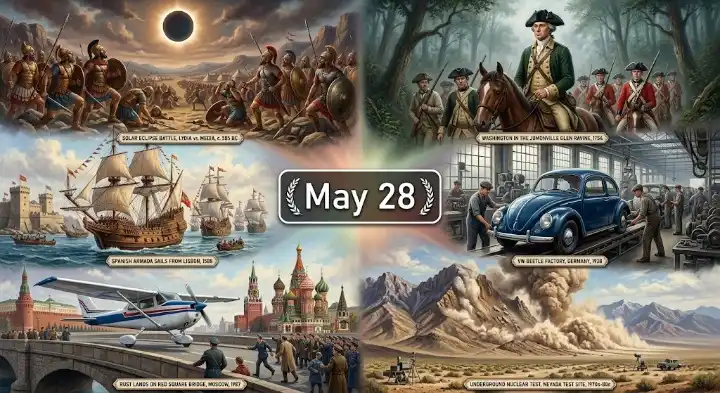
Soldiers from Lydia and Media clashed along the Halys River, locked in a brutal, six-year war that neither side could finish. Suddenly, the afternoon sky deepened into pitch blackness, turning day into night right above the muddy battlefield. Shield arms dropped and swords lowered as terrified warriors stared upward at the missing sun, recognizing a divine demand for peace. Greek thinker Thales of Miletus had predicted this exact cosmic blackout, marking the first time humans ever calculated a solar eclipse before it happened. The frightened kings signed a truce on the spot, sealing their peace with a double royal marriage.
Important Events That Happened On May 28 In History
585 BC – Battle of the Eclipse
Lydian and Median armies dropped their weapons in sheer terror as daytime turned to pitch black darkness during a fierce battle along the Halys River. Greek philosopher Thales of Miletus had predicted this exact cosmic event, mapping the movements of the moon and sun. This sudden solar blackout forced both kings to immediately halt their six-year war and negotiate a peaceful border treaty. Historians rely on this celestial event as the earliest precisely dated moment in human records.
621 – Battle of Hulao
Li Shimin led a disciplined Tang dynasty force against a massive rebel army numbering over one hundred thousand men at the strategic Hulao Pass. The brilliant commander held his ground, waiting out his exhausted opponents before launching a devastating cavalry charge that broke their lines. This sweeping victory crushed the last major resistance following the collapse of the Sui dynasty. A decades-long civil war ended, locking in three centuries of Tang prosperity and cultural golden age dominance.
934 – Æthelstan Invades Scotland
King Æthelstan marched a formidable English army north across the border while sending a massive war fleet to harry the Scottish coast. This ambitious military push aimed to humble King Constantine II, who had dared to challenge English influence in northern territories. Scottish forces withdrew deep into the highlands rather than risk open battle against the unified southern kingdom. This aggressive campaign cemented Æthelstan’s reputation as the supreme ruler across the entire British island.
1242 – Avignonet Massacre
Cathar sympathizers crept quietly into the castle of Avignonet under the dark cover of night, carrying sharp axes and heavy clubs. The raiders burst into the bedchambers of William Arnaud and his eleven Franciscan companions, hacking the Catholic inquisitors to death. Count Raymond VII of Toulouse likely looked the other way, eager to disrupt Rome’s brutal religious crackdowns in his territory. This sudden bloodbath triggered a swift, devastating counter-attack by papal forces that sealed the eventual destruction of the Cathar faith.
1347 – Imperial Byzantine Marriage
John V Palaiologos stood before the altar in Constantinople to wed Helena Kantakouzene, uniting two bitter, warring imperial dynasties. This political union aimed to heal a ruinous six-year civil war that had emptied the imperial treasury and devastated Balkan lands. Real power remained a vicious prize, leaving the teenage emperor trapped under the watchful eye of his new father-in-law. This fragile internal peace arrived too late to stop the Ottoman expansion that was slowly consuming the empire’s borders.
1533 – Anne Boleyn’s Marriage Validated
Archbishop Thomas Cranmer stood in a church courtroom and formally declared the secret marriage between King Henry VIII and Anne Boleyn entirely legal. This official decree followed his earlier ruling that chopped down the king’s decades-long marriage to Catherine of Aragon. The bold religious declaration openly defied the Pope’s authority and severed England’s ancient ties to Rome. This quick signature changed English history forever, launching a Protestant Reformation that remade the realm’s political identity.
1588 – Spanish Armada Sets Sail
Admiral Medina Sidonia watched from the deck as 130 massive wooden warships weighed anchor and slowly glided out of Lisbon’s harbor. This floating fortress carried thirty thousand soldiers and sailors, destined to invade Protestant England and overthrow Queen Elizabeth I. High winds and chaotic Atlantic tides slowed the departure, delaying the full fleet’s exit for two long weeks. This massive naval gamble opened a legendary conflict that ultimately broke Spain’s unchallenged mastery of the high seas.
1644 – Bolton Massacre
Prince Rupert led a ferocious Royalist cavalry charge through the muddy streets of Bolton, smashing the town’s Parliamentarian defenses. Angry soldiers swarmed the local population, killing up to sixteen hundred citizens and defenders in a frenzy of civil war vengeance. James Stanley, the Earl of Derby, reportedly directed the worst of the killing against his personal political enemies. This brutal civilian slaughter hardened hearts across England, ensuring no compromise could happen before the king eventually faced the executioner’s axe.
1754 – Battle of Jumonville Glen
George Washington directed a sudden volley of musket fire into a secluded French encampment hidden deep within the Pennsylvania wilderness. This brief, fifteen-minute skirmish killed a French diplomat and scattered his small scouting party across the frontier. The young lieutenant colonel had no idea his aggressive surprise attack would spark the French and Indian War. This remote woodland clash expanded into the Seven Years’ War, a global conflict that altered colonial borders worldwide.
1802 – Guadeloupe Slave Rebellion Tragedy
Louis Delgrès stood with four hundred armed, rebellious Black soldiers inside a fortified redoubt, surrounded by thousands of advancing French troops. Napoleon had sent an army to strip away their freedom and restore the brutal system of human slavery. Refusing to submit to chains, the defenders ignited their gunpowder stores and blew themselves up in a massive, defiant explosion. This tragic sacrifice remains a powerful symbol of resistance against colonial cruelty in the Caribbean.
1830 – Indian Removal Act Signed
President Andrew Jackson affixed his signature to a controversial bill that authorized the forced displacement of native populations from their ancestral eastern lands. This federal decree ignored existing treaties and handed over millions of rich acres to white southern planters. Thousands of Native Americans died from hunger, cold, and exhaustion during the brutal treks westward that followed. This legislation initiated the Trail of Tears, permanently scarring the American landscape and altering indigenous history.
1871 – Fall of the Paris Commune
French government troops breached the final stone barricades of Belleville, bringing a bloody end to the radical socialist experiment. This final day of the “Bloody Week” saw mass executions along cemetery walls, leaving thousands of communards dead in the smoking ruins of Paris. Regular citizens paid a terrible price as the conservative assembly crushed the working-class uprising without mercy. This total defeat silenced the French revolutionary left for a generation, securing a conservative Third Republic.
1892 – Sierra Club Founded
John Muir gathered a small group of visionary scientists and educators in a San Francisco office to sign incorporation papers. This brand-new organization dedicated itself to protecting the wild Sierra Nevada mountains from destructive logging and overgrazing. Muir believed regular citizens needed to experience pristine wilderness firsthand to appreciate its value. This pioneering group created the modern environmental movement, saving landmark spaces like Yosemite for future generations.
1905 – Battle of Tsushima Ends
Admiral Tōgō Heihachirō stood on his flagship bridge as the Imperial Japanese Navy completed the utter destruction of Russia’s Baltic Fleet. This decisive naval clash ended a global voyage for the Russian ships, which found themselves outmaneuvered and sunk within hours. This stunning defeat forced the Russian Tsar to sue for peace, exposing the deep decay within his imperial regime. Japan emerged from the smoke as the first Asian nation to defeat a major European power in modern warfare.
1907 – First Isle of Man TT
Motorcycle racers lined up on a dusty road in Saint John’s, ready to contest the inaugural International Tourist Trophy. Charles Collier completed the grueling, multi-lap course in just over four hours, averaging a modest thirty-eight miles per hour on his single-cylinder bike. Riders battled treacherous unpaved roads, wandering sheep, and frequent mechanical failures without modern safety gear. This modest event grew into the world’s most dangerous road race, testing human endurance to its absolute limits.
1918 – Caucasian Republics Declare Independence
Politicians gathered in Tbilisi to formally declare the birth of the Azerbaijan Democratic Republic and the First Republic of Armenia. These twin declarations emerged directly from the chaotic collapse of the Russian Empire and the violent distraction of the ongoing World War. Both small nations scrambled to build democratic institutions while facing hostile neighbors and deep regional poverty. This brief window of independence lasted less than three years before Soviet armies marched in to reclaim the territory.
1926 – Portuguese Coup d’État
General Gomes da Costa marched thousands of troops out of Braga, launching a military revolt against the chaotic First Republic. Regular citizens and politicians offered little resistance, exhausted by years of chronic inflation, labor strikes, and constant government collapses. This swift overthrow dismantled Portugal’s fragile democracy and installed a strict military regime known as the Ditadura Nacional. This takeover cleared the path for António de Oliveira Salazar to build a fascist dictatorship that lasted for decades.
1932 – Completion of the Afsluitdijk
Dutch engineers dropped the final massive boulders into the North Sea, completing a giant twenty-mile dike that tamed the ocean. This colossal public works project sealed off the stormy Zuiderzee bay, transforming a dangerous saltwater inlet into a calm, freshwater lake. The newly formed IJsselmeer allowed the Netherlands to drain vast tracts of seabed, creating rich new farming land for thousands of families. This masterpiece of modern engineering permanently altered the map of northern Europe.
1934 – Dionne Quintuplets Born
Oliva and Elzire Dionne welcomed five tiny baby girls into their modest, electricity-free farmhouse near Callander, Ontario. Yvonne, Annette, Cécile, Émilie, and Marie arrived two months early, weighing a combined total of just over thirteen pounds. Medical experts were stunned when all five sisters survived infancy, a miracle that had never happened before in recorded medical history. The government soon took custody of the girls, transforming them into a global tourist attraction that drew millions.
1936 – Alan Turing Submits Computing Paper
Alan Turing delivered his groundbreaking manuscript, “On Computable Numbers,” to the London Mathematical Society for publication. This theoretical paper introduced the concept of a universal machine capable of performing any mathematical calculation through simple binary code. The young mathematician accidentally invented the foundational logic of modern computer software long before actual hardware existed. This brilliant paper transformed abstract mathematics, setting the stage for the digital age we live in today.
1937 – Volkswagen Founded
German labor officials met in Berlin to launch a state-run automobile company under the direction of the Nazi government. The new venture aimed to mass-produce a durable, affordable vehicle that regular working-class families could purchase through a national savings plan. Ferdinand Porsche designed the distinctive, beetle-shaped car to meet strict government price targets and highway performance requirements. This wartime industrial project eventually evolved into one of the largest automotive manufacturing empires on earth.
1940 – Belgium Surrenders to Germany
King Leopold III shocked his cabinet and Allied commanders by ordering his battered army to lay down their weapons. The small nation’s defenses had collapsed after eighteen days of relentless German blitzkrieg tactics, leaving soldiers trapped against the sea. This sudden capitulation exposed the flank of retreating British and French forces, turning the Dunkirk evacuation into a desperate gamble. The king’s controversial decision to remain behind led to deep postwar anger and his eventual abdication.
1940 – Allies Recapture Narvik
Norwegian, French, Polish, and British infantry units launched a coordinated assault that successfully drove German occupiers out of the strategic northern port of Narvik. This hard-fought victory secured control over vital iron ore shipping routes, dealing Adolf Hitler his first major land defeat of the war. The triumph proved short-lived, as the catastrophic collapse of the western front in France forced an immediate Allied evacuation. Despite the retreat, this intense battle proved that the German war machine could be beaten.
1948 – Apartheid Prime Minister Elected
Daniel François Malan led the hardline National Party to a surprise election victory in South Africa, capturing power from the wartime establishment. The former Dutch Reformed minister campaigned on a strict, legal platform of absolute racial segregation known as Apartheid. His government immediately began drafting laws to strip non-white citizens of their remaining political rights, land ownership, and freedom of movement. This fateful vote locked South Africa into decades of brutal institutional oppression and global isolation.
1958 – Battle of El Uvero
Fidel Castro directed his small guerrilla band in a fierce, dawn assault on a heavily fortified army outpost along the rugged Cuban coast. Backed by Frank País’s urban militia units, the rebels fought a bloody, three-hour battle that forced the government garrison to surrender. This tactical victory yielded a massive haul of modern weapons and proved the rebel army could overwhelm fixed military installations. The triumph boosted rural morale, transforming the 26th of July Movement into a genuine threat to the Batista regime.
1961 – Amnesty International Founded
British lawyer Peter Benenson published a passionate front-page appeal titled “The Forgotten Prisoners” across several major international newspapers. His article highlighted the plight of regular citizens jailed globally for peacefully expressing political or religious beliefs. The overwhelming public response transformed a temporary media campaign into a permanent global human rights organization. This single article launched Amnesty International, mobilizing millions of citizens to defend human dignity worldwide.
1962 – Soviet Kosmos 5 Launched
Soviet rocket engineers watched from the Kapustin Yar launchpad as a Kosmos vehicle roared into orbit carrying a small scientific satellite. This military spacecraft carried sensitive radiation detectors designed to map the upper atmosphere and monitor American high-altitude nuclear tests. The data gathered helped Soviet scientists understand how space radiation disrupted long-range military radar and communications systems. This quiet launch marked another steady step forward in the highly competitive Cold War space race.
1964 – Palestine Liberation Organization Founded
Yasser Arafat and hundreds of Palestinian delegates gathered in East Jerusalem to establish a unified political body representing their displaced people. The assembly adopted a national charter demanding the liberation of Palestine and the establishment of independent self-rule. This historic gathering created the Palestine Liberation Organization, which brought disparate guerrilla groups under a single political umbrella. This move permanently altered Middle Eastern politics, creating a central voice for Palestinian nationalism.
1968 – Garuda Flight 892 Crash
Captain Padmodipoera struggled with a failing Convair 990 jetliner before the aircraft plunged into the ground near Nala Sopara, India. The routine flight from Bombay to Karachi went down minutes after takeoff, killing all twenty-nine passengers and crew members on board, along with one person on the ground. Investigating teams blamed severe mechanical malfunctions and difficult weather conditions for the disaster. This tragic accident prompted international aviation authorities to implement stricter maintenance checks for aging commercial jet Fleets.
1974 – Sunningdale Agreement Collapses
Northern Ireland’s chief executive Brian Faulkner resigned, forcing the collapse of the historic, power-sharing regional government. This ambitious political deal fell apart under the immense pressure of a devastating, two-week general strike organized by hardline loyalist workers. Paramilitary intimidation stopped transit, cut power grids, and brought daily commerce to a complete standstill across the province. This collapse ended the best hope for early peace, returning Northern Ireland to decades of direct rule from London.
1975 – Treaty of Lagos Signed
Fifteen West African heads of state met in Nigeria to sign a comprehensive economic integration pact. This historic agreement established the Economic Community of West African States, aiming to create a massive, borderless regional trading bloc. Leaders hoped to break old colonial economic dependencies by dropping trade tariffs and cooperating on major infrastructure projects. This ambitious treaty laid the foundation for regional peacekeeping efforts and freedom of movement for millions of citizens.
1975 – Brampton School Shooting
Sixteen-year-old Michael Slobodian walked into Brampton Centennial Secondary School carrying an unzipped guitar case packed with two loaded rifles. The distraught student opened fire in a crowded restroom and hallway, killing a popular teacher and a fellow student while wounding thirteen others. He turned the weapon on himself before police arrived, leaving the quiet Canadian community in absolute shock. This tragic incident stands as one of the earliest high school mass shootings in modern Canadian history.
1977 – Beverly Hills Supper Club Fire
Patrons inside the packed Beverly Hills Supper Club in Southgate, Kentucky, scrambled for the exits as thick, toxic smoke suddenly filled the Cabaret Room. Faulty, unpermitted electrical wiring in a front banquet room had smoldered for hours inside the walls before bursting into an unstoppable inferno. Inadequate fire exits, overcrowding, and a lack of audible alarms trapped hundreds of people within the sprawling complex, killing 165 victims. This horrific tragedy forced states to rewrite national building codes and implement mandatory sprinkler laws.
1979 – Greece Joins European Community
Prime Minister Konstantinos Karamanlis signed the formal treaty of accession during a grand ceremony in Athens, anchoring his nation to Western Europe. This historic agreement marked the end of a long journey toward economic recovery following the collapse of a brutal military dictatorship. Greek leaders believed European integration would safeguard their fragile democracy and modernize their agrarian economy. This entry expanded the European Economic Community south, paving the way for future Mediterranean expansions.
1987 – Mathias Rust Lands in Red Square
Eighteen-year-old West German pilot Mathias Rust shocked the world by landing his single-engine Cessna airplane on a bridge right next to Moscow’s Red Square. The amateur aviator had flown over five hundred miles from Finland, evading the Soviet Union’s supposedly invincible air defense radar network. The daring stunt humiliated top military brass and handed Soviet leader Mikhail Gorbachev a perfect excuse to fire hostile, anti-reform generals. This bizarre flight fundamentally shifted the internal politics of the late Cold War.
1991 – Fall of Addis Ababa
Rebel fighters from the Ethiopian People’s Revolutionary Democratic Front swept into the capital city of Addis Ababa, capturing the presidential palace. Dictator Mengistu Haile Mariam fled the country, bringing a bloody end to seventeen years of brutal Marxist rule known as the Derg. This sudden military collapse halted a devastating, decades-long civil war that had triggered catastrophic famines. The victorious coalition faced the immense task of rebuilding a ruined economy and restoring peace to the Horn of Africa.
1995 – Neftegorsk Earthquake Disaster
A powerful 7.0 magnitude earthquake struck the remote oil-producing town of Neftegorsk on Sakhalin Island during the middle of the night. The violent tremors collapsed poorly constructed, Soviet-era concrete apartment buildings within seconds, trapping sleeping families beneath heavy rubble. The disaster killed nearly two thousand citizens, wiping out almost two-thirds of the local population. Russian authorities decided the damage was too severe to repair, abandoning the settlement and leaving it as a permanent memorial.
1996 – Whitewater Convictions Handed Down
A federal jury in Arkansas returned guilty verdicts against Jim and Susan McDougal, along with sitting Governor Jim Guy Tucker, following a lengthy fraud trial. The convictions stemmed from a complex, failed real estate venture known as the Whitewater Development Corporation, which involved President Bill Clinton. Independent counsel investigators proved the defendants had used illegal loans and political influence to shore up their failing land deals. This high-profile verdict cast a long shadow over the white house for years.
1998 – Pakistan Conducts Chagai-I Nuclear Tests
Scientists deep inside the remote Chagai hills detonated five underground nuclear devices, sending shockwaves through the desert and global politics. Prime Minister Nawaz Sharif ordered the tests in a direct, matching response to India’s recent atomic detonations, establishing a policy of nuclear deterrence. The United States and Japan immediately slapped harsh economic sanctions on the country, aiming to halt a South Asian arms race. This historic moment made Pakistan the world’s seventh nuclear power, an event celebrated annually as Youm-e-Takbir.
1999 – Da Vinci’s Last Supper Returned to Display
Museum curators in Milan carefully pulled back protective curtains, revealing Leonardo da Vinci’s masterpiece after twenty-two years of painstaking restoration work. Specialized technicians had used microscopic lenses and delicate surgical tools to scrape away centuries of dirt, glue, and previous bad paint jobs. The fragile fifteenth-century mural had nearly faded away due to humidity, war damage, and poor painting techniques. Art lovers lined up for miles to catch a brief, fifteen-minute glimpse of the vibrant original colors.
2002 – Ground Zero Cleanup Concludes
Ironworkers severed the final standing steel column from the ruins of the World Trade Center, marking the official end of recovery efforts in Manhattan. For nine grueling months, recovery crews had worked around the clock, shifting more than one and a half million tons of debris from the attack site. A solemn, wordless procession accompanied the flag-draped girder out of Ground Zero to the sound of a lone bagpipe. This closing ceremony allowed a grieving New York City to pivot from rescue work toward long-term rebuilding.
2003 – Australian Governor-General Resigns
Peter Hollingworth delivered a televised address announcing his formal resignation from his post as Australia’s vice-regal representative. The former Anglican Archbishop faced intense public anger over his past failure to investigate serious child abuse claims within his Brisbane diocese. Critics and politicians argued his presence compromised the integrity of the nation’s highest office, triggering a rare constitutional crisis. His sudden departure forced the government to reform how it vets candidates for public appointments.
2004 – Ayad Allawi Named Iraqi Prime Minister
The Iraqi Governing Council emerged from intense negotiations to announce Ayad Allawi as the leader of the country’s incoming interim government. The long-time secular politician and former exile assumed authority directly from the occupying American coalition forces. Allawi faced the monumental task of organizing national elections while battling a rising insurgency and a ruined domestic economy. His appointment marked a fragile step toward reclaiming Iraqi sovereignty following the fall of Saddam Hussein.
2008 – Nepal Declares Itself a Republic
Lawmakers gathered in Kathmandu for the inaugural meeting of the new Constituent Assembly, voting overwhelmingly to abolish the country’s ancient monarchy. This historic declaration ended the 240-year reign of the Shah dynasty, forcing King Gyanendra to pack his bags and leave the royal palace as a regular citizen. The vote concluded a long peace process that brought former Maoist rebels out of the jungles and into mainstream politics. This peaceful transition transformed the old Himalayan kingdom into a secular republic.
2010 – Jnaneswari Express Train Derailment
The crowded Jnaneswari Express passenger train jumped its tracks in a remote pocket of West Bengal before an oncoming cargo train slammed into the wreckage. The horrific collision crushed several passenger carriages, killing 148 people and injuring hundreds of others trapped inside. Investigating authorities blamed local Maoist saboteurs for removing vital track components along the high-speed line. This tragic disaster highlighted the deep security challenges facing India’s massive, overstretched national rail network.
2011 – Malta Legalizes Divorce
Malta’s citizens flocked to polling stations for a historic referendum, voting fifty-three percent in favor of introducing legal divorce. The tiny Mediterranean island nation stood as one of the last places on earth where couples could not legally dissolve their marriage. The close vote followed months of fierce public debate between liberal reformers and the influential Catholic Church. Parliament quickly acted on the public mandate, passing a law that permanently altered Maltese social policy and family law.
2012 – Arkankergen Massacre Discovered
Border patrol officers arrived at the remote Arkankergen outpost in Kazakhstan to find the border station completely burned to the ground. Inside the smoking ruins, search teams located the bodies of fourteen border guards and a local herder, all shot to death. Authorities eventually arrested a teenage conscript, Vladislav Chelakh, who confessed to killing his fellow soldiers after suffering severe hazing. This shocking mass killing prompted a massive national investigation into systemic bullying within the military.
2013 – Gezi Park Protests Erupt
Anxious environmentalists camped out in Istanbul’s Gezi Park, putting their bodies in front of heavy bulldozers sent to raze the city’s green space for a shopping mall. Heavy-handed police attacks featuring tear gas and water cannons turned a minor local protest into a nationwide uprising against the government. Millions of regular Turkish citizens marched across the country, demanding greater personal freedoms and freedom of speech. This intense standoff became the largest political challenge to the ruling party in a generation.
2016 – Harambe Shot at Cincinnati Zoo
Zoo handlers made the difficult decision to shoot and kill Harambe, a rare western lowland gorilla, after a three-year-old boy slipped into his enclosure. The giant primate had grabbed the child and dragged him through the water, forcing staff to use lethal force instead of tranquilizers to protect the boy’s life. The incident triggered a massive wave of global online anger, media scrutiny, and a flood of internet culture memes. This viral event sparked intense public debates regarding animal captivity and zoo safety protocols.
2017 – Takuma Sato Wins Indy 500
Takuma Sato held off a furious late charge from Helio Castroneves, crossing the brickyard finish line to secure a historic victory at the Indianapolis 500. The seasoned racer drove an aggressive, flawless final sprint, becoming the first Asian and Japanese driver to claim the legendary motorsport trophy. Meanwhile, double Formula One world champion Fernando Alonso suffered cruel engine failure during his highly anticipated debut race. Sato’s historic victory sparked massive celebrations across Japan, cementing his place in racing history.
Ready for more historical context? Visit our previous posts.
Famous People Born On May 28
| Name | Description | Date |
|---|---|---|
| Sir Thomas North | English translator of Plutarch’s Lives (source for Shakespeare) | May 28, 1535 – 1601? |
| William Fiennes, 1st Viscount Saye and Sele | English statesman, opponent of Charles I | May 28, 1582 – April 14, 1662 |
| Pierre Séguier | Chancellor of France under Louis XIII and Louis XIV | May 28, 1588 – January 28, 1672 |
| Philipp, count von Cobenzl | Austrian statesman and chancellor | May 28, 1741 – August 30, 1810 |
| Edward Livingston | American lawyer, legislator, codified criminal law | May 28, 1764 – May 23, 1836 |
| Bernhard Severin Ingemann | Danish historical novelist and poet | May 28, 1789 – February 24, 1862 |
| P.G.T. Beauregard | Confederate general in American Civil War | May 28, 1818 – February 20, 1893 |
| Tony Pastor | American impresario, “father of vaudeville” | May 28, 1837 – August 26, 1908 |
| Luigi Capuana | Italian critic and writer, realism advocate | May 28, 1839 – November 29, 1915 |
| Frederic William Maitland | English jurist and historian of English law | May 28, 1850 – December 19, 1906 |
| Charles Francis Annesley Voysey | British architect and designer, Art Nouveau influence | May 28, 1857 – February 12, 1941 |
| Lizzie Black Kander | American welfare worker, created popular cookbook | May 28, 1858 – July 24, 1940 |
| Richard Réti | Hungarian chess master, Hypermodern school | May 28, 1889 – June 6, 1929 |
| Piggy Lambert | American basketball coach, pioneered fast break | May 28, 1888 – January 20, 1958 |
| Joseph H. Greenberg | American anthropologist and linguist, language universals | May 28, 1915 – May 7, 2001 |
| Barry Commoner | American biologist, environmental activist | May 28, 1917 – September 30, 2012 |
| John Creach | American musician (Jefferson Airplane) | May 28, 1917 – February 22, 1994 |
| May Swenson | American poet | May 28, 1919 – December 4, 1989 |
| N.T. Rama Rao | Indian actor, director, politician, founder of Telugu Desam Party | May 28, 1923 – January 18, 1996 |
| György Ligeti | Hungarian-born avant-garde composer | May 28, 1923 – June 12, 2006 |
| Bülent Ecevit | Prime minister of Turkey (four terms) | May 28, 1925 – November 5, 2006 |
| Dietrich Fischer-Dieskau | German operatic baritone, preeminent lieder singer | May 28, 1925 – May 18, 2012 |
| Thomas J.J. Altizer | American theologian, Death of God movement | May 28, 1927 – November 28, 2018 |
| Betty Shabazz | American educator, wife of Malcolm X | May 28, 1934 – June 23, 1997 |
| Jerry West | American basketball legend, NBA logo silhouette | May 28, 1938 – June 12, 2024 |
| Maeve Binchy | Irish best-selling novelist | May 28, 1940 – July 30, 2012 |
| Stanley B. Prusiner | American biochemist, Nobel Prize for prions | May 28, 1942 – Present |
| Rudy Giuliani | Mayor of New York City (1994–2001) | May 28, 1944 – Present |
| Gladys Knight | American singer, “Empress of Soul” | May 28, 1944 – Present |
| Zahi Hawass | Egyptian archaeologist, head of Egypt’s antiquities | May 28, 1947 – Present |
Famous People Died On May 28
| Name | Description | Date |
|---|---|---|
| Saint Germanus of Paris | French bishop and saint | c.496 – May 28, 576 |
| Wulfstan | Archbishop of York, Old English homilist | – May 28, 1023 |
| Lanfranc | Archbishop of Canterbury (1070–89), adviser to William the Conqueror | c.1005 – May 28, 1089 |
| Afonso IV | King of Portugal (1325–57) | February 8, 1291 – May 28, 1357 |
| Charles of France, duke of Berry | Son of Charles VII, fought against Louis XI | December 28, 1446 – May 28, 1472 |
| Thomas Howard, 1st earl of Suffolk | English commander against Spanish Armada | August 24, 1561 – May 28, 1626 |
| Richard Nicolls | First English governor of New York colony | 1624 – May 28, 1672 |
| Anne-Hilarion de Cotentin, count de Tourville | French admiral under Louis XIV | November 24, 1642 – May 28, 1701 |
| Luc de Clapiers, marquis de Vauvenargues | French moralist and essayist | August 6, 1715 – May 28, 1747 |
| Anton Friedrich Büsching | German geographer, scientific geography pioneer | September 27, 1724 – May 28, 1793 |
| Anton Raaff | German operatic tenor, foremost of his day | May 6, 1714 – May 28, 1797 |
| Henry Dundas, 1st Viscount Melville | British statesman, “King of Scotland” | April 28, 1742 – May 28, 1811 |
| Leopold Mozart | German composer, father and teacher of Wolfgang Amadeus | November 14, 1719 – May 28, 1787 |
| Noah Webster | American lexicographer, “Webster’s Dictionary” | October 16, 1758 – May 28, 1843 |
| Ernst Wilhelm Hengstenberg | German Lutheran theologian | October 20, 1802 – May 28, 1869 |
| John Russell Bartlett | American bibliographer, Dictionary of Americanisms | October 23, 1805 – May 28, 1886 |
| Paul-Émile Lecoq de Boisbaudran | French chemist, discovered gallium, samarium, dysprosium | April 18, 1838 – May 28, 1912 |
| Pencho Petkov Slaveykov | Bulgarian writer | April 27, 1866 – May 28, 1912 |
| John Lubbock, 1st Baron Avebury | British banker, politician, and naturalist | April 30, 1834 – May 28, 1913 |
| Ivan Franko | Ukrainian author and scholar | August 27, 1856 – May 28, 1916 |
| Charles Edward Montague | English novelist and journalist | January 1, 1867 – May 28, 1928 |
| Ed Gallagher | American vaudeville comedian | c.1863 – May 28, 1929 |
| Alice Stopford Green | Irish historian, independence supporter | May 30, 1847 – May 28, 1929 |
| Bertha Pappenheim | Austrian-Jewish activist, first psychoanalysis patient (“Anna O.”) | February 27, 1859 – May 28, 1936 |
| Alfred Adler | Austrian psychiatrist, individual psychology | February 7, 1870 – May 28, 1937 |
| Carter Glass | American politician, opposed New Deal | January 4, 1858 – May 28, 1946 |
| Kees van Dongen | Dutch-born French Fauvist painter | January 26, 1877 – May 28, 1968 |
| Edward VIII | King of United Kingdom, abdicated to marry Wallis Simpson | June 23, 1894 – May 28, 1972 |
| Ezzard Charles | American heavyweight boxing champion | July 7, 1921 – May 28, 1975 |
| Ilya Prigogine | Russian-born Belgian physical chemist, Nobel Prize (1977) | January 25, 1917 – May 28, 2003 |
Observances on May 28
- Youm-e-Takbir (Pakistan): An annual celebration honoring the 1998 nuclear tests that established the nation’s strategic defense capabilities.
- Republic Day (Nepal): A major public holiday marking the historic 2008 transition from an ancient monarchy to a modern democratic republic.
- Downfall of the Derg (Ethiopia): A national holiday commemorating the 1991 victory over the brutal military dictatorship in Addis Ababa.
- Flag Day (Philippines): This day marks the first time the national flag was raised in 1898 following a crucial victory against Spanish forces.
- Armed Forces Day (Croatia): Annual military displays and parades honoring the founding of the modern Croatian National Guard in 1991.
- Menstrual Hygiene Day: A global advocacy day focused on breaking social taboos and improving health education for women and girls everywhere.
⚛️ Frequently Asked Questions — May 28 in History
Pakistan detonated five underground nuclear devices within the remote Chagai hills, sending shockwaves through the surrounding desert. This military test occurred in direct response to India’s recent atomic explosions, establishing a policy of regional deterrence. The historic event made Pakistan the seventh nuclear-armed nation on earth.
The Chagai-I nuclear tests stand out as the most geopolitically significant event on this date, reshaping the balance of military power in South Asia. This moment permanently altered global non-proliferation efforts and locked in a dangerous standoff between neighboring nations. It continues to be marked as a defining day for international security.
Ian Fleming, the imaginative British intelligence officer who created the legendary James Bond spy novels, was born on this date in 1908. His experience working within naval intelligence during World War II provided the authentic background for his thrilling books. His iconic character went on to transform global pop culture and cinema.
Young George Washington led a surprise colonial militia raid against a French scouting party at Jumonville Glen in 1754. This brief wilderness clash in western Pennsylvania killed a French diplomat and lit the fuse for the French and Indian War. The conflict soon expanded into the Seven Years’ War across Europe.
Youm-e-Takbir is a national day of celebration observed across Pakistan to honor the achievements of the country’s atomic scientists. It marks the precise date the nation successfully tested its nuclear arsenal to counter neighboring threats. The day is remembered as a cornerstone of national sovereignty and defense.
Takuma Sato made racing history at the Indianapolis Motor Speedway by winning the legendary Indy 500 race in 2017. He drove a brilliant final stint to become the first Asian driver to capture the prestigious trophy. His victory stood out during a race that saw open-wheel champion Fernando Alonso suffer an engine failure.