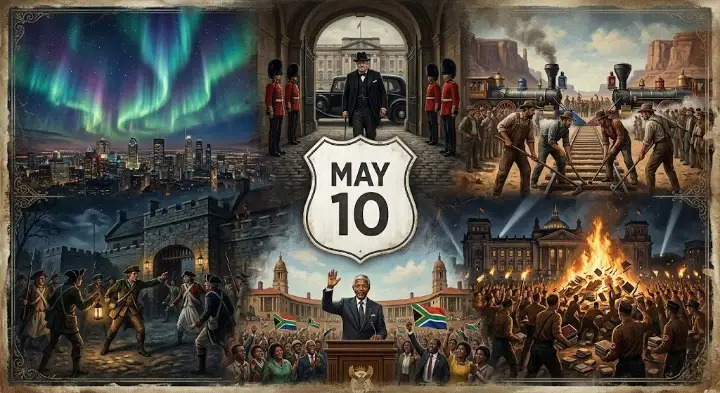
In the dark hours of May 10, 1940, Winston Churchill walked into Buckingham Palace to kiss the hands of King George VI as Britain’s new Prime Minister. Nazi panzers were already rolling into France and the Low Countries, threatening to crush Western Europe in a matter of weeks. The British Empire faced total annihilation, and the burden of its survival now rested on one man’s shoulders. Exactly fifty-four years later on this same date, Nelson Mandela stood before a jubilant crowd in Pretoria to take the oath as South Africa’s first Black president, ending centuries of white minority rule. This day in history May 10 brings together the collapse of empires and the birth of new eras of freedom.
💼 Quick Facts — May 10 in History
| 📌 Category | 📖 Event / Detail |
|---|---|
| 🌟 Most Significant Event | Winston Churchill becomes Prime Minister of the United Kingdom as Germany invades Western Europe (1940) |
| 🏆 Top 10 Key Events | • Han Dynasty astronomers record an early sunspot (28 BC) • Louis XVI and Marie Antoinette ascend the French throne (1774) • Ethan Allen and Benedict Arnold capture Fort Ticonderoga (1775) • Napoleon triumphs at the Battle of Lodi (1796) • The First Transcontinental Railroad is completed in Utah (1869) • The Indian Rebellion begins with the sepoy mutiny at Meerut (1857) • Nazi Germany launches massive public book burnings (1933) • Rudolf Hess parachutes into Scotland on a rogue peace mission (1941) • Nelson Mandela is inaugurated as President of South Africa (1994) • A deadly blizzard strikes Mount Everest, claiming eight lives (1996) |
| ⚔️ Key Battles | Battle of Helsinki (1713), Battle of Lodi (1796), Battle of Dong Ap Bia / Hamburger Hill begins (1969), Battle of Tabqa ends (2017) |
| 👤 Key Figures | Winston Churchill, Nelson Mandela, Louis XVI, Victoria Woodhull}- |
| 🌍 Observances | Mother’s Day (Mexico and Guatemala), Golden Spike Day (Utah), Constitution Day (Micronesia) |
Story of the Day: Churchill’s Darkest Hour and Brightest Dawn
Neville Chamberlain’s government had collapsed under the weight of wartime failures, forcing his resignation as the British realm faced its greatest existential threat. King George VI summoned Winston Churchill to Buckingham Palace on May 10, 1940, handing him the reins of a nation on the brink of ruin. Across the English Channel, Adolf Hitler’s war machine was simultaneously tearing through Belgium, Luxembourg, and the Netherlands. Churchill later wrote that he felt as if he were walking with destiny, and that all his past life had been a preparation for this hour. His ascension altered the course of World War II, replacing appeasement with an iron resolve to fight on the beaches, landing grounds, and fields until total victory was won.
Important Events That Happened On May 10 In History
28 BC – Chinese Astronomers Spot a Solar Anomaly
Han Dynasty astronomers looked toward the skies during the reign of Emperor Cheng and recorded a dark patch shifting across the face of the sun. Their systematic observation became one of the earliest reliably dated sunspot accounts in human history, long before Western Europe turned its telescopes to the stars. The imperial court viewed these stellar blemishes as warnings from heaven, demanding the emperor examine his governance. Today, this single parchment entry provides modern astrophysicists with invaluable baseline data for mapping long-term solar cycles.
946 – Alberic II Dictates the Papacy
Alberic II of Spoleto, the absolute ruler of Rome, engineered the election of Pope Agapetus II just days after the death of Pope Marinus II. This political maneuver ensured that the spiritual leader of Western Christendom remained firmly under local aristocratic control. Agapetus II was forced to navigate a papacy stripped of independent temporal power, functioning largely as an administrator for Alberic’s domain. The alliance consolidated secular rule over Rome while setting the stage for future reform movements desperate to wrench the Church from noble hands.
1291 – Scottish Nobles Bow to Edward I
Scottish lords and guardians gathered at Norham-on-Tweed to acknowledge the supreme authority of King Edward I of England before selecting their own new monarch. The Scottish throne sat vacant after the tragic death of the Maid of Norway, sparking a succession crisis that threatened civil war. Edward capitalized on their vulnerability, refusing to arbitrate the dispute unless the Scots accepted him as Lord Paramount of the realm. This forced submission sowed the seeds of the brutal Wars of Scottish Independence, transforming Edward from a peaceful mediator into the hated “Hammer of the Scots.”
1294 – Temür Ascends the Mongol Throne
Temür, the grandson of Kublai Khan, crossed the Mongolian steppes to be enthroned as Emperor Oljeitu of the Yuan Dynasty. His accession secured the continuity of the vast empire founded by Genghis Khan, though the realm had fractured into distinct, autonomous khanates. Temür chose a path of reconciliation, wrapping up costly military campaigns against Japan and Vietnam to focus on internal stability and trade. His reign solidified the Pax Mongolica, allowing merchants, ideas, and goods to flow safely from the borders of China to the shores of Europe.
1497 – Amerigo Vespucci Departs on a Contested Voyage
Amerigo Vespucci supposedly ordered his ships to weigh anchor at Cádiz, slipping into the Atlantic Ocean on a journey toward the unknown West. This specific expedition remains fiercely debated among maritime historians, with many dismissing it as a fabricated attempt to claim he reached the American mainland before Christopher Columbus. True or false, Vespucci’s subsequent letters detailed vibrant cultures and vast coastlines that conventional maps simply could not account for. The vivid accounts convinced European cartographers that these lands were a completely new continent, leading them to stamp his name onto the world map forever.
1503 – Columbus Encounters the Cayman Islands
Christopher Columbus steered his leaking fleet through the Caribbean during his fourth voyage when two low-lying islands swarming with wildlife materialized on the horizon. Thousands of sea turtles crowded the shallows, prompting the aging explorer to name the islands Las Tortugas. The abundant reptiles offered future buccaneers, privateers, and merchant sailors a vital source of fresh meat during long voyages across the Spanish Main. The remote islands eventually fell under British control, transitioning over the centuries from an isolated turtle haven into a global financial powerhouse.
1534 – Jacques Cartier Reaches Newfoundland
French navigator Jacques Cartier guided his two ships through the fog-shrouded waters of the North Atlantic until the rugged cliffs of Newfoundland came into view. Commissioned by King Francis I to locate a northern passage to the wealthy markets of Asia, Cartier began charting the jagged coastline and rich fishing grounds. His arrival marked the beginning of official French exploration into the interior of North America, paving the way for lucrative fur trapping networks. The local indigenous populations soon faced a wave of European colonization that reshaped the geography, culture, and power dynamics of the entire continent.
1591 – Elizabeth I Receives the Hermit’s Welcome
Queen Elizabeth I rode into the grand estate of Theobalds, where her chief adviser Lord Burghley staged an elaborate theatrical performance known as the Hermit’s Welcome. The costly pageant featured an actor dressed as a religious recluse who symbolically surrendered his quiet life to praise the Queen’s majestic rule. Burghley used the entertainment to mend political fences, entertain the royal court, and subtly petition the monarch for his son’s advancement. The event showcased the complex blend of art, flattery, and raw ambition that fueled the inner workings of the Tudor court.
1688 – Phetracha Seizes the Ayutthaya Kingdom
King Narai of Siam, weakened by severe illness, named his trusted military commander Phetracha as regent, unwittingly triggering a swift palace coup. Phetracha instantly mobilized nationalist forces to arrest the king’s favored Greek advisor, Constantine Phaulkon, executing him for treason. This sudden revolution broke the massive influence that French diplomats and Catholic missionaries had built within the Siamese court. Phetracha crowned himself king of the Ayutthaya Kingdom, plunging the nation into a long period of isolationism that kept Western imperial powers at arm’s length for generations.
1713 – Russian Sailors Ambush Helsinki
Admiral Fyodor Apraksin ordered the Russian Navy to launch a daring amphibious assault, landing troops at both Katajanokka and Hietalahti during the Great Northern War. The sudden maneuvers bypassed traditional Swedish defenses, throwing the local garrison into a panic as Russian artillery pounded the city. Swedish forces set fire to Helsinki before retreating, abandoning the smoking ruins to the advancing enemy troops. The successful landing secured Russia’s dominance over the Gulf of Finland, forcing Sweden to eventually cede vast Baltic territories and alter northern European politics permanently.
1768 – The St. George’s Fields Massacre Ignites London
British authorities threw radical journalist John Wilkes into the King’s Bench Prison for penning an article that blasted King George III. An angry crowd of fifteen thousand supporters gathered outside the jail, chanting slogans for liberty and demanding his immediate release. Fearing a massive insurrection, magistrates ordered the foot guards to open fire on the unarmed civilians, killing several protesters in the melee. The bloody clash fueled a rising wave of anti-government sentiment, convincing working-class Londoners that the crown would use deadly military force to silence political dissent.
1773 – The Tea Act Sparks a Colonial Backlash
The Parliament of Great Britain passed the controversial Tea Act, aiming to bail out the bankrupt British East India Company by granting it a monopoly on tea sales in North America. The legislation actually lowered the price of tea, but it retained the hated Townshend duty and bypassed independent colonial merchants entirely. American colonists viewed the act as a deceptive trap designed to force their submission to taxation without representation. The simmering resentment boiled over months later when activists boarded East India ships and dumped cargo into the harbor, putting the colonies on an irreversible path toward war.
1774 – Louis XVI Inherits a Crumbling France
King Louis XV died of smallpox at Versailles, thrusting his nineteen-year-old grandson Louis XVI and young Marie Antoinette onto the French throne. The inexperienced teenage rulers inherited a nation deep in financial debt, plagued by severe social inequality, and desperate for systemic reform. Louis initially attempted to implement fiscal changes, but conservative nobles successfully blocked every meaningful effort to fix the economy. The royal couple’s inability to solve the growing crisis alienated the desperate populace, culminating fifteen years later in the French Revolution and the fall of the monarchy.
1775 – Allen and Arnold Capture Fort Ticonderoga
Ethan Allen and Colonel Benedict Arnold led a stealthy pre-dawn raid across Lake Champlain, surprising the sleeping British garrison at Fort Ticonderoga. The Green Mountain Boys swarmed the stone fortress without losing a single man, securing a massive cache of heavy artillery for the American cause. Colonel Henry Knox later dragged these captured cannons through snow and mud to the hills overlooking Boston, forcing British ships to evacuate the city. The stunning victory provided the Continental Army with its first major strategic triumph, proving that ragtag colonial militias could outmaneuver professional British soldiers.
1775 – The Second Continental Congress Convenes
Colonial delegates met at the Pennsylvania State House in Philadelphia just weeks after the bloody skirmishes at Lexington and Concord. Leaders like Benjamin Franklin, John Adams, and George Washington gathered to organize a unified response to British military aggression. The assembly quickly established the Continental Army, appointed Washington as commander-in-chief, and began printing paper currency to fund the escalating conflict. This legislative body evolved into the de facto national government of the colonies, eventually drafting the declaration that severed ties with the British Empire.
1796 – Napoleon Triumphs at Lodi Bridge
General Napoleon Bonaparte dashed into the thick of battle at Lodi, rallying his French troops to storm a narrow wooden bridge across the Adda River. Austrian rearguards unleashed a hail of grapeshot, but a desperate French bayonet charge smashed through the defensive line and forced an Austrian retreat. The victory cost the Austrians two thousand men and opened the gates of Milan to the young French commander. The triumph earned Napoleon the lifelong devotion of his soldiers, who nicknamed him “The Little Corporal,” and convinced him that he was destined for global greatness.
1801 – Tripoli Declares War on the United States
Yusuf Karamanli, the Pasha of Tripoli, ordered his soldiers to chop down the flagpole at the American consulate, declaring war on the young United States. The conflict erupted after President Thomas Jefferson refused to pay exorbitant tribute demands to protect American merchant shipping from Barbary pirates. Jefferson responded by dispatching the U.S. Navy to the Mediterranean Sea, initiating the nation’s first major foreign military conflict away from home soil. The war tested American naval capabilities and led to the daring capture of Derna, immortalized in the Marine Corps Hymn.
1824 – The National Gallery Opens in London
Art lovers crowded into a modest townhouse at 10 Pall Mall as the National Gallery opened its doors to the public for the very first time. The British government purchased thirty-eight masterpieces from the estate of banker John Julius Angerstein to form the foundation of a national art collection. Unlike royal collections on the European continent, this gallery was free to all citizens, aiming to bring world-class art to the working public. The institution eventually moved to Trafalgar Square, growing into a world-famous museum holding centuries of creative human history.
1833 – Vietnamese Rebels Challenge Emperor Minh Mạng
Lê Văn Khôi launched a fierce armed rebellion in southern Vietnam, seizing the strategic citadel of Phiên An against the forces of Emperor Minh Mạng. The uprising ignited after the emperor posthumously humiliated the respected mandarin Lê Văn Duyệt, a beloved leader who had protected southern autonomy. Rebel forces allied with local Christians, disgruntled peasants, and neighboring Siamese troops to resist imperial dominance. Minh Mạng crushed the rebellion two years later with extreme brutality, executing thousands and tightening his autocratic grip over the Vietnamese state.
1837 – The Panic of 1837 Wrecks Wall Street
New York City banks abruptly suspended all specie payments, refusing to redeem paper banknotes for actual gold or silver coin. This sudden freeze triggered a massive financial panic, causing hundreds of business failures, widespread unemployment, and a collapse in land values across the country. The deep economic depression dragged on for nearly seven years, destroying early American labor unions and draining state treasuries. The crisis remained the worst financial catastrophe in American history until the Great Depression altered the global economy a century later.
1849 – The Astor Place Riot Devastates Manhattan
An angry mob of ten thousand working-class New Yorkers swarmed the elite Astor Place Opera House, throwing bricks and stones at the theater walls. The violence stemmed from a bitter cultural feud between supporters of American actor Edwin Forrest and fans of visiting British Shakespearean star William Charles Macready. The state militia opened fire on the rioters to restore order, killing twenty-two people and injuring over one hundred. The bloody incident exposed deep class divisions, nativist resentment, and anti-British sentiment bubbling beneath the surface of New York society.
1857 – The Indian Rebellion Begins at Meerut
Indian soldiers turned their weapons on their British commanding officers at the Meerut cantonment, igniting the Indian Rebellion of 1857. The mutinous sepoys shot British officials, freed jailed comrades, and marched toward Delhi to proclaim the elderly Mughal emperor as their leader. The uprising sparked from years of cultural disrespect, land confiscation, and rumors that new rifle cartridges were greased with animal fat. The bloody conflict raged for over a year, ending the rule of the British East India Company and bringing India under direct crown control.
1865 – Union Soldiers Mortally Wound William Quantrill
Union guerrilla hunters tracked Confederate raider William Quantrill to a barn in Taylorsville, Kentucky, opening fire as he attempted to flee on horseback. A bullet shattered Quantrill’s spine, paralyzing the notorious bushwhacker whose band had slaughtered over 150 civilians in the Lawrence Massacre. Soldiers transported the dying guerrilla leader to a military prison hospital in Louisville, where he lingered in intense pain for nearly a month. His capture effectively ended the brutal, irregular guerrilla warfare that had terrorized the Western border states during the Civil War.
1869 – The Golden Spike Unites the American Continent
Workers drove a final spike made of solid gold into a polished laurel tie at Promontory Summit, Utah, completing the First Transcontinental Railroad. The ceremonial hammer blows connected the Union Pacific and Central Pacific tracks, linking the Atlantic and Pacific oceans by rail for the first time. A telegraph operator wired the single word “DONE” to a waiting nation, setting off wild celebrations in major cities across the continent. The monumental engineering feat slashed coast-to-coast travel time from months to six days, accelerating westward expansion and altering Native American lands.
1872 – Victoria Woodhull Crashing the Presidential Race
The Equal Rights Party gathered in New York City to nominate Victoria Woodhull as the first female candidate for President of the United States. Woodhull, a radical stockbroker, journalist, and women’s suffrage activist, ran on a platform advocating free love, labor reform, and civil rights. Her historic nomination occurred nearly fifty years before American women secured the constitutional right to vote in federal elections. Her campaign faced intense public backlash, ending with her spending election night jailed on obscenity charges for publishing a scandal sheet.
1876 – Philadelphia Hosts the Centennial Exposition
President Ulysses S. Grant threw a giant switch to start the massive Corliss Steam Engine, officially opening the Centennial International Exhibition in Philadelphia. The world’s fair celebrated the hundredth anniversary of American independence, showcasing the nation’s rapid industrial growth and inventive spirit to global visitors. Millions of tourists wandered through the pavilions, marveling at new inventions like Alexander Graham Bell’s telephone, the Remington typewriter, and Heinz Ketchup. The exhibition announced America’s arrival as an industrial superpower, ready to compete with the established empires of Europe.
1881 – Carol I Wins the Romanian Crown
Carol I walked into the capital city of Bucharest to be crowned the very first King of the Romanian Kingdom. The coronation followed a hard-fought war against the Ottoman Empire, which successfully secured Romania’s absolute independence on the international stage. Carol chose to have his royal crown forged from the melted steel of a captured Ottoman cannon, symbolizing the sacrifice of Romanian soldiers. His long, stable reign modernized the nation’s infrastructure, expanded its economy, and anchored Romania firmly within the shifting European political landscape.
1899 – The Klaukkala Axe Murders Terrorize Finland
Karl Emil Malmelin, a disgruntled farmworker, armed himself with an axe and slaughtered seven people at the Simola croft in the village of Klaukkala. The victims included the farm owner, his family, and several domestic workers, all killed in a sudden fit of rage over personal grievances. The brutal mass murder shocked the quiet rural communities of Finland, sparking a massive manhunt that quickly captured the fleeing laborer. The tragedy left a dark mark on local folklore, remaining one of the most notorious violent crimes in Finnish history.
1904 – August Horch Establishes an Automotive Legacy
August Horch gathered investors in Zwickau, Germany, to incorporate Horch & Cie. Motorwagenwerke AG, an automotive workshop dedicated to building luxury cars. Internal disputes with his board of directors eventually forced Horch out of his own company just a few years later. Restricted from using his own last name for a new venture, he translated “Horch”—which means “listen” in German—into Latin, creating the brand name Audi. This original factory laid the groundwork for a manufacturing network that evolved into a famous modern luxury car brand.
1908 – Anna Jarvis Launches Mother’s Day
Anna Jarvis organized a special memorial service at St. Andrew’s Methodist Church in Grafton, West Virginia, to honor her deceased mother. Jarvis distributed five hundred white carnations to the congregation, initiating the first official observation of Mother’s Day in the United States. She envisioned the day as an intimate, personal tribute to maternal devotion and family sacrifice. The celebration quickly gained national popularity, but Jarvis spent her later years bitterly protesting the commercialization of the holiday by florists and greeting card corporations.
1916 – Shackleton Lands the James Caird
Sir Ernest Shackleton guided his tiny, battered lifeboat through crashing surf and jagged rocks to touch land at South Georgia Island. Shackleton and five exhausted companions had sailed 800 nautical miles across the treacherous Southern Ocean from Elephant Island, navigating freezing winds and massive waves. The desperate voyage aimed to find help for the crew of his sunken expedition ship, the Endurance, stranded deep in Antarctic ice. The successful landing enabled Shackleton to organize a rescue mission, ensuring that every single member of his stranded expedition survived.
1924 – J. Edgar Hoover Takes Control of the Bureau
Attorney General Harlan Fiske Stone appointed twenty-nine-year-old J. Edgar Hoover as the acting director of the Bureau of Investigation. Hoover inherited a small, scandal-plagued agency and immediately began transforming it into a highly disciplined, technologically advanced crime-fighting organization. He introduced a centralized fingerprint file, established a national crime laboratory, and instituted rigorous training standards for agents. Hoover retained his absolute control over the expanded Federal Bureau of Investigation (FBI) for nearly half a century, accumulating unmatched power and surveillance files on American public life.
1933 – Nazi Students Burn Books in Berlin
Thousands of cheering Nazi students marched into the Opernplatz in Berlin, tossing upwards of 25,000 “un-German” books into a giant blazing bonfire. Propaganda Minister Joseph Goebbels spoke to the crowd, praising the destruction of literature written by Jewish, socialist, and avant-garde authors like Albert Einstein, Karl Marx, and Sigmund Freud. Similar state-sponsored book burnings occurred in university towns across Germany, signaling the absolute death of intellectual freedom under the Third Reich. The fires realized the haunting words of poet Heinrich Heine: where they burn books, they will end up burning human beings.
1940 – British Forces Occupy Neutral Iceland
Royal Navy destroyers sliced through the northern Atlantic waves, carrying 746 British marines into the harbor of Reykjavík to occupy neutral Iceland. Code-named Operation Fork, the pre-emptive invasion aimed to prevent Nazi Germany from seizing the strategic island nation and choking vital Atlantic shipping lanes. The Icelandic government issued a formal protest against the violation of their neutrality, but instructed citizens not to resist the incoming soldiers. The military occupation secured the North Atlantic gap, transforming the isolated island into a crucial air and naval base for Allied forces.
1941 – The Luftwaffe Hammers the House of Commons
Waves of German bombers roared over London in one of the most destructive air raids of the Blitz, dropping incendiary bombs directly onto the Palace of Westminster. The intense firestorm completely gutted the historic debating chamber of the House of Commons, leaving a smoking shell of twisted metal and ash. Winston Churchill chose not to rebuild the chamber immediately, opting to have MPs meet in the House of Lords to maintain government continuity during the war. The ruined architecture became a visual symbol of British defiance against the unrelenting air campaign of Nazi Germany.
1941 – Rudolf Hess Parachutes Into Scotland
Deputy Führer Rudolf Hess strapped on his parachute and leaped from a Messerschmitt fighter plane into the dark skies over Renfrewshire, Scotland. The high-ranking Nazi official flew on a rogue, self-styled peace mission, hoping to bypass Churchill and negotiate a treaty with British aristocrats before Germany invaded Russia. British authorities promptly arrested the disoriented leader in a farm field, locking him away as a prisoner of war for the remainder of the conflict. Adolf Hitler stripped Hess of his titles and declared him insane, while the British government dismissed his bizarre peace proposals out of hand.
1942 – Thailand Invades the Burmese Shan States
The Phayap Army of Thailand marched across the northern border, launching an invasion of the Shan States as part of the wider Japanese Burma Campaign. Allied with the Axis powers, Thai leadership sought to reclaim historic territories and expand their regional influence under the cover of global war. Thai troops fought through rugged jungle terrain, driving back outnumbered Chinese Nationalist forces who were defending the retreat of British administrators. The occupation created a temporary wartime territory, but Thailand was forced to return the contested lands to Burma following the total defeat of Japan.
1946 – America Launches Its First V-2 Rocket
Engineers at the White Sands Proving Ground in New Mexico fired a captured German V-2 rocket, watching it streak into the desert sky. The successful launch utilized components seized from the underground Nazi factories of Mittelwerk, reassembled under the guidance of imported German scientists like Wernher von Braun. The test flight provided American researchers with their first hands-on experience operating advanced, liquid-fueled ballistic missiles. This military research program laid the foundation for the American space program, directly leading to the development of the rockets that carried humans to the moon.
1961 – Air France Flight 406 Explodes Over the Sahara
A Lockheed Starliner operating as Air France Flight 406 disintegrated mid-air, raining debris down onto the desolate desert sands of the Algerian Sahara. All seventy-eight passengers and crew aboard died instantly when a bomb detonated in the aircraft’s empennage during the flight from Bangui to Paris. The deadly sabotage occurred amid the violent tensions of the Algerian War of Independence, though no political group ever claimed official responsibility for the attack. The tragedy highlighted the vulnerability of commercial aviation to acts of international terrorism during geopolitical conflicts.
1962 – Marvel Comics Unleashes the Incredible Hulk
Comic book fans browsed newsstands and discovered the first issue of The Incredible Hulk, created by writer Stan Lee and artist Jack Kirby. Inspired by the classic tales of Frankenstein and Dr. Jekyll and Mr. Hyde, the story introduced Dr. Bruce Banner, a scientist transformed into a raging monster by a freak gamma bomb explosion. The original character design featured gray skin, but printing difficulties forced Marvel to switch the behemoth’s color to green in the very next issue. The character grew into a cultural icon, exploring human anxiety regarding scientific advancement and inner anger.
1967 – The Northrop M2-F2 Crashes on Landing
Research pilot Bruce Peterson guided the experimental Northrop M2-F2 wingless lifting body toward the dry lakebed of Edwards Air Force Base. An unexpected roll oscillation destabilized the craft just feet above the ground, causing it to flip over and bounce violently across the desert floor at 250 miles per hour. Peterson survived the horrific, fiery crash with severe injuries, losing sight in his right eye due to a subsequent hospital infection. The dramatic film footage of the accident later inspired the hit novel Cyborg and the famous television series The Six Million Dollar Man.
1969 – The Battle of Hamburger Hill Begins
American and South Vietnamese soldiers launched a frontal assault on the heavily fortified positions of the North Vietnamese Army atop Hill 937. The bloody conflict developed into a grueling ten-day meat grinder, characterized by steep mud slopes, torrential rains, and entrenched enemy machine-gun bunkers. GIs soon dubbed the mountain “Hamburger Hill” due to the horrific casualties sustained trying to capture the crest. The military high command ordered troops to abandon the hill just days after securing it, sparking intense criticism in America regarding the strategy of the Vietnam War.
1975 – Sony Launches the Betamax VCR
Sony executives unveiled the Betamax videocassette recorder in Japan, offering consumers the ability to record television programs and watch movies at home. The pioneering format delivered high-quality video playback, but it quickly ran into fierce competition from JVC’s alternative VHS system. A brutal format war ensued, with VHS ultimately dominating the global consumer market due to its longer recording times and cheaper production costs. The corporate battle became a classic case study in business schools, demonstrating that superior technology does not always guarantee commercial market victory.
1993 – The Kader Toy Factory Fire Devastates Bangkok
A small fire broke out in the fabric department of the Kader Toy Factory in Thailand, quickly transforming into a raging inferno due to poor building construction. The multi-story structures lacked fire exits, alarms, or sprinkler systems, and management had locked the exit doors to prevent employee theft. The factory floors collapsed in minutes, trapping hundreds of young garment workers beneath heavy, smoking concrete debris. The disaster killed 188 people and injured over 400, remaining the worst industrial factory fire in world history and forcing global brands to rethink safety standards.
1994 – Nelson Mandela Takes the Presidency
Nelson Mandela stood before a jubilant crowd of world leaders and citizens at the Union Buildings in Pretoria to be sworn in as South Africa’s president. His inauguration followed the country’s first fully democratic election, completing a miraculous transition from the brutal era of apartheid to a multi-racial democracy. Mandela, who had spent twenty-seven years locked away in apartheid prisons, preached a message of national reconciliation and racial harmony. His historic speech urged the nation to let freedom reign, declaring that the beautiful land would never again experience the oppression of one by another.
1996 – A Deadly Blizzard Strikes Mount Everest
An unexpected, violent blizzard slammed into the upper slopes of Mount Everest, trapping several commercial expeditions deep inside the death zone. Hurricane-force winds, blinding snow, and sub-zero temperatures disoriented climbers returning from the summit in the dark. Eight mountaineers, including legendary expedition leaders Rob Hall and Scott Fischer, died on the exposed ridges of the mountain before morning. The tragedy shocked the global climbing community, exposing the extreme dangers of the commercialization of Everest and inspiring the best-selling memoir Into Thin Air.
1997 – The Qayen Earthquake Devastates Iran
A powerful 7.3 magnitude earthquake ruptured a 110-kilometer fault line across the Khorasan Province of eastern Iran, flattening entire rural villages. The violent tremors pulverized traditional adobe homes, crushing families beneath heavy mud brick walls while they rested. The disaster claimed 1,567 lives, injured over 2,300 people, and left fifty thousand citizens homeless across the arid region. International aid rushed to the scene to assist recovery efforts, highlighting the constant vulnerability of Middle Eastern communities located along active tectonic plate boundaries.
2002 – Spy Robert Hanssen Receives a Life Sentence
A federal judge sentenced former FBI agent Robert Hanssen to life imprisonment without the possibility of parole for committing treason against the United States. Hanssen had spent over two decades selling classified national security secrets to Soviet and Russian intelligence agencies in exchange for $1.4 million in cash and diamonds. His compromised intelligence exposed numerous American deep-cover assets, led directly to the execution of multiple double agents, and revealed top-secret nuclear countermeasure plans. The devastating espionage breach forced the FBI to overhaul its internal security and employee monitoring protocols.
2005 – A Grenade Fails to Explode Near George W. Bush
Vladimir Arutyunian tossed a live, Soviet-made hand grenade toward the podium where U.S. President George W. Bush was addressing a massive crowd in Tbilisi, Georgia. The weapon sailed through the air and landed just twenty meters from the president, striking a young girl before bouncing to the ground. A red tartan handkerchief wrapped tightly around the grenade blocked its internal firing pin, preventing a deadly explosion that would have altered global politics. Georgian authorities tracked down and arrested Arutyunian weeks later, sentencing the lone assassin to life in prison.
2012 – Suicide Car Bombs Rock Damascus
Two suicide attackers detonated car bombs packed with heavy military explosives outside a military intelligence complex in Damascus, Syria. The twin blasts tore through rush-hour traffic, shattering building facades, flipping vehicles, and leaving cratered ruins filled with debris. The explosions killed 55 people and wounded over 370 others, marking one of the deadliest single attacks in the capital during the opening stages of the Syrian Civil War. The coordinated bombing underscored the rapid descent of the country into a brutal, multi-sided conflict that displaced millions of people.
2013 – One World Trade Center Claims the Sky
Construction crews hoisted a massive steel spire atop One World Trade Center in New York City, pushing the building to its final architectural height of 1,776 feet. The specific height served as a deliberate, symbolic nod to the year the United States signed the Declaration of Independence. The skyscraper officially became the tallest building in the Western Hemisphere, dominating the Manhattan skyline where the Twin Towers once stood. The structural completion marked a major milestone in rebuilding Lower Manhattan, offering a visible symbol of resilience to the city.
2017 – The Battle of Tabqa Reaches Its End
The Syrian Democratic Forces, backed by international coalition airstrikes, successfully cleared the final Islamic State strongholds in the city of Al-Tabqah and its adjacent hydroelectric dam. The strategic victory concluded weeks of intense urban combat and risky amphibious landings behind enemy lines along Lake Assad. Capturing Tabqa stripped ISIS of a vital military base and cut off major supply routes leading directly into their self-proclaimed capital of Raqqa. The operation crippled the group’s territorial grip over northern Syria, bringing their brutal regional rule closer to collapse.
2022 – The Royal Succession Takes a Symbolic Shift
Queen Elizabeth II missed the State Opening of Parliament for the first time in nearly sixty years, citing ongoing mobility issues. The Prince of Wales and the Duke of Cambridge rode to Westminster to open the legislative session, acting together as Counsellors of State. Prince Charles sat upon the consort’s throne, reading the traditional Queen’s Speech outlining the government’s upcoming legislative agenda to assembled MPs. The historic shift offered the British public a visible preview of the inevitable transition of the crown, signaling the twilight of the second Elizabethan era.
2024 – Extreme Solar Storms Batter Earth
A series of powerful coronal mass ejections erupted from a giant sunspot cluster, triggering the most intense geomagnetic storms to strike Earth since 2003. The solar bombardment supercharged the upper atmosphere, generating vibrant auroras that painted the night skies pink, green, and purple across latitudes that rarely witness the northern lights. Power grid operators, satellite controllers, and commercial aviation lines implemented emergency protocols to mitigate potential electrical disruptions and signal failures. The solar storm served as a reminder of our planet’s constant vulnerability to space weather.
Missed the last chapter? Catch up on yesterday’s facts here.
Famous People Born On May 10
| Name | Description | Date |
|---|---|---|
| Jean Mairet | French classical dramatist, forerunner of Corneille | May 10, 1604 – January 31, 1686 |
| Jean-Marie Leclair, the Elder | French violinist, founder of French school of violin | May 10, 1697 – October 22, 1764 |
| Anne-Robert-Jacques Turgot, baron de l’Aulne | French economist, comptroller general under Louis XVI | May 10, 1727 – March 18, 1781 |
| Victor Louis | French Neoclassical architect, theatre specialist | May 10, 1731 – July 2, 1800 |
| George Steevens | English Shakespearean commentator, collaborated with Samuel Johnson | May 10, 1736 – January 22, 1800 |
| Robert Gray | American explorer, first U.S. captain to circumnavigate globe | May 10, 1755 – 1806 |
| Claude-Joseph Rouget de Lisle | Author of “La Marseillaise,” French national anthem | May 10, 1760 – June 26, 1836 |
| Louis-Nicolas Davout, duke of Auerstedt | French marshal, Napoleon’s most distinguished field commander | May 10, 1770 – June 1, 1823 |
| Gaspard Monge, count de Péluse | French mathematician, invented descriptive geometry | May 10, 1746 – July 28, 1818 |
| Jared Sparks | American publisher, biographer, president of Harvard | May 10, 1789 – March 14, 1866 |
| Alexander Braun | German botanist, nature philosophy school | May 10, 1805 – March 29, 1877 |
| Elisha King Root | American inventor and engineer, Colt firearms | May 10, 1808 – August 31, 1865 |
| Sir Hugh Low | British administrator in Malaya | May 10, 1824 – April 18, 1905 |
| Henry Clifton Sorby | English geologist, “father of microscopical petrography” | May 10, 1826 – March 9, 1908 |
| William R. Grace | American shipowner, founder of W.R. Grace & Co. | May 10, 1832 – March 21, 1904 |
| Pinckney Benton Stewart Pinchback | African American politician, Reconstruction-era Louisiana leader | May 10, 1837 – December 21, 1921 |
| James Bryce, Viscount Bryce | British statesman, diplomat, historian of U.S. politics | May 10, 1838 – January 22, 1922 |
| Kaufmann Kohler | German-American rabbi, influential Reform theologian | May 10, 1843 – January 28, 1926 |
| Thomas Lipton | British merchant, Lipton tea empire | May 10, 1850 – October 2, 1931 |
| Léon Bakst | Russian artist, revolutionary Ballets Russes designer | May 10, 1866 – December 27, 1924 |
| Marcel Mauss | French sociologist and anthropologist, gift exchange theory | May 10, 1872 – February 10, 1950 |
| Ivan Cankar | Slovene novelist and playwright | May 10, 1876 – December 11, 1918 |
| Symon Petlyura | Ukrainian political leader, independence fight | May 10, 1879 – May 25, 1926 |
| Fritz von Unruh | German Expressionist dramatist | May 10, 1885 – November 28, 1970 |
| Richard James Mulcahy | Irish Republican Army chief of staff | May 10, 1886 – December 16, 1971 |
| Karl Barth | Swiss Protestant theologian, “wholly otherness of God” | May 10, 1886 – December 9, 1968 |
| Antonin Raymond | Czech-born U.S. architect, worked in Japan | May 10, 1888 – November 21, 1976 |
| Max Steiner | Austrian-born U.S. composer, film score pioneer | May 10, 1888 – December 28, 1971 |
| Armando Reverón | Venezuelan impressionist painter | May 10, 1889 – September 18, 1954 |
| Einar Gerhardsen | Four-time prime minister of Norway | May 10, 1897 – September 19, 1987 |
Famous People Died On May 10
| Name | Description | Date |
|---|---|---|
| Mieszko II Lambert | King of Poland (1025–34) | 990 – May 10, 1034 |
| Kitabatake Chikafusa | Japanese warrior-statesman, author of Jinnō shōtōki | 1293 – May 10, 1354 |
| Sebastian Brant | German satirical poet, The Ship of Fools | 1457 – May 10, 1521 |
| Leonhard Fuchs | German botanist and physician | January 17, 1501 – May 10, 1566 |
| Jean de La Bruyère | French satiric moralist, Les Caractères | August 1645 – May 10, 1696 |
| Sir George Etherege | English dramatist, Restoration comedy of manners | c.1635 – c.May 10, 1692 |
| Christoph Graupner | German composer of Bach’s era | January 13, 1683 – May 10, 1760 |
| Charles Beauclerk, 1st duke of Saint Albans | Illegitimate son of Charles II and Nell Gwyn | May 8, 1670 – May 10, 1726 |
| Ehrengarde Melusina, duchess of Kendal | Mistress of King George I of England | December 25, 1667 – May 10, 1743 |
| Cosmas Damian Asam | German Baroque fresco painter | September 29, 1686 – May 10, 1739 |
| Jean-Baptiste-Donatien de Vimeur, comte de Rochambeau | French general in American Revolution | July 1, 1725 – May 10, 1807 |
| Andrew Bell | Scottish engraver, cofounder of Encyclopædia Britannica | 1726 – May 10, 1809 |
| Thomas Young | English physician and physicist, wave theory of light | June 13, 1773 – May 10, 1829 |
| Elizabeth of France | French princess, sister of Louis XVI | May 3, 1764 – May 10, 1794 |
| Stanislao Cannizzaro | Italian chemist, Cannizzaro reaction | July 13, 1826 – May 10, 1910 |
| William Ferguson Massey | Prime minister of New Zealand (1912–25) | March 26, 1856 – May 10, 1925 |
| Alexandru Marghiloman | Romanian statesman in WWI | July 4, 1854 – May 10, 1925 |
| Alton B. Parker | American jurist, Democratic presidential nominee (1904) | May 14, 1852 – May 10, 1926 |
| Edward Stratemeyer | American writer, Hardy Boys and Tom Swift series | October 4, 1862 – May 10, 1930 |
| Shimomura Kanzan | Japanese painter, modernized traditional painting | April 10, 1873 – May 10, 1930 |
| Mukhtar Ahmad Ansari | Indian physician and nationalist | December 25, 1880 – May 10, 1936 |
| Vladimir Germanovich Bogoraz | Russian anthropologist, Chukchi studies | April 27, 1865 – May 10, 1936 |
| Viola Allen | American Shakespearean actress | October 27, 1869 – May 10, 1948 |
| Belle da Costa Greene | American librarian, organized J.P. Morgan’s library | November 26, 1879 – May 10, 1950 |
| Clark L. Hull | American psychologist, learning theory | May 24, 1884 – May 10, 1952 |
| Yury Karlovich Olesha | Russian Soviet writer | March 3, 1899 – May 10, 1960 |
| Gene Lipscomb | American football player | August 9, 1931 – May 10, 1963 |
| Peter Weiss | German dramatist and novelist | November 8, 1916 – May 10, 1982 |
| Shen Congwen | Chinese lyric novelist | December 28, 1902 – May 10, 1988 |
| Walker Percy | American novelist of the New South | May 28, 1916 – May 10, 1990 |
Observances on May 10
- Mother’s Day (Mexico and Guatemala): Families gather for vibrant celebrations, traditional music serenades, and large communal meals to honor the matriarchs of their households on this fixed calendar date.
- Golden Spike Day (Promontory, Utah): Rail enthusiasts and historians meet at the historic park site to re-enact the driving of the final spike, celebrating the completion of the Transcontinental Railroad.
- Constitution Day (Micronesia): Citizens participate in cultural festivals, parades, and public speeches commemorating the adoption of their nation’s governing document and internal autonomy.
💼 Frequently Asked Questions — May 10 in History
Winston Churchill became Prime Minister of the United Kingdom following the resignation of Neville Chamberlain. On the very same day, Nazi Germany launched its massive invasion of France, Belgium, Luxembourg, and the Netherlands, escalating World War II into Western Europe.
The twin historical bookends of May 10 are Winston Churchill taking control of Britain in 1940 as Western Europe faced Nazi invasion, and Nelson Mandela being inaugurated as South Africa’s first Black president in 1994. Both events marked massive turning points in global governance.
John Wilkes Booth, the American stage actor who later assassinated President Abraham Lincoln at Ford’s Theatre, was born on this date in 1838. His birth introduced a figure whose violent actions altered the course of American Reconstruction.
The American Revolutionary War saw a major triumph on this date in 1775 when Ethan Allen and Benedict Arnold led a surprise raid to capture Fort Ticonderoga from the British. Their success secured heavy cannons that later forced the British to evacuate Boston.
Mother’s Day is celebrated on a fixed date of May 10 across Mexico and Guatemala, differing from the floating Sunday schedule used in other nations. It serves as a deeply rooted cultural celebration honoring maternal societal roles through family feasts and music.
In 2024, a series of powerful solar storms slammed into Earth’s atmosphere, generating breathtaking auroral displays across the globe. The geomagnetic event was the most powerful solar storm recorded since the historic Halloween storms of 2003.