Aelia Eudocia walked through the crowds of Constantinople on June 7, 421, to marry Emperor Theodosius II and become an empress of Byzantium. This Greek philosopher’s daughter had risen from standard citizenship to the absolute peak of imperial power. Her wedding marked the start of a date that would repeatedly redefine world maps and reshape nations across centuries. Knowing this day in history June 7 helps contextualize how modern borders, legal frameworks, and global balances of power came to be.
Story of the Day: The Day the Pirate Capital Sank
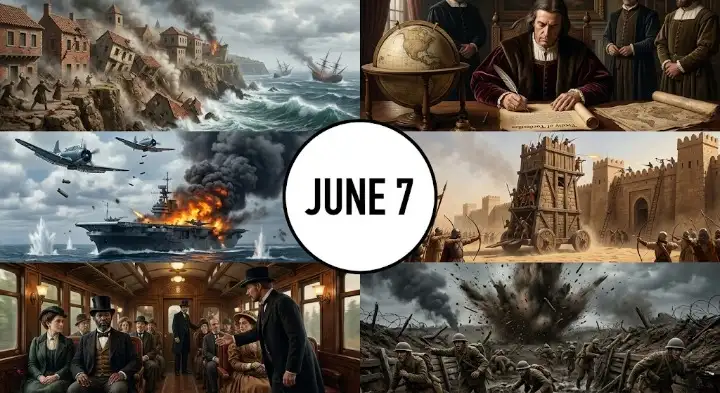
Port Royal, Jamaica, had earned its reputation as the wickedest city on Earth, a wealthy haven where privateers and pirates spent Spanish gold in overcrowded taverns. That reality vanished in three minutes on the morning of June 7, 1692, when a massive earthquake struck the island. The sand beneath the heavy brick buildings liquefied instantly, causing entire streets to slide directly into the harbor. More than 1,600 people perished as the sea swallowed the town, drowning citizens in their own homes and trapping ships in the ruins. Survivors viewed the sudden, absolute destruction as divine judgment on the notorious port, ending its era as a Caribbean powerhouse and shifting Jamaica’s trade center permanently to Kingston.
Important Events That Happened On June 7 In History
421 – Byzantine Imperial Wedding
Aelia Eudocia married Emperor Theodosius II in the heart of Constantinople to officially claim her title as Byzantine Empress. Her rise from an educated Athenian commoner to the absolute peak of Roman power surprised the Mediterranean world. The marriage secured a highly intellectual patron for the empire who heavily influenced religious policy and education. This union established a lasting legacy of classical learning within the imperial court.
879 – Croatian Independence Recognized
Pope John VIII dispatched an official letter to Duke Branimir recognizing the Duchy of Croatia as a sovereign state. This papal endorsement gave the young duchy legal legitimacy among the fractious kingdoms of early medieval Europe. Branimir successfully detached his lands from Byzantine and Frankish control through this diplomatic victory. Croatia dates its foundation as a distinct political entity back to this single piece of papal correspondence.
1002 – Henry II Crowned King
German nobles gathered to witness Henry II receive his crown as King of Germany after weeks of political maneuvering. The cousin of the childless Emperor Otto III had to seize the royal insignia by force to secure his claim against rivals. His coronation solidified the Ottonian dynasty’s grip on Central Europe despite fierce local opposition. This victory set him on a direct path to claiming the Holy Roman Empire.
1099 – Siege of Jerusalem Begins
First Crusade soldiers marched to the stone walls of Jerusalem and initiated their final, bloody siege. Thousands of weary European knights surrounded the heavily fortified city after a brutal three-year overland trek. The local garrison dug in for an existential struggle that would last several weeks. This confrontation led directly to the violent capture of the city and altered Middle Eastern politics for centuries.
1420 – Venice Conquers Udine
Venetian troops marched through the breached gates of Udine to bring a violent end to the independence of Patria del Friuli. The regional parliament surrendered its historic autonomy after failing to stop the advancing mercenary armies of the republic. Venice absorbed the entire territory into its expanding land empire to control lucrative alpine trade routes. The conquest permanently shifted the balance of power in northeastern Italy toward Venetian dominance.
1494 – Treaty of Tordesillas Signed
Spanish and Portuguese diplomats signed the Treaty of Tordesillas to split the non-Christian world clean in half. A line drawn straight down the Atlantic Ocean gave Spain everything to the west and Portugal everything to the east. This arbitrary division occurred before Europeans even knew the true scale of the American continents. The agreement explains why Brazil speaks Portuguese today while the rest of South America speaks Spanish.
1614 – The Addled Parliament Dissolves
King James I dissolved the English Parliament in a fit of rage after two months of total legislative deadlock. Lawmakers flatly refused to grant the crown new taxes unless the king abandoned his custom duties on trade. Not a single bill passed during the brief, hostile session, earning it the permanent nickname of the Addled Parliament. This bitter standoff widened the financial and political rift that eventually caused the English Civil War.
1628 – Petition of Right Enacted
Charles I reluctantly granted royal assent to the Petition of Right to secure vital wartime funds from Parliament. This landmark constitutional document banned the crown from raising unapproved taxes or imprisoning citizens without cause. The king despised the limitations on his absolute power but desperately needed cash to fight France. This law established the fundamental principle that even a monarch must answer to the legal system.
1640 – Corpus de Sang Riot
Catalan reapers armed with agricultural tools swarmed Barcelona and killed the Spanish Viceroy, Dalmau de Queralt. The laborers revolted after months of being forced to quarter and feed Spanish royal soldiers fighting France. This bloody street battle turned a localized peasant grievance into a massive regional rebellion against Madrid. The clash sparked the Reapers’ War, fracturing the Spanish monarchy’s control over Catalonia for over a decade.
1654 – Coronation of Louis XIV
Louis XIV stood before the altar at Reims Cathedral to receive the crown of France as an absolute monarch. The young king took full control of a nation recently fractured by years of civil warfare and noble rebellions. He used the elaborate religious ceremony to project total authority over his remaining political rivals. This event initiated a seventy-two-year reign that turned France into the dominant cultural and military superpower of Europe.
1692 – Port Royal Earthquake
A catastrophic earthquake struck Jamaica and dropped the bustling pirate haven of Port Royal straight into the sea. The ground liquefied beneath the heavy brick buildings, killing 1,600 citizens in less than three minutes. Giant waves rolled over the remaining docks to wreck dozens of merchant vessels trapped in the harbor. The disaster destroyed the economic capital of the Caribbean and forced survivors to build a new settlement at Kingston.
1776 – Lee Resolution Presented
Richard Henry Lee stood before the Continental Congress to formally move that the United Colonies declare themselves free and independent states. John Adams immediately seconded the radical motion, forcing cautious delegates to debate open treason against the British Crown. The resolution broke a year of political hesitation regarding a permanent separation from London. This specific proposal led directly to the drafting of the United States Declaration of Independence.
1788 – Day of the Tiles
Civilians in Grenoble climbed onto their roofs to rain heavy clay tiles down upon invading royal troops. The angry crowd rushed to defend local judges who were being exiled by the king for protesting royal taxes. The chaotic street fight forced the royal regiments to retreat out of the city entirely. This open act of urban defiance served as one of the opening sparks of the French Revolution.
1800 – Thompson Maps the Saskatchewan
David Thompson pushed his canoe through the reeds to reach the mouth of the Saskatchewan River in modern Manitoba. The relentless fur trader mapped every mile of the rugged waterway to open up western Canada for commerce. His precise geographic calculations filled the blank spaces on existing North American maps for British empires. This expedition laid the logistical groundwork for the rapid expansion of the global fur trade.
1810 – Gazeta de Buenos Ayres Founded
Mariano Moreno published the first edition of the Gazeta de Buenos Ayres to spread revolutionary ideals across Argentina. The newly formed rebel government needed a public voice to counter Spanish royalist propaganda in South America. The newspaper printed radical essays on liberty, free trade, and independent self-governance every week. This publication served as the ideological engine for the South American wars of independence.
1832 – Great Reform Act Passed
King William IV signed the Great Reform Act into law to fundamentally alter the British political system. The legislation abolished “rotten boroughs” where tiny hamlets sent members to Parliament while massive industrial cities had no representation. It expanded voting rights to the rising industrial middle class for the first time in British history. This peaceful reform averted a violent working-class revolution across England and Wales.
1832 – Asian Cholera Hits Quebec
Irish immigrants fleeing poverty stepped off ships in Quebec, unknowingly bringing Asian cholera into Lower Canada. The invisible waterborne disease swept through the crowded riverside neighborhoods of the city within forty-eight hours. Over 6,000 people died across the province as doctors failed to find a cure for the sudden epidemic. The tragedy fueled deep social and political tensions between local French Canadians and British authorities.
1862 – Lyons-Seward Treaty Signed
The United States and the United Kingdom signed the Lyons-Seward Treaty to launch a joint naval crackdown on the African slave trade. Abraham Lincoln agreed to let British warships search suspicious American-flagged vessels to prevent southern confederates from securing foreign aid. The treaty effectively ended the transatlantic slave trade by closing the last major legal loopholes used by human traffickers. This diplomatic deal kept Britain neutral during the American Civil War.
1866 – Fenian Raiders Repelled
One thousand eight hundred Irish-American Fenian veterans retreated across the US border after looting towns in Canada East. The armed raiders sought to capture Canadian territory to leverage Britain into granting independence to Ireland. Local Canadian militia units marched through the mud to confront the invaders near Saint-Armand. The failure of the raid convinced Canadian politicians to unite their provinces into a single defensive confederation.
1880 – Battle of Arica Ends
Chilean soldiers launched a fierce uphill assault to capture the heavily fortified stronghold of Morro de Arica from Peruvian defenders. The brutal hand-to-hand combat on the coastal cliffs ended the decisive Desert Campaign of the War of the Pacific. Peru lost its primary southern naval base and its entire regional army during the two-hour battle. The victory gave Chile permanent control over valuable mineral-rich territories that it holds to this day.
1892 – Homer Plessy Arrested
Homer Plessy bought a first-class ticket and sat down in a whites-only train car in New Orleans, Louisiana. The light-skinned civil rights activist intentionally broke the law to test the state’s strict segregation acts in court. A conductor ordered him to leave, and a private detective arrested him when he refused to move. His resulting legal battle led to the Plessy v. Ferguson decision, legalizing “separate but equal” laws across America.
1899 – Carrie Nation’s Saloon Campaign
Carrie Nation walked into a saloon in Kiowa, Kansas, and used heavy rocks to smash the inventory of alcohol to pieces. The tall temperance activist believed that liquor was destroying American families and that local authorities were ignoring prohibition laws. Her destructive crusade quickly upgraded from rocks to a trademark hand hatchet. This violent protest style energized the political movement that eventually banned alcohol across the United States.
1905 – Norway Dissolves Swedish Union
Norway’s Storting parliament voted unanimously to dissolve its ninety-one-year-old political union with the Swedish monarchy. The politicians declared that King Oscar II had ceased to function as Norway’s king after he blocked their independent foreign policy. Swedish authorities threatened military mobilization before a peaceful national plebiscite confirmed the split. The bloodless separation allowed Norway to emerge as a fully independent modern nation.
1906 – RMS Lusitania Launched
Shipyard workers in Glasgow cheered as the massive hull of the RMS Lusitania slid into the waters of the River Clyde. The Cunard Line designed the ocean liner to reclaim the prestigious Blue Riband for the fastest Atlantic crossing. It featured unprecedented luxury alongside secret structural designs for potential wartime naval service. Its launch marked the height of the pre-war industrial competition between Great Britain and Germany.
1917 – Battle of Messines Mines
Allied engineers detonated nineteen massive underground mines directly beneath the German trenches at Messines Ridge in Belgium. The simultaneous explosions killed 10,000 German soldiers instantly and created a blast heard all the way in London. British and ANZAC troops rushed forward through the dust to capture the disrupted high ground within hours. This attack stood as one of the most successful and lethal military mining operations in human history.
1919 – Sette Giugno Riots
British infantry opened fire on a crowd of angry protestors in Valletta, killing four Maltese citizens during the Sette Giugno riots. The population had revolted against soaring bread prices and the colonial government’s refusal to grant them political autonomy. The unexpected bloodshed united the island’s rival political factions against British rule. This tragedy forced London to draft a new constitution giving Malta its first self-governing national assembly.
1929 – Lateran Treaty Ratified
Premier Benito Mussolini and Cardinal Gasparri signed the Lateran Treaty to officially bring the independent state of Vatican City into existence. The agreement ended a bitter sixty-year political dispute between the Catholic Church and the Kingdom of Italy. The Pope received full sovereignty over his small Roman enclave alongside a massive financial payout for lost papal territories. This pact stabilized relations between church and state in modern Italy.
1938 – Yellow River Floods Created
Chinese Nationalist troops blew up the dikes of the Yellow River to stop the rapid advance of imperial Japanese forces. The artificial flood waters successfully bogged down Japanese tanks but drowned 500,000 to 900,000 Chinese civilians without warning. Millions of rural peasants lost their homes and crops as the river shifted course completely. This desperate military strategy caused one of the largest state-created environmental disasters in human history.
1940 – King Haakon Enters Exile
King Haakon VII and his government boarded a British warship in Tromsø to flee into exile in London. The royal family refused to surrender to invading Nazi forces or recognize the puppet government of Vidkun Quisling. They kept the legal Norwegian state alive from abroad by broadcasting resistance messages to their occupied homeland. The king spent exactly five years in exile before returning to a liberated Norway.
1942 – Battle of Midway Victory
American naval forces turned back the Imperial Japanese fleet as the decisive Battle of Midway came to an end. US dive-bombers sank four elite Japanese aircraft carriers in a matter of minutes, breaking the back of the imperial navy’s offensive power. The unexpected victory stopped Japan’s eastward expansion and balanced the naval war in the Pacific. This clash shifted the strategic initiative over to the Allied forces for the remainder of World War II.
1942 – Aleutian Islands Occupied
Japanese soldiers waded ashore on the remote islands of Attu and Kiska to launch the Aleutian Islands Campaign. This landing marked the first time a foreign enemy had occupied sovereign American soil since the War of 1812. The Japanese high command hoped to create a northern defensive screen to distract the US Navy from the central Pacific. The occupation forced American forces into a grueling, year-long arctic campaign to reclaim the islands.
1944 – Ardenne Abbey Massacre
German soldiers belonging to the SS Division Hitlerjugend marched twenty-three Canadian prisoners of war into the garden of Ardenne Abbey and executed them. The captured troops had been taken during the chaotic fighting of the Normandy landings the day before. The war crime reflected the brutal fanatical training of the young German division on the Western Front. This tragedy resulted in the postwar conviction of SS commander Kurt Meyer for war crimes.
1945 – King Haakon VII Returns
King Haakon VII stepped off a ship onto the docks of Oslo to a chaotic welcome from thousands of liberated citizens. The monarch returned exactly five years to the day after he fled the advancing Nazi occupation forces. His homecoming symbolized the official restoration of democracy and sovereignty across Norway. The event marked the final end of World War II’s dark shadow over the Nordic nation.
1946 – BBC Television Returns
The BBC turned its television transmitters back on after keeping them completely dark for seven long years during World War II. The service had been abruptly shut down in 1939 to prevent German bombers from using the radio signals as navigation beacons. The broadcaster restarted the service by airing the exact same Mickey Mouse cartoon that had been interrupted by the war. This return signaled the revival of peacetime entertainment for post-war British families.
1948 – Oujda and Jerada Riots
Angry crowds rioted through the Jewish quarters of Oujda and Jerada, killing forty-two Moroccan Jews following the outbreak of the Arab-Israeli war. The localized violence erupted as geopolitical tensions over the creation of Israel reached North Africa. Local security forces struggled to restore order in the crowded, isolated mining towns for days. The tragedy prompted a massive migration of Morocco’s historic Jewish population to Israel and France.
1948 – Edvard Beneš Resigns
Edvard Beneš resigned his office as President of Czechoslovakia to avoid signing a new constitution that legalized a totalitarian state. The veteran diplomat watched his democratic government get dismantled by a Soviet-backed communist coup. His departure removed the last legal obstacle to the total Soviet domination of Eastern Europe. This resignation locked Czechoslovakia behind the Iron Curtain for the next forty years of the Cold War.
1955 – Lux Radio Theatre Ends
The Lux Radio Theatre signed off the air permanently after broadcasting its final radio drama to millions of regular listeners. The legendary show had brought the magic of Hollywood and Broadway directly into American living rooms since 1934. It featured top-tier stars performing live, full-length audio adaptations of popular films and theater productions. The cancellation marked the final surrender of golden-age network radio to the rising popularity of television.
1962 – University of Algiers Library Burned
OAS terrorists set fire to the University of Algiers library, destroying 500,000 irreplaceable books and historical manuscripts. The extremist French nationalist group launched the arson attack to sabotage Algeria’s transition to full independence from France. The massive inferno ruined decades of academic research and local cultural heritage in a matter of hours. This destruction stood as one of the final acts of violence in the Algerian War.
1965 – Griswold v. Connecticut Decided
The Supreme Court of the United States struck down a state law that criminalized the use of birth control by married couples. The landmark Griswold v. Connecticut ruling established a constitutional right to privacy within the home for the first time. The justices argued that the Bill of Rights created a zone of personal freedom where state governments could not interfere. This decision laid the legal groundwork for future rulings on reproductive rights and marriage.
1967 – Israeli Forces Enter Jerusalem
Israeli paratroopers fought their way into the Old City of Jerusalem during the third day of the Six-Day War. Soldiers advanced to the Western Wall, bringing the ancient site under Jewish administrative control for the first time in two millennia. The rapid victory fundamentally altered the geography of the modern Middle East and redefined the Israeli-Palestinian conflict. This military advance led directly to the unification of the city under Israeli law.
1971 – Cohen v. California Ruling
The US Supreme Court overturned the conviction of Paul Cohen for wearing a jacket printed with a vulgar anti-draft slogan inside a courthouse. The justices ruled that offensive writing is fully protected under the First Amendment if it does not incite violence. The landmark opinion famously stated that “one man’s vulgarity is another’s lyric.” This decision expanded American free speech protections to include raw, offensive, and emotional political commentary.
1971 – Ken Ballew Raid
Federal ATF agents broke down the door of Ken Ballew’s apartment during a dynamic raid for illegal military hand grenades. The agents shot and permanently paralyzed the local configuration enthusiast after he picked up a replica rifle in self-defense. The raid turned up nothing but inert, legal surplus smoke grenades and training canisters. This controversial incident sparked intense national debates regarding federal law enforcement tactics and Second Amendment rights.
1971 – Allegheny Airlines Flight 485 Crashes
Allegheny Airlines Flight 485 clipped a ridge of trees and crashed into a swampy field while approaching New Haven, Connecticut. The pilot descended past safe limits through dense fog, killing twenty-eight people aboard the turboprop aircraft. Only three individuals survived the impact and subsequent fire in the shattered fuselage. The accident forced the aviation industry to implement stricter automated cockpit monitoring systems for low-visibility landings.
1975 – Sony Launches Betamax
Sony placed the first Betamax videocassette recorders onto retail shelves, letting consumers record television shows at home for the first time. The compact machine offered high-quality video playback but was tied to an expensive, proprietary format. The product launch initiated a fierce global format war against JVC’s competing VHS system. Sony eventually lost the market battle because VHS tapes could record for twice as long at a lower price.
1977 – Silver Jubilee High Day
Five hundred million people switched on their television sets to watch Queen Elizabeth II ride in a gold coach to St. Paul’s Cathedral. The elaborate street pageantry marked the official high day of her Silver Jubilee, celebrating twenty-five years on the British throne. Millions of ordinary citizens organized massive neighborhood block parties across Great Britain to toast the monarchy. The global broadcast demonstrated the enduring international appeal of the British royal family.
1981 – Operation Opera Strike
Israeli F-16 fighter jets flew low across the desert to bomb and destroy Iraq’s Osiraq nuclear reactor in a surprise airstrip attack. The military command ordered the preemptive strike out of fear that Saddam Hussein was using the facility to build atomic weapons. The successful mission caught the Iraqi air defenses completely off guard, destroying the facility in less than two minutes. This attack established the “Begin Doctrine” of preventing hostile regional neighbors from acquiring weapons of mass destruction.
1982 – Graceland Opens to Public
Priscilla Presley unlocked the front doors of Graceland to let regular fans tour the private estate of Elvis Presley for the first time. The family opened the mansion to generate steady revenue to pay off massive inheritance taxes and maintain the singer’s legacy. Management kept the private upstairs bathroom where Elvis died completely off-limits to visitors out of respect. The property quickly grew into one of the most visited historic homes in the United States.
1989 – Surinam Airways Flight 764 Crashes
Surinam Airways Flight 764 struck a group of trees and flipped upside down while attempting a low-visibility landing in Paramaribo, Suriname. The captain ignored automated cockpit warnings and attempted to land through dense ground fog without proper ground navigation signals. The catastrophic impact killed 176 people, including fifteen professional Dutch-Surinamese soccer players traveling for an exhibition match. The tragedy remains the deadliest aviation disaster in Suriname’s history.
1991 – Mount Pinatubo Erupts
Mount Pinatubo erupted with sudden violence, blasting a massive column of volcanic ash seven kilometers into the sky over the Philippines. The initial explosion blanketed nearby towns in thick grey dust and forced thousands of residents to flee their homes. This blast served as the opening salvo for a much larger, catastrophic eruption that occurred a week later. The event disrupted global aviation routes and altered worldwide weather patterns for over a year.
2000 – Lebanon Blue Line Defined
United Nations cartographers drew the “Blue Line” across the rocky hillsides to establish a temporary border between Israel and Lebanon. The international body created the demarcation line to verify the complete withdrawal of Israeli military forces from southern Lebanese territory. Both nations agreed to respect the boundary despite ongoing disputes over small pockets of agricultural land. The blue markers remain a tense buffer zone patrolled by international peacekeepers.
2017 – Myanmar Air Force Crash
A Myanmar Air Force Shaanxi Y-8 transport aircraft vanished from radar and plunged into the Andaman Sea near the town of Dawei. The plane carried 122 passengers, including military personnel, their wives, and children traveling home for the holidays. Search crews recovered wreckage and bodies from the water after bad weather caused sudden structural failure at high altitude. The incident stands as the deadliest aviation disaster in the history of Myanmar.
Revisit the important lessons from yesterday’s history post.
Famous People Born On June 7
| Name | Description | Date |
|---|---|---|
| Federico da Montefeltro | Italian condottiero and Duke of Urbino, a renowned Renaissance military commander and patron of the arts | 1422 – 1482 |
| John III of Portugal | King of Portugal who oversaw the expansion of the Portuguese Empire during the Age of Discovery | 1502 – 1557 |
| Robert Jenkinson, 2nd Earl of Liverpool | English politician who served as Prime Minister of the United Kingdom during the Napoleonic Wars | 1770 – 1828 |
| James Young Simpson | Scottish obstetrician who pioneered the use of chloroform as an anesthetic in childbirth | 1811 – 1870 |
| Paul Gauguin | French Post-Impressionist painter and sculptor, known for his experimental use of color and work in Tahiti | 1848 – 1903 |
| Philipp Lenard | Slovak-German physicist and Nobel Prize laureate for his work on cathode rays and the photoelectric effect | 1862 – 1947 |
| Charles Rennie Mackintosh | Scottish architect, designer, and painter, a leading figure in the Art Nouveau and Glasgow Style movements | 1868 – 1928 |
| Knud Rasmussen | Danish anthropologist and explorer, known for his expeditions among Arctic and Inuit peoples | 1879 – 1933 |
| Henri Coandă | Romanian engineer and inventor, designer of the Coandă-1910, one of the earliest jet aircraft experiments | 1886 – 1972 |
| Gillis Grafström | Swedish figure skater who won three consecutive Olympic gold medals in men’s singles | 1893 – 1938 |
| Alexander P. de Seversky | Georgian-American pilot and engineer, co-designer of the Republic P-47 Thunderbolt fighter aircraft | 1894 – 1974 |
| Robert S. Mulliken | American physicist and chemist, Nobel Prize laureate for work on molecular orbital theory | 1896 – 1986 |
| Imre Nagy | Hungarian politician and 44th Prime Minister of Hungary, executed for his role in the 1956 Hungarian Revolution | 1896 – 1958 |
| George Szell | Hungarian-American conductor and composer, best known for his leadership of the Cleveland Orchestra | 1897 – 1970 |
| Frederick Terman | American engineering professor, considered the “father of Silicon Valley” for his mentorship of Stanford graduates | 1900 – 1982 |
| James J. Braddock | American heavyweight boxing champion, known as the “Cinderella Man” for his unlikely comeback during the Great Depression | 1905 – 1974 |
| Virginia Apgar | American anesthesiologist and pediatrician, developer of the Apgar Score to assess newborn health | 1909 – 1974 |
| Jessica Tandy | English-American actress, winner of an Academy Award for her role in Driving Miss Daisy | 1909 – 1994 |
| Gwendolyn Brooks | American poet and the first African American to win a Pulitzer Prize for Poetry | 1917 – 2000 |
| Dean Martin | American singer, actor, and producer, a member of the “Rat Pack” and a major entertainer of the 20th century | 1917 – 1995 |
| James Ivory | American director, producer, and screenwriter, known for award-winning period dramas like A Room with a View | 1928 – Present |
| John Turner | Canadian lawyer and politician, 17th Prime Minister of Canada | 1929 – 2020 |
| Tom Jones | Welsh singer and actor, one of the most popular vocalists of the 1960s and a lasting music icon | 1940 – Present |
| Nikki Giovanni | American poet, writer, and activist, a leading figure in the Black Arts Movement | 1943 – 2024 |
| Wolfgang Schüssel | Austrian lawyer and politician, 26th Chancellor of Austria | 1945 – Present |
| Liam Neeson | Irish-American actor, known for his leading roles in films such as Schindler’s List and the Taken franchise | 1952 – Present |
| Orhan Pamuk | Turkish-American novelist and Nobel Prize laureate, one of the most celebrated living authors in world literature | 1952 – Present |
| Prince | American singer-songwriter, multi-instrumentalist, and actor, one of the most iconic and influential musicians in pop history | 1958 – 2016 |
| Mike Pence | American politician, 48th Vice President of the United States and 50th Governor of Indiana | 1959 – Present |
| Allen Iverson | American basketball player, an 11-time NBA All-Star and one of the most influential guards in league history | 1975 – Present |
Famous People Died On June 7
| Name | Description | Date |
|---|---|---|
| Robert the Bruce | Scottish king who led Scotland during the First War of Scottish Independence against England | 1274 – 1329 |
| Ashikaga Takauji | Japanese shōgun who founded the Ashikaga shogunate and the Muromachi period | 1305 – 1358 |
| Anne of Bohemia | English queen as the wife of King Richard II, known for her influence and mediation skills | 1366 – 1394 |
| Casimir IV Jagiellon | Grand Duke of Lithuania and King of Poland, one of the most successful rulers in Polish-Lithuanian history | 1427 – 1492 |
| Thomas West, 3rd Baron De La Warr | English politician and Colonial Governor of Virginia, after whom Delaware is named | 1577 – 1618 |
| Joseph von Fraunhofer | German optician, physicist, and astronomer, known for the Fraunhofer lines in the solar spectrum | 1787 – 1826 |
| Frederick William III of Prussia | King of Prussia during the Napoleonic Wars, who played a key role in the defeat of Napoleon | 1770 – 1840 |
| Friedrich Hölderlin | German lyric poet, one of the most important figures of German Romanticism | 1770 – 1843 |
| Chief Seattle | American tribal chief of the Duwamish people, after whom the city of Seattle is named | 1780 – 1866 |
| Jean Harlow | American actress and singer, a major sex symbol of the 1930s known as the “Blonde Bombshell” | 1911 – 1937 |
| Alan Turing | English mathematician and computer scientist, a pioneer of computer science and codebreaking during WWII | 1912 – 1954 |
| Judy Holliday | American actress and singer, winner of an Academy Award for her role in Born Yesterday | 1921 – 1965 |
| Jean Arp | German-French sculptor, painter, and poet, a key figure in the Dada and Surrealist art movements | 1886 – 1966 |
| Dorothy Parker | American poet, short story writer, and critic, known for her sharp wit and membership in the Algonquin Round Table | 1893 – 1967 |
| E. M. Forster | English novelist and essayist, author of classics such as A Passage to India and Howards End | 1879 – 1970 |
| Henry Miller | American novelist and essayist, known for his groundbreaking and controversial works like Tropic of Cancer | 1891 – 1980 |
| Bill France Sr. | American race car driver and businessman, co-founder of NASCAR and its first president | 1909 – 1992 |
| Víctor Paz Estenssoro | Bolivian politician, 52nd President of Bolivia, who led the 1952 National Revolution | 1907 – 2001 |
| Abu Musab al-Zarqawi | Jordanian militant and leader of Al-Qaeda in Iraq, a key figure in the Iraq insurgency | 1966 – 2006 |
| Phillip V. Tobias | South African paleontologist and academic, a leading expert on human evolution and the study of hominid fossils | 1925 – 2012 |
| Pierre Mauroy | French educator and politician, Prime Minister of France from 1981 to 1984 | 1928 – 2013 |
| Richard Ramirez | American serial killer known as the “Night Stalker,” convicted of multiple murders in California | 1960 – 2013 |
| Christopher Lee | English actor, known for his roles as Dracula and Saruman, one of the most prolific actors in film history | 1922 – 2015 |
| The Iron Sheik | Iranian-American professional wrestler and actor, a former WWF Heavyweight Champion | 1942 – 2023 |
| William Anders | American astronaut and lunar explorer, a member of Apollo 8 who took the iconic “Earthrise” photograph | 1933 – 2024 |
| George II Rákóczi | Prince of Transylvania, who led an unsuccessful invasion of Poland | 1621 – 1660 |
| Dan Duryea | American actor and singer, known for his roles in film noir as a villain | 1907 – 1968 |
| Ronald George Wreyford Norrish | English chemist and Nobel Prize laureate for work on flash photolysis | 1897 – 1978 |
| Philip Guston | Canadian-American painter and educator, a major figure in Abstract Expressionism and later Neo-Expressionism | 1913 – 1980 |
| Signe Hasso | Swedish-American actress, known for her work in both Hollywood and Swedish cinema | 1915 – 2002 |
Observances on June 7
- Union Dissolution Day (Independence Day of Norway): Commemorates the 1905 parliamentary vote that ended the political union with Sweden, celebrated as the birth of modern Norwegian sovereignty.
- Sette Giugno (Malta): A national holiday honoring the memory of the four Maltese citizens killed by British troops during the anti-colonial food riots of 1919.
- Flag Day (Peru): Commemorates the historic Battle of Arica and honors the military personnel who died defending the nation during the War of the Pacific.
- Journalist Day (Argentina): Established to honor the 1810 founding of the Gazeta de Buenos Ayres, the country’s first independent revolutionary newspaper.
- Birthday of Prince Joachim (Denmark): Marks the celebration of the younger son of Queen Margrethe II, observed within the Danish royal family.
- Anniversary of the Memorandum of the Slovak Nation (Slovakia): Honors the 1861 political document that first demanded national autonomy for Slovaks within the Kingdom of Hungary.
- Tourette Syndrome Awareness Day: A global health day dedicated to educating the public and reducing social stigma surrounding Tourette syndrome.
⚓ Frequently Asked Questions — June 7 in History
The Battle of Midway ended in a decisive victory for the United States, breaking the offensive power of the Imperial Japanese Navy by sinking four of its fleet aircraft carriers. Simultaneously, Japanese forces landed on the remote islands of Attu and Kiska, beginning the Aleutian Islands Campaign off Alaska.
The Battle of Midway in 1942 holds this title because it permanently shifted the balance of power in the Pacific Theater during World War II. The American victory halted Japanese expansion and allowed the Allied forces to transition from defensive actions to a sustained offensive strategy.
Prince Joachim of Denmark, the younger son of Queen Margrethe II, was born on this day in 1969. In historical records, June 7 also marks the date when Aelia Eudocia married Emperor Theodosius II in 421, launching her historic career as an influential Byzantine Empress.
The First Crusade launched the direct Siege of Jerusalem in 1099 to begin the final phase of their holy war. Centuries later in 1917, Allied engineers detonated nineteen massive underground mines beneath German positions at the Battle of Messines during World War I.
Sette Giugno is a national holiday in Malta that honors the memory of four Maltese citizens killed when British colonial soldiers fired into a protesting crowd in 1919. The people had rioted over soaring food prices, and their deaths catalyzed the Maltese movement for self-governance.
A Myanmar Air Force Shaanxi Y-8 transport aircraft crashed into the Andaman Sea in 2017, claiming the lives of all 122 military personnel and family members on board. In 2000, the United Nations officially established the Blue Line to serve as the border between Israel and Lebanon.