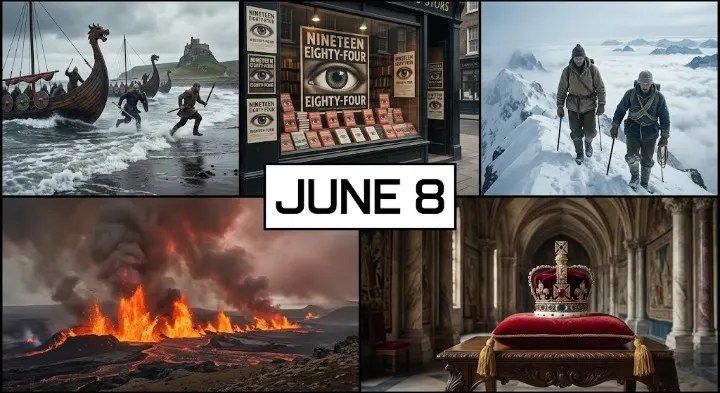
On a chilly morning in Northumberland, a line of wooden longships cut silently through the North Sea surf toward the holy island of Lindisfarne. Monks looked up from their prayers to see armed raiders splashing onto the sand with iron axes raised. The peaceful monastery was plundered, its treasures stolen, and its inhabitants slaughtered in a single morning. This brutal morning shock on June 8, 793, shattered the peace of Western Christendom and marked the terrifying arrival of the Viking Age.
Story of the Day: The Disappearance of Mallory and Irvine on Everest
High on the northeast ridge of Mount Everest, a brief break in the swirling mist exposed two tiny black dots moving upward against the snow. Odell, watching from a lower camp, noted that his fellow British climbers were pushing hard toward the summit. George Mallory and Andrew Irvine were never seen alive again, swallowed by the mountain’s extreme altitude and freezing winds. Their disappearance created the greatest mystery in mountaineering history, leaving behind a haunting question that remains unanswered. Finding Mallory’s preserved body decades later proved he fell, but failed to confirm if he reached the peak first.
Important Events That Happened On June 8 In History
218 – Battle of Antioch
Syrian soldiers loyal to the teenager Elagabalus clashed with the imperial guard of Emperor Macrinus outside the gates of Antioch. Macrinus fled the field disguised as a courier when his troops broke under the fierce rebel onslaught, signaling a total collapse of his short rule. The teenage victor claimed the imperial throne, bringing a chaotic era of religious eccentricity to Rome. This victory placed a priest of the sun god at the head of the Mediterranean world.
452 – Attila Invades Italy
Attila led a massive coalition of Hun warriors across the Alps, descending directly onto the wealthy, undefended plains of Northern Italy. Aquileia was completely erased from the map, forcing panicked survivors to flee into the nearby coastal lagoons for safety. This desperate flight created the permanent mud-flat settlements that eventually grew into the city of Venice. Rome itself trembled until a papal delegation convinced the invaders to turn back.
536 – Pope Silverius Elected
Silverius assumed the papal throne in Rome during a time of intense military friction between the Byzantine Empire and the Ostrogoths. Belisarius, the imperial general, was marching north to capture the city, putting the new pope in a dangerous political vice. Accusations of treason quickly ruined his papacy, leading to his forced removal and exile on a distant island. His rise ended the period of peaceful Gothic oversight of the Roman Church.
793 – Lindisfarne Abbey Sacked
Norse longships glided onto the tidal shores of Lindisfarne, unleashing an unprecedented wave of violence against the defenseless monastic community. English kings realized their coastal borders were totally exposed to seafaring raiders who cared nothing for Christian holy sanctuaries. The shocking destruction of this famous center of learning echoed through every royal court in Europe. Decades of defensive panic and regional warfare against Viking invaders followed this single morning raid.
1042 – Edward the Confessor Crowned
Edward took the English crown following the sudden death of his Danish predecessor, restoring the ancient line of Cerdic to power. Anglo-Saxon nobility celebrated the return of a native ruler after decades of harsh Scandinavian dominion over their lands. His deeply religious rule was constantly undermined by the powerful Earl Godwin, who controlled the kingdom’s real military muscle. Edward’s failure to produce an heir set up the catastrophic Norman conquest twenty-four years later.
1057 – Isaac Komnenos Proclaimed Emperor
Byzantine military units gathered in the fields of Paphlagonia to reject the civilian rule of Emperor Michael VI. Isaac Komnenos accepted their cheers and raised the standard of open rebellion against the bloated administration in Constantinople. The capital’s elite could not resist the combined pressure of the veteran provincial armies marching toward the walls. This military coup brought the powerful Komnenian dynasty to power, reshaping Byzantine defenses for two centuries.
1191 – Richard the Lionheart Arrives at Acre
English war vessels sailed into the harbor of Acre, carrying King Richard I to reinforce the gridlocked siege forces. French and German crusaders cheered the arrival of fresh English troops, heavy siege weaponry, and vast financial resources. The Muslim garrison inside the walls saw their supply lines completely cut off by this newly energized naval blockade. Richard’s arrival accelerated the fall of the city, shifting the strategic balance of the Third Crusade.
1663 – Battle of Ameixial
Portuguese infantry regiments held their ground against a massive Spanish advance in the rolling hills near Estremoz. The decisive bayonet charges broke the Spanish lines, securing a vital victory that preserved Lisbon’s sovereignty from Madrid’s control. Spanish hopes of easily reclaiming their rebellious neighbor died on this bloody battlefield. This clash effectively sealed the success of the Portuguese Restoration War, ensuring independent global trade networks.
1772 – Alexander Fordyce Flees to France
Alexander Fordyce packed his bags and slipped out of London to escape the massive gambling debts he accumulated shorting East India Company stock. His sudden disappearance caused immediate panic across British banks, forcing dozens of prominent financial houses to halt payments. The resulting credit contraction spread rapidly across the English Channel, causing widespread business failures in Amsterdam. This single man’s flight triggered one of the earliest global banking panics.
1776 – Battle of Trois-Rivières
Continental Army soldiers waded through thick Canadian swamps only to find themselves directly in front of dug-in British infantry lines. The American assault crumbled under a hail of disciplined musket fire from regular troops and armed vessels waiting along the river. This severe tactical blunder ended any American ambition of capturing Quebec or bringing Canada into the anti-British rebellion. The battered survivors retreated south, leaving the northern frontier firmly in royal hands.
1783 – Laki Eruption Begins
A massive volcanic fissure opened in southern Iceland, unleashing a toxic cloud of sulfur dioxide that choked the entire island. The resulting volcanic haze destroyed livestock populations, triggering a horrific seven-year famine that killed a quarter of Iceland’s human residents. Global wind patterns carried the poisonous fog across Europe, blocking sunlight and ruining agricultural crop yields for several seasons. The resulting hunger and economic misery helped fuel the social unrest that sparked the French Revolution.
1789 – Bill of Rights Introduced
James Madison stood before a skeptical House of Representatives and introduced twelve proposed structural amendments to the young United States Constitution. Federalists argued these specific legal additions were completely unnecessary, while Anti-Federalists demanded clear protections against federal tyranny. Madison’s persistence ensured the creation of explicit guarantees for free speech, religious practice, and trial by jury. Ten of these original drafts became the fundamental legal bedrock of American civil liberties.
1794 – Cult of the Supreme Being Inaugurated
Maximilien Robespierre led a massive procession through Paris to celebrate his new state-sponsored deist religion. Citizens wore civic wreaths and sang engineered hymns designed to replace the nation’s traditional Catholic worship with rational patriotism. The massive papier-mâché statue of Atheism was ritually burned to reveal a figure of Wisdom underneath. This bizarre display alienated regular citizens and convinced politicians that Robespierre was slipping into dangerous, unhinged megalomania.
1856 – Pitcairn Islanders Reach Norfolk Island
Nearly two hundred residents packed their belongings and landed on Norfolk Island to escape the severe overcrowding on Pitcairn. These settlers, all direct descendants of the famous HMS Bounty mutineers, established a unique, self-governing community on the abandoned penal colony. They brought their distinct blending of British maritime tradition and Tahitian culture to a new homeland. This migration saved the small population from starvation and secured their survival in the Pacific.
1861 – Tennessee Secedes from the Union
Voters across Tennessee headed to the polls and chose to break ties with the United States government. Deep regional divisions split the state, as mountainous East Tennessee voted heavily to remain loyal to the federal Union. Governor Isham Harris immediately organized state regiments to join the growing Confederate war effort in the South. This decision turned the state into a massive, bloody battleground for the next four years.
1862 – Battle of Cross Keys
Confederate soldiers under General Stonewall Jackson dug into defensive positions to confront an advancing Union army in Virginia. Jackson’s clever tactical placement blunted the northern assault, securing a key victory that protected his supply wagons. The successful defense prevented these federal divisions from marching east to reinforce the primary Union push against Richmond. This victory allowed Jackson to dominate the entire Shenandoah Valley campaign.
1867 – Franz Joseph Crowned King of Hungary
Franz Joseph walked into the historic Buda Castle to receive the sacred Crown of Saint Stephen, cementing a new dual monarchy. This formal coronation finalized the Austro-Hungarian Compromise, giving Hungarian elites equal political status with Austrian authorities. The agreement stabilized the fractured Habsburg Empire after years of devastating nationalist rebellions and external military defeats. It created a complex multi-ethnic superpower that lasted until the First World War.
1887 – Herman Hollerith Patents the Punched Card Calculator
Herman Hollerith filed paperwork for a mechanical system that recorded census data using holes punched into paper cards. Clerks used his innovative electrical tabulating machine to process complex population statistics in weeks rather than several years. This invention revolutionized how governments and large corporations tracked massive amounts of organizational data. His small enterprise eventually evolved into IBM, laying the technical foundation for modern electronic computing.
1906 – Antiquities Act Signed
President Theodore Roosevelt signed legislation granting the executive branch power to protect historic ruins and natural landscapes. This law allowed presidents to bypass congressional delays to establish national monuments via executive proclamation. Native American archaeological sites across the American West were immediately saved from destructive pothunters and commercial looters. This single piece of legislation preserved millions of acres of public wilderness for future generations.
1928 – National Revolutionary Army Captures Beijing
Chinese nationalist troops marched triumphantly into the historic capital of Beijing, ending the chaotic rule of regional warlords. Generalissimo Chiang Kai-shek ordered the city renamed Beiping to show that the new seat of government was located further south in Nanjing. This victory marked the formal conclusion of the Northern Expedition, which aimed to unify the divided country. The capture reshaped Chinese politics and set up a fierce rivalry with communist factions.
1929 – First Female British Cabinet Minister Appointed
Margaret Bondfield took the oath of office as Minister of Labour under Prime Minister Ramsay MacDonald’s new government. Trade unionists celebrated her rise, as she had spent decades fighting for fair wages and better conditions for working-class women. Her appointment broke a century-old gender barrier at the absolute highest level of British political power. She navigated severe economic crises and rising unemployment during her historic term.
1940 – Operation Alphabet Completed
Allied naval vessels slipped away from the Norwegian port of Narvik, carrying twenty-four thousand soldiers out of Scandinavia. This stealthy withdrawal abandoned Norway to German occupation so these vital troops could defend France against the blitzkrieg. King Haakon VII joined the retreat, establishing a government-in-exile in London to coordinate the resistance. The departure closed the northern front and left Germany in total control of strategic iron ore routes.
1941 – Syria–Lebanon Campaign Begins
British Commonwealth divisions crossed the southern border into the Levant to confront the entrenched forces of Vichy France. Military planners feared Nazi Germany would use these French airfields to launch devastating attacks against British interests in Iraq. The ensuing conflict forced former Allied brothers-in-arms to fight each other in brutal desert conditions. This offensive secured the Middle East and denied the Axis powers a crucial foothold in the eastern Mediterranean.
1942 – Japanese Submarines Shell Sydney
Imperial Japanese Navy submarines surfaced in the dark waters off eastern Australia and fired dozens of shells into Sydney and Newcastle. Terrified residents woke to the sound of explosions hitting residential neighborhoods and key industrial sites. The random bombardment caused minimal structural damage but triggered widespread panic about an imminent mainland invasion. This naval attack brought the immediate realities of World War II directly to Australian soil.
1943 – Battle of Porta Begins
Greek resistance fighters took up defensive positions around the mountain pass of Porta to halt an advancing Italian army column. The partisan fighters used clever ambush tactics to inflict heavy casualties on the better-equipped occupation troops. Italian commanders responded by burning down nearby civilian villages in an effort to break the local population’s spirit. This two-day engagement proved that organized resistance groups could successfully challenge Axis conventional forces.
1949 – Nineteen Eighty-Four Published
Bookstores across the United States began selling George Orwell’s terrifying vision of a totalitarian future dominated by Big Brother. Readers were introduced to a grim world of thoughtcrimes, doublethink, and continuous state surveillance. The book’s stark warning about the manipulation of objective truth resonated deeply with an audience entering the Cold War. Terms from this single novel became the permanent vocabulary for describing government overreach.
1953 – Beecher Tornado Disaster
A violent F5 tornado descended on the community of Beecher, Michigan, erasing entire suburban neighborhoods in minutes. The massive funnel killed over one hundred people and left hundreds more with severe injuries along its destructive path. This tragedy remains one of the deadliest single tornado events in modern American history. The immense scale of the disaster forced federal agencies to overhaul national severe weather warning networks.
1953 – Supreme Court Rules Against Segregated Restaurants
The United States Supreme Court ruled that Washington, D.C. establishments could not legally refuse service to black customers. Activist Mary Church Terrell led the legal fight after being turned away from a local lunch counter because of her race. The unanimous decision enforced forgotten Reconstruction-era civil rights laws that protected equal public accommodations. This judicial victory provided a crucial legal tool for dismantling segregation across the nation’s capital.
1959 – First Missile Mail Attempt
The submarine USS Barbero fired a converted cruise missile containing thousands of letters toward the coast of Florida. Postal officials cheered as the mail delivery vehicle successfully landed at a naval air station after a short flight. Postmaster General Arthur Summerfield declared that guided missiles would soon deliver mail across the globe in minutes. The expensive program was quickly abandoned because conventional aircraft proved far more practical and safe.
1961 – Duke of Kent Marries Katharine Worsley
Prince Edward walked down the historic aisle of York Minster to marry Katharine Worsley before an international audience. Royal enthusiasts gathered in the ancient northern city to witness the first major royal wedding held there in centuries. The elegant ceremony brought together old British aristocracy and modern public figures during a changing cultural era. This union added a popular, dedicated couple to the working ranks of the royal family.
1966 – Starfighter and Valkyrie Collision
An F-104 Starfighter caught the turbulent wake of the massive XB-70 Valkyrie prototype during a commercial photo shoot over California. The supersonic jet flipped upside down, shearing off both vertical stabilizers of the experimental bomber before exploding. NASA test pilot Joseph Walker and Air Force pilot Carl Cross died in the horrific double crash. The tragedy destroyed a multi-million dollar aviation program and ended plans for a supersonic military bomber force.
1966 – Topeka Tornado Devastation
A massive tornado cut a destructive diagonal path straight through the heart of Topeka, Kansas, causing unprecedented damage. The violent winds ripped apart the historic campus of Washburn University and flattened thousands of local homes. Alert citizens heeded early radio warnings, keeping the final death toll low despite the massive physical destruction. The recovery effort cost hundreds of millions of dollars and permanently altered the city’s architectural landscape.
1967 – USS Liberty Incident
Israeli jet fighters and motor torpedo boats repeatedly attacked the USS Liberty, a neutral American intelligence ship in the Mediterranean. The sustained assault left over thirty American sailors dead and wounded more than one hundred others during the height of the Six-Day War. Israel quickly apologized, calling the deadly encounter a tragic case of mistaken identity in a chaotic combat zone. The controversial incident strained relations between Washington and Jerusalem for years.
1968 – James Earl Ray Arrested
Scotland Yard detectives intercepted James Earl Ray at London Heathrow Airport as he attempted to board a flight to Brussels. The fugitive assassin had spent two months on the run using a forged Canadian passport after killing Martin Luther King Jr. Investigators found a loaded firearm and incriminating travel documents in his personal luggage. His capture ended an international manhunt and brought him back to Tennessee to face trial.
1972 – “Napalm Girl” Photograph Taken
A South Vietnamese plane mistakenly dropped incendiary napalm bombs on civilian positions near the village of Trảng Bàng. Nine-year-old Phan Thị Kim Phúc ripped off her burning clothes and ran screaming down Route 1 alongside her panicked family. Photographer Nick Ut captured the raw agony of that exact second in a picture that shocked the global conscience. The iconic image humanized the immense civilian cost of the Vietnam War and accelerated anti-war sentiment worldwide.
1982 – Bluff Cove Air Attacks
Argentine Skyhawk fighter jets swooped over the waters of Bluff Cove, launching a surprise bombing raid on two British landing ships. The RFA Sir Galahad and RFA Sir Tristram caught fire immediately, trapping hundreds of soldiers inside the smoking, twisted hulls. Fifty-six British servicemen died in the explosions, marking the single costliest day for British forces during the entire Falklands War. The disaster forced commanders to tighten air defense networks around the islands.
1982 – VASP Flight 168 Crash
A Boeing 727 passenger jet slammed into a forested mountain ridge while descending toward the city of Fortaleza, Brazil. The captain ignored multiple automated altitude warnings because he became disoriented by the bright lights of the city below. All one hundred and twenty-eight people on board died instantly when the aircraft disintegrated on impact. This tragedy remains one of the deadliest aviation disasters in South American history, leading to stricter pilot training.
1983 – Reeve Aleutian Airways Flight 8 Emergency
A passenger propeller snapped off a Lockheed L-188 Electra, tearing a deep gash through the belly of the plane over Alaska. The flying metal jammed the primary flight controls, forcing the pilots to manually maneuver the damaged aircraft using engine power alone. The crew managed to execute a successful emergency landing in Anchorage without a single injury to the passengers. The incredible landing was praised as an extraordinary feat of raw piloting skill.
1984 – New South Wales Decriminalizes Homosexuality
The parliament of New South Wales passed historic reform legislation officially removing homosexual acts from the state’s criminal code. Human rights activists celebrated the victory after enduring years of aggressive police harassment and deep social marginalization. The legal shift followed intense public campaigning and bitter debates within the regional conservative government. This decision marked a major turning point for LGBTQ+ legal equality across the Australian continent.
1987 – New Zealand Declares Nuclear-Free Zone
Prime Minister David Lange’s government passed a historic law banning nuclear-powered or nuclear-armed vessels from entering New Zealand waters. This bold environmental legislation effectively blocked US Navy warships from docking, fracturing the long-standing ANZUS military alliance. Regular citizens marched in support of the policy, embracing a national identity focused on global disarmament. The decision turned the small island nation into an international leader for environmental activism.
1992 – First World Oceans Day
Delegates at the United Nations Earth Summit in Rio de Janeiro organized the first global celebration dedicated to marine conservation. Environmentalists used the platform to highlight the severe dangers of plastic pollution, commercial overfishing, and habitat destruction. The event aimed to reconnect regular citizens with the vital role oceans play in stabilizing the global climate system. It led to international commitments to protect endangered marine ecosystems.
1992 – GP Express Airlines Flight 861 Crashes
A commuter transport plane struck a ridge of trees while attempting a difficult instrument landing approach in Anniston, Alabama. The crew lost situational awareness in low-visibility conditions, causing the aircraft to drop well below its safe altitude. Three people died in the impact, while several others survived with critical injuries. The subsequent federal safety investigation led to much stricter oversight for regional commercial airline operators.
1995 – Captain Scott O’Grady Rescued
US Marines launched a daring helicopter rescue mission deep inside hostile Bosnian territory to extract a downed American fighter pilot. Captain Scott O’Grady had spent six days evading armed Serbian paramilitary patrols by eating insects and drinking rainwater. The rescue teams landed under heavy anti-aircraft fire, successfully pulling O’Grady into the aircraft within minutes of touchdown. The extraction provided a major morale boost to NATO forces operating in the Balkans.
2001 – Osaka School Massacre
Mamoru Takuma walked into Ikeda Elementary School armed with a kitchen knife and began attacking young students and teachers. Eight children died and fifteen others suffered severe wounds before brave faculty members managed to overpower the intruder. The senseless tragedy shocked Japan, a nation with exceptionally low rates of violent public crime. The event forced schools nationwide to install locked security gates and re-evaluate student safety protocols.
2004 – Century’s First Venus Transit
Astronomers and amateur observers across the globe turned their telescopes toward the sky to watch Venus pass directly across the face of the sun. This rare celestial alignment had not occurred since 1882, making it a highly anticipated event for modern science. Researchers used advanced digital equipment to collect atmospheric data that helped them refine techniques for analyzing planets orbiting distant stars. The transit offered a bridge to the dawn of modern astronomy.
2007 – Newcastle Storms and Pasha Bulker Grounding
A severe weather system hit the coast of New South Wales, unleashing torrential rains that triggered massive regional flooding. The violent winds drove the MV Pasha Bulker, a massive commercial bulk carrier ship, directly onto the sand at Nobbys Beach. Nine people died across the region during the chaotic storms, which cut power to hundreds of thousands of local homes. The grounded ship became a temporary tourist attraction before engineers refloated it weeks later.
2007 – Space Shuttle Atlantis Launches
The Space Shuttle Atlantis roared off the launch pad at Kennedy Space Center on mission STS-117. The vehicle carried heavy truss segments and a massive new set of solar arrays destined for the International Space Station. Astronauts completed multiple demanding spacewalks to install the hardware and boost the station’s electrical power capacity. The successful mission prepared the orbital outpost for the arrival of new international research laboratories.
2008 – Akihabara Massacre
Tomohiro Kato drove a rented cargo truck directly into a crowded pedestrian shopping street in Tokyo’s famous Akihabara district. After hitting several innocent bystanders, he jumped out of the vehicle and began stabbing panicked shoppers with a dagger. Seven people died and eleven others suffered severe injuries during the daytime rampage. The senseless tragedy forced Japanese authorities to ban vehicle traffic on the popular shopping street during peak hours.
2023 – Donald Trump Indicted on Federal Document Charges
A federal grand jury in Miami handed down a multi-count criminal indictment against former US President Donald Trump. Prosecutors accused him of intentionally mishandling highly classified national security records after leaving the White House. The legal document alleged that he willfully retained defense secrets and obstructed federal efforts to recover them. This historic indictment marked the first time a former American chief executive faced federal criminal charges.
Curious about history’s timeline? Click here for the previous entry.
Famous People Born On June 8
| Name | Description | Date |
|---|---|---|
| Giovanni Domenico Cassini | Italian-French mathematician and astronomer who discovered four of Saturn’s moons and the Cassini Division | 1625 – 1712 |
| William Dampier | English explorer, navigator, and buccaneer, the first person to circumnavigate the world three times | 1651 – 1715 |
| Tomaso Albinoni | Italian violinist and Baroque composer, best known for his Adagio in G minor | 1671 – 1751 |
| John Smeaton | English civil engineer, designer of the Eddystone Lighthouse and pioneer of modern engineering | 1724 – 1794 |
| Robert Schumann | German composer and influential music critic, one of the greatest composers of the Romantic era | 1810 – 1856 |
| John Everett Millais | English painter and illustrator, a co-founder of the Pre-Raphaelite Brotherhood | 1829 – 1896 |
| Frank Lloyd Wright | American architect, designer of Fallingwater and the Guggenheim Museum, a pioneer of organic architecture | 1867 – 1959 |
| Santiago Bernabéu | Spanish footballer and manager, president of Real Madrid for 35 years, after whom their stadium is named | 1895 – 1978 |
| Marguerite Yourcenar | Belgian-French author and poet, the first woman elected to the Académie Française | 1903 – 1987 |
| John W. Campbell | American journalist and author, influential editor of Astounding Science Fiction who shaped the Golden Age of Sci-Fi | 1910 – 1971 |
| Francis Crick | English biologist and neuroscientist, co-discoverer of the structure of DNA and Nobel Prize laureate | 1916 – 2004 |
| Byron White | American football player, lawyer, and U.S. Supreme Court Justice, serving for over 30 years | 1917 – 2002 |
| Robert Preston | American actor and singer, best known for his role as Professor Harold Hill in The Music Man | 1918 – 1987 |
| Suharto | Indonesian soldier and politician, 2nd President of Indonesia who ruled for 31 years | 1921 – 2008 |
| Barbara Bush | American First Lady, wife of George H. W. Bush and mother of George W. Bush, a popular public figure | 1925 – 2018 |
| Jerry Stiller | American actor, comedian, and producer, known for his roles in Seinfeld and The King of Queens | 1927 – 2020 |
| Gustavo Gutiérrez | Peruvian philosopher, theologian, and priest, widely considered the father of Liberation Theology | 1928 – 2024 |
| Robert Aumann | German-American mathematician and economist, Nobel Prize laureate for work on game theory | 1930 – Present |
| Joan Rivers | American comedian, actress, and television host, a pioneering female stand-up comic and cultural icon | 1933 – 2014 |
| Kenneth G. Wilson | American physicist and academic, Nobel Prize laureate for his work on the theory of phase transitions | 1936 – 2013 |
| Bruce McCandless II | American aviator and NASA astronaut, the first person to fly untethered in space using the MMU | 1937 – 2017 |
| Nancy Sinatra | American singer and actress, known for her hit song “These Boots Are Made for Walkin'” | 1940 – Present |
| William Calley | American military officer, convicted of the My Lai Massacre during the Vietnam War | 1943 – Present |
| Boz Scaggs | American singer-songwriter and guitarist, known for his blend of rock and soul in hits like “Lowdown” | 1944 – Present |
| Sara Paretsky | American author, creator of the female private detective V.I. Warshawski, a pioneer in crime fiction | 1947 – Present |
| Emanuel Ax | Polish-American pianist and educator, a Grammy-winning classical musician | 1949 – Present |
| Bonnie Tyler | Welsh singer-songwriter, known for her powerful voice and hits like “Total Eclipse of the Heart” | 1951 – Present |
| Tim Berners-Lee | English computer scientist, inventor of the World Wide Web, one of the most influential figures in modern history | 1955 – Present |
| Kanye West | American rapper, producer, director, and fashion designer, one of the most influential and controversial figures in popular culture | 1977 – Present |
| Kim Clijsters | Belgian tennis player, winner of six Grand Slam singles titles and a former world No. 1 | 1983 – Present |
Famous People Died On June 8
| Name | Description | Date |
|---|---|---|
| Muhammad | The central figure of Islam, prophet and founder of the Islamic faith | c. 570 – 632 |
| Harthacnut | English-Danish king, the last Scandinavian king to rule England | 1018 – 1042 |
| Edward, the Black Prince | English prince, heir to King Edward III and a renowned military commander during the Hundred Years’ War | 1330 – 1376 |
| Elizabeth Woodville | Queen consort of England as the wife of King Edward IV, a central figure in the Wars of the Roses | 1437 – 1492 |
| Tokugawa Iemitsu | Japanese shōgun, the third ruler of the Tokugawa shogunate, who implemented strict isolationist policies | 1604 – 1651 |
| Sophia of Hanover | German noblewoman, heiress to the British throne and ancestress of all British monarchs since 1714 | 1630 – 1714 |
| Johann Joachim Winckelmann | German archaeologist and scholar, considered the father of art history and modern archaeology | 1717 – 1768 |
| Thomas Paine | English-American theorist and author, a Founding Father whose pamphlets inspired the American Revolution | 1737 – 1809 |
| Sarah Siddons | Welsh actress, considered the greatest tragedienne of the 18th century | 1755 – 1831 |
| Andrew Jackson | American general and politician, 7th President of the United States and founder of the Democratic Party | 1767 – 1845 |
| George Sand | French author and playwright, one of the most prominent and prolific writers of the Romantic era | 1804 – 1876 |
| Gerard Manley Hopkins | English poet and Jesuit priest, one of the most innovative poets of the Victorian era | 1844 – 1889 |
| Emily Davison | English suffragette, who died after stepping in front of the King’s horse at the Epsom Derby | 1872 – 1913 |
| Marie Laurencin | French painter and sculptor, a leading female artist of the Cubist and Fauvist movements | 1883 – 1956 |
| Robert Taylor | American actor, one of the most popular leading men of Hollywood’s Golden Age | 1911 – 1969 |
| Abraham Maslow | American psychologist, founder of humanistic psychology and creator of Maslow’s hierarchy of needs | 1908 – 1970 |
| Satchel Paige | American baseball player, one of the greatest pitchers in the Negro leagues and MLB history | 1906 – 1982 |
| Juan Carlos Onganía | Argentine general and politician, 35th President of Argentina, who led a military coup in 1966 | 1914 – 1995 |
| Karen Wetterhahn | American chemist who died from dimethylmercury poisoning, raising awareness of chemical safety | 1948 – 1997 |
| Sani Abacha | Nigerian general and politician, 10th President of Nigeria, a military dictator who ruled with an iron fist | 1943 – 1998 |
| Omar Bongo | Gabonese captain and politician, President of Gabon for over 41 years, one of the longest-ruling leaders in Africa | 1935 – 2009 |
| Paul Cellucci | American soldier and politician, 69th Governor of Massachusetts | 1948 – 2013 |
| Anthony Bourdain | American chef and travel documentarian, a celebrated author and television personality who explored global cuisine and culture | 1956 – 2018 |
| Paula Rego | Portuguese-British visual artist, known for her figurative paintings and feminist themes | 1935 – 2022 |
| Pat Robertson | American televangelist, media mogul, and political figure, founder of the Christian Broadcasting Network | 1930 – 2023 |
| Ramoji Rao | Indian businessman, media proprietor, and film producer, founder of the Eenadu media group | 1936 – 2024 |
| Chet Walker | American basketball player, a 7-time NBA All-Star and member of the Naismith Memorial Basketball Hall of Fame | 1940 – 2024 |
| Johann Wilhelm, Elector Palatine | German nobleman, Elector of the Palatinate and a patron of the arts | 1658 – 1716 |
| August Hermann Francke | German-Lutheran pietist, philanthropist, and scholar, founder of the Francke Foundations | 1663 – 1727 |
| Louis XVII of France | The disputed King of France, son of Louis XVI and Marie Antoinette, who died young in captivity | 1785 – 1795 |
Observances on June 8
- World Oceans Day: This United Nations-recognized day promotes global awareness about marine conservation, plastic reduction, and sustainable fishing practices to protect the world’s waters.
- Bounty Day (Norfolk Island): Residents of Norfolk Island celebrate the historic arrival of the Pitcairn Islanders in 1856, marking the event with traditional dress, historical reenactments, and community feasts.
- World Brain Tumor Day: Established by the German Brain Tumor Association, this international health day raises awareness for patients and funds vital medical research into effective treatments.
- Primož Trubar Day (Slovenia): This public holiday honors the 16th-century Protestant reformer who wrote the very first printed books in the Slovenian language, preserving national cultural identity.
- First Indochina War Day (France): This national day of remembrance honors French military service members who fought and died during the conflict in Southeast Asia from 1946 to 1954.
- Caribbean American HIV/AIDS Awareness Day: This health initiative focuses resources on education, testing, and reducing healthcare disparities within Caribbean American communities across the United States.
- Engineer’s Day (Peru): Peruvian institutions celebrate the professional achievements of engineers and their contributions to the nation’s infrastructure and technological development.
🛡️ Frequently Asked Questions — June 8 in History
Norse raiders landed on the holy island of Lindisfarne and brutally destroyed the local Christian monastery. This sudden attack shocked Western Europe because it targeted unarmed monks in a sacred sanctuary. The event is recognized by historians as the formal beginning of the Viking Age in the British Isles.
The Viking raid on Lindisfarne Abbey in 793 stands out as the day’s most transformative event. It disrupted centuries of relative coastal peace in Britain and initiated a centuries-long era of Norse migration, invasion, and cultural integration across Europe.
Frank Lloyd Wright, the legendary American architect who pioneered the organic “Prairie School” style of design, was born on this day in 1867. His innovative approach to integrating buildings into their natural surroundings permanently transformed modern global architecture.
British forces suffered a major setback during the 1982 Falklands War when Argentine Skyhawk jets launched a surprise bombing raid on two landing ships at Bluff Cove. The attack killed fifty-six British servicemen, making it the single deadliest day for the UK military during the entire conflict.
First celebrated during the 1992 Earth Summit in Rio de Janeiro, this day raises awareness about the critical health of global marine ecosystems. It is remembered annually to encourage international cooperation in fighting plastic pollution and protecting marine biodiversity.
Former US President Donald Trump was indicted by a federal grand jury in Miami on June 8, 2023. The historic legal action charged him with willfully retaining classified national security documents and obstructing justice, marking a unique moment in American political history.