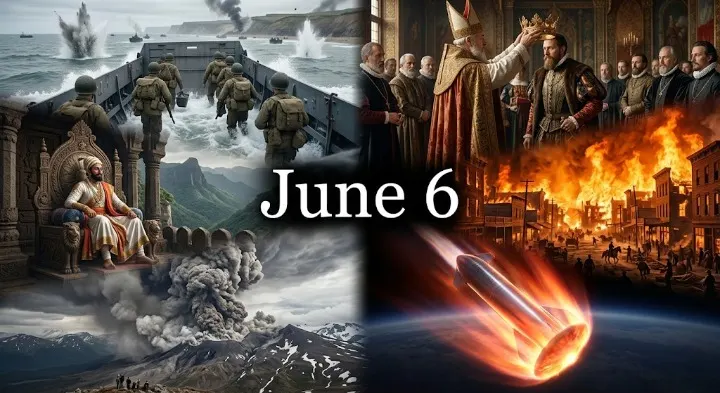
Private Dutch Schultz lay gripping the vibrating floor of his landing craft as English Channel spray soaked his uniform. The twenty-one-year-old paratrooper knew the flat-bottomed boat was heading straight into a wall of German machine-gun fire. Millions of lives hung in the balance across a fifty-mile stretch of French coastline. This day in history June 6 marks the moment the modern world held its breath as the Allies launched the largest amphibious invasion ever attempted.
👶 Quick Facts — June 6 in History
| 📌 Category | 📖 Event / Detail |
|---|---|
| 🌟 Most Significant Event | Operation Overlord Allied Landings (1944) |
| 🏆 Top 10 Key Events | • Coronation of Constantine VII (913) • Lo Mustang Earthquake (1505) • Battle of Novara (1513) • Gustav Vasa Elected King (1523) • Queen Christina Abdicates (1654) • Shivaji Crowned Chhatrapati (1674) • Siege of Havana Begins (1762) • Battle of Stoney Creek (1813) • Great Seattle Fire (1889) • Novarupta Volcanic Eruption (1912) |
| ⚔️ Key Battles | Battle of Novara, Siege of Havana, Battle of Stoney Creek, First Battle of Memphis, Battle of Embabo, Battle of Belleau Wood, Battle of Midway (final operations), Operation Neptune (D-Day), Battle of Raqqa |
| 👤 Key Figures | General Dwight D. Eisenhower, King Gustav Vasa, Emperor Shivaji, Alexis St. Martin, James Meredith |
| 🌍 Observances | D-Day Invasion Anniversary, National Day of Sweden, Memorial Day (South Korea), Queensland Day, UN Russian Language Day |
Story of the Day: The Longest Day at Normandy
Dwight D. Eisenhower scribbled a draft apology note on a scrap piece of paper just in case the entire operation ended in disaster. He then sent 160,000 Allied troops straight into the teeth of Nazi fortifications along the beaches of Normandy. Code-named Operation Neptune, this massive seaborne assault involved five thousand landing crafts pushing through rough, grey waves. Soldiers dropped into neck-deep water under a hail of heavy artillery and whizzing bullets. By nightfall, British, American, and Canadian troops secured tentative footholds on five blood-stained beaches, cracking Hitler’s Atlantic Wall wide open. This monumental gamble turned the tide of World War II, initiating the slow, agonizing liberation of Western Europe.
Important Events That Happened On June 6 In History
913 – An Eight-Year-Old Boy Inherits Byzantium
Constantine VII sat wide-eyed on the ornate throne of Constantinople while powerful adult men whispered political schemes around him. The illegitimate child faced immediate danger after his dying uncle, Alexander, appointed a unstable seven-man regency council led by Patriarch Nicholas Mystikos. Royal bloodlines meant little in the cutthroat atmosphere of the Byzantine Empire, where assassination was a common political tool. The boy survived the initial palace plots, eventually ruling for decades and becoming one of the empire’s greatest scholar-monarchs.
1505 – The Lo Mustang Earthquake Devastates Tibet
Mountain walls crumbled instantly into deep Himalayan valleys as a massive magnitude 8.2 earthquake ripped through the earth. Pagodas, ancient monasteries, and entire villages across Nepal and Tibet vanished beneath roaring cascades of rock and dust. The violent shockwaves traveled hundreds of miles south, splitting foundations in Kathmandu and terrorizing people across the Indo-Gangetic plain. This catastrophic tectonic shift altered the regional landscape forever, wiping out families and flattening early architectural wonders.
1513 – Swiss Pikes Shatter French Ambitions in Italy
Thick mud splattered across the heavy armor of French soldiers as Swiss infantrymen emerged from the morning mist near Novara. King Louis II de la Trémoille thought his forces held the upper hand, but the aggressive Swiss charge completely overwhelmed his lines. Fierce hand-to-hand combat ended with the total route of the French army, forcing them to completely abandon their territorial claims in Milan. Duke Massimiliano Sforza returned to power that evening, cementing the reputation of Swiss mercenary units as the most feared infantry in Europe.
1523 – Gustav Vasa Snaps the Kalmar Union
Gustav Vasa accepted the crown from roaring Swedish nobles, ending centuries of Danish dominance with a single political decree. The newly elected king stepped forward to lead a nation fractured by years of bitter rebellion and bloody executions. This bold declaration severed ties with the Scandinavian alliance, giving birth to the modern independent state of Sweden. The historic date remains so deeply woven into the national identity that the country still celebrates it every year as its National Day.
1654 – Queen Christina Walks Away from the Throne
Queen Christina shocked the royal courts of Europe by stripped off her Swedish regalia and formally abdicating in front of her assembled parliament. The highly intellectual ruler refused to marry, loathed royal court expectations, and secretively planned a forbidden life change. She handed the crown over to her cousin, Charles Gustav, before fleeing the Protestant nation to convert to Roman Catholicism. Her dramatic exit allowed her to live as an independent philosopher in Rome, proving that personal conviction could outweigh imperial power.
1674 – Shivaji Founds the Maratha Empire
Shivaji Maharaj climbed the stone steps of Raigad Fort while priest poured holy waters over his head to crown him Chhatrapati. The legendary warrior-leader successfully defied the massive Mughal Empire and the regional Deccan sultanates to carve out an independent Hindu kingdom. This elaborate coronation ceremony challenged foreign dominance over the Indian subcontinent, establishing a powerful new sovereignty. His military innovations and administrative systems laid foundations for an empire that would dominate India for over a century.
1762 – British Warships Blockade Spanish Havana
Admiral George Pocock watched from his flagship deck as hundreds of British transport vessels surrounded the heavily fortified harbor of Havana. The massive amphibious operation caught the Spanish garrison completely off guard during the heights of the Seven Years’ War. British troops landed on the tropical beaches, beginning a grueling two-month siege defined by yellow fever and intense artillery duels. The eventual fall of the wealthy city crippled Spanish trade networks, shifting global colonial power balances toward London.
1813 – A Night Raid Saves Upper Canada
Colonel John Vincent led seven hundred British regulars silently through the pitch-black woods of Stoney Creek to launch a desperate surprise bayonet charge. A massive American force double their size slept soundly around their campfires, confident after recent military advances. The chaotic night battle resulted in the capture of both American generals, forcing the invading army into a disorganized, panicked retreat. This tactical gamble saved Upper Canada from total conquest, marking a permanent strategic turning point in the War of 1812.
1822 – A Shotgun Blast Creates a Living Window
Alexis St. Martin groaned on a cabin floor after an accidental shotgun blast tore a gaping hole directly into his stomach. Army surgeon William Beaumont rushed to dress the horrific wound, fully expecting the young French-Canadian fur trapper to die within hours. The injury miraculously healed in a bizarre fashion, leaving an open, functional skin flap leading straight into the stomach cavity. Beaumont used this unique opportunity to conduct years of pioneering experiments, fundamentally changing medical knowledge regarding human digestion.
1832 – The June Rebellion Dies in Paris
National Guardsmen charged the barricades of the Rue Saint-Denis, ruthlessly cutting down the last student revolutionaries fighting for a new French Republic. The anti-monarchist uprising erupted during a crowded funeral procession, but failed to gather the widespread public support the young rebels desperately needed. Victor Hugo watched these tragic street battles unfold, capturing the desperate bravery of the doomed idealists. The failed insurrection solidified King Louis-Philippe’s grip on power, inspiring the iconic events later immortalized in Les Misérables.
1844 – George Williams Offers Refuge to London Youth
George Williams gathered a small group of fellow drapers in a dingy room above a London shop to address a growing social crisis. The Industrial Revolution filled the city with young rural men working brutal hours and living in squalid, temptation-filled tenements. Williams created a safe, non-denominational Christian space focused on prayer, education, and healthy community life. This modest meeting birthed the Young Men’s Christian Association (YMCA), expanding globally to support millions of young people.
1859 – Queensland Splits from New South Wales
Queen Victoria signed the formal letters patent, officially separating the massive northern frontier territory from New South Wales. Settlers in Brisbane celebrated the news wildly, eager to manage their own vast natural resources and political destiny. The new colony received the name Queensland in honor of the British monarch, establishing its own independent parliament weeks later. Local citizens still commemorate this foundational moment of autonomy every year on June 6, calling it Queensland Day.
1862 – Union Gunboats Obliterate the Confederate Mississippi Fleet
Flag Officer Charles Davis ordered his ironclad fleet forward, engaging a makeshift line of Confederate cottonclad rams right in front of Memphis. Thousands of local citizens crowded the river bluffs to watch the fierce, roaring naval battle unfold beneath thick black smoke. The superior Union firepower sank or captured nearly the entire southern flotilla in under an hour of intense ramming and shooting. The immediate surrender of the city gave the Union total control over the northern Mississippi River, cutting off vital southern supply lines.
1882 – The Shewan Hegemony Rises in Ethiopia
Menelik II of Shewa directed his troops forward at the Battle of Embabo, smashing the opposing Gojjame army in a brutal clash for regional supremacy. Shewan forces quickly captured the enemy leader, Negus Tekle Haymanot, completely breaking his political influence. This decisive victory established Menelik’s undisputed dominance over the wealthy trade territories located south of the Abay River. The triumph paved his direct path to the imperial throne, laying structural foundations for a unified modern Ethiopian state.
1889 – A Glue Pot Ignites the Great Seattle Fire
John Back was heating a pot of animal glue over a gasoline stove when it accidentally boiled over, catching greasy wood shavings on fire. The small wood-shop blaze quickly spread through downtown Seattle, fueled by dry wooden buildings and a broken municipal water system. The inferno raged for hours, completely destroying over twenty-five blocks of businesses, docks, and houses. Local residents refused to quit, rebuilding the entire city center using brick, stone, and elevated iron street grids.
1892 – The Chicago “L” Carries Its First Passengers
Steam locomotive number four chugged out of the station, pulling three wooden passenger cars along a brand-new elevated iron track high above the city streets. Thousands of curious commuters bought tickets, eager to bypass the congested, muddy thoroughfares of late-nineteenth-century Chicago. This inaugural run marked the official birth of the iconic Chicago “L” rapid transit network. The innovative transit system allowed the city to rapidly expand outward, transforming how urban populations lived, worked, and commuted.
1894 – Colorado Troops Step In to Protect Striking Miners
Governor Davis H. Waite ordered the state militia to march into the Cripple Creek mining district to protect striking laborers from corporate violence. Mine owners hired a private army of hundreds of armed deputies, intending to break the Western Federation of Miners by force. Waite’s unprecedented intervention marked the first time in American history that a state government used military force to support labor over capital. The militia successfully prevented a bloody corporate massacre, forcing owners to negotiate a fair wage compromise.
1912 – Novarupta Explodes in the Alaskan Wilderness
A massive subterranean roar echoed across the Alaska Peninsula as the earth ripped open, unleashing the most violent volcanic eruption of the twentieth century. The explosion blasted thirty times more magma into the atmosphere than the later 1980 eruption of Mount St. Helens. Ash clouds choked out the sun for three consecutive days, turning day into pitch-black night across towns hundreds of miles away. The cataclysmic event created the famous Valley of Ten Thousand Smokes, leaving a scarred, volcanic landscape behind.
1918 – U.S. Marines Face the Horror of Belleau Wood
First Lieutenant John Thomason led his men directly into a dense, dark forest of tangled trees and hidden German machine-gun nests near Château-Thierry. The U.S. Marine Corps suffered its worst single-day casualty count in history as they advanced across open wheat fields under relentless artillery fire. The intense hand-to-hand fighting became so fierce that the desperate Germans nicknamed their American adversaries “Devil Dogs.” The Marines successfully held the line, stopping a major German offensive aimed directly at Paris.
1925 – Walter Chrysler Launches an Automotive Empire
Walter Chrysler stood inside the remains of the struggling Maxwell Motor Company and signed the legal paperwork creating the original Chrysler Corporation. The ambitious mechanic-turned-executive knew the highly competitive American automobile market required innovative engineering and affordable pricing to survive. He immediately introduced advanced features like four-wheel hydraulic brakes and high-compression engines to the public. His shrewd business reorganization turned a failing factory into one of the big three Detroit automotive manufacturing giants.
1933 – The First Drive-In Movie Theater Opens
Richard Hollingshead invited drivers to park their vehicles on his gravel lot in Camden, New Jersey, to watch a movie projected onto a giant screen. He mounted three large speakers to the screen structure, allowing families to enjoy film entertainment from the comfort of their own automobiles. This innovative outdoor entertainment model combined two of America’s greatest mid-century obsessions: Hollywood cinema and car culture. The concept exploded in popularity across the country, creating a timeless cultural staple of suburban American life.
1934 – FDR Cleans Up Wall Street
President Franklin D. Roosevelt signed the Securities Exchange Act into law, striking a massive regulatory blow against fraudulent financial speculation. The New Deal legislation established the U.S. Securities and Exchange Commission to police stock markets and protect everyday investors. Wall Street operators could no longer manipulate stock values in dark, unregulated rooms without facing serious federal criminal penalties. This structural reform restored public trust in American financial institutions following the devastating stock market crash of 1929.
1942 – Four Japanese Aircraft Carriers Sink at Midway
Admiral Isoroku Yamamoto ordered a strategic retreat as the remaining ships of the Imperial Japanese Navy sailed away from Midway Atoll in defeat. American dive-bombers caught the Japanese fleet at a vulnerable moment, sinking four elite aircraft carriers—Akagi, Kaga, Sōryū, and Hiryū—in a single day. The devastating naval loss cost Japan its experienced pilots and permanent naval supremacy in the Pacific Theater. This stunning victory turned the tide of World War II, putting American forces on an offensive march toward Tokyo.
1944 – British Gliders Secure the Pegasus Bridge
Major John Howard led six wooden gliders through the dark night sky, landing silently just yards away from the vital Caen canal and Orne River bridges. British paratroopers burst out of the aircraft, overwhelming the German defenders in a daring, fast-paced surprise assault known as Operation Coup de Main. Holding these bridges prevented German armored divisions from launching counterattacks against the vulnerable Allied troops landing on the beaches. This precise airborne operation secured the eastern flank of the Normandy invasion within minutes.
1966 – A Sniper Halts the March Against Fear
James Meredith walked down Highway 51 near Hernando, Mississippi, determined to encourage African-American citizens to register to vote despite white intimidation. A white sniper hidden in the roadside bushes suddenly fired several shotgun blasts, dropping the prominent civil rights activist to the pavement. Photographer Jack R. Thornell captured the raw agony of the wounded leader, producing a jarring image that won the Pulitzer Prize. The violent attack backfired completely, drawing thousands of civil rights leaders to complete the historic march.
1971 – Soyuz 11 Launches Toward Tragedy
Cosmonauts Georgy Dobrovolsky, Vladislav Volkov, and Viktor Patsayev smiled and waved as their rocket blasted off from the Baikonur Cosmodrome. The crew successfully docked with Salyut 1, completing three weeks of groundbreaking scientific research inside the world’s very first space station. Their triumphant return turned into a nightmare when an automated ventilation valve jerked open during re-entry, venting their oxygen into space. The capsule landed safely on target, but recovery teams opened the hatch to find all three men suffocated.
1971 – Two Planes Collide Over the San Gabriel Mountains
Captain Robert Nicolai guided his Hughes Airwest DC-9 commercial airliner through a routine descent toward Los Angeles international airport. Without warning, a military F-4 Phantom jet fighter traveling at supersonic speeds sliced directly through the civilian aircraft over southern California. The violent mid-air collision tore both planes apart, sending debris raining down into the rugged canyons below. All fifty people aboard the commercial airliner died instantly, prompting federal authorities to completely overhaul national civilian-military air traffic control safety systems.
1975 – British Voters Say Yes to Europe
Everyday citizens across the United Kingdom walked into local polling stations to cast ballots in the country’s first nationwide referendum. Prime Minister Harold Wilson called the public vote to decide if Britain should remain inside the European Economic Community. An overwhelming sixty-seven percent of voters chose to stay, reflecting a widespread desire for economic stability and continental cooperation. This historic decision bound Britain’s economic future to Europe for forty years until the Brexit vote reversed it.
1976 – The Double Six Crash Shakes Sabah
Chief Minister Tun Fuad Stephens boarded a small Australian-built Nomad aircraft to return home after critical economic negotiations in Malaysia. The plane stalled mysteriously during its final approach, plunging straight into the shallow coastal waters near Kota Kinabalu Airport. The violent impact killed Stephens and several key members of his state cabinet, wiping out an entire political generation. The sudden loss altered the political trajectory of Sabah, sparking decades of intense conspiracy theories regarding natural resource control.
1982 – Israeli Tanks Cross into Lebanon
Defense Minister Ariel Sharon ordered Israeli armored columns across the northern border, launching Operation Peace for the Galilee. The invasion aimed to eliminate Palestinian Liberation Organization bases that were launching rocket attacks into northern Israeli towns. The military advance quickly pushed past the border zone, leading to intense urban warfare and a prolonged siege of Beirut. This aggressive intervention drew Israel into a complex, decades-long military occupation that reshaped the modern geopolitical landscape of the Middle East.
1985 – The Angel of Death is Exhumed in Brazil
Forensic scientists gathered around an overgrown grave marked “Wolfgang Gerhard” in a small Brazilian cemetery, carefully digging up human remains. International investigators believed the plot actually held the body of Josef Mengele, the notorious Auschwitz concentration camp doctor who evaded capture for decades. Advanced skeletal analysis and subsequent DNA testing proved the sadistic war criminal drowned while swimming at a local resort in 1979. The discovery closed a long chapter of the post-war hunt for missing Nazi fugitives.
1992 – Copa Flight 201 Plunges into the Jungle
Captain Chial led his Boeing 737 into a patch of turbulent weather shortly after taking off from Panama City. A malfunctioning attitude indicator tricked the pilots into believing the plane was turning left, causing them to overcorrect and enter a steep dive. The extreme aerodynamic forces broke the aircraft apart in mid-air before it slammed into the dense, remote jungle of the Darién Gap. All forty-seven people on board died, forcing airlines to improve pilot training regarding cockpit instrument failures.
1993 – Mongolia Chooses Its First Elected President
Punsalmaagiin Ochirbat stood before roaring crowds after winning Mongolia’s first direct, democratic presidential election. The nation spent decades functioning as a isolated Soviet satellite state before peaceful street protests forced a systemic democratic transition. Ochirbat’s victory solidified the country’s shift toward a open market economy and a multiparty political framework. This peaceful transfer of executive power proved that democratic institutions could thrive in a region long dominated by authoritarian regimes.
1994 – A Hidden Repair Flaw Brings Down Flight 2303
A China Northwest Airlines Tupolev Tu-154 rolled down the runway at Xi’an Airport, carrying 160 passengers bound for the southern coast. Just minutes after takeoff, an undetected maintenance error caused the automated flight control system to shake the aircraft violently from side to side. The structural frame could not withstand the extreme mechanical vibrations, breaking apart over rural farmlands. The tragic crash remains the deadliest aviation disaster to ever occur on mainland Chinese soil.
2002 – An Asteroid Explodes Over the Mediterranean
An undetected ten-meter space rock slammed into Earth’s upper atmosphere at thousands of miles per hour between Greece and Libya. The sudden friction triggered a blinding mid-air detonation, releasing twenty-six kilotons of energy over the open sea. The blast force exceeded the atomic bomb dropped on Nagasaki, sending low-frequency sound waves around the globe. Because the blast happened over deep ocean waters, it caused zero damage, reminding scientists how vulnerable the planet remains to random space debris.
2017 – The Battle to Reclaim Raqqa Begins
Syrian Democratic Forces advanced into the outskirts of Raqqa under the cover of intense coalition airstrikes, launching an offensive to liberate the city. The urban stronghold served as the de facto capital of the Islamic State terror network for years. Elite soldiers faced months of grueling street-by-street clearing operations against hidden snipers, suicide bombers, and extensive improvised explosive traps. The brutal battle eventually liberated the local population, breaking the territorial grip of the caliphate.
2023 – The Kakhovka Dam Collapses Amidst War
A massive midnight explosion ripped through the structural heart of the Kakhovka Dam, sending millions of tons of water roaring down the Dnipro River. The catastrophic breach flooded dozens of downstream Ukrainian villages, forcing thousands of civilians to abandon their homes in panic. The artificial deluge destroyed vital agricultural fields, triggered long-term ecological disasters, and threatened the cooling systems of Europe’s largest nuclear power plant. The destruction introduced a devastating new environmental crisis to the ongoing war.
2024 – Starship Achieves a Fiery Indian Ocean Landing
SpaceX engineers cheered in California as the massive Starship rocket survived peak atmospheric heating during its fourth integrated flight test. The giant steel spacecraft suffered visible flap damage from scorching plasma, but maintained stable control during its descent through the upper atmosphere. The vehicle completed its complex flip maneuver, executing a soft splashdown in the Indian Ocean right on target. This engineering milestone brought humanity one step closer to developing fully reusable rockets capable of reaching Mars.
Trace our historical timeline one step further by clicking here.
Famous People Born On June 6
| Name | Description | Date |
|---|---|---|
| Regiomontanus | German mathematician, astronomer, and bishop, a key figure in the development of modern astronomy | 1436 – 1476 |
| Diego Velázquez | Spanish painter and leading artist of the Spanish Golden Age, court painter to King Philip IV | 1599 – 1660 |
| Pierre Corneille | French playwright and producer, considered one of the three great 17th-century French dramatists | 1606 – 1684 |
| Joseph I of Portugal | King of Portugal from 1750 until his death, known for rebuilding Lisbon after the 1755 earthquake | 1714 – 1777 |
| Nathan Hale | American soldier and spy for the Continental Army during the American Revolutionary War, executed by the British | 1755 – 1776 |
| Alexander Pushkin | Russian author and poet, widely considered the founder of modern Russian literature | 1799 – 1837 |
| Friedrich Bayer | German pharmacist and founder of the pharmaceutical company Bayer | 1825 – 1880 |
| Karl Ferdinand Braun | German-American physicist and academic, Nobel Prize laureate for contributions to wireless telegraphy | 1850 – 1918 |
| Robert Falcon Scott | English Royal Navy officer and explorer who led two expeditions to the Antarctic, reaching the South Pole in 1912 | 1868 – 1912 |
| Thomas Mann | German novelist and critic, Nobel Prize laureate, author of Death in Venice and The Magic Mountain | 1875 – 1955 |
| Italo Balbo | Italian air marshal and fascist politician who led the Italian Air Force and helped develop Mussolini’s air power | 1896 – 1940 |
| Sukarno | Indonesian engineer and politician, 1st President of Indonesia and a key figure in the country’s independence movement | 1901 – 1970 |
| Aram Khachaturian | Armenian composer and conductor, best known for his ballet Spartacus and the Sabre Dance | 1903 – 1978 |
| Isaiah Berlin | Latvian-English historian and philosopher, known for his work on political philosophy and the concept of liberty | 1909 – 1997 |
| Hamani Diori | Nigerien academic and politician, 1st President of Niger, serving from 1960 to 1974 | 1916 – 1989 |
| Kirk Kerkorian | American businessman and financier who built the Tracinda Corporation and was a major figure in the Las Vegas casino industry | 1917 – 2015 |
| Edwin G. Krebs | American biochemist and academic, Nobel Prize laureate for discoveries concerning protein phosphorylation | 1918 – 2009 |
| Peter Carington, 6th Baron Carrington | British army officer and politician, 6th Secretary General of NATO, known for his diplomatic career | 1919 – 2018 |
| Sunil Dutt | Indian actor, director, producer, and politician, a major star of Hindi cinema | 1929 – 2005 |
| David Scott | American colonel, engineer, and NASA astronaut, commander of Apollo 15 and one of only 12 men to walk on the Moon | 1932 – Present |
| Heinrich Rohrer | Swiss physicist and academic, Nobel Prize laureate for co-inventing the scanning tunneling microscope | 1933 – 2013 |
| Albert II | King of the Belgians from 1993 to 2013, abdicated in favor of his son Philippe | 1934 – Present |
| Levi Stubbs | American soul singer and lead vocalist of the Four Tops, a legendary Motown group | 1936 – 2008 |
| Marian Wright Edelman | American activist and founder of the Children’s Defense Fund, a leading child rights advocate | 1939 – Present |
| Richard Smalley | American chemist and academic, Nobel Prize laureate for the discovery of fullerenes (buckyballs) | 1943 – 2005 |
| Tommie Smith | American sprinter and football player, 1968 Olympic 200m gold medalist famous for his Black Power salute | 1944 – Present |
| Robert Englund | American actor, best known for portraying Freddy Krueger in the Nightmare on Elm Street franchise | 1947 – Present |
| Harvey Fierstein | American actor and playwright, a four-time Tony Award winner known for Torch Song Trilogy | 1952 – Present |
| Björn Borg | Swedish tennis player, winner of eleven Grand Slam singles titles including five consecutive Wimbledon championships | 1956 – Present |
| Paul Giamatti | American actor and producer, known for roles in Sideways and Billions, winner of a Golden Globe and an Academy Award | 1967 – Present |
Famous People Died On June 6
| Name | Description | Date |
|---|---|---|
| Alexander III | Byzantine Emperor from 912 to 913, known for his brief and ineffective reign | 870 – 913 |
| Norbert of Xanten | German bishop and saint, founder of the Premonstratensian order of canons regular | 1060 – 1134 |
| Henry I | King of Castile and Toledo, ascended at age 11 and died young, his reign was short and unstable | 1204 – 1217 |
| João de Castro | Portuguese soldier and politician, 4th Governor of Portuguese India, known for his naval campaigns | 1500 – 1548 |
| Patrick Henry | American lawyer and politician, 1st Governor of Virginia, famous for his “Give me liberty, or give me death!” speech | 1736 – 1799 |
| Jeremy Bentham | English jurist and philosopher, founder of modern utilitarianism and a leading social reformer | 1748 – 1832 |
| Camillo Benso, Count of Cavour | Italian politician and statesman, 1st Prime Minister of Italy, a key figure in the unification of Italy | 1810 – 1861 |
| William Quantrill | American Confederate guerrilla leader during the American Civil War, notorious for his brutal tactics | 1837 – 1865 |
| Robert Stirling | Scottish minister and engineer, inventor of the Stirling engine, a heat engine that is still of interest today | 1790 – 1878 |
| John A. Macdonald | Scottish-Canadian lawyer and politician, 1st Prime Minister of Canada, a key architect of Canadian Confederation | 1815 – 1891 |
| Yuan Shikai | Chinese general and politician, 2nd President of the Republic of China, who attempted to restore the monarchy | 1859 – 1916 |
| Lillian Russell | American actress and singer, a major star of vaudeville and musical theater in the late 19th and early 20th centuries | 1860 – 1922 |
| Julian Byng, 1st Viscount Byng of Vimy | British field marshal and politician, 12th Governor-General of Canada, commander of the Canadian Corps at Vimy Ridge | 1862 – 1935 |
| Louis Chevrolet | American race car driver and businessman, co-founder of the Chevrolet Motor Car Company | 1878 – 1941 |
| Gerhart Hauptmann | German novelist, poet, and playwright, Nobel Prize laureate and a leading figure in German naturalism | 1862 – 1946 |
| Louis Lumière | French film director, producer, and screenwriter, one of the pioneers of cinema alongside his brother Auguste | 1864 – 1948 |
| Carl Gustav Jung | Swiss psychiatrist and psychotherapist, founder of analytical psychology, a towering figure in the history of psychology | 1875 – 1961 |
| Yves Klein | French painter, a leading figure in post-war European art and the Nouveau Réalisme movement, known for his International Klein Blue | 1928 – 1962 |
| Robert F. Kennedy | American soldier, lawyer, and politician, 64th United States Attorney General and a U.S. Senator, assassinated during his 1968 presidential campaign | 1925 – 1968 |
| J. Paul Getty | American businessman, founder of Getty Oil Company, who was once the richest living man in the world | 1892 – 1976 |
| Stan Getz | American saxophonist and jazz innovator, known as “The Sound” for his lyrical tone, a key figure in bossa nova | 1927 – 1991 |
| George Davis Snell | American geneticist and immunologist, Nobel Prize laureate for his studies of histocompatibility and transplantation | 1903 – 1996 |
| Anne Bancroft | American film actress, winner of the Academy Award for Best Actress for her role in The Miracle Worker | 1931 – 2005 |
| Billy Preston | American singer-songwriter and pianist, a renowned session musician who worked with The Beatles and The Rolling Stones | 1946 – 2006 |
| Jean Dausset | French-Spanish immunologist and academic, Nobel Prize laureate for his work on the major histocompatibility complex | 1916 – 2009 |
| Vladimir Krutov | Russian ice hockey player, a member of the famed KLM Line and one of the greatest Soviet players of all time | 1960 – 2012 |
| Jerome Karle | American crystallographer and academic, Nobel Prize laureate for developing methods for determining the structure of molecules | 1918 – 2013 |
| Esther Williams | American swimmer and actress, known for her starring roles in MGM musicals and swimming spectaculars | 1921 – 2013 |
| Viktor Korchnoi | Russian chess grandmaster, widely regarded as the best player never to win the World Chess Championship | 1931 – 2016 |
| Peter Shaffer | English playwright and screenwriter, best known for his plays Equus and Amadeus, which won multiple awards | 1926 – 2016 |
Observances on June 6
- D-Day Invasion Anniversary: Commemorated globally across the beaches of Normandy, France, to honor the Allied soldiers who fought and died during the 1944 liberation of Europe.
- National Day of Sweden: Celebrated across Sweden with royal processions and flag ceremonies to mark the 1523 election of King Gustav Vasa and the birth of the independent nation.
- Memorial Day (South Korea): Observed with a nationwide one-minute siren at 10:00 AM to honor the military personnel who died during the Korean War and other national conflicts.
- Queensland Day: Marked throughout the Australian state of Queensland to celebrate its formal separation from New South Wales as an independent colony in 1859.
- UN Russian Language Day: Established by UNESCO to promote cultural diversity and honor literature icon Alexander Pushkin, who was born on this date in 1799.
🪖 Frequently Asked Questions — June 6 in History
Allied forces launched Operation Overlord, landing 160,000 troops along a fifty-mile stretch of heavily fortified French coastline in Normandy. This massive amphibious assault cracked Hitler’s Atlantic Wall and initiated the liberation of Western Europe from Nazi control.
The D-Day landings of 1944 stand as the most significant event of this date due to the immense scale of the operation and its immediate impact on ending World War II. It altered the geopolitical landscape of Europe for the remainder of the twentieth century.
Alexander Pushkin, widely considered the father of modern Russian literature, was born on this date in 1799. His poetic masterpieces and dramatic works fundamentally reshaped the structure and style of the Russian literary language.
The Battle of Belleau Wood occurred on this date in 1918, during which the U.S. Marine Corps suffered its worst single-day casualty count in history while stopping a German advance toward Paris.
This holiday commemorates the election of Gustav Vasa as King of Sweden on June 6, 1523, which effectively dissolved the troubled Kalmar Union with Denmark. It marks the foundation of Sweden as an independent, modern sovereign state.
The SpaceX Starship rocket successfully completed its fourth integrated flight test on this date in 2024, surviving extreme atmospheric re-entry heating to execute a controlled splashdown in the Indian Ocean.