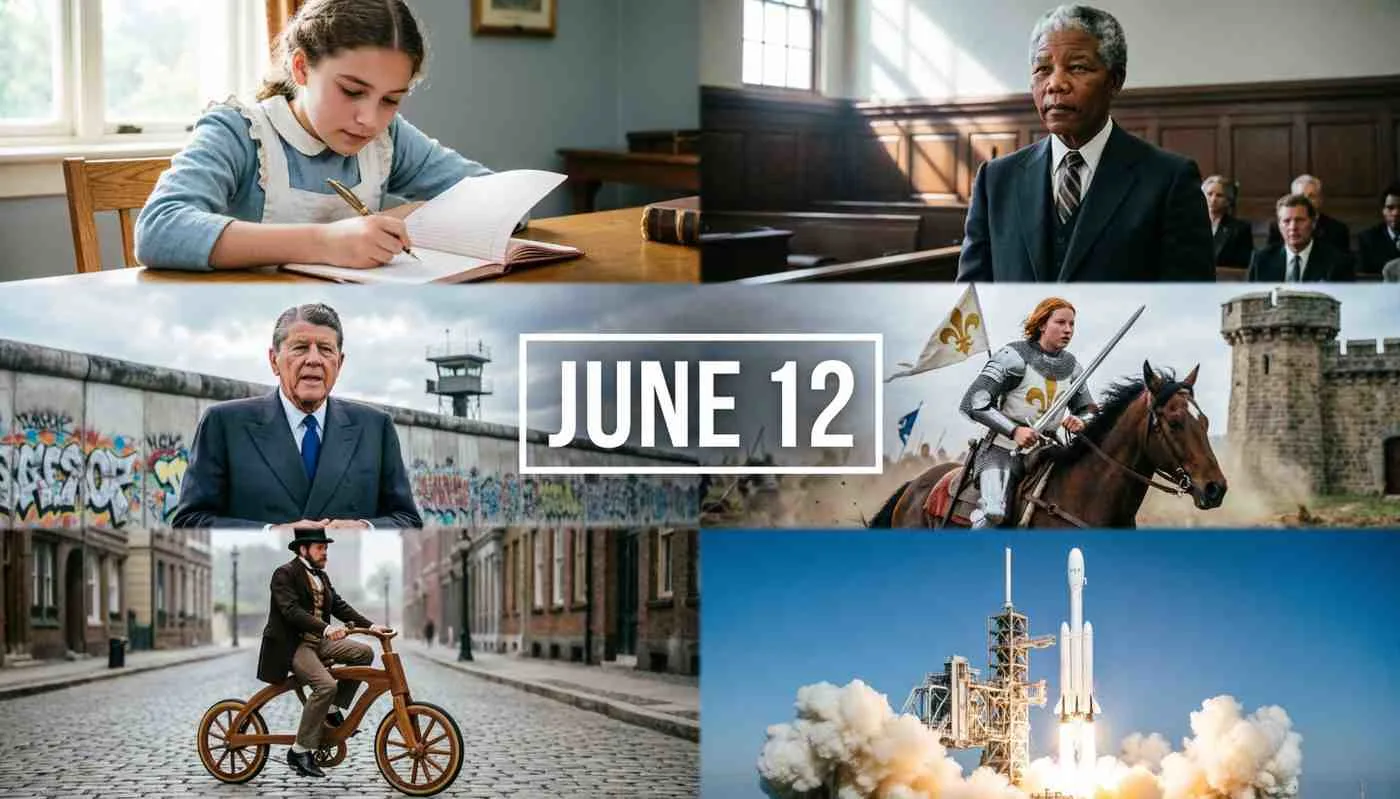
Anne Frank sat at her family’s dining table on the morning of June 12, 1942, unwrapping a red-and-white checkered autograph book that would become the world’s most famous diary. Outside her Amsterdam window, Nazi occupation tightened its grip daily. Inside, a thirteen-year-old girl began writing down her thoughts, completely unaware that her private words would eventually expose the raw human reality of the Holocaust to future generations. Finding out what happened on June 12 in history reveals how singular moments of courage, tragedy, and political defiance permanently reshape the global landscape.
📅 Quick Facts — June 12 in History
| 📌 Category | 📖 Event / Detail |
|---|---|
| 🌟 Most Significant Event | Anne Frank receives her diary (1942) |
| 🏆 Top 10 Key Events | • Battle of Augsburg (910) • Founding of Delhi Sultanate (1206) • Capture of Jargeau by Joan of Arc (1429) • Founding of Helsinki (1550) • Adoption of Virginia Declaration of Rights (1776) • Philippine Independence Declaration (1898) • Nelson Mandela life sentence (1964) • Loving v. Virginia ruling (1967) • Ronald Reagan’s Berlin Wall speech (1987) • Camp Speicher massacre (2014) |
| ⚔️ Key Battles | Battle of Augsburg, Battle of Jargeau, Battle of Gabbard, Battle of Ballynahinch, Battle of Cold Harbor, Battle of Carentan |
| 👤 Key Figures | Anne Frank, Nelson Mandela, Ronald Reagan, Joan of Arc |
| 🌍 Observances | Loving Day (USA), Russia Day, World Day Against Child Labour, Independence Day (Philippines) |
Story of the Day: Nelson Mandela Sentenced to Life Behind Bars
Eight men sat quietly in a Pretoria courtroom on June 12, 1964, waiting to hear if they would hang. Nelson Mandela and his fellow anti-apartheid activists had spent months on trial for sabotage and plotting to overthrow the South African government. Instead of a death sentence, the judge handed down life imprisonment, sending Mandela to the brutal limestone quarries of Robben Island. Rather than silencing the resistance, this sentence turned Prisoner 46664 into a global symbol of unyielding defiance against racial oppression.
Important Events That Happened On June 12 In History
910 – Battle of Augsburg
Hungarian horse archers wheeled around in apparent panic, fleeing from King Louis the Child’s East Frankish army across the plains of Germany. The pursuing German soldiers broke ranks, celebrating an easy victory too early. Suddenly, the nomadic warriors turned on their horses and launched a devastating volley of arrows into the disorganized pursuers. This classic feigned retreat completely shattered the Frankish forces, cementing Hungarian military dominance in Central Europe for a generation.
1042 – Constantine IX Monomachos Crowned Byzantine Emperor
Constantine IX Monomachos walked into the imperial palace of Constantinople to receive his crown, completing an astonishing rise to power. Just twenty-four hours earlier, he had married the aging Empress Zoe Porphyrogenita to secure his place on the throne. The hasty union ended a volatile political vacuum that had threatened the empire with civil war. His reign would stabilize the Byzantine court but also oversee the deepening religious rifts that eventually led to the Great Schism.
1206 – Qutb ud-Din Aibak Founds Delhi Sultanate
Qutb ud-Din Aibak, a former military slave who rose to become a trusted general, declared himself the independent ruler of northern India. His coronation in Lahore broke ties with the central Asian Ghurid Empire and established the Delhi Sultanate. This political shift marked the formal beginning of centuries of Islamic dynastic rule across the Indian subcontinent. The new administration initiated a massive wave of architectural and cultural transformation, blending Persian and local Indian traditions.
1240 – Disputation of Paris Begins
Four prominent rabbis sat down across from a Christian monk converted from Judaism inside the royal court of King Louis IX. The tense, forced theological debate targeted the contents of the Talmud, which the Church claimed insulted Christian beliefs. This highly orchestrated public trial gave Jewish scholars little room for real defense. Within two years, the immediate consequence of this confrontation was the public burning of twenty-four wagonloads of irreplaceable Hebrew manuscripts in Paris.
1381 – Peasants’ Revolt Encamps at Blackheath
Wat Tyler led tens of thousands of angry English laborers onto the fields of Blackheath, just outside the city walls of London. Armed with pitchforks and clubs, the commoners demanded an immediate end to serfdom and the hated poll tax. King Richard II could see the campfires from the Tower of London as the country’s social hierarchy faced its greatest challenge. The massive gathering set off days of violent rioting that resulted in the burning of tax records and execution of royal ministers.
1418 – Armagnac-Burgundian Civil War Massacres
Angry Parisian mobs smashed through prison doors, hunting down anyone associated with Bernard VII, Count of Armagnac. The long-running French civil war boiled over into the streets as citizens slaughtered Armagnac sympathizers, foreign bankers, and students. Thousands of bodies lined the roads as the rival Burgundian faction seized complete control of the capital. This savage internal slaughter crippled French unity at the exact moment English invaders were marching through Normandy.
1429 – Joan of Arc Captures Jargeau
Joan of Arc charged toward the walls of Jargeau, waving her white banner to rally French troops on the second day of the siege. An English stone struck her helmet, knocking the teenage mystic from her scaling ladder, but she scrambled back up instantly. Her fierce momentum overwhelmed the defenders, forcing the capture of the English commander, William de la Pole. This rapid victory secured the Loire River valley, opening a direct path for the coronation of the French king.
1550 – Helsinki Founded by King Gustav I
King Gustav I of Sweden issued a royal decree ordering the merchants of several coastal towns to pack up and move to a new trading outpost. This forced settlement on the Gulf of Finland aimed to compete directly with the powerful Hanseatic city of Reval across the water. The early wooden village struggled for decades against poverty, disease, and harsh winter isolation. Centuries later, this remote Swedish outpost would transform into the thriving, modern capital city of Finland.
1643 – Westminster Assembly Convenes
One hundred and twenty-one Puritan theologians gathered inside Westminster Abbey without the permission of King Charles I. The English Parliament ordered this meeting to completely restructure the Church of England, aiming to strip away the remaining Catholic traditions. This direct defiance of royal authority deepened the ideological divide of the ongoing English Civil War. The assembly spent years producing the Westminster Confession of Faith, which still guides Presbyterian churches worldwide today.
1653 – Battle of the Gabbard Begins
One hundred Dutch warships clashed with an English fleet off the coast of Suffolk, launching a massive artillery duel at sea. The opening salvos of this First Anglo-Dutch War engagement filled the North Sea with choking black powder smoke. Admiral Maarten Tromp attempted to break the English line but faced a newly organized, highly disciplined naval tactic called the line of battle. The fierce fighting raged into the next day, threatening the vital merchant shipping lanes of the Netherlands.
1665 – Thomas Willett Appointed First Mayor of New York
Thomas Willett took the oath of office as the chief executive of New York City, replacing the old Dutch system of colonial governors. The English military occupation forces selected the merchant due to his fluency in both English and Dutch, hoping to ease local tensions. His appointment marked the formal administrative transition from New Amsterdam to a permanent British colonial city. This governance model laid the foundation for the municipal structure of modern America’s largest metropolis.
1758 – Siege of Louisbourg Commences
Brigadier General James Wolfe led a daring amphibious assault through heavy surf, landing British troops on the rocky shores of Nova Scotia. French cannons poured fire onto the beaches from the massive fortress of Louisbourg, which guarded the entrance to the St. Lawrence River. Wolfe’s men fought through the defensive lines, forcing the French back into their stone ramparts. This initial breach began a grueling siege that eventually stripped France of its Atlantic stronghold in Canada.
1772 – Marc-Joseph Marion du Fresne Killed by Māori
French navigator Marc-Joseph Marion du Fresne walked into a coastal village in New Zealand’s Bay of Islands, unaware that his crew had broken local tribal taboos. Māori warriors ambushed the captain and twenty-five of his men, killing them instantly in defense of their sacred laws. The surviving French sailors launched a brutal retaliation campaign, burning nearby villages and killing hundreds of locals. The tragic cultural misunderstanding delayed European colonization of the islands for decades.
1775 – Martial Law Declared in Massachusetts
General Thomas Gage issued a stern proclamation from his headquarters in Boston, suspending all civilian laws across the rebellious colony. The British military commander offered a full royal pardon to any colonist who surrendered their weapons and returned to their allegiance. Gage named only two exceptions to this amnesty: Samuel Adams and John Hancock, who were marked for the gallows if caught. This aggressive decree closed any lingering hope for a peaceful compromise, pushing America into open war.
1776 – Virginia Declaration of Rights Adopted
Virginia delegates voted unanimously to adopt a groundbreaking framework of individual liberties during a convention in Williamsburg. Drafted largely by George Mason, the document asserted that all men are inherently free and possess natural rights to life, liberty, and property. This bold political statement directly influenced Thomas Jefferson as he drafted the Declaration of Independence a few weeks later. It remains the foundational blueprint for the United States Bill of Rights.
1798 – Battle of Ballynahinch Begins
Irish rebels armed mostly with homemade pikes took up defensive positions on the hills overlooking a small town in County Down. British forces advanced with heavy artillery, systematically shelling the insurgent lines to crush the United Irishmen rebellion. The fierce clash turned into a chaotic night of street fighting and burning buildings. The defeat at Ballynahinch shattered the revolutionary movement in Ulster, leading to mass executions of the rebel leadership.
1813 – Capture of USRC Surveyor
British boarding parties rowed silently through the darkness of Virginia’s York River, targeting the United States revenue cutter Surveyor. Captain Samuel Travis and his small crew spotted the attackers at the last moment, putting up a fierce hand-to-hand fight with cutlasses and pistols. The British outnumbered the Americans and quickly took control of the deck. Impressed by the desperate American defense, the British commander returned Travis’s sword as a token of military respect.
1817 – First Dandy Horse Bicycle Driven
Karl von Drais pushed his feet against the dirt road of Mannheim, Germany, coasting forward on a two-wheeled wooden machine. This steerable vehicle, known as the dandy horse or running machine, had no pedals or gears. Drais constructed the invention out of wood to find an alternative to horses during a period of widespread crop failures and starvation. His short journey marked the true birth of mechanized personal transport, evolving into the modern bicycle.
1821 – Sennar Kingdom Surrenders to Ottoman Empire
Badi VII, the final monarch of the Funj Dynasty, stepped down from his throne and surrendered his capital city to Isma’il Pasha. The advancing Ottoman Egyptian army used modern firearms that the ancient Sudanese kingdom could not match. This quiet surrender ended three centuries of independent black Islamic rule in the region. The conquest integrated Sudan into the expanding Ottoman realm, changing the geopolitical borders of northeast Africa forever.
1830 – French Invasion of Algiers Begins
Thirty-four thousand French soldiers marched off their transport ships onto the beaches of Sidi Ferruch, just west of Algiers. This massive military landing aimed to depose the local Ottoman ruler under the pretext of avenging a diplomatic insult. The local defensive forces could not stop the heavily armed European columns from securing the beachhead. This aggressive landing initiated a brutal, decades-long colonial conquest that integrated Algeria into the French Empire.
1864 – Battle of Cold Harbor Ends
General Ulysses S. Grant ordered his Union troops to abandon their blood-soaked trenches in Virginia and move south toward Petersburg. The withdrawal conceded a clear tactical victory to General Robert E. Lee’s well-entrenched Confederate army. Grant had lost thousands of men in a series of futile, frontal assaults against impenetrable defensive lines over twelve days. The heavy northern casualties sparked widespread anti-war protests across the Union states during an election year.
1898 – Philippine Declaration of Independence
General Emilio Aguinaldo stood on the balcony of his mansion in Cavite and unfurled the new national flag of the Philippines. Bands played the national anthem as Aguinaldo declared the islands permanently independent from three centuries of Spanish colonial rule. The celebration proved short-lived, as the United States refused to recognize the new republic. Within months, the Treaty of Paris transferred control of the islands to America, sparking a new war for independence.
1899 – New Richmond Tornado Strikes
A massive, multi-vortex tornado dropped out of the sky over Wisconsin, obliterating the town of New Richmond in a matter of minutes. The violent storm leveled the entire business district and tossed heavy brick buildings into the air during a crowded circus event. One hundred and seventeen people died, and hundreds more suffered severe injuries along the path of destruction. It remains the ninth deadliest tornado in American history, leading to major advancements in storm tracking.
1900 – Reichstag Approves German Naval Expansion
German lawmakers passed a massive defense bill authorizing the construction of thirty-eight advanced battleships over the next two decades. Kaiser Wilhelm II championed the aggressive expansion program to challenge Great Britain’s long-standing dominance over the world’s oceans. The heavy investment triggered a frantic, competitive naval arms race across Europe. This escalating military build-up poisoned diplomatic relations and helped set the stage for the outbreak of World War I.
1914 – Massacre of Phocaea
Turkish irregular troops swarmed into the ancient coastal town of Phocaea, launching a systematic campaign of violence against the ethnic Greek population. The attackers plundered homes, killed up to one hundred civilians, and forced thousands of terrified residents onto boats bound for Greece. This localized atrocity formed part of a broader, state-sponsored ethnic cleansing operation across the late Ottoman Empire. The forced expulsions permanently altered the demographic makeup of the Aegean coast.
1921 – Chemical Weapons Used Against Tambov Rebellion
Red Army commander Mikhail Tukhachevsky signed a draconian military order authorizing the deployment of toxic gas against peasant insurgents in the forests of Tambov. The desperate farmers had rebelled against the Soviet government’s brutal grain requisition policies. Choking clouds of chlorine gas forced the hidden rebels out of the woods into open gunfire. This ruthless deployment crushed the peasant uprising, solidifying Bolshevik control over the Russian countryside at a terrible human cost.
1935 – Chaco War Ceasefire Negotiated
Diplomats from Bolivia and Paraguay signed a formal armistice in Buenos Aires, bringing an immediate halt to three years of bloody jungle warfare. The conflict over the desolate, oil-rich Chaco Boreal region had cost the lives of over one hundred thousand soldiers. Both nations were financially ruined and militarily exhausted by the grueling campaign. The ceasefire line eventually became the permanent international border, leaving Paraguay in control of most of the disputed territory.
1939 – Dr. Cyclops Begins Production
Camera crews at Paramount Pictures turned on their modified, bulky cameras to begin filming the horror movie Dr. Cyclops. This production marked the first time a science fiction horror film utilized the complex, three-strip Technicolor process. The vibrant color technology enhanced the innovative special effects used to depict mad scientists and shrunken humans. The film’s commercial success proved that color cinematography could enhance dark, atmospheric fantasy stories.
1939 – Baseball Hall of Fame Opens
Thousands of sports fans packed into the small village of Cooperstown, New York, to witness the opening of the National Baseball Hall of Fame. Legendary players like Babe Ruth, Ty Cobb, and Honus Wagner stood on the stage to accept their induction as the inaugural class. The museum chose the rural location based on the popular myth that Abner Doubleday invented the game there. The opening established a permanent home to honor the history and legends of America’s pastime.
1940 – British and French Troops Surrender at Saint-Valery
General Erwin Rommel trapped thirteen thousand British and French soldiers against the sheer chalk cliffs of Saint-Valery-en-Caux. Thick coastal fog prevented the Royal Navy from launching an evacuation effort similar to the miracle at Dunkirk. Out of ammunition, food, and options, the Allied commanders surrendered their entire force to the advancing German Panzer divisions. The loss wiped out the remaining British combat units left on mainland France during the disaster of 1940.
1943 – Brzeżany Ghetto Liquidated
German SS units and local auxiliary police surrounded the Jewish ghetto in Brzeżany, Poland, rounding up the remaining residents. The troops marched roughly 1,180 men, women, and children to the city’s old Jewish graveyard. The captors forced the prisoners to strip before systematically shooting them over open pits. This brutal operation completely wiped out a historic Jewish community that had thrived in the region for hundreds of years.
1944 – American Paratroopers Secure Carentan
Soldiers of the 101st Airborne Division fought their way through the ruined streets of Carentan, clearing out the last German defenders. The strategic French town connected the American landing forces at Utah and Omaha beaches into a single, continuous front. The paratroopers endured days of intense artillery fire and close-quarters combat to hold the town against fierce German counterattacks. Securing this junction was vital for the survival of the entire Normandy beachhead.
1950 – Air France Flight Crashes Near Bahrain
An Air France Douglas DC-4 passenger plane plunged into the shallow waters of the Persian Gulf during a blinding sandstorm. The aircraft was attempting a difficult night approach to Bahrain International Airport while operating a scheduled flight from Saigon. Rescue boats rushed to the scene but found only three survivors among the forty-nine people on board. The tragedy forced international airlines to drastically improve their foul-weather navigation instruments.
1954 – Dominic Savio Canonized as a Saint
Pope Pius XII stood before a massive crowd at St. Peter’s Basilica to declare fourteen-year-old Dominic Savio a saint. The Italian teenager had died of pleurisy in 1857 after living a life dedicated entirely to faith and kindness under the guidance of Saint John Bosco. His canonization made him the youngest unmartyred saint in the history of the Roman Catholic Church at that time. His life became an inspirational model for Catholic youth groups worldwide.
1963 – Medgar Evers Assassinated
Civil rights leader Medgar Evers pulled into his driveway in Jackson, Mississippi, stepped out of his car carrying NAACP t-shirts, and was shot in the back. A white supremacist sniper, Byron De La Beckwith, fired the fatal round from a hidden position across the street. The murder of the prominent activist sparked national outrage and massive protest marches across the segregated American South. The tragedy pushed President John F. Kennedy to advocate more aggressively for comprehensive civil rights legislation.
1963 – Cleopatra Released in Theaters
Twentieth Century Fox debuted the historical epic Cleopatra in American theaters, starring Elizabeth Taylor and Richard Burton. The massive production had nearly bankrupted the movie studio due to constant script changes, lavish sets, and health emergencies. It set a record as the most expensive movie ever made up to that point in film history. Despite the off-screen scandals and mixed reviews, the film’s visual scale set a benchmark for Hollywood epics.
1967 – Supreme Court Rules on Loving v. Virginia
Chief Justice Earl Warren delivered a unanimous Supreme Court opinion invalidating all state laws that banned interracial marriage. The landmark case arose after Richard and Mildred Loving, an interracial couple, were arrested in their Virginia bedroom for breaking the state’s racial integrity laws. The historic ruling declared that the freedom to marry is a vital civil right that cannot be restricted by race. This decision overturned centuries of discriminatory legal codes across America.
1775 – State of Uttar Pradesh v. Raj Narain Ruling
Judge Jagmohanlal Sinha delivered a stunning verdict in the High Court of Allahabad, convicting Indian Prime Minister Indira Gandhi of electoral malpractice. The historic ruling voided her recent election victory and banned her from holding any public office for six years. The judicial decision threatened to strip the country’s most powerful leader of her authority, plunging the nation into an immediate political crisis. Gandhi reacted by declaring a state of national emergency to retain her grip on power.
1979 – Gossamer Albatross Crosses English Channel
Bryan Allen pedaled a fragile, human-powered aircraft across the English Channel, landing safely on a beach in France after a grueling three-hour flight. The lightweight craft, constructed of carbon fiber and clear plastic, relied entirely on Allen’s leg strength to turn the large propeller. He battled leg cramps and headhunting winds just inches above the water’s surface to claim the second Kremer prize. This remarkable feat proved the limits of human endurance and ultra-light aviation engineering.
1981 – Raiders of the Lost Ark Debuts
Movie theaters across America premiered Raiders of the Lost Ark, introducing audiences to the adventurous archaeologist Indiana Jones. Directed by Steven Spielberg and created by George Lucas, the film combined classic Saturday matinee cliffhangers with modern special effects. Harrison Ford’s charismatic performance turned the fedora-wearing hero into an instant global pop culture icon. The movie’s phenomenal box office success launched one of the most successful franchises in cinema history.
1982 – Nuclear Disarmament Rally Packs New York
Nearly one million people filled the lawns of Central Park to stage the largest anti-nuclear protest in American history. Activists, musicians, and ordinary citizens gathered to demand an immediate freeze on the production and deployment of atomic weapons by global superpowers. The massive crowd sent a clear, undeniable message to the White House during the height of Cold War tensions. This public display of resistance helped push world leaders toward serious arms reduction negotiations.
1987 – Jean-Bédel Bokassa Sentenced to Death
A court in the Central African Republic found former dictator Jean-Bédel Bokassa guilty of mass murder, embezzlement, and treason. Bokassa had famously spent his country’s entire annual budget on a lavish coronation ceremony to declare himself emperor in the 1970s. After being overthrown, he made the bizarre decision to return from exile, leading to his immediate arrest and public trial. The death sentence was later commuted to life imprisonment before his eventual release.
1987 – Ronald Reagan Challenges Gorbachev at Berlin Wall
President Ronald Reagan stood before the concrete barricade of the Brandenburg Gate and delivered a direct message to the Soviet leadership. Speaking into bulletproof glass, Reagan uttered his famous phrase: “Mr. Gorbachev, tear down this wall!” The bold speech challenged the Soviet Union’s commitment to political reform and freedom in Eastern Europe. The dramatic moment became the defining oratorical image of the final years of the Cold War.
1988 – Austral Líneas Aéreas Flight 046 Crashes
A McDonnell Douglas MD-81 passenger jet struck a row of trees and nose-dived into the ground short of the runway in Posadas, Argentina. The pilots were attempting a hazardous instrument approach through heavy fog and pouring rain. All twenty-two passengers and crew members died instantly when the aircraft broke apart on impact. Investigation into the disaster revealed severe deficiencies in the airport’s primitive radar navigation systems.
1990 – Russia Day Sovereignty Declaration
The First Congress of People’s Deputies of the Russian Federation voted overwhelmingly to adopt the Declaration of State Sovereignty. This legislative act declared that Russia’s domestic laws took precedence over the central decisions of the Soviet Union. The bold declaration directly challenged the authority of Soviet President Mikhail Gorbachev. This administrative fracturing accelerated the collapse of the Soviet state, and the date is now celebrated as Russia’s national day.
1991 – Boris Yeltsin Elected President of Russia
Millions of Russian citizens cast their ballots in the first open, democratic presidential election in the nation’s long history. Boris Yeltsin won a decisive victory over a field of communist-backed rivals, riding a wave of popular support for radical economic and political reform. His historic election gave him a powerful democratic mandate independent of the failing Soviet Union. Yeltsin’s ascension transformed him into the primary political rival to Soviet leader Mikhail Gorbachev.
1991 – Kokkadichcholai Massacre in Sri Lanka
Sri Lankan government troops stormed through the eastern village of Kokkadichcholai, launching a brutal retaliatory strike against Tamil civilians following a landmine blast. Soldiers shot or hacked to death 152 minority residents, including women and infants, before burning their homes to the ground. The state military initially attempted to blame local rebel groups for the mass casualties. A subsequent independent inquiry exposed the military’s direct role, fueling the fires of the long civil war.
1993 – Nigerian Presidential Election Annulled
Millions of voters stood in long lines across Nigeria to cast ballots in an election meant to end a decade of military dictatorship. Preliminary results showed a clear, historic victory for wealthy businessman Moshood Kashimawo Olawale Abiola across diverse ethnic regions. Fearing a loss of power, the military dictator Ibrahim Babangida abruptly annulled the entire election before the official tally could finish. This sudden reversal plunged Nigeria into years of severe political chaos and protests.
1999 – NATO Peacekeepers Enter Kosovo
Armed columns of NATO-led troops, known as the Kosovo Force, crossed the border from Macedonia into the war-torn province of Kosovo. This military deployment, code-named Operation Joint Guardian, followed a grueling seventy-eight-day aerial bombing campaign against Yugoslav forces. Paratroopers secured strategic roads and towns to enforce a ceasefire and protect returning ethnic Albanian refugees. The delicate mission aimed to stabilize the Balkans after years of ethnic cleansing.
2009 – Iranian Presidential Election Spark Protests
Iranian election officials announced a surprise, landslide victory for incumbent President Mahmoud Ahmadinejad just hours after the polls closed. Millions of reformist voters suspecting widespread fraud flooded the streets of Tehran in spontaneous protest, chanting “Where is my vote?” This massive public defiance sparked the Green Movement, the largest domestic uprising against the Islamic Republic since 1979. The government responded with a violent security crackdown, arresting thousands.
2014 – Camp Speicher Massacre
Islamic State gunmen ambushed Camp Speicher near Tikrit, capturing up to 1,700 Shia Iraqi military cadets who were fleeing the base unarmed. The terrorists loaded the young men onto trucks and executed them systematically along riverbanks and mass trenches. This horrific assault stands as the second-deadliest act of terrorism in modern global history, surpassed only by the September 11 attacks. The tragedy galvanized Iraqi society, triggering a massive mobilization to defeat the terrorist group.
2016 – Orlando Nightclub Shooting
A heavily armed gunman walked into the Pulse nightclub in Orlando, Florida, and opened fire on a crowd celebrating a Latin theme night. The attacker killed forty-nine people and wounded fifty-eight others inside the gay establishment during a terrifying three-hour hostage siege. Police SWAT teams ended the massacre by crashing an armored vehicle through the building wall and killing the gunman. It remains one of the deadliest mass shootings in modern American history.
2018 – Trump and Kim Jong-un Meet in Singapore
President Donald Trump and North Korean leader Kim Jong-un walked onto a staged terrace in Singapore, exchanging a historic handshake. The meeting marked the first time sitting leaders of the two adversarial nations had ever met face-to-face. The highly publicized summit aimed to defuse months of escalating nuclear threats and military posturing in the Pacific. While the event produced dramatic imagery, it yielded few concrete agreements on denuclearization.
2019 – Kassym-Jomart Tokayev Inaugurated in Kazakhstan
Kassym-Jomart Tokayev took the oath of office as the second president of Kazakhstan during a formal ceremony in the capital city. His ascension followed the sudden resignation of Nursultan Nazarbayev, who had ruled the nation since the fall of the Soviet Union. The transition triggered widespread street protests by citizens demanding genuine democratic reforms rather than a hand-picked succession. Tokayev assumed control of a deeply strategic, energy-rich nation caught between Russia and China.
2024 – Mangaf Building Fire Kills 50
A sudden, intense fire broke out on the lower floors of a heavily crowded residential building in the industrial district of Mangaf, Kuwait. Thick black smoke trapped dozens of foreign migrant laborers inside their apartments as they slept. At least fifty people died of smoke inhalation or injuries sustained while leaping from upper windows to escape the flames. The tragic event exposed widespread violations of building safety codes and poor living conditions for foreign workers.
2025 – Air India Flight 171 Crashes into Ahmedabad College
An Air India Boeing 787-8 Dreamliner lost engine power and slammed into the B. J. Medical College grounds seconds after takeoff. The catastrophic impact killed 241 people on board and nineteen individuals on the ground, leaving a single miraculous survivor. This tragic disaster marked the very first fatal crash and hull loss of the Boeing 787 Dreamliner model since its introduction. Global aviation authorities launched immediate structural investigations into the aircraft’s electrical and propulsion systems.
2026 – Elon Musk Becomes First Trillionaire
SpaceX successfully executed its highly anticipated initial public offering on Wall Street, sending the company’s valuation to unprecedented heights. The market surge pushed Elon Musk’s personal net worth past the one trillion US dollar mark for the first time in financial history. This financial milestone highlighted the massive commercialization of the modern aerospace industry and private satellite networks. It triggered intense global debates regarding wealth concentration and the political influence of mega-billionaires.
Travel further back into our collection of past events.
Famous People Born On June 12
| Name | Description | Date |
|---|---|---|
| Cosimo I de’ Medici, Grand Duke of Tuscany | Italian nobleman and ruler, founder of the Medici grand duchy and a major patron of Renaissance art | 1519 – 1574 |
| Harriet Martineau | English sociologist and author, one of the first female sociologists and a pioneering writer on social theory | 1802 – 1876 |
| John A. Roebling | German-American engineer, designer of the Brooklyn Bridge, a landmark of 19th-century engineering | 1806 – 1869 |
| Charles Kingsley | English priest, historian, and author, known for his novel The Water-Babies and his Christian socialist views | 1819 – 1875 |
| Johanna Spyri | Swiss author, best known for her classic children’s novel Heidi | 1827 – 1901 |
| David Gill | Scottish-English astronomer and author, known for his work on stellar parallax and astrophotography | 1843 – 1914 |
| Oliver Lodge | English physicist and academic, pioneer of wireless telegraphy and early investigations into the ether | 1851 – 1940 |
| Egon Schiele | Austrian soldier and painter, a leading figurative painter of the Expressionist movement | 1890 – 1918 |
| Djuna Barnes | American novelist, journalist, and playwright, a key figure in modernist literature and the Parisian expatriate scene | 1892 – 1982 |
| Anthony Eden | English soldier and politician, Prime Minister of the United Kingdom during the Suez Crisis | 1897 – 1977 |
| Fritz Albert Lipmann | German-American biochemist and academic, Nobel Prize laureate for discovering coenzyme A | 1899 – 1986 |
| Weegee | Ukrainian-American photographer and journalist, known for his gritty black-and-white street photography of New York City | 1899 – 1968 |
| Otto Skorzeny | German SS officer, a prominent commando leader during World War II who led the rescue of Mussolini | 1908 – 1975 |
| Go Seigen | Chinese-Japanese Go player, considered one of the greatest Go players of the 20th century | 1914 – 2014 |
| David Rockefeller | American banker and businessman, a prominent financier and philanthropist, patriarch of the Rockefeller family | 1915 – 2017 |
| Uta Hagen | German-American actress and educator, a legendary acting teacher and Broadway star | 1919 – 2004 |
| George H. W. Bush | American lieutenant and politician, 41st President of the United States, and former Vice President and CIA Director | 1924 – 2018 |
| Richard M. Sherman | American composer and director, co-wrote the songs for Mary Poppins and The Jungle Book, winner of two Academy Awards | 1928 – 2024 |
| Anne Frank | German-Dutch diarist, whose diary is one of the most powerful and widely read accounts of the Holocaust | 1929 – 1945 |
| Vic Damone | American singer-songwriter and actor, a popular crooner known for his smooth baritone voice | 1928 – 2018 |
| Jim Nabors | American actor and singer, best known for his role as Gomer Pyle on The Andy Griffith Show | 1930 – 2017 |
| Mamo Wolde | Ethiopian runner, Olympic gold and silver medalist in the marathon and 10,000 meters | 1932 – 2002 |
| Eddie Adams | American photographer and journalist, known for his Pulitzer Prize-winning photo of the execution of a Viet Cong prisoner | 1933 – 2004 |
| Vladimir Arnold | Russian-French mathematician and academic, one of the most influential mathematicians of the 20th century | 1937 – 2010 |
| Marv Albert | American sportscaster, one of the most recognizable voices in basketball and sports broadcasting | 1941 – Present |
| Chick Corea | American pianist and composer, a jazz legend and one of the most influential keyboardists of all time | 1941 – 2021 |
| Javed Miandad | Pakistani cricketer and coach, one of the greatest batsmen in cricket history | 1957 – Present |
| Adriana Lima | Brazilian model and actress, one of the most famous Victoria’s Secret Angels | 1981 – Present |
| Christine Sinclair | Canadian soccer player, the all-time leading goal scorer in international soccer history | 1983 – Present |
| Philippe Coutinho | Brazilian footballer, a playmaker who played for Liverpool, Barcelona, and Bayern Munich | 1992 – Present |
Famous People Died On June 12
| Name | Description | Date |
|---|---|---|
| Æthelflæd | Mercian daughter of Alfred the Great, a powerful ruler who defended Mercia against Viking invasions | 870 – 918 |
| Leo III | Pope who crowned Charlemagne as Holy Roman Emperor on Christmas Day 800 | 750 – 816 |
| Imagawa Yoshimoto | Japanese daimyō, a powerful warlord defeated and killed at the Battle of Okehazama | 1519 – 1560 |
| Renée of France | Duchess of Ferrara, a French princess who became a patron of the Reformation | 1510 – 1574 |
| Pierre Augereau | French general, a Marshal of France under Napoleon Bonaparte | 1757 – 1816 |
| Frédéric Passy | French economist and academic, Nobel Peace Prize laureate and a pioneer of the peace movement | 1822 – 1912 |
| Teresa Carreño | Venezuelan-American singer-songwriter, pianist, and conductor, a legendary virtuoso pianist | 1853 – 1917 |
| Mikhail Tukhachevsky | Russian general, a key Soviet military commander who was executed during Stalin’s purges | 1893 – 1937 |
| Jimmy Dorsey | American saxophonist, composer, and bandleader, a major figure in the big band era with his brother Tommy | 1904 – 1957 |
| Medgar Evers | American soldier and activist, a civil rights leader assassinated for his work fighting segregation | 1925 – 1963 |
| Edmund Wilson | American critic, essayist, and editor, one of the most influential literary critics of the 20th century | 1895 – 1972 |
| Guo Moruo | Chinese historian, author, and poet, a major intellectual figure in 20th-century China | 1892 – 1978 |
| Masayoshi Ōhira | Japanese politician, 68th Prime Minister of Japan, who died in office | 1910 – 1980 |
| Karl von Frisch | Austrian-German ethologist and academic, Nobel Prize laureate for his work on bee communication | 1886 – 1982 |
| Norma Shearer | Canadian-American actress, a leading star of MGM during Hollywood’s Golden Age | 1902 – 1983 |
| Menachem Mendel Schneerson | Russian-American rabbi and author, the revered leader of the Chabad-Lubavitch Hasidic movement | 1902 – 1994 |
| Arturo Benedetti Michelangeli | Italian pianist, one of the most acclaimed and enigmatic classical pianists of the 20th century | 1920 – 1995 |
| Bulat Okudzhava | Russian singer-songwriter and guitarist, a pioneer of Russian bard music and a voice of dissent | 1924 – 1997 |
| Leo Buscaglia | American author and educator, a motivational speaker and advocate for the power of love | 1924 – 1998 |
| Bill Blass | American fashion designer, founder of Bill Blass Limited, a symbol of American style | 1922 – 2002 |
| Gregory Peck | American actor and political activist, a Hollywood icon known for To Kill a Mockingbird | 1916 – 2003 |
| György Ligeti | Romanian-Hungarian composer and educator, one of the most important avant-garde composers of the 20th century | 1923 – 2006 |
| Elinor Ostrom | American political scientist and economist, Nobel Prize laureate, the first woman to win the Nobel in Economics | 1933 – 2012 |
| Silvio Berlusconi | Italian businessman and politician, a billionaire media mogul who served multiple terms as Prime Minister of Italy | 1936 – 2023 |
| Treat Williams | American actor, known for his roles in Hair and Everwood, a versatile stage and screen performer | 1951 – 2023 |
| Jerry West | American basketball player and executive, an NBA legend known as “The Logo” and a Hall of Famer | 1938 – 2024 |
| Philip Baker Hall | American actor, known for his supporting roles in Seinfeld, Boogie Nights, and Magnolia | 1931 – 2022 |
| John Romita Sr. | Comic book artist and author, a legendary Marvel artist known for his work on The Amazing Spider-Man | 1930 – 2023 |
| William H. Donaldson | American businessman, founder of Donaldson, Lufkin & Jenrette and former SEC Chairman | 1931 – 2024 |
| Terence O’Neill, Baron O’Neill of the Maine | English captain and politician, 4th Prime Minister of Northern Ireland | 1914 – 1990 |
Observances on June 12
- Loving Day (United States): An annual celebration honoring the 1967 Supreme Court decision that struck down all state laws banning interracial marriage.
- Russia Day (Russia): The national holiday of the Russian Federation, commemorating the formal adoption of the Declaration of State Sovereignty in 1990.
- World Day Against Child Labour: A global awareness day launched by the International Labour Organization to focus attention on ending the exploitation of children.
- Independence Day (Philippines): A national holiday celebrating the country’s 1898 declaration of independence from Spanish colonial rule.
- Chaco Armistice Day (Paraguay): A holiday marking the 1935 ceasefire that ended the bloody Chaco War against Bolivia.
- Dia dos Namorados (Brazil): The Brazilian equivalent of Valentine’s Day, celebrated with gifts, romantic dinners, and local festivities.
📖 Frequently Asked Questions — June 12 in History
Thirteen-year-old Anne Frank received a red-and-white checkered autograph book for her birthday while living in Nazi-occupied Amsterdam. She immediately began using it as a private diary to record her experiences during the Holocaust. Her observations would later become one of the world’s most widely read testimonies of human resilience.
The most significant event is Anne Frank receiving her diary in 1942, which provided a voice to millions silenced by the Holocaust. On this same date, Nelson Mandela received a life sentence in 1964, and President Ronald Reagan delivered his historic speech at the Berlin Wall in 1987.
Anne Frank, the legendary diarist who documented her life hiding from Nazi forces during World War II, was born in Frankfurt, Germany, on this date in 1929. Her deep, insightful writings continue to inspire readers globally.
General Erwin Rommel forced the surrender of thirteen thousand British and French troops at Saint-Valery-en-Caux during the Battle of France in 1940. Additionally, American paratroopers secured the strategic crossroads of Carentan during the Normandy campaign in 1944.
Loving Day is an American observance celebrating the landmark 1967 Supreme Court ruling Loving v. Virginia, which declared all state laws banning interracial marriage unconstitutional. The day honors the courage of Richard and Mildred Loving, who challenged discriminatory legal codes to protect their family.
South African-American tech entrepreneur Elon Musk became the world’s first trillionaire following the initial public offering of SpaceX in 2026. Just one year prior, an Air India Boeing 787 crashed into a medical college in Ahmedabad, marking the first fatal accident for that aircraft type.