Constantine the Great stood in the imperial palace of Nicomedia on June 13, 313, holding a document that would change Western civilization forever. For three centuries, wearing the wrong faith in the Roman Empire meant facing the lions or the executioner’s blade. This newly published decree, the Edict of Milan, stripped away that terror by granting legal rights and absolute religious freedom to every citizen. Meeting your neighbors for worship was no longer a treasonous act punishable by death. Over a millennium later, this exact calendar date would continue to host world-shifting events, from a secret presidential cancer surgery to the terrifying dawn of robotic warfare over London skies. Let us unpack what happened on June 13 in history through the moments that shaped our world.
📅 Quick Facts — June 13 in History
| 📌 Category | 📖 Event / Detail |
|---|---|
| 🌟 Most Significant Event | Publication of the Edict of Milan (313) |
| 🏆 Top 10 Key Events | • Roman religious freedom decree (313) • Ibn Battuta begins 24-year journey (1325) • Peasants torch Savoy Palace (1381) • Martin Luther breaks celibacy vows (1525) • Rhode Island bans slave imports (1774) • Lafayette arrives in America (1777) • Secret jaw surgery for President Cleveland (1893) • First German V1 flying bomb hits England (1944) • Miranda v. Arizona ruling (1966) • Pioneer 10 leaves central Solar System (1983) |
| ⚔️ Key Battles | Siege of St. Augustine (1740); Battle of Villers-Bocage (1944); Battles of Tumbledown and Wireless Ridge (1982) |
| 👤 Key Figures | Constantine the Great, Ibn Battuta, Wat Tyler, Giuseppe Verdi, Charles Lindbergh, Thurgood Marshall, Timothy McVeigh |
| 🌍 Observances | International Albinism Awareness Day, Inventors’ Day (Hungary), Suleimaniah City Fallen and Martyrs Day (Iraqi Kurdistan) |
Story of the Day: The Secret Midnight Surgery of President Grover Cleveland
President Grover Cleveland sat in a private cabin aboard his friend’s yacht, the Oneida, as it drifted lazily through the waters of Long Island Sound on July 1, 1893. Weeks earlier, on June 13, the president had run his tongue across the roof of his mouth and felt a rough, worrisome patch that his doctor quickly diagnosed as a malignant, life-threatening carcinoma. America was sliding into a catastrophic financial panic, and Cleveland knew that public knowledge of his cancer would trigger an absolute wallop to the stock market.
To prevent a total economic collapse, a team of six surgeons bound the president to a regular armchair, propped his jaw open with a custom spring, and operated entirely in the dark while the boat rolled with the waves. Working through the mouth to avoid any external scars, they successfully excised a massive portion of his upper left jawbone. The public remained completely oblivious to the brush with death until 1917, when one of the operating doctors finally broke his silence nine years after Cleveland passed away.
Important Events That Happened On June 13 In History
313 – Edict of Milan Published
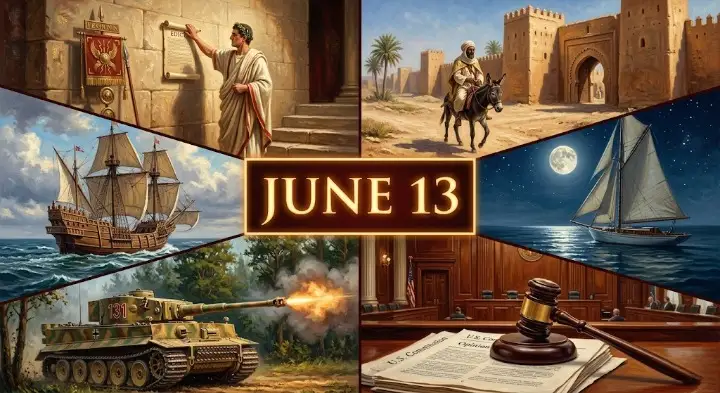
Constantine the Great and co-emperor Licinius signed a proclamation that finally brought a definitive end to the brutal, state-sanctioned persecution of Christians. Roman officials in Nicomedia posted the text publicly, ensuring that citizens could worship any deity they chose without fear of execution or asset seizure. Property confiscated during the Great Persecution was ordered to be returned to its rightful owners immediately. This single administrative act shifted Christianity from an outlawed underground movement into the foundational pillar of the European continent.
1325 – Ibn Battuta Begins Travels
Twenty-one-year-old legal scholar Ibn Battuta closed the door of his family home in Tangier, Morocco, and set out alone on a donkey for a traditional pilgrimage to Mecca. He expected to be gone for several months, but an insatiable desire to see the world kept him moving across Africa, Asia, and Europe for the next twenty-four years. His trek covered roughly 73,000 miles, completely eclipsing the journey of his contemporary Marco Polo. The detailed travelogues he compiled later provided modern historians with their most vibrant, complete picture of medieval Islamic society.
1381 – Savoy Palace Torched in Peasants’ Revolt
Wat Tyler led a furious army of English commoners through the gates of London to protest oppressive poll taxes and systemic serfdom. The rebels targeted the grand Savoy Palace, the luxurious riverfront estate belonging to the deeply despised royal advisor John of Gaunt. Rather than looting the treasures inside, the crowd methodically smashed gold ornaments and set the entire structure ablaze to make a political statement. This dramatic confrontation forced King Richard II to meet the peasants face-to-face and falsely promise sweeping structural reforms.
1514 – Henry Grace à Dieu Dedicated
Shipwrights at the newly minted Woolwich Dockyard cheered as the largest, most formidable warship of its era was officially dedicated for service. Named the Henry Grace à Dieu, or “Great Harry,” this massive vessel weighed over 1,000 tons and featured four soaring masts to carry its innovative artillery load. King Henry VIII ordered its construction specifically to project English naval dominance and counter the growing fleet of rival Scotland. The floating fortress set a brand-new standard for naval engineering by integrating heavy cannons directly into the lower decks.
1525 – Martin Luther Marries Katharina von Bora
Protestant reformer Martin Luther exchanged wedding vows with Katharina von Bora, an escaped nun whom he had helped smuggle out of a convent inside a fish barrel. By entering into holy matrimony, Luther openly defied the centuries-old celibacy mandate imposed on clergy members by the Roman Catholic Church. The marriage shocked European society but successfully turned their household into a practical model for the new Protestant clerical family. Their partnership proved that spiritual devotion could happily co-exist with regular marital life and parenthood.
1625 – King Charles I Marries Henrietta Maria
King Charles I of England stood at Canterbury to welcome his fifteen-year-old French bride, Princess Henrietta Maria, following their proxy wedding ceremony. The union sparked immediate anxiety throughout the English Parliament because the new queen was a devout Roman Catholic who refused to participate in Anglican coronation rites. This deep religious friction eroded the king’s standing with his intensely Protestant subjects from the very start of his reign. The cultural and political divide created by their marriage helped lay the groundwork for the devastating English Civil War.
1740 – Siege of St. Augustine Commences
Georgia provincial governor James Oglethorpe marched a coalition of British colonial troops and Native American allies into Spanish Florida to attack the fortress of Castillo de San Marcos. The assault was intended to secure the southern frontier for Britain during the larger, ongoing War of Jenkins’ Ear. Spanish defenders retreated inside their coquina stone walls, which unexpectedly absorbed the British cannonballs without shattering or collapsing. The siege dragged on unsuccessfully for weeks before tropical diseases and arriving Spanish reinforcements forced Oglethorpe to retreat.
1774 – Rhode Island Bans Slave Importation
Rhode Island lawmakers passed a historic statute declaring that any person brought into the colony from that point forward would be granted immediate freedom. This legislative move made Rhode Island the very first of Britain’s thirteen North American colonies to outlaw the direct importation of enslaved people. The decision was heavily driven by growing anti-British sentiment and a philosophical desire to align local laws with the emerging rhetoric of human liberty. It marked an early, critical milestone in the long and fractured history of the American abolitionist movement.
1777 – Marquis de Lafayette Lands in America
Nineteen-year-old French aristocrat Gilbert du Motier, Marquis de Lafayette, stepped off a ship near Charleston, South Carolina, determined to join the American struggle against the British Crown. Having purchased a vessel with his own family fortune, he arrived without any official endorsement from the French government. The Continental Congress initially resisted his offers until they realized he wanted no salary and possessed elite European military training. Lafayette quickly became a trusted confidant to George Washington and a brilliant tactical leader in the field.
1805 – Meriwether Lewis Sights Great Falls
Scouting miles ahead of his main expedition party, Meriwether Lewis heard a distant, roaring rumble and saw a massive plume of mist rising above the plains of modern-day Montana. He walked over a ridge and became the first white American to behold the stunning Great Falls of the Missouri River. While the breathtaking sight confirmed they were on the correct geographic path to the Pacific, it also presented a grueling logistical nightmare. The travelers had to spend a month hauling their heavy dugout canoes over eighteen miles of rugged, cactus-strewn terrain.
1850 – American League of Colored Laborers Formed
Black activists and skilled tradesmen gathered in a meeting hall in New York City to launch the first formal African American labor union in the United States. Frederick Douglass and other prominent leaders organized the group to combat their systematic exclusion from white-dominated labor organizations. The league focused on establishing independent apprenticeships, funding black-owned workshops, and promoting agricultural training for young workers. Their efforts provided a vital economic shield for free Black laborers navigating a deeply segregated, hostile industrial economy.
1855 – Giuseppe Verdi’s Les Vêpres Siciliennes Premieres
Opera enthusiasts packed the magnificent Salle Le Peletier in Paris for the grand premiere of Giuseppe Verdi’s twentieth masterpiece, Les vêpres siciliennes. Written in the traditional French grand opera style, the performance featured five acts of complex, dramatic orchestration accompanied by an elaborate ballet sequence. The historical plot centered on a violent thirteenth-century Sicilian rebellion against oppressive French rule, which felt intensely relevant to contemporary European nationalist movements. The production earned rave reviews and solidified Verdi’s status as a premier cultural icon.
1878 – Congress of Berlin Convenes
Diplomats from Europe’s most powerful empires gathered in Berlin under the leadership of Otto von Bismarck to rewrite the geopolitical map of the Balkan Peninsula. The summit was organized to revise the highly controversial Treaty of San Stefano, which Russia had recently forced upon the defeated Ottoman Empire. Over the course of a month, the participants stripped away several Russian territorial gains to maintain a fragile balance of power. The resulting border adjustments left deep ethnic tensions unresolved, effectively turning the region into a ticking geopolitical time bomb.
1881 – USS Jeannette Crushed by Ice Pack
Captain George W. De Long watched in horror as thick, shifting Arctic ice packs finally breached the iron-strengthened hull of his exploration vessel, the USS Jeannette. The ship had been trapped fast in the relentless ice for nearly two agonizing years while attempting to reach the North Pole via the Bering Strait. The crew abandoned the sinking vessel, salvaging three small boats and meager provisions to begin a desperate trek across the frozen wastes toward Siberia. Many of the men, including De Long himself, ultimately perished from starvation and exposure.
1886 – Great Vancouver Fire Devastates City
A routine brush clearing fire ignited by workers on the Canadian Pacific Railway suddenly spiraled out of control under fierce summer winds. Within forty-five minutes, a raging wall of flames swept through the young settlement of Vancouver, reducing nearly one thousand wooden buildings to smoldering ash. Citizens fled toward the cold waters of Burrard Inlet, clinging to docks and boats to survive the intense heat. Despite the near-total destruction of their infrastructure, resilient residents began rebuilding their city with brick and stone the very next morning.
1895 – Émile Levassor Wins First Auto Race
French engineer Émile Levassor gripped the steering lever of his wood-framed Panhard et Levassor car as he crossed the finish line of the world’s first true automobile endurance race. He drove the grueling 732-mile course from Paris to Bordeaux and back entirely by himself, refusing to take a break for forty-eight hours and forty-seven minutes. His vehicle averaged a then-unheard-of speed of fifteen miles per hour using an innovative rear-wheel-drive system. The historic victory permanently demonstrated the reliability of gasoline engines over steam-powered competitors.
1898 – Yukon Territory Formed
The Canadian Parliament officially passed the Yukon Territory Act, carving a brand-new administrative district out of the vast Northwest Territories. Government leaders selected Dawson City as the regional capital to establish legal order amidst the chaotic Klondike Gold Rush, which had drawn over thirty thousand fortune hunters to the remote northern wilderness. The creation of the territory allowed Mounties to enforce strict border controls, collect mineral taxes, and manage volatile property disputes. It successfully transformed a lawless mining frontier into an organized, profitable Canadian province.
1917 – Deadliest German Air Raid on London
Fourteen twin-engine German Gotha G.IV bombers appeared out of a bright summer sky over London to unleash a devastating daytime bombing run. The high-explosive ordnance hit packed railway stations, busy commercial districts, and Upper North Street School in Poplar, where a single bomb killed eighteen young children. The attack caused 162 civilian deaths and left more than four hundred Londoners with severe injuries. The public outrage generated by this tragedy forced the British military to completely reorganize their home air defense systems and form the Royal Air Force.
1927 – Charles Lindbergh Receives Ticker-Tape Parade
Millions of ecstatic spectators lined Fifth Avenue in New York City to catch a glimpse of twenty-five-year-old aviator Charles Lindbergh following his solo transatlantic flight. Office workers rained down an estimated 1,800 tons of torn telephone books and ticker tape from skyscrapers, completely blanketing the parade route in artificial snow. The massive celebration transformed the quiet midwestern pilot into one of the most famous celebrities on the planet overnight. His historic achievement fundamentally altered public perception, proving that commercial long-distance aviation was viable.
1944 – Tank Ace Michael Wittmann Ambushes Allied Division
German tank commander Michael Wittmann drove his lone Tiger I tank out of a hidden treeline to ambush advanced elements of the British 7th Armoured Division near Villers-Bocage. Within fifteen minutes of chaotic close-quarters fighting, Wittmann single-handedly destroyed fourteen heavy tanks, fifteen personnel carriers, and multiple anti-tank weapons. The shocking assault completely derailed the British plan to outflank the German defensive line around the strategic city of Caen. The engagement became a staple of wartime propaganda, highlighting the lethal defensive power of heavy German armor.
1944 – SS Forces Counterattack at Carentan
German panzergrenadiers, reinforced by the elite 17th SS Division, launched a fierce, pre-dawn counterattack against American paratroopers defending the critical crossroads town of Carentan. The German command recognized that if they could recapture this position, they could split the Allied landing forces between Utah and Omaha beaches. Airborne soldiers from the 101st Division held their ground through hours of brutal, hand-to-hand combat along the hedgerows. The timely arrival of the US 2nd Armored Division finally broke the German offensive and secured the beachhead linkup.
1944 – First V1 Flying Bomb Strikes England
Residents of Kent woke to an unfamiliar, rhythmic buzzing sound as Germany launched its very first V1 flying bomb attack against the British mainland. Of the eleven primitive cruise missiles fired from launch sites in occupied France, only four actually crossed the English Channel to strike ground targets. One weapon detoned in Bethnal Green, destroying several homes and killing six civilians. This milestone marked the terrifying dawn of automated, robotic warfare, forcing British defenses to scramble to counter an enemy pilotless threat.
1952 – Soviet MiG-15 Shoots Down Swedish DC-3
An unarmed Swedish military Douglas DC-3 transport plane carrying advanced electronic intelligence gathering equipment vanished without a trace over the international waters of the Baltic Sea. Decades later, declassified files revealed that a Soviet MiG-15 fighter jet had intercepted and shot down the aircraft, killing all eight crew members aboard. The Soviet Union denied any involvement in the incident for nearly forty years, sparking a deep diplomatic freeze known as the Catalina Affair. The wreckage was finally located on the sea floor in 2003.
1956 – Real Madrid Wins Inaugural European Cup
Spanish football giant Real Madrid rallied from a multi-goal deficit to defeat French champions Stade de Reims 4–3 in a thrilling final match at the Parc des Princes in Paris. The high-stakes victory earned them the very first European Cup trophy, a brand-new tournament designed to pit Europe’s elite domestic league winners against each other. Star forward Alfredo Di Stéfano orchestrated the dramatic comeback, cementing the club’s legendary status on the international stage. The competition eventually evolved into the modern UEFA Champions League.
1966 – Supreme Court Establishes Miranda Rights
The United States Supreme Court issued a landmark 5-4 ruling in the case of Miranda v. Arizona, fundamentally transforming American law enforcement procedures. Chief Justice Earl Warren declared that police officers must clearly inform criminal suspects of their constitutional Fifth Amendment rights before conducting any formal interrogation. The historic decision mandated the familiar warning regarding the right to remain silent and the right to retained legal counsel. Any confessions obtained without this explicit notification were rendered inadmissible in a court of law.
1967 – Thurgood Marshall Nominated to Supreme Court
President Lyndon B. Johnson stood before White House reporters to nominate civil rights attorney and Solicitor General Thurgood Marshall to the United States Supreme Court. Marshall had already earned national renown for successfully arguing the historic Brown v. Board of Education school desegregation case before the high court. His appointment challenged decades of systemic racial exclusion within the American legal system. Following a tense Senate confirmation battle, Marshall took his seat as the first Black justice in the court’s history.
1971 – New York Times Publishes Pentagon Papers
The front page of The New York Times featured a bombshell exposé containing leaked portions of a top-secret, 7,000-page Department of Defense study on the Vietnam War. Leaked by military analyst Daniel Ellsberg, the highly sensitive documents proved that multiple presidential administrations had systematically lied to the public and Congress about the true scale of US military operations. The Nixon administration filed an immediate injunction to halt further publication, sparking a historic, high-stakes battle over press freedom and the First Amendment.
1973 – Historic Dodgers Infield Plays Together
Los Angeles Dodgers manager Walter Alston filled out his lineup card against the Philadelphia Phillies, unknowingly kicking off a major sporting era. Teammates Steve Garvey, Davey Lopes, Ron Cey, and Bill Russell took the field together as the starting infield for the very first time. This specific core of players stayed together without a single personnel change for the next eight and a half seasons, setting an all-time Major League Baseball longevity record. Their remarkable consistency yielded four National League pennants and a World Series title.
1977 – James Earl Ray Recaptured
Dozens of state troopers and tracking hounds swarmed the rugged mountains of Tennessee to corner James Earl Ray, the convicted assassin of civil rights leader Martin Luther King Jr. Ray had managed to escape from the maximum-security Brushy Mountain State Penitentiary three days earlier by scaling a wall with a makeshift ladder. His brief run for freedom ended without a shootout just eight miles from the prison walls. The escape prompted an intense federal investigation into institutional security flaws and potential outside help.
1981 – Marcus Sarjeant Fires Blanks at Queen Elizabeth II
A nineteen-year-old youth named Marcus Sarjeant stepped forward from a dense crowd during the annual Trooping the Colour ceremony to fire six rapid shots directly at Queen Elizabeth II. The sudden cracks startled the Queen’s horse, Burmese, but the monarch managed to bring the animal back under control within seconds as guards tackled the assailant. Authorities quickly determined the pistol carried only blank ammunition and that Sarjeant was seeking personal notoriety. He became the first person since the nineteenth century to be prosecuted under the Treason Act of 1842.
1982 – Fahd Becomes King of Saudi Arabia
Crown Prince Fahd ascended to the throne of Saudi Arabia following the sudden, fatal heart attack of his brother, King Khalid. Fahd had already spent years managing the daily administrative affairs of the kingdom due to his brother’s failing physical health. His official assumption of power brought an experienced, modernizing leader to the helm during a period of massive regional instability fueled by the Iran-Iraq War. His subsequent domestic policies prioritized rapid infrastructure development and closer defense ties with western nations.
1982 – Battles of Tumbledown and Wireless Ridge Begin
British infantry units launched a coordinated, nighttime assault against entrenched Argentine defensive lines on the rocky peaks overlooking Port Stanley. The bloody confrontations at Mount Tumbledown and Wireless Ridge represented the final, decisive encounters of the Falklands War. Soldiers engaged in fierce, close-range night fighting under freezing rain and heavy artillery barrages to clear the mountaintops. The collapse of these final high-ground strongholds left the Argentine command with no tactical option but to negotiate a total surrender.
1983 – Pioneer 10 Leaves Central Solar System
Scientists at NASA cheered as data streams confirmed that the aging Pioneer 10 space probe had crossed beyond the distant orbit of Neptune. This milestone made the small, nuclear-powered craft the very first human-made object to journey outside the main boundaries of our solar system. Launched over a decade earlier, the probe had already completed a historic flyby of Jupiter and transmitted invaluable data about outer space environments. It continued traveling toward the deep interstellar medium carrying a gold-anodized plaque designed to communicate with alien life.
1990 – Mineriad Violence Errupts in Bucharest
A truckload of heavily armed miners from the Jiu Valley rolled into the streets of Bucharest under orders from newly elected President Ion Iliescu to crush a peaceful anti-communist student protest. The miners attacked the demonstration camps with clubs and iron bars, smashing university buildings and independent newspaper offices in the process. The ensuing state-sponsored chaos resulted in the deaths of at least six people and left hundreds more with severe injuries. The brutal crackdown severely damaged Romania’s global reputation as it transitioned away from iron-curtain rule.
1994 – Jury Blames Exxon for Valdez Disaster
A federal jury in Anchorage, Alaska, returned a sweeping verdict finding that absolute recklessness by the Exxon Corporation and Captain Joseph Hazelwood directly caused the catastrophic 1989 Exxon Valdez oil spill. The legal determination opened the door for thousands of local fishermen, native Alaskans, and business owners to seek up to $15 billion in punitive damages. The historic ruling established a critical legal precedent regarding corporate accountability for environmental disasters. It forced oil conglomerates to dramatically overhaul their safety and shipping protocols.
1996 – Montana Freemen Surrender After Standoff
The longest armed standoff in modern FBI history drew to a peaceful conclusion as the final sixteen members of the radical Montana Freemen walked out of their fortified ranch compound. The anti-government group had spent eighty-one tense days surrounded by federal agents after refusing to recognize federal authority and issuing millions in fraudulent checks. Negotiators successfully used third-party intermediaries to convince the group to surrender without a repeat of the tragic violence seen at Waco. The peaceful resolution was hailed as a major tactical triumph for law enforcement.
1996 – Garuda Indonesia Flight 865 Crashes
A Garuda Indonesia McDonnell Douglas DC-10 crew attempted to abort their takeoff from Fukuoka Airport in Japan after a catastrophic failure of the number-one engine. The massive airliner overran the runway tarmac at high speed, plowing through a perimeter fence and breaking into three pieces before catching fire. Despite the intense flames and structural damage, efficient airport rescue crews saved all but three of the 275 passengers on board. The accident investigation prompted severe global reviews regarding high-speed abort procedures for heavy commercial aircraft.
1997 – Timothy McVeigh Sentenced to Death
A federal jury in Denver voted unanimously to sentence thirty-two-year-old Gulf War veteran Timothy McVeigh to death by lethal injection for his role in the 1995 Oklahoma City bombing. The domestic terrorist attack had shattered the Alfred P. Murrah Federal Building, claiming 168 innocent lives and injuring hundreds of others. Family members of the victims sat silently in the packed courtroom as the judge read the definitive sentence aloud. McVeigh showed absolutely no emotion as he became the first federal prisoner sentenced to die in over three decades.
1997 – Uphaar Cinema Fire Tragedey in Delhi
Hundreds of moviegoers packed the Uphaar Cinema in New Delhi for a matinee screening of a popular new film when a massive transformer explosion in the basement filled the auditorium with toxic black smoke. Blocked exit doors, unlit stairwells, and a total lack of emergency footlights trapped panicked patrons inside the balcony section. The disaster resulted in fifty-nine deaths from asphyxiation and left over one hundred people with severe respiratory injuries. The horrific event sparked a decades-long legal battle for stricter public safety codes across India.
1999 – BMW Wins 24 Hours of Le Mans
The BMW Motorsport racing team celebrated a historic milestone as their V12 LMR open-top prototype car crossed the finish line to claim overall victory at the 24 Hours of Le Mans. Drivers Joachim Winkelhock, Pierluigi Martini, and Yannick Dalmas completed 365 laps of grueling, high-speed racing, outlasting fierce competition from corporate rivals Toyota and Audi. The triumph marked the first and only time BMW captured the prestigious endurance title as a full factory team entry. The race solidified their engineering reputation within the global motorsport industry.
2000 – Historic Inter-Korea Summit Begins
South Korean President Kim Dae-jung stepped off an airplane in Pyongyang to warm handshakes from North Korean leader Kim Jong-il, marking the start of the first-ever summit between the divided nations since the Korean War. Smiling together on the tarmac, the two leaders initiated three days of high-stakes diplomatic talks aimed at easing decades of military tension and reuniting separated families. The historic meeting generated immense global optimism and ultimately earned Kim Dae-jung the Nobel Peace Prize for his groundbreaking “Sunshine Policy” of engagement.
2000 – Italy Pardons Pope’s Attacker Mehmet Ali Ağca
Italian President Carlo Azeglio Ciampi signed an official clemency decree pardoning Mehmet Ali Ağca, the Turkish extremist who had shot and nearly killed Pope John Paul II in 1981. The unusual pardon arrived after the Pope publicly forgave his attacker during a personal prison cell visit and formally requested his release. Following nineteen years of confinement in a maximum-security Italian prison, Ağca was immediately deported back to his native Turkey to serve out an unrelated sentence for an earlier murder conviction.
2002 – United States Exits Anti-Ballistic Missile Treaty
The United States officially terminated its participation in the historic 1972 Anti-Ballistic Missile Treaty, marking the first time in modern history that America withdrew from a major international arms control agreement. President George W. Bush argued that the Cold War-era restrictions prevented the development of a comprehensive national missile defense system capable of protecting against rogue states. The strategic policy departure drew sharp criticism from Russia and China, who warned it could trigger a dangerous new global arms race.
2005 – Michael Jackson Acquitted in Trial
A California jury returned a sweeping not-guilty verdict on all ten counts in the high-profile child molestation trial of pop superstar Michael Jackson. The intense, four-month legal battle had drawn hundreds of international reporters and passionate fans to the Santa Maria courthouse daily. The prosecution’s case collapsed under grueling cross-examination that revealed deep inconsistencies in the chief accuser’s testimony. While the definitive acquittal saved Jackson from a lengthy prison sentence, the highly public ordeal permanently tarnished his global career.
2007 – Al-Askari Mosque Bombed a Second Time
Insurgents detonated hidden explosive charges inside the historic Al-Askari Mosque in Samarra, bringing down the structure’s two remaining golden minaret towers. The revered Shiite holy site had already suffered catastrophic damage during a massive 2006 bombing that ignited a wave of bloody sectarian violence across Iraq. The second targeted strike was intentionally timed to reignite civil conflict just as security conditions were beginning to stabilize. International leaders condemned the destruction, calling it a deliberate assault on Iraq’s cultural heritage.
2010 – Spacecraft Hayabusa Returns to Earth
Scientists gathered in the dark expanse of the Australian Outback to track a blazing fireball as the return capsule of the Japanese spacecraft Hayabusa streaked through the atmosphere. The robotic probe completed a seven-year, four-billion-mile journey that included a historic landing on the asteroid Itokawa. Despite suffering near-fatal thruster failures and communication blackouts, the resilient craft successfully delivered the first microscopic dust samples collected directly from an asteroid’s surface. The engineering triumph provided researchers with unprecedented clues about the early solar system.
2012 – Wave of Bombings Devastates Iraq
A coordinated series of more than twenty bombings tore through busy marketplaces, religious gathering sites, and police checkpoints in Baghdad, Hillah, Kirkuk, and dozens of other Iraqi cities. The synchronized attacks targeted Shiite pilgrims participating in an annual religious commemoration, killing ninety-three citizens and leaving more than three hundred wounded. Security experts traced the sophisticated assault back to Al-Qaeda operatives seeking to destabilize the central government following the withdrawal of US troops. The tragedy highlighted the fragile security state of the nation.
2018 – Volkswagen Fined Over Emissions Scandal
German prosecutors issued a definitive one-billion-euro fine against automotive giant Volkswagen to penalize the company’s widespread manipulation of diesel emissions testing. The legal penalty concluded a massive corporate investigation revealing that engineers had installed secret software to hide actual pollution levels from global regulators. The scandal forced the resignation of top executives, triggered millions of vehicle recalls, and severely damaged Germany’s industrial reputation. The historic fine marked one of the largest corporate financial penalties ever levied by German authorities.
2021 – Shiyan Gas Explosion Kills Twelve
A massive, high-pressure gas line explosion tore through a busy two-story community market building in the Zhangwan district of Shiyan, located within China’s Hubei province. The early morning blast leveled the structure while residents were buying breakfast and fresh produce, trapping dozens under heavy concrete debris. Emergency rescue crews pulled nearly 150 injured survivors from the wreckage through hours of dangerous operations. The industrial tragedy prompted immediate, country-wide safety inspections of aging municipal gas infrastructure to prevent similar system failures.
2023 – Niger River Wedding Boat Capsizes
An overloaded wooden river boat carrying over 250 wedding guests back from a late-night ceremony split apart and capsized in the dark waters of the Niger River in Kwara State, Nigeria. The vessel hit a submerged tree trunk during a period of heavy river flooding, throwing passengers into the fast-moving current without life jackets. Local fishermen rushed to the scene but managed to save only a portion of the travelers, leaving at least one hundred dead. The tragedy underscored severe regional infrastructure deficits and lack of maritime safety enforcement.
2023 – Nottingham Stabbing and Ramming Attack
A lone assailant carrying a large hunting knife launched a horrific, early morning rampage through the streets of Nottingham, England. The attacker fatally stabbed two nineteen-year-old university students walking home and a local school caretaker before stealing a panel van to ram three pedestrians in the city center. Armed police officers intercepted and subdued the suspect using a Taser within minutes of the vehicle assault. The senseless violence shocked the tight-knit university community and prompted deep national debates regarding mental health tracking and public safety.
2025 – Israel Launches Twelve-Day War
Israeli fighter jets roared across the night sky to initiate an intense wave of preemptive precision airstrikes against strategic military installations and drone production facilities inside Iran. The sudden, large-scale bombardment marked the opening salvo of what military historians quickly named the Twelve Day War, a intense regional conflict that brought long-simmering covert hostilities into the open. The military engagement disrupted global shipping lanes and forced immediate, emergency mediation sessions at the United Nations. The conflict permanently altered the modern balance of power in the Middle East.
Discover the stories you missed from yesterday’s history lesson.
Famous People Born On June 13
| Name | Description | Date |
|---|---|---|
| Charles the Bald | Holy Roman Emperor and King of West Francia, grandson of Charlemagne | 823 – 877 |
| Charles the Fat | Holy Roman Emperor and King of East Francia, the last Carolingian emperor to rule a united empire | 839 – 888 |
| Taejong of Joseon | Third monarch of the Joseon dynasty of Korea, a key figure in consolidating the dynasty’s power | 1367 – 1422 |
| Willebrord Snell | Dutch astronomer and mathematician, discoverer of Snell’s law of refraction | 1580 – 1626 |
| Frances Burney | English novelist and playwright, a major figure in 18th-century literature | 1752 – 1840 |
| Thomas Young | English physicist and physiologist, known for the wave theory of light and Young’s modulus | 1773 – 1829 |
| Winfield Scott | American general, a key military leader in the War of 1812, the Mexican-American War, and the Civil War | 1786 – 1866 |
| José Antonio Páez | Venezuelan general and politician, President of Venezuela and a leader in the independence movement | 1790 – 1873 |
| James Clerk Maxwell | Scottish physicist and mathematician, formulated the classical theory of electromagnetic radiation | 1831 – 1879 |
| Charles Algernon Parsons | English engineer, inventor of the steam turbine, founder of C. A. Parsons and Company | 1854 – 1931 |
| W. B. Yeats | Irish poet and playwright, Nobel Prize laureate, one of the foremost literary figures of the 20th century | 1865 – 1939 |
| Jules Bordet | Belgian immunologist and microbiologist, Nobel Prize laureate for discoveries in immunity | 1870 – 1961 |
| Fernando Pessoa | Portuguese poet and critic, one of the most significant literary figures of the 20th century | 1888 – 1935 |
| Basil Rathbone | South African-born British-American actor, best known for his portrayal of Sherlock Holmes | 1892 – 1967 |
| Dorothy L. Sayers | English author and poet, creator of the detective Lord Peter Wimsey | 1893 – 1957 |
| Paavo Nurmi | Finnish runner and coach, “The Flying Finn,” one of the greatest long-distance runners in history | 1897 – 1973 |
| Carlos Chávez | Mexican composer, conductor, and journalist, a leading figure in Mexican classical music | 1899 – 1978 |
| Tage Erlander | Swedish lieutenant and politician, 25th Prime Minister of Sweden, holding office for 23 years | 1901 – 1985 |
| Luis Walter Alvarez | American physicist and academic, Nobel Prize laureate, known for the Alvarez hypothesis on dinosaur extinction | 1911 – 1988 |
| Don Budge | American tennis player and coach, the first player to win the Grand Slam in a single year | 1915 – 2000 |
| Ben Johnson | American actor and stuntman, Academy Award winner for The Last Picture Show | 1918 – 1996 |
| Paul Lynde | American actor and comedian, known for his role on Bewitched and as a regular on The Hollywood Squares | 1926 – 1982 |
| Slim Dusty | Australian singer-songwriter and guitarist, a legendary figure in Australian country music | 1927 – 2003 |
| John Forbes Nash, Jr. | American mathematician and academic, Nobel Prize laureate, subject of the film A Beautiful Mind | 1928 – 2015 |
| Christo | Bulgarian-French sculptor and painter, known for large-scale environmental artworks like wrapping the Reichstag | 1935 – 2020 |
| Ban Ki-moon | South Korean politician and diplomat, 8th Secretary-General of the United Nations | 1944 – Present |
| Sher Bahadur Deuba | Nepalese politician, 32nd Prime Minister of Nepal, serving multiple terms | 1946 – Present |
| Stellan Skarsgård | Swedish actor, known for his roles in Good Will Hunting, Pirates of the Caribbean, and Dune | 1951 – Present |
| Tim Allen | American actor, comedian, and producer, known for Home Improvement and the Toy Story franchise | 1953 – Present |
| Chris Evans | American actor and producer, best known for his role as Captain America in the Marvel Cinematic Universe | 1981 – Present |
Famous People Died On June 13
| Name | Description | Date |
|---|---|---|
| Xiahou Dun | Chinese general, a key military commander under Cao Cao during the Three Kingdoms period | died 220 |
| Anthony of Padua | Portuguese priest and saint, one of the most venerated figures in the Franciscan order | 1195 – 1231 |
| Miyamoto Musashi | Japanese samurai, a legendary swordsman and author of The Book of Five Rings | 1584 – 1645 |
| Henry Middleton | American farmer and politician, 2nd President of the Continental Congress | 1717 – 1784 |
| Henry Gray | English anatomist and surgeon, author of the classic medical textbook Gray’s Anatomy | 1827 – 1861 |
| Ludwig II | King of Bavaria, known as “Mad King Ludwig,” builder of Neuschwanstein Castle | 1845 – 1886 |
| Kitasato Shibasaburō | Japanese medical doctor and bacteriologist, pioneer in the study of infectious diseases | 1851 – 1931 |
| Ben Chifley | Australian engineer and politician, 16th Prime Minister of Australia | 1885 – 1951 |
| Martin Buber | Austrian-Israeli philosopher and theologian, known for his philosophy of dialogue and I and Thou | 1878 – 1965 |
| Georg von Békésy | Hungarian biophysicist and academic, Nobel Prize laureate for research on the inner ear | 1899 – 1972 |
| Benny Goodman | American clarinet player, songwriter and bandleader, the “King of Swing” | 1909 – 1986 |
| Geraldine Page | American actress, Academy Award winner and one of the great stage and screen actresses of the 20th century | 1924 – 1987 |
| Deke Slayton | American soldier, pilot and astronaut, one of NASA’s original Mercury Seven astronauts | 1924 – 1993 |
| Charles Haughey | Irish lawyer and politician, 7th Taoiseach of Ireland, a dominant and controversial figure in Irish politics | 1925 – 2006 |
| Tim Russert | American journalist and lawyer, a respected television news anchor and political analyst | 1950 – 2009 |
| Mitsuharu Misawa | Japanese professional wrestler, a legendary figure in Japanese puroresu | 1962 – 2009 |
| Jimmy Dean | American singer and businessman, known for “Big Bad John” and founder of Jimmy Dean Foods | 1928 – 2010 |
| Mehdi Hassan | Pakistani ghazal singer and playback singer, one of the greatest classical vocalists of South Asia | 1927 – 2012 |
| Gyula Grosics | Hungarian footballer and manager, legendary goalkeeper of the “Golden Team” of the 1950s | 1926 – 2014 |
| Chuck Noll | American football player and coach, four-time Super Bowl-winning coach of the Pittsburgh Steelers | 1932 – 2014 |
| Ned Beatty | American actor, known for his roles in Network, Deliverance, and Superman | 1937 – 2021 |
| Cormac McCarthy | American author, one of the greatest novelists of the late 20th and early 21st centuries, author of The Road | 1933 – 2023 |
| Angela Bofill | American R&B singer, known for hits like “This Time I’ll Be Sweeter” | 1954 – 2024 |
| Roger Cook | New Zealand-born British investigative journalist, known for the TV series The Cook Report | 1943 – 2026 |
| José Bonifácio de Andrada | Brazilian poet, academic, and politician, a key figure in Brazil’s independence | 1763 – 1838 |
| John Cox Bray | Australian politician, 15th Premier of South Australia | 1842 – 1894 |
| Osamu Dazai | Japanese author, a major figure in post-war Japanese literature, known for No Longer Human | 1909 – 1948 |
| Walter Rodney | Guyanese historian and activist, a leading Pan-Africanist and scholar | 1942 – 1980 |
| Alberto Henschel | German-Brazilian photographer and businessman, one of the most important photographers in Brazilian history | 1827 – 1882 |
Observances on June 13
June 13 features several unique cultural and humanitarian observances worldwide:
- International Albinism Awareness Day: Established by the United Nations, this day combats systemic discrimination and social stigma while celebrating the human rights of people living with albinism globally.
- Inventors’ Day (Hungary): Celebrated on the anniversary of Albert Szent-Györgyi registering his patent for synthetic Vitamin C, this day honors the contributions of Hungarian scientists to global technology.
- Suleimaniah City Fallen and Martyrs Day (Iraqi Kurdistan): A solemn day of remembrance honoring the local citizens and military personnel who lost their lives defending the city throughout regional conflicts.
🚀 Frequently Asked Questions — June 13 in History
Germany initiated its very first V1 Flying Bomb cruise missile attack against the British mainland during World War II, marking a terrifying evolution in automated warfare. Simultaneously, on the battlefields of Normandy, legendary German tank ace Michael Wittmann carried out a devastating close-quarters ambush against the British 7th Armoured Division at Villers-Bocage.
The publication of the Edict of Milan in 313 stands as the most influential event on this date. Signed by emperors Constantine and Licinius, it legalised Christianity and established total religious tolerance across the vast Roman Empire, permanently redirecting the course of Western civilization.
Famous Irish poet and dramatist William Butler Yeats was born on this date in 1865, going on to become a pillar of twentieth-century literature and a Nobel Prize winner. Hollywood actor Chris Evans, globally recognized for portraying Captain America, was also born on this date in 1981.
The British Army launched its final, decisive night assaults against Argentine mountaintop strongholds during the Battles of Tumbledown and Wireless Ridge in 1982. These successful engagements shattered the final defensive line protecting Port Stanley, forcing an immediate Argentine surrender to end the Falklands War.
This global observance was created by the United Nations to educate the public about the genetic condition and halt the severe social persecution individuals face in specific regions. It emphasizes safety, equal access to healthcare, and the protection of basic human rights for the global albinism community.
Israel initiated a massive wave of precision airstrikes against military assets inside Iran in 2025, triggering the short but highly volatile Twelve Day War. In 2023, a horrific knife and vehicle ramming rampage resulted in three civilian fatalities and several injuries across the city of Nottingham, England.