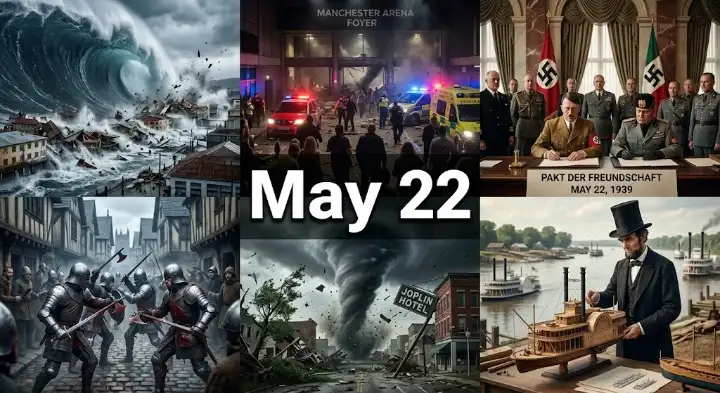
In the late afternoon of May 22, 1960, the earth beneath southern Chile split open with a violence never before recorded by human instruments. Entire towns buckled, coastlines permanently sank, and monstrous tsunamis raced across the Pacific Ocean. It remains the most powerful seismic event ever measured. Decades later on this exact calendar date, the focus shifted from natural tragedy to human malice when a bomber targeted young music fans leaving a concert hall in Manchester, England. This day in history May 22, bridges these moments of sheer survival and profound grief.
👶 Quick Facts — May 22 in History
| 📌 Category | 📖 Event / Detail |
|---|---|
| 🌟 Most Significant Event | The Great Chilean Earthquake (Valdivia earthquake) strikes southern Chile, registering a record-shattering 9.5 magnitude on the moment magnitude scale (1960) |
| 🏆 Top 10 Key Events | • Warlord Dong Zhuo is assassinated by his adoptive son Lü Bu during the late Han Dynasty (192) • Halley’s Comet reaches perihelion, its closest point to the Sun (760) • The Wars of the Roses begin in England with the First Battle of St Albans (1455) • Tóxcatl Massacre occurs as Spanish conquistadors slaughter Aztec nobles in Tenochtitlan (1520) • Napoleon Bonaparte is defeated by Austrian forces at the Battle of Aspern-Essling (1809) • US Senator Charles Sumner is brutally beaten with a cane by Representative Preston Brooks on the Senate floor (1856) • Germany and Italy sign the Pact of Steel, forming a military alliance (1939) • US nuclear-powered submarine USS Scorpion sinks southwest of the Azores with 99 men aboard (1968) • A suicide bomber attacks a concert at Manchester Arena in England, killing 22 people (2017) • Pakistan International Airlines Flight 8303 crashes near Karachi, killing 97 passengers and crew (2020) |
| ⚔️ Key Battles | First Battle of St Albans (1455); Battle of Aspern-Essling (1809); Battle of Beringia (1916); Siege of Port Hudson begins (1863) |
| 👤 Key Figures | Lü Bu, Richard Duke of York, Abraham Lincoln, Preston Brooks, Chiang Kai-shek, Donald Trump |
| 🌍 Observances | International Day for Biological Diversity, World Goth Day, Unity Day (Yemen), Republic Day (Sri Lanka), Abolition Day (Martinique), Harvey Milk Day (California) |
Story of the Day: The Great Chilean Earthquake
At 3:11 PM on May 22, 1960, a massive fault zone along the coast of Chile ruptured over a stretch of 600 miles. Registering a staggering 9.5 on the moment magnitude scale, the quake violently shook the region for ten minutes, collapsing structures and triggering massive landslides. Minutes later, a wall of water towering 82 feet high slammed into the Chilean coast, obliterating fishing villages before racing across the open ocean to strike Hawaii and Japan. The sheer force permanently altered the geography of the region, lowering parts of the coastline by several feet. Today, it remains the ultimate benchmark for seismic energy, reminding us how quickly the ground beneath our feet can change.
Important Events That Happened On May 22 In History
192 – Dong Zhuo Assassinated
Lü Bu drew his concealed weapon inside the imperial palace courtyard and struck down his tyrannical adoptive father, Dong Zhuo. The brutal warlord had held the Han dynasty court hostage through terror, executions, and forced relocation of the capital. Courtiers rejoiced in the streets of Chang’an over the sudden demise of the hated dictator. This dramatic betrayal accelerated the collapse of central authority, plunging ancient China directly into the fractured chaos of the Three Kingdoms era.
760 – Halley’s Comet Perihelion
Stargazers across China and Europe watched a brilliant streak of light cut through the night sky as Halley’s Comet reached its closest point to the sun. Chinese astronomers meticulously documented the long tail of the cosmic traveler in imperial archives, interpreting it as an omen for the state. This marking represented the fourteenth recorded perihelion passage of the famous comet by human observers. The ancient logs provide modern astronomers with invaluable data to calculate the long-term orbital adjustments of the icy body.
853 – Sack of Damietta
Byzantine warships suddenly appeared on the horizon and launched a devastating surprise amphibious assault against the Egyptian port city of Damietta. Finding the garrison completely undefended, the naval forces plundered the strategic trade hub and burned down its massive warehouses. The attacking fleet captured vital stockpiles of weapons intended for the Abbasid caliphate’s naval operations. This bold stroke forced the Muslim rulers of Egypt to immediately invest in major coastal fortifications to prevent future Roman incursions.
1176 – Saladin Escapes the Assassins
Sultan Saladin sat inside his military tent near Aleppo when a knife-wielding agent of the secretive Hashshashin sect sprang from the shadows. The attacker struck the Sultan’s head, but specialized chainmail armor hidden beneath his turban deflected the deadly blade. Royal guards wrestled the assassin down before he could strike again, killing him on the spot. The close call filled Saladin with paranoia, driving him to launch a fierce retaliatory campaign against the Assassin strongholds in the Syrian mountains.
1200 – Treaty of Le Goulet
King John of England met King Philip II of France on an island in the Seine River to sign a comprehensive peace pact. John conceded large portions of disputed Norman territory and recognized French overlordship in exchange for secure recognition as the rightful English monarch. The agreement briefly paused decades of bitter territorial conflict between the rival Plantagenet and Capetian dynasties. The terms cost England dearly, earning John the humiliating nickname “Softsword” and setting the stage for his eventual loss of Normandy.
1246 – Henry Raspe Elected Anti-King
German noblemen and high-ranking bishops gathered under the direction of the Pope to defiantly elect Henry Raspe as the rival king of Germany. The bold political maneuver directly challenged the ruling monarch, Conrad IV, during a bitter dispute between the Holy Roman Emperor and the Catholic Church. This election fractured the kingdom into warring factions, forcing local rulers to pick sides between papal authority and imperial bloodlines. Raspe died less than a year later, leaving Germany deeply unstable and plagued by civil strife.
1254 – Serbian-Venetian Peace Treaty
King Stefan Uroš I of Serbia sat with diplomats from the Republic of Venice to sign a formal end to their border war. The treaty restored stable trade relations, defined commercial borders, and ensured protection for Venetian merchants traveling across Serbian silver-mining regions. Venice secured its maritime trade routes along the Adriatic sea while the Serbian kingdom avoided a costly prolonged conflict. The peace allowed both regional powers to focus on expanding their economic influence throughout the Balkan peninsula.
1370 – Brussels Massacre
An angry mob stormed the Jewish quarter of Brussels, rounding up thirteen members of the community and burning them alive at the stake. Local religious leaders fueled the violence by claiming the victims had stabbed consecrated church bread, which allegedly bled miraculously. The surviving Jewish families were stripped of their belongings and permanently banished from the region of Brabant. This horrific anti-Semitic attack devastated the local community and stood as a dark chapter of religious persecution in medieval Belgium.
1377 – Papal Bulls Against Wycliffe
Pope Gregory XI signed five separate official decrees condemning the radical theological writings of English scholar John Wycliffe. The papal orders accused Wycliffe of heresy for attacking the immense wealth and political power of the Catholic hierarchy. Church officials sent these documents to Oxford University and English bishops, demanding the immediate arrest of the rebellious preacher. Wycliffe escaped execution due to strong protection from influential English nobles, laying the intellectual foundations for the Protestant Reformation.
1455 – First Battle of St Albans
Richard, Duke of York, led his armored soldiers through the narrow streets of St Albans to clash with the royal forces of King Henry VI. The fierce, bloody skirmish ended in a decisive Yorkist victory and the physical capture of the mentally incapacitated monarch. Lancastrian commanders fell in the streets, creating bitter blood feuds among the English nobility. This sudden outbreak of open violence marked the official beginning of the devastating civil wars known as the Wars of the Roses.
1520 – Tóxcatl Massacre
Spanish captain Pedro de Alvarado ordered his heavily armed conquistadors to block the exits of the Great Temple during an Aztec religious festival. The soldiers fell upon the unarmed Aztec nobility with swords and spears, slaughtering thousands of dancers and priests in cold blood. The unprovoked brutality enraged the citizens of Tenochtitlan, who rose up in a massive, furious rebellion against the occupying Spaniards. This slaughter ended all chances of peaceful negotiation, leading directly to a war that destroyed the Aztec Empire.
1629 – Treaty of Lübeck
Holy Roman Emperor Ferdinand II signed a formal peace pact with King Christian IV of Denmark to end Danish involvement in the Thirty Years’ War. Christian surrendered his claims to German bishoprics but successfully retained full control over his ancestral Danish lands. The treaty removed a major Protestant protector from the conflict, leaving imperial Catholic forces dominant across northern Germany. The war continued to ravage central Europe for nearly twenty more years as new foreign powers entered the fray.
1762 – Treaty of Hamburg
Prussian and Swedish diplomats gathered in the neutral city of Hamburg to sign a peace treaty ending their bitter conflict in the Seven Years’ War. The agreement restored all pre-war borders, returning captured territories without any exchange of money or land concessions. Sweden exited the war after suffering heavy financial losses and failing to reclaim lost lands in Pomerania. This peace allowed Prussian King Frederick the Great to focus his entire military machine against the remaining Austrian forces.
1762 – Trevi Fountain Completed
Pope Clemens XIII joined cheering crowds in Rome to celebrate the official inauguration of the massive Trevi Fountain. Architect Giuseppe Pannini finally finished the sprawling Baroque masterpiece, utilizing dramatic sculptures of Oceanus to control rushing waters over artificial cliffs. The project took thirty years of complex stonework and engineering to transform a simple Roman aqueduct terminal into a monument. Today, millions of travelers crowd the small square daily, tossing coins into the basin to ensure their return to the Eternal City.
1766 – Istanbul Earthquake
A violent earthquake shook Istanbul in the early morning hours, destroying structural walls, toppling minarets, and cracking the massive dome of the Hagia Sophia. The powerful tremors triggered a destructive tsunami in the Sea of Marmara, swamping coastal shipyards and causing thousands of deaths. Imperial officials estimated that over four thousand people lost their lives in the debris of collapsed stone homes. The disaster forced Sultan Mustafa III to launch a massive, years-long rebuilding campaign to restore the imperial capital.
1804 – Lewis and Clark Depart
William Clark led the Corps of Discovery away from the riverbanks of St. Charles, Missouri, steering their heavily loaded boats up the muddy Missouri River. Meriwether Lewis joined the expedition team days later, launching an official mission ordered by President Thomas Jefferson to map the newly acquired Louisiana Purchase. The small crew faced unknown terrain, dangerous river currents, and unmapped wilderness. This departure marked the opening chapter of a legendary two-year trek that connected the United States to the Pacific coast.
1807 – Aaron Burr Indicted
A federal grand jury in Richmond, Virginia, formally indicted former United States Vice President Aaron Burr on charges of high treason. Prosecutors accused Burr of gathering a private military force to conquer Spanish lands and establish his own independent empire in the West. The high-profile arrest shocked the young nation and created a fierce political battle between Burr and President Thomas Jefferson. Chief Justice John Marshall eventually acquitted Burr, setting a strict legal standard for what qualifies as treason under American law.
1809 – Battle of Aspern-Essling Ends
Austrian troops under Archduke Charles repelled furious French assaults along the Danube River, inflicting a major military defeat on Napoleon Bonaparte. The fierce two-day battle cost both sides over twenty thousand casualties and claimed the life of French Marshal Jean Lannes. Napoleon’s invincible reputation shattered as his forces retreated across the river under heavy enemy artillery fire. This clash proved that European armies had finally adapted to French tactics, altering the course of the Napoleonic Wars.
1816 – Littleport Riots
An angry crowd of unemployed agricultural laborers gathered in a Littleport pub, armed themselves with sticks, and began destroying the homes of wealthy grain merchants. The laborers rioted over starvation wages, lack of work, and the skyrocketing cost of basic bread following the Napoleonic Wars. The violent protests spread to the nearby town of Ely the following day, forcing the British government to deploy military troops to restore order. Authorities arrested dozens of rioters, hanging five leaders to deter future working-class rebellions.
1819 – SS Savannah Sets Sail
The pioneering steamship SS Savannah cleared the harbor at Savannah, Georgia, and headed into the open Atlantic Ocean bound for Liverpool, England. The innovative vessel carried a heavy steam engine alongside traditional sails, attempting a feat never before achieved by a steam-powered ship. The historic voyage took twenty-nine days, though the crew used steam power for only a fraction of the trip due to fuel limits. This crossing proved that steam technology could survive the rough conditions of transoceanic travel.
1826 – HMS Beagle’s First Voyage
Commanders ordered the sails raised aboard HMS Beagle as the hydrographic survey ship departed from England on its first official expedition to South America. The crew set out to chart the complex, rocky coastlines of Patagonia and Tierra del Fuego for British maritime safety. This initial four-year mission established the vessel’s reputation for conducting high-precision scientific and geographical surveying work. The success of this trip led directly to the famous second voyage that carried a young Charles Darwin around the world.
1840 – Penal Transportation Abolished in New South Wales
British officials issued an order officially ending the practice of shipping convicted criminals from Great Britain to the colony of New South Wales. The decision followed intense political pressure from free settlers who wanted to transform the region from a penal colony into a respectable society. Over eighty thousand convicts had arrived in the colony since 1788, clearing forests and building early infrastructure. This shift marked a major turning point, allowing Australia to transition toward free immigration and self-governance.
1846 – Associated Press Founded
Editors from five rival New York City newspapers met in a crowded office to form a non-profit news cooperative called the Associated Press. The journalists combined their financial resources to fund a single, shared telegraph line to gather rapid news updates from the Mexican-American War. This cooperative model eliminated the massive costs of sending individual reporters to distant battlefields. The small organization grew into one of the largest news-gathering syndicates on Earth, standardizing objective reporting across the globe.
1848 – Slavery Abolished in Martinique
Enslaved workers across the Caribbean island of Martinique rose up in open defiance, forcing the colonial governor to sign an immediate decree of emancipation. The local rebellion anticipated an official abolition law passed weeks earlier by the new revolutionary government back in Paris. Thousands of ecstatic plantation laborers walked off the fields to celebrate their hard-won freedom after centuries of colonial oppression. This momentous declaration permanently ended the brutal system of chattel slavery throughout the French West Indies.
1849 – Abraham Lincoln Receives Patent
The United States Patent Office granted patent number 6,469 to a young Illinois lawyer named Abraham Lincoln for a device designed to lift stranded boats over river shoals. Lincoln conceived the idea of using inflatable rubber bellows after his own cargo boat got stuck on a shallow river dam. The invention was never manufactured for commercial use, remaining a small curiosity in technological history. This achievement left Lincoln as the only president in United States history to ever hold an official patent.
1856 – Caning of Charles Sumner
Congressman Preston Brooks strode into the Senate chamber, raised a heavy gold-headed cane, and brutally beat Senator Charles Sumner at his desk. Brooks attacked the northern politician to avenge an anti-slavery speech that had insulted his Southern relatives and home state. Sumner collapsed onto the floor, bleeding heavily and suffering severe head trauma that kept him away from politics for years. This shocking act of political violence enraged northern citizens, deeped regional divisions, and signaled the approach of civil war.
1863 – Siege of Port Hudson Begins
Union soldiers launched a massive assault against the Confederate stronghold of Port Hudson, Louisiana, initiating a grueling encirclement that lasted 48 days. The Union military sought to capture the fortified clifftop positions to secure complete control over the vital Mississippi River transport routes. Confederate defenders held out through starvation and disease, enduring the longest continuous siege in American military history. The garrison finally surrendered after learning that Vicksburg had fallen, giving the Union complete control of the river.
1864 – Red River Campaign Fails
Union General Nathaniel Banks ordered his retreating columns to abandon their positions, marking the official end of the disastrous ten-week Red River Campaign. The ambitious military expedition into Louisiana had failed to capture Shreveport, secure vital cotton supplies, or establish a firm Union foothold in Texas. Confederate forces inflicted heavy casualties on the Union troops, forcing them back down the river under constant sniper fire. The costly failure prolonged the war in the Trans-Mississippi theater and ruined Banks’ military reputation.
1866 – Winchester Repeating Arms Founded
Industrialist Oliver Winchester officially reorganized his manufacturing business in New Haven, Connecticut, founding the Winchester Repeating Arms Company. The factory began mass-producing innovative lever-action rifles that allowed shooters to fire multiple rounds without reloading. These rugged, reliable weapons became incredibly popular among Western settlers, lawmen, and military forces worldwide. The company’s famous Model 1873 rifle eventually earned a permanent place in history as “The Gun that Won the West.”
1872 – Amnesty Act Signed
President Ulysses S. Grant signed the Amnesty Act into law, restoring full civil and political rights to thousands of former Confederate citizens. The legislation removed strict voting and office-holding bans that had been placed on southern rebels following the American Civil War. The law excluded roughly five hundred high-ranking Confederate leaders, keeping them barred from public office. This political move accelerated the end of the Reconstruction Era, allowing southern Democrats to quickly regain control of local governments.
1874 – Verdi’s Requiem Premieres
Conductor Giuseppe Verdi raised his baton inside the church of San Marco in Milan to lead the emotional first performance of his Requiem. Verdi composed the powerful choral masterpiece to honor the first anniversary of the death of his beloved friend, Italian writer Alessandro Manzoni. The dramatic, operatic intensity of the religious music deeply moved the packed audience of artists and dignitaries. The composition became one of the most frequently performed choral works in classical music history.
1905 – Ullah Millet Established
Ottoman Sultan Abdul Hamid II issued an official decree establishing the Ullah millet, recognizing Aromanians as a distinct ethno-religious group within the empire. The decision granted them their own schools, religious freedom, and the right to hold services in their native language rather than Greek. Aromanians celebrated the decree as a massive victory for their long-suffering cultural identity in the volatile Balkans. This milestone is still observed by communities today as Aromanian National Day to honor their survival.
1906 – Wright Brothers Granted Patent
The United States Patent Office issued patent number 821,393 to Orville and Wilbur Wright for their innovative “Flying-Machine.” The legal document protected their unique method of controlling an aircraft through wing-warping, rather than focusing on the engine power itself. This successful patent gave the brothers a powerful legal tool to challenge rival aviators across the country. The acquisition triggered a series of bitter patent wars that slowed the early development of American aviation for a decade.
1915 – Lassen Peak Erupts
A massive explosion shattered the summit of Lassen Peak in northern California, sending a giant mushroom cloud of ash twelve miles into the sky. The powerful eruption blasted a new crater, melted deep snowpacks, and sent destructive mudslides racing down the mountain valleys. The volcanic blast flattened trees across a wide area, transforming local forests into a desolate landscape. It remained the only volcanic eruption in the contiguous United States during the twentieth century until Mount St. Helens erupted in 1980.
1915 – Quintinshill Rail Disaster
Two passenger trains collided head-on near Gretna Green, Scotland, before a third express train plowed into the wreckage, triggering a massive fire. The horrific accident occurred because negligent railway signalmen forgot a stationary troop train parked on the main line. The intense blaze killed 227 people, mostly Scottish soldiers heading south to fight in World War I. This disaster remains the deadliest rail accident in British history, leading to strict overhauls of railway safety protocols.
1916 – Battle of Beringia
British forces deployed rapid-firing Maxim machine guns to shatter a charge by the Darfur Sultanate army under Sultan Ali Dinar in western Sudan. The Sultan had allied with the Ottoman Empire during World War I, prompting the British to launch a preemptive invasion to secure the region. The superior British firepower broke the tribal lines within hours, forcing the surviving fighters to scatter into the desert. This decisive victory resulted in the formal annexation of Darfur into Anglo-Egyptian Sudan.
1926 – Chiang Kai-shek Purges Kuomintang
Chiang Kai-shek solidified his personal control over the Kuomintang party in China by removing left-wing members and communists from key leadership positions. Chiang used his military authority to sideline political rivals who favored Soviet influence, shifting the party toward a conservative direction. This political purge ended the unified front that had been working to conquer local warlords. The internal rift set the stage for a brutal, decades-long civil war between the Chinese Nationalists and Communists.
1927 – Xining Earthquake
A massive 8.3 magnitude earthquake rocked the remote region near Xining, China, causing hillsides to collapse and burying entire agricultural villages under tons of earth. The violent tremors leveled stone structures, fractured roads, and left thousands of families exposed to the harsh elements. Local officials estimated that over two hundred thousand people died in the disaster, making it one of the most destructive earthquakes in human history. The remote location delayed rescue efforts, worsening the tragedy for survivors.
1939 – Pact of Steel Signed
German Foreign Minister Joachim von Ribbentrop and Italian Foreign Minister Galeazzo Ciano sat at a desk in Berlin to sign the Pact of Steel. The military alliance bound Adolf Hitler’s Nazi Germany and Benito Mussolini’s Fascist Italy to support each other in the event of war. The treaty formalized the Axis powers, creating a dangerous military bloc in western Europe. This aggressive agreement emboldened Hitler to proceed with his plans to invade Poland, accelerating the start of World War II.
1941 – British Troops Take Fallujah
British soldiers advanced through desert heat to capture the strategic Iraqi city of Fallujah during the brief Anglo-Iraqi War. The assault forced nationalist rebel forces to retreat toward Baghdad, securing vital bridges over the Euphrates River for the British military. The victory restored British control over crucial oil pipelines and military airbases in the region. This campaign prevented Nazi Germany from establishing a foothold in the Middle East during a critical phase of World War II.
1942 – Mexico Enters World War II
President Manuel Ávila Camacho addressed a special session of congress to declare war on the Axis powers, joining the side of the Allies. The decision followed the German sinking of two Mexican oil tankers in the Gulf of Mexico. Mexico mobilized its workforce to supply vital raw materials to the United States and deployed a fighter squadron to the Pacific. This entry united North America in the global fight against fascism, boosting Allied logistics.
1943 – Stalin Disbands Comintern
Soviet Premier Joseph Stalin issued an official decree dissolving the Comintern, the international organization dedicated to spreading global communist revolution. Stalin took this diplomatic step to reassure his wartime allies, the United States and Great Britain, that the Soviet Union would not interfere in their internal politics. The move helped strengthen the Allied coalition during the critical fight against Nazi Germany. This dissolution signaled a shift toward traditional state diplomacy over radical ideological expansion.
1947 – Truman Doctrine Enacted
President Harry S. Truman signed a major foreign aid bill into law, sending four hundred million dollars in military and economic assistance to Greece and Turkey. The legislation aimed to support the two nations as they fought off internal communist insurgencies and Soviet territorial pressure. This move marked the official launch of the American containment policy designed to stop the global spread of Soviet influence. The act established a template for American foreign policy throughout the Cold War.
1948 – Finnish Interior Minister Dismissed
Finnish President J. K. Paasikivi removed Interior Minister Yrjö Leino from his post following a successful vote of no confidence in parliament. Lawmakers censured Leino after discovering he had illegally handed nineteen political prisoners over to Soviet secret police in 1945. The removal triggered massive protests by communist factory workers who feared a loss of political influence in post-war Finland. The decisive firing protected Finland’s fragile democracy from falling under complete Soviet control.
1957 – South Africa Enacts University Segregation
The government of South Africa approved a law enforcing strict racial separation across all public university campuses. The legislation banned Black students from enrolling in white universities, forcing them to attend separate, underfunded tribal colleges instead. This move extended the brutal state system of apartheid into higher education, crushing academic freedom and limiting career opportunities for non-white citizens. The law sparked decades of intense student protests and international academic boycotts.
1958 – Ceylon Riots Break Out
A series of violent ethnic riots erupted across Ceylon after deep tensions boiled over between the majority Sinhalese and minority Tamil populations. Mobs attacked Tamil homes, businesses, and transit trains, causing widespread destruction and an estimated three hundred deaths. The government declared a state of emergency, deploying the military to enforce strict curfews and halt the spreading violence. This tragic outbreak marked a dark turning point that poisoned ethnic relations on the island for decades.
1962 – Continental Flight 11 Crash
A Boeing 707 operating as Continental Airlines Flight 11 tore apart in mid-air and crashed into a field near Unionville, Missouri, killing all 45 people on board. Investigators discovered that a desperate passenger had detonated a dynamite bomb inside the rear toilet to collect insurance money. The tragic explosion represented the first commercial jetliner crash caused by an intentional act of sabotage. The disaster forced airlines to implement stricter baggage checks and security screenings.
1963 – Grigoris Lambrakis Attacked
Far-right extremists struck Greek pacifist politician Grigoris Lambrakis over the head with a club after he delivered an anti-war speech in Thessaloniki. Lambrakis suffered severe brain damage and died in a hospital five days later, sparking massive anti-government protests across Greece. The investigation revealed deep connections between the attackers, local police forces, and right-wing secret societies. The tragic assassination worsened political divisions, leading toward the eventual establishment of a military dictatorship.
1964 – Great Society Launched
President Lyndon B. Johnson delivered a graduation address at the University of Michigan, outlining his sweeping domestic reform program known as the Great Society. Johnson called for an end to racial injustice and poverty in America, proposing major federal initiatives for education, healthcare, and urban renewal. The ambitious speech set the stage for historic legislation, including Medicare, Medicaid, and the Voting Rights Act. This address reshaped the role of the federal government in American social policy.
1967 – Egypt Closes Straits of Tiran
Egyptian President Gamal Abdel Nasser ordered his military to close the strategic Straits of Tiran to all shipping bound for Israel. The blockade cut off Israel’s vital southern port of Eilat, blocking access to crucial oil imports from East Asia. Nasser’s aggressive move directly violated international maritime agreements and raised military tensions to a breaking point. This closing acted as the immediate trigger for the Six-Day War, which erupted two weeks later.
1967 – L’Innovation Store Fire
A fire broke out during a busy lunch hour inside the crowded L’Innovation department store in Brussels, Belgium, quickly engulfing the multi-story building in flames. The fast-moving blaze trapped hundreds of shoppers inside due to open stairwells, lack of emergency exits, and highly flammable merchandise. The disaster claimed 323 lives, making it the most devastating fire in Belgian history. The tragedy forced cities across Europe to rewrite building codes, requiring modern fire sprinklers and emergency exits.
1868 – USS Scorpion Sinks
The nuclear-powered attack submarine USS Scorpion sank into the Atlantic Ocean with 99 crewmen on board, settling two miles down on the sea floor near the Azores. Navy officials lost contact with the vessel as it returned from a Mediterranean deployment, launching a massive search operation. Oceanographic teams eventually located the shattered hull using specialized underwater sonar systems. The cause of the loss remains classified, standing as one of the great mysteries of the Cold War.
1969 – Apollo 10 Lunar Flyby
Astronauts Thomas Stafford and Eugene Cernan guided Apollo 10’s Lunar Module down to a mere 8.4 nautical miles above the craters of the Moon. The crew tested the spacecraft’s radar, landing gear, and engines in lunar orbit, acting as a final dress rehearsal for the upcoming moon landing. The successful mission sent back clear color television broadcasts of the lunar surface to millions of viewers on Earth. This flight proved that the technology was ready to land humans on the Moon.
1972 – Sri Lanka Becomes a Republic
The island nation of Ceylon officially adopted a new constitution, breaking its final legal ties to the British crown to become the independent Republic of Sri Lanka. The historic document established a new parliament, replaced the British governor-general with a president, and declared Buddhism as the state’s primary religion. The change fulfilled a long-standing goal of the local independence movement to erase colonial influence. The new name restored an ancient title meaning “Resplendent Island” to the global map.
1972 – Derry Women Attack Sinn Féin
Over four hundred angry women marched through the streets of Derry, Northern Ireland, to storm the offices of Sinn Féin. The crowd attacked the building to protest the recent murder of William Best, a young local British soldier killed by the Irish Republican Army while home on leave. The rare public demonstration showed deep frustration with paramilitary violence within the Catholic community. The intense backlash forced the Official IRA to declare a ceasefire days later.
1987 – Hashimpura Massacre
Provincial armed constabulary forces rounded up dozens of Muslim men from the Hashimpura neighborhood in Meerut, India, drove them to a remote canal, and shot them in cold blood. The soldiers dumped the bodies into the water before fleeing into the night, leaving over forty people dead. The horrific event occurred during a wave of intense communal rioting between Hindu and Muslim residents in the city. The tragedy sparked decades of legal battles, leading to the eventual conviction of the officers involved.
1987 – First Rugby World Cup
New Zealand winger John Kirwan sprinted past Italian defenders to score a stunning try as the first-ever Rugby World Cup kicked off at Eden Park in Auckland. The tournament united sixteen national teams in a global competition to crown a true world champion for the first time. The opening match ended in a dominant 70–6 victory for the host nation, setting a standard for the rest of the competition. This event transformed rugby from an amateur sport into a global commercial phenomenon.
1990 – Yemen Unification
Politicians gathered in Aden to raise a new flag, celebrating the formal merger of North Yemen and South Yemen into the single Republic of Yemen. The unification ended decades of ideological conflict between the capitalist North and the Marxist-governed South following the collapse of Soviet aid. Ali Abdullah Saleh took office as the leader of the newly united nation. The merger faced immense economic strain, leading to a brief civil war a few years later.
1992 – UN Expands Admissions
Diplomats inside the United Nations General Assembly building voted to formally admit Bosnia and Herzegovina, Croatia, and Slovenia as full member states. The admission recognized the independence of the three breakaway nations following the violent collapse of Yugoslavia. The vote gave the young republics an international platform to voice their concerns during ongoing regional wars. This entry marked a major diplomatic milestone in securing global recognition for the new Balkan nations.
1994 – Haiti Embargo Begins
A strict, worldwide trade embargo enforced by United States warships went into effect along the coast of Haiti. The United Nations ordered the total blockade to pressure the local military regime into restoring elected President Jean-Bertrand Aristide to power. The embargo cut off vital fuel and food supplies, devastating the island’s economy and triggering a massive migration crisis. The intense economic pressure eventually forced the military leaders to step down later that year.
1996 – Myanmar Jails Dissidents
Military forces in Myanmar arrested 71 prominent supporters of democracy leader Aung San Suu Kyi in a coordinated midnight sweep across Yangon. The regime launched the crackdown to block a planned opposition meeting that aimed to challenge the military’s grip on power. Armed guards blocked access to Suu Kyi’s home, preventing her followers from gathering. The arrests drew sharp criticism from international human rights organizations, deepening the nation’s political isolation.
1998 – Secret Service Compelled to Testify
A United States federal judge ruled that Secret Service agents could be forced to testify before a grand jury regarding the ongoing Lewinsky investigation. Independent Counsel Kenneth Starr sought the testimony to discover what agents had seen inside the White House involving President Bill Clinton. The Treasury Department fought the order, arguing that forcing agents to testify would compromise presidential safety. The landmark decision established that executive privilege did not protect security details during criminal investigations.
2000 – Jaffna Fighting Intensifies
Sri Lankan military forces launched heavy artillery strikes against Tamil rebel positions around the strategic northern city of Jaffna. Over two days of intense, close-quarters combat left more than 150 rebel fighters dead as both sides fought for control of the vital peninsula. The clashes displaced thousands of civilians, who fled into local churches and schools to escape the shelling. This heavy fighting marked a bloody escalation in the long-running Sri Lankan Civil War.
2002 – Bobby Frank Cherry Convicted
A jury in Birmingham, Alabama, found former Ku Klux Klan member Bobby Frank Cherry guilty of murder for his role in a historic civil rights tragedy. Cherry helped plant a dynamite bomb that tore through the 16th Street Baptist Church in 1963, killing four young Black girls. The conviction came nearly forty years after the attack, following the discovery of long-buried FBI files and new witness testimony. The verdict brought a small measure of justice to a grieving community.
2010 – Air India Express Flight 812 Crash
A Boeing 737 operating as Air India Express Flight 812 overshot the hilltop runway at Mangalore, crashed down a steep cliff, and burst into flames. The horrific accident killed 158 people on board, leaving only eight survivors in the smoking wreckage. Investigators blamed the tragedy on pilot error, noting the captain had fallen asleep during the flight and misjudged the landing speed. It stood as the deadliest aviation disaster in India for over a decade.
2010 – Inter Milan Wins Treble
Striker Diego Milito scored two brilliant goals as Inter Milan defeated Bayern Munich 2–0 in the Champions League final in Madrid. The victory secured the ultimate European crown for manager José Mourinho’s disciplined squad. The historic win capped an incredible season, making Inter Milan the first, and only, Italian club to win the treble of Serie A, Coppa Italia, and the Champions League. Fans celebrated across Milan, painting the city squares in black and blue.
2011 – Joplin Tornado
A massive EF5 tornado tore through the heart of Joplin, Missouri, packing winds over 200 miles per hour and carving a mile-wide path of destruction. The monstrous storm flattened entire neighborhoods, crushed a local hospital, and killed 158 people. The disaster caused 2.8 billion dollars in damages, making it the costliest single tornado in United States history. The community launched a massive, years-long rebuilding effort to restore their shattered town.
2012 – Tokyo Skytree Opens
Thousands of excited visitors braved rainy weather to ascend the newly opened Tokyo Skytree, the world’s tallest freestanding broadcast tower. The massive structure reached a height of 634 meters, utilizing advanced seismic engineering to survive major earthquakes. The tower provided panoramic views across the Tokyo metropolitan area while serving as a central hub for digital broadcasting. The completion added a distinctive landmark to the city’s sprawling modern skyline.
2012 – First Commercial ISS Flight
A Falcon 9 rocket roared off the launch pad at Cape Canaveral, carrying SpaceX’s Dragon capsule on a historic mission to space. The launch marked the first time a private commercial company sent a spacecraft to dock with the International Space Station. The capsule carried vital cargo supplies, proving that private enterprise could handle complex orbital logistics for NASA. This successful flight opened a new era of commercial space exploration.
2013 – Murder of Lee Rigby
Two Islamic extremists armed with knives attacked British Army soldier Lee Rigby near the Royal Artillery Barracks in Woolwich, London. The assailants killed the off-duty fusilier in broad daylight before shouting political slogans at shocked bystanders on the street. Armed police officers arrived within minutes, shooting and capturing both attackers after a brief confrontation. The brutal public murder shocked the nation and triggered intense debates over domestic counter-terrorism policies.
2014 – Thai Military Coup
General Prayut Chan-o-cha appeared on national television to announce that the military had seized total control of the government in Thailand. The coup followed six months of violent political protests that had paralyzed the capital city of Bangkok. The military suspended the constitution, enforced a strict night curfew, and detained prominent political leaders to restore order. The takeover marked the twelfth successful military coup in Thailand’s modern history.
2014 – Ürümqi Explosion
Two off-road vehicles drove through a crowded morning market in Ürümqi, China, throwing explosives out the windows before detonating in a massive fireball. The violent terrorist attack killed 43 people and left over ninety shoppers injured in the capital of the Xinjiang region. Chinese authorities blamed the deadly assault on radical separatist groups operating in the western province. The tragedy prompted the government to launch a sweeping, long-term security crackdown across the entire region.
2015 – Ireland Marriage Referendum
Citizens across the Republic of Ireland cast their ballots in a historic public vote on the legal status of marriage. The final count revealed a resounding victory for change, making Ireland the first nation on Earth to legalize same-sex marriage through a popular public referendum. Thousands of cheering supporters gathered at Dublin Castle to celebrate the historic civil rights milestone. The vote signaled a major cultural shift in the traditionally conservative country.
2017 – Manchester Arena Bombing
A suicide bomber detonated a shrapnel-filled explosive device in the crowded foyer of the Manchester Arena as thousands of young fans left an Ariana Grande concert. The horrific blast killed twenty-two people, mostly teenagers and parents, and left hundreds more suffering from severe physical injuries. The attack targeted the youngest members of society, sparking worldwide grief and a massive counter-terrorism investigation. The city responded with resilience, uniting under the symbol of the Manchester bee.
2017 – Donald Trump Visits Western Wall
President Donald Trump walked up to the ancient stones of the Western Wall in Jerusalem, placed his hand on the structure, and tucked a small written prayer into a crevice. The brief visit marked the first time a sitting United States president visited the holy site during an official term. The historic stop formed part of a broader Middle Eastern tour aimed at strengthening diplomatic ties with Israel. The visit drew sharp political reactions across the region due to the disputed status of the holy city.
2020 – PIA Flight 8303 Crash
An Airbus A320 operating as Pakistan International Airlines Flight 8303 suffered engine failure and crashed into a dense residential neighborhood near Karachi’s Jinnah International Airport. The plane destroyed several homes in Model Colony, killing 97 people on board and one resident on the ground, while two passengers miraculously survived. Investigators pointed to severe pilot error, noting the crew failed to follow standard landing protocols during an initial approach. The tragedy led to intense reviews of airline safety and pilot licensing across Pakistan.
2021 – Gansu Ultramarathon Disaster
A sudden, violent wave of freezing rain and gale-force winds struck runners competing in a high-altitude 100-kilometer ultramarathon in Gansu province, China. The extreme drop in temperature caught the athletes exposed on a rugged mountain trail without proper cold-weather gear. Hypothermia quickly incapacitated dozens of competitors, leaving twenty-one runners dead on the rocky slopes before rescue teams could reach them. The tragedy triggered a nationwide halt to all extreme sporting events to review safety rules.
2026 – Changzhi Mine Explosion
A sudden gas buildup triggered a massive explosion deep inside a coal mine in Changzhi, Shanxi province, trapping dozens of workers underground. Rescue crews worked through thick smoke and unstable tunnels, attempting to reach the lower shafts of the facility. The blast killed at least 82 miners, making it one of the deadliest industrial accidents in China’s mining sector in years. Government officials immediately ordered a temporary shutdown of all nearby mines to conduct safety inspections.
Click here to browse our collection of previous daily facts.
Famous People Born On May 22
| Name | Description | Date |
|---|---|---|
| Hubert Robert | French landscape painter, “Robert des Ruines” | May 22, 1733 – April 15, 1808 |
| Alexander Monro, secundus | Scottish physician and anatomist, Edinburgh University | May 22, 1733 – October 2, 1817 |
| Henry Bathurst, 3rd Earl Bathurst | British Tory statesman | May 22, 1762 – July 27, 1834 |
| Giuseppe Parini | Italian poet and satirist, Il giorno | May 22, 1729 – August 15, 1799 |
| William Sturgeon | English electrical engineer, invented first practical electromagnet | May 22, 1783 – December 4, 1850 |
| Arthur Tappan | American philanthropist, abolitionist | May 22, 1786 – July 23, 1865 |
| Gérard de Nerval | French Romantic poet, influenced Symbolists and Surrealists | May 22, 1808 – January 26, 1855 |
| Worthington Whittredge | American landscape painter, Hudson River school | May 22, 1820 – February 25, 1910 |
| Albrecht von Gräfe | German eye surgeon, founder of modern ophthalmology | May 22, 1828 – July 20, 1870 |
| Christopher Columbus Langdell | American educator, introduced case method at Harvard Law | May 22, 1826 – July 6, 1906 |
| Catulle Mendès | French Parnassian poet and novelist | May 22, 1841 – February 9, 1909 |
| Mary Cassatt | American Impressionist painter | May 22, 1844 – June 14, 1926 |
| Bertha Honoré Palmer | American philanthropist and socialite | May 22, 1849 – May 5, 1918 |
| Oliver Perry Hay | American paleontologist, fossil vertebrate catalogs | May 22, 1846 – November 2, 1930 |
| Arthur Conan Doyle | Scottish author, creator of Sherlock Holmes | May 22, 1859 – July 7, 1930 |
| Giacomo Matteotti | Italian Socialist leader, assassinated by Fascists | May 22, 1885 – June 10, 1924 |
| Sir Ernest Oppenheimer | German-born South African mining industrialist | May 22, 1880 – November 25, 1957 |
| Johannes Robert Becher | German poet, critic, and government official | May 22, 1891 – October 11, 1958 |
| Peter Matthiessen | American novelist and naturalist | May 22, 1927 – Present |
| George A. Olah | Hungarian American chemist, Nobel Prize (1994) | May 22, 1927 – March 8, 2017 |
| Hergé | Belgian cartoonist, creator of Tintin | May 22, 1907 – March 3, 1983 |
| Laurence Olivier | British actor, greatest English-speaking actor of 20th century | May 22, 1907 – July 11, 1989 |
| Sun Ra | American jazz composer and bandleader | May 22, 1914 – May 30, 1993 |
| Thomas Gold | Austrian-born British astronomer, steady-state theory | May 22, 1920 – June 22, 2004 |
| Quinn Martin | American television producer | May 22, 1922 – September 6, 1987 |
| Jean Tinguely | Swiss kinetic sculptor | May 22, 1925 – August 30, 1991 |
| Garry Wills | American historian and journalist | May 22, 1934 – Present |
| Bernard Shaw | American television journalist, first CNN chief anchor | May 22, 1940 – September 7, 2022 |
| Menzies Campbell | Scottish politician, Liberal Democrat leader (2006–07) | May 22, 1941 – Present |
| George Best | Irish-born football (soccer) player | May 22, 1946 – November 25, 2005 |
Famous People Died On May 22
| Name | Description | Date |
|---|---|---|
| Edmund Beaufort, 2nd duke of Somerset | English Lancastrian leader, Wars of the Roses | c.1406 – May 22, 1455 |
| Francesco Guicciardini | Florentine historian and statesman, Storia d’Italia | March 6, 1483 – May 22, 1540 |
| Alexander VII | Pope (1655–67) | February 13, 1599 – May 22, 1667 |
| Alessandro Manzoni | Italian novelist, The Betrothed | March 7, 1785 – May 22, 1873 |
| Ferdinand II | King of the Two Sicilies (1830–59) | January 12, 1810 – May 22, 1859 |
| Aimable-Jean-Jacques Pélissier, duc de Malakoff | Marshal of France, Crimean War commander | November 16, 1794 – May 22, 1864 |
| Julius Plücker | German mathematician and physicist, analytic geometry | June 16, 1801 – May 22, 1868 |
| Victor Hugo | French Romantic writer, Les Misérables | February 26, 1802 – May 22, 1885 |
| Heinrich, baron von Gagern | German politician, president of 1848–49 Frankfurt Assembly | August 20, 1799 – May 22, 1880 |
| George Maclean | Scottish president of Cape Coast, Gold Coast | February 24, 1801 – May 22, 1847 |
| Maria Edgeworth | Anglo-Irish novelist, children’s stories | January 1, 1767 – May 22, 1849 |
| William Lindley | British civil engineer, rebuilt Hamburg after fire | September 7, 1808 – May 22, 1900 |
| Lilly Martin Spencer | American genre painter | November 26, 1822 – May 22, 1902 |
| Jules Renard | French writer, Poil de carotte | February 22, 1864 – May 22, 1910 |
| Jacob Wackernagel | Swiss linguist, Wackernagel’s law | December 11, 1853 – May 22, 1938 |
| William J. Glackens | American realist painter | March 13, 1870 – May 22, 1938 |
| Ernst Toller | German Expressionist playwright and political activist | December 1, 1893 – May 22, 1939 |
| Helen Taft | American first lady, wife of William Howard Taft | June 2, 1861 – May 22, 1943 |
| Karl Hermann Frank | German Nazi ruler of Bohemia and Moravia | January 24, 1898 – May 22, 1946 |
| Claude McKay | Jamaican-born poet, Harlem Renaissance | September 15, 1889 – May 22, 1948 |
| James V. Forrestal | First U.S. secretary of defense (1947–49) | February 15, 1892 – May 22, 1949 |
| Hans Pfitzner | German composer | May 5, 1869 – May 22, 1949 |
| John M. Cooper | American Roman Catholic priest and ethnologist | October 28, 1881 – May 22, 1949 |
| Lena Madesin Phillips | American lawyer, founder of businesswomen’s organizations | October 15, 1881 – May 22, 1955 |
| Charles Albert Bender | American baseball pitcher, credited with inventing slider | May 5, 1883 – May 22, 1954 |
| Langston Hughes | American poet, Harlem Renaissance leader | February 1, 1901? – May 22, 1967 |
| Joseph Wood Krutch | American naturalist and critic | November 25, 1893 – May 22, 1970 |
| C. Day-Lewis | British poet, poet laureate (1968–72) | April 27, 1904 – May 22, 1972 |
| Dame Margaret Rutherford | British actress | May 11, 1892 – May 22, 1972 |
| Lefty Grove | American baseball pitcher, Hall of Famer | March 6, 1900 – May 22, 1975 |
Observances on May 22
- International Day for Biological Diversity: Established by the United Nations to increase global understanding and awareness of critical biodiversity issues threatening our planet’s ecosystems.
- World Goth Day: An annual celebration of goth subculture, fashion, music, and art, allowing alternative communities worldwide to embrace their unique dark identity.
- Unity Day (Yemen): Commemorates the historic 1990 unification of North and South Yemen into a single republic, marked by official political speeches and military parades.
- Republic Day (Sri Lanka): Remembers the momentous adoption of the 1972 constitution that ended British dominion status and created the modern republic.
- Abolition Day (Martinique): A public holiday celebrating the hard-fought 1848 emancipation of enslaved people on the island following a successful worker uprising.
- Harvey Milk Day (California): Honors the memory and civil rights achievements of the pioneering openly gay politician who fought for equality before his assassination.
🌍 Frequently Asked Questions — May 22 in History
The most powerful seismic event in recorded human history struck southern Chile, registering a staggering 9.5 magnitude. The massive earthquake triggered devastating tsunamis across the Pacific Ocean and permanently altered the coastline of the region.
The Great Chilean Earthquake of 1960 stands as the most significant event due to its unprecedented physical scale and lasting geological impact on the planet. This natural disaster established a new baseline for measuring seismic energy globally.
German classical composer Richard Wagner was born on this date in 1813, rewriting the rules of opera with masterpieces like The Ring Cycle. English actor and director Laurence Olivier was also born on this day in 1907.
The Wars of the Roses officially began on this day in 1455 with the outbreak of the First Battle of St Albans. In 1809, Napoleon suffered his first major career defeat on this date at the Battle of Aspern-Essling.
This United Nations observance aims to raise global awareness about the rapid destruction of ecosystems and the vital importance of protecting diverse animal and plant species. It is remembered to promote sustainable solutions for the future.
A devastating gas explosion struck a coal mine in Changzhi, China, in 2026, claiming the lives of at least 82 miners. In 2020, Pakistan International Airlines Flight 8303 tragically crashed into a residential neighborhood in Karachi.