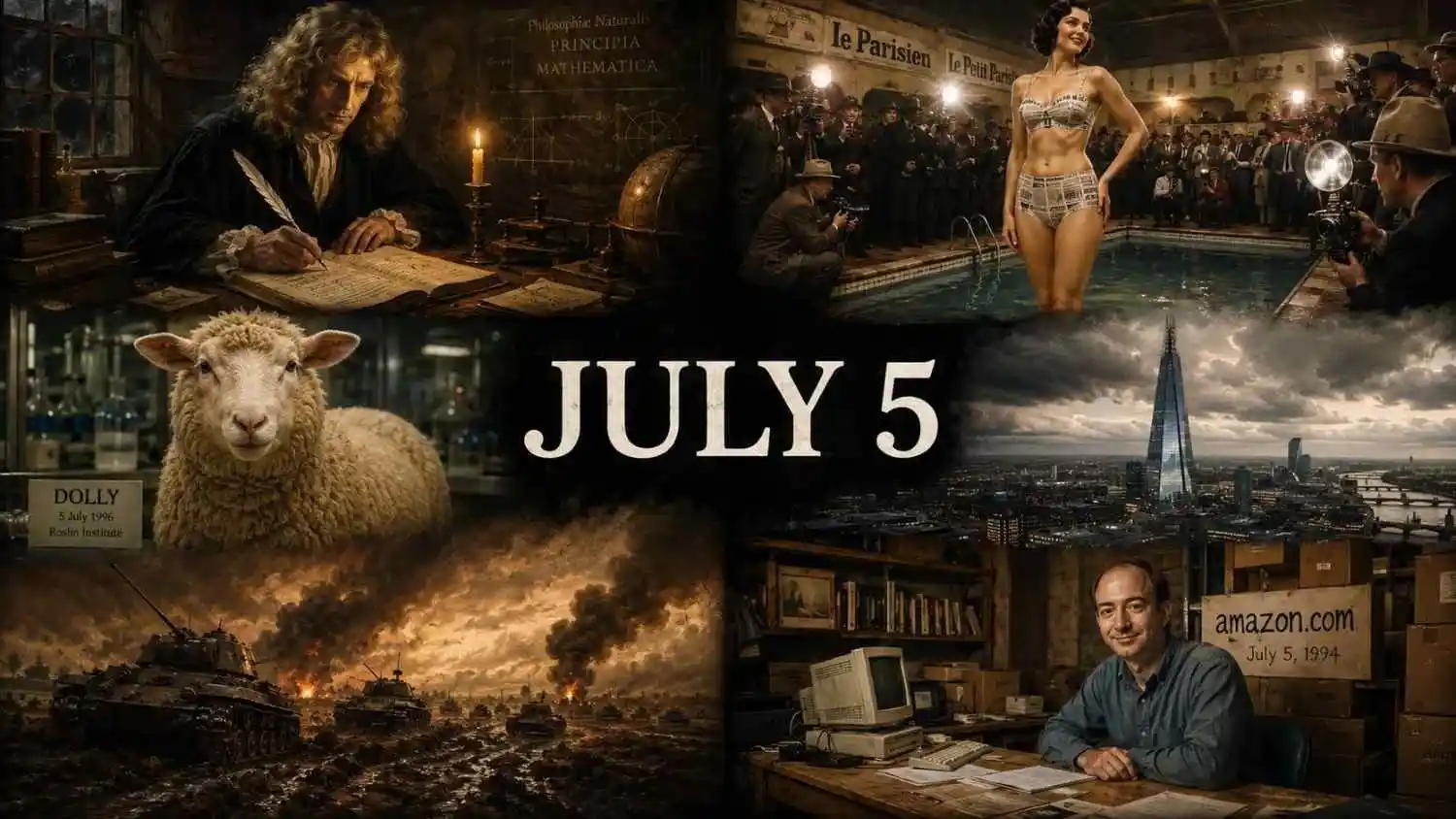
Isaac Newton sat at his desk in Cambridge, staring at the final page of a manuscript that would alter how humans understand the cosmos forever. For years, he had lived like a hermit, skip-reading meals and pacing his garden while working out the mathematical laws of gravity. On July 5, 1687, the Royal Society published his Philosophiæ Naturalis Principia Mathematica. This day in history July 5 marks the exact moment the universe stopped being an unpredictable mystery and became a clockwork machine governed by predictable, unbreakable laws.
📅 Quick Facts — July 5 in History
| 📌 Category | 📖 Event / Detail |
|---|---|
| 🌟 Most Significant Event | Sir Isaac Newton publishes the Philosophiæ Naturalis Principia Mathematica, fundamentally reshaping physics and engineering (1687) |
| 🏆 Top 10 Key Events | • Roman Emperor Constantine the Great officially opens Constantine’s Bridge over the Danube (328) • Isaac Newton alters scientific history by publishing his masterwork, the Principia (1687) • Napoleon Bonaparte’s French forces engage the Austrian Empire at the massive Battle of Wagram (1809) • The Venezuelan Declaration of Independence is formally adopted by a congress of provinces (1811) • Frederick Douglass delivers his historic “What to the Slave Is the Fourth of July?” speech in Rochester, New York (1852) • Nazi Germany launches Operation Citadel, triggering the monumental Battle of Kursk against Soviet forces (1943) • The United Kingdom officially launches the National Health Service (NHS), providing universal healthcare (1948) • Elvis Presley makes music history by recording his very first commercial single, “That’s All Right,” at Sun Records (1954) • Algeria officially proclaims its independence from France following a brutal, eight-year liberation war (1962) • Dolly the Sheep, the world’s first mammal cloned from an adult somatic cell, is born at the Roslin Institute (1996) |
| ⚔️ Key Battles | Battle of Manolada (1316), Battle of Çamurlu (1413), Battle of Lansdowne (1643), Battle of Chesma (1770), Battle of Wagram (1809), Battle of Chippawa (1814), Battle of Kursk (1943), Battle of Osan (1950) |
| 👤 Key Figures | Sir Isaac Newton, Frederick Douglass, Elvis Presley, Dolly the Sheep, Sir Keir Starmer (who officially assumed office as UK Prime Minister on this day in 2024) |
| 🌍 Observances | Independence Day (Algeria), Independence Day (Cape Verde), Independence Day (Venezuela), Fifth of July (New York historic emancipation celebration), Bloody Thursday (marking the 1934 San Francisco general strike violence) |
Story of the Day: The Day a Scanty Swimsuit Scandalized Paris
Micheline Bernardini stepped out onto the edge of the Piscine Molitor swimming pool on July 5, 1946, wearing four small triangles of newsprint-printed fabric. French designer Louis Réard had spent weeks looking for a woman brave enough to wear his latest creation, but every professional fashion model in Paris refused. Bernardini, an 18-year-old nude dancer from the Casino de Paris, had no such hesitations.
Réard knew his creation would cause a cultural explosion, so he named it the “bikini” after Bikini Atoll, the Pacific island where the US military had tested an atomic bomb just days earlier. The design was so small it could fit entirely inside a matchbox. Newspapers screamed in outrage, the Vatican declared it sinful, and several Catholic nations banned it from public beaches. Yet, Bernardini received over 50,000 fan letters within weeks, signaling a permanent, irreversible shift in global fashion and body politics.
Important Events That Happened On July 5 In History
328 – The Opening of Constantine’s Bridge
Roman architect Theophilus Patricius stood on the banks of the Danube River to watch Emperor Constantine cross a massive new masonry structure. Engineers had managed to span the treacherous river between modern-day Romania and Bulgaria, making it the longest stone bridge ever built in antiquity. Roman legions could now march swiftly across the northern frontier to counter barbarian incursions at a moment’s notice. The strategic crossing secured the empire’s border for decades before collapsing under the weight of winter ice and neglect.
1294 – Election of Pope Celestine V
Cardinals gathered in Perugia finally broke a bitter, two-year political deadlock by electing an 79-year-old hermit living in a mountain cave. Peter of Morrone had sent the cardinals a stern letter warning them of divine wrath if they didn’t pick a leader soon, so they gave him the crown instead. The deeply pious monk wept when messengers brought him the news, completely unprepared for the corrupt world of Roman ecclesiastical power. His papacy lasted just five chaotic months before he became the first pope in history to formally resign from office.
1316 – The Battle of Manolada
Ferdinand of Majorca charged his cavalry into the marshy plains of Elis to seize control of the rich Principality of Achaea. Standing in his path was Louis of Burgundy, a rival claimant determined to crush the Spanish challenger’s ambitions once and for all. A sudden, violent clash of armored knights turned the summer heat into a bloodbath as Ferdinand’s front lines fractured under the pressure. The Spanish prince was captured and promptly decapitated on the field, instantly ending his house’s claim to the Peloponnese peninsula.
1413 – The Battle of Çamurlu
Mehmed Çelebi led his loyal Ottoman troops onto a muddy battlefield near modern-day Sofia to fight his own brother, Musa. The brothers had waged a brutal civil war for a decade, tearing the fractured empire apart after their father’s capture by Tamerlane. Mehmed’s cavalry completely overwhelmed Musa’s lines, breaking the rival prince’s resolve and forcing him into a desperate retreat. Musa was hunted down in a nearby marsh and strangled with a bowstring, leaving Mehmed as the sole, undisputed Sultan of a reunited Ottoman Empire.
1584 – The Maronite College Is Established
Pope Gregory XIII signed a papal decree in Rome that opened a dedicated seminary for Christian students arriving from the mountains of Lebanon. The Maronite College provided a vital intellectual bridge between the Holy See and the isolated Christian communities living deep inside the Islamic Ottoman Empire. Young scholars studied theology and classical languages before returning home to preserve their ancient heritage against mounting political pressure. The institution transformed into a powerful engine for Middle Eastern printing, literature, and diplomatic relations with Europe.
1594 – The Campaign of Danture Begins
Pedro Lopes de Sousa led a heavily armed Portuguese army into the dense, mountain rainforests surrounding the Kingdom of Kandy. The European invaders intended to completely subjugate the last independent kingdom on the island of Sri Lanka and install a puppet ruler. Kandyan guerrilla fighters watched from the canopy, waiting for the columns to stretch thin along the treacherous, muddy tracks. Within weeks, the Portuguese forces were entirely surrounded, starved of supplies, and utterly annihilated in one of Europe’s worst colonial defeats in Asia.
1610 – John Guy Sails for Newfoundland
John Guy walked down the wooden docks of Bristol and boarded a merchant vessel packed with 39 adventurous English colonists. The merchant adventurer carried a royal charter from King James I to establish Cuper’s Cove, the first official English settlement on the rugged island. Guy aimed to turn the treacherous northern fishery into a year-round, profitable enterprise while securing British claims against Spanish rivals. The tiny outpost braved brutal winter storms and scurvy, laying the foundational brick for Britain’s eventual empire in North America.
1643 – The Battle of Landsdowne
Royalist pikemen struggled up the steep, muddy slopes of Lansdown Hill outside Bath directly into a wall of Parliamentarian gunfire. Sir Ralph Hopton’s men faced entrenched forces determined to block the Royalist advance toward the strategic prize of Bristol. A desperate, bloody hand-to-hand struggle at the crest left the hill in Royalist hands, but the victory came at a horrifying cost in human lives. The heavy casualties crippled both regional armies, turning the local landscape into a graveyard and ensuring the English Civil War dragged on.
1687 – Newton Publishes the Principia
Isaac Newton watched as a small London print shop bound the final pages of his masterpiece on the mathematical laws of nature. The reclusive Cambridge professor had spent years calculating the mechanics of the cosmos after a casual conversation about falling apples. His work proved that the exact same mathematical rules governing an object on Earth also dictate the orbits of distant planets. The book completely dismantled medieval science, instantly launching the modern age of physics and engineering.
1770 – The Battle of Chesma Begins
Russian Admiral Grigory Spiridov ordered his ships to drop anchor outside the Ottoman harbor of Chesma and open fire. The imperial fleet had sailed all the way from the Baltic Sea to support a Greek rebellion against Turkish rule in the Mediterranean. Russian fireships drifted into the packed bay under the cover of total darkness, igniting a catastrophic chain-reaction explosion among the wooden hulls. The morning light revealed the entire Ottoman navy reduced to smoking timber, marking their worst maritime disaster in two centuries.
1775 – The Olive Branch Petition Adopted
John Dickinson stood before the Second Continental Congress in Philadelphia and urged his fellow delegates to approve one final appeal to King George III. The delegates feared a full-scale, bloody war with the British Empire despite the recent armed clashes at Lexington and Concord. The petition professed total loyalty to the crown while begging the king to stop his parliament’s aggressive taxation policies. King George refused to even look at the document, declaring the colonies to be in open rebellion and making war inevitable.
1803 – The Convention of Artlenburg Is Signed
Hanoverian generals sat in a tent near the Elbe River and signed a total surrender to the advancing armies of Napoleon Bonaparte. The Electorate of Hanover was ruled directly by the British King George III, making it a primary target for French imperial expansion. The treaty completely disbanded the local military forces and placed the wealthy region under direct French occupation. The sudden loss enraged London, stripping the British crown of its ancestral European lands and shifting the balance of continental power.
1807 – British Defeat in Buenos Aires
Lieutenant-General John Whitelocke marched his elite British soldiers into the grid-like streets of Buenos Aires, expecting a swift colonial capitulation. Local criollo militias and ordinary townspeople climbed onto the flat roofs, raining boiling oil, rocks, and heavy musket fire down on the invaders. The urban trap completely disorganized the British regiments, forcing hundreds of soldiers to surrender inside churches and convents. Whitelocke signed a total retreat within forty-eight hours, a humiliation that shattered British hopes of conquering South America.
1809 – The Battle of Wagram Begins
Napoleon Bonaparte ordered his engineers to construct floating bridges across the rain-swollen Danube River under the cover of a massive artillery barrage. Over 300,000 French and Austrian soldiers converged on the plains near Vienna in the largest clash of the Napoleonic Wars so far. Archduke Charles stood ready with a massive defensive line, determined to break France’s iron grip on Central Europe. The opening day brought chaotic, close-quarters infantry fighting that left thousands dead and set the stage for a decisive tactical showdown.
1811 – Venezuelan Declaration of Independence
Francisco de Miranda and a radical congress of provincial leaders gathered in Caracas to sign a historic document severing all ties with the Spanish Empire. The delegates took advantage of Napoleon’s recent invasion of Spain to establish the very first independent republic in South America. The bold announcement split the country apart, driving royalist citizens to take up arms against the new republican government. This act launched a brutal, decades-long war of liberation that would eventually consume the entire continent.
1813 – British Raids on New York Begin
British soldiers landed on the shores of Plattsburgh under the cover of morning fog, launching three weeks of destructive amphibious raids along the New York frontier. The naval forces aimed to destroy American military supply depots, burn public buildings, and disrupt the US invasion plans for Canada. American militia units struggled to contain the fast-moving British forces as they torched barracks and seized tons of ammunition. The successful campaign exposed the deep vulnerability of the northern United States border during the War of 1812.
1814 – The Battle of Chippawa
American Major General Jacob Brown led his gray-uniformed infantry columns across the Niagara River to confront a veteran British force under General Phineas Riall. The British commander mistook the American soldiers for poorly trained militia until they deployed into perfect battle lines under heavy artillery fire. Brown’s well-drilled men advanced through intense grape-shot, shattering the British lines with a disciplined bayonet charge. The hard-fought American victory proved that the young United States army could finally defeat regular British troops in an open field.
1830 – The French Capture of Algiers
The Comte de Bourmont led an army of 37,000 French soldiers through the gates of Algiers, forcing the ruling Ottoman Dey to sign a total capitulation. The invasion was launched by King Charles X as a desperate political gamble to distract the French public from growing unrest at home. French troops quickly plundered the city’s state treasury, seizing over 48 million francs in gold and silver. The occupation marked the sudden end of centuries of Algerian autonomy and began 132 years of brutal colonial rule.
1833 – The Lê Văn Khôi Revolt Begins
Lê Văn Khôi broke out of his prison cell alongside 27 desperate soldiers, stormed the Phiên An citadel, and executed the imperial governor of Saigon. Khôi launched the bloody mutiny to avenge his adoptive father, a legendary general whose memory had been systematically defiled by Emperor Minh Mạng. The regional uprising spread like wildfire across southern Vietnam, drawing deep support from local Christians and peasants who hated the central government’s heavy taxes. The rebellion triggered a genocidal imperial crackdown that devastated the Mekong Delta.
1833 – The Third Battle of Cape St. Vincent
Admiral Charles Napier paced the deck of his flagship, ordering his small fleet to close the distance with the powerful navy of the Portuguese usurper Dom Miguel. Napier was fighting for the liberal constitutionalist forces in a bitter civil war that had torn Portugal apart. His crews executed a daring, close-range boarding action, swarming the decks of Miguel’s much larger warships and forcing them to strike their colors. The stunning naval victory completely broke the absolutist blockade, securing the crown for the young Queen Maria II.
1841 – Thomas Cook Organizes the First Package Tour
Thomas Cook stood on the platform of Leicester railway station, welcoming 540 temperance reformers onto a chartered train bound for a rally in Loughborough. The former cabinet maker had negotiated a special group rate with the Midland Railway Company, providing a round-trip ticket and a ham lecture sandwich for a single shilling. Cook realized that ordinary working-class people would travel in massive numbers if someone handled the complex logistics for them. The short, twelve-mile rail journey marked the birth of the modern global tourism industry.
1852 – Frederick Douglass Delivers Historic Speech
Frederick Douglass stepped up to the podium at Corinthian Hall in Rochester, looking out at a large crowd gathered to celebrate the nation’s founding. The famous abolitionist shocked his white audience by asking a searing question: “What, to the American slave, is your Fourth of July?” He blasted the hypocrisy of a nation that boisterously celebrated freedom and independence while holding millions of human beings in brutal, legal bondage. The address is regarded as one of the most powerful anti-slavery speeches in American history.
1859 – The United States Claims Midway Atoll
Captain John Brooke ordered his crew aboard the USS Fenimore Cooper to drop anchor beside two isolated, uninhabited sand spits in the North Pacific. The American naval officer officially mapped the tiny islands and claimed them for the United States under the Guano Islands Act. The remote outpost offered a critical coaling station for steamships making the long journey across the ocean to Asian ports. Decades later, this tiny speck of sand would become the strategic focal point of the Pacific War.
1865 – The US Secret Service Begins Operation
William P. Wood took the oath of office in Washington, D.C., as the first director of a new federal agency created to combat rampant financial crime. On the day he was assassinated, President Abraham Lincoln had authorized the creation of the Secret Service to stop counterfeiters who had flooded the post-Civil War economy with fake paper money. Nearly one-third of all US currency in circulation at the time was completely fraudulent, threatening to collapse the national economy. The agency spent its first decades hunting down illegal printing presses before taking on presidential protection.
1884 – Germany Takes Possession of Cameroon
German explorer Gustav Nachtigal signed a series of trade treaties with King Bell and King Akwa on the muddy banks of the Cameroon River. Nachtigal hastily raised the imperial German flag over the coastal settlements, beating a rival British naval vessel to the region by just a few days. Chancellor Otto von Bismarck ordered the annexation to secure rich rubber and palm oil markets for German industrial giants. The treaty launched a harsh colonial occupation that systematically reshaped the geography and politics of West Africa.
1915 – The Liberty Bell’s Final Journey
Pennsylvania railroad engineers carefully lowered the cracked Liberty Bell onto a custom-built, open-air flatcar draped in red, white, and blue bunting. The historic icon rolled out of Philadelphia on a grand, transcontinental rail tour bound for the Panama-Pacific International Exposition in San Francisco. Millions of Americans lined the tracks in small towns across the country to glimpse the symbol of national unity during the dark opening years of World War I. City officials noted the dangerous expansion of the famous crack and vowed this would be its final trip outside Philadelphia.
1934 – “Bloody Thursday” in San Francisco
Police officers donning gas masks opened fire with shotguns and tear gas on thousands of striking longshoremen along San Francisco’s Embarcadero. The maritime workers had shut down the West Coast shipping industry for two months, demanding fair wages and an end to corrupt union hiring bosses. The violent street battle left two union workers dead and hundreds injured, turning the waterfront into a smoke-filled combat zone. The killings triggered a massive general strike that completely paralyzed the city and forced employers to negotiate.
1935 – FDR Signs the National Labor Relations Act
President Franklin D. Roosevelt sat at his desk in the White House, surrounded by labor leaders, and signed the historic Wagner Act into law. The landmark legislation guaranteed American private-sector workers the legal right to form unions, engage in collective bargaining, and take strike action. The law created a federal watchdog agency to investigate and punish corporations using illegal union-busting tactics against their employees. The act transformed the American workplace, fueling a massive post-war expansion of the middle class.
1940 – Vichy France Severs Ties with Britain
Marshal Philippe Pétain announced a total break in diplomatic relations between his new collaborationist French government and the United Kingdom. The diplomatic rupture was triggered by a surprise British naval attack on the French fleet at Mers-el-Kébir, which killed over 1,200 French sailors. Winston Churchill had ordered the controversial strike to prevent the French warships from falling into Nazi hands after France’s surrender. The tragic incident turned former allies into bitter enemies, complicating the war in the Mediterranean.
1941 – German Troops Reach the Dnieper River
General Heinz Guderian’s panzer divisions ground to a halt along the banks of the Dnieper River, completing a lightning advance deep into Soviet territory. Operation Barbarossa had shattered the Red Army’s border defenses, trapping hundreds of thousands of Russian soldiers in massive pockets. The natural water barrier offered the Soviet command a brief opportunity to organize a defensive line to protect the industrial heartland. The German arrival at the river signaled the end of the war’s opening phase and the start of a brutal war of attrition.
1943 – Operation Husky Fleet Sails
Hundreds of Allied transport ships weighed anchor in North African ports, heading out into a stormy Mediterranean Sea toward the beaches of Sicily. General Dwight D. Eisenhower risked the dangerous weather to catch the Italian and German defenders completely off guard. The massive armada carried over 160,000 soldiers, launching the opening salvo of the Western Allied invasion of fortress Europe. The strategic assault would knock Italy out of the war within months and open a bloody second front.
1943 – The Battle of Kursk Begins
Field Marshal Erich von Manstein unleashed thousands of German tanks against heavily fortified Soviet lines around the salient of Kursk. Operation Citadel was Nazi Germany’s final gamble to regain the strategic initiative on the Eastern Front following their disaster at Stalingrad. Red Army commanders had spent months digging deep defensive belts, planting millions of mines, and massing their own armor. The clash escalated into the largest tank battle in human history, featuring savage, close-quarters mechanical warfare that broke the back of the panzer divisions.
1945 – Britain’s Post-War Election
Millions of British citizens lined up outside polling stations to cast their ballots in the nation’s first general election in a decade. Prime Minister Winston Churchill campaigned on his record as a war leader, expecting an easy victory over the opposition. Working-class voters turned out to support Clement Attlee’s Labour Party, which promised a welfare state, free healthcare, and affordable housing. The election results were locked away for three weeks to allow soldiers serving overseas to vote, setting up a political earthquake.
1946 – Micheline Bernardini Models the First Bikini
An 18-year-old Paris dancer walked past a crowd of flashing cameras at the Piscine Molitor wearing a daring new two-piece swimsuit. Designer Louis Réard named the tiny outfit after Bikini Atoll, where the US military had just conducted an atomic bomb test, predicting the fashion would be explosive. The design used just 30 inches of fabric, scandalizing traditional society and causing several European nations to ban it from beaches. The public debut permanently transformed global beach culture and body fashion.
1948 – The National Health Service Is Born
Health Minister Aneurin Bevan walked through the doors of Park Hospital in Manchester, symbolically taking control of Britain’s medical infrastructure. The National Health Service Acts officially launched a revolutionary public system offering free healthcare to every citizen based on clinical need rather than wealth. The government took over thousands of independent, struggling voluntary and municipal hospitals across the country on a single morning. Despite fierce initial opposition from doctors, the service became a defining cornerstone of modern British society.
1950 – The Battle of Osan
Lieutenant Colonel Charles B. Smith led 540 poorly equipped American soldiers into defensive positions along a highway just north of Osan. Task Force Smith represented the very first American ground unit deployed to stop the blitzkrieg advance of the North Korean army. A column of Soviet-built T-34 tanks rolled through the American lines, completely brushing aside infantry anti-tank weapons that failed to pierce their thick armor. The chaotic retreat exposed how badly unprepared the United States military was for the Korean War.
1950 – Israel Passes the Law of Return
Members of the Knesset stood up and cheered as they voted unanimously to pass a foundational piece of legislation for the young state. The Law of Return granted every Jewish person in the world the legal right to immigrate to Israel and automatically claim citizenship. Prime Minister David Ben-Gurion declared the law to be a direct response to the horrors of the Holocaust, ensuring Jews would never be stateless again. The act triggered a massive wave of immigration that fundamentally transformed the demography of the Middle East.
1954 – The BBC Broadcasts First Daily TV News
Richard Baker sat behind a microphone in a London studio and read a script detailing international events while static text cards appeared on screen. The BBC’s first daily television news bulletin lasted just twenty minutes and intentionally hid the newsreader’s face to preserve total journalistic objectivity. Viewers used to radio news struggled with the primitive visual format, which relied on newsreel footage that took hours to develop. The broadcast marked the humble start of the television news age in Great Britain.
1954 – Elvis Presley Records “That’s All Right”
Elvis Presley picked up his acoustic guitar during a late-night break at Sun Records in Memphis and began fooling around with an old blues track. Producer Sam Phillips stopped what he was doing, turned on the tape machine, and told Elvis to start over from the beginning. The raw, energetic track blended African-American rhythm and blues with white country music, creating a dangerous new sound that defied segregation-era radio categories. The impromptu recording session launched Elvis’s career and sparked the global explosion of rock and roll.
1962 – Algerian Independence Proclaimed
Millions of Algerians poured into the streets of Algiers, waving green and white flags to celebrate the official end of French rule. The declaration arrived exactly 132 years after the initial French invasion of 1830 and followed a savage, eight-year war of liberation that cost hundreds of thousands of lives. French President Charles de Gaulle withdrew imperial troops after a national referendum confirmed the colony’s total break from France. The triumph served as a powerful symbol of decolonization across the African continent.
1970 – Air Canada Flight 621 Crashes
A Douglas DC-8 passenger jet flying from Montreal to Los Angeles suffered a catastrophic structural failure while attempting to land at Toronto’s international airport. The co-pilot accidentally deployed the aircraft’s ground spoilers too early during the approach, causing the plane to drop heavily and slam into the runway. The violent impact ripped one of the engines completely off the wing, triggering a series of massive fuel explosions as the pilots tried to climb away. All 109 passengers and crew died when the aircraft plunged into a farm field in Brampton.
1971 – Voting Age Lowered to 18
President Richard Nixon sat before television cameras in the East Room of the White House to formally certify the Twenty-sixth Amendment. The constitutional change lowered the minimum voting age across the United States from 21 down to 18 years. The legislative push gained unstoppable momentum from the Vietnam War, where thousands of young men were drafted into combat before they were legally old enough to vote for their commander-in-chief. The amendment instantly added millions of young Americans to the national voter rolls.
1973 – The Kingman Propane Explosion
A tiny fire broke out as workers transferred liquid propane from a railroad tanker car to a storage facility in Kingman, Arizona. Firefighters rushed to the scene and began spraying water on the overheating tank, unaware that internal pressure was rising to a critical point. A massive boiling liquid expanding vapor explosion (BLEVE) suddenly ruptured the hull, creating a fireball that expanded for hundreds of yards. The blast killed eleven firefighters instantly and injured over a hundred onlookers, changing hazardous material training forever.
1973 – Military Coup in Rwanda
Major General Juvénal Habyarimana led an elite truckload of army officers into Kigali, arresting President Grégoire Kayibanda without firing a single shot. Habyarimana launched the bloodless coup to exploit growing ethnic violence and regional political gridlock that threatened to tear the country apart. The military junta suspended the constitution, banned all political parties, and placed northern military loyalists in every key government position. The takeover began a twenty-one-year dictatorship that deepened internal divisions, setting the stage for future tragedy.
1975 – Arthur Ashe Wins Wimbledon
Arthur Ashe raised his racket toward the sky on Center Court after defeating the heavily favored Jimmy Connors in a masterclass of tactical tennis. The 31-year-old American used a series of delicate soft slices and junk lobs to completely dismantle his opponent’s powerful baseline game. The historic victory made Ashe the very first Black man to win the prestigious Wimbledon singles title. Ashe used his historic platform to blast South African apartheid and advocate for civil rights around the globe.
1975 – Cape Verde Gains Independence
Portuguese officials lowered their flag in Praia, ending five centuries of colonial rule over the strategic volcanic archipelago of Cape Verde. Aristides Pereira took office as the new nation’s first president, heading a Marxist liberation movement that had fought a long guerrilla war in Guinea-Bissau. The islands had served as a vital hub for the transatlantic slave trade and Portuguese military operations in Africa. The transition marked another major collapse of Portugal’s African empire following the Carnation Revolution in Lisbon.
1977 – Operation Fair Play in Pakistan
General Muhammad Zia-ul-Haq ordered troops to surround the official residence of Prime Minister Zulfikar Ali Bhutto in Islamabad under the cover of darkness. The bloodless military coup followed months of violent street protests over alleged election rigging by Bhutto’s ruling party. Zia declared martial law across the country, suspended the constitution, and promised fresh democratic elections within ninety days. The takeover began eleven years of military dictatorship, transforming Pakistan’s legal and political landscape.
1980 – Björn Borg Wins Fifth Wimbledon
Swedish tennis star Björn Borg fell to his knees on the grass of Center Court after winning a grueling, five-set epic against his American rival John McEnroe. The match featured a legendary, thirty-four-point fourth-set tiebreak that pushed both athletes to their absolute physical and mental limits. Borg’s cool composure under intense pressure secured his fifth consecutive Wimbledon singles crown, a feat never before achieved in the modern era. The historic rivalry gripped the sporting world, cementing tennis as a global television phenomenon.
1984 – United States v. Leon Decided
Supreme Court Justice Byron White delivered a landmark ruling that altered how the Fourth Amendment applies to criminal investigations across America. The court voted 6-3 to establish a “good-faith exception” to the long-standing exclusionary rule regarding police searches. The new judicial standard allowed prosecutors to use evidence gathered by officers who relied on a defective search warrant, provided the mistake was made by a judge rather than the police. Civil liberties groups blasted the decision, claiming it eroded protections against unlawful searches.
1887 – The Black Tigers Born in Sri Lanka
A Tamil rebel known as Miller drove a truck packed with explosives through the gates of a Sri Lankan Army garrison at Nelliady, blowing himself up. The deadly blast killed an estimated forty soldiers and marked the first official suicide attack executed by the Liberation Tigers of Tamil Eelam (LTTE). The strike led to the formation of the Black Tigers, an elite, highly secretive wing of the rebel group dedicated to suicide operations. The terrifying tactic became a signature weapon of the civil war, claiming the lives of two world leaders.
1989 – Oliver North Is Sentenced
U.S. District Judge Gerhard A. Gesell ordered former National Security Council aide Oliver North to pay $150,000 in fines and perform 1,200 hours of community service. North had been convicted of three felony charges related to his role in the Iran-Contra affair, which involved secretly selling weapons to Iran to illegally fund right-wing rebels in Nicaragua. The retired Marine Lieutenant Colonel avoided prison time after the judge noted he was following orders from higher officials. All of North’s convictions were overturned on appeal due to his immunized congressional testimony.
1994 – Jeff Bezos Founds Amazon
Jeff Bezos sat at a makeshift wooden desk inside a garage in Bellevue, Washington, and officially incorporated a small online bookstore called Cadabra. The former Wall Street executive changed the company’s name to Amazon a few months later after a lawyer mistakenly heard the original name as “cadaver.” Bezos chose the book market because of its vast global inventory and the ease of shipping paperbacks directly to customers’ homes. The tiny startup grew into a global e-commerce and cloud computing giant, completely reshaping modern retail.
1995 – Armenia Adopts Its Constitution
Millions of Armenian citizens went to the polls to approve a new constitution, completing the nation’s transition away from Soviet legal frameworks. The document established a strong presidential system of government and guaranteed fundamental human rights and private property ownership. The vote took place alongside controversial parliamentary elections that were marred by allegations of fraud and the banning of opposition parties. The adoption marked a critical milestone in Armenia’s struggle to build an independent state following the collapse of the Soviet Union.
1996 – Dolly the Sheep Is Cloned
Scientists at the Roslin Institute in Scotland watched a Finn Dorset lamb take its first breath, completing a breakthrough that shocked the scientific community. Embryologist Ian Wilmut and his team had successfully cloned a mammal from an adult somatic cell using a method called nuclear transfer. The lamb, named Dolly, proved that specialized cells could be reprogrammed to create an entirely new, genetically identical organism. The discovery triggered intense ethical debates around the world regarding the future possibility of cloning human beings.
1997 – Sri Lankan Politician Assassinated
Two unidentified gunmen opened fire on Sri Lankan Tamil Member of Parliament A. Thangathurai as he walked outside a school in the coastal town of Trincomalee. The moderate politician was shot dead alongside a local principal while inspecting new classrooms funded by his office. Authorities blamed the attack on the separatist LTTE rebels, who regularly targeted Tamil politicians who chose to participate in democratic politics rather than armed rebellion. The killing shattered regional peace talks and deepened the bloody civil war.
1999 – US Sanctions the Taliban
President Bill Clinton signed an executive order imposing strict economic and trade sanctions against the Taliban regime ruling Afghanistan. The American move was a direct response to the fundamentalist group’s refusal to hand over Osama bin Laden following the deadly 1998 US embassy bombings in East Africa. The sanctions completely froze all Taliban-controlled assets within the United States and banned any commercial flights between the two nations. The economic measures failed to dislodge the regime or force them to close terrorist training camps.
2003 – SARS Outbreak Contained
The World Health Organization issued a statement declaring that the global outbreak of Severe Acute Respiratory Syndrome (SARS) had been successfully brought under control. Health officials lifted their final travel warning for Taiwan after thirty days passed without a single new case of human-to-human transmission. The respiratory virus had spread rapidly from southern China to thirty countries, infecting over 8,000 people and killing 774. The successful containment relied on old-fashioned quarantine measures, rapid contact tracing, and international scientific cooperation.
2004 – First Direct Indonesian Presidential Election
Millions of Indonesian citizens lined up at polling stations across thousands of islands to vote in the country’s first direct presidential election. Voters cast their ballots by punching holes through paper photos of their preferred candidates, choosing between five distinct political teams. Former general Susilo Bambang Yudhoyono emerged as the frontrunner, promising to fight corruption and rebuild an economy shattered by the Asian financial crisis. The peaceful democratic exercise marked the end of decades of authoritarian military transition following the fall of Suharto.
2006 – North Korean Missile Tests
North Korean military engineers launched seven ballistic missiles from coastal bases into the Sea of Japan, triggering an immediate international security alert. The test cluster included short-range Scud missiles, medium-range Rodongs, and a new, long-range Taepodong-2 rocket capable of reaching Alaska. The long-range missile suffered a catastrophic structural failure just forty seconds into its flight, plunging into the ocean. The provocations drew fierce condemnation from neighbors and led to a tightening of United Nations economic sanctions.
2009 – Ürümqi Riots Break Out
Thousands of Uyghur protesters marched into the central plazas of Ürümqi, leading to a wave of ethnic violence that tore through the capital of Xinjiang. The initial demonstration over the factory deaths of migrant workers degenerated into street clashes as crowds attacked Han Chinese citizens and burned vehicles. Paramilitary forces locked down the city with checkpoints, cut off internet access across the entire province, and arrested hundreds of suspected rioters. The Chinese government reported nearly 200 people dead, making it the deadliest ethnic violence in the region for decades.
2009 – Staffordshire Hoard Discovered
Terry Herbert swept his metal detector across a freshly plowed field near the village of Hammerwich, picking up a strong signal that led to a life-changing find. The amateur treasure hunter unearthed a massive cache of Anglo-Saxon gold, silver, and garnet items buried deep in the soil. Archaeologists uncovered over 1,500 individual military artifacts, including decorative sword pommels, gold helmet fragments, and a Christian cross. The historic hoard represented the largest collection of Anglo-Saxon metalwork ever found, completely reshaping historians’ view of seventh-century English kingdoms.
2012 – The Shard Inaugurated in London
Qatari Prime Minister Hamad bin Jassim bin Jaber Al Thani and Prince Andrew pulled a lever to project a massive laser light show across the London sky from the top of a new glass skyscraper. The Shard stood at an imposing height of 310 meters, officially opening its doors as the tallest building on the European continent. Italian architect Renzo Piano designed the 87-story, pyramid-shaped tower to look like a shard of glass rising from the historic Southwark landscape. The glassy monolith became a prominent symbol of London’s changing financial skyline.
2016 – Juno Probe Arrives at Jupiter
NASA flight controllers in California burst into applause as telemetry confirmed that the solar-powered Juno spacecraft had fired its main engine and entered orbit around Jupiter. The probe had traveled 1.7 billion miles over five years to reach the gas giant, navigating through intense, deadly radiation belts surrounding the planet. Juno commenced a detailed, twenty-month scientific survey designed to peer beneath the thick cloud layers to study the planet’s core, water content, and massive magnetic fields. The mission gathered data that upended long-held theories about the solar system’s creation.
2022 – UK Government Resignations Begin
Chancellor Rishi Sunak and Health Secretary Sajid Javid published their resignation letters within minutes of each other, triggering a massive political crisis for Prime Minister Boris Johnson. The senior cabinet ministers stated they could no longer defend the government following a series of integrity scandals involving the handling of sexual misconduct allegations against a senior party official. The sudden double exit broke the prime minister’s executive authority, unleashing a wave of dozens of junior minister resignations over forty-eight hours that forced Johnson to step down.
2023 – Final Ariane 5 Launch
An Ariane 5 heavy-lift rocket blasted off from the European spaceport in Kourou, French Guiana, disappearing into the evening clouds on its final operational mission. The European Space Agency rocket safely delivered two military communications satellites into orbit, completing twenty-seven years of spaceflight service. The workhorse vehicle had built a legendary reputation for reliability over 117 launches, carrying historic payloads like the James Webb Space Telescope into deep space. The retirement left Europe without an independent heavy-lift rocket during delays to its successor.
2024 – Keir Starmer Appointed Prime Minister
Keir Starmer walked up the steps of 10 Downing Street to deliver his first address as Prime Minister after a landslide election victory over the Conservative Party. The former human rights lawyer and Director of Public Prosecutions had rebuilt the Labour Party over four years, running on a platform of economic stability and public service renewal. The election results wiped out dozens of senior Tory ministers, ending fourteen years of Conservative rule. Starmer became the first Labour leader to win a general election since Tony Blair’s victory in 2005.
Continue your journey through time by clicking here.
Famous People Born on July 5
| Name | Description | Dates |
|---|---|---|
| Thomas Hooker | Founder of the Colony of Connecticut | 1586 – 1647 |
| Sarah Siddons | England’s greatest tragic stage actress | 1755 – 1831 |
| Stamford Raffles | Founder of modern Singapore | 1781 – 1826 |
| Sylvester Graham | American dietary reformer; creator of Graham flour | 1794 – 1851 |
| David Farragut | First Admiral of the U.S. Navy | 1801 – 1870 |
| Robert FitzRoy | HMS Beagle captain and pioneering meteorologist | 1805 – 1865 |
| P. T. Barnum | Legendary American showman and circus founder | 1810 – 1891 |
| William J. M. Rankine | Scottish engineer and thermodynamics pioneer | 1820 – 1872 |
| Cecil Rhodes | British imperialist and founder of Rhodes Scholarship | 1853 – 1902 |
| Clara Zetkin | German socialist leader and women’s rights activist | 1857 – 1933 |
| A. E. Douglass | Astronomer; founder of dendrochronology | 1867 – 1962 |
| Dwight F. Davis | Founder of the Davis Cup tennis tournament | 1879 – 1945 |
| Inayat Khan | Indian Sufi mystic and spiritual teacher | 1882 – 1927 |
| Willem Drees | Prime Minister who rebuilt the Netherlands after WWII | 1886 – 1988 |
| Jean Cocteau | French poet, novelist, filmmaker, and artist | 1889 – 1963 |
| Ernst Mayr | Influential evolutionary biologist | 1904 – 2005 |
| Georges Pompidou | President of France (1969–1974) | 1911 – 1974 |
| James Mirrlees | Nobel Prize-winning economist | 1936 – 2018 |
| Chuck Close | American photorealist painter | 1940 – 2021 |
| Robbie Robertson | Guitarist and songwriter for The Band | 1943 – 2023 |
| Gerard ‘t Hooft | Nobel Prize-winning theoretical physicist | 1946 – Present |
| Huey Lewis | American rock singer and frontman of Huey Lewis and the News | 1950 – Present |
| Bill Watterson | Creator of the Calvin and Hobbes comic strip | 1958 – Present |
| Edie Falco | Emmy Award-winning actress (The Sopranos, Nurse Jackie) | 1963 – Present |
| Gianfranco Zola | Italian football legend and manager | 1966 – Present |
| Susan Wojcicki | Former CEO of YouTube | 1968 – 2024 |
| RZA | Rapper, producer, and founder of Wu-Tang Clan | 1969 – Present |
| Hernán Crespo | Argentine football striker and coach | 1975 – Present |
| Megan Rapinoe | American footballer and World Cup champion | 1985 – Present |
| Shohei Ohtani | Japanese baseball superstar and MLB two-way player | 1994 – Present |
Famous People Died on July 5
| Name | Description | Dates |
|---|---|---|
| Anthony Maria Zaccaria | Italian Catholic saint and founder of the Barnabites | 1502 – 1539 |
| Stamford Raffles | Founder of modern Singapore | 1781 – 1826 |
| Nicéphore Niépce | Inventor of the world’s first permanent photograph | 1765 – 1833 |
| Lewis Armistead | Confederate general of the American Civil War | 1817 – 1863 |
| Albrecht Kossel | Nobel Prize-winning German biochemist | 1853 – 1927 |
| John Curtin | Prime Minister of Australia during World War II | 1885 – 1945 |
| Georges Bernanos | French novelist and essayist | 1888 – 1948 |
| Carole Landis | American film actress | 1919 – 1948 |
| George de Hevesy | Nobel Prize-winning chemist | 1885 – 1966 |
| Walter Gropius | Founder of the Bauhaus school of architecture | 1883 – 1969 |
| Tom Mboya | Influential Kenyan independence leader and politician | 1930 – 1969 |
| Leo McCarey | Academy Award-winning film director | 1898 – 1969 |
| Harry James | American jazz trumpeter and bandleader | 1916 – 1983 |
| Howard Nemerov | Pulitzer Prize-winning American poet | 1920 – 1991 |
| Sid Luckman | Hall of Fame American football quarterback | 1916 – 1998 |
| Katy Jurado | Mexican actress and Hollywood pioneer | 1924 – 2002 |
| Ted Williams | Baseball Hall of Fame legend | 1918 – 2002 |
| James Stockdale | U.S. Navy admiral and Medal of Honor recipient | 1923 – 2005 |
| Kenneth Lay | Founder and CEO of Enron | 1942 – 2006 |
| Cy Twombly | Influential American contemporary artist | 1928 – 2011 |
| Yoichiro Nambu | Nobel Prize-winning theoretical physicist | 1921 – 2015 |
| Nick Cordero | Canadian actor and Broadway performer | 1978 – 2020 |
| Raffaella Carrà | Italian singer, dancer, and television icon | 1943 – 2021 |
| Richard Donner | Director of Superman and Lethal Weapon | 1930 – 2021 |
| Jon Landau | Oscar-winning producer of Titanic and Avatar | 1960 – 2024 |
| Bengt I. Samuelsson | Nobel Prize-winning Swedish biochemist | 1934 – 2024 |
| Vic Seixas | American tennis champion and Grand Slam winner | 1923 – 2024 |
Observances on July 5
- Independence Day (Algeria): A national holiday marked by military parades, speeches, and concerts celebrating the end of French colonial rule in 1962.
- Independence Day (Cape Verde): Commemorates the nation’s liberation from Portuguese colonial rule in 1975, celebrated with traditional music and cultural festivals across the islands.
- Independence Day (Venezuela): Marks the historic 1811 signing of the declaration of independence from Spain, observed with civic parades and National Armed Forces Day ceremonies.
- Fifth of July (New York): A historical African-American celebration commemorating the official legal abolition of slavery within New York State on July 4, 1827, traditionally held a day later to avoid conflict with Independence Day events.
- Bloody Thursday: Remembered by the International Longshore and Warehouse Union (ILWU) with silent marches and work stoppages along West Coast docks to honor the striking workers killed by police in 1934.
🍎 Frequently Asked Questions — July 5 in History
Isaac Newton changed our understanding of the universe by publishing his masterwork, the Principia Mathematica. The book laid out the fundamental laws of motion and universal gravitation that modern engineering relies on.
The publication of Isaac Newton’s Principia Mathematica in 1687 altered the course of human science. It proved that the exact same mechanical laws govern both an apple falling on Earth and the orbits of the planets.
Scottish colonial administrator Thomas Stamford Raffles, who founded modern Singapore, was born on this day in 1781. The date also marks the birth of P.T. Barnum in 1810, the legendary American showman who created the modern circus.
German armored forces launched Operation Citadel in 1943, initiating the Battle of Kursk against entrenched Soviet positions. This massive clash escalated into the largest tank battle in human history and broke Nazi Germany’s offensive power on the Eastern Front.
Algerian Independence Day celebrates the official end of 132 years of French colonial rule on July 5, 1962. It honors the immense sacrifices made by the Algerian people during a brutal, eight-year war of liberation.
Keir Starmer was officially appointed Prime Minister by King Charles III in 2024 following a landslide election victory. The political shift ended fourteen years of Conservative rule and brought the Labour Party back to power.