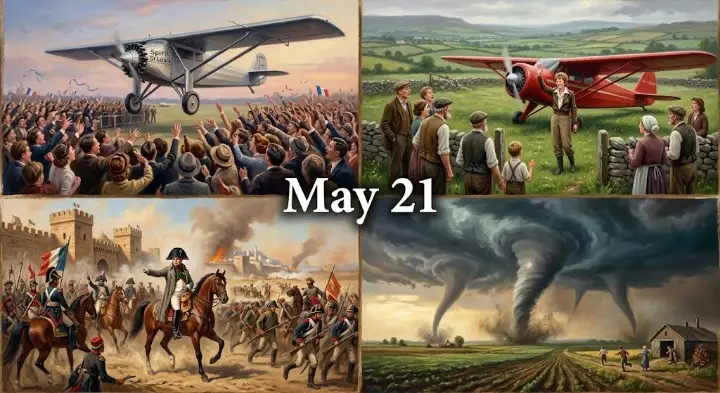
Charles Lindbergh stepped out of his silver monoplane into a roaring crowd of 150,000 screaming Parisians, having just conquered the Atlantic alone. That single, exhausted step on May 21, 1927, instantly transformed global aviation. This day in history May 21, is filled with such paradigm shifts, where solitary human will collided directly with destiny.
👶 Quick Facts — May 21 in History
| 📌 Category | 📖 Event / Detail |
|---|---|
| 🌟 Most Significant Event | Charles Lindbergh completes the first solo nonstop transatlantic flight, landing in Paris (1927) |
| 🏆 Top 10 Key Events | • Roman Tetrarchy begins (293) • Siege of Acre ends in defeat for Napoleon (1799) • Slavery abolished in Colombia (1851) • Paris Commune suppressed during Bloody Week (1871) • American Red Cross founded (1881) • FIFA established in Paris (1904) • Lindbergh completes transatlantic flight (1927) • Amelia Earhart completes solo transatlantic flight (1932) • Indian Prime Minister Rajiv Gandhi assassinated (1991) • Indonesian President Suharto resigns (1998) |
| ⚔️ Key Battles | Siege of Syracuse (878), Siege of Acre (1799), Battle of Aspern-Essling (1809), Battle of Iquique (1879), Battle of San Carlos (1982) |
| 👤 Key Figures | Charles Lindbergh, Amelia Earhart, Napoleon Bonaparte, Clara Barton |
| 🌍 Observances | International Tea Day, World Day for Cultural Diversity, Circassian Day of Mourning, Navy Day (Chile) |
Story of the Day: The Night Lindbergh Conquered the Atlantic
Thirty-three and a half hours after lifting off from New York, a slender 25-year-old pilot peered through a fogged cockpit window into the dark French countryside. Charles Lindbergh was running on pure adrenaline and cheap coffee, fighting hallucinations across thousands of miles of open ocean. When he finally guided the Spirit of St. Louis down onto the runway at Le Bourget Field, the barrier between continents dissolved forever. Over 150,000 people broke through police lines, rushing the plane to hoist the exhausted pilot onto their shoulders. It was a triumph of human endurance that fundamentally proved long-distance commercial aviation was no longer a distant dream, but an immediate reality.
Important Events That Happened On May 21 In History
293 – Tetrarchy Established in Rome
Diocletian and Maximian appointed Galerius as Caesar to fortify the fractured borders of the sprawling Roman Empire. This radical political experiment divided supreme executive power among four distinct co-rulers to prevent endless civil wars. The new administrative system temporarily stabilized the empire’s failing economy and secured its threatened frontiers. This bureaucratic overhaul laid the groundwork for splitting Rome permanently into Western and Eastern empires.
878 – Muslim Aghlabids Capture Syracuse
Thirsty and starving Byzantine defenders surrendered the strategic fortress city of Syracuse after a brutal nine-month siege. Aghlabid forces breached the massive stone walls, putting an end to centuries of unbroken Byzantine rule in Sicily. The fall of this metropolis marked a massive geopolitical shift in the central Mediterranean theater. Islamic culture, architecture, and governance took firm root across the island for the next two centuries.
879 – Pope John VIII Blesses Branimir
Pope John VIII drafted a papal letter granting his solemn apostolic blessing to Prince Branimir and the Croatian populace. This spiritual document effectively recognized Croatia as an independent political entity separate from the Frankish empire. Diplomatic validation from Rome gave the young duchy vital sovereignty and protection from aggressive neighboring rulers. Croatians still celebrate this exchange as the birth of their formal international statehood.
996 – Otto III Crowned Holy Roman Emperor
Sixteen-year-old German King Otto III received the imperial crown from his own cousin, Pope Gregory V, inside Rome. The ambitious teenager envisioned a grand restoration of ancient Roman authority combined with modern Christian governance. His rapid ascent bypassed seasoned regional dukes and asserted direct imperial control over turbulent Italian politics. This youthful coronation tightly bound German royal interests to Italian soil for generations to come.
1294 – Coronation of Michael IX Palaiologos
Byzantine Emperor Andronikos II officially elevated his young son Michael IX to co-emperor during a grand cathedral ceremony. The aging dynasty sought to guarantee a smooth, undisputed line of succession amid mounting foreign threats. Michael took immediate command of defensive forces struggling to contain aggressive Turkish incursions in Asia Minor. His early coronation sustained the fragile Palaiologos family line during a period of terminal imperial decline.
1347 – Coronation of John VI Kantakouzenos
Patriarch Isidore I crowned John VI Kantakouzenos inside the Church of St. Mary of Blachernae following a devastating civil war. The triumphant general assumed co-rule alongside the legitimate young heir to heal deep social fractures. Decades of internal conflict had already emptied the imperial treasury and left borders vulnerable to foreign raiders. This compromised crowning failed to stop the slow, agonizing dissolution of the Byzantine state.
1349 – Dušan’s Code Enacted in Serbia
Emperor Stefan Dušan the Mighty published a comprehensive legal constitution before a grand state assembly in Skopje. This legal document standardized judicial punishments, protected property rights, and regulated the powerful Serbian Orthodox Church. Dušan aimed to civilize his rapidly expanding territory by replacing lawless regional blood feuds with imperial statutes. The sophisticated code became the enduring backbone of medieval Serbian civilization and national identity.
1403 – Castilian Embassy Sent to Timur
King Henry III of Castile dispatched diplomat Ruy González de Clavijo on a hazardous journey toward central Asia. The Spanish monarch sought an offensive military alliance with the warlord Timur against the expanding Ottoman Empire. Clavijo spent years traversing dangerous terrain to reach the legendary silk road capital of Samarkand. This historic journey yielded the earliest detailed European accounts of the highly guarded Timurid court.
1424 – King James I Crowned at Scone
Scottish nobles gathered at Scone Abbey to crown James I after his eighteen-year captivity in England. The returned king immediately launched a ruthless political campaign to strip power from corrupt domestic regents. He centralized judicial authority and modernized the royal tax system to pay off his staggering English ransom. His aggressive reforms sparked bitter blood feuds that eventually led to his violent assassination.
1554 – Queen Mary I Charters Derby School
Queen Mary I signed a royal charter establishing Derby School as a formal grammar institution for English boys. The royal declaration funded classical education by reallocating local properties seized during the turbulent Protestant Reformation. Local merchants gained direct control over educating future civic leaders outside of traditional monastic oversight. This continuous institution operated for over four centuries, shaping generations of regional scholars.
1659 – Concert of The Hague Signed
Diplomats from the Dutch Republic, England, and France signed an intervention pact concerning the Second Northern War. The western powers forced Sweden and Denmark toward the negotiating table to safeguard lucrative Baltic trade routes. This joint diplomatic pressure demonstrated that international trade interests now dictated western European foreign policy decisions. The alliance successfully maintained a delicate balance of naval power in northern waters.
1660 – Battle of Long Sault Concludes
Iroquois warriors overwhelmed a makeshift fort held by seventeen French militiamen and their native allies after five days of combat. Adam Dollard des Ormeaux led his small colonial force in a desperate stand along the Ottawa River. The fierce resistance inflicted heavy casualties on the attackers, forcing them to abandon their planned raid on Montreal. French colonists viewed this tactical defeat as a miraculous salvation for their fragile settlement.
1674 – John Sobieski Elected King of Poland
Polish nobles voted overwhelmingly to lift military commander John Sobieski to the royal throne of the Commonwealth. Sobieski had recently shattered Ottoman forces at Khotyn, earning him legendary status across Christian Europe. His election shifted Polish focus toward aggressive defense against Islamic expansion in the volatile eastern territories. He used this royal platform to organize the relief forces that later saved Vienna in 1683.
1703 – Daniel Defoe Imprisoned for Libel
English authorities jailed writer Daniel Defoe for publishing a scathing satirical pamphlet targeting the religious establishment. The government viewed his ironic writing as seditious libel against the Church of England and the Crown. Defoe endured public exposure in the pillory, where supportive crowds threw flowers instead of rocks. This early brush with political censorship pushed him away from politics and toward writing immortal novels like Robinson Crusoe.
1725 – Order of St. Alexander Nevsky Instituted
Empress Catherine I created a prestigious military merit award named after Russia’s legendary medieval warrior prince. The imperial decoration honored exceptional service among top-tier diplomats and battlefield commanders who protected the homeland. The Soviet regime resurrected this exact medal during the darkest hours of World War II to inspire national defense. It bridges imperial and modern Russian military traditions across three distinct centuries.
1758 – Mary Campbell Abducted by Lenape
Lenape warriors snatched ten-year-old Mary Campbell from her family home during the French and Indian War. The native tribe adopted the young girl into their community, teaching her their language, customs, and survival skills. She lived among her captors for six years before military treaties forced her return to white society. Her experience became one of colonial America’s most famous and well-documented captivity narratives.
1792 – Volcanic Tsunami Devastates Kyūshū
A collapsing lava dome on Mount Unzen triggered a massive landslide that slammed into the Shimabara Gulf. The sudden impact generated a towering tsunami wave that flattened coastal villages across the Japanese island of Kyūshū. Nearly 15,000 people drowned in the churning waters, making it Japan’s worst historical volcanic disaster. This tragic event forced coastal communities to rethink natural disaster preparation for generations.
1799 – Siege of Acre Ends in French Defeat
Napoleon Bonaparte abandoned his two-month siege of the strategic Ottoman fortress city of Acre. British naval support and stubborn Turkish resistance repeatedly turned back furious French infantry assaults. The costly failure checked Napoleon’s grand dreams of conquering the Middle East and marching onward toward British India. This painful setback marked the very first major military defeat of his legendary career.
1809 – Battle of Aspern-Essling Begins
Austrian forces under Archduke Charles launched a massive attack against French troops crossing the swollen Danube River. Napoleon’s engineers struggled to keep fragile pontoon bridges intact under constant Austrian artillery bombardment. The intense two-day engagement marked the first time Napoleon faced a well-organized, determined frontal assault by the Austrian army. This bloody encounter shattered the myth of French battlefield invincibility.
1851 – Slavery Abolished in Colombia
President José Hilario López signed a historic emancipation law outlawing chattel slavery throughout the Republic of Colombia. The government promised financial compensation to former owners while granting immediate civil rights to thousands of Afro-Colombians. Landowners launched a brief, failed rebellion trying to preserve their free agricultural labor force. The law marked a massive step forward for human rights in South America.
1856 – Lawrence, Kansas Burned by Pro-Slavery Forces
A heavily armed pro-slavery posse raided, ransacked, and burned the anti-slavery settlement of Lawrence. The attackers destroyed local newspaper printing presses, looted private homes, and demolished the Free-State Hotel. This violent raid escalated the regional guerrilla conflict known across America as “Bleeding Kansas.” The destruction fueled intense national anger, driving the country closer to full-scale civil war.
1863 – Union Army Closes Port Hudson Escape
Federal troops locked down the final remaining escape route out of the Confederate stronghold of Port Hudson. General Nathaniel Banks prepared his men for a prolonged, punishing siege to choke off the vital Mississippi River outpost. This tactical movement isolated thousands of Confederate defenders from their western supply lines and reinforcement armies. The coming siege would become the longest continuous layout in American military history.
1864 – Russo-Circassian War Ends in Exile
Imperial Russian commanders declared total victory over native tribes, ending seventy years of brutal Caucasus warfare. The Tsarist government forced hundreds of thousands of surviving Circassians to flee their ancestral mountain homelands. Mass expulsions across the Black Sea led to widespread starvation, disease outbreaks, and catastrophic loss of life. Circassians around the globe still mark this dark date as their national Day of Mourning.
1864 – Battle of Spotsylvania Court House Concludes
General Ulysses S. Grant ended twelve days of horrific, indecisive combat against Robert E. Lee’s entrenched forces. The bloody stalemate cost both armies over 30,000 total casualties in the tangled Virginia wilderness. Grant refused to retreat north, choosing instead to march his army further south toward Richmond. This relentless strategy shifted the American Civil War into a permanent war of attrition.
1864 – Ionian Islands Reunite with Greece
British authorities officially transferred governance of the strategic Ionian Islands back to the Kingdom of Greece. The diplomatic handover celebrated the arrival of the newly elected, British-approved Greek monarch, King George I. Local islanders welcomed the peaceful end to fifty years of foreign military protectorate rule. This peaceful transition marked an early success for the Greek national unification movement.
1871 – French Troops Invade Paris Commune
Government infantry forces breached the outer ramparts of Paris to crush the radical socialist Commune government. The intrusion sparked a week of desperate street fighting and widespread arson across historic neighborhoods. By the end of this “Bloody Week,” over 20,000 Parisian citizens lay dead in the streets. The brutal crackdown suppressed French radical leftist movements for more than a generation.
1871 – Europe’s First Rack Railway Opens
Engineers inaugurated the Rigi Bahnen mountain railway on the steep slopes of Mount Rigi in Switzerland. Niklaus Riggenbach designed the innovative cog-wheel tracking system to safely haul passenger cars up steep alpine inclines. This technological breakthrough opened rugged mountain peaks to mass tourism for the very first time. It transformed the Swiss tourism industry and proved cog railways could handle extreme terrain.
1879 – Chilean and Peruvian Ships Battle at Iquique
Two wooden Chilean warships engaged two heavily armored Peruvian ironclads blocking the valuable mineral port of Iquique. The Peruvian ironclad Huáscar rammed and sank the Chilean corvette Esmeralda, killing Captain Arturo Prat on his own deck. Prat’s dramatic death transformed him into an immortal national hero across Chile overnight. The naval battle galvanized Chilean public resolve, turning the tide of the War of the Pacific.
1881 – American Red Cross Established
Clara Barton organized the American Red Cross in Dansville, New York, after working with European relief agencies. The pioneering nurse wanted a permanent organization to alleviate human suffering during natural disasters and military conflicts. She expanded the group’s mission beyond wartime aid to include peacetime emergency relief work. Her relentless efforts established a permanent fixture in global humanitarian assistance.
1894 – Manchester Ship Canal Officially Opens
Queen Victoria boarded the royal yacht to formally open the massive Manchester Ship Canal in northern England. The thirty-six-mile engineering marvel connected inland manufacturing mills directly to the open Irish Sea. This project bypassed costly Liverpool port duties, reviving Manchester’s struggling industrial economy. It stood as the largest navigational ship canal anywhere in the world at opening.
1904 – FIFA Founded in Paris
Football representatives from seven European nations gathered in Paris to form a global governing body for the sport. The founders aimed to standardize playing rules and arrange organized international competitions. They created a framework that eventually unified diverse regional playing styles under one single banner. This low-key meeting birthed the organization that now manages the world’s most popular sporting event.
1911 – Treaty of Ciudad Juárez Signed
Mexican President Porfirio Díaz signed a historic peace treaty with revolutionary leader Francisco Madero. The agreement forced the aging dictator to resign his office and flee into European exile. It successfully ended the initial, bloody phase of fighting across the country’s northern states. The treaty failed to solve deep agrarian problems, plunging Mexico into a decade of civil war.
1917 – Imperial War Graves Commission Established
King George V signed a royal charter creating a permanent organization to honor dead British Empire soldiers. The commission vowed to record names and construct uniform headstones for every fallen service member. They rejected social class distinctions, ensuring officers and low-ranking privates received identical, respectful burials. This massive project created thousands of quiet, beautifully manicured cemeteries across former battlefields.
1917 – Great Atlanta Fire Devastates City
A small trash fire quickly exploded out of control, sweeping through 300 acres of downtown Atlanta. Strong winds pushed the flames through dense neighborhoods, destroying over 2,000 homes, businesses, and historic churches. Firefighters dynamically dynamited entire blocks of private houses to create firebreaks and halt the destruction. The disaster left 10,000 people homeless but resulted in only one single fatality.
1924 – Leopold and Loeb Commit Thrill Killing
University of Chicago students Nathan Leopold and Richard Loeb kidnapped and murdered 14-year-old Bobby Franks. The wealthy intellectuals spent months planning the perfect crime simply to prove their supposed mental superiority. A dropped pair of eyeglasses near the disposal site quickly led police detectives straight to the killers. Their subsequent trial became a sensational media circus focused on teenage arrogance and the death penalty.
1925 – Doktor Faust Premieres in Dresden
The Dresden State Opera staged the world premiere of Ferruccio Busoni’s unfinished masterpiece, Doktor Faust. Pupil Philipp Jarnach spent months completing the complex musical score following his master’s sudden death. The opera utilized avant-garde musical structures to retell the classic, dark tale of a scholar trading his soul for power. It marked a major milestone for twentieth-century modernist theatrical music.
1932 – Amelia Earhart Lands in Northern Ireland
Fierce Atlantic storms forced aviator Amelia Earhart to land her red plane in a pasture near Derry. The sudden touchdown completed her journey as the very first woman to fly solo across the Atlantic Ocean. She braved fuel leaks and mechanical failures during her exhausting fifteen-hour journey from Newfoundland. Her historic flight proved women could compete directly with men in the dangerous world of aviation.
1934 – Oskaloosa Fingerprints All Citizens
Oskaloosa, Iowa, became the first American town to fingerprint every single one of its local residents. Civic leaders launched the voluntary identification program to deter crime and identify victims of natural disasters. Police officers visited local schools, businesses, and private homes to compile their massive new biometric archive. This controversial experiment drew national attention to growing government surveillance methods.
1936 – Sada Abe Arrested in Tokyo
Tokyo police arrested Sada Abe after she spent days wandering the streets carrying her dead lover’s severed genitals. She had asphyxiated her partner during an intense, obsessive romantic encounter inside a suburban tea house. Her bizarre behavior and lack of remorse captivated public attention across imperial Japan. The scandalous case quickly became a permanent fixture in modern Japanese psychological and pop-culture history.
1937 – Soviet North Pole-1 Station Opens
Four Soviet researchers landed on a massive drifting ice floe to open the world’s first polar research station. The team spent months collecting vital meteorological, oceanographic, and geophysical data near the top of the globe. Their scientific work advanced human understanding of Arctic weather systems and international shipping lanes. The dangerous mission demonstrated early Soviet dominance in polar aviation and exploration.
1939 – Canadian National War Memorial Unveiled
King George VI and Queen Elizabeth pulled away drapes to unveil a massive bronze war memorial in Ottawa. Over 100,000 military veterans gathered around the monument to honor Canadians killed during World War II. The striking sculpture depicted twenty-three uniform figures marching through a granite arch toward peace. It remains Canada’s central focal point for national remembrance and reflection.
1946 – Louis Slotin Fatally Irradiated
Physicist Louis Slotin slipped while manipulating a plutonium bomb core inside a secret Los Alamos laboratory. His screwdriver slipped, triggering a sudden flash of blue light and a lethal burst of hard radiation. Slotin quickly used his own body to shield fellow scientists from receiving fatal doses. He died nine days later, becoming the second casualty of the infamous “demon core.”
1951 – Ninth Street Art Exhibition Opens
Avant-garde painters gathered in a vacant New York building to launch the historic Ninth Street Art Exhibition. Jackson Pollock, Willem de Kooning, and Joan Mitchell displayed radical abstract paintings together for the first time. The independent show bypassed conservative gallery curators, establishing the New York School of Abstract Expressionism. It shifted the center of the modern art world away from Paris toward New York.
1961 – Martial Law Declared in Alabama
Alabama Governor John Patterson declared martial law after white mobs brutally attacked civil rights Freedom Riders in Montgomery. The governor deployed heavily armed National Guard troops to restore public order and protect black churches. Federal marshals flooded the city to enforce integration laws on interstate travel buses. This explosive confrontation forced the federal government to actively defend civil rights workers.
1966 – UVF Declares War on the IRA
The Ulster Volunteer Force issued a public statement declaring war against the Irish Republican Army in Northern Ireland. The loyalist paramilitary group vowed to execute known republican activists to prevent any disruption to British rule. They launched a series of random sectarian shootings, marking the bloody opening of the modern “Troubles.” This declaration sparked three decades of urban guerrilla warfare.
1969 – Rosariazo Uprising Explodes in Argentina
Thousands of Argentine students and industrial factory workers filled the streets of Rosario to protest police brutality. The mass rioting erupted after local security forces shot and killed a 15-year-old student during a peaceful demonstration. Protesters built burning barricades and clashed with military units sent to enforce a strict curfew. This massive civil uprising badly destabilized the ruling military dictatorship of Juan Carlos Onganía.
1972 – Michelangelo’s Pietà Damaged by Vandal
Mentally disturbed geologist Laszlo Toth jumped an altar inside St. Peter’s Basilica to attack Michelangelo’s masterpiece. He smashed the marble statue with a geologist’s hammer, breaking Mary’s arm and nose while screaming out religious delusions. Shocked onlookers tackled the vandal to prevent the complete destruction of the Renaissance treasure. Vatican artists spent years carefully restoring the sculpture behind thick bulletproof glass.
1976 – Yuba City Bus Disaster Kills 29
A school bus carrying a high school choir veered off an elevated freeway off-ramp in Martinez, California. The heavy vehicle flipped over and dropped thirty feet, crushing the roof into the passenger seats. The horrific crash killed twenty-eight students and one adult chaperone, making it a catastrophic highway disaster. An investigation later revealed a critical mechanical brake failure caused the tragedy.
1979 – White Night Riots Explode in San Francisco
Angry protestors attacked City Hall and torched police cars after a jury returned a lenient manslaughter verdict for Dan White. White had snuck into City Hall and assassinated Mayor George Moscone and gay Supervisor Harvey Milk. The gay community viewed the light sentence as a direct endorsement of anti-gay violence. The subsequent riots resulted in dozens of injuries and substantial property damage across downtown.
1981 – Propaganda Due Membership List Released
Italian police officials shocked the nation by publishing a secret membership roster for the illegal Propaganda Due Masonic lodge. The list contained names of top-ranking military generals, wealthy businessmen, and prominent national politicians. This clandestine network was actively plotting to subvert Italy’s democratic government and install an authoritarian regime. The explosive revelation brought down the sitting cabinet of Prime Minister Arnaldo Forlani.
1981 – United Artists Sold to MGM
Transamerica Corporation agreed to sell its historic United Artists film studio to Metro-Goldwyn-Mayer for $380 million. The corporate sell-off followed the historic box office collapse of the western film Heaven’s Gate. The movie ran millions over budget, pushing the legendary studio to the absolute brink of total financial bankruptcy. This high-profile sale ended United Artists’ long era of creative independence.
1982 – Battle of San Carlos Begins
British amphibious infantry launched a surprise landing at San Carlos Water during the Falklands War. Argentine fighter jets retaliated immediately, launching low-level bombing runs against the vulnerable British invasion fleet. The fierce air-sea battle sank several British warships but failed to dislodge the troops on the beachhead. The successful landing secured a permanent base for reclaiming the islands.
1888 – Margaret Thatcher Delivers “Sermon on the Mound”
Prime Minister Margaret Thatcher delivered a highly controversial religious speech before the General Assembly of the Church of Scotland. She utilized biblical passages to justify her aggressive capitalist economic policies and individualist social reforms. Critics fiercely attacked the speech, viewing it as an arrogant attempt to mix politics with theology. The address alienated Scottish church leaders and deepened regional political divisions.
1991 – Rajiv Gandhi Assassinated by Suicide Bomber
A female suicide bomber carrying hidden explosives assassinated former Indian Prime Minister Rajiv Gandhi during an election rally near Madras. The attacker belonged to the Liberation Tigers of Tamil Eelam, a militant separatist group from Sri Lanka. The blast killed fourteen bystanders, plunging India into a state of profound political shock and mourning. This tragic event altered the political landscape of South Asia forever.
1991 – Mengistu Haile Mariam Flees Ethiopia
Dictator Mengistu Haile Mariam abandoned his presidential palace and fled to Zimbabwe as rebel armies closed in on Addis Ababa. His sudden escape ended seventeen years of brutal Marxist military rule marked by state-sponsored terror and man-made famines. Rebel coalition forces entered the capital city without facing major resistance, bringing a formal end to the long Ethiopian Civil War.
1992 – Johnny Carson’s Final Guest Episode
Johnny Carson hosted his penultimate episode of The Tonight Show, welcoming final guests Robin Williams and Bette Midler. Midler sang an emotional, impromptu rendition of “One for My Baby” that brought the legendary late-night host to tears. Millions of American viewers tuned in to say goodbye to a cultural icon who had dominated late-night television for three decades. The broadcast marked the end of an era for network television.
1994 – Yemeni Civil War Erupts
The Democratic Republic of Yemen declared an independent state, attempting to break away from the Republic of Yemen. Full-scale military warfare erupted immediately as northern government troops launched an invasion into southern territories. Heavily armed units clashed around the strategic port city of Aden, causing heavy civilian casualties. The brief civil war ended weeks later with the northern forces maintaining national unity.
1996 – MV Bukoba Sinks on Lake Victoria
An overcrowded passenger ferry capsized and sank in deep water just miles outside the Tanzanian port of Mwanza. The maritime disaster killed nearly 1,000 passengers who were trapped inside the hull of the vessel. Rescue divers lacked proper equipment, slowing down efforts to retrieve bodies from the underwater wreckage. Tanzania observed three national days of mourning following the horrific transport tragedy.
1996 – Tibhirine Monks Murdered in Algeria
An Algerian Islamic extremist group announced they had executed seven Trappist monks kidnapped from their monastery months earlier. The French monks had chosen to stay in their isolated Algerian village to continue humanitarian work despite the raging civil war. Their tragic deaths sparked international outrage and highlighted the extreme dangers facing foreign aid workers. The exact circumstances of their killings remain shrouded in mystery.
1998 – Five Miami Abortion Clinics Attacked
An unknown attacker sprayed foul-smelling butyric acid into five separate reproductive health clinics across Miami. The chemical assaults forced immediate medical evacuations, injuring doctor staff and requiring expensive decontamination work. These coordinated strikes marked a sharp escalation in radical anti-abortion violence across the United States. Law enforcement agencies stepped up security measures around medical clinics nationwide.
1998 – Indonesian President Suharto Resigns
President Suharto resigned his office after thirty-two years of authoritarian rule over Indonesia. The sudden stepping-down followed massive student protests, deadly street riots, and economic ruin caused by the Asian financial crisis. Military leaders withdrew their support, leaving the dictator completely isolated inside his presidential palace. His departure opened the door for democratic reforms across the island nation.
2000 – Wilkes-Barre Plane Crash Kills 19
A twin-engine executive charter plane crashed into a wooded hillside near Wilkes-Barre, Pennsylvania. The aircraft ran completely out of fuel after executing multiple failed landing approaches during dense fog. The violent impact killed all nineteen people on board, including corporate executives returning home from an overseas business trip. The tragedy forced federal safety officials to review pilot fuel management regulations.
2001 – France Passes Taubira Law
The French Parliament passed a historic law officially classifying the Atlantic slave trade as a crime against humanity. Christiane Taubira championed the legislation, which mandated teaching the dark history of slavery in all public school curricula. The law forced the nation to confront its past imperial wealth built on colonial exploitation. It served as a major turning point for civil rights discussions across modern Europe.
2003 – Boumerdès Earthquake Devastates Algeria
A massive 6.8 magnitude earthquake struck northern Algeria, collapsing thousands of concrete buildings into rubble. The violent tremors killed over 2,200 people, left tens of thousands homeless, and triggered a moderate tsunami across the Mediterranean. Emergency crews struggled to find survivors trapped inside flattened apartment complexes. It stood as the country’s deadliest seismic event in over twenty years.
2005 – Kingda Ka Roller Coaster Opens
Six Flags Great Adventure opened Kingda Ka, a massive roller coaster reaching a peak height of 456 feet. The hydraulic launch system blasted trains from zero to 128 miles per hour in less than four seconds. Thrill-seekers flooded the New Jersey amusement park to experience the world’s tallest and fastest roller coaster ride. The engineering feat redefined structural limits for the amusement park industry.
2006 – Montenegro Votes for Independence
Montenegrin citizens filled polling stations to vote on a historic referendum proposing a separation from Serbia. Over 55% of voters backed full independence, hitting the strict threshold set by European Union monitors. The peaceful vote successfully dissolved the final remaining fragment of the former Yugoslav federation. Montenegro emerged as Europe’s newest sovereign nation without a single drop of blood shed.
2010 – JAXA Launches IKAROS Spacecraft
The Japan Aerospace Exploration Agency successfully launched the innovative IKAROS spacecraft aboard an H-IIA rocket. The experimental vessel utilized a giant solar sail to harvest pressure from sunlight particles for deep space propulsion. It successfully demonstrated that solar sailing could propel spaceships across long interplanetary distances without using chemical fuel. The craft completed a historic flyby of Venus later that year.
2011 – Harold Camping’s Judgment Day Fails
Radio evangelist Harold Camping predicted that a catastrophic global earthquake would signal the end of the world on this date. Thousands of loyal followers spent their life savings advertising the prophecy on billboards across America. When the day passed peacefully without incident, Camping faced widespread public ridicule and media scrutiny. The failed prediction forced the broadcaster to permanently retire from public life.
2012 – Himara Bus Accident Kills 13
A passenger bus carrying university students skidded off a mountain highway near Himara, Albania. The vehicle plunged over a steep cliff, killing thirteen people and leaving twenty-one others seriously injured. National authorities declared an official day of mourning, closing government offices to honor the young victims. The tragedy sparked public demands for immediate safety upgrades along rugged mountain roads.
2012 – Suicide Bomber Kills 120 in Sanaa
A suicide bomber dressed in a military uniform detonated an explosive vest during an army parade rehearsal in Sanaa, Yemen. The massive blast killed over 120 soldiers and injured hundreds of bystanders in a central public square. Al-Qaeda militants claimed credit for the strike, calling it revenge for ongoing government military offensives. The horrific attack highlighted the deep security crisis gripping the unstable nation.
2014 – Taipei MRT Stabbing Spree
A lone university student pulled out a knife and began randomly attacking passengers on a moving Taipei subway train. The sudden assault killed four people and wounded twenty-four others before brave riders managed to tackle the attacker at a station. The rare act of public violence shocked the peaceful island of Taiwan, forcing subway authorities to drastically increase armed police patrols across transit networks.
2017 – Ringling Bros. Circus Performs Final Show
The Ringling Bros. and Barnum & Bailey Circus staged its final live performance at Nassau Coliseum, ending a 146-year run. Declining ticket sales, high operating costs, and intense animal welfare protests forced owners to close down the legendary traveling show. Performers delivered a final act filled with aerial acrobatics and nostalgic musical numbers. The closing closed the curtain on a classic era of American entertainment.
2024 – Greenfield Tornado Ravages Iowa
A multi-vortex tornado ripped through rural Iowa, cutting a path of complete destruction directly through the town of Greenfield. The violent storm killed five people, injured thirty-five others, and flattened entire residential neighborhoods. Specialized radar systems tracked wind speeds exceeding 300 miles per hour inside the vortex. It marked only the third time in meteorological history that such extreme wind speeds were recorded.
2024 – Taichung MRT Stabbing Attack
A young man pulled out a kitchen knife and began attacking commuters on a moving Taichung subway train. Four passengers suffered serious injuries while trying to disarm the attacker before train security units could intervene. The violent encounter echoed a similar transit tragedy from Taiwan’s past, sparking immediate public debates regarding subway security protocols. Authorities praised the brave passengers who stepped in to stop the attacker.
Catch up on the historical tales you missed yesterday.
Famous People Born On May 21
| Name | Description | Date |
|---|---|---|
| Giulio Alberoni | Italian statesman, de facto premier of Spain (1716–19) | May 21, 1664 – June 16, 1752 |
| Francis Egerton, 3rd duke of Bridgewater | British noble, founder of British inland navigation | May 21, 1736 – March 8, 1803 |
| Lucien Bonaparte | French politician, Napoleon’s brother | May 21, 1775 – June 29, 1840 |
| Elizabeth Fry | British Quaker philanthropist, prison reformer | May 21, 1780 – October 12, 1845 |
| August Immanuel Bekker | German philologist, critical editions of Greek writers | May 21, 1785 – June 7, 1871 |
| Gaspard-Gustave de Coriolis | French physicist, described Coriolis force | May 21, 1792 – September 19, 1843 |
| Paul de Kock | Prolific French novelist of Parisian life | May 21, 1793 – August 29, 1871 |
| Reverdy Johnson | American lawyer, U.S. senator, attorney general | May 21, 1796 – February 10, 1876 |
| Rudolf Hermann Lotze | German philosopher, Theistic Idealism | May 21, 1817 – July 1, 1881 |
| Edwin P. Christy | American minstrel show performer, founder of Christy Minstrels | May 21, 1815 – May 21, 1862 |
| Nikolay Karlovich Giers | Russian foreign minister under Alexander III | May 21, 1820 – January 26, 1895 |
| Konstantin Petrovich Pobedonostsev | Russian conservative political philosopher | May 21, 1827 – March 23, 1907 |
| Charles E. Bessey | American botanist, plant morphology pioneer | May 21, 1845 – February 25, 1915 |
| Gustav Lindenthal | Austrian-born American civil engineer, Hell Gate Bridge | May 21, 1850 – July 31, 1935 |
| Louis Renault | French jurist, Nobel Peace Prize (1907) | May 21, 1843 – February 8, 1918 |
| Émile Verhaeren | Belgian French-language poet | May 21, 1855 – November 27, 1916 |
| José Batlle y Ordóñez | President of Uruguay (1903–07, 1911–15) | May 21, 1856 – October 20, 1929 |
| Grace Hoadley Dodge | American philanthropist, welfare for working women | May 21, 1856 – December 27, 1914 |
| Édouard-Jean-Baptiste Goursat | French mathematician, function theory | May 21, 1858 – November 25, 1936 |
| Willem Einthoven | Dutch physiologist, Nobel Prize (1924), inventor of electrocardiograph | May 21, 1860 – September 29, 1927 |
| Frances Densmore | American ethnologist, recorded Native American music | May 21, 1867 – June 5, 1957 |
| Nils Christofer Dunér | Swedish astronomer, studied Sun’s rotation | May 21, 1839 – November 10, 1914 |
| John Hookham Frere | British diplomat and man of letters | May 21, 1769 – January 7, 1846 |
| John Peale Bishop | American poet and critic, “lost generation” | May 21, 1892 – April 4, 1944 |
| Tudor Arghezi | Romanian poet and novelist | May 21, 1880 – July 14, 1967 |
| Glenn Hammond Curtiss | American aviation pioneer and aircraft manufacturer | May 21, 1878 – July 23, 1930 |
| Lázaro Cárdenas | President of Mexico (1934–40), redistributed land | May 21, 1895 – October 19, 1970 |
| Suzanne Lilar | Belgian essayist, novelist, and playwright | May 21, 1901 – December 11, 1992 |
| Dame Barbara Cartland | English author of romantic novels | July 9, 1901 – May 21, 2000 |
| Marcel Breuer | Hungarian-born architect, International Style | May 21, 1902 – July 1, 1981 |
Famous People Died On May 21
| Name | Description | Date |
|---|---|---|
| Charles I | Duke of Lower Lorraine, last Carolingian claimant for French throne | 953 – May 21, 992? |
| Louis V | King of France (986–87), last Carolingian monarch | 967 – May 21, 987 |
| Conrad IV | German king (1237–54), king of Sicily (1251–54) | April 25, 1228 – May 21, 1254 |
| Christian I | King of Denmark, Norway, and Sweden, founder of Oldenburg dynasty | 1426 – May 21, 1481 |
| Thomas Howard, 2nd duke of Norfolk | English noble under Henry VII and Henry VIII | 1443 – May 21, 1524 |
| Tommaso Campanella | Italian philosopher and poet, La città del sole | September 5, 1568 – May 21, 1639 |
| Pieter Corneliszoon Hooft | Dutch dramatist and poet, Renaissance literature | March 16, 1581 – May 21, 1647 |
| James Graham, 5th Earl and 1st Marquess of Montrose | Scottish Royalist general | 1612 – May 21, 1650 |
| John Eliot | Puritan missionary, translated Bible into Algonquian | 1604 – May 21, 1690 |
| Niccolò Zucchi | Italian astronomer, built early reflecting telescope | December 6, 1586 – May 21, 1670 |
| Christopher Smart | English religious poet, A Song to David | April 11, 1722 – May 21, 1771 |
| Thomas Warton, the Younger | English poet laureate (1785–90), history of English poetry | January 9, 1728 – May 21, 1790 |
| Sir John Hawkins | English magistrate, author of first history of music in English | March 30, 1719 – May 21, 1789 |
| Carl Wilhelm Scheele | German Swedish chemist, discovered oxygen and chlorine | December 9, 1742 – May 21, 1786 |
| Charles, chevalier d’Éon de Beaumont | French secret agent, cross-dressing figure | October 5, 1728 – May 21, 1810 |
| William Nicholson | English chemist, discovered electrolysis of water | 1753 – May 21, 1815 |
| Julian Ursyn Niemcewicz | Polish playwright and poet | February 6, 1757 – May 21, 1841 |
| John Drew, Sr. | American actor and theatrical manager | September 3, 1827 – May 21, 1862 |
| Edwin P. Christy | American minstrel performer | May 21, 1815 – May 21, 1862 |
| Gaston Planté | French physicist, invented lead-acid battery | April 22, 1834 – May 21, 1889 |
| August Kundt | German physicist, velocity of sound in gases | November 18, 1839 – May 21, 1894 |
| Franz von Suppé | Austrian composer of light operas | April 18, 1819 – May 21, 1895 |
| Fitz-John Porter | Union general in Civil War, court-martialed | August 31, 1822 – May 21, 1901 |
| E. L. Godkin | Anglo-American editor, founder of The Nation | October 2, 1831 – May 21, 1902 |
| Albion W. Tourgée | American lawyer, novelist, civil rights activist | May 2, 1838 – May 21, 1905 |
| Williamina Paton Stevens Fleming | American astronomer, stellar spectra classification | May 15, 1857 – May 21, 1911 |
| Eleanor Hodgman Porter | American novelist, creator of Pollyanna | December 19, 1868 – May 21, 1920 |
| Ferdinand Walsin Esterhazy | French army officer, key figure in Dreyfus affair | 1847 – May 21, 1923 |
| Hans Goldschmidt | German chemist, invented alumino-thermic process | January 18, 1861 – May 21, 1923 |
| Ronald Firbank | English novelist, literary innovator | January 17, 1886 – May 21, 1926 |
Observances on May 21
- Circassian Day of Mourning: Observed by Circassians worldwide to honor the hundreds of thousands of ancestors killed or exiled by Imperial Russia in 1864.
- Saint Helena Day: Celebrates the discovery of the remote South Atlantic island by Portuguese navigators on May 21, 1502.
- Day of Patriots and Military (Hungary): Honors Hungarian service members and historical freedom fighters who sacrificed their lives for national sovereignty.
- Independence Day (Montenegro): Commemorates the historic 2006 referendum where citizens voted to break away from Serbia to form a sovereign nation.
- Navy Day (Chile): Honors Captain Arturo Prat and the brave crew of the Esmeralda who died fighting Peruvian forces at the Battle of Iquique in 1879.
- International Tea Day: A United Nations observance highlighting the deep cultural history, sustainable production, and economic value of tea farming worldwide.
- World Day for Cultural Diversity for Dialogue and Development: Promotes global cultural diversity, mutual understanding, and sustainable development across diverse human societies.
🛩️ Frequently Asked Questions — May 21 in History
Charles Lindbergh successfully landed his custom monoplane in Paris after a gruelling solo flight across the Atlantic Ocean. His flight proved long-distance aviation was possible and transformed him into an international hero.
The solo transatlantic flight by Charles Lindbergh in 1927 stands as the most influential event on this date. It completely revolutionized the commercial aviation industry and connected the globe in a new way.
King Philip II of Spain, who ruled over a massive global empire during the Golden Age, was born on this date in 1527. Legendary industrialist Armand Hammer was also born on this day in 1898.
Napoleon Bonaparte suffered a major defeat when he abandoned his long siege of Acre in 1799. British naval support helped Ottoman defenders turn back the French forces.
This United Nations observance promotes sustainable tea farming methods and honors the workers who drive the global tea trade. It highlights the deep cultural and economic impact of tea across human civilization.
A violent multi-vortex tornado devastated the town of Greenfield, Iowa, on this date in 2024. The storm produced extreme wind speeds exceeding 300 miles per hour, making it one of the most powerful tornados ever recorded.