📅 Quick Facts — July 4 in History
| 📌 Category | 📖 Event / Detail |
|---|---|
| 🌟 Most Significant Event | The United States Declaration of Independence is formally adopted by the Second Continental Congress (1776) |
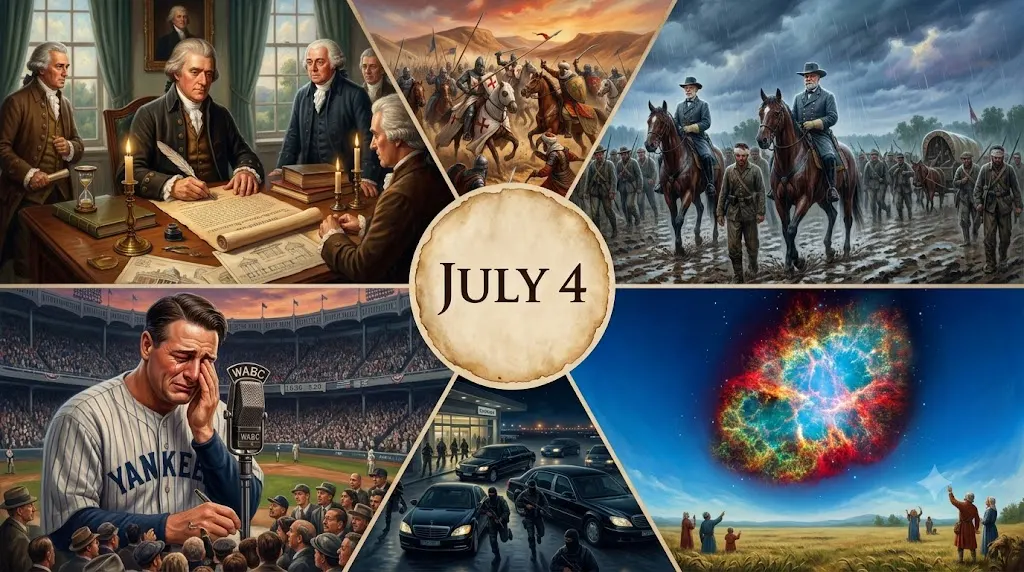
| 🏆 Top 10 Key Events | • Theban forces defeat Sparta at the Battle of Mantinea, ending Spartan hegemony (362 BC) • Saladin decisively triumphs over the Crusader armies at the Battle of Hattin (1187) • The Siege of Kamakura ends, marking the official fall of the Kamakura Shogunate in Japan (1333) • Polish-Lithuanian forces defeat Russia at the Battle of Klushino, opening the road to Moscow (1610) • The American colonies officially sever ties with Great Britain via the Declaration of Independence (1776) • The monumentally impactful Louisiana Purchase is publicly announced to the American nation (1803) • The Siege of Vicksburg ends as Confederate forces surrender the stronghold to Ulysses S. Grant (1863) • General Robert E. Lee begins his somber retreat south following the Confederate defeat at Gettysburg (1863) • Israeli commandos execute a daring counter-terrorist hostage rescue mission during the Raid on Entebbe (1976) • CERN scientists announce the historic discovery of a new subatomic particle matching the Higgs boson (2012) |
| ⚔️ Key Battles | Battle of Mantinea (362 BC), Battle of Hattin (1187), Battle of West-Capelle (1253), Siege of Kamakura (1333), Battle of Klushino (1610), Siege of Nándorfehérvár / Belgrade (1456), Siege of Vicksburg (1863), Battle of Helena (1863), Gettysburg Retreat (1863), Battle of Hamel (1918), Battle of Kursk begins (1943), Siege of Sevastopol concludes (1942) |
| 👤 Key Figures | Thomas Jefferson, Saladin, Lou Gehrig, General Ulysses S. Grant, General Robert E. Lee |
| 🌍 Observances | Independence Day (United States), Liberation Day (Rwanda), Republic Day (Philippines), Liberation Day (Northern Mariana Islands), CARICOM Day (Caribbean Community), Dree Festival (Arunachal Pradesh, India) |
Story of the Day: The Secret Miracle at Entebbe
Four pro-Palestinian hijackers held over a hundred Jewish and Israeli hostages inside a terminal building in Uganda, backed by the erratic dictator Idi Amin. The deadline was ticking toward mass execution unless their demands were met. Israel chose a different path, launching a daring, near-impossible rescue mission over 2,500 miles from home.
Commandos flew into the midnight darkness of Entebbe airport, disguised in a black Mercedes made to look like Idi Amin’s personal car. They stormed the terminal, killed the hijackers, and evacuated 102 hostages in under an hour. The masterfully executed operation stunned global intelligence networks and proved that modern democracies could strike back against international terrorism anywhere on earth.
Important Events That Happened On July 4 In History
362 BC – Battle of Mantinea
Epaminondas led the Theban army into a crushing collision against the Spartan ranks on the plains of Arcadia. The brilliant tactical maneuvers broke the legendary Spartan hoplite wall and secured a decisive victory. Theban celebrations turned to ash when Epaminondas died from a spear wound on the field, leaving Greece without a dominant leader and vulnerable to Macedonian conquest.
26 BC – Triumph of Crassus
Marcus Licinius Crassus rode through the cheering crowds of Rome in a magnificent chariot to receive his official triumph. Legionaries marched behind him displaying the spoils of his brutal campaigns across the rugged hills of Thrace. The public display solidified his political weight during the delicate transition from Roman Republic to Empire, proving his military value to Augustus Caesar.
414 – Regency of Pulcheria
Aelia Pulcheria stood before the high altar of Constantinople, swore a public vow of lifelong chastity, and claimed the title of Augusta. The thirteen-year-old emperor Theodosius II stood beside his older sister as she dismissed the old praefect Anthemius to take absolute control of the government. Her administrative grip preserved the stability of the Eastern Byzantine Empire through decades of nomadic invasions and religious crises.
638 – Succession of Heraclonas
Emperor Heraclius gathered his court to proclaim his younger sons Heraclonas and David as augustus and caesar. The aging ruler watched his court offer oaths of loyalty to the young boys while their elder brother, Heraclius Constantine, visibly withered from failing health. The desperate political maneuvering divided the imperial family and triggered a brutal palace power struggle just as Arab armies began threatening the empire’s borders.
836 – Pactum Sicardi
Prince Sicard of Benevento dipped his quill to sign a sweeping peace treaty with the representatives of the Duchy of Naples. The document brought a sudden halt to decades of bloody, territorial warfare that had exhausted the towns and fields of southern Italy. Merchant ships immediately filled the trade lanes again, creating a stable economic framework that allowed regional cultures to survive incoming Saracen raids.
993 – Canonization of Ulrich
Pope John XV issued a solemn decree elevating the late Bishop Ulrich of Augsburg to the official status of a Christian saint. The declaration marked the first time in western religious history that a pope formally canonized a saint through an official papal bull. The new administrative process pulled local veneration under central Vatican control, transforming how the Catholic Church honored its most holy figures.
1054 – Birth of the Crab Nebula
Chinese court astronomers looked toward the horn of the constellation Zeta Tauri and gasped at a blazing light where darkness used to be. The exploding star shone so fiercely that it remained clearly visible in the blue daytime sky for several months before slowly fading away. Modern astronomers eventually pointed their telescopes at those exact coordinates to discover the vibrant, expanding gas clouds of the Crab Nebula.
1120 – Jordan II of Capua
Jordan II walked into the cathedral of Capua to receive the holy anointing oil as the new sovereign prince of his lands. The sudden death of his infant nephew had left the Norman principality leaderless and exposed to greedy rival lords. His rapid ascension stabilized the region’s noble families, ensuring the small state could defend its borders against aggressive papal expansion.
1187 – Battle of Hattin
Saladin drew his curved sword and ordered a final charge against the exhausted, thirst-ravaged crusader army pinned against the Horns of Hattin. King Guy of Lusignan watched his elite knights collapse from heat exhaustion before the Muslim forces captured the True Cross. The total destruction of the crusader field army left Jerusalem completely undefended, shifting the balance of power in the Levant for centuries.
1253 – Battle of West-Capelle
John I of Avesnes watched his armored knights crash through the muddy lines of Guy of Dampierre on the fields of West-Capelle. The violent clash settled a bitter, multi-generational family feud over the wealthy inheritances of Flanders and Hainaut. John’s total victory permanently divided the territories, reshaping the aristocratic borders of the Low Countries and altering French royal influence in the region.
1333 – Siege of Kamakura
Regent Hōjō Takatoki retreated into the smoky depths of Tōshō-ji temple while forces loyal to Emperor Go-Daigo breached the outer walls of Kamakura. The defeated regent and hundreds of his loyal family members committed mass suicide as the wooden buildings burned around them. The dramatic sacrifice brought a violent, definitive end to the Kamakura shogunate, restoring imperial authority to Japan after decades of military rule.
1359 – Surrender of Forlì
Francesco II Ordelaffi walked out of his battered fortress to surrender the city of Forlì to the papal commander, Gil de Albornoz. The proud warlord had defied years of sieges, papal excommunications, and military assaults to keep his independent grip on the Romagna region. His ultimate submission allowed the Vatican to consolidate its fragmented territories into a tightly controlled, highly centralized Papal State.
1456 – Siege of Belgrade
Sultan Mehmed II deployed his massive bronze cannons along the Danube river and ordered the opening bombardment of Nándorfehérvár. The Ottoman forces filled the horizons with tents and elite Janissary units, determined to smash through the strategic fortress guarding the gateway to central Europe. The sudden assault forced Hungarian defender John Hunyadi to scramble a desperate relief army to save the city from annihilation.
1534 – Election of Christian III
Danish nobles gathered in the quiet church of Rye to elect Christian III as the new King of Denmark and Norway. The controversial vote completely bypassed the traditional council, sparking a furious civil war known as the Count’s Feud. Christian’s ultimate military victory allowed him to establish a centralized Protestant state, fundamentally transforming Scandinavian culture, religion, and politics forever.
1584 – Roanoke Landing
Philip Amadas and Arthur Barlowe dropped anchor off the coast of Roanoke Island and stepped onto the sun-drenched Atlantic shoreline. The English captains explored the lush maritime forests, met the local indigenous populations, and claimed the vast territory for Queen Elizabeth I. Their glowing reports back to London directly triggered the launch of the famous, ill-fated “Lost Colony” experiments a few years later.
1610 – Battle of Klushino
Hetman Stanisław Żółkiewski ordered his elite Polish winged hussars to charge directly into a massive, combined force of Russian and Swedish troops. The ferocious cavalry onslaught shattered the enemy lines, forcing a chaotic retreat and leaving the road to the capital wide open. Polish troops marched into Moscow a few days later, seizing the Kremlin during the chaotic peak of Russia’s Time of Troubles.
1634 – Foundation of Trois-Rivières
Sieur de Laviolette drove thick wooden stakes into the high ground overlooking the St. Lawrence River to construct a fortified trading post. The isolated settlement of Trois-Rivières was designed to secure a lucrative alliance with regional Algonquin tribes against Mohawk war parties. The small outpost grew into the second-oldest permanent settlement in New France, acting as a crucial launchpad for North American interior exploration.
1744 – Treaty of Lancaster
Iroquois sachems sat across from British colonial governors in Lancaster, Pennsylvania, and reluctantly put their marks on a sweeping land deed. The native leaders ceded their ancestral hunting grounds between the Allegheny Mountains and the Ohio River for a meager payment in trade goods. The controversial agreement triggered decades of violent border warfare as white settlers rushed into the newly stolen valley territories.
1774 – Orangetown Resolutions
Patriot leaders gathered inside a smoky tavern in Orangetown, New York, to vote on a fierce public protest against the British Coercive Acts. The signed document boldly declared that King George III had no legal right to tax American colonies without their direct parliamentary consent. The local rebellion served as an ideological stepping stone, uniting rural communities to support armed resistance against British military rule.
1776 – Birth of the United States
John Hancock smashed his large signature onto the final draft of the Declaration of Independence inside the Pennsylvania State House. The Continental Congress formally severed all political ties with Great Britain, risking their lives for the radical idea that all men are created equal. The historic document transformed a chaotic colonial rebellion into a formal war for national sovereignty, changing global governance forever.
1778 – Capture of Kaskaskia
George Rogers Clark led a small force of dirty, exhausted Virginia militia out of the woods to surprise the British garrison at Kaskaskia. The Americans captured the vital Mississippi River outpost without firing a single shot, convincing the local French population to switch their allegiances. The quiet victory secured the massive Illinois country for the young United States, expanding the young nation’s wartime borders deep into the western frontier.
1802 – West Point Opens
Major Jonathan Williams gathered five military officers and five young cadets to open the United States Military Academy at West Point. The rocky fortress overlooking the strategic Hudson River curve was repurposed to train professional engineers and artillery experts for the young republic. The elite institution developed the military minds that would construct the nation’s infrastructure and command its armies through every major global conflict.
1803 – Louisiana Purchase Announced
President Thomas Jefferson authorized the official newspapers to print the dazzling news that the United States had purchased the Louisiana Territory from France. For fifteen million dollars, the young nation instantly doubled its geographic size, gaining control of the massive Mississippi River trade routes. The landmark real estate deal opened the western half of the continent to explosive, often violent expansion and settlement.
1817 – Erie Canal Construction
Laborers spat on their hands, grabbed heavy shovels, and began digging the earth near Rome, New York, to build the Erie Canal. Engineers faced the daunting task of cutting a 363-mile water highway through dense wilderness to connect the Atlantic Ocean with the Great Lakes. The massive infrastructure project drastically dropped shipping costs, turning New York City into the financial capital of the western hemisphere.
1818 – US Flag Act
President James Monroe signed a law that set the standard design of the American flag to thirteen permanent stripes representing the original colonies. The legislation ordered that a new star would be added to the blue field on the Fourth of July following the admission of any new state. The flexible design allowed the national symbol to grow alongside the country’s rapid western expansion without altering its core identity.
1827 – Emancipation in New York
African Americans took to the streets of New York to celebrate the formal legal abolition of chattel slavery across the state. The historic legislation freed thousands of remaining enslaved people, making New York one of the first states to enforce total emancipation. The hard-fought victory energized the early abolitionist movement, transforming Manhattan into a vital hub for underground railroad networks.
1831 – America (My Country, ‘Tis of Thee)
Samuel Francis Smith stood before a packed congregation at the Park Street Church in Boston to hear children sing his new lyrics to “My Country, ‘Tis of Thee.” The patriotic song used the familiar melody of the British national anthem to praise American freedom and natural landscapes instead. The emotional performance resonated deeply across the fractured country, turning the tune into a de facto national anthem for generations.
1832 – Female Suffrage Lecture
John Neal stepped up to a public podium in America to deliver a blistering, unprecedented lecture demanding full voting rights for women. The controversial writer argued that denying women political representation was a direct violation of the nation’s founding democratic principles. His radical speech shocked traditional audiences but provided the intellectual fuel that sparked the organized women’s rights movement decades later.
1832 – Durham University Founded
King William IV put his royal seal on an Act of Parliament that officially established Durham University in northern England. The high-profile opening marked the first time a recognized university had been founded in England since Cambridge opened over six00 years prior. The new institution challenged the academic monopoly of Oxford and Cambridge, bringing modern higher education to the industrial north.
1837 – Long-Distance Railway Opens
Engineers fired up steam locomotives at Birmingham and Liverpool to celebrate the grand opening of the Grand Junction Railway. The iron tracks stretched across eighty-two miles of English countryside, creating the world’s first true long-distance rail line. The engineering triumph proved that heavy freight and passengers could move rapidly between major industrial cities, accelerating the global Industrial Revolution.
1838 – Iowa Territory Organized
President Martin Van Buren signed the congressional act that officially carved the Iowa Territory out of the vast western frontier. Settlers quickly established a local government in Burlington to manage the explosive influx of farmers seeking rich, black prairie soil. The new legal status triggered rapid infrastructure development, paving the way for Iowa to claim its place as the twenty-ninth state.
1845 – Thoreau Moves to Walden
Henry David Thoreau walked into the woods near Concord, Massachusetts, and carried his few belongings into a small, self-built cabin on Walden Pond. The young philosopher wanted to live deliberately, stripping away modern commercial distractions to study nature and human consciousness deeply. His rich personal reflections during his two years there formed the basis of his masterpiece, Walden, which anchored the global environmental movement.
1855 – Leaves of Grass Published
Walt Whitman walked into a small Brooklyn printing shop to pick up the first self-published copies of his radical poetry collection, Leaves of Grass. The thin book featured twelve untitled poems written in an wild, unrhymed free-verse style that shocked traditional literary critics. His raw, sensual celebration of democracy and the human body permanently broke the rules of American literature, changing poetry forever.
1862 – Alice in Wonderland Is Born
Lewis Carroll sat in a small rowboat, rowing up the River Thames with young Alice Liddell and her sisters under a cloudless summer sky. To pass the time, the young mathematician spun a fantastical story about a bored girl who tumbled down a rabbit hole into a bizarre world. Alice loved the tale so much she begged him to write it down, creating the manuscript that grew into Alice’s Adventures in Wonderland.
1863 – Siege of Vicksburg Ends
General John C. Pemberton led his starving Confederate soldiers out of their muddy trenches to surrender the strategic city of Vicksburg to Ulysses S. Grant. The forty-seven-day Union siege had forced local civilians to live in caves and eat rats to survive. The vital victory gave the Union total control of the Mississippi River, cutting the Confederacy completely in half and marking a major turning point in the war.
1863 – Battle of Helena
Major General Benjamin Prentiss ordered his Union troops to dig in along the bluffs of Helena, Arkansas, to repel a furious Confederate assault. The Rebel forces launched a desperate, bloody charge to capture the river port and draw Union troops away from the critical siege at Vicksburg. The Union victory crushed the Confederate presence in eastern Arkansas, clearing a safe path for the capture of Little Rock.
1863 – Retreat from Gettysburg
General Robert E. Lee stood in a torrential downpour, watching his shattered Army of Northern Virginia begin a miserable retreat south toward the Potomac River. The bloody defeat at Gettysburg the previous day had broken his offensive power, costing him over twenty-eight thousand irreplaceable soldiers. The quiet withdrawal signaled the absolute end of the Confederacy’s last major invasion of the Northern states.
1879 – Fall of Ulundi
Lord Chelmsford ordered British infantry squares to open a devastating fire against thousands of Zulu warriors charging across the plains of Ulundi. The superior firepower of Gatling guns and artillery cut down the royal regiments, allowing British troops to capture and burn the imperial capital to the ground. The destruction forced King Cetshwayo to flee, ending the Anglo-Zulu War and destroying Zulu independence.
1881 – Tuskegee Institute Opens
Booker T. Washington stood inside a leaking, dilapidated shanty church to welcome the very first class of thirty Black students to the Tuskegee Institute in Alabama. The young educator emphasized practical vocational training combined with academic excellence to help newly freed people achieve true economic independence. The tiny school expanded into a massive university, producing generations of brilliant African American leaders.
1886 – Trans-Canadian Rail Completed
Engineers and weary passengers cheered as the Canadian Pacific Railway’s first scheduled transcontinental train hissed to a stop in Port Moody, British Columbia. The steam train had traveled six grueling days from Montreal, conquering treacherous mountain passes and vast prairies to connect the country coast to coast. The engineering marvel tied the distant western provinces to eastern Canada, securing the nation’s geopolitical borders.
1887 – Jinnah Joins Sindh-Madrasa
A ten-year-old boy named Mahomedali Jinnahbhai walked up the steps of the Sindh-Madrasa-tul-Islam in Karachi to enroll in his first formal classes. The historic institution offered a modern Western education combined with Islamic cultural studies to young students in the region. The young boy grew up to become Quaid-i-Azam Muhammad Ali Jinnah, using his sharp legal mind to lead the movement that founded Pakistan.
1892 – Double July 4 in Samoa
King Malietoa Laupepa issued a royal decree shifting Western Samoa across the International Date Line to align his country’s trading calendar with California. The sudden adjustment caused Monday, July 4, to occur twice in a row, creating a unique leap year containing 367 days. The calendar shift boosted economic ties with American merchant ships but left confused sailors struggling to log their voyages accurately.
1894 – Republic of Hawaii Proclaimed
Sanford B. Dole stood on the steps of the executive building in Honolulu to declare himself president of the newly formed Republic of Hawaii. The wealthy fruit baron and his corporate allies had orchestrated the illegal overthrow of Queen Liliuokalani the previous year to protect their sugar profits. The short-lived puppet republic was explicitly designed to hold power until they could convince Washington to annex the islands.
1898 – Sinking of the SS La Bourgogne
Captain Deloncle tried frantically to navigate the ocean liner SS La Bourgogne through a blinding Atlantic fog bank near Nova Scotia when the British sailing ship Cromartyshire sliced open her iron hull. The damaged steamer listed violently and sank in under an hour, taking 549 lives down into the freezing water. The chaotic disaster became one of the worst maritime tragedies of the century, exposing a shocking lack of lifeboats.
1901 – Taft in the Philippines
William Howard Taft stepped onto a decorated stage in Manila to take his official oath as the first American civil governor of the Philippines. The heavy-set politician assumed control from the military authorities, tasked with building a colonial administration while guerrilla warfare still flickered in the distant jungle provinces. His legal reforms tied the archipelago’s economy directly to American corporate interests for decades.
1903 – Philippine–American War Ends
President Theodore Roosevelt issued an official executive order declaring the bloody Philippine-American War to be formally concluded. The brutal three-year conflict had cost the lives of over four thousand American soldiers and hundreds of thousands of Filipino civilians. Despite the white house decree, scattered guerrilla units ignored the announcement and continued launching ambush attacks against American occupation forces for years.
1910 – Johnson-Jeffries Riots
Jack Johnson unleashed a ferocious combination in the fifteenth round to knock out the “Great White Hope” Jim Jeffries in Reno, Nevada. The decisive victory cemented Johnson as the undisputed heavyweight champion, infuriating white supremacists who had prayed for his defeat. The sporting triumph triggered a wave of race riots across dozens of American cities, resulting in over twenty deaths and hundreds of injuries.
1911 – Eastern United States Heat Wave
Mercury levels surged past one hundred degrees across Manhattan, trapping millions of residents in an oppressive, stagnant blanket of humid air. The historic eleven-day heat wave melted asphalt streets, buckled iron rail lines, and pushed urban tenements into deadly ovens. The extreme weather killed over 380 people across the northeast before a cooling ocean breeze finally broke the suffocating atmospheric pressure.
1913 – The Great Reunion
President Woodrow Wilson stood before a massive tent filled with over fifty thousand elderly Union and Confederate veterans at Gettysburg. The old men, many missing limbs, shook hands across the stone walls where they had shot at each other fifty years earlier. Wilson delivered an emotional address praising national reconciliation, though his speech deliberately ignored the unresolved racial inequalities that still fractured the nation.
1914 – Funeral of Franz Ferdinand
Imperial guards carried the dark wooden coffins of Archduke Franz Ferdinand and his wife Sophie into the chapel of Hofburg Palace in Vienna. Emperor Franz Joseph attended the somber, low-profile service just six days after Serbian nationalists assassinated the royal couple in Sarajevo. The quiet funeral took place while imperial diplomats drafted the harsh ultimatums that would drag Europe into World War I.
1918 – Ascension of Mehmed VI
Mehmed VI walked through the grand corridors of Topkapi Palace to ascend the historic Ottoman throne following the sudden death of his brother, Mehmed V. The new sultan assumed absolute leadership over an empire on the brink of complete military and economic collapse. His brief, tragic reign saw the total dismemberment of Ottoman territories by Allied occupation forces at the end of the Great War.
1918 – Battle of Hamel
General John Monash coordinated an attack of Australian, British, and American troops against heavily fortified German trenches near Le Hamel. The innovative commander synchronized tanks, infantry, and air drops to overrun the positions in exactly ninety-three minutes. The brief, flawless victory provided the tactical blueprint that Allied planners used to break the brutal stalemate on the Western Front.
1927 – First Flight of the Lockheed Vega
Test pilot Eddie Allen opened the throttle of the sleek, wooden Lockheed Vega and lifted off the dirt runway into the California sky. The innovative aircraft featured a smooth, monocoque fuselage design that radically reduced wind resistance and boosted top speeds. The advanced plane became the favorite choice of record-breaking aviators like Amelia Earhart and Wiley Post, accelerating the Golden Age of Flight.
1939 – Lou Gehrig’s Farewell
Lou Gehrig stepped away from the microphone at Yankee Stadium, wiped a tear from his eye, and looked up at sixty-one thousand weeping baseball fans. The legendary “Iron Horse” had just been diagnosed with ALS, forcing him into a sudden, heartbreaking retirement from the game he loved. His emotional declaration that he was the luckiest man on the face of the earth remains one of the most poignant moments in American sports.
1941 – Lviv Professors Massacre
Gestapo officers and Ukrainian auxiliary police rounded up dozens of prominent Polish scientists, writers, and professors from their homes in captured Lwów. The prisoners were marched to a nearby hillside and shot in the back of the head during a coordinated execution campaign. The brutal killings were part of a systematic Nazi strategy to erase the intellectual elite of the conquered Polish nation.
1941 – Burning of the Riga Synagogues
Nazi Einsatzgruppen forces and local collaborators locked three hundred Jewish refugees inside the basement of the Great Choral Synagogue in Riga. The soldiers splashed gasoline across the wooden doors and set the massive building ablaze, shooting anyone who tried to escape the flames. The horrific atrocity marked the violent beginning of the near-total destruction of Latvia’s ancient Jewish population during the Holocaust.
1942 – Siege of Sevastopol Ends
General Erich von Manstein ordered German troops to raise the swastika flag over the smoking ruins of the naval fortress of Sevastopol. The fanatical Soviet garrison surrendered the city after enduring 250 days of relentless, heavy artillery bombardments and brutal hand-to-hand fighting. The hard-fought victory gave Nazi Germany total control over the Crimean peninsula, securing their southern flank for the summer push toward Stalingrad.
1943 – Battle of Kursk Begins
German Panzer divisions fired their massive main guns into Soviet defensive lines near Prokhorovka, igniting the Battle of Kursk. The clash involved over two million men and six thousand tanks, turning the dusty Russian plains into the largest tank battle in human history. The Red Army had dug deep trenches and minefields, successfully halting the German offensive and permanently breaking Hitler’s armored power on the Eastern Front.
1943 – Death of Władysław Sikorski
A Royal Air Force B-24 Liberator bomber lost altitude moments after takeoff and crashed violently into the sea off the coast of Gibraltar. The tragic accident killed sixteen passengers, including General Władysław Sikorski, the prime minister of the Polish government-in-exile. His sudden death deprived Poland of its most influential wartime statesman, leaving the nation vulnerable to Soviet political dominance after the war.
1946 – Kielce Pogrom
A furious Polish mob, backed by local communist policemen, surrounded a Jewish committee building in Kielce to attack Holocaust survivors who had returned home. The crowd beat forty-two Jewish men, women, and children to death based on a false rumor about a Christian boy being kidnapped. The post-war atrocity shocked the international community, triggering the mass flight of remaining Polish Jews out of Eastern Europe.
1946 – Philippine Independence
Manuel Roxas raised the red, white, and blue flag of the independent Philippines in Manila while American officials lowered the Stars and Stripes. The historic ceremony ended 381 years of continuous colonial occupation by Spain, Japan, and the United States. The young republic faced the immense task of rebuilding a capital city completely flattened by the destructive battles of World War II.
1947 – Indian Independence Bill
Prime Minister Clement Attlee stood before a quiet British House of Commons to present the historic Indian Independence Bill. The sweeping legislation proposed the rapid dissolution of the British Raj and the creation of two separate sovereign nations: India and Pakistan. The hurried political partition triggered one of the largest, most violent mass migrations in human history as millions scrambled across the new borders.
1950 – Radio Free Europe Broadcasts
Engineers in Munich threw a high-voltage switch to send the very first shortwave news broadcast from Radio Free Europe into communist Czechoslovakia. The station was secretly funded by the American CIA to pierce the Soviet Information blockade with Western news and political commentary. The daily broadcasts became a crucial ideological weapon during the Cold War, keeping anti-communist sentiment alive behind the Iron Curtain.
1951 – William N. Oatis Sentenced
A communist judge in Prague banged his gavel to sentence American journalist William N. Oatis to ten years in a hard-labor prison. The Associated Press bureau chief had been arrested and tortured by secret police on absurd, fabricated charges of western espionage. His high-profile imprisonment caused a major diplomatic freeze, prompting Washington to launch harsh economic sanctions against Czechoslovakia until his release.
1951 – Invention of the Junction Transistor
William Shockley called a press conference at Bell Labs to announce the invention of the revolutionary junction transistor. The tiny three-pronged sandwich of germanium used a fraction of the power required by old, fragile glass vacuum tubes. The breakthrough allowed engineers to shrink electronic circuits down to a microscopic scale, launching the modern computer age and changing global technology forever.
1954 – British Rationing Ends
Housewives across Great Britain tore up their paper ration books as restrictions on the sale of meat were officially lifted by the government. The long-awaited policy ended fourteen years of strict wartime food controls that had dictated what citizens could eat long after World War II concluded. British families rushed to butcher shops to buy fresh steaks without government interference, signaling a return to true peace-time normalcy.
1960 – The 50-Star Flag Debuts
Military guards hoisted the new fifty-star American flag over Independence Hall in Philadelphia just past midnight. The extra star was added to the blue field to honor Hawaii, which had joined the union as the fiftieth state nearly ten months earlier. The clean design remained unchanged for decades, marking the longest-running flag configuration in the history of the United States.
1961 – Soviet Submarine K-19 Disaster
Captain Nikolai Zateyev received a frantic warning that the primary nuclear reactor on the submarine K-19 had suffered a total coolant leak off the coast of Greenland. Engineering teams volunteered to crawl into the irradiated reactor compartment without protective suits to weld a makeshift emergency cooling line. Their sacrifice prevented a catastrophic nuclear explosion, though twenty-two crewmen died of agonizing radiation poisoning within months.
1966 – Freedom of Information Act Signed
President Lyndon B. Johnson sat at his desk in Texas and reluctantly signed the Freedom of Information Act into federal law. The landmark transparency legislation granted ordinary citizens and journalists the legal right to request access to secret government documents. The new accountability tool transformed investigative journalism, forcing federal agencies to expose decades of hidden historical records to public scrutiny.
1973 – Treaty of Chaguaramas
Four Caribbean leaders gathered in Trinidad and Tobago to sign the Treaty of Chaguaramas, officially creating the Caribbean Community (CARICOM). The historic economic pact replaced the weak free trade association with a unified common market and shared foreign policy goals. The agreement served as a massive milestone toward regional integration, boosting the global political leverage of small island nations.
1977 – George Jackson Brigade Bombing
Radical left-wing militants from the George Jackson Brigade detonated a bomb at a major electrical power substation near the Washington state capitol. The blast ripped through transformers and knocked out power to the government complex in a show of solidarity with striking prisoners at Walla Walla Penitentiary. The domestic terror attack triggered a massive FBI manhunt that eventually dismantled the underground guerrilla organization.
1982 – Iranian Diplomats Kidnapped
Christian Phalange militiamen forced an official diplomatic vehicle to a halt at a military checkpoint in northern Lebanon. Armed gunmen pulled three Iranian diplomats and a prominent news journalist out of the car and drove them away into the chaotic war zone. Despite decades of intense international investigations and prisoner swap negotiations, their ultimate fate inside the secret prisons of Lebanon remains completely unknown.
1982 – Space Shuttle Columbia Lands
Astronauts Ken Mattingly and Henry Hartsfield guided the Space Shuttle Columbia to a smooth, dusty landing at Edwards Air Force Base. The perfect touchdown concluded the STS-4 mission, the fourth and final experimental test flight of the massive reusable spacecraft program. President Ronald Reagan stood on the tarmac to officially declare the Space Shuttle fleet fully operational for future commercial and military missions.
1994 – Kigali Falls
Rwandan Patriotic Front soldiers, commanded by Paul Kagame, marched into the ruined streets of Kigali to claim total control of the capital city. The rapid military advance broke the extremist Hutu government forces and brought a sudden halt to the Rwandan genocide inside the city limits. The victorious troops discovered a ghost town littered with mass graves, initiating a long, painful era of national rebuilding.
1997 – Mars Pathfinder Lands
NASA flight controllers cheered wildly as the Pathfinder space probe bounced safely onto the red, rocky plains of Ares Vallis using a giant cluster of protective airbags. The innovative spacecraft deployed Sojourner, a tiny wheeled rover that began capturing high-resolution photos of the Martian landscape. The successful mission revolutionized planetary exploration, proving that low-cost robotic rovers could survive on another world.
1998 – Japan Launches Nozomi
Engineers at the Kagoshima Space Center monitored telemetry as a powerful rocket blasted the Nozomi space probe into orbit toward Mars. The complex launch established Japan as the third nation to attempt interplanetary exploration, joining the space programs of the United States and Russia. Though technical anomalies ultimately prevented the probe from entering Martian orbit, the mission laid crucial engineering groundwork for future deep-space voyages.
2001 – Vladivostok Air Flight 352
A Tupolev Tu-154 commercial airliner suddenly went into a violent stall and plunged into a dense forest during its final approach to Irkutsk Airport. The tragic crash killed all 145 passengers and crew members on board, scattering debris across a remote Siberian valley. Air investigators blamed pilot disorientation during a steep turn, marking one of the deadliest aviation disasters in modern Russian history.
2002 – Bangui Cargo Plane Crash
A Boeing 707 cargo aircraft suffered a sudden mechanical failure and came crashing down into a crowded residential neighborhood near Bangui International Airport. The impact killed twenty-eight people on board and destroyed several homes on the ground as fuel tanks exploded into flames. The horrific accident exposed severe maintenance failures within regional charter airlines, prompting international calls for stricter aviation safety audits.
2004 – Freedom Tower Cornerstone
Construction workers lowered a massive twenty-ton block of inscribed granite into the earth at the World Trade Center site in lower Manhattan. The symbolic laying of the Freedom Tower cornerstone marked the official beginning of rebuilding efforts following the tragic destruction of the September 11 attacks. The ceremony provided a somber moment of national resilience, transforming a scar of terror into a monument of hope.
2004 – Greece Wins Euro 2004
Angelos Charisteas leaped high into the air to head home a perfect corner kick, lifting Greece to a stunning 1-0 victory over Portugal in Lisbon. The defensive triumph concluded one of the greatest underdog runs in sporting history, turning an unheralded team into European football champions. The historic win triggered massive celebrations across Greece, proving that discipline could beat individual superstitions and superstar squads.
2005 – Deep Impact Collides
Scientists at the Jet Propulsion Laboratory cheered as a copper-tipped impactor vehicle slammed directly into the icy core of comet Tempel 1. The high-speed celestial collision blasted a massive cloud of dust and ancient ice out into space, allowing the nearby Deep Impact mothership to analyze the debris. The data provided humanity with its first look at the raw, unaltered building blocks of our solar system.
2006 – Discovery Launches STS-121
Commander Steven Lindsey monitored engine monitors as Space Shuttle Discovery roared off the launch pad on a bright afternoon in Florida. The launch marked the only time a space shuttle departed on Independence Day, drawing intense global media focus back to Cape Canaveral. The successful mission delivered vital supplies to the International Space Station, proving the fleet could fly safely after the Columbia tragedy.
2008 – Minsk Concert Bombing
A hidden shrapnel bomb exploded inside a crowded plaza during an open-air independence day concert in Minsk, injuring fifty concertgoers. Belarusian President Alexander Lukashenko was standing nearby when the blast occurred, prompting immediate speculation about an assassination attempt. The violent event triggered a sweeping political crackdown by secret police, resulting in the mass detention of opposition activists.
2009 – Statue of Liberty Crown Reopens
Tourists climbed the cramped, spiral iron stairs inside the Statue of Liberty to look out through the crown windows for the first time in eight years. Federal authorities had locked access to the crown following the September 11 attacks due to severe security and evacuation concerns. The high-profile reopening served as a joyous symbol of a city reclaiming its open, democratic public spaces from fear.
2009 – Mindanao Bombings Begin
An improvised explosive device tore through a crowded street near a historic cathedral in Cotabato City, initiating a coordinated four-day bombing campaign across Mindanao. The violent blasts killed several civilians and wounded dozens more, spreading terror through the southern Philippine islands. Security forces blamed radical separatist groups, intensifying long-running military counter-terrorism operations across the region.
2012 – Higgs Boson Discovered
Physicists inside a packed auditorium at CERN applauded and wept as data screens confirmed the discovery of a new subatomic particle matching the theoretical Higgs Boson. The breakthrough was achieved by smashing protons together at near light-speed inside the twenty-seven-kilometer ring of the Large Hadron Collider. The discovery confirmed the existence of the Higgs field, solving the mystery of how elementary particles acquire mass.
2015 – Chile Claims Copa América
Alexis Sánchez chipped a bold, ice-cold penalty shot down the center of the net to seal Chile’s victory over Argentina in a thrilling shootout. The historic win secured Chile’s first international football championship in ninety-nine years of tournament history. Millions of ecstatic fans filled the avenues of Santiago, celebrating a golden generation of players who had finally broken decades of sporting heartbreak.
2024 – Labour Landslide Victory
Keir Starmer stood outside Downing Street to claim a massive landslide majority in the United Kingdom general election. The Labour Party swept hundreds of parliamentary seats across the country, bringing a sudden, definitive end to fourteen consecutive years of Conservative governance. The dramatic political realignment signaled a profound public demand for economic stability and public service reform across Britain.
2025 – Texas Hill Country Flood
A sudden, violent atmospheric river dumped unprecedented torrents of rain onto the rocky terrain of the Texas Hill Country, turning quiet rivers into deadly walls of mud and water. The flash floods swept away historic bridges, swallowed whole neighborhoods, and claimed the lives of at least 108 people. The tragic disaster sparked emergency infrastructure reviews and highlighted the increasing volatility of extreme weather.
2025 – Oasis Reunion Tour
Liam and Noel Gallagher stepped out onto the stage at Cardiff’s Principality Stadium, striking the opening chords of “Rock ‘n’ Roll Star” to a roaring crowd of seventy-four thousand fans. The high-energy performance ended a bitter, sixteen-year fraternal hiatus that had broken apart one of Britain’s most iconic rock bands. The stadium tour became a massive cultural phenomenon, drawing generations of fans together for a nostalgic celebration.
Curious about what happened yesterday? Click for the full story.
Famous People Born on July 4
| Name | Role / Description | Lifespan |
|---|---|---|
| Usama ibn Munqidh | Arab poet, diplomat, and Crusades chronicler | 1095–1188 |
| Murad III | Ottoman Sultan | 1546–1595 |
| George Everest | Welsh surveyor; Mount Everest named after him | 1790–1866 |
| Nathaniel Hawthorne | American novelist (*The Scarlet Letter*) | 1804–1864 |
| Giuseppe Garibaldi | Italian revolutionary and national hero | 1807–1882 |
| Hiram Walker | Businessman; founder of Canadian Club whisky | 1816–1899 |
| Stephen Foster | American songwriter (“Oh! Susanna”) | 1826–1864 |
| Thomas John Barnardo | Irish philanthropist; founder of Barnardo’s homes | 1845–1905 |
| Henrietta Swan Leavitt | American astronomer; discovered Cepheid variable relation | 1868–1921 |
| Calvin Coolidge | 30th President of the United States | 1872–1933 |
| Rube Goldberg | Cartoonist and inventor of “Rube Goldberg machines” | 1883–1970 |
| Mao Dun | Chinese novelist and literary critic | 1896–1981 |
| Alluri Sitarama Raju | Indian freedom fighter | 1897–1924 |
| Meyer Lansky | American organized crime figure | 1902–1983 |
| Gloria Stuart | American actress (*Titanic*) | 1910–2010 |
| Mitch Miller | American singer and record producer | 1911–2010 |
| Eva Marie Saint | Academy Award-winning American actress | 1924–Present |
| Alfredo Di Stéfano | Argentine-Spanish football legend | 1926–2014 |
| Gina Lollobrigida | Italian actress and photographer | 1927–2023 |
| Neil Simon | Pulitzer Prize-winning playwright | 1927–2018 |
| George Steinbrenner | Owner of the New York Yankees | 1930–2010 |
| Bill Withers | American singer-songwriter (“Lean on Me”) | 1938–2020 |
| Geraldo Rivera | American journalist and television host | 1943–Present |
| Ron Kovic | Vietnam veteran, author, and peace activist | 1946–Present |
| Michael Milken | American financier and philanthropist | 1946–Present |
| Álvaro Uribe | 39th President of Colombia | 1952–Present |
| Pam Shriver | American tennis champion | 1962–Present |
| Elie Saab | Lebanese fashion designer | 1964–Present |
| Angelique Boyer | French-Mexican actress | 1988–Present |
| Post Malone | American rapper, singer, and songwriter | 1995–Present |
Famous People Who Died on July 4
| Name | Role / Description | Lifespan |
|---|---|---|
| Hayreddin Barbarossa | Ottoman admiral | 1478–1546 |
| William Byrd | English Renaissance composer | c.1540–1623 |
| Samuel Richardson | English novelist (*Pamela*) | 1689–1761 |
| John Adams | 2nd President of the United States | 1735–1826 |
| Thomas Jefferson | 3rd President of the United States; principal author of the Declaration of Independence | 1743–1826 |
| James Monroe | 5th President of the United States | 1758–1831 |
| François-René de Chateaubriand | French writer and statesman | 1768–1848 |
| Hannibal Hamlin | 15th Vice President of the United States | 1809–1891 |
| Swami Vivekananda | Indian Hindu monk and philosopher | 1863–1902 |
| Giovanni Schiaparelli | Italian astronomer | 1835–1910 |
| Alan Seeger | American poet | 1888–1916 |
| Marie Curie | Nobel Prize-winning physicist and chemist | 1867–1934 |
| Władysław Sikorski | Polish Prime Minister and military leader | 1881–1943 |
| Pingali Venkayya | Designer of the Indian national flag | 1876–1963 |
| Barnett Newman | American abstract expressionist painter | 1905–1970 |
| Georgette Heyer | English historical novelist | 1902–1974 |
| Yonatan Netanyahu | Israeli military commander | 1946–1976 |
| Victor Chang | Australian heart surgeon | 1936–1991 |
| Astor Piazzolla | Argentine tango composer | 1921–1992 |
| Eva Gabor | Hungarian-American actress | 1919–1995 |
| Bob Ross | American painter and television host | 1942–1995 |
| Charles Kuralt | American journalist | 1934–1997 |
| Barry White | American singer-songwriter | 1944–2003 |
| Hank Stram | American football coach | 1923–2005 |
| Steve McNair | American NFL quarterback | 1973–2009 |
| Abbas Kiarostami | Iranian filmmaker | 1940–2016 |
| Kazuki Takahashi | Japanese manga creator (*Yu-Gi-Oh!*) | 1961–2022 |
| Mark Snow | American television composer (*The X-Files*) | 1946–2025 |
| Bobby Jenks | American baseball player | 1981–2025 |
| Richard Greenberg | American playwright | 1958–2025 |
Observances on July 4
- Independence Day (United States): Commemorates the formal adoption of the Declaration of Independence in 1776, celebrated with fireworks, family barbecues, and patriotic parades across the country.
- Liberation Day (Rwanda): Honors the historic day in 1994 when the Rwandan Patriotic Front captured Kigali, bringing a definitive end to the horrific Rwandan genocide against the Tutsi.
- Republic Day (Philippines): Marks the day in 1946 when the United States formally recognized Philippine sovereignty, establishing full national independence after centuries of foreign colonial rule.
- Liberation Day (Northern Mariana Islands): Commemorates the successful end of World War II military occupation, honoring the enduring resilience of the indigenous population through global conflicts.
- CARICOM Day: Celebrates the signing of the Treaty of Chaguaramas in 1973, which unified Caribbean nations through shared economic goals and regional cooperation.
- Dree Festival (Arunachal Pradesh, India): Initiated by the agricultural Apatani tribe, this vibrant festival features traditional dances and prayers to secure a bountiful harvest and protect crops from pests.
🦅 Frequently Asked Questions — July 4 in History
The Second Continental Congress formally adopted the Declaration of Independence inside the humid state house in Philadelphia. The historic document severed all political ties between the thirteen American colonies and Great Britain, creating a new sovereign nation. The act turned a colonial tax rebellion into a formal revolutionary war that altered global democratic history.
The adoption of the United States Declaration of Independence in 1776 stands as the most influential event on this calendar date. The document introduced the radical political concept that all humans possess natural rights to life, liberty, and the pursuit of happiness. This single text inspired democratic revolutions across France, Latin America, and the wider world for centuries.
American folklore icon and legendary frontiersman David “Davy” Crockett was born on this date in 1786. He grew up to become a celebrated soldier, a Tennessee politician, and a vocal advocate for poor settlers before dying at the historic Battle of the Alamo. His adventurous life and distinct coonskin cap became permanent symbols of early American frontier history.
The Confederate fortress city of Vicksburg surrendered to Union General Ulysses S. Grant in 1863 after enduring a brutal forty-seven-day siege. On that exact same morning, General Robert E. Lee began his agonizing retreat from the Gettysburg battlefield following his catastrophic defeat there. These twin Union victories permanently broke the strategic offensive capabilities of the Confederacy.
Liberation Day marks the specific afternoon in 1994 when the soldiers of the Rwandan Patriotic Front captured the capital city of Kigali. The decisive military victory successfully overthrew the extremist Hutu regime and halted the horrific Rwandan genocide that had claimed over eight hundred thousand innocent lives. Today, it serves as a somber national holiday dedicated to peace and unity.
The Labour Party, commanded by Keir Starmer, achieved a historic landslide victory in the United Kingdom general election in 2024. The overwhelming vote ended fourteen consecutive years of Conservative political leadership, fundamentally transforming the British parliament. The political shift launched a new legislative era focused on reviving public infrastructure and stabilizing the national economy.