The Siege of Orléans lasted from 12 October 1428 to 8 May 1429, when a French relief force led in part by Joan of Arc broke a seven-month English blockade of the city. Its outcome reversed the momentum of the Hundred Years’ War and made Joan of Arc a national figure almost overnight. Here’s exactly how it happened — and how much of the credit was really hers.
🏹 Quick Facts — Siege of Orléans
| 📌 Category | 📖 Event / Detail |
|---|---|
| 📅 Dates & Duration | October 12, 1428 – May 8, 1429 (209 days) |
| 📍 Location | Orléans, located on the strategic Loire River, Kingdom of France |
| 🛡️ English/Burgundian Commanders | Thomas Montagu, Earl of Salisbury (killed November 1428); later John Talbot and William de la Pole, Earl of Suffolk |
| ⚜️ French Commanders | Jean de Dunois (“the Bastard of Orléans”), Étienne de Vignolles (“La Hire”), and Joan of Arc |
| 🏆 Outcome | Decisive French victory; English forces fully abandon the siege on May 8, 1429 |
| 🌟 Why It Mattered | It turned the tide of the Hundred Years’ War and successfully opened the heavily contested road to Reims for King Charles VII’s coronation |
Why Orléans Mattered
Picture France in the autumn of 1428. It isn’t really one country anymore — it’s a patchwork of English-held territory in the north, a Burgundian faction allied with England, and a shrinking pocket of loyalty to the uncrowned Charles VII south of the Loire. That river is the last real line of defense. And Orléans sits right on it, guarding the one crossing that matters most.
Lose Orléans, and there’s nothing stopping the English from pushing straight into the heart of what’s left of loyal France. Win at Orléans, and the whole war tips the other way. Everyone on both sides understood the stakes. That’s why the English committed a full siege army to it, and why the city’s fall or survival became, in a real sense, a referendum on whether France would keep existing as an independent kingdom at all.
The Siege Before Joan Arrived
The English army under the Earl of Salisbury arrived outside Orléans in October 1428 and started doing what siege armies do: building a ring of fortified positions called bastilles around the city to choke off supplies and reinforcements. It wasn’t a fast, dramatic assault. It was slow strangulation.
Salisbury himself didn’t survive to see how it ended — he was fatally wounded by a cannonball in early November, just weeks into the siege, while scouting the city’s defenses from a captured tower. Command passed to other English lords, and the siege ground on through a hard winter.
By February 1429, the city was running low on supplies, and a French attempt to intercept an English convoy turned into a small, humiliating defeat now remembered as the Battle of the Herrings — named for the barrels of salted fish the English were escorting to feed their troops through Lent. The French lost that skirmish. Morale inside Orléans, already thin, got thinner.
That’s the situation Joan of Arc walked into: a city seven months into a siege, its garrison exhausted, its supply lines cut, and its last field army just handed a defeat over a shipment of fish.
Joan’s Arrival and the Five-Day Turn
Joan reached Orléans on 29 April 1429, having already convinced Charles VII’s court at Chinon to give her a small role in the relief effort. She wasn’t put in overall command — the professional soldiers, Dunois and La Hire, still ran the military side of things. But her presence changed somethiang in the city almost immediately. Word had spread that a peasant girl claiming divine guidance was coming to break the siege, and for a garrison that had spent months losing, that story mattered as much as any tactic.
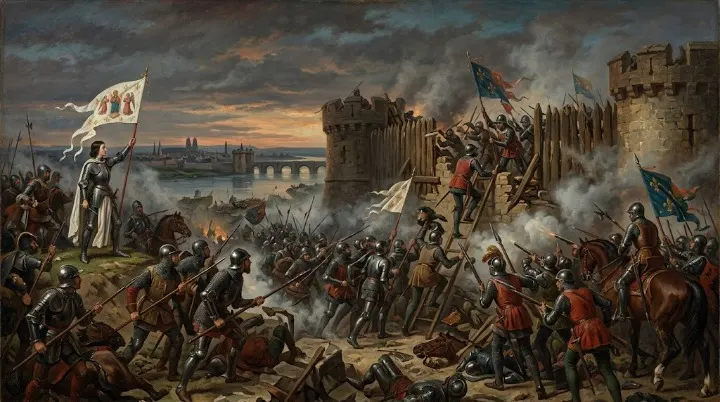
The real fighting started on 4 May, when French forces stormed and took the English fort at Saint-Loup. Two days later, on 6 May, they took the fortified monastery at the Augustins on the south bank. Joan was present at both, riding with the troops and, by multiple accounts, rallying men who’d started to fall back.
The decisive moment came on 7 May, at Les Tourelles — the fortified bridgehead controlling the crossing into the city. During the assault, an English crossbow bolt tore into Joan’s shoulder above her breastplate. She was pulled from the field, and for a while, the attack stalled.
Suddenly, Joan returned to the front lines. Seeing her alive and standing tall, the French felt invincible, while the superstitious English defenders panicked, believing she was using witchcraft. The French surged forward, crossed a broken span of the bridge using timber planks, and took Les Tourelles from both sides.
By the morning of May 8, the remaining English forces marched out of their remaining forts, drew up in battle formation, and invited the French to fight in the open field. Joan advised against attacking them on a Sunday. Denied their battle, the English turned around and marched away. The siege was over. Seven months of blockade ended in five days of fighting.
How Much Credit Does Joan Deserve?
Here’s where it gets genuinely complicated, and history books often argue over whether Joan was a brilliant general or just a lucky mascot. The truth sits comfortably in the middle.
Joan wasn’t a trained tactician, and she didn’t draw up the battle plans — that was Dunois and La Hire’s job, and they’d been fighting this war for years before she ever showed up. The military mechanics of taking Saint-Loup, the Augustins, and Les Tourelles followed conventional siege warfare of the era.
But “she didn’t plan the battles” doesn’t mean “she didn’t matter.” Contemporary accounts, including testimony later given at her rehabilitation trial, consistently describe her effect on morale as immediate and real — soldiers who’d been losing for months suddenly believed they could win, and belief is not a small factor in medieval warfare, where routs and last stands often turned on exactly that kind of momentum. Her insistence on returning to the field after being wounded at Les Tourelles, rather than a smaller, purely symbolic gesture, seems to have had a genuine tactical effect on a stalling assault.
The honest answer is that Orléans was won by professional soldiers executing conventional siege tactics, with Joan supplying something those tactics alone hadn’t produced in seven months: belief that this time, it would work.
⚜️ The Turning Point: Before vs. After Joan
| 🔍 Metric | ⏳ Before Joan (Oct 1428 – Late Apr 1429) | ⚡ After Joan (4–8 May 1429) |
|---|---|---|
| English Position | Fortified ring of bastilles, steady blockade locking down the city | Forts falling one by one (Saint-Loup, Augustins, Les Tourelles) |
| French Morale | Abysmally low; just suffered a crushing loss at the Battle of the Herrings | Rising sharply, described by stunned contemporaries as completely transformed |
| Supply Situation | The city was increasingly cut off and starving out | Heavy relief forces and vital provisions moving in freely |
| Outcome | Grim stalemate, steadily tilting toward a full English victory | The seven-month siege broken in a mere five days |
Aftermath: The Road to Reims
Breaking the siege didn’t end the war — the English still held Paris and much of the north. But it did something arguably more important in the short term: it proved, publicly and dramatically, that the English could be beaten. That proof gave Charles VII’s cause the momentum and legitimacy to move on its next goal — getting him crowned at Reims Cathedral, the traditional coronation site of French kings, deep in territory that had been firmly under Anglo-Burgundian control just months earlier.Orléans was the turning point that made Reims possible.
If you want the fuller story of what happened to Joan after that — the trial, the execution, and everything that followed — it’s all covered in our complete Joan of Arc biography.
🛡️ Frequently Asked Questions — The Siege of Orléans
Orléans was the strategic gateway between northern France (occupied by the English) and southern France (held by the Dauphin). If the city had fallen, the English could have invaded the south easily, ending French independence.
The siege lasted just under seven months, beginning on October 12, 1428, and ending with the English retreat on May 8, 1429.
Joan was not a formal military commander who drew up battle plans or managed logistics. Instead, she acted as a charismatic war leader and a powerful symbol of divine favor who held the army’s banner and inspired the troops to launch high-risk attacks.
The English army suffered heavy casualties, lost its top leadership, and was forced into a disorganized retreat northward, paving the way for further French victories at Jargeau and Patay.
Sources & Further Reading
- The International Joan of Arc Society — Academic research, historical translations, and contemporary records regarding her life and military campaigns.
- The Hundred Years’ War (1337-1453) — Official historical records