An anxious crowd packed into a sweltering Tennessee courtroom while lawyers prepared to debate the very origin of humanity. John T. Scopes, a quiet high school science teacher, sat at the center of a media storm that would transfix the world. This trial put modern science and traditional faith on a direct collision course under the summer heat. Finding what happened on July 10 in history reveals a tapestry of courtroom high drama, royal betrayals, and deep-sea sabotage that completely shifted our modern cultural landscape.
📅 Quick Facts — July 10 in History
| 📌 Category | 📖 Event / Detail |
|---|---|
| 🌟 Most Significant Event | The Scopes Monkey Trial begins in Dayton, Tennessee, putting the teaching of evolution on trial in America (1925) |
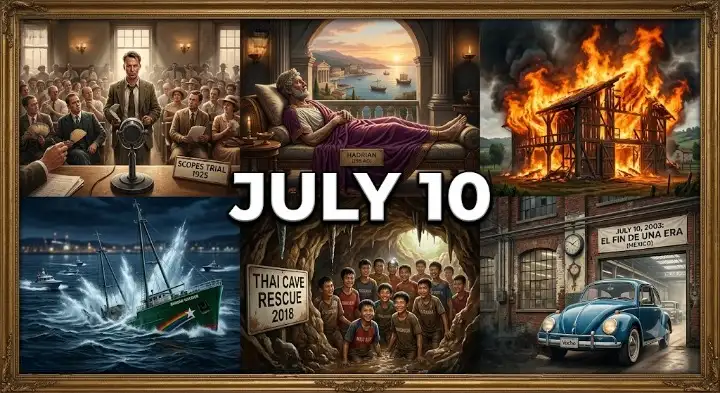
| 🏆 Top 10 Key Events | • Roman Emperor Hadrian dies at Baiae after a 21-year reign marked by peace and monumental building projects (138) • Soga no Iruka is assassinated during the Isshi Incident, leading to the collapse of the Soga clan in Japan (645) • The city of Dublin is traditionally recognized as founded following a historic Norse tax agreement (988) • The early Great Fire of London breaks out, decimating Southwark and trapping crowds on London Bridge (1212) • Four days after the death of Edward VI, Lady Jane Grey is proclaimed Queen of England for her tragic nine-day reign (1553) • William I of Orange (“William the Silent”) is shot and killed by Balthasar Gérard in Delft, Holland (1584) • United States President Andrew Jackson issues a stinging veto against the recharter of the Second Bank of the United States (1832) • Allied forces launch Operation Husky, embarking on the major amphibious and airborne invasion of Sicily (1943) • French DGSE secret agents bomb and sink the Greenpeace flagship Rainbow Warrior in Auckland Harbor, New Zealand (1985) • The miraculous international rescue effort at Tham Luang cave concludes successfully with all 13 members of the Wild Boars soccer team saved (2018) |
| ⚔️ Key Battles | Battle of Northampton (1460), Battle of Langport (1645), Battle of La Concepción (1882), Battle of Huamachuco (1883), Operation Husky (1943), Kanalkampf shipping attacks of the Battle of Britain begin (1940) |
| 👤 Key Figures | Emperor Hadrian, Lady Jane Grey, William I of Orange, John T. Scopes, Muhammad Ali Jinnah, Boris Yeltsin (sworn in as Russia’s first elected president on this day in 1991), Aung San Suu Kyi |
| 🌍 Observances | Bahamas Independence Day, Mauritania Armed Forces Day, Nikola Tesla Day, Wyoming Statehood Day |
Story of the Day: The Sinking of the Rainbow Warrior
Two sudden explosions ripped through the hull of the Greenpeace flagship Rainbow Warrior as she sat quietly moored in Auckland Harbour, New Zealand. Water rushed into the dark engine room, drowning photographer Fernando Pereira who had run below to grab his cameras. This was not a random accident, but a state-sponsored act of terror executed by undercover French secret agents. France wanted to stop the environmental group from protesting their upcoming nuclear tests in the Mururoa Atoll. The shocking international scandal severely backfired, turning global public opinion fiercely against nuclear testing and cementing the Greenpeace movement into a global powerhouse.
Important Events That Happened On July 10 In History
138 – Death of Emperor Hadrian
Hadrian drew his final, agonizing breaths at his coastal estate in Baiae on the bay of Naples while his doctors stood by helplessly. Roman citizens wept as news traveled to the capital that their restless, wall-building emperor had succumbed to heart failure. Workers carried his body back to Rome to rest eternally inside a massive, specially built mausoleum beside his late wife, Vibia Sabina. His passing handed total control of the vast Roman Empire to his chosen successor, Antoninus Pius, marking the end of a highly golden administrative era.
420 – Rise of the Liu Song Dynasty
Liu Yu marched confidently into the imperial court after successfully forcing Emperor Gong of Jin to give up his ancestral throne. The ambitious general placed the crown upon his own head and declared himself the absolute ruler of a brand new dynasty. This sudden coup brought a violent, definitive end to the historic Jin dynasty that had ruled for over a century. His cold political maneuvering plunged southern China into a dynamic new era of political structure known as the Liu Song dynasty.
518 – Coronation of Justin I
Justin I felt the heavy golden crown touch his brow as the Patriarch of Constantinople raised his hands to bless the new ruler. The elderly soldier had climbed the ranks from an illiterate peasant to the commander of the palace guard before securing the throne. Palace officials had spent the previous twenty-four hours plotting in secret after the sudden death of Emperor Anastasius. This unexpected coronation launched the Justinian dynasty, setting the stage for his brilliant nephew to later rebuild the legal framework of the western world.
645 – The Isshi Incident
Prince Naka-no-Ōe and his trusted ally Fujiwara no Kamatari hid their sharp weapons beneath their ceremonial robes inside the imperial palace. They struck without warning, brutally assassinating the powerful politician Soga no Iruka right before the eyes of the horrified Empress Kōgyoku. This bloody coup shattered the Soga clan’s iron grip on the imperial family within a matter of minutes. The sudden assassination triggered the famous Taika Reforms, completely centralizing Japanese government power away from wealthy clans and directly toward the emperor.
988 – The Founding of Dublin
Glúniairn, the Norse King of Dublin, bowed his head before Máel Sechnaill mac Domnaill, the High King of Ireland, to avoid a bloody war. The Viking ruler agreed to pay regular taxes in silver and officially accept the ancient jurisdiction of Irish Brehon Law. This peaceful submission marked a massive turning point where the fierce Viking raiders officially integrated into Irish society. Local historians record this specific tax agreement as the official birth of the modern capital city of Dublin.
1212 – The Great Fire of London
Thick black smoke choked the sky over the River Thames as a ferocious wall of fire swept through London’s wooden streets. Panicked citizens screamed and threw themselves into boats while the flames jumped from roof to roof, consuming churches, homes, and shops. The historic wooden London Bridge became a deadly trap, catching hundreds of fleeing people between two walls of intense heat. When the ash finally cooled, the most severe early fire in London’s history had reduced the majority of the medieval city to absolute rubble.
1290 – Assassination of Ladislaus IV
Ladislaus IV relaxed inside his private quarters at the castle of Körösszeg when three of his trusted Cuman soldiers drew their daggers. The assassins struck the Hungarian king repeatedly, leaving him to bleed to death on the floor of his own fortress. His volatile reign had infuriated local barons and the Pope because the king consistently adopted Cuman clothing, customs, and pagan traditions. His sudden murder plunged Hungary into a severe succession crisis that ultimately broke the power of the royal monarchy.
1460 – The Battle of Northampton
Richard Neville, the Earl of Warwick, ordered his Yorkist archers to advance through a heavy summer downpour toward the royal camp. A treacherous Lancastrian commander suddenly ordered his men to lay down their weapons, allowing Warwick’s forces to pour over the muddy trenches unchallenged. The Yorkists quickly slaughtered the king’s inner circle and took King Henry VI prisoner inside his own royal tent. This stunning military victory completely flipped the balance of power in the bloody Wars of the Roses, leaving the lancastrian cause in absolute tatters.
1499 – Nicolau Coelho Returns to Lisbon
Nicolau Coelho steered his battered ship, the Berrio, into the mouth of the Tagus River while excited crowds gathered along the Lisbon docks. The seasoned mariner had spent two grueling years facing storms, scurvy, and hostile fleets alongside the legendary explorer Vasco da Gama. His vessel was the very first of the historic expedition to make it back to Portugal after charting the sea route to India. His arrival proved that direct spice trade with Asia was finally a reality, shifting global economic power forever.
1512 – The Conquest of Navarre
Spanish troops marched across the border into the peaceful territory of Goizueta with their weapons drawn and banners flying high. King Ferdinand II of Aragon had launched this sudden military campaign to seize control of the strategically vital Kingdom of Navarre. Local defenders could do very little to stop the overwhelming power of the professional Spanish army. This opening military strike marked the official start of a brutal conquest that ultimately absorbed the Basque kingdom into the unified country of Spain.
1519 – The Prince of Ning Rebellion
Zhu Chenhao stood before his massive army and loudly denounced the Zhengde Emperor as an illegitimate ruler who had stolen the imperial crown. The rebellious prince ordered his soldiers to march north immediately, aiming his spears directly at the wealthy southern capital of Nanjing. This public declaration triggered the bloody Prince of Ning rebellion, sending shockwaves through the entire Ming dynasty. The bold military uprising threatened to tear China apart before royal forces could mobilize to defend the throne.
1553 – Lady Jane Grey Takes the Throne
Lady Jane Grey sat nervously inside the Tower of London as royal officials bowed low and proclaimed her the rightful Queen of England. The studious sixteen-year-old had been thrust onto the throne by her ambitious father-in-law following the tragic death of young King Edward VI. Protestant leaders desperately hoped her reign would prevent the Catholic Princess Mary from taking control of the deeply divided kingdom. Her desperate ascent began the shortest, most tragic reign in English history, lasting a mere nine days before she was overthrown.
1584 – Assassination of William I of Orange
Balthasar Gérard hid inside the shadows of a stone staircase in William of Orange’s private home in Delft, holding a loaded pistol. As the Dutch revolutionary leader finished his dinner and walked past, Gérard stepped out and shot him twice at point-blank range. William collapsed onto the floor, offering a final prayer for his people before dying in the arms of his family. The assassin had carried out the execution solely to claim a massive bounty offered by King Philip II of Spain.
1645 – The Battle of Langport
Sir Thomas Fairfax deployed his New Model Army along the muddy ridges of Somerset while Royalist cannons opened fire across the valley. Parliamentarian cavalrymen launched a daring charge directly down a narrow lane, smashing straight through the Royalist defenses under intense musket fire. This decisive tactical victory completely broke King Charles I’s final remaining stronghold in the west of England. The disaster left the Royalist cause completely crippled, effectively ensuring parliament’s ultimate victory in the English Civil War.
1668 – Henry Morgan Lands at Porto Bello
Henry Morgan ordered his privateers to drop anchor down the coast and quietly paddle their canoes toward the fortified Spanish city of Porto Bello. The legendary buccaneer knew the garrison was heavily armed, but he also knew the vaults were packed full of captured silver and gold. His men caught the Spanish sentries completely by surprise, scaling the stone fortresses using heavy wooden ladders under the cover of darkness. This bold raid secured one of the largest pirate ransoms in Caribbean history and cemented Morgan’s fearsome reputation.
1778 – France Joins the American Revolution
King Louis XVI signed an official royal declaration of war against the Kingdom of Great Britain inside the glittering halls of Versailles. The French monarch had watched the American colonists fight the British redcoats for years before deciding to provide full military support. This official declaration turned a localized colonial rebellion into a massive, multi-continental global conflict. French warships, troops, and gold began flowing across the Atlantic, providing the vital lifeline the Americans needed to win their independence.
1789 – Alexander Mackenzie Reaches the Delta
Alexander Mackenzie stood at the bow of his birchbark canoe, staring out at a massive, maze-like network of wilderness waterways. The intrepid fur trader had spent weeks paddling northwest from Lake Athabasca, hoping this uncharted river would lead him straight to the Pacific Ocean. He discovered that the massive river actually emptied into the freezing waters of the Arctic Ocean instead. This journey mapped the immense Mackenzie River delta, opening up vast new northern territories for the global fur trade.
1806 – The Vellore Mutiny
Indian sepoys crept out of their barracks inside the stone walls of Vellore Fort with their muskets loaded and bayonets fixed. They opened fire on the sleeping quarters of the British 69th Regiment, killing over a hundred British soldiers before sunrise. The native troops had rebelled because the British East India Company forced them to wear new hats made of animal hides and banned religious markings. This bloody uprising marked the very first major military mutiny by Indian soldiers against British rule on the subcontinent.
1832 – Andrew Jackson’s Bank Veto
President Andrew Jackson sat at his desk and scrawled a furious veto across a congressional bill designed to keep the Second Bank of the United States alive. The fiery president believed the centralized banking institution held way too much power over everyday American citizens and served only the wealthy elite. His controversial veto shocked the financial world and triggered a bitter economic conflict known as the Bank War. This bold move fundamentally changed the American financial system and set off a massive political debate over presidential power.
1850 – Millard Fillmore Sworn In
Millard Fillmore raised his right hand inside the crowded House of Representatives chamber and took the presidential oath of office. The quiet New Yorker had become the leader of the nation just twenty-four hours after President Zachary Taylor died of a sudden, severe stomach illness. The United States was on the verge of tearing itself apart over the highly explosive issue of expanding slavery into western territories. Fillmore’s unexpected rise to power paved the way for the controversial Compromise of 1850, briefly delaying the Civil War.
1877 – Mayagüez Receives Its City Charter
Local officials in the beautiful villa of Mayagüez, Puerto Rico, cheered loudly as they unrolled an official royal document bearing the seal of Spain. The Royal Crown had granted the prosperous coastal town its official charter, elevating it to the formal status of a full city. Decades of booming agricultural trade in sugar and coffee had transformed the small settlement into a vital economic hub. This royal recognition granted the community new local governing powers and sparked a major era of urban development.
1882 – The Battle of La Concepción
Seventy-seven Chilean soldiers barricaded themselves inside a small wooden church in the Andean village of La Concepción as over a thousand Peruvian troops surrounded them. The young garrison refused multiple offers to surrender, choosing to fight to the absolute last man over two days of brutal combat. Peruvian forces, many armed only with traditional spears, eventually overran the building and annihilated the entire Chilean force. This tragic stand marked Chile’s very last military defeat during the long, bitter War of the Pacific.
1883 – The Battle of Huamachuco
General Alejandro Gorostiaga ordered his Chilean infantrymen to charge up the rocky slopes of Huamachuco toward the defensive lines of the Peruvian army. The Peruvians fought bravely under the command of Andrés Avelino Cáceres, but they quickly ran completely out of ammunition during the heat of battle. The Chilean forces took immediate advantage of the shortage, routing the Peruvian lines and securing a decisive victory. This crushing defeat broke the back of Peruvian resistance, bringing a swift end to the War of the Pacific.
1890 – Wyoming Becomes a State
Wyoming politicians cheered as President Benjamin Harrison signed an official congressional proclamation in Washington, D.C. The rugged western territory was officially admitted into the Union as the 44th U.S. state. Wyoming entered the nation with a highly progressive constitution that guaranteed women the right to vote and hold public office. This historic admission earned Wyoming its permanent nickname, “The Equality State,” changing American political history forever.
1920 – Arthur Meighen Becomes Prime Minister
Arthur Meighen walked into the parliament buildings in Ottawa to officially take the oath as the ninth Prime Minister of Canada. The brilliant lawyer took control of the government following the sudden retirement of Sir Robert Borden due to failing health. Meighen faced a deeply fractured nation that was struggling to recover from the massive economic strains of the First World War. His sudden rise to leadership set off a fierce political rivalry with William Lyon Mackenzie King that shaped Canadian politics for decades.
1921 – Belfast’s Bloody Sunday
Gunfire rattled through the brick streets of Belfast as rival groups clashed in a wave of horrific sectarian violence. Gunmen took up positions on rooftops, firing indiscriminately into crowded residential neighborhoods while armored police cars raced through the chaos. Firefighters rushed to save burning buildings as over two hundred Catholic and Protestant homes were completely destroyed by arsonists. By midnight, twenty people lay dead and over a hundred were seriously wounded on the bloodiest day of the Irish War of Independence in the north.
1924 – Paavo Nurmi’s Olympic Triumph
Paavo Nurmi stood on the running track at the Paris Olympics, calmly checking his stopwatch while his competitors panted for breath. The legendary “Flying Finn” had just won the grueling 1,500-meter gold medal in spectacular, record-breaking fashion. Exactly one hour later, he lined up for the brutal 5,000-meter final and won another gold medal against the best long-distance runners in the world. This unimaginable athletic feat remains one of the most dominant single-day performances in the history of international sports.
1925 – The Scopes Monkey Trial Begins
John T. Scopes sat quietly at the defense table while a massive crowd packed into a sweltering courtroom in Dayton, Tennessee. The young high school science teacher stood accused of violating the state’s strict Butler Act by teaching the theory of evolution to his students. Famous lawyers William Jennings Bryan and Clarence Darrow prepared to battle over modern science and traditional religious faith. This dramatic opening day launched the infamous “Monkey Trial,” gripping millions of newspaper readers across the entire globe.
1927 – Assassination of Kevin O’Higgins
Kevin O’Higgins walked briskly down a sunlit street in Dublin on his way to Sunday Mass when a car suddenly screeched to a halt beside him. Three anti-treaty IRA gunmen jumped out and fired multiple pistol shots at the prominent Irish politician. O’Higgins collapsed onto the pavement, fatally wounded, while the assassins sped away into the city. The vice-president of the Irish Free State had been targeted because he signed execution orders for seventy-seven republican prisoners during the civil war.
1938 – Howard Hughes Begins World Flight
Howard Hughes climbed inside the cockpit of his custom Lockheed Super Electra airplane and fired up the twin engines. The eccentric millionaire pilot waved to a roaring crowd at New York’s Floyd Bennett Field before roaring down the runway into the morning sky. Hughes aimed to shatter the existing record for flying completely around the upper hemisphere of the globe. His meticulous planning and advanced radios allowed him to complete the historic journey in just ninety-one hours, setting a magnificent new world aviation record.
1940 – The Vichy Government Established
French politicians gathered inside the grand opera house in the resort town of Vichy to vote away their own democracy. The terrified assembly passed a constitutional law that handed absolute dictatorial power to the aging war hero Marshal Philippe Pétain. This dark vote officially established the collaborationist Vichy regime following France’s catastrophic military defeat by Nazi Germany. The new government immediately abandoned its democratic alliance, choosing instead to cooperate fully with Adolf Hitler’s occupying forces.
1940 – The Kanalkampf Attacks Begin
German Luftwaffe bombers roared over the English Channel, dropping heavy payloads directly onto British merchant shipping convoys. This aggressive aerial assault marked the official opening phase of the historic Kanalkampf, or “Channel Battles.” Adolf Hitler had ordered these intense strikes to clear the waters just six days before finalizing his plans for a full-scale invasion of Britain. The fierce dogfights over the water forced the Royal Air Force into action, triggering the Battle of Britain.
1941 – The Jedwabne Pogrom
A furious, armed mob of local residents dragged hundreds of their Jewish neighbors out of their homes in the small Polish village of Jedwabne. The attackers beat the defenseless families through the streets before forcing them inside a large wooden barn on the edge of town. The mob padlocked the doors and set the structure on fire, killing hundreds of innocent men, women, and children inside. This horrific massacre stood as a dark tragedy of local collaboration during the chaotic German occupation of Poland.
1942 – The Discovery of the Akutan Zero
An American navy pilot flew his patrol plane over remote Akutan Island when he spotted a gleaming, intact Japanese fighter aircraft resting upside down in a bog. The enemy pilot had crash-landed weeks earlier during the fierce Battle of Dutch Harbor, leaving the legendary plane completely preserved. US Navy mechanics rushed to salvage the aircraft, shipping it back to the mainland to study its specific flight characteristics in secret. This single discovery allowed American engineers to find the Zero’s fatal weaknesses, saving countless Allied pilots’ lives.
1943 – Operation Husky Begins
Thousands of British and American paratroopers dropped into the dark, windy skies over Sicily while hundreds of landing craft slammed into the sandy beaches. General Dwight D. Eisenhower had launched Operation Husky, unleashing a massive amphibious assault to rip southern Europe away from Axis control. The Allied troops fought through fierce coastal defenses, securing a vital foothold on the historic island within forty-eight hours. This giant invasion forced Italian dictator Benito Mussolini from power and opened up a massive second front in World War II.
1947 – Jinnah Recommended as Governor-General
British Prime Minister Clement Attlee stood before parliament and formally announced that Muhammad Ali Jinnah would become the first Governor-General of Pakistan. The brilliant statesman had spent decades leading the All-India Muslim League, fighting tirelessly to secure an independent homeland for Muslims on the subcontinent. This official British recommendation finalized the fast-approaching political partition of India. The announcement cemented Jinnah’s status as the historic father of a brand new nation that would gain independence just weeks later.
1948 – North Korea Established
Politicians gathered inside a grand hall in Pyongyang to officially declare the birth of the Democratic People’s Republic of Korea. Communist leader Kim Il-sung assumed absolute power over the northern half of the peninsula with the full backing of the Soviet Union. This formal announcement permanently solidified the deep political division that had formed after World War II. The creation of the new state set the stage for an intense, bloody conflict that would erupt into the Korean War just two years later.
1951 – Kaesong Armistice Talks Begin
United Nations and communist military commanders sat down across a wooden table inside a traditional pavilion in the border city of Kaesong. The two opposing sides met face-to-face for the very first time to discuss an official ceasefire in the bloody Korean War. Soldiers stood guard outside with their weapons ready while diplomats argued fiercely over troop positions and prisoner exchanges. These tense negotiations marked the long, agonizingly slow beginning of an armistice process that took two full years to finalize.
1962 – Telstar Launched Into Orbit
A powerful Delta rocket roared off the launchpad at Cape Canaveral, carrying a small, spherical satellite named Telstar into the night sky. The innovative spacecraft was designed by AT&T to test the very first active communications system in outer space. Within hours, Telstar successfully transmitted the first live television pictures, telephone calls, and fax images across the Atlantic Ocean. This historic launch revolutionized global media, laying the technological foundation for our modern, interconnected digital world.
1966 – The Chicago Freedom Rally
Martin Luther King Jr. stepped up to the microphone at Soldier Field while a massive crowd of sixty thousand people cheered under the hot sun. The civil rights leader demanded an immediate end to racist housing policies, unequal job access, and systemic segregation in northern cities. After his powerful speech, King marched directly to City Hall and taped a list of demands onto the front door. This massive rally marked the peak of the Chicago Freedom Movement, shifting the civil rights battleground to the American North.
1967 – New Zealand Decimalizes Currency
Bank clerks across New Zealand arrived at work to open heavy vaults filled with brand new, unfamiliar coins and banknotes. The government officially retired the traditional British system of pounds, shillings, and pence, replacing it with the modern New Zealand dollar. Officials had spent months running catchy radio ads to teach citizens how to count using the easy new decimal system. This smooth currency transition modernized the national economy and marked a major step away from British colonial traditions.
1973 – The Bahamas Gains Independence
Crowds cheered wildly in Nassau as the British Union Jack was slowly lowered and a new black, turquoise, and gold flag rose into the midnight sky. Prince Charles stood by to formally hand over the official constitutional documents, ending over three centuries of British colonial rule. The beautiful island nation joined the Commonwealth of Nations as a fully free and equal partner. This historic night sparked massive celebrations across the islands, marking the birth of an independent Bahamas.
1974 – EgyptAir Crash in Cairo
An EgyptAir Tupolev Tu-154 airliner roared down the runway at Cairo International Airport, lifting off into the sky on a routine training flight. The Soviet-built aircraft suddenly lost speed, stalled out, and crashed violently into the ground just moments after takeoff. Fire crews rushed to the burning wreckage, but the intense impact killed all six crew members on board instantly. This tragic training disaster forced international aviation officials to re-examine the specific handling characteristics of the airliner model.
1976 – Mercenaries Executed in Angola
Four foreign mercenaries stood before a military firing squad inside a courtyard in Luanda following the high-profile Luanda Trial. One American and three British soldiers had been captured while fighting for rebel forces during the bloody Angolan Civil War. The new communist government used the executions to send a fierce warning to western nations against intervening in their internal politics. The controversial deaths sparked massive international debates over the legal rights of hired soldiers in foreign conflicts.
1978 – Mauritanian Coup d’État
Armored vehicles rolled quietly into the streets of Nouakchott under the cover of early morning darkness, surrounding the presidential palace. Military officers led by Colonel Mustapha Ould Salek arrested President Moktar Ould Daddah without firing a single shot. The bloodless coup was launched because the nation’s economy was completely collapsing from a long, draining war in the Western Sahara. This sudden military takeover ended Daddah’s eighteen-year presidency and reshaped the political landscape of northwest Africa.
1985 – Soviet Aeroflot Flight 7425 Crashes
An Aeroflot Tupolev Tu-154 jetliner cruised high above the desert landscape of Uzbekistan when the aircraft suddenly stalled and entered a spinning dive. The pilots lost total control of the controls as the plane plummeted rapidly from thirty-six thousand feet. The aircraft slammed violently into the ground near Uchkuduk, killing all two hundred passengers and crew members instantly. This horrific crash remains the worst airline disaster in Soviet history, exposing severe flaws in pilot training and aircraft limits.
1991 – South Africa Readmitted to ICC
Cricket officials gathered inside a London boardroom and voted unanimously to welcome the South African cricket team back into international competition. The nation had been completely banned from global sports for over two decades due to its racist Apartheid policies. The International Cricket Council restored their membership after Nelson Mandela’s release and the steady dismantling of segregation laws. This emotional return symbolized South Africa’s journey back into the global community after decades of painful isolation.
1991 – Boris Yeltsin Takes Office
Boris Yeltsin stepped onto a grand stage in Moscow, placed his right hand on a copy of the constitution, and took the oath of office. He became the very first democratically elected president in the long history of Russia, standing before a cheering crowd. His inauguration marked a massive shift in power away from Mikhail Gorbachev and the old Soviet communist system. Within months, this historic democratic mandate allowed Yeltsin to guide the nation through the total collapse of the Soviet Union.
1991 – Birmingham Airplane Crash
A Beechcraft Model 99 commuter plane approached the runway at Birmingham Municipal Airport in Alabama under a dark, stormy sky. The twin-engine aircraft suddenly lost altitude, clipped a row of trees, and crashed violently into a nearby residential neighborhood. Emergency crews pulled two miraculously surviving passengers from the burning wreckage, but thirteen people lost their lives in the impact. National safety investigators later traced the tragic crash to severe radar issues and poor pilot decisions during bad weather.
1992 – Manuel Noriega Sentenced
A federal judge in Miami raised his gavel and sentenced former Panamanian dictator Manuel Noriega to forty years in a federal prison. The once-powerful military leader had been captured by US troops during the historic 1989 invasion of Panama. A jury found him guilty on multiple counts of racketeering, money laundering, and drug trafficking with the infamous Medellín cartel. This historic sentencing marked the first time in American history that a foreign head of state was convicted in a US court.
1995 – Aung San Suu Kyi Released
Aung San Suu Kyi stepped through the iron gates of her lakeside compound in Yangon, greeting an ecstatic crowd of thousands of supporters. The courageous pro-democracy leader had spent six long years under strict house arrest by order of Burma’s military dictatorship. She had refused multiple offers of freedom if she agreed to leave her beloved country, choosing instead to remain a symbol of peaceful resistance. Her sudden release breathed new life into the international movement for human rights in Southeast Asia.
1995 – The N95 Respirator Standard Enacted
The National Institute for Occupational Safety and Health officially enacted a brand new air filtration standard known as 42 CFR 84. This dry federal regulation created strict rules for a new class of protective face masks designed to block ninety-five percent of airborne particles. Engineers engineered the mask primarily to protect industrial workers from inhaling toxic dust and dangerous airborne bacteria. Decades later, this specific technical standard became the primary global defense for millions of healthcare workers during global pandemics.
1997 – Neanderthal DNA Confirms Human Roots
Scientists published a groundbreaking report in London after successfully extracting and analyzing DNA from an original Neanderthal skeleton. The genetic data proved that Neanderthals were a distinct evolutionary branch rather than direct ancestors of modern humans. This discovery provided powerful scientific support for the popular “Out of Africa” theory of human development. The historic data placed a shared genetic ancestor, an “African Eve,” at roughly one hundred thousand to two hundred thousand years ago.
1997 – Kidnapping of Miguel Ángel Blanco
Armed members of the Basque separatist group ETA cornered young politician Miguel Ángel Blanco in the town of Ermua, forcing him into a car at gunpoint. The terrorist group issued an immediate ultimatum, threatening to execute the young councilman unless the government moved all Basque prisoners closer to home. The shocking kidnapping sparked massive, spontaneous protests across Spain, with millions of citizens marching through the streets shouting for his immediate release. The tragic event united the Spanish public against political terrorism like never before.
1998 Dallas Diocese Abuse Settlement
Lawyers representing the Catholic Diocese of Dallas signed an official legal agreement to pay a historic twenty-three point four million dollars to nine former altar boys. The young men had filed lawsuits detailing years of horrific sexual abuse by a former parish priest named Rudolph Kos. This massive financial payout marked the largest single settlement in the history of Catholic Church abuse cases at that time. The public case forced religious leaders to confront systemic issues and implement strict new safety protections for children.
1999 – US Wins Women’s World Cup
Brandi Chastain smashed her penalty kick past the Chinese goalkeeper, sank to her knees, and celebrated in front of ninety thousand roaring fans at the Rose Bowl. The United States squad had fought through a grueling, scoreless match before defeating China in a dramatic penalty shootout to win the FIFA Women’s World Cup. The massive crowd set a permanent world record for attendance at a women’s sporting event. This historic victory transformed women’s soccer from a niche sport into a mainstream global phenomenon overnight.
2000 – EADS Aerospace Group Formed
Corporate executives in Paris and Munich signed final merger documents to officially create the European Aeronautic Defence and Space Company. This massive corporate deal combined the top aerospace firms of France, Germany, and Spain into a single industrial powerhouse. The strategic merger was designed to create a powerful European competitor capable of challenging American aviation giants like Boeing. This historic corporate marriage ultimately paved the way for the global commercial success of the modern Airbus aircraft line.
2000 – Bashar al-Assad Succeeds His Father
Bashar al-Assad stood inside the parliament building in Damascus and took the presidential oath of office before hundreds of loyal officials. The quiet, British-trained eye doctor took total control of Syria just weeks after the death of his iron-fisted father, Hafez al-Assad. The state legislature had quickly lowered the legal minimum age for presidents to ensure a smooth family transition of power. His smooth ascent brought a deceptive hope for political reform that ultimately ended in a brutal civil war years later.
2002 – Rubens Painting Sold for Record Price
An auctioneer at Sotheby’s in London slammed his gavel down as a classic masterpiece by Peter Paul Rubens sold for a staggering forty-nine point five million pounds. The magnificent artwork, titled The Massacre of the Innocents, was purchased by the wealthy Canadian collector Lord Thomson. The painting had been mistakenly attributed to a lesser artist for centuries before experts identified it as an authentic Rubens masterpiece. This historic sale shattered international auction records for old master paintings, shaking the global art world.
2006 – Fokker F27 Crashes in Pakistan
A Pakistan International Airlines Fokker F27 twin-engine turboprop took off from Multan International Airport, climbing into the afternoon sky. Just moments after lifting off, an engine exploded, causing the aircraft to clip a row of electric wires and plunge violently into an open field. Firefighters rushed to the blazing wreckage, but the intense impact killed all forty-five passengers and crew members on board. The tragic accident led to a temporary ban on Fokker aircraft across Pakistan while safety protocols were overhauled.
2007 – Erden Eruç Begins Circumnavigation
Erden Eruç climbed into his custom ocean rowing boat at Bodega Bay, California, dipped his oars into the water, and pulled away from the coast. The adventurous Turkish-American athlete aimed to complete the very first solo, entirely human-powered journey around the entire globe. He planned to rely solely on his own muscles to row across oceans, pedal bicycles across continents, and walk across wilderness trails. His departure launched a grueling five-year journey that ultimately secured multiple world records for human endurance.
2007 – The Storming of Lal Masjid
Pakistani elite commandos launched a massive, heavily armed assault on the historic Lal Masjid mosque complex in the heart of Islamabad. Radical Islamist militants had barricaded themselves inside the religious school, holding hundreds of students hostage during a tense week-long standoff. Intense gunfire and explosions echoed through the capital city for hours as soldiers cleared the fortified rooms one by one. The bloody operation left over a hundred people dead, deeply escalating the internal conflict against extremism.
2008 – Ljube Boškoski Acquitted
A panel of international judges at a United Nations tribunal in The Hague raised their papers and declared Ljube Boškoski not guilty of all war crimes charges. The former Macedonian Interior Minister had been accused of ordering a brutal 2001 police raid that killed innocent ethnic Albanian civilians. The court ruled that prosecutors had failed to prove he held direct command responsibility over the rogue officers involved. His sudden acquittal sparked wild celebrations among supporters back home, highlighting deep ethnic divisions.
2011 – Sinking of the Bulgaria
The Russian cruise ship Bulgaria listed heavily to one side as a sudden, violent summer storm caught her out on the wide Volga River. Water poured into the open portholes of the aging, twin-deck vessel, causing her to capsize and sink to the bottom in less than three minutes. Dozens of passengers were trapped inside the main music room as the ship went down. Rescue teams managed to save seventy-nine people, but one hundred and twenty-two drowned in the worst Russian river disaster in decades.
2011 – News of the World Closes Down
Editors and reporters gathered inside a London printing plant to watch the final, historic issue of the News of the World roll off the presses. The prominent 168-year-old weekly tabloid newspaper was forced to shut its doors forever following a massive global backlash over a systemic phone-hacking scandal. Executives closed the paper after revelations that journalists had illegally intercepted voice messages of crime victims, celebrities, and British soldiers. This sudden closure shook the global media landscape, permanently altering British journalism ethics.
2012 – Episcopal Church Approves Same-Sex Marriage
Bishops and lay deputies at the Episcopal Church’s general convention in Indianapolis voted overwhelmingly to approve an official liturgy for blessing same-sex relationships. This historic decision made them the first major US Christian denomination to formally allow gay couples to marry in their churches. The policy change allowed priests to perform marriage ceremonies in states where same-sex marriage was legally recognized. This bold move sparked deep theological debates, causing several conservative parishes to break away from the main church body.
2016 – Portugal Wins Euro 2016
Portuguese forward Éder collected a pass in extra time and fired a powerful, low shot directly past the French goalkeeper into the net. The underdog Portuguese squad fought through the intense final match without their injured superstar Cristiano Ronaldo, who cheered tearfully from the sidelines. The final whistle triggered wild celebrations from Lisbon to Porto as Portugal secured their very first major European soccer championship. This historic victory broke decades of international tournament heartbreak for the football-loving nation.
2017 – Mosul Liberated From ISIS
Iraqi Prime Minister Haider al-Abadi arrived in the historic city of Mosul, raising the national flag over a landscape of absolute ruin. He formally declared total victory over the Islamic State of Iraq and the Levant after nine months of brutal, street-by-street urban combat. Allied forces had systematically cleared the final terrorist strongholds out of the historic Old City districts. This major liberation brought an end to three years of horrific militant occupation and broke the spine of the group’s self-proclaimed caliphate.
2018 – Tham Luang Cave Rescue Completed
Expert cave divers emerged from the muddy, flooded mouth of the Tham Luang cave complex carrying the final member of a young Thai soccer team to safety. Twelve young boys and their dedicated coach had spent eighteen agonizing days trapped deep underground by sudden monsoon floodwaters. An international team of thousands of volunteers worked together, sedating the children to swim them through miles of pitch-black, flooded tunnels. The miraculous rescue ended in total success, though one brave Thai Navy SEAL tragically lost his life during the mission.
2019 – The Final Volkswagen Beetle Rolled Off the Line
Factory workers in Puebla, Mexico, cheered and wept as a gleaming denim-blue car slowly rolled off the assembly line surrounded by mariachi bands. This specific vehicle was the very last of five thousand nine hundred and sixty-one “Special Edition” models ever built. The historic moment brought a definitive end to eighty years of continuous production for the iconic, beetle-shaped car. This final automobile was rolled directly into a local museum, closing a massive chapter in global automotive history.
Discover the stories you missed from yesterday’s history lesson.
Famous People Born On July 10
| Name | Description | Date |
|---|---|---|
| John Calvin | French theologian and leading Protestant Reformer | 1509 – 1564 |
| William Blackstone | English jurist whose writings shaped common law | 1723 – 1780 |
| George M. Dallas | 11th Vice President of the United States | 1792 – 1864 |
| Camille Pissarro | Danish-French Impressionist painter | 1830 – 1903 |
| Henryk Wieniawski | Polish violin virtuoso and composer | 1835 – 1880 |
| Adolphus Busch | German-American businessman, co-founder of Anheuser-Busch | 1839 – 1913 |
| Nikola Tesla | Serbian-American inventor and electrical engineer | 1856 – 1943 |
| Marcel Proust | French novelist and author of In Search of Lost Time | 1871 – 1922 |
| Mary McLeod Bethune | American educator and civil rights leader | 1875 – 1955 |
| Giorgio de Chirico | Italian painter and founder of Metaphysical art | 1888 – 1978 |
| Carl Orff | German composer, creator of Carmina Burana | 1895 – 1982 |
| John Wyndham | English science fiction author | 1903 – 1969 |
| Terry-Thomas | English comedian and actor | 1911 – 1990 |
| Joe Shuster | Canadian-American illustrator, co-creator of Superman | 1914 – 1992 |
| David Brinkley | American television journalist and news anchor | 1920 – 2003 |
| Owen Chamberlain | American physicist and Nobel Prize winner | 1920 – 2006 |
| Eunice Kennedy Shriver | American activist and co-founder of the Special Olympics | 1921 – 2009 |
| Jake LaMotta | American world champion boxer | 1922 – 2017 |
| Mahathir Mohamad | Malaysian statesman and Prime Minister | 1925 – Present |
| Alice Munro | Canadian Nobel Prize-winning short story writer | 1931 – 2024 |
| Herbert Boyer | American biotechnologist, co-founder of Genentech | 1936 – Present |
| Mavis Staples | American gospel and soul singer | 1939 – Present |
| Ronnie James Dio | American heavy metal singer | 1942 – 2010 |
| Arthur Ashe | American tennis champion and humanitarian | 1943 – 1993 |
| Sunil Gavaskar | Indian cricket legend | 1949 – Present |
| Neil Tennant | English singer, Pet Shop Boys frontman | 1954 – Present |
| Jacky Cheung | Hong Kong singer and actor | 1961 – Present |
| Sofía Vergara | Colombian-American actress and television star | 1972 – Present |
| Chiwetel Ejiofor | English actor and filmmaker | 1977 – Present |
| Jessica Simpson | American singer, actress, and entrepreneur | 1980 – Present |
Famous People Died On July 10
| Name | Description | Date |
|---|---|---|
| Hadrian | Roman emperor who consolidated the Roman Empire | 76 – 138 |
| Canute IV | King of Denmark and Catholic saint | 1043 – 1086 |
| Henry II of France | King of France | 1519 – 1559 |
| William I of Orange | Leader of the Dutch Revolt and founder of the Dutch Republic | 1533 – 1584 |
| George Stubbs | English painter renowned for horse paintings | 1724 – 1806 |
| Louis Daguerre | French inventor of the daguerreotype photography process | 1787 – 1851 |
| Clement Clarke Moore | American author of A Visit from St. Nicholas | 1779 – 1863 |
| Paul Morphy | American chess prodigy | 1837 – 1884 |
| John Fisher, 1st Baron Fisher | British admiral and naval reformer | 1841 – 1920 |
| Jelly Roll Morton | American jazz pianist and composer | 1890 – 1941 |
| Bjarni Benediktsson | Prime Minister of Iceland | 1908 – 1970 |
| John D. Rockefeller III | American businessman and philanthropist | 1906 – 1978 |
| Arthur Fiedler | American conductor of the Boston Pops Orchestra | 1894 – 1979 |
| John Hammond | American record producer who discovered major music stars | 1910 – 1987 |
| Mel Blanc | Legendary American voice actor known as “The Man of a Thousand Voices” | 1908 – 1989 |
| Winston Graham | English novelist, creator of the Poldark series | 1908 – 2003 |
| Hiroaki Aoki | Japanese-American entrepreneur, founder of Benihana | 1938 – 2008 |
| Roland Petit | French ballet dancer and choreographer | 1924 – 2011 |
| Dolphy | Filipino actor and comedian | 1928 – 2012 |
| Zohra Sehgal | Indian actress and dancer | 1912 – 2014 |
| Roger Rees | Welsh-American actor and director | 1944 – 2015 |
| Omar Sharif | Egyptian international film actor | 1932 – 2015 |
| Jack Charlton | English World Cup-winning footballer and manager | 1935 – 2020 |
| Denise Nickerson | American actress, known for Willy Wonka & the Chocolate Factory | 1957 – 2019 |
| Lara van Ruijven | Dutch Olympic short-track speed skater | 1992 – 2020 |
Observances on July 10
Independence Day (Bahamas) Citizens across the islands of the Bahamas don vibrant clothing and gather in public squares to celebrate their full freedom from British colonial rule achieved in 1973. The national holiday features massive Junkanoo cultural parades, traditional music, and fireworks over Nassau Harbour.
Armed Forces Day: (Mauritania) Military regiments march through the streets of Nouakchott while crowds wave flags to honor the service and sacrifices of the nation’s military personnel. The official holiday features specialized weapon demonstrations, state awards, and speeches highlighting national security history.
Nikola Tesla Day: Scientists, engineers, and inventors across the globe celebrate the birthday of the brilliant visionary Nikola Tesla, born in 1856. Educational institutions organize specialized physics demonstrations and electrical exhibits to keep his incredible spirit of innovation alive for future generations.
Statehood Day (Wyoming)
Wyoming residents celebrate the historic anniversary of their entry into the United States as the 44th state back in 1890. Local communities host historical reenactments and museum exhibits highlighting their unique status as the very first state to grant full voting rights to women.
🐒 Frequently Asked Questions — July 10 in History
John T. Scopes stood trial in Dayton, Tennessee, for teaching evolution in a public school science class. The high-profile courtroom battle brought famous lawyers Clarence Darrow and William Jennings Bryan face-to-face. This dramatic event drew international media attention, turning a small southern town into a global stage for a fierce debate over science, education, and faith.
The launch of the Scopes Monkey Trial in 1925 stands out because it completely reshaped modern cultural, educational, and legal debates regarding science and religion. It forced a public conversation about free speech and classroom content that continues to influence educational policies across the world today.
Indian cricket legend Sunil Gavaskar and influential English jurist William Blackstone were both born on this day. Blackstone’s legal writings heavily shaped American common law, while Gavaskar became one of the greatest opening batsmen in international sports history. A complete list of other notable births can be found in our comprehensive historical archives above.
Allied forces launched Operation Husky in 1943, initiating a massive amphibious invasion of the island of Sicily during World War II. Thousands of troops landed on the beaches, successfully opening a vital second front in southern Europe. This major military campaign directly led to the downfall of Italian dictator Benito Mussolini.
This holiday marks the exact moment in 1973 when the Bahamas ended over three centuries of British colonial rule to become a fully independent nation. It is celebrated across the islands with vibrant cultural parades, Junkanoo music, and flag-raising ceremonies to honor their national sovereignty.
An international team successfully completed the miraculous Tham Luang cave rescue in Thailand in 2018, saving the final members of a youth soccer team. Twelve boys and their coach had spent eighteen days trapped deep underground by sudden monsoon floods. The complex operation required global cooperation and elite diving skills to bring everyone home safely.