n a sweltering morning in Weehawken, New Jersey, Aaron Burr raised his pistol and fired. The bullet tore into Alexander Hamilton’s abdomen, ending not just a man’s life but the political future of one of America’s most brilliant minds. Hamilton died the next day, and Burr’s career never recovered. But that was only one drama unfolding across centuries on July 11.
This date has witnessed the fall of emperors, the birth of kings, the first steps of explorers, and the last moments of thousands caught in violence. From a Scottish king who would unite a nation to a space station plunging back to Earth, July 11 holds stories that shaped our world.
📅 Quick Facts — July 11 in History
| 📌 Category | 📖 Event / Detail |
|---|---|
| 🌟 Most Significant Event | The Srebrenica massacre begins in Bosnia and Herzegovina, escalating into Europe’s worst act of genocide since World War II (1995) |
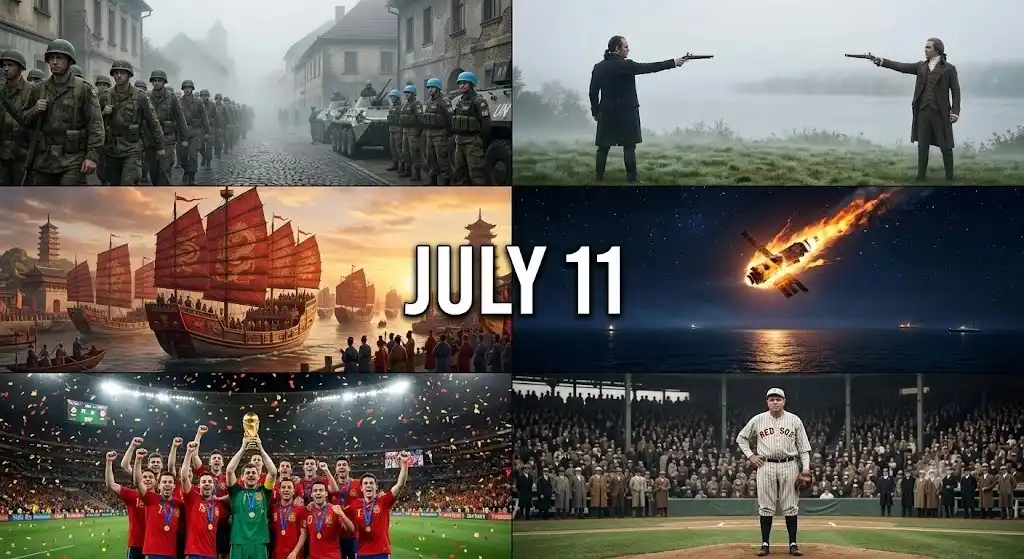
| 🏆 Top 10 Key Events | • Western Roman Emperor Anthemius is captured and killed in Rome by his own general, Ricimer (472) • A citizen militia defeats French royal cavalry at the Battle of the Golden Spurs, securing Flemish independence (1302) • Admiral Zheng He hoists his sails to embark on the historic first treasure voyage of Ming Dynasty exploration (1405) • Vice President Aaron Burr mortally wounds former Treasury Secretary Alexander Hamilton in their infamous duel (1804) • Star pitcher Babe Ruth makes his Major League Baseball debut on the mound for the Boston Red Sox (1914) • Harper Lee publishes her classic, Pulitzer Prize-winning novel To Kill a Mockingbird (1960) • Skylab, America’s first space station, burns through the atmosphere and crashes over the Indian Ocean and Australia (1979) • Bosnian Serb forces seize control of the UN safe area, initiating the horrific Srebrenica genocide (1995) • A coordinated series of pressure-cooker bomb blasts tears through Mumbai’s suburban rail network (2006) • Andrés Iniesta strikes in extra time to secure Spain’s first FIFA World Cup title in South Africa (2010) |
| 👤 Key Figures | Robert the Bruce (born 1274), President John Quincy Adams (born 1767), Alexander Hamilton (fatally wounded on this day in 1804) |
| 🌍 Observances | World Population Day, Srebrenica Genocide Remembrance Day, Day of the Flemish Community (Belgium) |
Story of the Day: The Srebrenica Massacre Begins
July 11, 1995. Bosnian Serb forces under General Ratko Mladić marched into the UN-protected “safe area” of Srebrenica. Dutch peacekeepers stood aside. Over the next eleven days, Serb soldiers separated Muslim men and boys from women, loaded them onto trucks, and drove them to execution sites. More than 8,000 were killed and dumped in mass graves. It was the worst massacre in Europe since World War II. The UN and international courts later ruled it genocide, but the world had watched and done nothing. Twenty years later, memorials still stand where fields once ran red.
Important Events That Happened On July 11 In History
472 – Western Roman Emperor Anthemius Is Killed in Rome
General Ricimer’s troops cornered Anthemius inside St. Peter’s Basilica, where the emperor had sought sanctuary. They dragged him out and beheaded him on the spot. The Western Roman Empire was crumbling fast, and this murder proved no one was safe — not even the man wearing the purple. Within four years, the empire would fall entirely.
911 – Viking Chief Rollo Signs the Treaty of Saint-Clair-sur-Epte
Charles the Simple faced a problem: Viking raiders kept sailing up French rivers, burning towns and demanding payment. So he cut a deal. Rollo, the Viking leader, would convert to Christianity, swear loyalty to the king, and defend the coast — in exchange for land. That land became Normandy, and Rollo’s descendants would conquer England in 1066. The treaty gave France peace and gave the Vikings a kingdom.
1302 – Flemish Infantry Crushes French Knights at the Battle of the Golden Spurs
French cavalry charged across the fields near Courtrai, confident they would scatter the Flemish foot soldiers. But the Flemish had chosen their ground well — ditches and streams slowed the horses, and the infantry wielded long pikes called goedendags. When the battle ended, hundreds of French knights lay dead, their golden spurs hacked off and hung in a church as trophies. The battle proved that common soldiers with good weapons could beat the finest cavalry in Europe.
1346 – Charles IV Is Elected King of the Romans
Charles of Luxembourg received the crown that would make him Holy Roman Emperor. He would rule for thirty-two years, turning Prague into a cultural capital and writing the Golden Bull that governed imperial elections for centuries. A scholar-king who spoke five languages, Charles made Bohemia the heart of Central Europe.
1405 – Admiral Zheng He Sets Sail on His First Voyage
From Nanjing’s docks, Zheng He led the largest fleet the world had ever seen — 317 ships, including massive treasure ships nine times longer than Columbus’s Santa Maria. His mission was not conquest but trade and diplomacy, carrying silk and porcelain to ports across Southeast Asia, India, and East Africa. The Ming emperor wanted the world to know China’s power, and Zheng He delivered that message for nearly thirty years.
1576 – Martin Frobisher Sights Greenland
Searching for the mythical Northwest Passage, Frobisher spotted the coast of Greenland and thought he’d found the island of Frisland. He landed, claimed it for England, and brought back what he thought was gold ore. It turned out to be worthless pyrite. But Frobisher’s voyages opened English eyes to the Arctic and sparked a century of exploration that would eventually yield the Hudson Bay trade.
1616 – Samuel de Champlain Returns to Quebec
After exploring the interior as far as Georgian Bay, Champlain returned to the settlement at Quebec to find it clinging to existence. He immediately began rebuilding and strengthening the fur trade that kept New France alive. Without Champlain’s persistence, French North America might have vanished within its first decade.
1708 – Duke of Marlborough Wins the Battle of Oudenarde
John Churchill, Duke of Marlborough, caught the French army trying to cross the Scheldt River and pounced. His skill at reading terrain and directing cavalry charges shattered the French lines. The victory kept France from marching on the Spanish Netherlands and cemented Marlborough’s reputation as one of history’s great generals.
1735 – Pluto Moves Inside Neptune’s Orbit for the Last Time
Mathematical calculations suggest that on this day, the dwarf planet Pluto moved closer to the Sun than Neptune — the last time this would happen until 1979. Pluto spent twenty years as the eighth “planet” before crossing back out. The gravitational dance between these two distant worlds still puzzles astronomers today.
1789 – Jacques Necker Is Dismissed as French Finance Minister
King Louis XVI fired his popular finance minister, and Paris exploded. Necker had championed tax reform and opposed the nobility’s privileges — his removal convinced ordinary Parisians that the king would never change. Two days later, they stormed the Bastille. The French Revolution had begun, and a minister’s firing was the spark.
1796 – The United States Takes Possession of Detroit
British troops marched out of Fort Detroit, and American soldiers marched in. The handover under the Jay Treaty gave the United States control over the Great Lakes region. Detroit, a tiny frontier outpost, would grow into an industrial powerhouse — but in 1796, it was just a fort with a few hundred people.
1798 – The United States Marine Corps Is Re-established
Congress created the Marine Corps in 1775, but disbanded it after the Revolution. Now, facing piracy in the Mediterranean, they brought it back. Two hundred years later, the Marines would still be the first boots on the ground in conflicts around the world — all because of an act signed on July 11.
1801 – Jean-Louis Pons Discovers His First Comet
From a rooftop in Marseille, Pons spotted a faint fuzzy light among the stars. It was his first comet — he would go on to find thirty-six more, more than anyone in history. A self-taught astronomer who started as a night watchman, Pons proved that passion matters more than pedigree.
1804 – Aaron Burr Mortally Wounds Alexander Hamilton in a Duel
The Vice President of the United States met the former Treasury Secretary on the dueling grounds at Weehawken. Hamilton fired first — intentionally missing, some historians believe. Burr fired second. His bullet tore through Hamilton’s liver, and the founding father died the next day. America lost its greatest financial mind, and Burr lost everything. He faced murder charges and went west, ultimately scheming to create his own empire in the Southwest.
1833 – Aboriginal Warrior Yagan Is Killed in Western Australia
Yagan had led resistance against white settlers, killing several colonists and eluding capture for months. When bounty hunters finally killed him, they cut off his head and sent it to England as a trophy. Today, Yagan is remembered as a hero of the Noongar people, and the fight to repatriate his remains lasted nearly two centuries.
1848 – Waterloo Railway Station Opens in London
London’s busiest station welcomed its first passengers on this day. Built on the site of a former tollgate, the original station was tiny compared to the glass-and-steel structure that stands today. But in 1848, it connected London to the South and West, shrinking England and changing travel forever.
1864 – Confederate Troops Attack Washington, D.C.
General Jubal Early’s soldiers marched on the Union capital, hoping to march right in. But the defenses held, and reinforcements arrived just in time. Union troops pushed Early back the next day, and the Confederate threat to Washington was over. The fight at Fort Stevens was one of the closest calls of the Civil War — Lincoln himself watched the fighting from the ramparts.
1882 – The British Fleet Bombards Alexandria
In his bedroom on the English ship HMS Alexandra, Admiral Seymour sent an ultimatum to Egyptian forces in Alexandria: surrender or face fire. The Egyptians refused. British guns pounded the city for ten hours, silencing the coastal batteries and opening Egypt to British occupation. Alexandria burned, and Egypt would not be truly independent for another seven decades.
1889 – Tijuana, Mexico, Is Founded
A handful of settlers established a ranching outpost just south of the California border. It would become a city of two million, famous for its cultural vibrancy and nightlife. But in 1889, Tijuana was just a dusty settlement where ranchers traded hides and no one predicted the millions who would eventually cross its borders.
1893 – Kōkichi Mikimoto Cultivates the First Pearl
Mikimoto inserted a bead into an oyster and waited years for the result. When he harvested a perfect pearl, he had unlocked nature’s secret. The cultured pearl industry was born, bringing jewels within reach of ordinary people. Mikimoto’s name became synonymous with pearls, and his method still produces most of the world’s pearls today.
1897 – Salomon Andrée Attempts to Reach the North Pole by Balloon
Andrée and two companions ascended from Spitsbergen in a hydrogen balloon, waving goodbye to the world. They were never seen alive again. Their bodies and diaries were discovered thirty-three years later — the balloon had crashed after only three days, and the men had died in the Arctic ice. Their courage, if not their judgment, entered exploration legend.
1914 – Babe Ruth Makes His Major League Baseball Debut
Twenty-year-old George Herman Ruth took the mound for the Boston Red Sox and pitched seven innings, allowing three runs and getting the win. Nobody that day guessed that Ruth would become the greatest baseball player who ever lived — hitting 714 home runs and forever changing the game.
1919 – The Netherlands Makes the Eight-Hour Day and Free Sunday Law
Dutch workers had long demanded shorter hours and a day of rest. After the upheaval of World War I, the government finally agreed. The law transformed Dutch society and became a model for labor rights across Europe.
1921 – A Truce in the Irish War of Independence Takes Effect
Guns fell silent across Ireland after two years of guerrilla warfare. The British and Irish Republicans agreed to stop fighting while negotiations continued. The truce paved the way for the treaty that established the Irish Free State — but it also split Ireland, leading to a civil war that cost even more lives.
1921 – William Howard Taft Is Sworn In as Chief Justice
The only man ever to lead both the executive and judicial branches took his oath as Chief Justice of the United States. Taft had always wanted the Supreme Court more than the presidency, and he served as Chief Justice for a decade, quietly shaping American law.
1922 – The Hollywood Bowl Opens
On a summer evening in Los Angeles, the first concert echoed across the hillsides. The Hollywood Bowl would become the most famous outdoor music venue in the world, hosting everyone from the Beatles to Billie Holiday. The opening night was modest — but the legend was born.
1924 – Eric Liddell Wins Gold in the 400 Metres at the Paris Olympics
Liddell refused to run the 100 metres, his best event, because the heats fell on a Sunday. But in the 400 metres, he ran the race of his life, setting a world record and winning Olympic gold. His story was later told in the film Chariots of Fire, and his faith remains an inspiration to athletes worldwide.
1940 – The Vichy France Regime Is Formally Established
Philippe Pétain, the hero of Verdun, signed the armistice that divided France. The south would be governed from the spa town of Vichy, collaborating with the Nazis. The north was under German occupation. France’s Third Republic, which had lasted seventy years, was dead.
1943 – Massacres of Poles in Volhynia and Eastern Galicia Reach Their Peak
Ukrainian Insurgent Army units attacked Polish villages with savage brutality, killing men, women, and children. The massacres continued throughout 1943, and by the end, 100,000 Poles were dead. The violence poisoned Ukrainian-Polish relations for generations, and the wounds have never fully healed.
1950 – Pakistan Joins the IMF and the World Bank
The new nation of Pakistan took its seat at the world’s financial institutions, seeking loans and investment for its struggling economy. It was a step toward international legitimacy — but economic stability would remain elusive for decades.
1957 – Aga Khan IV Becomes the 49th Imam of Ismaili Muslims
Karim Al-Hussaini inherited the office of Imamat at just twenty years old, following the death of his grandfather. As spiritual leader of fifteen million Ismailis worldwide, he would modernize the community, investing in schools, hospitals, and development projects across Africa and Asia.
1960 – Harper Lee’s To Kill a Mockingbird Is Published
The first copies of Lee’s novel hit bookstores, telling the story of Atticus Finch defending a Black man accused of rape in the Jim Crow South. The book won the Pulitzer Prize and sold over forty million copies. It remains a cornerstone of American literature, teaching generations about justice, empathy, and courage.
1962 – The First Transatlantic Satellite Television Transmission
A signal bounced off the Telstar satellite and appeared on screens in America and Europe. For the first time, people on both sides of the Atlantic watched the same images simultaneously. Television became truly global, and the world felt smaller than it ever had before.
1971 – Chile Completes the Nationalization of Its Copper Mines
President Salvador Allende signed the decree that gave Chile ownership of its copper reserves — the world’s largest. American mining companies lost billions, and the United States retaliated, cutting off credit and supporting Allende’s enemies. Three years later, the Chilean military seized power, and Allende was dead.
1979 – Skylab Crashes Back to Earth
America’s first space station burned up in the atmosphere, scattering debris across the Indian Ocean and Western Australia. Scientists had tried to control the crash, but Skylab had its own ideas. The $2.6 billion project ended with a spectacular fireball and a global sigh of relief that no one was hurt.
1991 – Nigeria Airways Flight 2120 Crashes Near Jeddah
All 261 passengers and crew died when the DC-8 caught fire shortly after takeoff. The investigation revealed a catastrophic tire failure and improper maintenance — one of many African aviation disasters that could have been prevented.
2006 – Mumbai Train Bombings Kill 209
Seven bombs exploded on Mumbai’s commuter trains within fifteen minutes, targeting packed first-class carriages during evening rush hour. Lashkar-e-Taiba and Pakistan’s ISI were implicated in the attacks. More than 600 people were wounded, and India cut off peace talks with Pakistan. The full extent of Pakistani involvement remains disputed, but the attacks marked one of the worst terror strikes in Indian history.
2010 – Spain Wins the FIFA World Cup
Andrés Iniesta’s goal in the 116th minute defeated the Netherlands 1–0, giving Spain its first World Cup title. The team that had been labelled “chokers” finally delivered, and millions celebrated across Spain. It was the culmination of a golden generation that had dominated European football for years.
2015 – Joaquín “El Chapo” Guzmán Escapes from Maximum Security Prison
The world’s most wanted drug lord walked out of Altiplano prison through a mile-long tunnel dug directly under his cell. He had even used a motorcycle on rails to travel the distance. El Chapo remained free for six months before being recaptured — and his escape embarrassed the Mexican government.
Revisit the important lessons from yesterday’s history post.
Famous People Born on July 11
| Name | Description | Dates |
|---|---|---|
| Robert the Bruce | King of Scotland and national hero | 1274 – 1329 |
| John Quincy Adams | 6th President of the United States | 1767 – 1848 |
| James Abbott McNeill Whistler | American-born painter and illustrator | 1834 – 1903 |
| E. B. White | American author of Charlotte’s Web and Stuart Little | 1899 – 1985 |
| Samuel Goudsmit | Physicist who co-discovered electron spin | 1902 – 1978 |
| Alexander Prokhorov | Nobel Prize-winning physicist | 1916 – 2002 |
| Gough Whitlam | 21st Prime Minister of Australia | 1916 – 2014 |
| Yul Brynner | Academy Award-winning actor | 1920 – 1985 |
| Richard Pipes | Influential historian of Russia | 1923 – 2018 |
| Theodore Maiman | Physicist who built the first laser | 1927 – 2007 |
| Frank Rosenblatt | AI pioneer and creator of the Perceptron | 1928 – 1971 |
| Harold Bloom | Influential literary critic | 1930 – 2019 |
| Giorgio Armani | Italian fashion designer and founder of Armani | 1934 – 2025 |
| Howard Gardner | Psychologist known for Multiple Intelligences theory | 1943 – Present |
| Pervez Hoodbhoy | Pakistani physicist and science educator | 1950 – Present |
| Stephen Lang | American film and stage actor | 1952 – Present |
| Leon Spinks | Olympic and heavyweight boxing champion | 1953 – 2021 |
| Amitav Ghosh | Indian novelist and essayist | 1956 – Present |
| Sela Ward | Emmy Award-winning actress | 1956 – Present |
| Hugo Sánchez | Mexican football legend and manager | 1958 – Present |
| Richie Sambora | Guitarist of Bon Jovi | 1959 – Present |
| Suzanne Vega | American singer-songwriter | 1959 – Present |
| Lisa Rinna | Actress and television personality | 1963 – Present |
| Jhumpa Lahiri | Pulitzer Prize-winning author | 1967 – Present |
| Justin Chambers | American actor (Grey’s Anatomy) | 1970 – Present |
| Lil’ Kim | American rapper and songwriter | 1974 – Present |
| Caroline Wozniacki | Danish Grand Slam tennis champion | 1990 – Present |
| Mohamed Elneny | Egyptian international footballer | 1992 – Present |
| Alessia Cara | Grammy Award-winning Canadian singer | 1996 – Present |
| Amad Diallo | Ivorian professional footballer | 2002 – Present |
Famous People Who Died on July 11
| Name | Description | Dates |
|---|---|---|
| Olga of Kiev | Regent of Kievan Rus and Christian saint | 890 – 969 |
| Giuseppe Arcimboldo | Italian Renaissance painter | 1527 – 1593 |
| Muhammad Abduh | Egyptian Islamic reformer and scholar | 1849 – 1905 |
| Simon Newcomb | Astronomer and mathematician | 1835 – 1909 |
| George Gershwin | Legendary American composer | 1898 – 1937 |
| John W. Campbell | Influential science fiction editor and author | 1910 – 1971 |
| Pedro Rodríguez | Mexican Formula One racing driver | 1940 – 1971 |
| Pär Lagerkvist | Nobel Prize-winning Swedish author | 1891 – 1974 |
| Ross Macdonald | Acclaimed crime novelist | 1915 – 1983 |
| Laurence Olivier | Legendary English actor and director | 1907 – 1989 |
| Gary Kildall | Computer scientist; founder of Digital Research | 1942 – 1994 |
| Robert Runcie | Archbishop of Canterbury | 1921 – 2000 |
| Herman Brood | Dutch musician and painter | 1946 – 2001 |
| Zahra Kazemi | Iranian-Canadian photojournalist | 1948 – 2003 |
| Laurance Rockefeller | American businessman and philanthropist | 1910 – 2004 |
| Frances Langford | American actress and singer | 1913 – 2005 |
| John Spencer | Two-time World Snooker Champion | 1935 – 2006 |
| Lady Bird Johnson | Former First Lady of the United States | 1912 – 2007 |
| Michael E. DeBakey | Pioneer heart surgeon | 1908 – 2008 |
| Arturo Gatti | World champion boxer | 1972 – 2009 |
| Charlie Haden | Influential jazz bassist | 1937 – 2014 |
| Tommy Ramone | Drummer and founding member of the Ramones | 1949 – 2014 |
| John Seigenthaler | American journalist | 1927 – 2014 |
| Satoru Iwata | President of Nintendo | 1959 – 2015 |
| Charlie Robinson | American actor | 1945 – 2021 |
| Renée Simonot | French actress | 1911 – 2021 |
| Milan Kundera | Czech-French novelist | 1929 – 2023 |
| Shelley Duvall | American actress | 1949 – 2024 |
| Monte Kiffin | American football coach | 1940 – 2024 |
| Stanley Tshabalala | South African football player and coach | 1949 – 2024 |
Observances on July 11
World Population Day — Established by the UN in 1989, this observance raises awareness about global population issues. It marks the day the world’s population hit five billion in 1987. Today, we’re past eight billion, and the challenges of sustainability and equity grow more urgent each year.
International Day of Reflection and Commemoration of the 1995 Genocide in Srebrenica — The UN established this day in May 2024 to honor the victims of Europe’s worst massacre since World War II. It calls for education and remembrance, ensuring that the 8,000 Muslim men and boys who died are never forgotten.
Day of the Flemish Community — Belgium’s Flemish region celebrates the victory at the Battle of the Golden Spurs (1302), where Flemish citizens defeated French knights. It’s a day of cultural pride and remembrance, with parades and festivals across Flanders.
Eleventh Night — Northern Ireland’s Protestant communities build bonfires on this night, the eve of the Twelfth of July celebrations marking the Battle of the Boyne (1690). It’s a deeply controversial tradition, often linked to sectarian tensions that still simmer.
Gospel Day — Kiribati celebrates the arrival of Christianity, with church services and community gatherings. It’s a public holiday in the Pacific island nation.
🦅 Frequently Asked Questions — July 11 in History
Vice President Aaron Burr shot Alexander Hamilton in a duel at Weehawken, New Jersey. Hamilton died the next day from his wounds. The duel ended Hamilton’s life and destroyed Burr’s political career, leaving both men with tragic legacies.
The Srebrenica massacre in 1995 is widely considered the most significant event. Bosnian Serb forces killed more than 8,000 Muslim men and boys in and around the UN-designated “safe area” of Srebrenica, creating Europe’s worst atrocity since the Holocaust.
Robert the Bruce, King of Scotland and national hero, was born on July 11, 1274. Alexander Prokhorov, a Nobel Prize-winning physicist, was born on this day. Other notable births include John Quincy Adams (1767), the sixth US president.
The Battle of the Golden Spurs (1302) saw Flemish forces defeat the French king’s royal army. Confederate General Jubal Early attacked Washington, D.C., on July 11, 1864. The Battle of Oudenarde (1708) was another major military engagement on this date.
July 11 marks the International Day of Reflection and Commemoration of the 1995 Genocide in Srebrenica. It honors the more than 8,000 Bosniak Muslim men and boys murdered by Bosnian Serb forces. The UN established this observance in 2024 to ensure the world never forgets the atrocity.
Recent events include Joaquín “El Chapo” Guzmán’s escape from Mexican prison in 2015, Spain winning the 2010 FIFA World Cup, and Richard Branson’s Virgin Galactic flight to space in 2021.