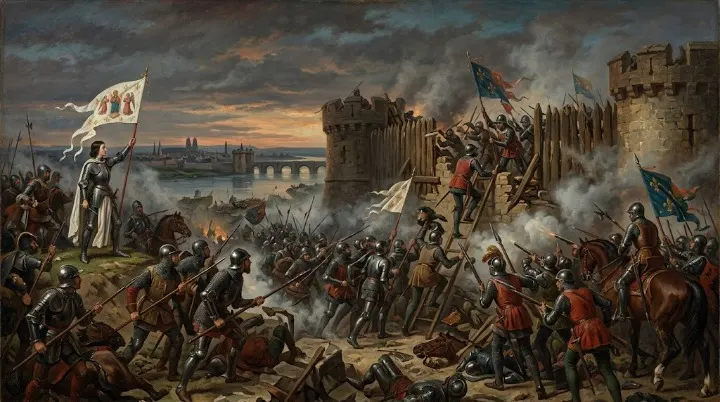
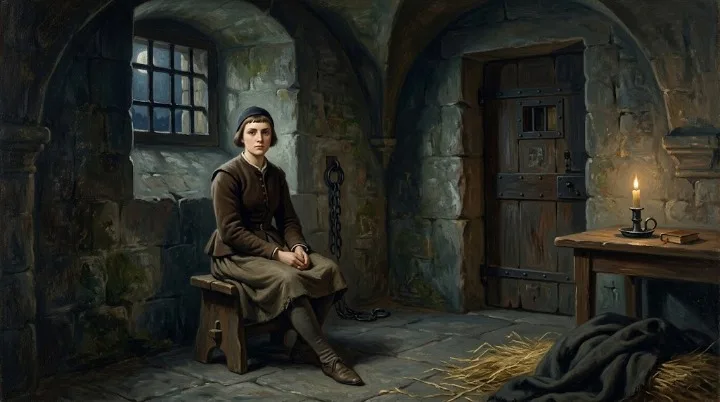
She rode into battle in armor. She slept among soldiers. She sat alone in a stone cell surrounded by English guards who wanted her dead. And through all of it, Joan of Arc kept wearing a doublet, hose, and boots laced tight enough that a man couldn’t tear them off her in the dark.
That single wardrobe choice is the reason she burned.
Not witchcraft. Not treason. Not even, technically, heresy in the way most people imagine it. When the court at Rouen finally ran out of ways to convict a 19-year-old peasant girl who’d out-generaled the English army, they reached for something almost absurdly specific: a line in the Book of Deuteronomy that forbids men and women from wearing each other’s clothes. Joan had been wearing male dress since she left home to save France. Her judges — led by a bishop with every reason to want her gone — decided that was enough.
She wore men’s clothing for reasons that had nothing to do with defiance and everything to do with survival: it let her fight, ride, and command soldiers as one of them, and later, in prison, it was the closest thing she had to a lock on her own body. Her judges knew all of that. They charged her anyway, because the clothing charge was the one accusation that didn’t require proving she was a witch — just that she’d broken a rule, un-broken it once under pressure, and then broken it again.
That second part — the “again” — is what actually killed her. Here’s how it happened.
⚖️ Quick Facts — The Trial and Condemnation of Joan of Arc
| 📌 Category | 📖 Event / Detail |
|---|---|
| 📅 Trial Began | January 9, 1431, in the pro-English stronghold of Rouen, France |
| 👤 Presiding Judge | Bishop Pierre Cauchon of Beauvais, a staunch ally of the English faction |
| 📜 Formal Charges | Reduced from 70 initial articles down to 12 core indictments, primarily targeting her claimed divine visions, her refusal to submit to Church authority, and her practice of wearing men’s clothing |
| 📝 Abjuration (Recantation) | May 24, 1431 — Under threat of immediate execution, she signs an abjuration document at the cemetery of Saint-Ouen |
| 🔄 Cross-Dressing Resumed | Discovered around May 28, 1431 (three or four days after her recantation), sealing her legal fate |
| ⚡ Legal Turning Point | May 29, 1431 — Formally declared a “relapsed heretic” by the ecclesiastical court, forfeiting her safety |
| 🔥 Execution | May 30, 1431 — Burned at the stake at the Vieux-Marché (Old Marketplace) in Rouen at approximately 19 years of age |
| 📜 Verdict Overturned | 1456 — A papal nullification trial formally voids the original biased proceedings and declares her innocent |
| 🌟 Canonization | May 16, 1920 — Officially declared a saint of the Roman Catholic Church by Pope Benedict XV |
The Practical Reasons
Start with the obvious: Joan of Arc spent two years living the life of a soldier, not a noblewoman. She rode for days at a stretch, wore plate armor over her clothes, and slept in camps surrounded by men-at-arms. A woman’s gown of the period — long, loose, layered — wasn’t just impractical for that life. It was dangerous. You cannot swing onto a warhorse or move fast in a skirmish wearing something designed to trail on the ground.
Male dress solved that instantly. Hose, doublet, and boots let her move, ride, and fight the way the men around her did. It also did something subtler: it folded her into the army as one of its own, rather than marking her out as the one woman among thousands of soldiers.
Then came the part of her life that made the clothing matter even more — her imprisonment. After her capture at Compiègne in 1430, Joan wasn’t held in a Church prison with nuns as guards, which was standard for a woman facing an ecclesiastical trial. She was kept in a secular English fortress, watched day and night by common soldiers. Later testimony, gathered during the retrial two decades on, described a set of tightly laced hose fastened to a doublet with roughly twenty ties — clothing that had to be deliberately, laboriously removed. That wasn’t fashion. It was a barrier.
By her own account, she kept wearing it in prison specifically because of the men guarding her. It made assault harder to carry out quickly and quietly, and in a cell with no locked door and no female attendants, that mattered more than any theological technicality.
The Legal Trap
Here’s where the story turns from practical necessity into a courtroom weapon.
Joan’s judges, led by Bishop Pierre Cauchon — a Frenchman allied with the English cause, appointed specifically to try her — spent months building a case. They started with seventy articles of accusation covering her visions, her claim to hear the voices of saints, her refusal to submit fully to Church authority, and her clothing. Most of those charges were theologically slippery. Proving someone’s visions were demonic rather than divine is difficult, especially when the accused answers every question with the same calm, consistent testimony a peasant girl was never supposed to be capable of.
The clothing charge was different. It was concrete. Canon law, drawing on Deuteronomy 22:5, prohibited cross-dressing as a moral and religious violation. Joan had been doing it openly, for years, in front of witnesses. There was no ambiguity to argue over — she wore it, or she didn’t.
That made it the perfect mechanism for a conviction the court needed but couldn’t easily get any other way. On May 24, facing an immediate threat of execution, Joan agreed to recant: she signed (or made her mark on) an abjuration, renouncing her visions and agreeing to stop wearing men’s clothing. In exchange, her sentence was commuted to life imprisonment.
But under the rules of a heresy trial, a first offense followed by recantation was survivable. A relapse was not. Canon law held that only someone who had once abjured their errors and then returned to them could be handed over for death. Cauchon’s court didn’t need to relitigate the theology of her visions. They just needed her back in men’s clothes.
What Actually Happened at the Recantation
Three or four days after her abjuration, Joan was found dressed in men’s clothing again.
The trial record and later testimony don’t agree on exactly how that happened, and that disagreement matters. According to accounts gathered at the 1456 nullification trial, Joan’s female clothing was taken from her cell — some witnesses said her guards left her nothing else to wear and that she resumed male dress because it was the only option available, and because it offered the same protection from assault that had motivated her before. Joan herself reportedly said she hadn’t fully understood that her promise extended to giving up the clothing for good, and that male dress was simply more practical for the life she was living among male guards.
When Cauchon was told, he moved fast. Joan was questioned, and in that questioning she also said something that mattered more than the clothes themselves: that her voices had returned, and that she regretted her earlier abjuration, which she said she’d only agreed to out of fear of the flames. That combination — the clothing and the retraction of her recantation — was enough. On May 29, a tribunal of judges and assessors declared her a relapsed heretic. The next morning, she was handed to the secular authorities and burned at the stake in Rouen’s Old Marketplace.
Historians’ Debate
Why did Joan put men’s clothing back on, knowing exactly what it would cost her? Historians don’t agree, and it’s worth holding their different readings side by side rather than picking a winner.
One view treats it as entrapment, pure and simple: her guards, whether acting on orders or their own initiative, removed her female clothing and left her with nothing but the men’s garments she’d worn before — engineering the very “relapse” the court needed. Under this reading, Joan didn’t choose defiance; she was maneuvered into it.
A second view leans on the practical explanation she gave in her own testimony — that the clothing protected her from the men guarding her, and that going back to it was less a statement than a matter of physical safety once she was again housed among soldiers.
A third view reads it as something closer to deliberate conviction. Joan told her judges her voices had returned and that she regretted recanting under threat of death. On this reading, resuming the clothing wasn’t incidental to that decision — it was part of taking back a truth she felt she’d betrayed under duress, whatever the cost.
None of these readings requires rejecting the others outright, and serious historians have argued for each. What the trial record actually shows is narrower than any of them: Joan wore men’s clothing, was found wearing it again after promising not to, and told the court her voices had come back. The court decided that combination made her a relapsed heretic. Everything about her internal reasoning beyond that is reconstruction — informed, careful reconstruction, but reconstruction all the same.
⚖️ Frequently Asked Questions — Joan of Arc’s Trial and Clothing Charges
Under canon law, yes — cross-dressing was treated as a moral violation, rooted in a prohibition in Deuteronomy 22:5. It wasn’t usually a capital matter on its own. What made it dangerous for Joan was the specific legal category of “relapse”: having recanted once, resuming the banned behavior classified her as someone who had returned to heresy, which under Inquisitorial procedure could be punished by death.
There’s no evidence for that in the trial record. Joan referred to herself as “the Maid” throughout her life and testimony, and her own explanations for wearing men’s clothing were practical and situational — safety while campaigning with soldiers, protection while imprisoned among male guards. Reading a modern gender identity onto her isn’t supported by what she actually said; her stated reasoning was about circumstance, not identity.
Within a day or two of guards finding her back in male dress, Cauchon and his fellow judges questioned her, concluded she had also renounced her earlier abjuration by saying her voices had returned, and declared her a relapsed heretic on May 29, 1431. She was handed over to secular authorities the next day and burned at the stake in Rouen.
Even judged against 15th-century procedure, no — and a second Church tribunal agreed. In 1456, a papal nullification trial reviewed the case and found the original proceedings biased and procedurally flawed, overturning the verdict entirely. Joan was later canonized in 1920. The clothing charge, in particular, has long been viewed by historians as a legal shortcut used to secure a death sentence the court couldn’t otherwise justify.
Sources & Further Reading
- Trial of Joan of Arc — Britannica
- St. Joan of Arc — Britannica biography
- Trial of Joan of Arc — Wikipedia, with primary source citations
- The Trial of Joan of Arc: An Account — Famous Trials (UMKC)
- Medieval Sourcebook: The Trial of Joan of Arc, 1431 — Fordham University
- Why Was Cross-Dressing the Only Crime Joan of Arc Was Charged With? — HowStuffWorks
- The Trials of Joan of Arc — History Today