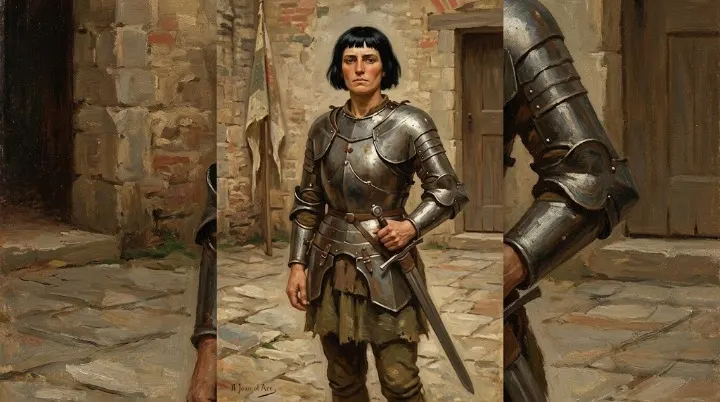
Joan of Arc was likely around 5’2″ (1.58 meters) tall, with short black hair, dark eyes, sun-darkened skin, and a stocky, muscular build from farm work and years on horseback. No authentic portrait of her survives, and much of her popular image — tall, fair, elegantly beautiful — comes from centuries of romanticized art rather than the historical record.
(For the full story of her life, trial, and death, see our complete Joan of Arc biography.)
🛡️ Quick Facts — Physical Appearance of Joan of Arc
| 📌 Attribute | 📖 Historical Description / Detail |
|---|---|
| 📏 Estimated Height | Approximately 5’2″ (1.58m)—extrapolated by historians from a 1429 clothing order rather than taken from a direct physical measurement |
| 💇♀️ Hair | Short, dark black, and cropped closely to mirror the standard practical men’s fashion of the era | 👁️ Eyes | Described vividly by her contemporaries as “large, dark, and remarkably grave” |
| 💪 Build | Stocky and muscularly built, frequently commended by soldiers for her unusual physical stamina and field endurance |
| 🩸 Distinguishing Mark | A small, distinctive red birthmark situated just behind one of her ears |
| 🎨 Authentic Portraits | None survive to modern times; the sole contemporary visual record is a small sketch drawn in the margin of a trial ledger by a courtroom clerk |
The Only Physical Description We Have
Here’s something that surprises a lot of people: we have no painted portrait of Joan of Arc made from life. Everything we know about how she actually looked comes from words — letters, trial testimony, and secondhand accounts from people who met her.
One of the fuller descriptions comes from Perceval de Boulainvilliers, chamberlain to Charles VII, who wrote to the King describing a young woman “of satisfying grace,” with “something virile in her bearing,” who spoke little but showed remarkable prudence when she did. He noted she ate sparingly, drank little wine, handled horses and weapons with obvious skill, and could stay fully armored for six days and nights without removing so much as a piece — an endurance detail that shows up again and again in independent accounts, suggesting it wasn’t exaggeration but something people genuinely found remarkable at the time.
Witnesses consistently agreed on a few physical details: short black hair, cut in a style close to the fashionable bob young men wore; dark, wide-set eyes; sun-darkened, weathered skin from months spent outdoors on campaign; and a small red birthmark behind one ear that multiple people who knew her personally mentioned independently. That last detail matters more than it might seem — when unconnected witnesses describe the same obscure physical trait, it’s a strong sign they’re describing a real memory, not repeating a legend.
How Historians Estimated Her Height
The 5’2″ figure you’ll see everywhere doesn’t come from any direct measurement — nobody in the 15th century recorded Joan’s height the way we would today. Instead, it comes from a clever piece of detective work.
In 1929, French scholar Adrien Harmand tracked down a genuine order for clothing made for Joan by the Duke of Orléans, given as a gift after she lifted the siege of his city in 1429. The order specified a robe of fine Brussels cloth measuring roughly 80 centimeters — and since men’s robes of that style ran from shoulder to knee, Harmand worked backward from that measurement to estimate her height at around 1.58 meters, or 5’2″.
It’s a reasonable estimate, but worth treating with a little caution: cloth was sold in whole units back then, so the amount ordered was likely rounded up rather than cut to an exact fit, meaning 5’2″ is closer to an upper bound than a precise number. What we can say with more confidence is that contemporaries consistently described her as short by the standards of the time — which, for a 15th-century peasant woman, would still have put her close to average height for her era, not unusually small.
The Myths: How Popular Art Got Her Wrong
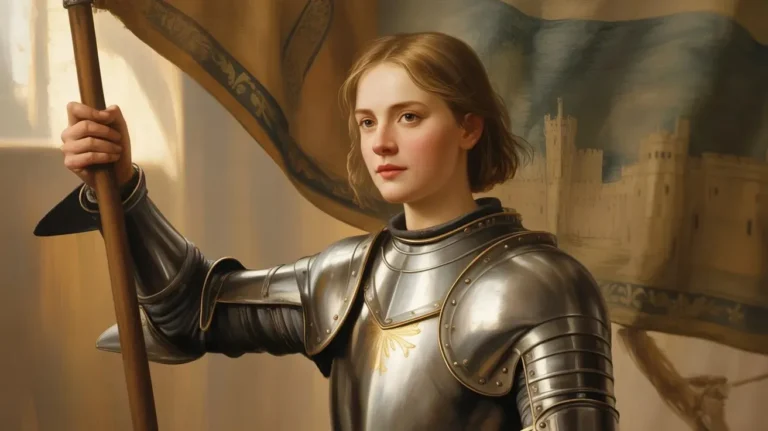
Walk through almost any gallery’s Joan of Arc paintings, and you’ll see a familiar type: tall, fair-skinned, often blonde or light brown-haired, conventionally beautiful in a way that reads as a 19th-century romantic ideal rather than a 15th-century peasant soldier. It’s a compelling image. It’s also almost entirely invented.
🎭 Myth vs. Reality: Appearance of Joan of Arc
| 🔍 Feature | ❌ Popular Myth | ✅ Historical Record |
|---|---|---|
| Hairstyle | Long, flowing hair cascading down her armor | Short black hair, cropped intentionally like a young man’s for practicality and protection |
| Complexion | Fair, delicate, and porcelain complexion | Sun-darkened, weathered, and hardened skin from constant outdoor military campaigning |
| Physique | Tall, willowy, and ethereal frame | Short and stocky (~5’2″), notably muscular and strong from years of physical farm labor |
| Facial Features | Conventionally elegant, radiant, and classical beauty | Described by contemporaries as “reasonably good-looking” but remarkably plain by courtly standards |
| Artistic Record | Famous paintings and portraits done from life | No authentic portrait exists at all; the only surviving sketch is a courtroom clerk’s brief margin doodle |
None of this is really art history’s fault — painters working centuries later simply had nothing to work from except written descriptions and their own era’s ideas of what a heroine should look like. But it does mean the version of Joan of Arc most people picture is largely a 19th- and 20th-century invention layered over a very different-looking 15th-century original.
Why No Authentic Portrait Exists
The single genuine contemporary image of Joan of Arc isn’t a portrait at all. It’s a small sketch drawn in the margin of French parliamentary notes by a clerk named Clément de Fauquembergue in 1429 — and he never actually saw her in person. It’s a doodle based on reputation, not observation.
There’s also a stone statue head from a church in Orléans, long associated with Joan by local tradition — the story goes that a sculptor modeled a statue of Saint Maurice on her likeness after she entered the city in triumph. It’s a nice story, but there’s no solid evidence connecting the sculpture to her specifically, and most historians now treat it as folklore rather than a genuine likeness.
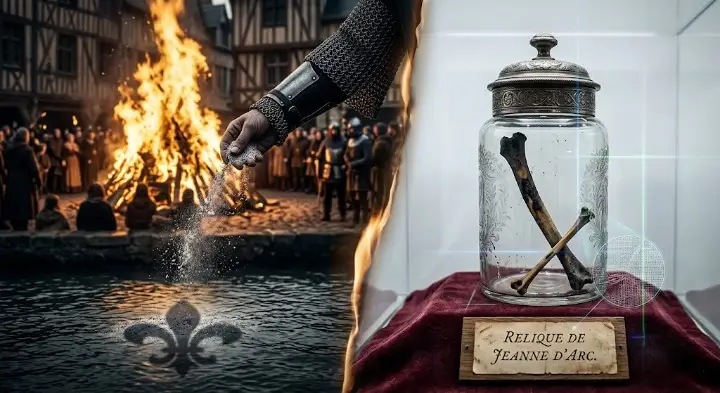
Every other image — the paintings, the statues, the illustrations in later manuscripts — was created after her death, sometimes generations after, by artists working purely from written accounts and imagination. It’s a fitting pattern, in a way: the same absence of hard physical evidence that shapes what we know about her face also shapes what happened to her physical remains after her execution — a mystery that took nearly six centuries, and a team of forensic scientists, to fully resolve.
👤 Frequently Asked Questions — Joan of Arc’s Physical Appearance
Historians estimate around 5’2″ (1.58m), based on a 1429 clothing order rather than a direct measurement, so it should be treated as an approximate upper bound rather than an exact figure.
Black, worn short in a style similar to men’s fashion of the period.
No. The only contemporary image is a margin sketch by a clerk who never met her. Every painting or statue commonly associated with her was made after her death.
Contemporary accounts describe her as “reasonably good-looking” but not conventionally pretty — sturdy, sun-darkened, and physically strong rather than delicate.