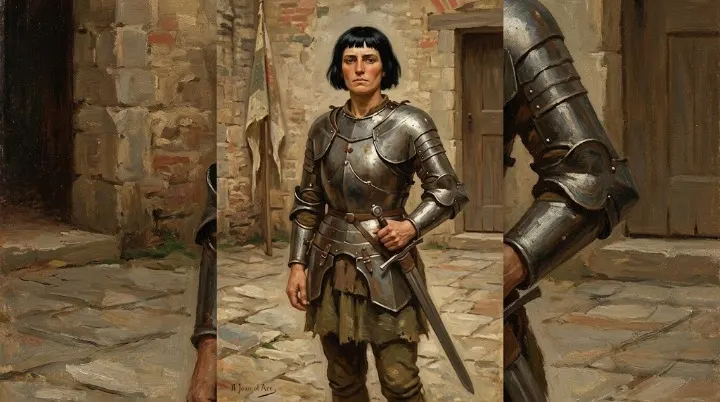
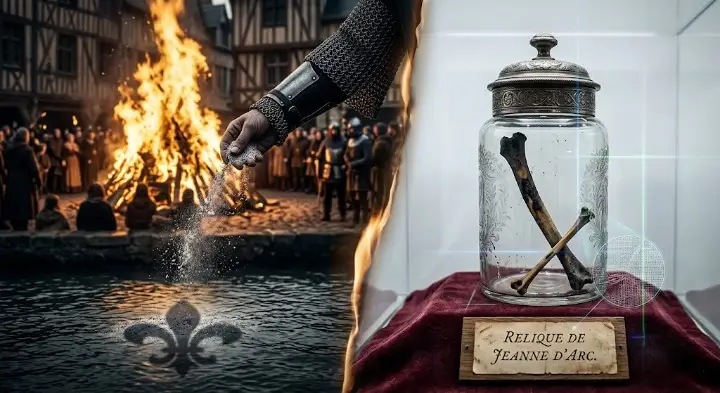
No genuine physical remains of Joan of Arc exist. Her body was deliberately burned three times and her ashes thrown into the Seine River in 1431, specifically to prevent her from becoming a martyr with relics to venerate. Despite that, a supposed relic surfaced in the 19th century, was venerated for over a hundred years, and was only proven fake by forensic scientists in 2007 — who found it was actually made from an embalmed Egyptian mummy.
🧪 Quick Facts — The Remains of Joan of Arc
| 📌 Category | 📖 Event / Detail |
|---|---|
| 🔥 Execution | May 30, 1431, at the Vieux-Marché square in Rouen, France |
| 🌊 Disposal of Remains | Her body was burned completely three consecutive times to prevent any bone gathering; her ashes were then scattered into the Seine River |
| 🏺 Alleged Relic Surfaced | A jar labeled as remnants of Joan of Arc was discovered in a Paris pharmacy attic in 1867, later transferred to a museum at the Archdiocese of Tours in Chinon |
| 📜 Declared “Genuine” | 1909 — The Roman Catholic Church declared the relic “probable” as genuine during the exact year of her beatification |
| 🔬 Debunked | 2007 — A highly detailed forensic and biochemical study led by French medical examiner Philippe Charlier exposed the relic as a hoax |
| 📦 Actual Contents | The remains consisted of a charred human rib and a cat femur, wrapped in linens chemically identical to Egyptian mummification materials and carbon-dated between the 7th and 3rd century BC |
Why There Are No Real Remains
When the English burned Joan of Arc at the stake in Rouen’s market square, they didn’t stop once. Accounts from the time describe her body being burned a second and third time, and her remaining ashes gathered up and thrown into the Seine. That wasn’t incidental cruelty. It was a deliberate strategy.
The English understood exactly what they were dealing with. If Joan’s body, or any part of it, survived the fire, it could become a relic — something French sympathizers could venerate, rally around, and use to keep her cause alive after her death. Denying her any physical remains was meant to deny her a legacy. It’s a strange kind of compliment, if you think about it: an enemy so worried about a 19-year-old’s afterlife that they burned her body three times just to be sure nothing was left.
For over four centuries, that was simply the end of the story. No remains, no relics, nothing left to find.
The Relic That Fooled People for a Century
Then, in 1867, something turned up in the attic of a Paris pharmacy: a small glass jar containing a blackened rib bone, a fragment of what looked like scorched cloth, and a cat’s leg bone. A label claimed they’d been recovered from the site of Joan of Arc’s execution.
The story people told themselves about the cat bone made a certain grim sense at the time — medieval executioners sometimes threw a black cat onto the pyre of someone convicted of witchcraft or heresy, since cats were associated with the devil. A charred cat bone next to charred human bone fit the folklore neatly.
The relic was handed over to the Archdiocese of Tours, which oversees the basilica at Domrémy, Joan’s birthplace, and it was displayed at a museum in Chinon. In 1909, the same year Joan was beatified by the Catholic Church, a group of scientists examined the relic and pronounced it “highly probable” that it was genuinely hers. For the better part of a century after that, it sat in its jar, treated as one of the few tangible connections to a saint who otherwise left almost nothing behind.
The 2007 Investigation That Changed Everything
In 2005 and 2006, a team of about twenty researchers — forensic scientists, a radiologist, a zoologist, a geneticist, an archaeologist, and, at one point, professional perfumers brought in to analyze the smell of the coating on the bones — took another look, led by forensic scientist Philippe Charlier.
What they found upended a hundred years of assumption. Carbon dating placed the rib bone and the cat bone between the 7th and 3rd centuries BC — more than a thousand years before Joan of Arc was even born. Chemical analysis of the black coating on the bones matched the resins used in ancient Egyptian embalming, not anything consistent with a body burned at a medieval execution. Pine pollen, likely from embalming resin, turned up in the samples. The team couldn’t extract usable DNA — the same embalming chemicals that helped date the bones had also destroyed the genetic material — so they couldn’t even confirm whether the mummy remains were male or female.
The conclusion was unavoidable: the “relic” wasn’t the remains of Joan of Arc at all. It was mummified material, most likely from an Egyptian mummy, that had somehow ended up repackaged as a relic thirteen centuries after the fact.
Why Would Someone Fake It?
Charlier’s team’s best guess points to the 19th century, and specifically to an apothecary. In that period, it wasn’t unheard of for pharmacists and collectors to acquire and sell fragments of Egyptian mummies — mummy parts had a strange vogue as curiosities and even, bizarrely, as ingredients in some medicines. The theory is that someone took genuine ancient Egyptian remains, already sitting in a pharmacy’s collection, and relabeled them as relics of Joan of Arc.
The timing is suggestive. Interest in Joan’s canonization was building through the second half of the 19th century, culminating in her beatification in 1909. A relic — any relic — would have been a valuable thing to produce right as the push for her sainthood gained momentum. Whether the person responsible believed they were helping a righteous cause or simply saw an opportunity is something no one can say for certain. What’s clear is that for a hundred years, it worked.
🧪 Frequently Asked Questions — The Alleged Relics of Joan of Arc
No. Her body was burned three times and her ashes thrown into the Seine River in 1431 specifically to prevent any physical remains from becoming relics.
A human rib bone and a cat’s leg bone, both dating from the 7th to 3rd century BC and bearing chemical traces consistent with ancient Egyptian embalming — not medieval execution.
In 2007, following forensic testing led by scientist Philippe Charlier and a team of about twenty researchers.
At a museum in Chinon, France, under the oversight of the Archdiocese of Tours.
Sources & Further Reading
“Remains not those of Joan of Arc, scientists say” — CBC News:
“Joan of Arc ‘relics’ confirmed to be fake” — NBC News: