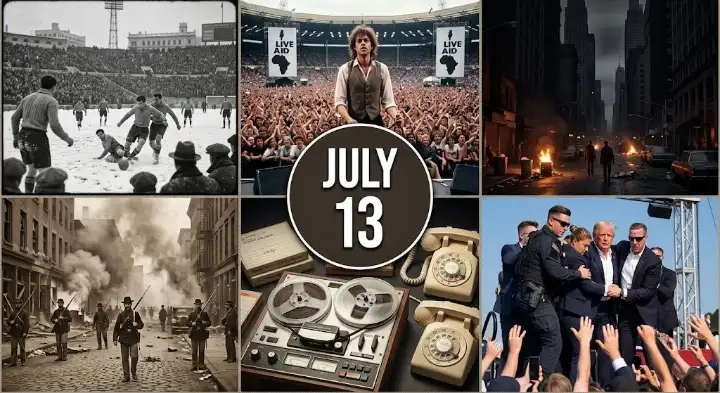
Heavy winter snow fell across South America as twenty-two men chased a leather ball on a freshly laid patch of grass. Nobody in the makeshift stadium realized they were standing at the birthplace of global sports culture. On this day in history July 13, 1930, the inaugural FIFA World Cup kicked off simultaneously in Montevideo, Uruguay, transforming a casual experiment into a multi-billion dollar obsession. History isn’t just a record of years; it is a collection of moments where the world shifted forever under our feet.
📅 Quick Facts — July 13 in History
| 📌 Category | 📖 Event / Detail |
|---|---|
| 🌟 Most Significant Event | The inaugural FIFA World Cup officially kicks off in Uruguay, opening a new era for global sports (1930) |
| 🏆 Top 10 Key Events | • King William I of Scotland is captured at Alnwick by a small force loyal to King Henry II of England (1174) • The Continental Congress passes the landmark Northwest Ordinance, establishing government rules for the new territory and banning slavery within it (1787) • King Victor Emmanuel I establishes the Carabinieri, serving as the premier gendarmerie and military police force of Italy (1814) • Outraged by wartime military conscription, violent anti-draft riots explode across New York City (1863) • Former White House aide Alexander Butterfield stuns investigators by revealing the existence of Richard Nixon’s secret Watergate taping system (1973) • A lightning strike triggers a massive, 25-hour blackout across New York City, leading to widespread looting and arson (1977) • The historic dual-venue Live Aid benefit concerts rock London and Philadelphia, raising millions for famine relief (1985) • A massive earthquake triggers a catastrophic avalanche on Lenin Peak (now in Tajikistan), killing 43 climbers in the worst mountaineering disaster in history (1990) • Following the Brexit referendum, David Cameron officially steps down, clearing the path for Theresa May to become UK Prime Minister (2016) • Donald Trump survives an assassination attempt after being shot and wounded in the right ear during a campaign rally in Pennsylvania (2024) |
| ⚔️ Key Battles | Battle of Alnwick (1174), Battle of Durbe (1260), Battle of Gravelines (1558), Battle of Roundway Down (1643), Battle of Shubra Khit (1798), Battle of Guaymas (1854), Battle of Wanat (2008) |
| 👤 Key Figures | Queen Eleanor of England, Bob Geldof (Live Aid organizer), Alexander Butterfield (Watergate whistleblower), Theresa May |
| 🌍 Observances | Kashmir Martyrs’ Day, Feast of Kalimát (Bahá’í Faith), Statehood Day (Montenegro), Naadam Festival Closing Ceremonies (Mongolia) |
Story of the Day: The Day the Music Fed the World
Seventy-two thousand fans packed into London’s Wembley Stadium while another ninety thousand crowded into Philadelphia’s JFK Stadium, all united by a single, desperate cause. Organizers scrambled to link global broadcast satellites to ensure nearly two billion people across 150 nations could watch the same stage simultaneously. Heavy metal bands, pop icons, and folk legends took turns at the microphones for sixteen straight hours, raising over 100 million dollars for Ethiopian famine relief. The sheer scale of the event proved that rock music could act as a global shield against human tragedy.
Important Events That Happened On July 13 In History
1174 – King William I Captured
English soldiers hidden by thick North Sea fog crept toward the walls of Alnwick Castle to surprise the invading Scottish army. King William I charged into the fray with just sixty horsemen, expecting an easy victory over the scouts. Horse and rider crashed to the mud in seconds, and the captured Scottish monarch was bound to a horse and taken south in chains. English authorities forced William to sign a humiliating treaty recognizing King Henry II as his absolute feudal superior.
1249 – Coronation of Alexander III
Seven-year-old Alexander III sat upon the sacred Stone of Scone while Scottish nobles draped a rich red dress over his small shoulders. Fears of an English invasion or internal dynamic coups hung heavy over the ancient abbey. A traditional Gaelic bard stepped from the crowd, reciting the boy’s entire royal lineage all the way back to the mythical first kings. Young Alexander took the crown, initiating a golden era of peace and stability that would last for nearly four decades.
1260 – The Battle of Durbe
Teutonic knights clad in heavy iron armor advanced across the marshy terrain of modern-day Latvia to crush the pagan tribes. Lithuanian forces feigned a retreat, drawing the overconfident crusaders deep into treacherous, muddy ground. Local conscripts serving under the knights suddenly turned their weapons on their masters, transforming the battlefield into an utter slaughterhouse. Grand Master Horn and 150 elite brothers died in the mud, handing the Livonian Order its worst military defeat of the century.
1402 – The Fall of Nanjing
Rebel soldiers loyal to the ambitious Prince Zhu Di breached the massive brick walls of Nanjing without facing a single defensive volley. Smoke poured from the imperial palace as regular citizens realized the internal Jingnan campaign was officially over. The young Jianwen Emperor vanished into the ash, sparking centuries of rumors that he escaped by donning the robes of a monk. The victorious prince climbed the throne as the Yongle Emperor, moving the capital to Beijing and building the Forbidden City.
1558 – The Battle of Gravelines
Spanish forces led by Count Lamoral of Egmont trapped a retreating French army against the sandy shores of the English Channel. English warships anchored just offshore opened fire, raining devastating artillery broadsides directly into the exposed French ranks. Panic rippled through the French infantry as Spanish cavalry charged down the dunes to finish the rout. The severe beating forced the French crown to sign a sweeping peace treaty, ending decades of major Italian wars.
1573 – The Siege of Haarlem Ends
Starving Dutch citizens ate old leather shoes and boiled grass inside the shattered walls of Haarlem after seven grueling months of isolation. Spanish troops finally breached the gates, ending one of the bloodiest standoffs of the Eighty Years’ War. The conquering army immediately executed two thousand civilian defenders, throwing bound pairs into the cold river waters. The horrific brutality backfired entirely, hardening Dutch resolve to fight the Spanish crown to the absolute death.
1586 – The Battle of Pantelleria
Five heavily armed merchant ships belonging to the English Levant Company encountered eleven Spanish and Maltese war galleys off the Mediterranean coast. The agile enemy galleys surrounded the English traders, attempting to board them using superior numbers. English crewmen used disciplined, rapid cannon fire to shatter the wooden hulls and oars of the attacking fleet. The merchants broke the blockade completely, proving that heavily built English trading vessels could defeat regular Mediterranean navies.
1643 – The Battle of Roundway Down
Parliamentary infantry led by Sir William Waller took defensive positions on a steep chalk hill, confident their line would hold. Royalist cavalry officer Henry Wilmot launched a sudden, aggressive uphill charge that caught the defenders completely off guard. The parliamentary horsemen panicked, broke ranks, and galloped wildly over the edge of a deadly, steep precipice. The entire infantry force surrendered hours later, giving the Royalist cause its most complete victory of the English Civil War.
1690 – The Raid on Teignmouth
French naval commander Anne Hilarion de Tourville ordered a fleet of shallow galleys to drop anchor in the shallow waters off Devon. Hundreds of French sailors stormed the beaches of Teignmouth, carrying torches and axes into the unprotected coastal settlement. Flames consumed more than a hundred homes and fishing vessels while the local population fled into the rural hills. The brutal raid marked the absolute last time a foreign enemy army successfully invaded mainland English soil.
1787 – The Northwest Ordinance Passes
The Congress of the Confederation gathered in New York to establish formal rules for governing the vast, untamed Northwest Territory. Lawmakers drew up a blueprint that guaranteed public education, freedom of religion, and the right to a trial by jury. The historic document strictly banned the introduction of human slavery north of the Ohio River. The sweeping piece of legislation created the exact mechanism for transforming wild territories into equal American states.
1794 – The Battle of Trippstadt Begins
French republican soldiers advanced through the dense forests of the Rhineland to attack entrenched Austrian and Prussian outposts. General René Moreaux ordered his troops to charge up the steep ravines despite facing heavy artillery fire. The allied coalition struggled to maintain communication across the rugged, broken terrain as French numbers grew. The multi-day clash pushed the coalition back, giving France control of critical territory along the western banks of the Rhine.
1798 – The Battle of Shubra Khit
Napoleon Bonaparte stood on the banks of the Nile, watching thousands of brilliant Mamluk cavalrymen charge toward his lines. The French general ordered his infantry to form massive, hollow defensive squares bristling with long bayonets. Wave after wave of elite horsemen crashed against the wall of iron, failing to break the modern military formation. A lucky French cannon strike exploded the Mamluk flagship on the river, sending the remaining defenders into a panicked retreat.
1814 – The Carabinieri Established
King Victor Emmanuel I issued a royal decree in Turin to protect his restored kingdom from rising civil unrest. The Italian monarch created an elite corps of premier soldiers tasked with policing both the regular army and the civilian public. These new lawmen wore distinctive bicorn hats and carried long carbines into every mountain village. The historic organization survived revolutions and world wars, evolving into the modern national gendarmerie of Italy.
1830 – Scottish Church College Founded
Scottish missionary Alexander Duff and Indian social reformer Raja Ram Mohan Roy opened a small schoolroom in the heart of Calcutta. The two men bucked traditional colonial trends by offering advanced higher education entirely in the English language. Local students flocked to the classrooms, absorbing Western science alongside rich classical Indian philosophy. The pioneering institution became the intellectual engine that powered the massive cultural movement known as the Bengali Renaissance.
1831 – The Regulamentul Organic Adopted
Russian administrative authorities finalized a massive legal text for the leaders of Wallachia in Bucharest. The new law introduced modern courts, standardized tax collection, and bureaucratic structure to the Danubian Principalities. The document concentrated real political power in the hands of wealthy landowners while leaving regular peasants landless. The code served as the first quasi-constitutional framework, laying the groundwork for the future unification of Romania.
1849 – The Charleston Slave Rebellion
A group of enslaved workers inside the walls of the Charleston Workhouse turned on their overseers and seized control of the complex. The brave rebels attempted to break out into the city streets to spark a wider, regional fight for freedom. Armed white militias and local police units rushed to the building, trapping the resistance fighters inside. State authorities crushed the uprising within hours, executing the leaders to prevent further thoughts of insurrection.
1854 – The Battle of Guaymas
Count Gaston de Raousset-Boulbon led a force of several hundred French filibusters into the Mexican port city of Guaymas. The European mercenaries expected a quick surrender from the local garrison, aiming to carve out an independent mining republic. General José María Yáñez organized a fierce, house-to-house defense that pinned the invaders against the hot wooden pier. The French force surrendered after three hours of intense fighting, ending the bizarre private invasion.
1863 – The New York City Draft Riots
Angered by a new Civil War conscription law that allowed wealthy men to buy their way out for 300 dollars, working-class mobs erupted in Lower Manhattan. Rioters torched draft offices, cut telegraph lines, and physically attacked federal officials trying to restore order. The violence turned into a racial purge, targeting Black citizens, homes, and businesses across the city. President Abraham Lincoln rushed battle-weary Union troops straight from Gettysburg to halt the deadliest civil disturbance in American history.
1878 – The Treaty of Berlin Signed
Diplomats from Europe’s greatest powers gathered in Germany to completely redraw the political map of the volatile Balkans. The complex agreement stripped the Ottoman Empire of vast European territories to prevent a wider continental war. Serbia, Montenegro, and Romania finally achieved absolute, recognized independence from centuries of imperial rule. The new borders ignored local ethnic realities, creating deep geopolitical fault lines that would eventually ignite World War I.
1913 – The Romanian Cholera Outbreak
Thousands of Romanian soldiers crossing the Danube during the Second Balkan War began collapsing from sudden, severe dehydration. The highly contagious cholera bacteria ripped through crowded military encampments that lacked clean water or basic sanitation. Uninfected troops carried the deadly disease back home across the border, sparking a major national epidemic. Medical pioneer Ioan Cantacuzino rushed to the front lines, introducing a massive vaccination campaign that halted the dying.
1919 – The R34 Airship Lands
The massive British airship R34 emerged from low clouds over Norfolk, gently touching down on the green airfield grass. The giant dirigible completed the first round-trip aerial voyage across the Atlantic Ocean, spending 182 total hours in the air. Crew members endured freezing cabin temperatures, shifting winds, and engine failures during the historic journey. The successful landing proved that long-distance international commercial air travel was entirely possible.
1930 – The First World Cup Kicks Off
French forward Lucien Laurent caught a crossing pass and volleyed a shot into the Mexican net during a driving winter snowstorm. A few miles away in the same city of Montevideo, the United States team took the field against Belgium. These simultaneous matches marked the opening day of the very first FIFA World Cup. Uruguay went on to take the trophy, starting a global sporting tradition that now stops the world every four years.
1941 – The Thirteenth of July Uprising
Montenegrin peasants armed with old hunting rifles and pitchforks launched a surprise assault on Italian occupation posts. The massive, spontaneous popular revolt caught the Axis command completely off guard, liberating large swathes of rural territory within days. Regular citizens took control of strategic communication lines and weapons depots across the countryside. The fierce resistance forced Italy to rush massive reinforcement divisions to the mountains to suppress the population.
1951 – The Vuoristorata Opens
Engineers finished tightening the timber joints on a towering new wooden roller coaster at the Linnanmäki amusement park in Helsinki. Crowds of eager visitors lined up to experience the sudden drops and high-speed turns of the massive ride. A trained brakeman rode on the back of every single train, manually slowing the cars down as they neared the station. The classic wooden coaster survived decades of park renovations, remaining one of Europe’s oldest operating wooden rides.
1956 – The Dartmouth Workshop Begins
A small group of mathematicians and engineers gathered in a quiet college room at Dartmouth to discuss thinking machines. The researchers spent the hot summer weeks arguing about language automation, neural networks, and self-improving code. The organizers chose the phrase “Artificial Intelligence” to describe their new field of study. The modest academic gathering laid the foundational concepts for the modern algorithms that power our digital world.
1962 – The Night of the Long Knives
British Prime Minister Harold Macmillan sat in his office and systematically fired seven members of his own Cabinet. The shocking political purge aimed to reverse falling poll numbers and rescue the struggling Conservative government. The public reacted with alarm to the sudden slaughter of loyal political allies, viewing the move as an act of raw desperation. The historic event shattered the National Liberals and permanently weakened Macmillan’s political authority.
1973 – Watergate Secret Tapes Revealed
Alexander Butterfield cleared his throat before answering the Senate Watergate Committee investigator’s direct question. The former White House aide revealed that President Richard Nixon had installed a secret voice-activated recording system throughout the Oval Office. The shocking testimony instantly transformed the entire investigation, providing a clear path to verify every conversation. The discovery of the physical tapes led directly to Nixon’s ultimate political downfall.
1977 – The Ogaden War Begins
Somali national troops crossed the border into the arid Ogaden region, launching a massive surprise invasion of neighboring Ethiopia. Armored divisions advanced quickly across the desert plains, catching the politically unstable Ethiopian state off guard. The sudden border war forced global superpowers to swap political alliances in the Horn of Africa within weeks. The bitter conflict raged for nine bloody months before a massive counteroffensive pushed the invaders back.
1977 – The New York City Blackout
Lightning struck a major substation in northern New York, triggering a cascading failure that plunged eight million people into total darkness. The stifling summer heat combined with the sudden power loss sent thousands of frustrated citizens into the city streets. Rioting, arson, and widespread looting erupted across dozens of neighborhoods, overwhelming local police stations. Power was finally restored after twenty-four chaotic hours, leaving behind millions of dollars in property damage.
1985 – The Live Aid Concerts
Musician Bob Geldof watched from the wings as legendary performers took the stage at London’s Wembley Stadium. Simultaneously, across the Atlantic, American musical icons kicked off their sets at JFK Stadium in Philadelphia. The historic benefit concert utilized a massive satellite network to reach nearly two billion viewers worldwide. The sixteen-hour musical marathon raised millions for Ethiopian famine relief, redefining the cultural power of rock music.
1985 – George H. W. Bush Acting President
White House staff prepared formal letters transferring executive authority from the Oval Office to the Vice President’s residence. Vice President George H. W. Bush became the Acting President of the United States for eight critical hours. President Ronald Reagan lay unconscious in a hospital bed while surgeons successfully removed polyps from his colon. The brief transfer marked the first official activation of the Twenty-Fifth Amendment’s temporary disability clause.
1990 – The Lenin Peak Disaster
A powerful 6.4-magnitude earthquake rocked the remote Pamir Mountains along the border of Tajikistan and Kyrgyzstan. The intense tremors dislodged a massive wall of ice and snow directly above a crowded mountaineering camp on Lenin Peak. The resulting avalanche swept down the slopes, burying forty-three international climbers in their tents. Rescue teams struggled against freezing weather, finding only one survivor in the deadliest accident in mountaineering history.
1995 – Space Shuttle Discovery Launches
The main engines of Space Shuttle Discovery roared to life, lifting the spacecraft off the launch pad at Cape Canaveral. The STS-70 mission carried an all-American crew tasked with deploying a critical advanced tracking and data relay satellite. The heavy payload entered orbit successfully, ensuring seamless communications for future space missions. The veteran orbiter returned safely to Earth after completing millions of miles in flight.
2003 – The Betancourt Rescue Aborted
French intelligence agents slipped into the Colombian jungle on a covert mission to locate a high-profile political hostage. The team aimed to rescue Íngrid Betancourt from the remote jungle camps of the active FARC guerrilla movement. The sensitive operation collapsed when local authorities discovered the presence of foreign operatives without their prior permission. The leaked details sparked a major international political scandal between Paris and Bogotá.
2008 – The Battle of Wanat
Hundreds of Taliban insurgents crept through the rugged mountains of Afghanistan to launch a pre-dawn assault on a remote American outpost. The attackers utilized heavy rocket-propelled grenades to shatter the defensive perimeter around the small village of Wanat. American soldiers fought house-to-house to hold their ground until attack helicopters arrived to break the siege. The fierce engagement resulted in nine American deaths, marking the costliest single battle since operations began.
2011 – The Mumbai Bombings
Three coordinated improvised explosive devices tore through crowded commercial districts during the chaotic evening rush hour in Mumbai. The blasts shattered glass and ripped through busy markets at Dadar, Zaveri Bazaar, and Opera House within minutes. Emergency workers rushed through the dense crowds to reach the wounded scattered across the concrete. The terrorist attack claimed twenty-six civilian lives and left over one hundred innocent commuters injured.
2011 – South Sudan Joins the UN
Delegates gathered at the United Nations headquarters in New York to vote on a historic change to world geography. The Security Council unanimously adopted Resolution 1999, officially admitting South Sudan as the 193rd member state. The historic vote followed decades of brutal civil war and a historic independence referendum. The new national flag rose outside the UN building, signaling a fresh start for the young African republic.
2011 – Noar Linhas Aéreas Flight 4896 Crashes
The twin-engine regional airliner lost power moments after lifting off from the runway in Recife, Brazil. The captain attempted to perform an emergency landing on a nearby sandy beach to save the passengers. The crippled aircraft clipped a low structure and slammed into an open field, bursting into flames upon impact. Emergency crews found no survivors among the sixteen people on board the short domestic flight.
2013 – Typhoon Soulik Strikes East China
Massive ocean waves smashed into the coastal stone breakwaters of Taiwan and Fujian province as a powerful storm moved ashore. Typhoon Soulik slammed the region with torrential rains and howling 115-mile-per-hour winds. The extreme weather destroyed thousands of homes, flooded vast farming valleys, and displaced millions of residents. The destructive storm claimed nine lives before slowly dissipating over mainland China.
2014 – Germany Wins the World Cup
German substitute Mario Götze controlled a lofted cross with his chest and volleyed the ball into the Argentine net during extra time. The single, brilliant strike broke a tense scoreless deadlock at the iconic Maracanã Stadium in Rio de Janeiro. The final whistle blew moments later, crowning Germany as the world soccer champions for the fourth time. The historic victory marked the first time a European nation won the tournament on South American soil.
2016 – Theresa May Becomes Prime Minister
David Cameron walked out of 10 Downing Street to hand his formal resignation to the Queen after the historic Brexit vote. Theresa May arrived at the palace moments later, accepting the royal invitation to form a new government. The veteran politician stepped to the podium as the second female prime minister in British history. May assumed power during a period of intense political division, facing the monumental task of leading Britain out of the European Union.
2020 – Naya Rivera’s Body Recovered
Search teams scanning the deep waters of Lake Piru in California located the body of the talented American actress. The young singer had vanished days earlier after renting a pontoon boat with her young son. Investigators concluded that Rivera used her remaining physical strength to push her child safely onto the deck before slipping beneath the surface. Fans worldwide mourned the tragic passing of the popular television star.
2024 – Donald Trump Assassination Attempt
A sniper opened fire from a nearby rooftop while former President Donald Trump addressed a packed campaign rally in Butler, Pennsylvania. A bullet grazed the speaker’s right ear, sending him to the stage floor as Secret Service agents rushed to shield his body. The gunman killed one rally attendee and critically injured two others before counter-snipers terminated the threat. The shocking event triggered an immediate national security crisis and altered the political landscape.
Click here to see what made headlines on this day in the past.
Famous People Born on July 13
| Name | Description | Dates |
|---|---|---|
| John Dee | English mathematician, astronomer, and occult scholar | 1527 – 1609 |
| Pope Clement X | Pope of the Catholic Church | 1590 – 1676 |
| Ferdinand III | Holy Roman Emperor | 1608 – 1657 |
| Thomas Rowlandson | English artist and caricaturist | 1756 – 1827 |
| John Clare | English poet | 1793 – 1864 |
| Otto Wagner | Austrian architect and pioneer of modern architecture | 1841 – 1918 |
| Sidney Webb | English economist and co-founder of the London School of Economics | 1859 – 1947 |
| Margaret Murray | British archaeologist and Egyptologist | 1863 – 1963 |
| John Jacob Astor IV | American businessman and Titanic passenger | 1864 – 1912 |
| Isaac Babel | Russian writer and journalist | 1894 – 1940 |
| Kenneth Clark | English art historian and broadcaster | 1903 – 1983 |
| Souphanouvong | First President of Laos | 1909 – 1995 |
| Dave Garroway | American television host and journalist | 1913 – 1982 |
| Kaoru Ishikawa | Japanese quality management pioneer | 1915 – 1989 |
| Alberto Ascari | Italian Formula One World Champion | 1918 – 1955 |
| Simone Veil | French politician and Holocaust survivor | 1927 – 2017 |
| Bob Crane | American actor (Hogan’s Heroes) | 1928 – 1978 |
| Wole Soyinka | Nigerian Nobel Prize-winning writer | 1934 – Present |
| Patrick Stewart | English actor (Star Trek, X-Men) | 1940 – Present |
| Harrison Ford | American actor (Star Wars, Indiana Jones) | 1942 – Present |
| Ernő Rubik | Hungarian inventor of the Rubik’s Cube | 1944 – Present |
| Cheech Marin | American comedian and actor | 1946 – Present |
| Michael Spinks | American heavyweight boxing champion | 1956 – Present |
| Cameron Crowe | American filmmaker and screenwriter | 1957 – Present |
| Tom Kenny | American voice actor (SpongeBob SquarePants) | 1962 – Present |
| Ken Jeong | American actor, comedian, and physician | 1969 – Present |
| José Andrés | Spanish-American celebrity chef and humanitarian | 1969 – Present |
| MF DOOM | British-American rapper and producer | 1971 – 2020 |
| Guillermo Ochoa | Mexican international football goalkeeper | 1985 – Present |
| Lamine Yamal | Spanish football prodigy | 2007 – Present |
Famous People Who Died on July 13
| Name | Description | Dates |
|---|---|---|
| Henry II | Holy Roman Emperor | 973 – 1024 |
| Rashi | Influential French rabbi and biblical commentator | 1040 – 1105 |
| Bertrand du Guesclin | French military commander | 1320 – 1380 |
| James Bradley | English astronomer who discovered stellar aberration | 1693 – 1762 |
| Jean-Paul Marat | French revolutionary leader | 1743 – 1793 |
| John C. Frémont | American explorer, soldier, and politician | 1813 – 1890 |
| August Kekulé | German chemist who developed the benzene structure | 1829 – 1896 |
| Gabriel Lippmann | Nobel Prize-winning physicist | 1845 – 1921 |
| Alfred Stieglitz | American photographer and modern art promoter | 1864 – 1946 |
| Arnold Schoenberg | Austrian-American composer | 1874 – 1951 |
| Frida Kahlo | Mexican painter | 1907 – 1954 |
| Tom Simpson | English professional cyclist | 1937 – 1967 |
| Leslie Groves | American general who directed the Manhattan Project | 1896 – 1970 |
| Patrick Blackett | British Nobel Prize-winning physicist | 1897 – 1974 |
| Seretse Khama | First President of Botswana | 1921 – 1980 |
| Davey Allison | American NASCAR driver | 1961 – 1993 |
| Jan Karski | Polish resistance hero and Holocaust witness | 1914 – 2000 |
| Compay Segundo | Cuban musician and Buena Vista Social Club star | 1907 – 2003 |
| Red Buttons | American comedian and Academy Award-winning actor | 1919 – 2006 |
| George Steinbrenner | American businessman and owner of the New York Yankees | 1930 – 2010 |
| Richard D. Zanuck | American film producer | 1934 – 2012 |
| Cory Monteith | Canadian actor and singer (Glee) | 1982 – 2013 |
| Nadine Gordimer | South African Nobel Prize-winning author | 1923 – 2014 |
| Lorin Maazel | American conductor and composer | 1930 – 2014 |
| Liu Xiaobo | Chinese Nobel Peace Prize laureate | 1955 – 2017 |
| Grant Imahara | American engineer and MythBusters host | 1970 – 2020 |
| Zindzi Mandela | South African diplomat and daughter of Nelson Mandela | 1960 – 2020 |
| Shannen Doherty | American actress (Beverly Hills, 90210, Charmed) | 1971 – 2024 |
| Richard Simmons | American fitness personality | 1948 – 2024 |
| Muhammadu Buhari | Nigerian president and military leader | 1942 – 2025 |
Observances on July 13
Kashmir Martyrs’ Day
People across Pakistan and the disputed Kashmir region observe this solemn anniversary to honor twenty-three Muslim protesters killed outside a Srinagar jail in 1931. Public gatherings and peaceful demonstrations commemorate the historical struggle against regional autocratic rule.
Feast of Kalimát
Followers of the Baháʼí Faith celebrate the opening day of the seventh month of their unique nineteen-month calendar. The word translates directly to “Words,” and communities gather to reflect on spiritual literature, share food, and discuss local service projects.
Statehood Day (Montenegro)
Citizens across Montenegro celebrate the dual anniversaries of their recognized independence at the historic 1878 Congress of Berlin and their brave 1941 anti-fascist uprising. National parades, concerts, and public speeches mark the foundational moments of their modern state.
The Last Day of Naadam
Mongolian families gather for the closing ceremonies of their ancient, traditional national festival. The final rounds of archery, horse racing, and traditional wrestling wrap up across the vast steppes, ending days of intense athletic competition.
🌍 Frequently Asked Questions — July 13 in History
The historic Live Aid benefit concerts took place simultaneously at Wembley Stadium in London and JFK Stadium in Philadelphia. Organized by musician Bob Geldof, the massive sixteen-hour musical event raised over 100 million dollars for Ethiopian famine relief.
The kickoff of the very first FIFA World Cup in Montevideo, Uruguay, in 1930 stands as the most influential moment. The initial matches between France, Mexico, the United States, and Belgium transformed soccer into a truly global sporting obsession.
Ferdinand III, the Holy Roman Emperor who helped negotiate the Peace of Westphalia, was born in 1608. Wole Soyinka, the legendary Nigerian playwright who became the first African to win the Nobel Prize for Literature, was born in 1934.
The New York City draft riots began in 1863, marking the worst civil disturbance in American history. Working-class citizens protested unfair Civil War conscription laws, resulting in widespread arson, racial violence, and the deployment of Union troops.
This regional day honors twenty-three Muslim protesters shot by state forces outside a Srinagar prison in 1931. The event is remembered as a foundational moment of popular resistance against autocratic regional rule in Kashmir.
Former United States President Donald Trump survived a shocking assassination attempt during a campaign rally in Butler, Pennsylvania, in 2024. A rooftop sniper grazed Trump’s ear and killed one rally attendee before being eliminated by security forces.