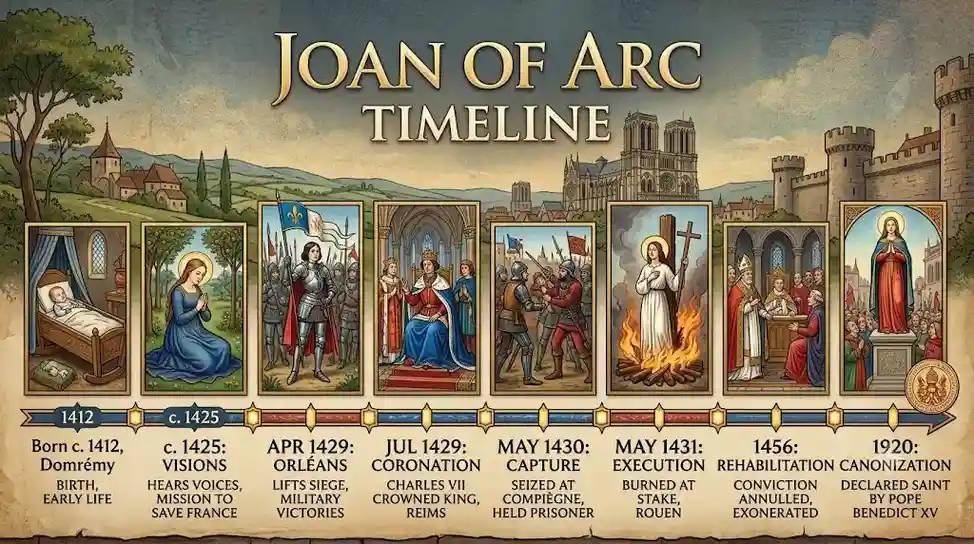
Joan of Arc lived just nineteen years, from her birth around 1412 to her execution in 1431 — but her story didn’t end there. It took nearly 500 more years, running through a rehabilitation trial in 1456 and finally canonization in 1920, before her legacy was fully settled. Here’s the complete timeline, in order. (For the full narrative behind these dates, see our complete Joan of Arc biography.)
⏳ Quick Facts — Timeline of Joan of Arc
| 📌 Milestone | 📖 Historical Date / Detail |
|---|---|
| 👶 Born | c. January 6, 1412, in the village of Domrémy, Kingdom of France |
| ✨ First Visions | c. 1425, around the age of 13, when she first heard the celestial voices in her father’s garden |
| ⚔️ Military Campaign | 1429, highlighted by her historic lifting of the strategic Siege of Orléans |
| 👑 Coronation of the King | July 17, 1429 — King Charles VII is officially crowned at Reims with Joan standing proudly by his side |
| 🕸️ Captured | May 23, 1430, ambushed and taken by Burgundian forces during a skirmish at Compiègne |
| 🔥 Executed | May 30, 1431, condemned for heresy and burned at the stake in Rouen at just 19 years old |
| 📜 Rehabilitation Trial | July 7, 1456 — The original sentence is officially overturned and nullified by a papal commission |
| 🌟 Canonized | May 16, 1920, formally declared a saint of the Roman Catholic Church by Pope Benedict XV |
Early Life to the First Voices (1412-1425)
Joan was born in the small village of Domrémy in northeastern France, most likely on 6 January 1412, though no birth record survives to confirm the exact date — it comes from her own later testimony about her age. She grew up the daughter of a farmer, in a region caught in the middle of the ongoing conflict between France and England.
Around 1425, at about thirteen years old, she later testified that she began hearing what she described as voices — she identified them as Saint Michael, Saint Catherine, and Saint Margaret — which she said grew clearer over the following years and eventually urged her toward a specific mission: help Charles VII reclaim his throne and drive the English out of France.
The Path to Power (1428-1429)
In May 1428, a teenage Joan traveled to the nearby town of Vaucouleurs to ask the local garrison commander, Robert de Baudricourt, for an armed escort to reach the royal court. He turned her away. She returned in January 1429, and this time — after growing local support and, according to some accounts, a prediction she made about a French military defeat that came true — he agreed.
She reached the royal court at Chinon in early March 1429 and met Charles VII directly on 6 March. Rather than accepting her claims outright, the court sent her to Poitiers for weeks of theological examination by a panel of clergy and scholars, checking her orthodoxy and character before anyone would risk attaching the crown’s cause to her. She passed and was given a small military role and her own suit of armor.
Military Triumph (1429)
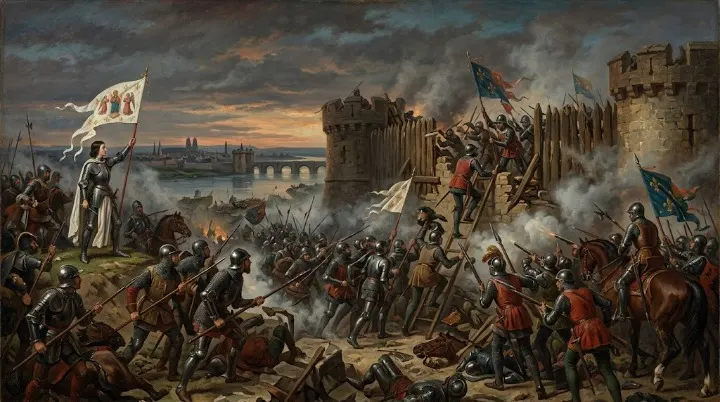
Joan arrived at the besieged city of Orléans on 29 April 1429. Over the next several days, French forces broke a seven-month English blockade in a rapid string of assaults, culminating in the fall of the fortified position at Les Tourelles on 7 May and the English withdrawal the following day.
She followed this with the Loire Campaign through June, including a decisive French victory at the Battle of Patay on 18 June — arguably a more crushing tactical win than Orléans itself, though less remembered. These victories opened the path to Reims Cathedral, deep in territory that had recently been under Anglo-Burgundian control, where Charles VII was formally crowned King of France on 17 July 1429, with Joan standing near him during the ceremony.
A subsequent assault on English-held Paris in September 1429 failed, and Joan was wounded in the attempt — the first real check on the momentum that had built since Orléans.
Capture, Trial, and Execution (1430-1431)
On 23 May 1430, during a military engagement at Compiègne, Joan was captured by Burgundian forces, allies of the English. She was held for months and eventually sold to the English in November 1430 for a substantial ransom.
Her trial for heresy opened in Rouen on 9 January 1431, presided over by Bishop Pierre Cauchon, with clear political motivation to discredit the king she had helped crown. On 24 May 1431, worn down by months of interrogation, she signed an abjuration recanting her claims. Days later, on 28 May, she resumed wearing men’s clothing — the court declared this a relapse into heresy, and she was sentenced to death.
Joan of Arc was burned at the stake in Rouen’s Vieux-Marché square on 30 May 1431. She was nineteen years old — and, deliberately, no physical remains of her survived the fire.
Vindication and Sainthood (1456-1920)
The story didn’t end at her death. Twenty-five years later, following a petition from her own mother, Isabelle Romée, and the rest of the d’Arc family, Pope Callixtus III authorized a new inquiry into her original trial. The timing wasn’t accidental — by the mid-1450s, the political tide had turned decisively against England, and Charles VII had a strong incentive to see the woman who’d crowned him formally cleared, since her conviction as a heretic had always cast a shadow over the legitimacy of his own reign. Witnesses who’d known her in Domrémy, fought beside her, or even sat on the original 1431 tribunal were re-examined, and their testimony painted a very different picture from the one Cauchon’s court had recorded. On 7 July 1456, the rehabilitation trial formally annulled her conviction, ruling the original proceedings unjust and tainted by political pressure.
Clearing her name, though, was a different matter from declaring her a saint, and that process moved far slower. It took until the late 19th century for a serious canonization campaign to gain real momentum, driven partly by French Catholic nationalism in the years following the Franco-Prussian War, when Joan’s story as a symbol of French resilience took on fresh political weight. She was beatified in 1909, and finally canonized by Pope Benedict XV on 16 May 1920 — nearly five hundred years after the fire in Rouen’s market square that was meant to erase her entirely.
Few historical figures travel that particular arc: executed as a heretic, formally exonerated a generation later, and ultimately declared a saint centuries after that. It’s a reminder that how history judges someone in the moment and how it judges them with distance can end up being two completely different verdicts.
Sources & Further Reading
- Joan of Arc — Encyclopaedia Britannica:
- Siege of Orléans — Encyclopaedia Britannica: