📅 Quick Facts — July 12 in History
| 📌 Category | 📖 Event / Detail |
|---|---|
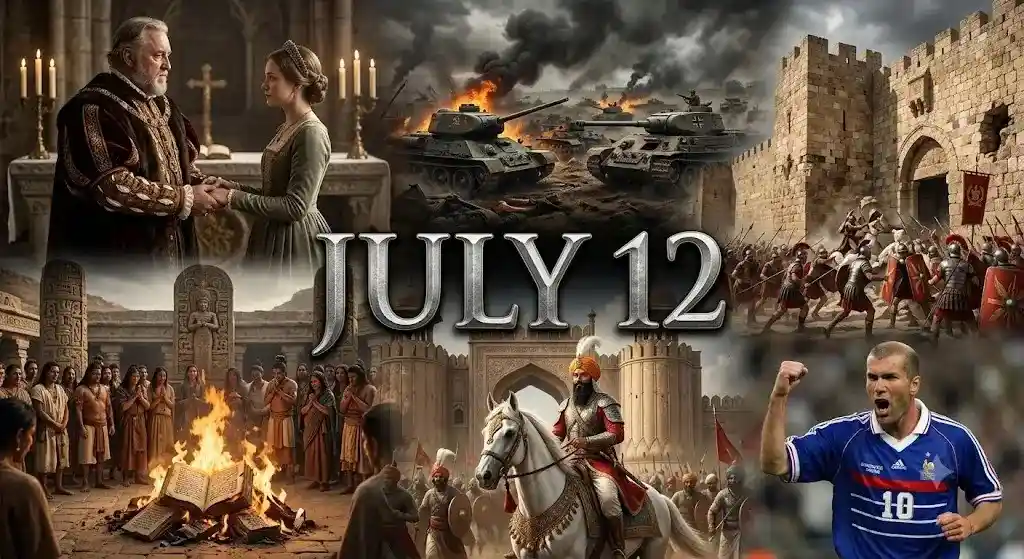
| 🌟 Most Significant Event | King Henry VIII marries his sixth and final wife, Catherine Parr, at Hampton Court Palace (1543) |
| 🏆 Top 10 Key Events | • Roman forces led by Titus breach the walls of Jerusalem, attacking the fortress of Antonia (70) • The dramatic Siege of Acre concludes during the Third Crusade, resulting in a crucial victory for Philip Augustus and Richard the Lionheart (1191) • Jack Cade, the leader of the prominent Kentish rebellion against Henry VI, is fatally wounded and killed in Sussex (1450) • Ranjit Singh successfully captures the city of Lahore, laying the foundation for the rising Sikh Empire (1799) • The colossal Battle of Prokhorovka takes place, marking one of the largest armored tank clashes in history during the Battle of Kursk (1943) • The mass expulsion of Palestinians begins in the towns of Lod and Ramla following Israeli military capture (1948) • The catastrophic Panshet Dam collapse triggers severe flooding that devastates parts of Pune, India (1961) • The iconic Australian Aboriginal Flag is flown for the first time at Victoria Square in Adelaide (1971) • The Gilbert Islands formally declare independence from the United Kingdom, renaming the nation Kiribati (1979) • Led by two Zinedine Zidane goals, France triumphs 3–0 over Brazil on home turf to win their first FIFA World Cup (1998) |
| ⚔️ Key Battles | Siege of Jerusalem (70), Siege of Acre (1191), Battle of Rajmahal (1576), Battle of Aughrim (1691), Second Battle of Algeciras (1801), Siege of Vidin (1913), Battle of Prokhorovka / Kursk (1943) |
| 👤 Key Figures | King Henry VIII, Queen Catherine Parr, Maharaja Ranjit Singh, Zinedine Zidane, Julius Caesar (born this day in 100 BC), Pablo Neruda (born this day in 1904) |
| 🌍 Observances | The Twelfth / Orangemen’s Day (Northern Ireland), Naadam Festival Second Day (Mongolia) |
Story of the Day: The Clash of Steel at Prokhorovka
Thick black smoke choked the summer sky over the village of Prokhorovka as hundreds of Soviet and German tanks smashed directly into each other. July 12, 1943, marked the absolute climax of the Battle of Kursk, the largest armored engagement the world had ever seen. General Pavel Rotmistrov ordered his Soviet T-34 tanks to charge forward at full speed, closing the distance so German Tiger tanks could not use their long-range guns. The battlefield turned into a chaotic maze of burning metal, explosions, and hand-to-hand combat between crews escaping their wrecked vehicles. By nightfall, the German advance stalled permanently, breaking the back of the Nazi panzer divisions and shifting the momentum of World War II toward Moscow.
Important Events That Happened On July 12 In History
70 – Titus Attacks the Walls of Jerusalem
Titus ordered his Roman legions to launch a massive assault against the ancient stone walls of Jerusalem after half a year of brutal siege warfare. Starving defenders fought desperately from the battlements, but the disciplined Roman war machine slowly gained ground. Three days later, the soldiers breached the final defenses, pouring into the streets with swords drawn. This breakthrough sealed the fate of the city, leading directly to the systemic burning and ruin of the historic Second Temple.
526 – Felix IV Becomes Pope
Roman church leaders selected Felix IV to fill the papal chair after the tragic death of Pope John I in a dark prison cell. The Ostrogothic King Theodoric the Great used his immense political power to pressure the clergy into this quick election. Felix took control of a deeply divided church, managing to keep the peace during a time of heavy barbarian influence. His leadership secured vital properties in Rome, turning ancient pagan temples into Christian places of worship.
813 – Leo V Crowned Byzantine Emperor
Leo the Armenian stood before the high altar in Constantinople to receive the imperial crown of the Byzantine Empire. Just twenty-four hours earlier, Leo used political leverage and military pressure to force the weak Emperor Michael I Rangabe to step down. The empire faced constant raids from Bulgarian forces, and the public wanted a strong military general in charge. Leo took the throne by force, initiating a strict rule that revived the controversial policy of state-sponsored iconoclasm.
927 – Kings Gather at Eamont Bridge
King Constantine II of Scotland and King Hywel Dda of Wales stood beside northern rulers to formally accept the authority of King Æthelstan of England. The meeting at Eamont Bridge followed a series of swift English military campaigns that forced these regional leaders to terms. By submitting to Æthelstan, the rulers established the outer boundaries of Anglo-Saxon control. This diplomatic submission brought seven rare years of peace to the volatile northern borders and laid the foundations for a unified English kingdom.
1191 – Third Crusade: Garrison at Acre Surrenders
Saladin’s Muslim garrison walked out of the fortified city of Acre and surrendered to the armies of Philip Augustus and Richard the Lionheart. The capitulation ended a brutal, agonizing two-year siege that cost thousands of lives on both sides. The Christian crusaders successfully reclaimed a vital Mediterranean port, securing a major logistical base for their holy war. This dramatic victory restored the Crusader States’ presence along the coast and set up a direct confrontation between King Richard and Saladin.
1335 – Pope Benedict XII Reforms the Cistercian Order
Pope Benedict XII sat at his desk in Avignon and signed the papal bull Fulgens sicut stella matutina to enforce strict discipline among Cistercian monks. The document targeted growing corruption, wealth gathering, and lazy habits that crept into the monasteries over the decades. Benedict demanded a return to manual labor, deep study, and the original vows of absolute poverty. This sweeping decree revitalized the spiritual life of the monks and restored the order’s fading reputation across medieval Europe.
1450 – Rebel Leader Jack Cade Killed in Flight
Sheriff Alexander Iden tracked down the wounded rebel leader Jack Cade as he hid in a wooded area near Heathfield, Sussex. King Henry VI previously offered a formal pardon to the rebels, but Cade remained a wanted fugitive with a price on his head. A short, violent struggle broke out in the brush, leaving the rebel leader mortally wounded before he could be brought to trial. Cade’s sudden death destroyed the momentum of the commoners’ rebellion, though his body was still taken to London to be ritually dragged and quartered.
1470 – Ottoman Forces Capture Euboea
Sultan Mehmed II watched his elite troops storm the Venetian fortress of Negroponte on the island of Euboea. The Ottoman army built a massive floating bridge across the Euripus Strait to funnel thousands of soldiers onto the island’s shores. Venetian defenders fought fiercely in the streets, but they were completely overwhelmed by the sheer numbers of the Turkish forces. The fall of this crucial naval base broke Venice’s dominant grip on the Aegean Sea and expanded Ottoman maritime power.
1488 – Choe Bu Returns to Korea After Shipwreck
Joseon Dynasty official Choe Bu stepped back onto Korean soil after a harrowing half-year journey through the heart of Ming Dynasty China. A violent storm blew his official ship off course, shipwrecking his crew and leaving them at the mercy of foreign authorities who initially suspected them of being pirates. Choe Bu used his extensive knowledge of Confucian texts to prove his identity to Chinese officials, earning a safe escort along the Grand Canal. His detailed travel diaries provided his king with an unmatched look at Chinese culture, technology, and geography.
1493 – Nuremberg Chronicle Published
Hartmann Schedel looked over the fresh ink of the Nuremberg Chronicle, one of the most complex and heavily illustrated books of the early printing era. The massive volume attempted to print the entire history of the world, from creation to the year 1493, using hundreds of detailed woodcut illustrations. Printers Anton Koberger and his workshop spent years carving the intricate blocks and setting the heavy metal type. The successful publication became an instant masterpiece, showing the incredible commercial power of the newly invented printing press.
1527 – Lê Cung Hoàng Cedes the Vietnamese Throne
Emperor Lê Cung Hoàng formally stepped down and handed the imperial seal to his powerful military general, Mạc Đăng Dung. The Lê dynasty suffered from years of internal weakness, leaving a political void that the ambitious general filled by executing rivals and gaining control of the army. This forced abdication brought a sudden end to the historic Later Lê era and established the new Mạc dynasty. The transition sparked decades of civil conflict as loyalist factions refused to accept the general’s new rule.
1543 – Henry VIII Marries Catherine Parr
King Henry VIII stood beside Catherine Parr in the small Queen’s Closet at Hampton Court Palace to exchange wedding vows. The aging, ailing king required a devoted companion and nurse, while Catherine stepped into the role to protect her reformist religious views. The marriage provided the royal court with stability, and the new queen successfully united the king’s estranged children, Mary, Elizabeth, and Edward. Her influence ensured that the royal line remained intact during the final years of Henry’s turbulent reign.
1562 – Bishop Diego de Landa Burns Maya Books
Fray Diego de Landa gathered a massive crowd in front of the Franciscan monastery at Maní and set fire to thousands of sacred Maya idols and books. The acting bishop believed the ancient texts contained nothing but dangerous lies and devil worship designed to lead new converts astray. The intense fire consumed centuries of indigenous history, philosophy, astronomy, and literature in a single afternoon. This destructive act caused immense grief among the Maya people and permanently erased the written memory of their civilization.
1576 – Mughal Empire Annexes Bengal
Akbar’s imperial Mughal army charged across the muddy fields of Rajmahal, routing the forces of Daud Khan Karrani, the Sultan of Bengal. The decisive battle ended with the capture and execution of the rebellious sultan, who resisted imperial rule for years. This military triumph permanently destroyed the independent Afghan rule in the region, bringing the vast wealth and trade networks of Bengal under direct Mughal control. Akbar integrated the territory into his expanding empire, securing his eastern frontier for generations.
1580 – Ostrog Bible Published in Ukraine
Printer Ivan Fyodorov pulled the final pages of the Ostrog Bible from his wooden press, completing the first full edition of the Bible in a Slavic language. Prince Konstantin Ostrozhsky funded the massive project to defend Eastern Orthodox traditions against growing Catholic influence in the region. Scholars spent years comparing Greek, Latin, and Old Church Slavonic manuscripts to ensure the translation was completely accurate. The finished book became a major milestone for Slavic literature, culture, and printing technology.
1691 – Williamite Forces Win the Battle of Aughrim
General Godert de Ginkel ordered a desperate cavalry charge across the bogs of County Galway, securing a bloody victory over the French and Jacobite army at Aughrim. The battle raged evenly for hours until the Jacobite commander, Marquis de St. Ruth, was decapitated by a well-aimed cannonball, leaving his troops leaderless and confused. The resulting rout turned into a massacre, costing thousands of Irish lives on the field. This crushing defeat broke the back of the Jacobite resistance in Ireland and solidified King William III’s hold on the British throne.
1776 – James Cook Begins His Final Voyage
Captain James Cook ordered the sails unfurled on HMS Resolution as he departed from Plymouth to begin his third major expedition into the Pacific Ocean. The British Admiralty tasked Cook with finding the fabled Northwest Passage, a frozen maritime shortcut connecting the Pacific and Atlantic oceans. This voyage took his crew through uncharted waters, leading to the European charting of the Hawaiian Islands and the mapping of the Alaskan coast. Cook never returned home from this journey, as a violent confrontation in Hawaii claimed his life three years later.
1789 – Camille Desmoulins Sparks the French Revolution
Camille Desmoulins leapt onto a table outside the Café de Foy in Paris, brandishing a pistol and shouting a desperate call to arms to an angry crowd. News of the sudden dismissal of the popular finance minister Jacques Necker convinced the public that the royal military planned to crush the city. Desmoulins’ passionate speech urged the citizens to wear green ribbons as a sign of resistance against the king. The resulting fury rippled across Paris, causing mass rioting that led directly to the storming of the Bastille just two days later.
1790 – France Passes Civil Constitution of the Clergy
The National Constituent Assembly in Paris passed the Civil Constitution of the Clergy, placing the French Catholic Church completely under state control. The new law stripped the Pope of his traditional authority to appoint bishops, turning priests into salaried public servants elected by local citizens. The Assembly demanded that all clergymen swear an oath of absolute loyalty to the new constitution. This radical move deeply divided the French public, driving a wedge between religious traditionalists and the revolutionary government.
1799 – Ranjit Singh Captures Lahore
Ranjit Singh led his cavalry through the open gates of Lahore, conquering the historic capital and cementing his position as the supreme leader of the Punjab. The local population grew tired of the misrule of the ruling Bhangi Sikh chiefs and invited the young leader to take control of the city. Ranjit Singh restored order immediately, protecting the citizens from looting and establishing a fair government. This major conquest marked the true birth of the Sikh Empire, allowing him to be crowned Maharaja shortly after.
1801 – British Fleet Triumphs at Algeciras
Rear-Admiral Sir James Saumarez commanded his British warships to attack a combined French and Spanish fleet in the dark waters of the Straits of Gibraltar. The nighttime naval engagement turned chaotic as British ships maneuvered between the enemy vessels, causing two massive Spanish three-deckers to mistake each other for foes. The two Spanish ships collided, caught fire, and exploded in spectacular fashion, killing more than two thousand sailors. This decisive victory restored British naval dominance in the Mediterranean during the French Revolutionary Wars.
1806 – German Principalities Form Confederation of the Rhine
Sixteen southern and western German states formally signed a treaty to leave the Holy Roman Empire and join the newly created Confederation of the Rhine. Emperor Napoleon forced this diplomatic break to establish a loyal military buffer zone along the eastern border of France. The departure of these core principalities stripped the Holy Roman Emperor, Francis II, of his remaining political authority. Within weeks, the ancient Holy Roman Empire dissolved completely, redrawing the geopolitical map of Central Europe.
1812 – American Troops Briefly Occupy Upper Canada
General William Hull marched his American Army of the Northwest across the Detroit River and occupied the quiet settlement of Sandwich in Upper Canada. Hull issued a bold proclamation to the Canadian public, promising them liberation from British tyranny if they refused to fight. The American general hoped for a quick, bloodless conquest, but his troops faced immediate supply shortages and guerrilla resistance from indigenous warriors led by Tecumseh. Fearing he would be cut off from supplies, Hull panicked and retreated across the river within weeks.
1847 – Woodstock Riot Claims Ten Lives
An angry confrontation between Irish Catholic immigrants and members of the Protestant Orange Order turned deadly on the streets of Woodstock, New Brunswick. The annual Orange parade passed directly through a Catholic neighborhood, sparking shouting matches that quickly escalated into a full-scale street brawl with clubs and firearms. Local authorities struggled to contain the violence as both sides brought in reinforcements from the surrounding countryside. The riot left up to ten people dead, exposing deep-seated religious and social tensions in the Canadian province.
1862 – US Congress Authorizes the Medal of Honor
President Abraham Lincoln signed a congressional measure to authorize the production and distribution of the Medal of Honor for the United States Army. The government needed a formal way to recognize soldiers who performed acts of extreme gallantry and courage on the battlefields of the American Civil War. The initial law allowed the medal to be awarded only to enlisted men, though it was later expanded to include officers. This historic legislation created the military’s highest decoration for valor under fire.
1913 – Serbian Forces Begin Siege of Vidin
Serbian artillery batteries opened fire on the fortified Bulgarian city of Vidin, surrounding the defenders during the bitter Second Balkan War. The Serbian command hoped to capture this strategic Danube port to cut off Bulgarian supply lines and force a quick surrender. Bulgarian troops held their positions under heavy bombardment, launching frequent counterattacks to keep the Serbians from breaching the inner walls. The siege ended abruptly a few days later when a general armistice was signed, preventing a final assault on the city.
1913 – Second Revolution Breaks Out in China
General Li Liejun declared the independence of Jiangxi province, launching the short-lived Second Revolution against the autocratic rule of President Yuan Shikai. Li acted in response to the political assassination of pro-democracy leader Song Jiaoren and Yuan’s illegal acquisition of massive foreign loans to fund his private army. Several southern Chinese provinces joined the rebellion, attempts to stop Yuan’s march toward a dictatorship. The underfunded rebel forces were crushed within months by the superior firepower of Yuan’s loyal Beiyang army.
1917 – Armed Vigilantes Enact the Bisbee Deportation
An armed posse of two thousand businessmen and vigilantes rounded up nearly 1,300 striking miners at gunpoint in the copper town of Bisbee, Arizona. The local sheriff orchestrated the mass kidnapping to break a strike organized by the Industrial Workers of the World against the local mining corporations. The vigilantes marched the workers into cattle cars and shipped them out to New Mexico, leaving them stranded in the desert without food or water. The brutal action successfully broke the union’s power but caused a massive national scandal.
1918 – Japanese Battleship Kawachi Explodes
A sudden internal explosion ripped through the ammunition magazines of the Imperial Japanese Navy battleship Kawachi as it rested at anchor in Tokuyama Bay. The blast tore open the heavy steel hull of the ship, causing it to capsize and sink into the mud within four minutes. At least 621 sailors lost their lives in the disaster, trapped beneath the decks or caught in the violent suction of the sinking vessel. An official naval investigation later blamed the explosion on the unstable decomposition of old cordite propellant stored in the holds.
1920 – Soviet–Lithuanian Peace Treaty Signed
Representatives from Soviet Russia and Lithuania signed a formal peace treaty in Moscow, officially recognizing the complete independence and sovereignty of the Lithuanian state. Vladimir Lenin’s Bolshevik government agreed to the terms to secure their western border while fighting the ongoing Polish–Soviet War. The treaty defined Lithuania’s eastern borders, explicitly including the disputed city of Vilnius within the new country’s territory. This diplomatic agreement allowed Lithuania to build its state institutions free from Russian interference for the next two decades.
1948 – Israeli Troops Expel Palestinians from Lod and Ramla
Prime Minister David Ben-Gurion signed an official military order directing Israeli forces to expel thousands of Arab residents from the twin towns of Lod and Ramla. The military operation took place during the height of the 1948 Arab–Israeli War to secure the vital highway connecting Tel Aviv and Jerusalem. Soldiers forced nearly fifty thousand people out of their homes, driving them on foot toward the West Bank lines in the blazing summer heat. The mass expulsion created a massive humanitarian crisis and became a defining event of the Palestinian exodus.
1960 – Orlyonok Young Pioneer Camp Founded
Soviet officials opened the gates of Orlyonok, the premiere state-run youth camp located on the scenic Black Sea coast of the Russian SFSR. The massive complex was designed to reward top-performing school children and mold them into dedicated members of the Communist Party. Thousands of young pioneers spent their summers participating in ideological education, athletic competitions, and collective outdoor work. The camp served as a model for Soviet youth culture, showcasing the state’s investment in the next generation of citizens.
1961 – Panshet Dam Collapse Floods Pune
The newly constructed Panshet Dam suddenly burst under the immense weight of heavy monsoon rains, unleashing a wall of water that swept directly into the Indian city of Pune. The raging floodwaters quickly overwhelmed the downstream Khadakwasla Dam, multiplying the disaster and submerging entire residential neighborhoods within hours. The catastrophe destroyed thousands of homes, ruined vital infrastructure, and claimed the lives of at least two thousand people. The tragedy forced local authorities to completely redesign the city’s modern flood management systems.
1961 – ČSA Flight 511 Crashes in Morocco
An Ilyushin Il-18 passenger plane operating as ČSA Flight 511 plunged into the ground during its approach to Casablanca–Anfa Airport in Morocco, killing all 72 people on board. The aircraft encountered severe weather conditions and thick low clouds as it prepared to land on the international route. The impact completely destroyed the plane, scattering wreckage across the rugged terrain and leaving no survivors among the passengers and crew. Investigators struggled to determine the exact cause, pointing to a mix of mechanical failure and pilot disorientation.
1963 – Pauline Reade Disappears in Manchester
Sixteen-year-old Pauline Reade left her home in Gorton, Manchester, to attend a local dance and never returned, marking the grim beginning of the Moors murders. Ian Brady and Myra Hindley kidnapped the young girl on the street, driving her to the desolate Saddleworth Moor where they committed the murder. Local police initially treated the case as a runaway incident, unaware that a pair of serial killers was operating in the area. The discovery of the crimes years later shocked the British public and forever changed modern police investigation techniques.
1967 – Newark Riots Erupt
A violent clash broke out between local police officers and black residents in Newark, New Jersey, following the brutal beating of an African American taxi driver named John Smith. The incident triggered years of built-up frustration over systemic police brutality, political exclusion, and severe housing discrimination in the city. The governor deployed the National Guard to restore order, leading to days of urban warfare, looting, and heavy gunfire. The riots resulted in 26 deaths and left large sections of Newark permanently scarred by arson and neglect.
1971 – Australian Aboriginal Flag Flown for the First Time
Aboriginal activist Harold Thomas raised his newly designed flag at a land rights rally in Victoria Square, Adelaide, creating an enduring symbol for indigenous Australians. The flag’s bold black, red, and yellow design represented the Aboriginal people, the red earth of the outback, and the sun as the giver of life. Thomas created the banner to give his community a distinct visual identity during their struggles for legal land recognition. The flag gained rapid national acceptance and was later recognized as an official flag of Australia.
1973 – Fire Destroys National Personnel Records Center
A massive fire broke out on the sixth floor of the National Personnel Records Center in St. Louis, Missouri, destroying millions of military service records. The intense blaze burned out of control for nearly five days because the building lacked an automated sprinkler system to contain the sparks. The disaster consumed approximately 80 percent of the army discharge records dating from 1912 to 1960, obliterating the official histories of millions of veterans. The loss created massive administrative hurdles for veterans attempting to claim their medical benefits.
1975 – São Tomé and Príncipe Gain Independence
Manuel Pinto da Costa stood before an ecstatic crowd in the capital city to declare the independence of São Tomé and Príncipe from centuries of Portuguese colonial rule. The island nation achieved its long-sought sovereignty following the Carnation Revolution in Lisbon, which brought down the conservative dictatorship in Portugal. The new government immediately nationalized the vast cocoa plantations that dominated the local economy for generations. This peaceful transition marked the birth of a new African republic, ending centuries of colonial exploitation.
1979 – Kiribati Achieves Independence
The remote island nation of Kiribati formally separated from the United Kingdom, bringing a peaceful end to decades of British colonial administration in the Pacific. Princess Anne attended the official ceremony in the capital of Tarawa, representing the British crown as the Union Jack was lowered for the final time. The new nation adopted a fresh constitution to unite the geographically scattered Gilbert, Line, and Phoenix island groups under a single democratic parliament. This independence allowed the islanders to take full control of their valuable maritime resources.
1995 – Seismologists Successfully Predict Myanmar–China Earthquake
Chinese scientists accurately predicted a powerful 7.3 magnitude earthquake along the Myanmar–China border, allowing local officials to evacuate vulnerable towns hours before the first tremors hit. Authorities cleared residents out of old brick buildings and moved them into open spaces, significantly reducing the potential body count. When the ground shook violently, destroying hundreds of homes, only 11 people lost their lives in the disaster. This successful prediction proved the immense life-saving value of modern seismic monitoring networks.
1998 – France Wins First World Cup Title
Zinedine Zidane leaped into the air to power two spectacular headers into the back of the net, leading France to a stunning 3-0 victory over Brazil in the World Cup final. The historic match at the Stade de France saw the home team completely outplay the defending South American champions in front of a global television audience. Emmanuel Petit added a third goal in the final seconds of the game, sparking wild celebrations along the Champs-Élysées in Paris. The victory brought a diverse nation together, creating a sense of unity across the country.
2001 – Space Shuttle Atlantis Launches STS-104
The Space Shuttle Atlantis roared off the launchpad at the Kennedy Space Center in Florida, embarking on mission STS-104 to the International Space Station. The primary objective of the flight was to deliver and install the Quest Joint Airlock, a massive steel component designed to allow astronauts to conduct spacewalks using both American and Russian spacesuits. The crew successfully attached the heavy airlock using the station’s robotic arm during a series of complex orbital maneuvers. This installation expanded the operational capabilities of the space station.
2006 – Hezbollah Raid Sparks Lebanon War
Hezbollah militants launched a surprise cross-border missile attack on Israeli military patrol vehicles, killing three soldiers and kidnapping two others. The daring raid took place along the volatile Lebanon–Israel border, triggering an immediate and intense military response from the Israeli government. The conflict quickly escalated into a full-scale war, featuring heavy Israeli airstrikes across Lebanon and thousands of rocket attacks targeting northern Israeli towns. The month-long conflict caused massive destruction and displaced hundreds of thousands of civilians on both sides.
2007 – Baghdad Airstrike Video Recorded
A US Army Apache helicopter crew engaged a group of men in a Baghdad suburb with heavy 30mm cannon fire, killing several individuals, including two Reuters journalists. The military command initially stated that the targets were armed insurgents operating in a combat zone during a tense security sweep. The incident gained massive international attention years later when the classified cockpit video footage was leaked to the public under the title “Collateral Murder.” The raw footage sparked intense global debates regarding modern drone warfare and military transparency.
2012 – Syrian Forces Attack Tremseh
Syrian government troops and allied militia forces surrounded the village of Tremseh, launching a heavy artillery bombardment before entering the streets to search homes. Activists reported that the assault targeted local opposition members and civilian families suspected of supporting the ongoing rebellion against the state. The violent operation resulted in the deaths of anywhere between 68 and 150 people, drawing sharp condemnation from international human rights organizations. The tragedy highlighted the increasing brutality of the expanding Syrian Civil War.
2012 – Tanker Truck Explosion Kills 100 in Nigeria
A fuel tanker truck veered off the road and tipped over into a ditch near the town of Okobie, Nigeria, drawing a large crowd of local residents who gathered to collect the leaking gasoline. A sudden spark ignited the fuel vapor, causing a massive explosion that trapped dozens of people in a giant ball of fire. The disaster claimed the lives of more than one hundred people on the spot, leaving dozens more with severe burns. The tragedy exposed the extreme poverty and lack of safety awareness in rural oil-producing regions.
2013 – Train Derails in Brétigny-sur-Orge
A French passenger train traveling at high speed suddenly split apart and derailed as it passed through the station at Brétigny-sur-Orge, killing six people and injuring two hundred more. Several carriages slammed into the concrete station platforms, trapping passengers inside the mangled metal frames. An official engineering investigation later revealed that a faulty steel connecting plate in a track switch had detached, causing the wheels to jump the rails. The disaster led to a massive overhaul of maintenance procedures across the French national rail network.
2024 – Gazpromavia Flight 9608 Crashes Near Kolomna
A Sukhoi Superjet 100 operating as Gazpromavia Flight 9608 plunged into a dense forest in Russia’s Kolomensky District, killing all three crew members on board. The aircraft was conducting a routine ferry flight following intensive scheduled maintenance at a nearby aircraft manufacturing plant. The plane disappeared from radar screens without emitting a distress call, exploding on impact with the ground. Civil aviation authorities launched a full investigation to determine if the crash was caused by a mechanical failure or an error during the repair process.
Don’t let yesterday’s history go untold—read it here.
🌟 Most Famous Births on July 12
| Person | Born | Why They’re Famous |
|---|---|---|
| Julius Caesar | 100 BC | Roman general, dictator, and one of history’s most influential political leaders. |
| Henry David Thoreau | 1817 | Author of Walden and a leading transcendentalist philosopher. |
| George Eastman | 1854 | Invented roll film and founded Kodak, making photography accessible to millions. |
| Pablo Neruda | 1904 | Nobel Prize-winning poet regarded as one of the greatest literary figures of the 20th century. |
| Buckminster Fuller | 1895 | Visionary architect, engineer, and creator of the geodesic dome. |
| Milton Berle | 1908 | Television pioneer known as “Mr. Television.” |
| Andrew Wyeth | 1917 | One of America’s best-known realist painters. |
| Elias James Corey | 1928 | Nobel Prize-winning chemist for work in organic synthesis. |
| Bill Cosby | 1937 | Influential comedian and television actor. |
| Christine McVie | 1943 | Keyboardist and songwriter for Fleetwood Mac. |
| Richard Simmons | 1948 | Fitness instructor and television personality. |
| Brian Grazer | 1951 | Academy Award-winning producer and co-founder of Imagine Entertainment. |
| Julio César Chávez | 1962 | One of boxing’s greatest champions. |
| Lee Byung-hun | 1970 | Internationally acclaimed Korean actor. |
| Kristi Yamaguchi | 1971 | Olympic gold medalist in figure skating. |
| Brock Lesnar | 1977 | WWE champion and former UFC heavyweight champion. |
| Michelle Rodriguez | 1978 | Star of the Fast & Furious film series. |
| James Rodríguez | 1991 | Colombian international football star. |
| Malala Yousafzai | 1997 | Nobel Peace Prize laureate and advocate for girls’ education. |
| Shai Gilgeous-Alexander | 1998 | NBA superstar and MVP-caliber guard. |
| Vinícius Júnior | 2000 | Brazilian international and Real Madrid forward. |
🕯️ Most Notable Deaths on July 12
| Person | Died | Why They’re Remembered |
|---|---|---|
| Desiderius Erasmus | 1536 | One of Europe’s greatest Renaissance scholars. |
| Alexander Hamilton | 1804 | First U.S. Secretary of the Treasury; died after his famous duel with Aaron Burr. |
| Charles Rolls | 1910 | Co-founder of Rolls-Royce. |
| Gertrude Bell | 1926 | Influential explorer and key figure in shaping modern Iraq. |
| Alfred Dreyfus | 1935 | Central figure in the historic Dreyfus Affair. |
| D. T. Suzuki | 1966 | Introduced Zen Buddhism to many Western audiences. |
| Minnie Riperton | 1979 | Celebrated vocalist known for “Lovin’ You.” |
| Amar Bose | 2013 | Founder of Bose Corporation and audio technology innovator. |
| Dara Singh | 2012 | Wrestling legend and Bollywood star. |
| Kelly Preston | 2020 | Film actress known for Jerry Maguire and other films. |
| Ruth Westheimer | 2024 | Popular educator and media personality known as “Dr. Ruth.” |
| Bill Viola | 2024 | Pioneer of contemporary video art. |
Observances on July 12
The Twelfth / Orangemen’s Day: Thousands of marchers wearing orange sashes take to the streets in Northern Ireland and Scotland every July 12 to celebrate the historic victory of King William III at the Battle of the Boyne in 1690. The day features massive street parades, traditional flute bands, and large bonfires lit in Protestant neighborhoods the night before.
Naadam (Second Day): Mongolians gather across the country for the second day of the traditional Naadam festival, focusing on high-stakes horse racing and archery competitions. Young riders navigate their mounts across miles of open steppe, while archers use ancient composite bows to hit distant targets, preserving the historic sporting skills of the nomadic empire.
👑 Frequently Asked Questions — July 12 in History
King Henry VIII married his sixth and final wife, Catherine Parr, during a small ceremony at Hampton Court Palace. The marriage brought long-sought domestic stability to the royal court and allowed the new queen to successfully reunite the king’s children, securing the Tudor line of succession.
The marriage of King Henry VIII to Catherine Parr remains highly significant for British history, alongside the massive tank battle at Prokhorovka in 1943. Both events reshaped the political and military landscapes of their respective eras, altering the destinies of entire nations.
Julius Caesar, the legendary Roman general and dictator who reshaped the Roman Republic into an empire, was born in 100 BC. Additionally, Nobel Prize-winning poet Pablo Neruda, widely considered one of the most influential literary figures of the 20th century, was born on this date in 1904.
The Battle of Prokhorovka took place on this date in 1943 during World War II, marking the absolute peak of the Battle of Kursk. Soviet and German panzer divisions engaged in a massive, close-range armored clash that permanently broke the offensive power of the Nazi tank forces.
Orangemen’s Day, or The Twelfth, is a major cultural observance celebrated in Northern Ireland to honor King William III’s victory over King James II at the Battle of the Boyne. The holiday features large street parades and musical performances to celebrate Protestant heritage and British identity.
A Sukhoi Superjet 100 operating as Gazpromavia Flight 9608 crashed in Russia’s Kolomensky District during a routine ferry flight, claiming the lives of all three crew members on board. The disaster triggered an immediate federal investigation into maintenance safety standards at regional repair facilities.