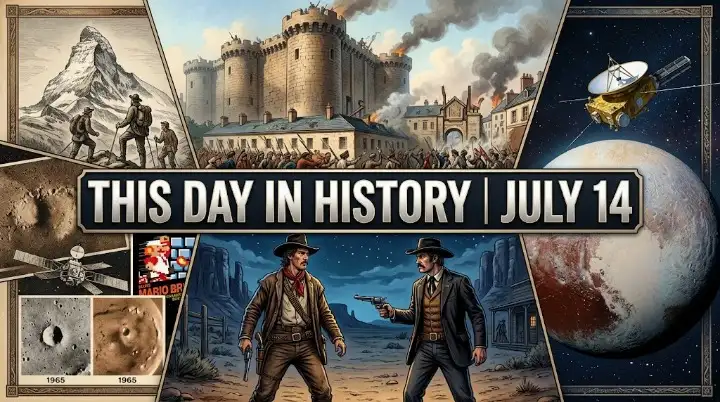
Edward Whymper clung to the icy ridge of the Matterhorn in 1865, staring down at the shattered rope that had just plunged four of his companions to their deaths. Triumph turned into terror in seconds. What happened on this day in history July 14 often walks that exact line between breakthrough and disaster. From American outlaws meeting their end in dark desert bedrooms to a tiny probe finally locking eyes with Pluto billions of miles away, today’s events show how quickly our reality can permanently shift.
📅 Quick Facts — July 14 in History
| 📌 Category | 📖 Event / Detail |
|---|---|
| 🌟 Most Significant Event | The Storming of the Bastille in Paris, a flashpoint of the French Revolution that signaled the end of absolute monarchy (1789) |
| 🏆 Top 10 Key Events | • Jan Žižka leads the Hussites to a decisive, outnumbered victory against Crusader forces at the Battle of Vítkov Hill (1420) • Following her capture at Compiègne, Joan of Arc is officially handed over to Bishop Pierre Cauchon to face her heresy trial (1430) • Edward Whymper leads the historic first successful ascent of the Matterhorn, though four team members perish on the descent (1865) • The Second Great Chicago Fire destroys over 800 structures, just three years after the famous 1871 blaze (1874) • Notorious outlaw Billy the Kid is shot and killed by Sheriff Pat Garrett in Fort Sumner, New Mexico (1881) • Explorer Hiram Bingham first uncovers the ancient, overgrown Incan citadel of Machu Picchu in Peru (1902) • The Nazi regime enacts the Law for the Prevention of Hereditarily Diseased Offspring, initiating forced eugenics policies (1933) • The Indian National Congress passes the “Quit India” resolution, demanding an immediate end to British colonial rule (1942) • NASA’s Mariner 4 space probe executes history’s first close-range flyby of Mars, transmitting the first close-up images of another planet (1965) • NASA’s New Horizons probe conducts the historic first close flyby of Pluto, capturing breathtaking images of its icy plains and mountains (2015) |
| ⚔️ Key Battles | Battle of Cape Colonna (982), Battle of Vítkov Hill (1420), Siege of Belgrade naval battle (1456), Sacking of Cadiz (1596), Battle of Lapua (1808), Battle of Delville Wood (1916), Battle of Taejon (1950) |
| 👤 Key Figures | Haruki Murakami (novelist), Emperor Akihito of Japan, Noah Clowney (NBA athlete), Gustav Klimt (painter born this day in 1862) |
| 🌍 Observances | Bastille Day (France), North Korean Defectors’ Day (South Korea), International Non-Binary People’s Day, Victoria Day (Sweden), Republic Day (Iraq) |
Story of the Day: The Storming of the Bastille
Parisian crowds shoved their way into the courtyard of the medieval fortress, demanding the commander hand over 250 barrels of gunpowder. Governor de Launay refused, ordering his guards to fire into the angry mob. Chaos erupted instantly as citizens and mutinous soldiers blasted the gates with stolen cannons. De Launay surrendered to save his remaining men, but the furious crowd dragged him into the street and took his head. The French monarchy lost control of the capital in a single bloody afternoon, igniting a revolution that shook Europe to its foundations.
Important Events That Happened On July 14 In History
982 – Battle of Cape Colonna
King Otto II marched his Frankish army into the blistering heat of Southern Italy to confront the Muslim forces of al-Qasim. Heavy imperial cavalry crashed into the Saracen lines, expecting a quick and brutal victory. A hidden reserve force flanked the Europeans instead, slaughtering the knights and forcing the Holy Roman Emperor to swim to a Byzantine ship to survive. The crushing defeat halted German expansion into southern Italy for generations.
1223 – Louis VIII Becomes King of France
Prince Louis stood by his dying father, Philip II, receiving the vast kingdom of France into his hands. His succession went entirely unchallenged, a rare and peaceful transfer of power in a violent era. He immediately rallied his nobles to strip the English of their remaining continental territories in Poitou. Though he ruled for only three years, his military aggression permanently secured the lands his father had won.
1420 – Battle of Vítkov Hill
Jan Žižka directed his badly outnumbered Czech Hussite forces from the high ground outside Prague. Peasant rebels wielding modified farming flails broke the charge of heavily armored crusaders led by Sigismund, Holy Roman Emperor. The attacking cavalry panicked on the steep slopes and routed, suffering heavy casualties. This victory secured Prague for the Hussites and proved that disciplined infantry could destroy traditional medieval cavalry.
1430 – Joan of Arc Handed to the English
Pierre Cauchon accepted a heavily guarded prisoner, Joan of Arc, from Burgundian soldiers in exchange for ten thousand francs. English authorities desperately wanted the teenage girl who had shattered their armies out of the picture. Her transfer to the bishop of Beauvais guaranteed she would face a rigged trial for heresy. This transaction sealed her fate, leading directly to her execution at the stake just a year later.
1456 – Naval Battle of Belgrade
John Hunyadi sailed a makeshift flotilla down the Danube to break a massive Ottoman blockade. Hungarian soldiers engaged the Turkish galleys in brutal hand-to-hand combat across the blood-soaked decks of chained ships. They sank three Ottoman galleys and captured four others, ripping a hole in the blockade. This daring river assault allowed desperately needed supplies and reinforcements to reach the besieged city of Belgrade.
1596 – Sacking of Cádiz
English and Dutch marines poured through the shattered gates of Spain’s wealthiest port city. The invaders spent hours stripping the city of gold, weapons, and hostages after utterly destroying the Spanish fleet anchored in the harbor. The raiders abandoned the burning ruins the very next day. Spain suffered a massive financial blow that crippled their ability to launch another armada against England.
1769 – Portolá Expedition Departs
Gaspar de Portolá led a dusty column of soldiers and missionaries out of their newly established base in San Diego. The men pushed north through unmapped coastal terrain in a desperate search for the legendary Port of Monterey. They suffered from scurvy and exhaustion, eventually stumbling past their target and accidentally finding San Francisco Bay instead. This grueling march established the first permanent Spanish land route through Alta California.
1771 – Foundation of Mission San Antonio de Padua
Franciscan friar Junípero Serra hung a bronze bell from an oak tree in the dry California scrubland. He rang it loudly to attract the local Salinan people to the site of his third mission. The Spanish quickly constructed adobe brick buildings and planted wheat fields in the fertile valley. The settlement became one of the most prosperous agricultural hubs in the California mission system.
1789 – Storming of the Bastille
Angry Parisians stormed the massive stone walls of the royal armory to seize weapons. Gunfire ripped through the courtyard as mutinous French guards turned their cannons on the fortress gates. The defending governor surrendered the garrison before the mob dragged him outside and killed him. This violent uprising shattered King Louis XVI’s absolute authority and triggered the French Revolution.
1790 – Fête de la Fédération
Thousands of citizens gathered in the pouring rain at the Champ de Mars to celebrate the first anniversary of the Bastille’s fall. King Louis XVI swore a public oath to uphold the new constitution alongside the Marquis de Lafayette. The festival briefly united a fractured nation under the promise of a constitutional monarchy. The fragile peace collapsed soon after, leading to the Reign of Terror.
1791 – Priestley Riots Begin
An angry mob in Birmingham hurled stones at a hotel where liberal reformers were celebrating the French Revolution. The rioters then marched to the home of scientist Joseph Priestley, smashing his laboratory equipment and burning his house to the ground. Local authorities did nothing to stop the violence for three days. Priestley eventually fled to the United States to escape the constant threat of conservative political violence.
1798 – Sedition Act Becomes Law
President John Adams signed a fiercely debated piece of legislation in the American capital. Federal authorities gained the power to imprison anyone who wrote or spoke maliciously against the United States government. The Adams administration immediately used the law to jail opposing newspaper editors and politicians. Public outrage over this attack on free speech helped Thomas Jefferson win the next presidential election.
1808 – Battle of Lapua
General Carl Johan Adlercreutz ordered his Swedish troops to charge across an open field toward Russian artillery positions. The infantry pushed through intense cannon fire, outflanking the Russian lines and forcing a chaotic retreat. The bold maneuver worked perfectly, despite the heavy losses sustained in the assault. Sweden secured a rare and crucial victory during the bitter winter campaigns of the Finnish War.
1853 – Exhibition of the Industry of All Nations Opens
President Franklin Pierce walked into the massive glass-and-iron Crystal Palace in New York City to officially open the first major American world’s fair. Visitors crowded around the newest industrial marvels, including Elisha Otis demonstrating a safety elevator by cutting its hoisting rope. The exhibition proved that American manufacturing and innovation could rival anything produced in Europe. The massive pavilion later burned to the ground in a spectacular fire.
1865 – First Ascent of the Matterhorn
Edward Whymper and his six companions hauled themselves onto the pristine summit of the Matterhorn, claiming the last great unconquered Alpine peak. The exhausted climbers began their treacherous descent down the sheer rock face an hour later. A sudden slip broke their rope, sending four men plunging thousands of feet to their deaths on the glacier below. The disaster sparked an international debate about the morality of high-altitude mountaineering.
1874 – The Chicago Fire of 1874
Flames tore through 47 acres of Chicago’s downtown just three years after the Great Fire had devastated the city. Terrified residents fled as the blaze consumed 812 wooden buildings and killed twenty people in a matter of hours. The fire insurance industry threatened to boycott the entire city unless drastic safety changes were made. Chicago’s city council immediately banned wooden construction in the central business district.
1881 – Billy the Kid Shot
Sheriff Pat Garrett sat in the dark bedroom of Pete Maxwell’s house in Fort Sumner, waiting quietly. William Bonney, known as Billy the Kid, walked into the room asking who was there in Spanish. Garrett fired two bullets from his revolver, striking the young outlaw in the chest and killing him instantly. The midnight ambush ended the life of the West’s most infamous fugitive and turned him into an American myth.
1900 – Capture of Tientsin
Soldiers from the Eight-Nation Alliance blasted their way through the massive southern walls of the Chinese city. Boxer rebels and Imperial Chinese troops fought a desperate house-to-house defense before the coalition forces overwhelmed them. The foreign armies looted the burning city relentlessly for days following the battle. This decisive victory opened the road for the alliance to march directly on Beijing.
1902 – Discovery of Machu Picchu
Agustín Lizárraga slashed his way through dense Andean jungle foliage high above the Urubamba River. The Peruvian farmer stepped into a massive complex of ruined stone terraces and temples hidden by centuries of overgrowth. He carved his name into a wall of the Temple of the Three Windows to mark his presence. His quiet find predated Hiram Bingham’s famous expedition to the “Lost City of the Incas” by nearly a decade.
1902 – Collapse of the St Mark’s Campanile
Onlookers in Venice watched in horror as a massive crack widened up the side of the iconic bell tower. The 300-foot brick structure groaned loudly before imploding into a massive pile of dust and rubble in St Mark’s Square. The collapse completely crushed the ornate loggetta below, though the only casualty was a caretaker’s cat. City officials vowed to rebuild the tower exactly as it was, a project that took exactly ten years to finish.
1911 – Aeroplane Lands on the White House Lawn
Harry Atwood circled his Wright brothers biplane over Washington D.C. before gliding down toward the executive mansion. He bounced the aircraft onto the South Lawn, where President William Howard Taft waited to greet him. The flight proved that aviation was rapidly maturing from a dangerous novelty into a reliable mode of transport. The president awarded the young exhibition pilot a gold medal for his daring Boston-to-Washington journey.
1915 – McMahon–Hussein Correspondence Begins
British official Henry McMahon drafted a secret letter to Hussein bin Ali, the Sharif of Mecca. The document offered British support for an independent Arab state if the Arabs launched a rebellion against the Ottoman Empire. Sharif Hussein accepted the terms, mobilizing his desert tribesman for a brutal guerrilla war. Britain later betrayed this promise by dividing the Middle East with France under the Sykes-Picot agreement.
1916 – Battle of Delville Wood Begins
South African troops charged into a dense forest thicket during the brutal Somme offensive. German artillery pounded the woods relentlessly, turning the trees into jagged splinters and the ground into a muddy slaughterhouse. The soldiers held the ruined perimeter for days, engaging in desperate hand-to-hand combat against repeated counterattacks. The South African brigade suffered catastrophic casualties, losing nearly eighty percent of its men before being relieved.
1933 – Hitler Abolishes German Political Parties
Adolf Hitler signed the Gleichschaltung decree in Berlin, outlawing the formation of any new political organizations. Nazi stormtroopers had already dismantled or intimidated every rival faction into dissolving themselves over the previous weeks. The decree officially cemented the Nazi Party as the sole legal political entity in Germany. The Weimar Republic’s fragile democracy died with the stroke of a pen, plunging the nation into a totalitarian nightmare.
1933 – Nazi Eugenics Programme Begins
German authorities proclaimed the Law for the Prevention of Hereditarily Diseased Offspring. Doctors received orders to enforce the compulsory sterilization of any citizen diagnosed with specific genetic, physical, or mental disorders. Special genetic health courts quickly condemned hundreds of thousands of people to forced surgical procedures. This horrific policy laid the medical and legal groundwork for the Holocaust’s extermination camps.
1942 – “Quit India” Resolution Approved
Mahatma Gandhi met with the Congress working committee in Wardha to finalize a massive political gamble. The leaders approved a resolution demanding an immediate end to British rule in India, authorizing mass civil disobedience if their demands were ignored. British authorities responded a few weeks later by throwing Gandhi and the entire Congress leadership into prison. The resulting nationwide riots fundamentally destabilized British colonial authority in South Asia.
1943 – George Washington Carver National Monument Created
President Franklin D. Roosevelt authorized the purchase of a small farm in Diamond, Missouri. The government dedicated the land where the famous agricultural scientist was born into slavery as a protected site. This act created the very first United States National Monument honoring an African American. The site permanently recognized Carver’s massive contributions to Southern agriculture and peanut crop innovation.
1948 – Palmiro Togliatti Shot
An anti-communist student stepped out of a crowd near the Italian Parliament and fired three bullets at the leader of the Italian Communist Party. Palmiro Togliatti collapsed onto the pavement with severe wounds to his head and neck. Furious workers immediately launched a massive general strike that paralyzed the country and brought Italy to the brink of civil war. Togliatti survived the surgery and appealed for calm from his hospital bed, averting an armed revolution.
1950 – Battle of Taejon Begins
American infantrymen dug defensive positions into the hills surrounding the vital South Korean transport hub. Heavily armored North Korean T-34 tanks smashed into the American lines, exploiting gaps in the badly stretched perimeter. The 24th Infantry Division fought a desperate delaying action block-by-block through the burning city before finally retreating. The brutal sacrifice bought United Nations forces just enough time to establish the impenetrable Pusan Perimeter.
1951 – Ferrari’s First Formula One Victory
José Froilán González wrestled his powerful Ferrari 375 around the sweeping corners of the Silverstone circuit. The Argentine driver pushed his car to the limit, finally breaking the dominant winning streak of the Alfa Romeo team. Enzo Ferrari cried upon hearing the news, famously declaring he felt like he had killed his own mother by beating Alfa Romeo. The victory launched the most successful and iconic dynasty in motorsport history.
1957 – Rawya Ateya Enters Parliament
Rawya Ateya walked into the National Assembly in Cairo to take her hard-won seat. She had campaigned fiercely across rural Egypt, breaking deeply entrenched cultural barriers to win the election. Her victory made her the very first female parliamentarian in the entire Arab world. She immediately began fighting for women’s rights and mandatory maternity leave, paving the way for generations of female politicians in the region.
1958 – July 14 Revolution in Iraq
Brigadier Abd al-Karim Qasim ordered his military units to seize control of the royal palace and the radio station in Baghdad. Rebel soldiers executed King Faisal II and his family in the palace courtyard, ending the British-backed Hashemite monarchy forever. The streets filled with citizens celebrating the violent overthrow of the old regime. Qasim established a republic, drastically altering the geopolitical balance of the Middle East.
1960 – Jane Goodall Arrives at Gombe
A twenty-six-year-old British woman stepped off a boat onto the rugged shores of the Gombe Stream Reserve in Tanzania. Jane Goodall carried only a notebook and binoculars to begin her field study of wild chimpanzees. She soon watched a chimpanzee strip leaves off a twig to fish for termites, proving that humans were not the only tool-making animals. Her controversial field methods revolutionized our understanding of primate behavior and human evolution.
1960 – Northwest Orient Airlines Flight 1-11 Ditches
Pilots of the DC-7C aircraft felt an engine tear itself apart mid-flight over the Pacific Ocean. The crew fought to control the crippled plane, executing a desperate nighttime water landing off the coast of Polillo Island. Rescue planes found the survivors clinging to life rafts in the dark water hours later. Forty-four people survived the violent crash, while only one passenger lost their life.
1965 – Mariner 4 Flyby of Mars
NASA technicians watched their monitors anxiously as the Mariner 4 probe approached the Red Planet. The spacecraft activated its television camera, capturing twenty-two grainy, close-up images of a heavily cratered, dead world. It took six agonizing hours for the weak radio signals to transmit the pictures back to Earth. These historic photographs shattered long-held beliefs that Mars might harbor advanced vegetation or alien canals.
1983 – Mario Bros. Released
Nintendo shipped a new arcade cabinet featuring two Italian plumbers to arcades across Japan. Players dropped coins in to help Mario and Luigi clear pests from the sewers of New York City. The simple platforming mechanics and competitive two-player mode proved instantly addictive. The game launched a massive media empire and turned a pixelated plumber into the most recognizable video game character on earth.
2001 – Murder of Peter Falconio
Bradley John Murdoch flagged down a camper van on a lonely, dark stretch of the Stuart Highway in the Australian outback. He shot British tourist Peter Falconio in the head before violently binding his girlfriend, Joanne Lees. Lees managed to escape into the dense scrubland, hiding for hours until she flagged down a passing truck. The resulting international manhunt ended with Murdoch’s conviction, though Falconio’s body was never found.
2001 – Rus Flight 9633 Crashes
An Ilyushin Il-76 cargo plane accelerated down the runway at Chkalovsky Airport near Moscow. The heavy aircraft struggled to gain altitude, clipping trees before slamming violently into a forest just past the runway. The massive explosion incinerated the fuselage instantly. All ten crew members on board perished in the fiery wreckage.
2002 – Jacques Chirac Assassination Attempt
Maxime Brunerie pulled a .22 caliber rifle from a guitar case while standing in a crowd on the Champs-Élysées. The right-wing extremist aimed the weapon at French President Jacques Chirac as he drove past in an open-top jeep. Bystanders tackled the gunman to the ground just as he squeezed the trigger, throwing off his aim. Police hauled the would-be assassin away, and the Bastille Day parade continued without the president ever realizing he had been targeted.
2013 – Rachel Carson Statue Dedicated
Environmentalists and scientists gathered in Woods Hole, Massachusetts, to unveil a bronze sculpture overlooking the water. The artwork honored Rachel Carson, the marine biologist whose writing sparked the modern environmental movement. Speakers praised her courage in challenging the chemical industry’s use of DDT despite facing massive corporate backlash. The statue secured her legacy in the very town where she began her ground-breaking scientific career.
2015 – New Horizons Flyby of Pluto
Mission control erupted in cheers as a telemetry signal confirmed the New Horizons probe survived its closest approach to Pluto. The piano-sized spacecraft whipped past the dwarf planet at 31,000 miles per hour, firing its cameras at the icy surface. The images revealed towering mountains of solid water ice and a massive, heart-shaped nitrogen glacier. This flawless flyby completed humanity’s initial reconnaissance of the classical solar system.
2016 – Nice Truck Attack
A terrorist drove a heavy cargo truck directly into a massive crowd watching Bastille Day fireworks on the Promenade des Anglais. He accelerated down the crowded coastal road for over a mile, deliberately crushing families and tourists. Police officers finally surrounded the vehicle and shot the driver dead through the shattered windshield. The horrific rampage left eighty-six people dead and profoundly traumatized the French nation.
2019 – Umeå Parachute Plane Crash
A GippsAero GA8 Airvan took off from a Swedish airfield carrying a group of eager skydivers. The aircraft suddenly plummeted from the sky shortly after takeoff, spiraling out of control toward the ground. The plane crashed violently onto an island in the Ume River, leaving no survivors. The tragedy, which killed all nine aboard, prompted immediate safety groundings of that aircraft model worldwide.
Need a history fix? Click here for our previous tales.
Famous People Born on July 14
| Name | Description | Dates |
|---|---|---|
| Murakami | Emperor of Japan | 926 – 967 |
| Cardinal Jules Mazarin | French statesman and chief minister | 1602 – 1661 |
| Johannes Peter Müller | German physiologist and anatomist | 1801 – 1858 |
| Florence Bascom | American geologist and pioneering scientist | 1862 – 1945 |
| Gustav Klimt | Austrian Symbolist painter | 1862 – 1918 |
| Gertrude Bell | English archaeologist, explorer, and diplomat | 1868 – 1926 |
| Dave Fleischer | American animator and co-creator of Betty Boop and Popeye cartoons | 1894 – 1979 |
| F. R. Leavis | British literary critic | 1895 – 1978 |
| Plaek Phibunsongkhram | Prime Minister of Thailand | 1897 – 1964 |
| William Hanna | American animator and co-founder of Hanna-Barbera | 1910 – 2001 |
| Woody Guthrie | American folk singer-songwriter | 1912 – 1967 |
| Gerald Ford | 38th President of the United States | 1913 – 2006 |
| Ingmar Bergman | Swedish film director and screenwriter | 1918 – 2007 |
| Geoffrey Wilkinson | British Nobel Prize-winning chemist | 1921 – 1996 |
| René Favaloro | Argentine heart surgeon and bypass surgery pioneer | 1923 – 2000 |
| Harry Dean Stanton | American actor | 1926 – 2017 |
| Rosey Grier | American football player and actor | 1932 – Present |
| Lee Elder | American golfer and civil rights pioneer | 1934 – 2021 |
| Ei-ichi Negishi | Japanese Nobel Prize-winning chemist | 1935 – 2021 |
| Yoshiro Mori | Prime Minister of Japan | 1937 – Present |
| Moshe Safdie | Israeli-Canadian architect | 1938 – Present |
| Maulana Karenga | American activist and creator of Kwanzaa | 1941 – Present |
| Javier Solana | Spanish politician and diplomat | 1942 – Present |
| Tommy Mottola | American music executive | 1949 – Present |
| Angélique Kidjo | Beninese Grammy-winning singer | 1960 – Present |
| Jane Lynch | American actress and comedian | 1960 – Present |
| Jackie Earle Haley | American actor | 1961 – Present |
| Phoebe Waller-Bridge | English actress, writer, and producer | 1985 – Present |
| Conor McGregor | Irish mixed martial artist | 1988 – Present |
| Noah Clowney | American basketball player | 2004 – Present |
Famous People Who Died on July 14
| Name | Description | Dates |
|---|---|---|
| Philip II of France | King of France | 1165 – 1223 |
| Camillus de Lellis | Italian saint and founder of the Camillians | 1550 – 1614 |
| Francisco de Miranda | Venezuelan revolutionary leader | 1750 – 1816 |
| Germaine de Staël | French writer and political philosopher | 1766 – 1817 |
| Augustin-Jean Fresnel | French physicist and pioneer of wave optics | 1788 – 1827 |
| Billy the Kid | American outlaw of the Old West | 1859/1860 – 1881 |
| Paul Kruger | President of the South African Republic | 1824 – 1904 |
| William Henry Perkin | English chemist who discovered mauveine | 1838 – 1907 |
| Marius Petipa | French ballet choreographer | 1818 – 1910 |
| Alphonse Mucha | Czech Art Nouveau painter | 1860 – 1939 |
| Jacinto Benavente | Spanish Nobel Prize-winning playwright | 1866 – 1954 |
| Adlai Stevenson II | American diplomat and UN ambassador | 1900 – 1965 |
| Tudor Arghezi | Romanian poet and author | 1880 – 1967 |
| Konstantin Paustovsky | Russian writer | 1892 – 1968 |
| Carl Spaatz | American World War II general | 1891 – 1974 |
| Raymond Loewy | French-American industrial designer | 1893 – 1986 |
| Léo Ferré | Monégasque singer-songwriter and poet | 1916 – 1993 |
| Richard McDonald | American businessman and co-founder of McDonald’s | 1909 – 1998 |
| Pepo | Chilean cartoonist and creator of Condorito | 1911 – 2000 |
| Cicely Saunders | Founder of the modern hospice movement | 1918 – 2005 |
| Maryam Mirzakhani | Iranian Fields Medal-winning mathematician | 1977 – 2017 |
| Ivana Trump | Czech-American businesswoman and media personality | 1949 – 2022 |
| Jacoby Jones | American football player | 1984 – 2024 |
| B. Saroja Devi | Indian film actress | 1938 – 2025 |
| Andrea Gibson | American poet and activist | 1975 – 2025 |
| John MacArthur | American evangelical pastor and author | 1939 – 2025 |
| Fauja Singh | British-Indian marathon runner | 1911 – 2025 |
Observances on July 14
- Bastille Day (France and dependencies): French citizens celebrate the 1789 storming of the Bastille prison and the birth of their republic.
- North Korean Defectors’ Day (in South Korea): South Korea honors the individuals who risked their lives to escape the northern regime and build new lives in the south.
- International Non-Binary People’s Day: A global day dedicated to recognizing and fighting for the rights of people who do not identify strictly as male or female.
- Victoria Day (Sweden): Swedes fly their national flag across the country to celebrate the birthday of Crown Princess Victoria.
- Republic Day (Iraq): Iraqis mark the 1958 military coup that violently overthrew the Hashemite monarchy and established a new government.
🇨🇵 Frequently Asked Questions — July 14 in History
Angry crowds stormed the Bastille prison in Paris to take gunpowder and weapons. This violent takeover broke the king’s control over the city and started the French Revolution.
The storming of the Bastille in 1789 is the most famous event of the day. It shattered the absolute power of the French monarchy and changed how European nations were governed.
Japanese author Haruki Murakami and Emperor Akihito of Japan share this birthday. American basketball player Noah Clowney was also born today, along with many other notable figures listed above.
The Battle of Delville Wood started on this day in 1916 during World War I. South African soldiers fought a brutal fight to hold a ruined forest and took massive casualties.
Bastille Day is the national holiday of France. It marks the day everyday citizens took over the Bastille prison in 1789 and celebrates the unity of the French people.
In 2015, NASA’s New Horizons space probe flew right past Pluto. It sent back the very first close-up pictures of the icy dwarf planet and its massive mountains.