📅 Quick Facts — July 15 in History
| 📌 Category | 📖 Event / Detail |
|---|---|
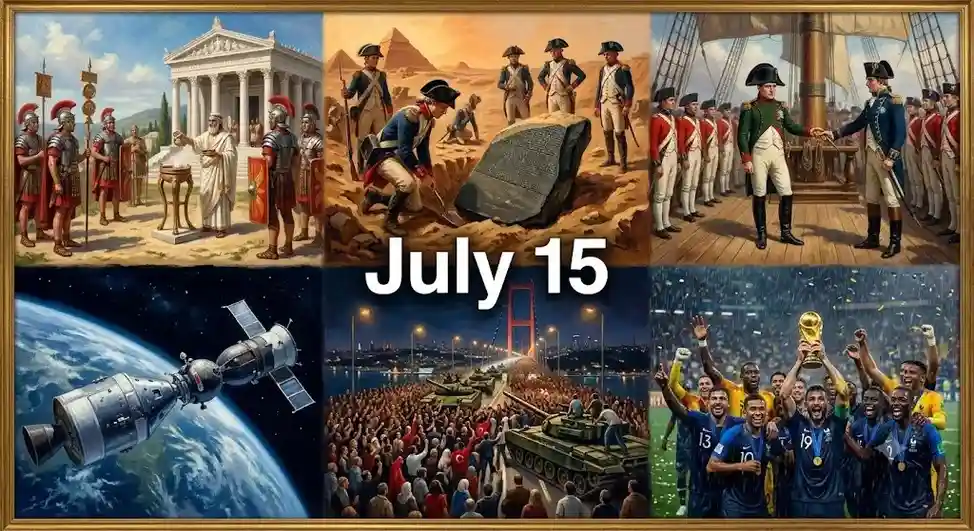
| 🌟 Most Significant Event | French soldiers under soldier-engineer Pierre-François Bouchard discover the Rosetta Stone in Rashid, Egypt, unlocking the mystery of ancient hieroglyphs (1799) |
| 🏆 Top 10 Key Events | • The legendary Temple of Castor and Pollux is officially dedicated in the Roman Forum (484 BC) • Roman military legions under the command of future Emperor Titus successfully breach the outer walls of Jerusalem (70) • A small Russian force led by Alexander Nevsky defeats a Swedish army at the highly strategic Battle of the Neva (1240) • A combined Polish-Lithuanian alliance decisively defeats the Teutonic Knights at the Battle of Grunwald (1410) • The Spanish Inquisition, active for over three and a half centuries, is officially and permanently abolished by royal decree (1834) • Austrian forces mount history’s earliest documented air raid, launching unpiloted balloon bombs over Venice (1849) • Imperial German forces push forward at the Marne River, initiating the Second Battle of the Marne—their final major offensive of WWI (1918) • The United States and Soviet Union launch the Apollo-Soyuz Test Project, facilitating history’s first joint space flight (1975) • Jack Dorsey, Noah Glass, Biz Stone, and Evan Williams officially launch Twitter, revolutionizing microblogging (2006) • Elements within the Turkish military attempt a coordinated, violent coup d’état against President Recep Tayyip Erdoğan (2016) |
| ⚔️ Key Battles | Siege of Jerusalem (70), Battle of the Neva (1240), Battle of Grunwald (1410), Second Battle of the Marne (1918), Operation Hastings (1966) |
| 👤 Key Figures | Pierre-François Bouchard, Alexander Nevsky, Emperor Xuanzong of Tang, Jimmy Carter, Psy (South Korean pop icon) |
| 🌍 Observances | EU Day for the Victims of the Global Climate Crisis, Statehood Day (Ukraine), Festival of Santa Rosalia (Palermo, Italy), Meänmaa Flag Day (Sweden/Finland) |
Story of the Day: The Night a Superpower Trembled in Ankara
F-16 fighter jets screamed low over the minarets of Ankara while tanks blockaded the iconic Bosphorus Bridge in Istanbul. A faction within the Turkish Armed Forces had mobilized armor and elite troops, declaring they had seized control of the state from President Recep Tayyip Erdoğan. For several tense hours, the fate of a critical NATO power hung in total suspension as explosions rocked the parliament building and news anchors read forced scripts at gunpoint.
Civilians changed the course of the night when they flooded the streets, facing down armored vehicles with nothing but flags and bare hands after an urgent FaceTime broadcast from their president. By sunrise, over two hundred people lay dead, but the rebellion collapsed as rogue soldiers surrendered en masse on the blood-stained tarmac. The failed uprising triggered an unprecedented political purge, permanently reshaping modern Turkey and cementing July 15 as a day of national trauma and state authority.
Important Events That Happened On July 15 In History
484 BC – Dedication of the Temple of Castor and Pollux
Roman generals and citizens gathered in the heart of the Forum to dedicate a massive new sanctuary to the twin demigods. Dictator Aulus Postumius Albus had vowed to build this monument after two mysterious horsemen led the young republic to a desperate military victory at Lake Regillus. The white marble structure immediately became a central hub for political debates, weight testing, and senate meetings. Its surviving three columns still stand over the ruins of Rome today as symbols of the city’s earliest mythic triumphs.
70 – Titus Breaches the Walls of Jerusalem
Roman battering rams smashed through the northern inner defenses of Jerusalem after months of brutal siege warfare. General Titus directed his legions to pour into the fractured city, driving Jewish defenders back toward the inner compound of the Second Temple. Citizens faced starvation, disease, and relentless artillery fire as the Roman grip tightened around their holiest sanctuary. The breakthrough marked the definitive collapse of Jewish resistance, leading directly to the total destruction of the temple weeks later.
756 – The Tragic Execution of Yang Guozhong
Mutinous Imperial Guards cornered Emperor Xuanzong of Tang at the remote Mawei Courier Station during a desperate retreat from rebel armies. Angry soldiers blamed Chancellor Yang Guozhong and his cousin, the imperial consort Yang Guifei, for letting General An Lushan’s rebellion ruin the empire. The guards refused to march further until Yang Guozhong was killed, forcing him into a violent death to appease the angry mob. This bloody mutiny broke the emperor’s spirit, forcing his abdication and leaving the dynasty in permanent decline.
1099 – Crusaders Seize the Holy Sepulchre
Exhausted Christian knights scaled the fortified walls of Jerusalem and fought their way to the Church of the Holy Sepulchre. Commander Godfrey of Bouillon led the final, bloody assault after a grueling multi-week siege that had left his men dying of thirst under the desert sun. The city fell into a scene of horrific slaughter as victorious forces killed thousands of Muslim and Jewish residents inside the sacred walls. This bloody victory secured the primary objective of the First Crusade and established centuries of Western rule in the Levant.
1149 – The Holy Sepulchre Reborn
Christian clergy and builders held a grand consecration ceremony in Jerusalem to unveil a completely transformed Holy Sepulchre complex. Queen Melisende of Jerusalem had ordered the unification of several scattered chapels under a single, massive Romanesque roof to mark fifty years of Crusader rule. Pilgrims from across Europe packed the dark, incense-filled nave to marvel at the towering new bell tower and brilliant mosaics. The architecture created during this dedication established the iconic layout that millions of global travelers still visit today.
1207 – King John Banishes the Monks of Canterbury
Armed royal officers marched into the historic cloisters of Canterbury Cathedral to expel the resident monks into forced exile. King John raged against the brotherhood because they had defiantly elected Stephen Langton as Archbishop of Canterbury without royal approval. The monks fled across the English Channel to seek safety in France, leaving the wealthiest abbey in England empty and exposed to royal seizure. This bitter feud prompted Pope Innocent III to place all of England under a strict religious interdict, setting off a chain of events that eventually forced John to sign the Magna Carta.
1240 – Alexander Nevsky Triumphs at the Neva
Prince Alexander of Novgorod launched a daring, unannounced assault against a Swedish landing party camped along the banks of the Neva River. The young prince caught the invading fleet completely unprepared, leading his local cavalry charges directly into the heart of the enemy camp. Swedish commanders panicked as their lines collapsed toward their ships, turning the riverbanks into a scene of chaotic retreat. This tactical victory earned the prince his legendary title “Nevsky” and blocked Western expansion into northern Russian territories.
1381 – The Brutal Execution of John Ball
Royal executioners dragged the radical priest John Ball to the gallows in the town of St Albans while King Richard II watched from his horse. Ball had served as the ideological voice of the historic Peasants’ Revolt, famously preaching that all humans were born equal under God without lords or serfs. The young king ordered his death by hanging, drawing, and quartering to send a terrifying message to any surviving rural rebels. His severed head was placed on London Bridge, but his revolutionary ideas about human equality outlived the medieval feudal system.
1410 – Knights Fall at the Battle of Grunwald
Polish and Lithuanian warriors charged across the muddy fields of Prussia to collide with the heavily armored lines of the Teutonic Order. King Władysław II Jagiełło outmaneuvered the proud German knights by exhausting them in the summer heat before launching his main tactical counterattack. The grand master of the order was killed alongside most of his elite commanders, causing a total collapse of their monastic military state. This monumental clash broke the power of the Teutonic Knights forever and established the Polish-Lithuanian union as a dominant European superpower.
1482 – Boabdil Claims the Throne of Granada
Prince Muhammad XI, known to history as Boabdil, rode into the magnificent palaces of the Alhambra to be crowned the last Nasrid king. The ambitious young prince had launched a successful coup against his own father, capitalizing on public anger over heavy taxes and lost border wars. His ascension sparked a bitter civil war among the regional Muslim factions just as Christian armies prepared their final campaign against the kingdom. This internal betrayal doomed the state, leading directly to the fall of Islamic Spain ten years later.
1640 – Finland Inaugurates Its First University
Swedish governors and local scholars gathered in Turku to open the Royal Academy, bringing higher education to the Finnish wilderness for the first time. Count Per Brahe established the institution with just four faculties to train local administrators, lawyers, and Lutheran priests for the expanding Swedish Empire. Students studied Latin, theology, and philosophy in a modest wooden building close to the cathedral. This tiny academy grew over centuries to become the University of Helsinki, serving as the foundational cradle of Finnish science and national identity.
1738 – Two Men Burned Alive in St. Petersburg
Tsarist executioners bound Baruch Laibov and Alexander Voznitsyn to wooden stakes in a public square in St. Petersburg before lighting the fires. Voznitsyn, a retired captain in the Russian navy, had chosen to convert to Judaism under the instruction of Laibov, a wealthy Jewish merchant. Empress Anna Ivanovna personally signed their death warrants to make a terrifying public example of anyone stepping outside the Russian Orthodox faith. The horrific execution triggered a wave of anti-Semitic state decrees that restricted Jewish life across the Russian Empire for generations.
1741 – Aleksei Chirikov Sights the Alaskan Coast
Russian navigator Aleksei Chirikov stared through the sea mist from the deck of the St. Paul to see the massive snow-capped peaks of Southeast Alaska. Separated from his commander Vitus Bering during a violent storm, Chirikov sent a longboat of armed sailors ashore to find fresh water. The men vanished into the dense coastal forests, becoming the very first Europeans to set foot on Alaskan soil. This sighting gave the Russian Empire its formal claim to the vast North American territory, sparking a century of fur trading.
1789 – Lafayette Takes Command of Paris
French revolutionaries and citizens cheered in the streets as the Marquis de Lafayette accepted the position of Colonel General of the new National Guard. Fresh from fighting in the American Revolution, the idealistic nobleman took control of the citizen militia just one day after the historic storming of the Bastille. Lafayette immediately ordered his men to wear a new tricolor cockade, blending the royal white with the revolutionary blue and red of Paris. His appointment gave the chaotic early revolution a disciplined military structure and created the modern national flag of France.
1799 – French Soldiers Stumble Upon the Rosetta Stone
Captain Pierre-François Bouchard noticed an unusual slab of dark stone built into an old wall during fortification work in the Egyptian village of Rosetta. Napoleon’s engineering officer ordered his men to carefully dig out the block, revealing three distinct bands of ancient text carved into its flat face. The stone contained the exact same royal decree written in hieroglyphs, Demotic script, and ancient Greek. This accidental discovery gave scholars the bilingual key needed to decode Egyptian hieroglyphs, unlocking three thousand years of forgotten pharaonic history.
1806 – Zebulon Pike Begins His Western Expedition
Lieutenant Zebulon Pike ordered his small detachment of US Army soldiers to push their boats into the Missouri River near St. Louis. Sent by General James Wilkinson to explore the southwestern borders of the Louisiana Purchase, Pike set out to locate the headwaters of the Arkansas River. His journey took his team across uncharted plains and into the high peaks of Colorado, where he encountered the massive mountain that now bears his name. The data collected during this trek provided young America with its first strategic maps of the Spanish frontier.
1815 – Napoleon Bonaparte Surrenders Aboard the HMS Bellerophon
Napoleon walked up the wooden gangway of the British warship HMS Bellerophon off the coast of Rochefort to offer his final surrender. Following his total defeat at Waterloo and his abandonment by the French parliament, the fallen emperor realized his dream of conquest was over. Captain Frederick Maitland received the legendary general with formal military courtesy, securing him as a prisoner of the British Crown. This historic surrender ended two decades of global warfare and resulted in Napoleon’s permanent exile to the remote island of St. Helena.
1823 – Fire Consumes the Basilica of Saint Paul Outside the Walls
A careless roofer left a brass pan of live coals on the timber roof of Rome’s historic Basilica of Saint Paul, sparking an uncontrollable inferno. The ancient church, which had stood since the fourth century as a monument over the apostle Paul’s grave, burned intensely through the night until its grand marble columns cracked and collapsed. Romans wept in the streets as the roof caved in, destroying priceless early Christian mosaics and historic papal portraits. The disaster prompted an international rebuilding campaign that completely restored the structure over the following decades.
1834 – The Spanish Inquisition Disbands Forever
Queen Regent Maria Cristina signed a royal decree that officially ended the Spanish Inquisition after nearly four centuries of religious terror. Established by Ferdinand and Isabella to enforce Catholic orthodoxy, the institution had spent generations conducting secret trials, torturing suspects, and burning heretics at the stake. By the nineteenth century, the tribunals had lost their political utility and operated as a broken bureaucratic remnant of a bygone era. The final closure of the inquisitorial courts marked a permanent shift toward modern secular law across Spain.
1838 – Ralph Waldo Emerson Outrages Harvard Clergy
Philosopher Ralph Waldo Emerson stood before the graduating class of Harvard Divinity School to deliver an address that shook the American religious establishment. Emerson told the young ministers that biblical miracles were outdated concepts and declared that Jesus was a great man, but entirely human rather than God. The conservative Protestant community reacted with immediate public fury, denouncing Emerson as an atheist and a dangerous radical. The controversy got him banned from speaking at Harvard for thirty years, but it established Transcendentalism as a major intellectual movement.
1840 – The Convention of London Reshapes the Middle East
Diplomats from Europe’s five great powers signed a treaty in London to halt the dangerous military expansion of Muhammad Ali of Egypt. The Egyptian ruler had conquered Syria and threatened to overthrow the entire Ottoman Empire, risking a chaotic collapse of regional stability. The European powers offered Muhammad Ali permanent rule over Egypt if he pulled his troops out of the Levant and returned the captured Ottoman fleet. This strategic agreement stabilized the Near East for decades and initiated a pattern of Western intervention in Middle Eastern borders.
1849 – The First Air Raid Falls on Venice
Austrian military forces launched two hundred pilotless paper balloons carrying shrapnel bombs into the skies above the besieged city of Venice. Developed by artillery officer Franz von Uchatius, the balloons used long tinder fuses designed to drop explosives directly onto the crowded canals and squares below. Most of the weapons missed their targets due to shifting sea winds, but a few bombs exploded over the city center, causing widespread panic among the local population. This experimental assault marked the birth of aerial warfare, changing the nature of modern siege combat.
1862 – The CSS Arkansas Runs the Union Blockade
Lieutenant Isaac Brown steered the Confederate ironclad CSS Arkansas out of the Yazoo River to single-handedly attack a massive fleet of Union warships on the Mississippi. The crude, armor-plated vessel rammed and blasted its way through Admiral David Farragut’s lines, severely damaging three Union ships while taking heavy cannon fire herself. Sailors cheered from the docks of Vicksburg as the battered Confederate ship emerged through the smoke to safety. The daring run temporarily disrupted Union control of the river and extended the bloody struggle for the Western theater.
1870 – Georgia Readmitted to the United States
Governor Rufus Bullock watched as Congress approved the legislation that officially readmitted Georgia to the Union, ending the painful era of military Reconstruction. Georgia had been expelled from the federal government twice due to state leaders refusing to ratify the Fourteenth Amendment and expelling Black legislators from office. After finally seating a reconstructed legislature and securing voting rights for freed slaves, the state regained its full sovereignty. This political milestone marked the formal return of all former Confederate states to the American republic.
1870 – Canada Absorbs Rupert’s Land and Creates Manitoba
Prime Minister John A. Macdonald finalized the largest land transfer in Canadian history, acquiring Rupert’s Land and the North-Western Territory from the Hudson’s Bay Company. The young government paid three hundred thousand pounds to secure the vast wilderness, using it to establish the province of Manitoba and the Northwest Territories on the same day. This massive territorial expansion followed months of intense resistance from Louis Riel and the local Métis population, who demanded protection for their land rights. The acquisition paved the way for transcontinental rail lines and Western settlement.
1888 – Mount Bandai Erupts in Japan
A massive phreatic explosion tore through the peak of Mount Bandai in Fukushima Prefecture, obliterating the northern face of the volcano in seconds. The violent blast triggered a catastrophic avalanche of mud and rock that buried eleven alpine villages and suffocated hundreds of rural residents. Rivers were blocked instantly, creating new lakes across the altered landscape while thick volcanic ash turned day into night across northern Japan. The disaster killed approximately five hundred people and prompted the Japanese government to establish its very first modern seismic monitoring systems.
1910 – Alzheimer’s Disease Receives Its Official Name
German psychiatrist Emil Kraepelin published the eighth edition of his textbook Clinical Psychiatry, introducing a new medical term to the world. Kraepelin chose to name the progressive, brain-wasting dementia “Alzheimer’s Disease” to honor his colleague Alois Alzheimer, who had discovered the characteristic plaques and tangles in a patient’s brain four years earlier. The formal naming transformed a poorly understood mental condition into a specific, recognized neurological pathology. This shift laid the groundwork for all modern research into age-related cognitive decline.
1916 – William Boeing Incorporates Pacific Aero Products
Timber merchant William Boeing and Navy engineer George Conrad Westervelt met in a lakeside shipyard in Seattle to incorporate their new aviation enterprise. Operating out of a modest wooden boathouse, the partners began building single-engine seaplanes using lightweight spruce wood from local forests. The company struggled through its first year before changing its name to the Boeing Airplane Company to secure lucrative military contracts during the First World War. This small Pacific Northwest business grew over the next century into the largest aerospace manufacturer in the world.
1918 – Germany Launches the Second Battle of the Marne
German artillery opened a massive bombardment along the River Marne as General Erich Ludendorff unleashed his final strategic offensive of World War I. Thousands of German stormtroopers crossed the river in canvas boats, trying to split the French armies and open a direct route toward Paris. French and American lines held firm against the initial shock, using deep trenches and rapid counter-battery fire to stall the German advance within days. This desperate battle broke the offensive power of the German army, turning the tide of the war toward the final Allied victory.
1920 – Poland Establishes the Silesian Voivodeship
The Polish Parliament passed a constitutional law creating the autonomous Silesian Voivodeship ahead of a tense border plebiscite with Germany. This legislative act granted the resource-rich region its own regional parliament and treasury to encourage local Upper Silesians to vote for integration with the new Polish Republic. The political move intensified ethnic rivalries between Polish miners and German landowners across the industrial heartland. The resulting vote divided the territory, sparking localized guerrilla warfare before international borders were finalized.
1922 – The Japanese Communist Party Founded in Secret
A small group of radical intellectuals and labor activists met in a hidden location in Tokyo to organize the Japanese Communist Party. Operating under the leadership of Sen Katayama, the group defied the imperial government by demanding the abolition of the monarchy and the redistribution of corporate land to peasants. The state responded with immediate brutality, passing harsh security laws that drove the party deeper underground and led to mass arrests of suspected leftists. This secret meeting began a long history of underground ideological resistance against Japanese militarism.
1927 – Police Fire on Protesters in Vienna
Austrian police officers opened fire on an angry crowd of workers outside the Palace of Justice in Vienna, killing eighty-nine demonstrators. The protest erupted after a right-wing paramilitary group was acquitted of murdering a left-wing veteran and a young child in a rural brawl. Furious workers torched the courthouse, trapping officials inside as smoke filled the city center and mounted police charged into the crowds. This shocking street massacre deeply fractured Austrian society, setting off a bitter political polarization that led directly to civil war.
1942 – Nazi Germany Begins Mass Deportation of Dutch Jews
Armed SS officers and local collaborationist police began loading over two thousand Jewish men, women, and children onto cattle cars at the Westerbork transit camp. This train marked the official start of the mass deportation of one hundred thousand Jews from the occupied Netherlands to the gas chambers of Auschwitz and Sobibor. Nazi authorities tricked families into believing they were going to labor camps in Germany, forcing them to hand over their house keys before boarding. Only a tiny fraction of those packed onto these trains survived the war.
1946 – Britain Annexes North Borneo
British colonial officials held a formal ceremony in Jesselton to annex the State of North Borneo as a crown colony, ending sixty-five years of corporate rule. The British North Borneo Company surrendered its charter because it could not afford the massive financial cost of rebuilding the territory after widespread destruction during World War II. The British government took direct control of the region, investing in infrastructure, schools, and rubber plantations to stabilize the local economy. This territory eventually transitioned into the modern Malaysian state of Sabah.
1954 – The Boeing 367-80 Takes Its First Flight
Test pilot Alvin “Tex” Johnston pushed the throttles forward, lifting the experimental Boeing 367-80 jet prototype off the runway at Renton Field. Known affectionately as the “Dash 80,” the sweep-winged, four-engine jet liner climbed smoothly into the skies above Washington state, validating years of secret corporate investment. The successful flight revolutionized commercial travel by proving that jet engines could safely carry passengers across oceans at twice the speed of propeller planes. This single prototype served as the design foundation for both the iconic Boeing 707 and the military C-135.
1955 – Nobel Laureates Sign the Mainau Declaration
Eighteen world-renowned scientists gathered on the island of Mainau to sign an urgent public manifesto warning humanity about the horrors of nuclear warfare. Initiated by German physicists Otto Hahn and Max Born, the declaration stated that any major war with atomic weapons would result in the total destruction of global civilization. The founders appealed directly to world leaders to renounce force as a tool of international diplomacy. Thirty-four additional Nobel winners signed the document, helping launch the modern anti-nuclear peace movement during the height of the Cold War.
1966 – Operation Hastings Begins in Vietnam
United States Marines and South Vietnamese troops climbed out of transport helicopters into the jungle clearings of Quang Tri Province to launch Operation Hastings. The joint military command ordered the massive sweep to stop the North Vietnamese Army’s 324B Division from moving across the Demilitarized Zone into South Vietnam. Heavy fighting erupted around a hill known as “The Razorback,” where troops encountered entrenched machine-gun bunkers and heavy mortar fire in the dense brush. The brutal battle lasted three weeks, resulting in heavy casualties on both sides before the northern forces withdrew.
1971 – The United Red Army Emerges in Japan
Left-wing radicals Fusako Shigenobu and Tsuneo Mori led a secret meeting in the mountains of Japan to merge two militant factions into the United Red Army. The group advocated for a violent global communist revolution, building hidden training camps where they practiced martial arts and studied guerrilla tactics. Their internal fanaticism quickly turned into horror when leaders conducted brutal purges, murdering twelve of their own members for “lack of revolutionary zeal.” This group’s violent path culminated in a bloody mountain lodge siege that shocked the Japanese public.
1974 – Nationalists Launch a Violent Coup in Cyprus
Greek military officers led an armored column of tanks into Nicosia to storm the presidential palace and overthrow Archbishop Makarios III. Sponsored by the ruling military junta in Athens, the nationalist rebels installed Nikos Sampson as president with the goal of unifying Cyprus with Greece. Makarios narrowly escaped the burning palace through a side door, fleeing to a British military base while street fighting broke out between rival factions. This aggressive coup shattered the delicate ethnic balance on the island, prompting a military invasion by Turkey five days later.
1975 – The Historic Apollo-Soyuz Joint Launch
A Saturn IB rocket lifted off from Florida hours after a Soyuz booster climbed into the sky from Kazakhstan, initiating the first joint space flight between America and the Soviet Union. The mission sent Tom Stafford and Alexei Leonov into orbit to dock their respective spacecraft together high above the Atlantic Ocean. When the hatches opened, the commanders shook hands through the docking module, signaling a symbolic end to the aggressive Space Race. This historic flight was the final launch for both the Apollo spacecraft and the legendary Saturn rocket family.
1975 – Aeroflot Flight E-15 Crashes in Batumi
An Aeroflot Yakovlev Yak-40 jet descended through thick fog and heavy rain toward the runway at Batumi International Airport in Georgia. The pilots lost visual contact with the ground, drifting off course until the aircraft slammed into a steep forested ridge near the Soviet resort city. The violent impact destroyed the plane instantly, killing all forty passengers and crew members on board before rescue teams could locate the remote crash site. The tragic accident prompted Soviet aviation authorities to upgrade radar systems at mountain-rimmed regional airports.
1979 – Jimmy Carter Delivers His “Malaise” Speech
President Jimmy Carter sat before television cameras in the Oval Office to deliver a live, primetime address during a severe national energy crisis. Carter spoke directly about a fundamental “crisis of confidence” threatening the future of America, criticizing consumerism and asking citizens to conserve fuel. While he never used the actual word “malaise,” the public interpreted his somber tone as an admission of national decline rather than a call for unity. The speech backfired politically, damaging his reelection prospects and opening the door for Ronald Reagan’s optimistic campaign.
1983 – ASALA Militants Attack Orly Airport
Armenian militants belonging to the ASALA organization detonated a suitcase bomb at the crowded Turkish Airlines check-in counter inside Orly Airport in Paris. The blast tore through the terminal lobby, sending glass and metal shrapnel through lines of travelers, killing eight people and injuring over fifty others. French counter-terrorism police flooded the airport, launching a massive manhunt that quickly led to the arrest of the bomb-maker in a nearby suburb. This tragic bombing alienated public support for the militant group and triggered a coordinated European crackdown on international terrorism.
1983 – Nintendo and Sega Transform the Console Market
Retailers across Japan stacked their shelves with two competing home video game systems on the exact same afternoon: the Nintendo Famicom and the Sega SG-1000. Nintendo launched its system with advanced graphics and ports of hit arcade games, while Sega offered a computer-hybrid system tailored for early tech enthusiasts. The Famicom initially suffered from a faulty chip recall before going on to dominate the market and entering America as the iconic Nintendo Entertainment System. This single afternoon launched the modern multi-billion-dollar home console industry.
1996 – Belgian Air Force C-130 Crashes at Eindhoven
A Belgian Air Force C-130 Hercules transport aircraft drifted off line on its final approach to Eindhoven Airport in the Netherlands. The cargo plane, carrying the Royal Netherlands Army marching band home from a concert tour, encountered a sudden bird strike that knocked out two engines moments before touchdown. The aircraft veered off the runway, bursting into an intense fireball that overwhelmed the airport’s emergency response teams. The tragic crash killed thirty-four people, leading to a major reform of military rescue procedures across Europe.
1998 – Tamil MP S. Shanmuganathan Assassinated
Sri Lankan politician S. Shanmuganathan died instantly when a hidden claymore mine detonated next to his vehicle along a rural highway in Vavuniya. The veteran Tamil Member of Parliament had spent years working to broker peace between regional ethnic factions and the central Colombo government. Local security forces blamed the separatist Liberation Tigers of Tamil Eelam for planting the roadside bomb as part of a campaign against moderate minority leaders. His violent assassination escalated the Sri Lankan Civil War, scuttling regional peace talks for years.
2002 – John Walker Lindh Pleads Guilty
Captured American citizen John Walker Lindh walked into a federal courtroom in Virginia to plead guilty to supplying services to the Taliban. Dubbed the “American Taliban” by national media, Lindh had been discovered alive inside a flooded prison fortress by US Special Forces during the initial invasion of Afghanistan. He agreed to a twenty-year prison sentence as part of a plea deal that dropped terrorism charges in exchange for his full cooperation with military intelligence. His public trial highlighted the complex nature of radicalization in the post-9/11 world.
2002 – Pakistan Sentences Ahmed Omar Saeed Sheikh to Death
A judge inside an anti-terrorism court in Hyderabad pronounced a death sentence for British-born militant Ahmed Omar Saeed Sheikh. The court found Sheikh guilty of masterminding the high-profile kidnapping and brutal murder of Wall Street Journal reporter Daniel Pearl. Three co-defendants received life sentences during the high-security trial, which had been moved to a prison facility due to credible assassination threats against court officials. The verdict marked a high-stakes moment in Pakistan’s post-9/11 crackdown on international extremist networks.
2003 – AOL Disbands Netscape and Founds Mozilla
Executives at AOL Time Warner announced the permanent closure of Netscape’s remaining web development offices, ending the historic browser wars of the late nineties. On the exact same afternoon, the displaced engineers launched the Mozilla Foundation, an independent non-profit organization dedicated to keeping the web open and competitive. The new foundation took over the open-source code from Netscape, using it to develop a fast, secure alternative browser called Firefox. This corporate closure saved open-source web development from complete monopoly control.
2006 – Twitter Launches to the Public
Software developers Jack Dorsey and Biz Stone clicked a button in an office in San Francisco, opening a simple messaging platform called Twitter to the global public. Originally designed as an internal SMS tool for tech workers to share short status updates, the service allowed users to broadcast thoughts in exactly 140 characters. Users quickly developed new conventions like hashtags and retweets to share real-time news across the expanding digital landscape. This launch changed global media, turning a simple text tool into a major platform for political revolutions and public debate.
2009 – Caspian Airlines Flight 7908 Crashes in Iran
A Tupolev Tu-154 commercial airliner operated by Caspian Airlines took off from Tehran, climbing toward the skies above northwestern Iran on its way to Armenia. Sixteen minutes into the flight, a catastrophic engine failure caused the tail section to catch fire, sending the jet into a steep, uncontrollable dive. The aircraft slammed into an open agricultural field near Jannatabad at high speed, exploding into a massive crater that killed all 168 people on board. The tragedy led to calls for modernizing Iran’s commercially isolated civilian aviation fleet.
2009 – Space Shuttle Endeavour Launches on STS-127
The Space Shuttle Endeavour roared off Launch Pad 39A at the Kennedy Space Center, lighting up the Florida sky after five consecutive weather delays. Commander Mark Polansky guided the shuttle into orbit on a mission to deliver the final components of Japan’s Kibō laboratory module to the International Space Station. Astronauts conducted five complex spacewalks over sixteen days to bolt the massive exposed facility into place. This successful mission completed Japan’s primary contribution to the orbital platform, solidifying international cooperation in space exploration.
2012 – Psy Releases Gangnam Style
South Korean musician Psy uploaded a colorful, satirical music video titled “Gangnam Style” to his YouTube channel, aiming to entertain local pop fans. The video featured an eccentric, horse-riding dance step set against an infectious electronic beat that poked fun at the affluent lifestyle of Seoul’s Gangnam District. The video went viral globally within weeks, crossing cultural borders to become the first video in history to reach one billion views on the platform. This release marked the global arrival of the Hallyu wave, changing the international music landscape.
2014 – Moscow Metro Derailment Kills 24
A packed morning commuter train suddenly derailed between the Slavyansky Bulvar and Park Pobedy stations on the Moscow Metro system. The lead cars slammed into a concrete wall inside the dark tunnel at high speed, crushing several compartments and trapping hundreds of passengers underground. Emergency crews worked for hours in intense heat and dust to free injured commuters from the twisted metal ruins, confirming twenty-four deaths and over 160 serious injuries. Investigators traced the cause to a faulty switch wire installed during recent track maintenance.
2018 – France Wins Its Second World Cup Title
French players danced in a torrential downpour on the pitch at the Luzhniki Stadium in Moscow after defeating Croatia 4-2 in a dramatic World Cup final. Young forward Kylian Mbappé scored a stunning long-range goal, becoming the first teenager to score in a final since Pelé achieved the feat sixty years earlier. Manager Didier Deschamps joined an elite group of men to win the tournament as both a player and a coach. The victory sparked wild celebrations across France, uniting the nation around a diverse, modern generation of athletic heroes.
Revisit the important lessons from yesterday’s history post.
Famous People Born on July 15
| Name | Description | Date |
|---|---|---|
| Rembrandt | Dutch painter and one of history’s greatest artists | 1606–1669 |
| Clement Clarke Moore | American poet, author of A Visit from St. Nicholas | 1779–1863 |
| Sir John Fowler | English civil engineer, co-designer of the Forth Bridge | 1817–1898 |
| Vilfredo Pareto | Italian economist and sociologist, creator of the Pareto Principle | 1848–1923 |
| Frances Xavier Cabrini | Italian-American Catholic saint and missionary | 1850–1917 |
| Emmeline Pankhurst | British suffragette leader and women’s rights activist | 1858–1928 |
| Alfred Harmsworth, 1st Viscount Northcliffe | British newspaper publisher and media pioneer | 1865–1922 |
| Jean-Baptiste Charcot | French polar explorer and scientist | 1867–1936 |
| Walter Benjamin | German philosopher, cultural critic, and essayist | 1892–1940 |
| K. Kamaraj | Indian statesman and influential political leader | 1903–1975 |
| Dorothy Fields | American Academy Award-winning lyricist | 1905–1974 |
| Akhtar Hameed Khan | Pakistani social scientist and rural development pioneer | 1914–1999 |
| Robert Conquest | British-American historian and author | 1917–2015 |
| Brenda Milner | British-Canadian neuropsychologist and memory researcher | 1918–Present |
| Iris Murdoch | British-Irish novelist and philosopher | 1919–1999 |
| Robert Bruce Merrifield | American Nobel Prize-winning biochemist | 1921–2006 |
| Leon M. Lederman | American Nobel Prize-winning physicist | 1922–2018 |
| Jacques Derrida | French philosopher, founder of deconstruction | 1930–2004 |
| Clive Cussler | American adventure novelist | 1931–2020 |
| Jocelyn Bell Burnell | Northern Irish astrophysicist, co-discoverer of pulsars | 1943–Present |
| Linda Ronstadt | American singer and multiple Grammy Award winner | 1946–Present |
| Hassanal Bolkiah | Sultan of Brunei | 1946–Present |
| Carl Bildt | Former Prime Minister of Sweden | 1949–Present |
| Arianna Huffington | Greek-American journalist and founder of HuffPost | 1950–Present |
| Jesse Ventura | American wrestler, actor, and former Governor of Minnesota | 1951–Present |
| Mario Kempes | Argentine football legend and 1978 World Cup hero | 1954–Present |
| Joe Satriani | American virtuoso guitarist | 1956–Present |
| Forest Whitaker | American Academy Award-winning actor | 1961–Present |
| Adam Savage | American television host and special effects expert | 1967–Present |
| Damian Lillard | American NBA basketball star | 1990–Present |
Famous People Who Died on July 15
| Name | Description | Date |
|---|---|---|
| Rudolf I of Germany | First Habsburg King of Germany | 1218–1291 |
| Lisa del Giocondo | Believed to be the model for Leonardo da Vinci’s Mona Lisa | 1479–1542 |
| Annibale Carracci | Influential Italian Baroque painter | 1560–1609 |
| Carl Czerny | Austrian composer and piano teacher | 1791–1857 |
| General Tom Thumb | American circus performer and entertainer | 1838–1883 |
| Rosalía de Castro | Spanish poet and novelist | 1837–1885 |
| Gottfried Keller | Swiss novelist and poet | 1819–1890 |
| Anton Chekhov | Russian playwright and master of the short story | 1860–1904 |
| Emil Fischer | German Nobel Prize-winning chemist | 1852–1919 |
| Hugo von Hofmannsthal | Austrian poet and playwright | 1874–1929 |
| Eugen Bleuler | Swiss psychiatrist who coined the term “schizophrenia” | 1857–1940 |
| Robert Wadlow | Tallest person in recorded history | 1918–1940 |
| John J. Pershing | American World War I general | 1860–1948 |
| James M. Cox | American politician and newspaper publisher | 1870–1957 |
| Ernest Bloch | Swiss-American composer | 1880–1959 |
| Christine Chubbuck | American television journalist | 1944–1974 |
| Paul Gallico | American novelist and journalist | 1897–1976 |
| Margaret Lockwood | English actress | 1916–1990 |
| Bert Convy | American actor and game show host | 1933–1991 |
| Gianni Versace | Italian fashion designer and founder of Versace | 1946–1997 |
| Roberto Bolaño | Chilean novelist and poet | 1953–2003 |
| James MacGregor Burns | American historian and presidential scholar | 1918–2014 |
| Martin Landau | American Academy Award-winning actor | 1928–2017 |
| Peter R. de Vries | Dutch investigative journalist and crime reporter | 1956–2021 |
Observances on July 15
July 15 features several distinct commemorations across the globe, reflecting environmental reality, cultural devotion, and national pride:
- EU Day for the Victims of the Global Climate Crisis: A solemn observance established throughout the European Union to remember lives lost to extreme weather events and call for immediate climate action.
- Statehood Day (Ukraine): A national holiday celebrating the foundations of Ukrainian statehood, culture, and historic European identity.
- Festival of Santa Rosalia (Palermo, Sicily): A historic religious celebration honoring the patron saint of Palermo with massive street processions, floats, and fireworks to commemorate the end of a historic plague.
- Meänmaa Flag Day: A regional cultural celebration held across the Torne Valley to honor the unique identity, language, and heritage of the local Tornedalian people living along the border of Sweden and Finland.
🇪🇬 Frequently Asked Questions — July 15 in History
French military engineers under the command of Pierre-François Bouchard discovered the Rosetta Stone during fortification work in the Egyptian village of Rashid. This granodiorite slab contained the exact same royal decree carved in hieroglyphs, Demotic script, and ancient Greek. The bilingual text provided modern scholars with the essential key needed to decipher Egyptian hieroglyphs, unlocking thousands of years of pharaonic history.
The discovery of the Rosetta Stone in 1799 stands out as the most significant event due to its permanent impact on historical knowledge. By allowing linguists to decode hieroglyphs, it rescued an entire ancient civilization from absolute silence, transforming our understanding of early human development.
Rembrandt van Rijn, the legendary Dutch painter master famed for his exceptional use of light and shadow, was born on this day in 1606. This date also marks the birth of Akhtar Hameed Khan in 1914, the prominent Pakistani social scientist who pioneered innovative rural development and microfinance models across South Asia.
The Second Battle of the Marne began on July 15, 1918, marking the final major German offensive along the Western Front during World War I. Allied forces held their ground against the initial shock before launching a decisive counterattack that turned the tide of the war toward an Allied victory.
This day serves as a solemn memorial across the European Union to honor individuals who have lost their lives to devastating floods, heatwaves, and wildfires. It is remembered to put a human face on environmental data and urge global communities to take immediate action against ecological destruction.
France captured its second World Cup championship on July 15, 2018, by defeating a resilient Croatia 4-2 in a thrilling final match in Moscow. The victory turned Kylian Mbappé into a global icon and sparked massive celebrations across the streets of Paris.